• Home
  • indulge
  • new poetry
    • About Luna Luna
    • resources
    • search
  • editor
  • dark hour
  • submit
Menu

luna luna magazine

  • Home
  • indulge
  • new poetry
  • About
    • About Luna Luna
    • resources
    • search
  • editor
  • dark hour
  • submit
delicious new poetry
'the doors of the night open' — poetry by Juan Armando Rojas (translated by Paula J. Lambert)
Nov 29, 2025
'the doors of the night open' — poetry by Juan Armando Rojas (translated by Paula J. Lambert)
Nov 29, 2025
Nov 29, 2025
'we can be forlorn women' — poetry by Stevie Belchak
Nov 29, 2025
'we can be forlorn women' — poetry by Stevie Belchak
Nov 29, 2025
Nov 29, 2025
'I do whatever the light tells me to' — poetry by Catherine Bai
Nov 29, 2025
'I do whatever the light tells me to' — poetry by Catherine Bai
Nov 29, 2025
Nov 29, 2025
‘to kill bodice and give sacrament’ — poetry By Kale Hensley
Nov 29, 2025
‘to kill bodice and give sacrament’ — poetry By Kale Hensley
Nov 29, 2025
Nov 29, 2025
'Venetian draped in goatskin' — poetry by Natalie Mariko
Nov 29, 2025
'Venetian draped in goatskin' — poetry by Natalie Mariko
Nov 29, 2025
Nov 29, 2025
'the long sorrow of the color red' — centos by Patrice Boyer Claeys
Nov 28, 2025
'the long sorrow of the color red' — centos by Patrice Boyer Claeys
Nov 28, 2025
Nov 28, 2025
'Flowers are the offspring of longing' — poetry by Ellen Kombiyil
Nov 28, 2025
'Flowers are the offspring of longing' — poetry by Ellen Kombiyil
Nov 28, 2025
Nov 28, 2025
'punish or repent' — poetry by Chris McCreary
Nov 28, 2025
'punish or repent' — poetry by Chris McCreary
Nov 28, 2025
Nov 28, 2025
'long, dangerous grasses' — poetry by Jessica Purdy
Nov 28, 2025
'long, dangerous grasses' — poetry by Jessica Purdy
Nov 28, 2025
Nov 28, 2025
'gifting nighttime honey' — poetry by Nathan Hassall
Nov 28, 2025
'gifting nighttime honey' — poetry by Nathan Hassall
Nov 28, 2025
Nov 28, 2025
'A theory of pauses' — poetry by Jeanne Morel and Anthony Warnke
Nov 28, 2025
'A theory of pauses' — poetry by Jeanne Morel and Anthony Warnke
Nov 28, 2025
Nov 28, 2025
'into the voluminous abyss' — poetry by D.J. Huppatz
Nov 28, 2025
'into the voluminous abyss' — poetry by D.J. Huppatz
Nov 28, 2025
Nov 28, 2025
'an animal within an animal' — a poem by Carolee Bennett
Nov 28, 2025
'an animal within an animal' — a poem by Carolee Bennett
Nov 28, 2025
Nov 28, 2025
‘in the glitter-open black' — poetry by Fox Henry Frazier
Oct 31, 2025
‘in the glitter-open black' — poetry by Fox Henry Frazier
Oct 31, 2025
Oct 31, 2025
'poet as tarantula,  poem as waste' — poetry by  Ewen Glass
Oct 31, 2025
'poet as tarantula, poem as waste' — poetry by Ewen Glass
Oct 31, 2025
Oct 31, 2025
'my god wearing a body' — poetry by Tom Nutting
Oct 31, 2025
'my god wearing a body' — poetry by Tom Nutting
Oct 31, 2025
Oct 31, 2025
'Hours rot away in regalia' — poetry by Stephanie Chang
Oct 31, 2025
'Hours rot away in regalia' — poetry by Stephanie Chang
Oct 31, 2025
Oct 31, 2025
'down down down the hall of mirrors' — poetry by Ronnie K. Stephens
Oct 31, 2025
'down down down the hall of mirrors' — poetry by Ronnie K. Stephens
Oct 31, 2025
Oct 31, 2025
'Grew appendages, clawed towards light' — poetry by Lucie Brooks
Oct 31, 2025
'Grew appendages, clawed towards light' — poetry by Lucie Brooks
Oct 31, 2025
Oct 31, 2025
'do not be afraid' — poetry by Maia Decker
Oct 31, 2025
'do not be afraid' — poetry by Maia Decker
Oct 31, 2025
Oct 31, 2025
'The darkened bedroom' — poetry by Jessica Purdy
Oct 31, 2025
'The darkened bedroom' — poetry by Jessica Purdy
Oct 31, 2025
Oct 31, 2025
'I am the body that I am under' — poetry by Jennifer MacBain-Stephens
Oct 31, 2025
'I am the body that I am under' — poetry by Jennifer MacBain-Stephens
Oct 31, 2025
Oct 31, 2025
goddess energy.jpg
Oct 26, 2025
'Hotter than gluttony' — poetry by Anne-Adele Wight
Oct 26, 2025
Oct 26, 2025
'As though from Babel' — poetry by Fox Henry Frazier
Oct 26, 2025
'As though from Babel' — poetry by Fox Henry Frazier
Oct 26, 2025
Oct 26, 2025
'See my wants' — poetry by Aaliyah Anderson
Oct 26, 2025
'See my wants' — poetry by Aaliyah Anderson
Oct 26, 2025
Oct 26, 2025
'black viper dangling a golden fruit' — poetry by Nova Glyn
Oct 26, 2025
'black viper dangling a golden fruit' — poetry by Nova Glyn
Oct 26, 2025
Oct 26, 2025
'It would be unfair to touch you' — poetry by grace (ge) gilbert
Oct 26, 2025
'It would be unfair to touch you' — poetry by grace (ge) gilbert
Oct 26, 2025
Oct 26, 2025
'Praying in retrograde' — poetry by Courtney Leigh
Oct 26, 2025
'Praying in retrograde' — poetry by Courtney Leigh
Oct 26, 2025
Oct 26, 2025
'To not want is death' — poetry by Letitia Trent
Oct 26, 2025
'To not want is death' — poetry by Letitia Trent
Oct 26, 2025
Oct 26, 2025
'Our wildness the eternal now' — poetry by Hannah Levy
Oct 26, 2025
'Our wildness the eternal now' — poetry by Hannah Levy
Oct 26, 2025
Oct 26, 2025

The Albatross of Success: Performance, Exhaustion and Gratitude

November 27, 2019

BY LISA MARIE BASILE

I wrote this post because I felt I owed the truth to myself and my community — and maybe some of you will recognize yourself in my experiences.

I also wrote this post because I am grateful for the platforms I have and want to sustainably nourish them rather than quit.

Despite feeling gratitude for the fact that I am able to write, I am suffering burn-out. I am exhausted from being “on.” I struggle with reality versus the Internet. And it all stems from my relationship with success, social media, and the pressure to “keep up.” Some of this is my fault. So I’m here to be accountable, and to question why, when we achieve the things we want to achieve, we feel so…lost.

‘Success’ is supposed to look and feel happy, right?

Over the past year, I’ve acknowledged and written about living a slightly more ‘visible’ life and the pitfalls of success and social media — mostly in captions on Facebook or Instagram. I’ve come to realize, with gem-like clarity, that a) I can no longer go on thinking about it without taking action, b) others are going through this, too and c) it means I have an opportunity to rewrite my life. In short, am a volcano waiting to explode and quit if I don’t get a handle on it.

Maybe you write books or articles or create products or edit a magazine or lead a community. Whatever success you have had (not talking strictly about money or fame), I’m talking to the parts of that success that feel complex and too dirty to say aloud. The parts where you have to show up, all the time, literally and figuratively. Because you asked for it.

This isn’t going to be a poetic, profound, or beautiful piece of writing. It’s just going to be me, Lisa Marie Basile, a poet, and author, and the editor-in-chief of Luna Luna, talking to you.

See what happened there? I have gotten so used to saying that I am a poet, an author, an editor — that sometimes, just sometimes, I forget I’m also Lisa. I’m just a human.

But I’m also a dancer. I’m also a Trekkie. I am also someone who will try (and probably enjoy) literally any other food. I am also someone who works out. I am also someone who loves to study languages. I am also a goofball — a huge goofball. I like to wear PJs most of the time. I don’t always dress glamorously, although Instagram may tell you otherwise. I am in a long-term relationship that is very sweet and good. I struggle with anxiety that gets worse every year. I struggle with imposter syndrome. I live with a degenerative disease called Ankylosing Spondylitis (and much of my true joy comes from being a moderator and advocate for health organizations). I have friends from all walks of life, many who aren’t writers. I like everything magical. I like books, even airport thrillers. I am a former foster youth. I am passionate about people being compassionate and generous toward marginalized communities. I have experienced the effects of poverty, addiction, the criminal justice system, and grief.

How do I encapsulate myself?

How can we each bring our fullness to the stage — when we want to?

We focus so closely on our brand & being “on” that we make ourselves smaller.

To the world, I am not many of the things I describe above. To the world, I’m a full-time writer. I’ve written several books of poetry and have two books of nonfiction, both of which you can buy across the globe. So, I’m also an avatar — a digital representation of me. And that fucks with me. A lot.

Much of my time is spent online (which is great because the Internet allows me to earn money and pay my rent and bills). I run Luna Luna (which I lovingly started in 2013) and promote my books and lead discussions in digital communities. I also spend way too much fucking time curating Instagram accounts and being careful with my branding and strategy. I love being a visible person and a writer, but the constant pressure (some imagined, some very real) to be available, to provide insight, to be moral, or to be wise can be daunting. What is in my books is what I have to offer, but I don’t know everything.

Many of us offer services, ideas, works, and creations, but at what point do you become oversaturated with what you do, versus who you are?

When people write to me about needing emotional help or wanting to publish a book because I’ve inspired them, it deeply touches me and it feels like success. Other writers tell me these are the messages that literally keep them going — and it’s true! The issue is, I can’t help everyone. I don’t have the time or energy. I have had to find ways to respond respectfully (but disengage) because I value this aspect of my life.

So what happens when you cannot physically live up to your own ideas of success?

What happens when you and your avatar fail to present the perfect image?

What happens when you can’t reflect your own curation?

We force ourselves to live as multiple avatars — and that can make us feel disconnected

The thing is, our passion and creative projects often grow bigger than us. Many of us feel immense pressure to build them and scale them quickly or to grow their presence via social media — and at a wild rate. This can be exciting, validating, and fun — but we do have to question why we believe we need to make more, do more, be more, grow more, compete for more. Because we live in a digital age, many of us are parsing ourselves out (like Horcruxes!), cutting slivers off for Twitter and Instagram and Facebook and LinkedIn and email and website management and promotional stuff.

What happens to the real person on the other end of the computer? What happens to us when we are so busy being a different version of ourselves everywhere? Do we lose in-real-life connections or a sense of intimacy? Has it become so second nature that we don’t even think about it?

Well, I do think about it and I think it might be making me feel a little lost.

Were we all supposed to be this many things, to this many people, all the time?

Are we supposed to be on the other end of a phone all day?

What happens when we slow down? Does our brand die? Do we risk our success — and is it worth it In the end?

We feel what we make or do or create cannot be really real without all of the ‘stuff’ that comes with something being a ‘success.’ Like social proof. Or connecting with the right people. Or being engaged X amount of times per day or week.

One popular writer I spoke to the other day said to me, “I have to post the right pictures with the right people, to show my popularity or success. And then everything else just sort of sits on my phone, unseen. I feel like I’m not being real.”

And so we get caught up more in the production than the creation. In the facade. And it happens to so many of us. We forget the little things, the mundane stuff.

When I write a book, the book’s life inevitably changes. Its soul changes. My publishers own a piece of the book, and so the book becomes more about its digital presence and its sales than it does the blood and meat of the text — or at least that what it can feel like. As a writer, you know this going into the contract. But that doesn’t mean you don’t experience the weirdness of your creation becoming a commodity.

Like many writers, influencers, leaders, or creators, I spend so much time promoting, connecting the dots, and doing the admin work that an advance or royalties couldn’t begin to cover (and yes, us writers are undervalued and underpaid — if we are paid at all, which is not the fault of most publishers or magazines, but inherent issues of capitalist society).

I spend so much time being on, being sensitive to people’s needs to the point of self-silencing, or repeating, “sorry it took me a while to respond” that I forget to be off. What it feels like to do nothing. To simply breath. To not have 38 emails that must be answered at all times.

I forgot that I am, on most occasions, not always being paid for the extra work that I do as a “literary citizen” and that I have relationships, debts, and chronic illness to manage. I forget that I am allowed to step away and take a break. I think more of us need to find a way to step away when we need to without the endless grief and shame and guilt that has been pounded into us by capitalism. I know this because I’ve talked to other editors who feel they will let everyone down if they take time to care for themselves. Where are we getting these ideas? What is the root?

It has worn me down. I used to write for Luna Luna all the time, for example. Now, it’s a few times a month. And I have decided to be okay with that.

We have to draw critical boundaries — even with the things we love. The performative self is an uncanny valley.

I am — we all are — valuable simply by being alive. The amount of emails, tweets, and posts you send in one day does not determine your intrinsic value.

I have realized that I am allowed to mourn for a loss of simplicity, even though it means getting to do what I love — write.

I have realized that gratitude can exist alongside tiredness.

I have realized that being in love with the creative process of making a book or running a site or spearheading a public project does NOT negate or erase or preclude or make exempt your exhaustion or loneliness or lostness — both in general and to do with the project.

One example: I have talked to so many others writers who have a book and spend all their time pushing it; they then realize that despite the glory of sharing one’s work, there is a darker side: the performance. Catching a glimpse of yourself in the performative space of branding and sales can make you feel empty, soulless and tired. It is the uncanny valley.

But when we have contracts and promises, we have a duty to share our creations and engage with others, which means we each, as individuals, must gauge where the line of authenticity and gratitude and joy becomes performance and resentment and chore. We have to know when our success is holding us back.

Someone recently said to me, “Success made me timid. Once I realized people liked me and trusted me and expected things from me, I started going inward and getting quieter, choosing my words, cutting out parts of myself that I’d share publicly because I didn’t want to run the risk of people not liking me.”

That made me feel sad. Like, stone-in-the-fucking-chest sad. I felt sad because I recognized myself in it. Being a writer or creator means taking on a certain responsibility — to yourself, your community, your platform. It requires care, nourishment, and respect. That cannot be neglected. But sometimes, when you do have the pressure of engagement, you don’t know what will work for or speak to or help everyone. So you freeze. You question yourself. You wonder why you’re there at all.

We have to reevaluate what’s working and what isn’t about our success, our availability, and our day-to-day lives as creators AND humans.

When we have the chance to share our voices, to speak out, to do something beyond ourselves, to make community spaces, to publish a fucking book that people read — we are doing something magical, magnificent, and life-altering. I should know this. I am the first person in my family to go to college — straight out of foster care. I took out thousands of dollars in loans and got a Master’s degree because I thought it’d give me a leg up (it gave me some big opportunities — along with massive debt). I fought CPTSD and extreme trauma to get where I am, so how dare I question it?

Because we each get to reevaluate what is working and what isn’t. When we don’t assess what makes us feel good and true and right, we can never grow or be okay in our own skin.

I have talked to so, so, so many people whose success became a sort of albatross — precisely because it is not always in alignment with what feels right. You can have and lack something at the same time.

I feel like on my way “up,” I forgot to shed some necessary skin. But then I realized that my sense of success is more internal. It’s more about how I feel about myself than, say, follower count.

In the end, I have decided to make a list of things that I personally can do to alleviate some of those pressures and fears:

  1. Find gratitude and start from there. It is a privilege to be in the position of questioning what success looks like.

  2. Stop letting social media dictate my “brand.” Instead, share more of myself, without fear of it being “off-brand.” If I lose followers, oh well.

  3. Nurture hobbies outside of my career path.

  4. Stop trying to make everyone like you. Stop worrying you’ll offend someone. Just try your best at being kind — and if it doesn’t cut it, fuck it.

  5. Realize that “success” is determined by how you feel about yourself or what you can do for others, not by what you have.

  6. There is such thing as too much of a good thing. Realize that rest, silence, and time away is necessary.

This is my confession. I hope it resonates.
In Personal Essay, Wellness Tags confession, success
Comment

One Change That Transformed My Bedroom Into A Spectacularly Sacred Space

September 10, 2019

Stephanie Valente lives in Brooklyn, New York, and works as an editor. One day, she would like to be a silent film star. She is the author of Hotel Ghost (Bottlecap Press, 2015) and Waiting for the End of the World (Bottlecap Press, 2017). Her work has appeared in dotdotdash, Nano Fiction, LIES/ISLE, and Uphook Press. She can be found at her website.

Read More
In Lifestyle, Wellness Tags rituals
Comment
lisa marie basile italy

Magical Water, Ancestry, & Shadow Work In Italy

August 26, 2019

BY LISA MARIE BASILE

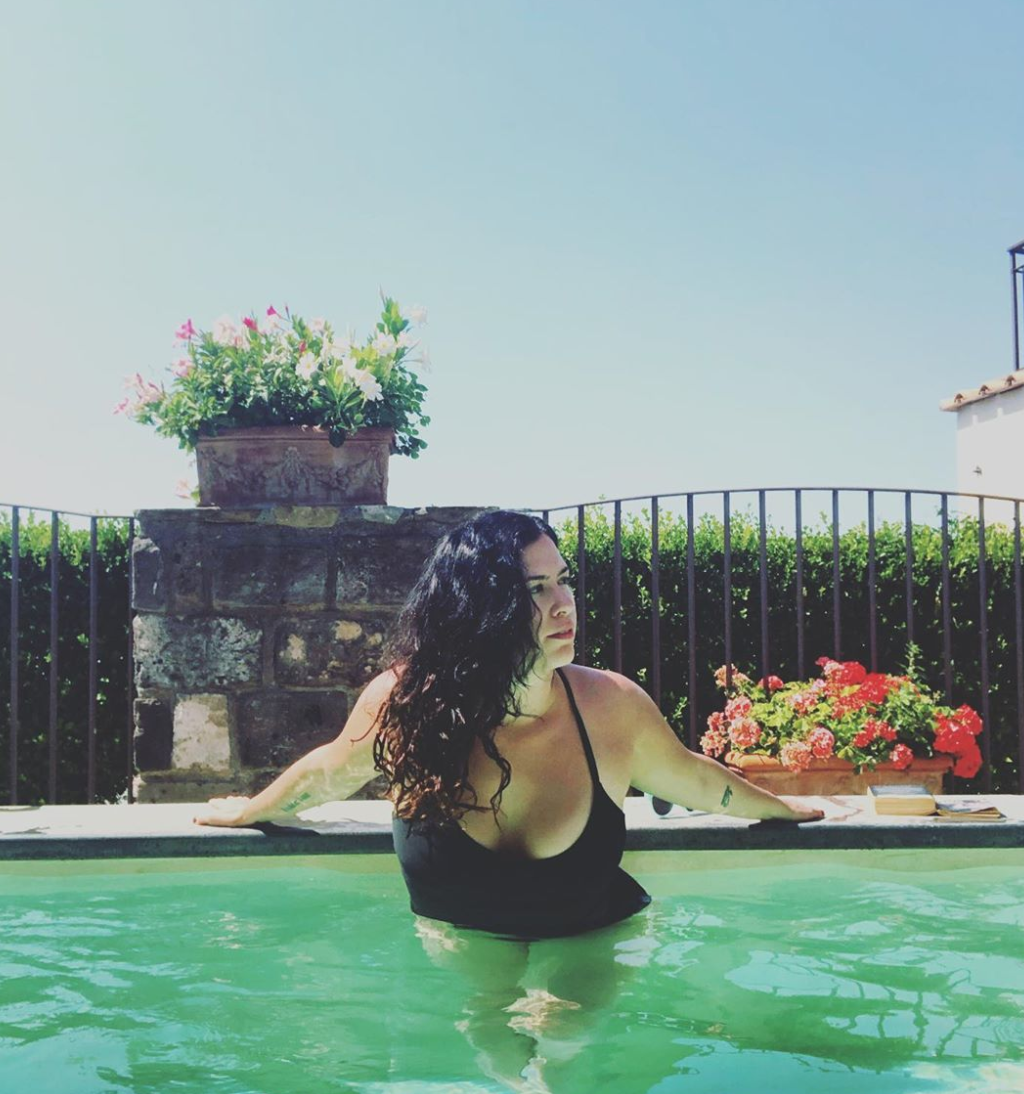
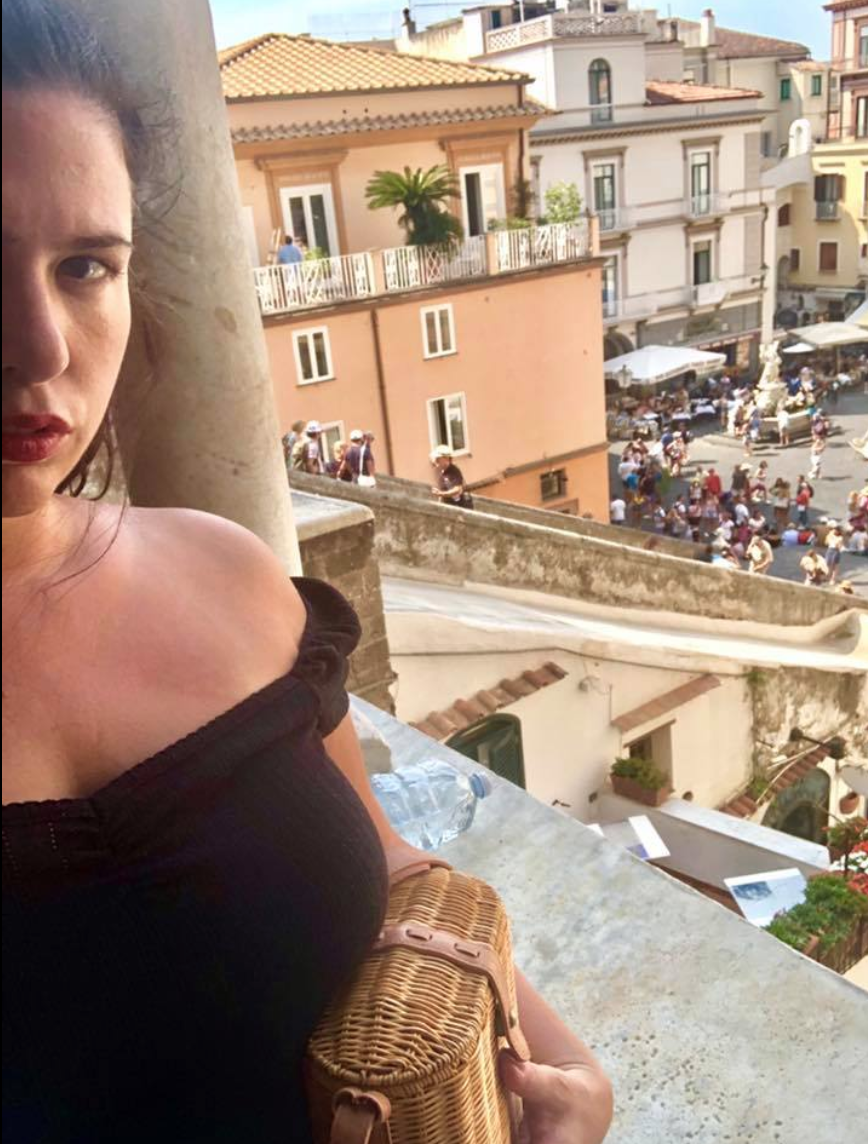
I came to Sorrento in Campania, Italy for eight days, alone. Actually, I’m writing this from the balcony off of my room during the golden hour, when the pink and white flowers and the ivy vines are drenched in a soft honey-colored light. God’s filter. The cosmos’ generous reminder that Earth is perfect without us. But the Italian people surely make a strong argument; they are one of the world’s maestros of splendor and creation. From their frescoes to the delicate placement of flowers wherever and anywhere flowers can grow, the Italians understand the holiness of not only aesthetics but intentional living. 

So, in the land of the sirens, as the Sorrento coast is known, it is no surprise that I — without a true understanding of what I would embark on — fell well into the depths. Perhaps you can blame it on my elemental nature; I’m a scorpio whose language is cthonic. I crave the long hours of confession and exploration and transformation. 

Before Italy, I’d been in London alone — in quaint Datchet, a village just outside London, technically —  for three days. So for 11 days, I’d been in relative solitude, save for ordering a pint or cobbling enough Italian together to purchase a boat ticket. 

View this post on Instagram

A post shared by lisa marie basile (@lisamariebasile) on Aug 26, 2019 at 1:31am PDT

As a gift to myself for finishing my forthcoming book, The Magical Writing Grimoire (2020), I booked a holiday to Italy, on my own — to write, to dream, to swim in the cerulean sea, to see where my blood comes from.

But as I would learn — when night fell here in Italy, it fell hard, and without a soul to speak to on my own (in this six-room church-turned-bed and breakfast tucked high into the mountains) I felt a transformation take place.

Into the depths 

For some, eleven days of solitude is doable, desirable even. But for many, it’s not. It is a sentencing. It isn’t that I crave silence. On the contrary; I fear it — especially coming from New York City. It’s that I needed it. There’s a difference. 

If I could not quiet my mind, if I could not disappear from my life, how could I truly know what it meant? What could I learn from the other side of my life, where my own body is my only anchor?

As creators — writers, leaders, artists — and as humans, we rely on a kind of sustenance. You pick the poison. We need to drink it, inhale it, dive into it. For me, that bread and wine is light and space, solitude, apart-ness. A certain relinquishing of comfort. I needed to be challenged, far away from the myself and the places I knew. I felt a restlessness growing in me that demanded a sequestering. 

For the longest time, however, my weaknesses have found the form of a fear of abandonment, the need for (but fear of) quiet, and lack of control. It comes from trauma and it comes from knowing that around any corner I might fall into the abyss of self. Thinking too much. Add a little wine, and I’m fucking gone.

But in being alone, I have faced my demons. I have named them. Here in Italy I’ve abandoned what I knew to be comfortable and safe. I felt, in some moments, far into the mountains in this isolated commune high above the more populated Sorrento coastline, that I abandoned myself. What were you thinking, I asked myself at least once, coming here alone, for all this time, without anywhere to go on your own? There are two restaurants down the road, a market that closes for siesta, and winding streets of farmland that cannot be traversed by foot.

I’d abandoned a sense of control. First of all — traveling abroad is not like going to the cinema alone or sitting awkwardly, fidgeting during a solo dinner. The end point is not soon. The awkwardness is replaced by a small village curiosity, a light that shines on you and is hot and is real. You begin to see yourself as the subject. But you realize the ego is a type of demon you must drag out to the little square and send off on its way.

But more than noticing my aloneness, control issues threw me into the sea. I could not control the inevitable surprises, which came in the form of car breakdowns, missing boat rides, nearly fainting in 90-degree heat. Walking up hundreds of steps, on a cliff, just to get to some semblance of where other people are. 

And of course, the quiet. The heavy quiet that pools in like a ghost, under the door and through the shutters, at night. The quiet that tells you how far you are from everything, how many hours you have until sleep finally settles in. What of the anxieties and rogue feelings of sadness? They are there, a chaotic circus of them all, prodding you, reminding you how far up the mountain you are — without a car nor a means of leaving. When you look out the window, you see Vesuvius. 

You think of your body as ash. 

But isn’t this what you came for you, I asked myself. Isn’t this what we all want? In life, we are forced to move through our traumas — things that have happened to us, things that have been done to us. We carry our wounds as an albatross, even if we aren’t aware of it. And life has dealt us all a heavy hand. 

In my day, I’ve seen, either in myself or in my family, foster care addiction. I’ve seen chronic illness and death. I’ve seen poverty and I’ve seen prison. What are your wounds?

Why would I willingly stoke the flame after survival? Why I let myself be lured by sirens?

In some sense, choosing to be uncomfortable and choosing to work through the quiet is the lesson. It is a pain that I didn’t quite expect in coming alone to a faraway country without a friend or anyone to speak to. But it wasn’t the pain of place. It was the pain I brought with me.

I was the hurt. I brought my fear. I brought my anxiety. Italy didn’t do this to me. There’s a certain shock in realizing that. And a definite freedom.

li galli islands

Solitude & loneliness are not the same

I felt so alone on so many nights, an aloneness that was less about not being near people or places and more about my individual decision to fly 4,000 miles from home. How the gift of autonomy comes with a solitude that must be understood and appreciated, rather than feared.

How we are, ultimately, alone.

But being alone is not the same as loneliness. The people in the market, the people in the farms plucking lemons, the people who make me limoncello, the people who steer our boats from island to island, the people who direct me to the nearest whatever it is, the tourists who see me sitting alone and ask me to dine with them — there are people everywhere, and that is a treasure. Those small slivers of conversations are a reminder that we are alone, but we don’t have to be lonely.

The earth sees you. It wants you to be here.

One night, I texted my father for help. The loneliness followed me up the little hill when I walked back from dinner. My father, Italian as they come, served many years in prison — and weeks in solitary. I felt silly asking him for him, but I knew he’d understand what solitude could do, and he said:

Always realize today is just one day. And tomorrow is a new beginning. A new opportunity to feel differently or experience different things. Don’t let your mind control your feelings. Think how lucky you are —being able to travel. And having people in your life that love you and care about you. You are never detached or isolated. The world is much too small for that anymore. Everyone is connected. I love you.

In silence, we grow. It reminds us that not only can we and do we survive, we are self-resilient when we willingly put ourselves in uncomfortable situations, when we decide to settle in and let the silence fill us with every thought and memory imaginable.

There is no way down the mountain. There is nothing but your own mind — and no matter how luxurious or beautiful the country or place you are in, we are all alone, bodies full of chemicals and traumas that demand we look them in the eye. 

Ancestral work is healing

My father’s family is Italian and Sicilian — at least his parents and great grandparents were. We have Spanish and West Asian ancestors as well.

I was raised in New Jersey with my Italian/Sicilian grandparents. My nonna, from Palermo. My grandfather, part Napolitano. I only saw Naples from the car, its hundreds of homes — colorful, scattered, boxy, so much laundry hanging you could see it from space. Many of its people are living in poverty, under the stronghold of a mafia, the Camorra. They say Naples is the realest city in Italian, a place that doesn’t afford any of the luxuries or predictable splendor of other cities. It’s hard and gritty and I have that in my blood.

My grandfather, Sabatino, whose family hails from this city — what must his family have done to get to America? What drove them out? What sort of assimilation problems did they have when Italians were considered dirt?

italy amalfi

My grandmother Concetta Maria came by boat — you can see her name on a ship’s manifest, along with her sisters, one of which fell so ill she had to be taken to the hospital upon arrival in the port of the United States. She told me once about the blackshirts, Benito Mussolini's men, wandering around as she sat under lemon trees.

She spoke Sicilian, my grandfather spoke an Italian dialect. They made fun of one another’s language. When they came here, they didn’t teach any of their seven children Italian or Sicilian. They forced assimilation in the household, as many immigrants do.

In any sort of ancestral work, you aim to understand your bloodline. In my case, my grandparents were relentlessly catholic, deeply disappointed in many of their non-catholic grandchildren — me — and generally chose favorites. Some were favored, coddled, loved. Near the end of my grandmother’s life, well into her 90s, she made me cake, presented me with a rosary, made a sort of apology. 

I’ll never forget it. She pulled a long lock of black hair from a box and wielded it over the dinner table. She kept her hair, as if to keep her youth, her vitality.

To this day, my black hair reminds me of her. I care for my hair — wavy and coarse and wild — because it is Italian hair. It is my own. 

And on this trip, when I boated from Sorrento to Capri, I thought of them, of their struggles, of how hard they worked to make a life for themselves. Where they failed and how they loved. How they made my father, the artist and musician and poet, and how he made me.

I dove from the small passenger boat into the deep emerald-green water. I was submerged quickly, lungs full of salt water so thick and fast that I gagged. I swam back to the boat’s ladder, frightened, and out of control. But I caught my bearings and swam again. The sea wanted me to know her.

This was baptismal. Swimming in the waters of my blood, my body fully cradled by the earth’s watery womb. Towering island rocks loomed over my head. I was being tugged on by the ancient ghosts of time, my ancestors saying hello, my ancestral land showing me its gusto and bravado. And its softness. In the water a sense of home came over me, no matter how scared or foreign I felt.

I was there because two people, at some point, made love. And they lived here, and they fished in these very waters, and then their children had children. And someone, some girl, me, came back — in search for something.

There is a photograph of my grandfather standing at the water’s edge, birds flocking all around, his black jacket strewn over his shoulder all casual, as he looks back at the camera from afar. It is so blurry you couldn’t make it out entirely, but it is on the prayer card from his funeral, so we know it’s him. You could make him out anyway — his deep golden skin, his firm stance. 

He was a fisherman, and my father is a fisherman. They spoke the language of water. They understood and understand water in their very nature.

 And now I speak it too. Born of a water sign, obsessed by the depths, I am called to the sea by sirens.

positano

Parthenope, the siren of Naples

At my bed & breakfast, my door is labeled in gold: Parthenope. I only remotely knew of this siren, that she was one of the many who lived on the coast of Sorrento. But I was not expected to know her so well.

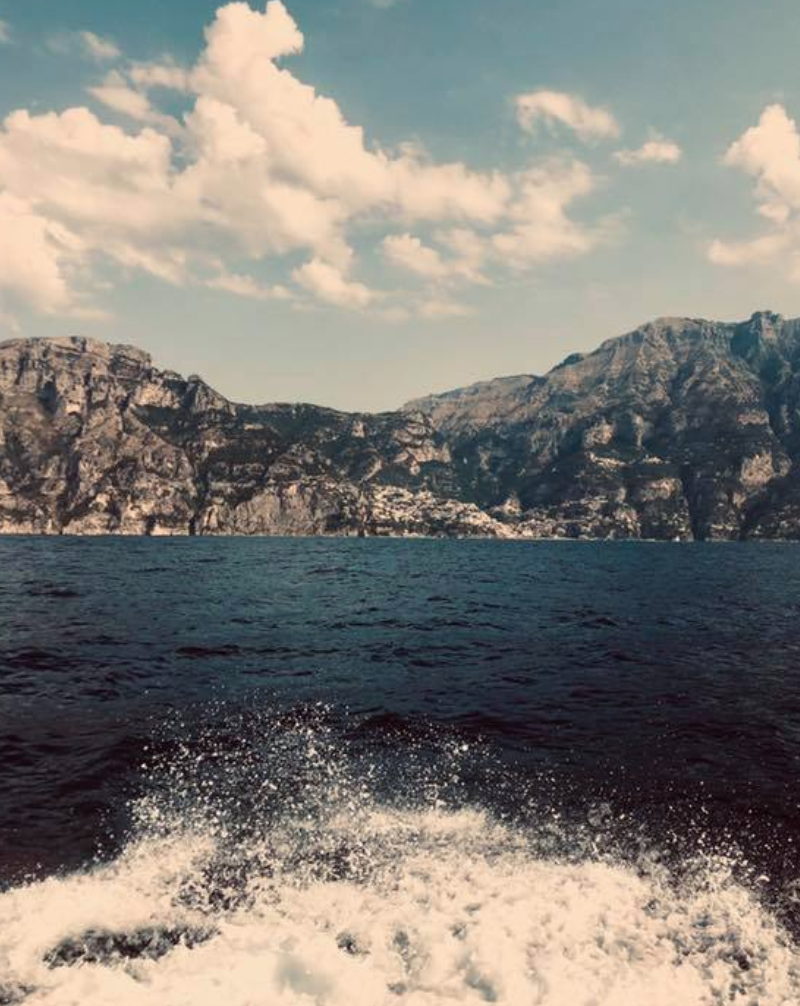
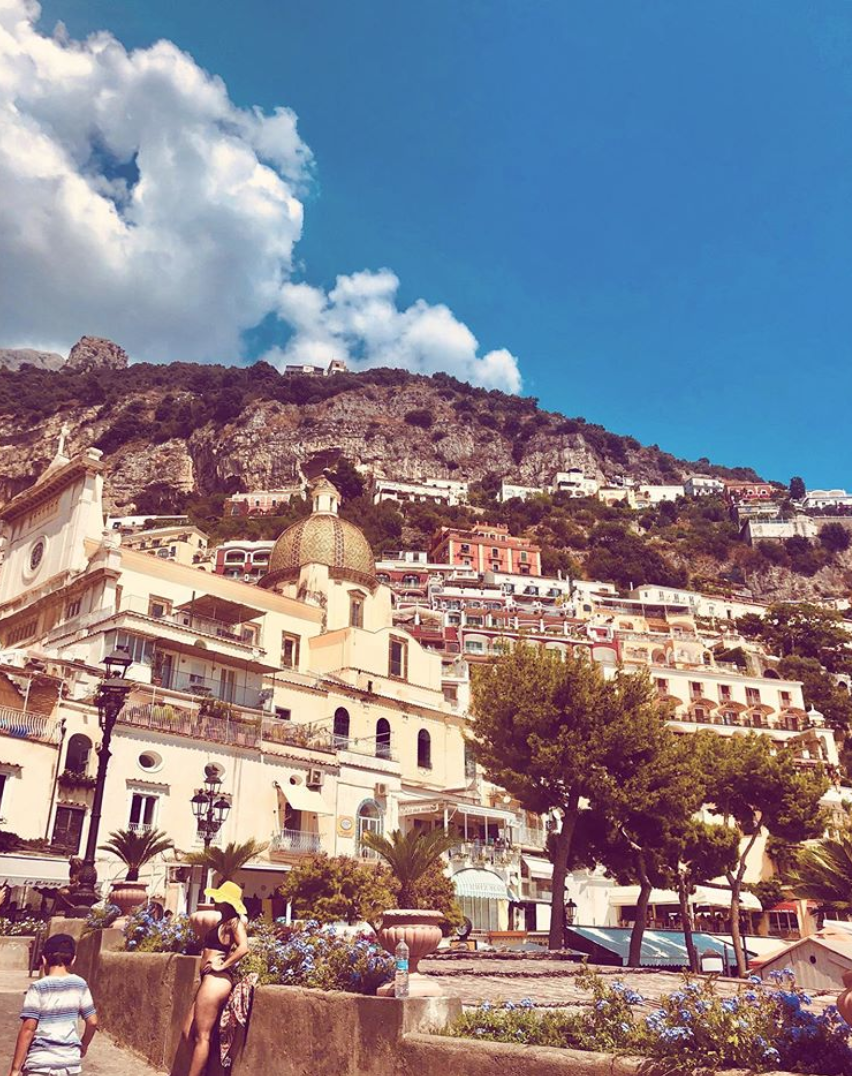
On the way to Amalfi and Positano one day, we pass Li Galli, an archipelago of little islands — Gallo Lungo, La Castelluccia, and La Rotonda— surrounded by cerulean water. These islands are also known as Le Sirenuse, where Ulysses’s sailors were sought out by the sirens, thought to be named Parthenope, Leucosia, and Ligeia. Of course, sailors would crash in wild waters against these jutting rocks, only to blame the voice of women for their misfortune.

The sirens, aside from singing, played the flute and the lyre, instruments which glide on the wind with a sort of frenzied beauty. The siren stories goes back to the 1st century, when Greeks told their tales. I imagine them as mermaids, although they are also commonly depicted as having a bird body with human heads.
.
My room, the is Parthenope room, is decorated in light blue, gold, and ivory. Of course, this was initiatory, a blood welcoming. Upon first entering, I fell into a deep rejuvenating sleep, lulled by some song, some sustenance from ancient times.

My dreams were of water and lineage.

When I awoke, I felt I’d become a siren, a descendent of Parthenope, perhaps, someone who understood the sea. And, while we’re at it, can bring sailors to their deaths.

The legends — and there are many — say that Parthenope was said to throw herself into the sea when she couldn’t please Odysseus with her siren song. Her body was found on the shore of Naples, where my grandfather comes from. Other stories say that a centaur fell in love with Parthenope, but Jupiter couldn’t have this — and so he turned her into the city of Naples, while the centaur became Vesuvius. And when Vesuvius couldn’t have her love, he would erupt.

Parthenope taught me something — that even in beauty there is darkness. It is up to you find the light. You can find it on islands, and you can find it in yourself.

But there is so much I don’t know. There is so much I’ll never know. For many, the mystery of lineage is a wound. A forced removal of information. A wound of colonialism and genocide. A nothingness. An end of the line. 

For me, it’s the fact that my ancestors were disappointed that I wasn’t more Catholic, that my parents hadn’t stayed together. That they didn’t pass on their language.

My ancestral work, I’ve realized, is accepting that I can still come from a place, still be of a thing, still call upon the past, still devote my life to exploring my blood — even if my family wasn’t perfect, even if I wasn’t catholic enough in the eyes of my grandparents. Because ancestral work is so much bigger than everything we understand.

My ancestors tell me to find gratitude in being alive, to look out and see the sky and sea, to find magic in the city and the thousands of doorways and street signs — and to keep looking for Synchronicity. To always keep your eyes and ears open. Messages find their way.

How many of the ones of who made me plucked lemons? How many of them swam in the shore? How many of them drove through the city streets of Naples, or down the mountains in Sorrento? How many of them stopped and prayed at the very churches I photographed? How many of them built cities with their own hands and brought culture to America when they came? How many of them stayed in Italia?

The sheer fact that life moves onward, rolling as water, a siren song that continues — and how lucky it is that I get to breath in this existence? That is my ancestral work. 

What have you learned on your travels? It doesn’t need to be far to be meaningful.

positano

A place always reveals itself long after you leave


Tonight, my last night, the air feels quieter. The dark feels more expansive. The room feels emptier. As if the fullness of my adventure has come to a close, and I am just waiting departure. As if my body has left already, but some essence of me stays. Sometimes this cutting off hurts. You can’t place why, but it does. The places we go, especially those we were meant to see, feel the vibration of our leaving as much as we feel them fade into the distance. That’s the cord.

Of course, once I leave, this place will become more real to me — more beautiful, somehow — than it was when I was there. The greens will be the most green. The curtains will always be swaying in my mind.

What I will remember isn’t the long nights or anxieties, the running from terminal to terminal or the breakdowns in language. I’ll remember the way the sun melted into the ocean. I’ll remember how the Italians are late even to toll their own bells. I’ll remember the way the skipper looked when I thanked him. His golden body sweating from long days carrying bodies to and from the coast lines. I’ll remember the long siestas and the open windows and the dogs in the street.

I’ll remember how quickly my room filled with light when I opened the shutter even a little. How much the light wants to get in. How we must let it. How we owe it to our lives, our fears, our wounds, and our ancestors.


Lisa Marie Basile is the founding editor of Luna Luna Magazine, an editor at Ingram’s Little Infinite, and co-host for the podcast, AstroLushes, which intersects astrology, literature, wellness, and culture. She regularly creates dialogue and writes about intentionality and ritual, creativity, poetry, foster care, addiction, family trauma, and chronic illness—particularly Ankylosing Spondylitis, a disease with which she lives. Most recently, she is the author of LIGHT MAGIC FOR DARK TIMES (Quarto Publishing/Fair Winds Press), a collection of practices and rituals for intentional and magical living, as well as a poetry collection, NYMPHOLEPSY (co-authored by Alyssa Morhardt-Goldstein). Her second book of nonfiction, The Magical Writing Grimoir, will be published by Quarto/Fair Winds Press in April 2020. It explores the use of writing as ritual and catharsis. Her essays and other work can be found in The New York Times, Chakrubs, Catapult, Narratively, Sabat Magazine, Refinery 29, Healthline, Entropy, Narratively, Catapult, Best American Experimental Writing. She studied English and psychology as an undergraduate at Pace University, and received a Masters in writing from NYC’s The New School. FOLLOW HER ON INSTAGRAM HERE.

In Place, Wellness, Magic Tags ancestral work, italy, sorrento, campania, travel, world travel, tourism, li galli, sirens, siren songs, solitude, Traveling, italia, naples, mafia, ancestors, magic
Comment

Powerful Mantras for Badass Witches

July 23, 2019

Stephanie Valente lives in Brooklyn, New York, and works as an editor. One day, she would like to be a silent film star. She is the author of Hotel Ghost (Bottlecap Press, 2015) and Waiting for the End of the World (Bottlecap Press, 2017).  Her work has appeared in  dotdotdash, Nano Fiction, LIES/ISLE, and Uphook Press. She can be found at her website.

Read More
In Wellness, Lifestyle Tags magic, astrology
Comment
andy-holmes-734162-unsplash.jpg

The Astrolushes Podcast: Skeptics, Cosmic Lessons, & Authenticity

June 13, 2019

Astrolushes is a podcast at the intersection of astrology and literature, ritual, wellness, pop culture, creativity — and, of course, wine. Expect guests, giveaways, & games — and get ready to go deep with us.

The water-sign hosts are Andi Talarico, poet, book reviewer and Strega (@anditalarico) & Lisa Marie Basile, poet, author of Light Magic for Dark Times, & editor of Luna Luna Magazine (@lisamariebasile + @lunalunamag). You can the astrolushes on Twitter, too, here.

Screen Shot 2019-06-13 at 4.35.28 PM.png Screen Shot 2019-06-13 at 4.35.45 PM.png Screen Shot 2019-06-13 at 4.36.00 PM.png

LISA MARIE BASILE: Let’s chat about the birth of AstroLushes! I think it sort of started on a drive we took to Salem, MA, where we witched out for a weekend and visited HausWitch for my Light Magic for Dark Times writing workshop. In the car, I threw celebrity and literary names at you and had you guess their big 3 signs. You were amazingly on point! I'm wondering, besides having fun with it, what do you personally think the 'use' or 'reason' for this astro-knowledge is? I think people are generally fascinated, but we both know there's more to it.

ANDI TALARICO: That road trip and our time in Salem definitely feels like the genesis of this show! It started with us guessing celebrity's charts and now it's just a part of all of our conversations. I feel like now we're constantly wondering about writers and actors and philosophers through the lens of their astrological placements. It's a fun game but I think it also allows for a possibly deeper understanding of the art and culture that we engage with.

And engagement was how I came to astrology. My mother always read our horoscopes from the paper when I was growing up; she's a mystical Pisces who has visited psychics, believes in prophetic dreams, and finds herself fascinated by the moon. I inherited a lot of my curiosity from her. But by age 12 our household had changed considerably and it became a harder place to exist and grow in. So it's no surprise to me, looking back, why that was the time I started studying astrology.

It was a way of making sense of the world. It also gave me an opportunity to talk to people about themselves (and to keep the focus off of myself.) It made me feel like I had some sort of agency, a voice, a new authority. Now, the language of astrology, to me, is less about telling people about themselves and actually, much like my tarot practice, using the themes and ideas as lessons that we can use to fully become our best, most authentic selves. That's where it crosses over into self-care as well.

How do you feel about people who think astrology is bogus, Lisa?

Astrology…much like tarot practice, uses the themes and ideas as lessons that we can use to fully become our best, most authentic selves. That's where it crosses over into self-care as well. — Andi Talarico

Screen Shot 2019-06-13 at 4.37.11 PM.png

LISA MARIE BASILE: I love that you say it's an engagement with everything around us. And that, as a child, it helped you navigate a very difficult world. It truly is a language we learn and then we speak, and that can bring people together in an instant. And it can help us focus on the many characteristics of ourselves. In my life, processing the trauma I've experienced through the filter of the Scorpio has been amazingly beneficial; I now look on it all as transformative, rather than destructive. 

It's also really interesting to give a name to the various inclinations and motivations for people's art or behaviors. Especially when you look at creative people, or really evil people, and you start seeing how many of them fit into a certain astrological sign, or element. It may not be scientifically proven, but that’s the sort of mystery and liminality that we derive meaning from.

I am a scientific person. I believe that reason, empirical evidence, and research is important. I live with a chronic illness, and I'm a health writer as a day job. It's important to me that information is disseminated accurately, or, say, that the injections I take have been proven both effective and safe, and that sometimes, you need medication over meditation, in order to heal.

At the same time — people need to know there’s more to health and wellness than big pharma. And there’s more to this world than what we can see. I think the zodiac allows us to approach the liminal, the intuitive, the subterranean. It does exist outside of 'objective science' and that's okay. It allows us to dive headfirst into the shadows of this world and our lives, and I think that's the key to the feeling whole — straddling both sides. Science has a place, but so does the esoteric. You can't prove love, but we all feel it. So, it's the same thing. Some things we just explore knowing that it may be obscure. I am grateful to be able to take part in the world from both stances. 

What do you think about how people can use the zodiac as a healing tool, or in daily ritual?

There more to this world than what we can see. I think the zodiac allows us to approach the liminal, the intuitive, the subterranean. It exists outside of 'objective science' and that's okay. It allows us to dive headfirst into the shadows of this world and our lives, and I think that's the key to the feeling whole — straddling both sides. Science has a place, but so does the esoteric. You can't prove love, but we all feel it. — LISA MARIE BASILE

View this post on Instagram

Sunday afternoons at home. 📸 by @michaelsterling

A post shared by Andi Talarico (@anditalarico) on Apr 7, 2019 at 10:18am PDT

ANDI TALARICO: I definitely look through several horoscopes during the morning to see what my day/week might bring me. I mean, the basis of horoscopes are transits, what the movement of the current celestial journey means in my zodiac placements, and I love that about horoscopes — how it's a constant reminder that everything changes, nothing stays still, and how cyclical life can be, for good or bad.

I like to look to the planets/celestial bodies and their assigned western astrological associations for greater personal meeting. Like, what does it mean to be represented, as I am, by the Moon? The Moon shines because it reflects the light that is given to it. I feel the same way, again, for good and bad. I also shine brightest when I'm basking in the the light of stimulating conversation and affection. I turn inward and dark when I'm not given light to work with.

Also, since the Moon transits more often than other bodies, since it's constantly waxing or waning, it serves as a beautiful remind to keep pushing forward, that this moment isn't forever, to enjoy the view and perspective before it changes yet again. It's why I have a little crescent moon tattooed on my finger — my constant reminder that the only constant is change.

How do you feel connected or represented by Pluto, Lisa? Pluto is such a symbolically important planet of creative destruction, I'd love to hear your thoughts on that!

What does it mean to be represented, as I am, by the Moon? The Moon shines because it reflects the light that is given to it. I feel the same way, again, for good and bad. I also shine brightest when I'm basking in the the light of stimulating conversation and affection. I turn inward and dark when I'm not given light to work with. — ANDI TALARICO

LISA MARIE BASILE: Oh, that’s so beautiful! When you say, “I turn inward and dark when I'm not given light to work with,” I feel that in my core! I love the idea of this cosmic duality, how it represents the shadowy quietude and the display of light. It reminds me that we are all just star stuff. It’s why I started Luna Luna! 

It’s funny you mention the tattoo, because I have one that also reminds me that things change; it’s an ampersand. Maybe that’s why you and I are so drawn astrology? That it provides a foundation we can find stability in but the fluidity we need to always be growing.

I think the fact that Pluto has been considered a planet, a not-planet, an exoplanet and whatever else, is very beautiful—a perfect and living representation of Pluto as a symbol: it dies and is reborn, and yet it remains this beautiful archetype of transformation, weathering the storms of idea and rule and order. Could literally anything be more perfect? 

Pluto is my beautiful ruler, and I am indebted to its reminders. I have always been able to die and rise. I lean into the dark and then I die. I go into dark periods of change and emerge. I almost need it more than the light. But I suppose, that is my language. The darkness becomes a kind of light that makes sense. 

I think that’s the beauty of this cosmic story. No matter what you believe or feel skeptical about, astrology’s narrative, symbolism and reminder to explore the grandness of human emotion and circumstance is all splayed out up there. We just need to look up. 

What do you think about people who say they they believe in astrology and make Huge Life Decisions around it? Do you think it’s important to figure astrology into your day to day? Jobs? Dates? Etc? Or do you think it serves its best purpose as a tool for introspection, rather than a rulebook?

No matter what you believe or feel skeptical about, astrology’s narrative, symbolism and reminder to explore the grandness of human emotion and circumstance is all splayed out up there. We just need to look up. — LISA MARIE BASILE

ANDI TALARICO: LOVE this: "...Pluto as a symbol: it dies and is reborn, and yet it remains this beautiful archetype of transformation, weathering the storms of idea and rule and order. "

View this post on Instagram

wandering the streets, finding magic in Spanish taverns and wooden bars and long conversations and hanging flowers 💐 camera 📷 by either @lifestudies or @anditalarico

A post shared by lisa marie basile (@lisamariebasile) on Apr 15, 2019 at 8:50am PDT

As for me, I don't make huge life decisions based on astrology in the sense, that, say, I won't work with people of certain signs or judge them based on their natal chart. The idea of not dating this sign or that sign is a prejudice to me, and unfair. Even knowing someone's chart information is an act of intimacy — that's private knowledge — and to use it against someone or to think you know everything about a person based on it...hell no. Absolutely not.

Can it help you locate potential challenges? Yes, I believe that. Is is exciting when your synastry is in alignment and looks positive? Of course. But we're all much more than our natal charts. We're our upbringing, we're our ancestors, we're survivors, we're our good days and bad days, we're what we've been allowed to be and what we've rebelled against. Our zodiac signs matter but they don't make or break us.

I WILL make decisions based on transits and the moon's phases, though. Like, new beginnings during the new moon — that just makes sense to my entire being, both my physical and spiritual self. I definitely believe in harnessing the new energy at the start of a new zodiac phase — focus on good communication at the start of Gemini season! Make those spreadsheets in honor of Virgos everywhere! Get real sexy at Scorpio time!

But, would I, say, not send an important email when Mercury's in Retrograde? No, I try not to rely THAT heavily on astrology. I try to use it more as a guide and tool for learning than a strict rulebook. But...I also hate rules and authority in general. I naturally bristle against those who think they have the exact answers, at least in areas that don't involve exactitude and true yes or no areas. I'm a skeptical human, in many ways.

Is is exciting when your synastry is in alignment and looks positive? Of course. But we're all much more than our natal charts. We're our upbringing, we're our ancestors, we're survivors, we're our good days and bad days, we're what we've been allowed to be and what we've rebelled against. Our zodiac signs matter but they don't make or break us. — ANDI TALARICO


FANCY THE COSMOS, WINE, AND A COZY CONVERSATION BETWEEN FRIENDS? LISTEN TO THE ASTROLUSHES PODCAST HERE


In Pop Culture, Social Issues, Poetry & Prose, Interviews, Lifestyle, Body Ritual, Wellness Tags astrolushes
Comment

Body Ritual: Journal Prompts for Chronic Illness Exploration

April 11, 2019

BY LISA MARIE BASILE

Body Ritual is Lisa Marie Basile's column about wellness, chronic illness and finding healing and autonomy in ritual. You can follow her
on Instagram for more on this topic.

If you live with a chronic illness, or if you love someone who has one, you know the delicate balancing act it requires. Living on that liminal precipice, between doing just enough and doing too much, requires an almost spiritual focus. And it’s tiring. I know, as I have ankylosing spondylitis, a degenerative, incurable spinal disease.

Who we feel we are within our minds is not always what our bodies reflect. And sometimes, that very lack of reconciliation rewires us. We start to believe we cannot, are not, will not.

We can, we are, and we will embrace the wholeness of our limitations and our magic. It doesn’t matter if people want us to stay quiet, go away, or stop complaining. We have a right to explore what it means to experience life as we do.

Stigma, lack of education, and fear make it hard to exist in a body that exists on the margins. Sometimes all the noise and suffering keeps us at a distance from ourselves. We often are so tired from the pain or insomnia or anxiety that we smile and pretend everything is okay. We sometimes allow ourselves to be taken advantage of just so we can seem “normal.” We push the limits of our bodies and lose grip on our boundaries. Sometimes, we get through the day, and that’s it. Sometimes it’s hard to feel empowered, to feel enough, to feel that we can and are and will.

The deep and important work that goes into healing the trauma of illness is often ignored. Instead, we focus on the day to day needs. We keep our heads above the water — but the secret is that we must become the sea.

I remember one of the first days many years ago when I realized that my body wasn't working the way it was supposed to. I was doing something simple, something that should've been innate. . Climbing on a bike, I thought that my hips were off, almost as if I was completely out of alignment. The best example I can give is when your car's axle is off and it continuously steers toward the left or to the right. There was no center, no feeling of steadiness, almost as if I could split in half or split into thirds and each part of me would fall to pieces in different directions. . My #AnkylosingSpondylitis (an #autoimmune or immune-mediated, incurable, degenerative spinal disease) deeply affects my hips, which is pretty ironic because I spent many years hating them for being so wide. Because society. Because magazines. Sometimes I wonder if I poured all of my negative energy into my body, making myself sick, as if I casted a spell - but I *know* that that is not the case. . Regardless, I try to treat my body with love and respect these days - I love my hips -and I try to see those situations in which I cannot do something or cannot do something comfortably, with compassion. I am always in the pool, where I feel I am larger than life, able to move fluidly with the lower impact, made stronger by water's sneaky resistance. But there are days when I want to crawl into bed and hide forever. Sometimes I win, sometimes it does. It's a process. It is my process. . Movement is integral to my life, it is ritual. It is a song. It is the ONLY thing keeping my spine from fusing; I am literally running for my life. But it can also be painful. . So sometimes I use devices and tools to make my life a little bit easier, and I wrote all about that for @healthline - check it out in my bio. https://bit.ly/2Hw5O2q

134 Likes, 8 Comments - lisa marie basile (@lisamariebasile) on Instagram: "I remember one of the first days many years ago when I realized that my body wasn't working the way..."

Recently I decided to go inward and empower myself to make time and space for my voice and needs as someone with chronic illness. Instead of trying to blend in or assure everyone that, “I’m fine, really,” I stared down into visit the abyss. I decided to take my time, for no reason but my own needs, and look my chronic illness in its eyes.

I cut through the noise and the stigma and the denial. My body, alight and in focus.

To do this, I made a list of chronic illness journal prompts and chose a beautiful journal strictly for these questions (or you may want to type these out or dictate your answers).

So, I wrote down several questions in my journal, and attempted to answer them. At times I answered one a day. Sometimes I answered several in one go. The important thing is that you take the time to be honest with yourself.

What I learned from answering the below questions astonished me; I was able to advocate better for my needs, recognize and make space for joy and gratitude, and find the parts of myself, like glass shards, I thought I’d lost. I didn’t lose them, it turns out. They simply changed form.

Chronic Illness Journal Prompts

  • Who am I without my chronic illness?

  • Who am I with my chronic illness?

  • How did I change when I was diagnosed?

  • How did I not change when diagnosed?

  • How is my pain level today? How is my fatigue?

  • Are my basic needs met? How can I facilitate this?

  • What positive thing have I learned about myself while actively experiencing symptoms or side effects?

  • What negative thing have I learned about myself while actively experiencing symptoms or side effects?

  • What do I do during periods of remission?

  • What do I do or feel when I’m in a flare-up?

  • Are there any ways at all to bridge the gap between feeling good and not feeling good?

  • How do others make me feel about my chronic illness?

  • Who understands my illness and supports me in my experience of it?

  • How can I help others understand my illness?

  • What do I not feel comfortable explaining about my illness?

  • Where are my boundaries?

  • Where can I be more receptive or open? Is it in receiving love? Is it in talking about my needs?

  • How do my finances play into my illness?

  • Are there areas in which I am privileged and thus, have gratitude?

  • Are there community resources or other resources I can tap into for help?

  • How does my race, gender, or educational background impact my experience of chronic illness?

  • How does my illness impact my job?

  • How does my illness impact my social and/or sex life?

  • Are there other intersecting issues that impact my chronic illness?

  • What do I love about my body?

  • What do I need to feel happy on a day to day basis?

  • What do I need to feel sustainably happy in the long term?

  • Among the things I need, which do I have?

  • What are three things I am thankful for right now, in this very instance?

  • If I am not happy, what is in my power to change that?

  • What work — no matter how seemingly ‘small’ — can I do to advocate for or contribute the wellness of others who may be suffering? Would this feel gratifying?

  • What gives me hope?


Also read:

BODY RITUAL: 12 VERY REAL THINGS I LEARNED ABOUT CHRONIC ILLNESS

BODY RITUAL: GRATITUDE MAGIC

AT THE INTERSECTION OF CHRONIC ILLNESS & RITUAL


Lisa Marie Basile is a poet, essayist and editor living in New York City. She's the founding editor of Luna Luna Magazine, an editor at Ingram’s Little Infinite, and co-host for the podcast, AstroLushes. Most recently, she is the author of LIGHT MAGIC FOR DARK TIMES (Quarto Publishing/Fair Winds Press), a collection of practices and rituals for intentional and magical living, as well as a poetry collection, NYMPHOLEPSY . Her second book of nonfiction, WORDCRAFT, will be published by Quarto/Fair Winds Press in April 2020. It explores the use of writing as ritual and catharsis. Her essays and other work can be found in The New York Times, Chakrubs, Catapult, Narratively, Sabat Magazine, Refinery 29, Healthline, Entropy, Bust, Bustle, The Establishment, Hello Giggles, Ravishly, and more. She studied English and psychology as an undergraduate at Pace University, and received a Masters in writing from NYC’s The New School. Want to learn more? She’s been featured at Amy Poehler’s Smart Girls, HelloGiggles, The Cools, and more.

In Wellness, Social Issues, Lifestyle Tags chronic illness, Chronic pain, Chronic Illness, ankylosing spondylitis, journaling, Journal Writing, writing, therapy, wellness, body ritual
Comment
astrolushes

AstroLushes: A New Podcast for Astrology Lovers Everywhere

March 11, 2019

ASTROLUSHES is a podcast at the intersection of astrology and literature, ritual, wellness, pop culture, creativity — and, of course, wine. Hosted by Luna Luna editor-in-chief Lisa Marie Basile and contributor Andi Talarico (both water signs!), you can expect guests, giveaways, book reviews, and more. You’ll have fun, but you’ll also go deep.

Episode 1 is an introductory episode during which the hosts chat about astrology’s impact in their own lives, plus they tackle the ideas of reductive astrology memes, pop culture (Rihanna lyrics!), folk magic, family lineage and trauma. They also a Rapid Fire Round of Guess That Sign (which sign is Poe?).

For now, you can listen to ASTROLUSHES on Anchor.Fm (there’s an app and also a website), but the podcast will soon be available on iTunes, Spotify, and everywhere else podcasts can be found. If you like what you hear, leave them a clap or star the show on Anchor. You can also listen below!

You can tweet them at @astrolushes.

In Lifestyle, Music, Wellness, Social Issues Tags astrolushes, astrology, podcast, trauma, wellness, literature, lisa marie basile, andi talarico
Comment

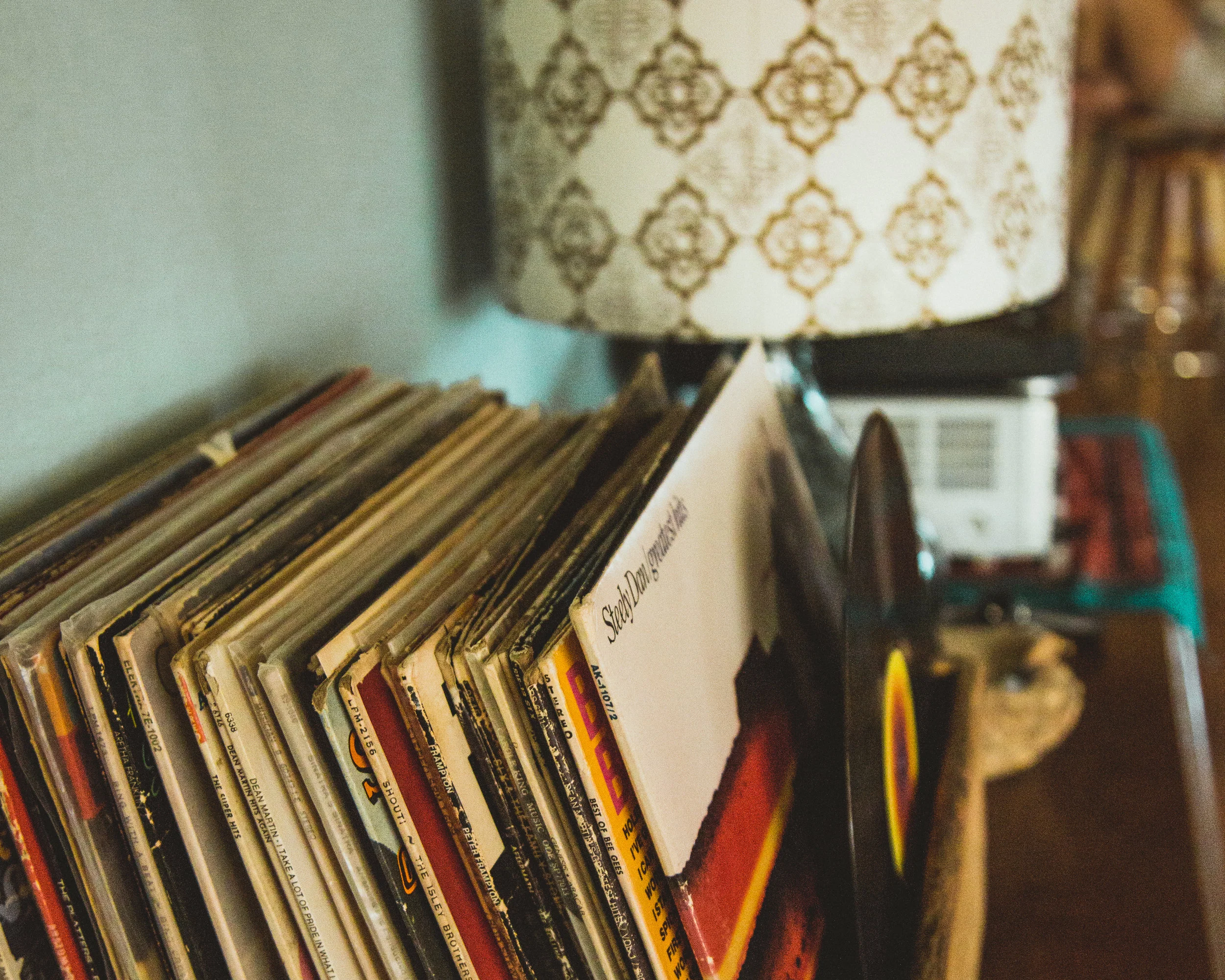
Weekend Ritual: Grounding & Visualizing with Vinyl Records

March 1, 2019

Stephanie Valente lives in Brooklyn, NY. She has published Hotel Ghost (Bottlecap Press, 2015) and waiting for the end of the world (Bottlecap Press, 2017) and has work included in Susan, TL;DR, and Cosmonauts Avenue. Sometimes, she feels human. http://stephanievalente.com

Read More
In Wellness, Lifestyle Tags magic, rituals, music
Comment
Photo by Rob Potter on Unsplash

Photo by Rob Potter on Unsplash

Healer or Trickster? On Healers Taking Advantage of The Vulnerable

February 25, 2019

BY LISA MARIE BASILE

In a recent article in The Daily Dot, a popular influencer was called out for their “blurry” beliefs and work, overpriced but not actually handmade goods (as claimed) and abusive tendencies toward employees. The overarching message of the piece: Not every healer or influencer out there — no matter their follower numbers or beautiful Insta-curation — is worth their salt. Some, in fact, are downright theives. 

I’ve always taken issue with people selling promises of healing without any real sense of accountability. Grandiose and often empty words (“light and love heals everything,” “all you have to do is manifest hard enough!” and “you have to invest in X to find abundance”) are distracting to people in rough situations. These are — I have been, and will be — people who want to be seen, validated, and healed. 

I just can’t get past overpriced abundance rituals, the refusal to acknowledge the importance of shadow work, or concepts that aren’t grounded in reality. Because love and light and abundance rituals do not solve racism or poverty. And because telling people your cheap, badly-produced goods are ethically sourced hurts everyone at every level.

The thing is, it’s hard to tell the frauds from the sincere folks. I started noticing this several years ago, when I created Luna Luna (which obviously has a vertical around magic and ritual).  I’d come across healers and gurus and guides who seemed to have it all together: Beautiful photos. Money. Bestselling books. They’d sell full moon serums or crystal-infused oils. They’d sell you candles that would attract money or heal a disease or find you a lover. How could one parse the capitalist who appropriates spirituality from the person who genuinely cared? And how can one ethically tout an object that ‘cures’ social and physical/mental ills, without acknowledging the many variables at play?

I would consider myself spiritual in specific ways, but this wasn’t always the case. I identify with the archetype of the witch, and I have carved space for ritual and meditation in my life, but it took a long time for me to get there. For one, I have leftover trauma from childhood catholicism; adhering to strict beliefs and associations (this color represents this outcome, for example) doesn’t quite sit right with me. I prefer chaos. I prefer to go off my gut. I prefer to study, learn, and then take what feels good for me. My practice these days is mostly based on meditation, journaling, and connecting with nature. 

View this post on Instagram

I’ve had a few people direct me to a specific recent article about healing/spiritual/ community manipulation and emotional abuse today, asking for my opinion. I’ve been out of commission all week with two removed teeth (fucking worst), but I did take the time to read the piece. . I’ve even written one like it (with a different subject, for which I received numerous cease and desist letters) for @lunalunamag in the past. It is still up. So I’ll keep it short and sweet: there are lots of spiritual ‘gurus’ and ‘guides’ out there. Especially on Instagram. We are treated to highly curated, beautifully designed shows of magic and healing and quotes. Some of it is amazing. Some of it feels a little shady. Right? Some people swear they can save you, that they have the answers, that they can guide you to divinity or healing. Some sell products. There are as many frauds as their are people who want to support, empower, uplift, and love you, though. Sometimes there’s no way of actually knowing, though, since all of this is presented in such a magnificent manner. No one can hold all the answers. No one knows you better than you. They can provide tools and inspiration, but that’s it. Otherwise, even the gospel of the curated Instagram is still just a shady ass who-knows-what’s-real being shouted toward you in an array of pretty colors. This is the case for any industry. . Your gut is what matters. When you feel like you need support and encouragement or a little burst of inspiration, find what feels right to you. Whether that’s joining a group dedicated to ritual or reading quotes from a certain influencer. There is a dark belly to even the beautiful things—and your gut knows it. Trust your own feelings and put stock in your heart above all other promises and products. I say this because I have experienced group manipulation, promises of splendor, people trying to tell me how to get rid of my “demons” in ways that felt off to my own personal intuitions. It’s a hard, vulnerable line to walk, and it’s easy to be led astray. This is not on you. But it should be stopped. 💓

A post shared by Lisa Marie Basile (@lisamariebasile) on Feb 20, 2019 at 3:43pm PST

So when I see someone make grand promises, that you have to do this to do this, or believe this to achieve this, or buy this to get this— especially to the vulnerable: the poor, the sick, the disabled, the traumatized, the abused — it doesn’t sit right with me.

Sometimes those promises come in the form of feigned care and support, when at the bottom of it all was an Instagram strategy and some pretty words.

I don’t believe that any one person can have the answers. And I don’t believe that anyone should peddle goods to people when they don’t have the integrity to back it up.

Among those promises would be actual spiritual advice despite questionable stuff, like the not-so-ethical production of goods, plagiarism of both products and feel-good quotes, and employee mistreatment. This likely happens a lot, but all of this came up in the Daily Dot article about this one specific person.

So what do we do about it all?

I wrote a book about self-care and regenerative rituals, so I spent a lot of time thinking about this sort of thing. When writing my book I wanted to make sure it was a guidebook, not a rulebook. That any practice I wrote of wasn’t from a closed culture — and that anything referenced I cited in the Resources section.

I wanted to make sure my book was a byproduct of my experience, not a way or promise or path. That the reader would be self-healing using my prompts, that I would not — and could not — be healing them. That, if anything, the book and the reader would enter into a conversation about healing together. 

That’s the thing about healing. It has to happen in a safe space. Before I started really working to heal my lasting trauma from childhood — the obsessive memories of homeless shelters, assault as a child, family addiction, foster care, chronic illness — I found comfort in all sorts of untoward things.

This included drinking all night with friends who thought getting obliterated was the answer. I found comfort in false friendships or relationships, where people wanted to be loved more than they want mutual loving care. I turned to fraudulent psychics here and there for advice, and of course there were those who’d want to dig into my pockets rather than genuinely help. 

The point is, we take comfort and care wherever we can find it — and sometimes, because of pain, loneliness, poverty we turn a blind eye to gut feelings. I’s hard to know if it’s helping or prolonging the wound.

The Internet version of this really is the abundance of healers and guides out there. Many of them are wonderful — and many are my friends, who take special care to create products and books and ideas around self-care and healing products — but many are there for fame and fortune, not to help.

They want to preach at you, not have a conversation. They claim to know the answers, rather than admit that they’re always going to be searching. They lack self-awareness, charging big money to people who literally are seeking magic work because they’re on the verge of eviction.

It’s hard to know what sort of intentions people have. Sadly, there’s just no cut or dry answer. How could there be? I think our gut has to do the work. But for the gut to work we have to have self-compassion and give ourself the space and time to let our intuition work. This is a process — a process damaged by hope being dashed by scammers.

We could spend $45 on a healing candle from someone with 50,000 followers and a beautiful Instagram page, someone who hasn’t provided insight or vulnerability elsewhere or even a glimpse into their own real lives. Or we can buy a tarot session or a book or a crystal from someone who is less concerned with a perfect, sort of distant, who-are-you-really? branding, whose track record shows an active interest in trauma recovery or healing or helping others before they started earning money from it. And even the above is an oversimplification. 

If something doesn’t feel right, even if that something has a quarter of a million followers or is quoted in wellness articles, you are by no means obliged to look to it for wisdom.

I say all of this because I think on my own mother, my own friends, and myself — and all the times we needed a hand, a source of inspiration, a talisman of hope,  or a guide to getting back to ourselves. It would be a real shame to get a candle or a reading or a downloadable guide that came from someone who wasn’t sincerely invested in our care, who only wanted to make money, and who used unethical means to produce a product, from conception to production. 

I read a piece the other day by Kaitlin Coppock for Sphere + Sundry. It’s a comprehensive look at fraud-work in the spiritual and healing communities, and it goes into much better detail than I can. It covers:

“Tips for distinguishing real practitioners of astrology, witchcraft, and spirituality from self-serving charlatans taking advantage of the mounting witch-strology renaissance. And lastly, recommendations for how professionals (or aspiring professionals) can navigate related ethical considerations.”


I recommend reading the above and asking questions for yourself. Stay alert, be good to yourselves, and don’t let influencer numbers drown out your intuition. 


Lisa Marie Basile is the founding creative director of Luna Luna Magazine—a digital diary of literature, magical living and idea. She is the author of "Light Magic for Dark Times," a modern collection of inspired rituals and daily healing practices. She's also the author of a few poetry collections, including 2018's "Nympholepsy." Her work encounters the intersection of ritual, wellness, chronic illness, overcoming trauma, and creativity, and she has written for The New York Times, Narratively, Sabat Magazine, Healthline, The Establishment, Refinery 29, Bust, Hello Giggles, and more. Her work can be seen in Best Small Fictions, Best American Experimental Writing, and several other anthologies. Lisa Marie earned a Masters degree in Writing from The New School and studied literature and psychology as an undergraduate at Pace University.

In Social Issues, Wellness, Lifestyle Tags fraud, spiritual abuse, scammers, healers, healing, instagram, gurus
2 Comments
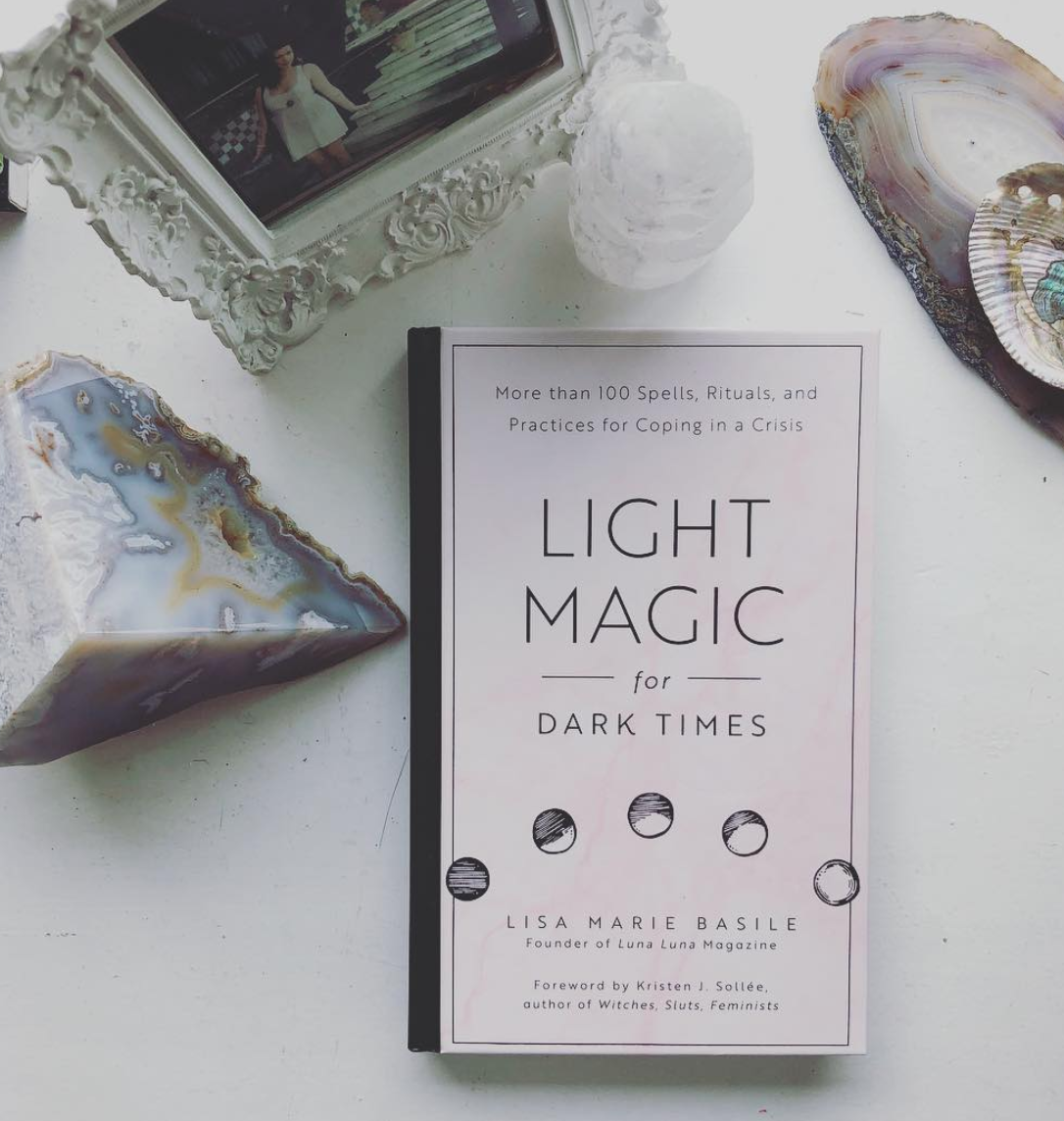
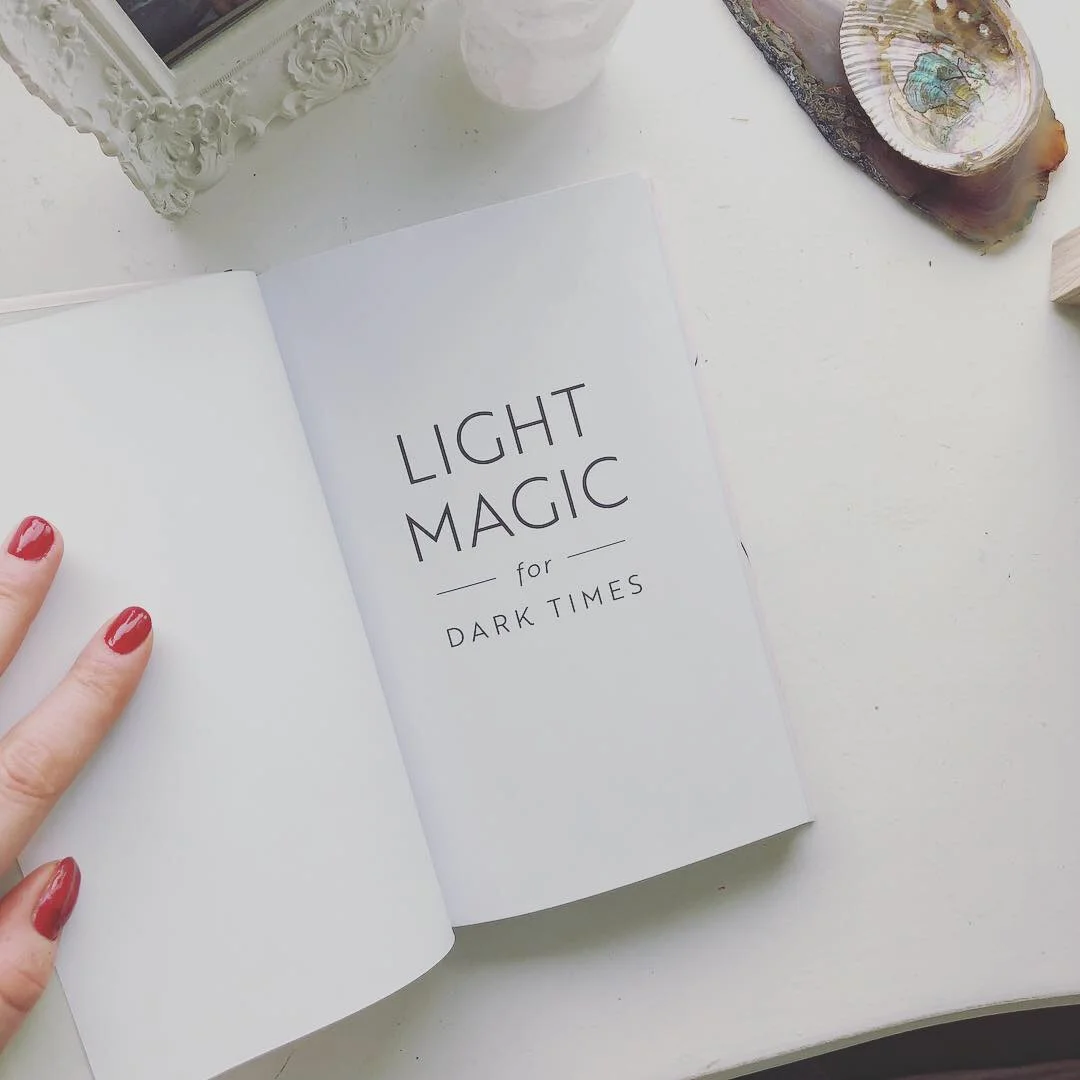
light magic for dark times

A Grimoire For Self-Love: A Peek At Light Magic for Dark Times

January 28, 2019

BY LISA MARIE BASILE

Welcome to a sneak peak of my grimoire of self-development and ritualized living!

Though the archetype of the witch is part of what inspired LIGHT MAGIC FOR DARK TIMES, it’s also a book of what inspired me about people I love and care for, like my mother, who has had to grow and regrow several times over; like the people I know who have used their voice for personal and community change in the face of systemic oppression. It’s a book of love and care, of rebellion, of reclamation, and growth. That energy is magic.

I wrote LMDT after an editor actually spied a ritual of mine here at Luna Luna and asked me to expand on it— and so it is, in many ways, the unofficial Luna Luna grimoire.

Here are all the places you can pick up the book. And here’s a look at what’s inside:

View this post on Instagram

I’ve been using this word board to remind myself of things each day — to stay shadowy, to stay magical, to breath, to listen. Also having a little a fun with it with #lightmagicfordarktimes🔮 . What do you want to remember each day, today, right now?

A post shared by Light Magic For Dark Times (@lightmagic_darktimes) on Jan 24, 2019 at 2:15pm PST

IMG_7951.JPG

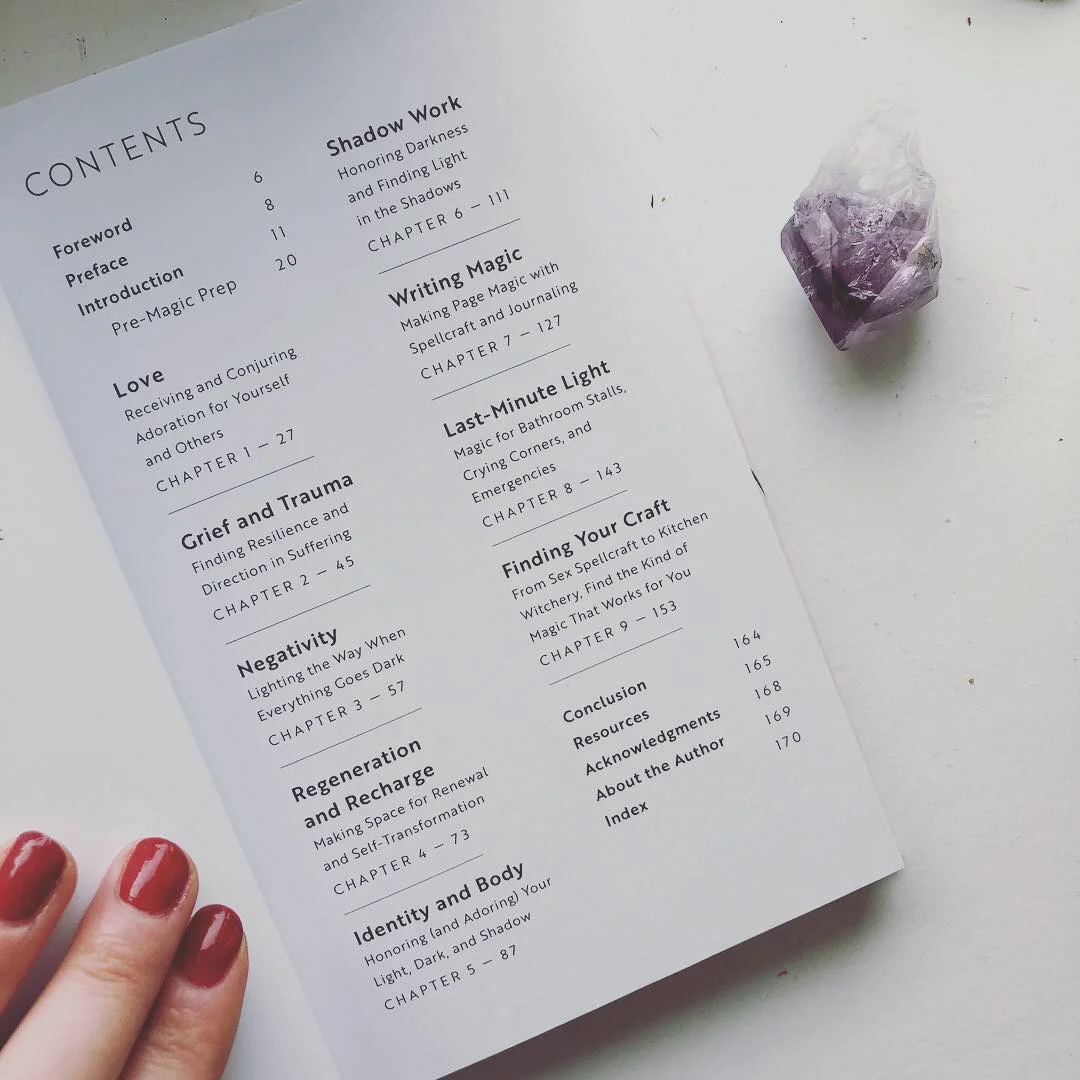
Light Magic for Dark Times is all about ritualizing your life and finding your inner magic — by embracing the light and the shadow together.

IMG_7952.JPG

It was written as a guide through the self.

IMG_7949.JPG

The chapters cover everything from journaling and sigil creation to finding your own personal magic and integrating daily ritual.

IMG_7950.JPG

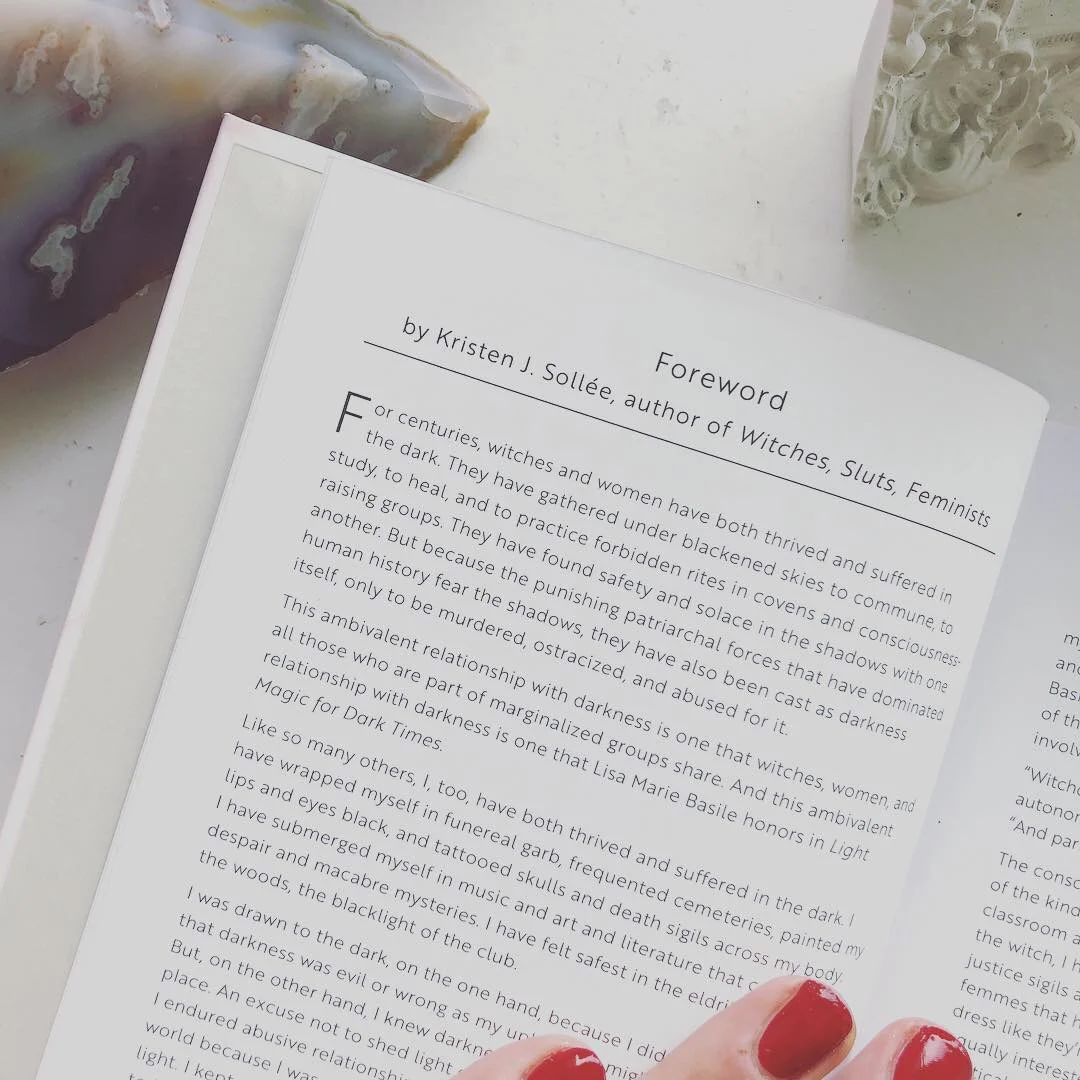
The foreword was written by the inimitable Kristen J. Sollée. You should read her book, Witches, Sluts, Feminists: Conjuring The Sex Positive.

IMG_7953.JPG

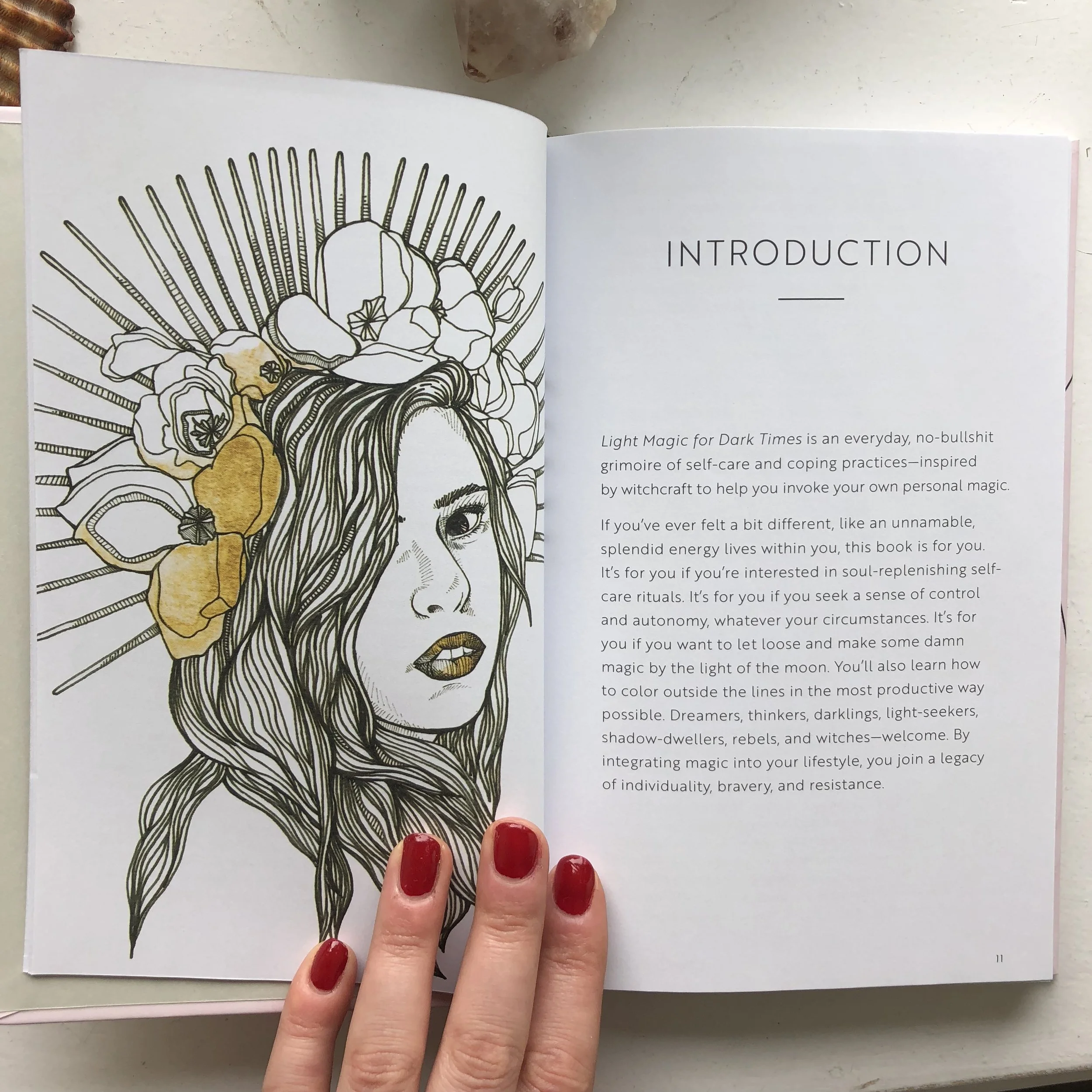
Because I’m a poet, you’ll see a lot of literary references woven throughout the book.

IMAGE.JPG

Light Magic for Dark Times is for the rebels, dreamers, shadow-dwellers, thinkers, darklings, & light-seekers amongst us.

IMAGE.JPG

You can find more inside peeks below

View this post on Instagram

A peek inside #LightMagicforDarkTimes — from journaling prompts & sigil work to shadow exploration and self-love rituals, my book is designed for anyone who wants to ritualize their life, lean into the archetype of the witch, and celebrate the many layers of self — both dark and light.

A post shared by Light Magic For Dark Times (@lightmagic_darktimes) on Jan 28, 2019 at 11:53am PST

View this post on Instagram

I have always felt a connection with darkness, the space between here and now, the shadow. For so long I have felt not only a home in the dark—but too comfortable, almost naturally made of it. I do not think this is a bad thing. I understand its liminality & language, just as I think others do when they encounter a hardship or loss or trauma at a young age. This changes our hearts, our wirings, and even our physiological responses. . Shadow work is about reframing those changes and making that liminality work for you—the pain is not always a negative. I believe it is an opportunity to transform, or cycle through transformations, as I learned early from a mentor. It might take a while, or feel bumpy, but it can happen. . For example, when I was much younger in my teens and in foster care, I always held the blaring sense that I was different, invisible, not enough. I heard the others gossiping about me and I longed to vanish, to be validated in my heartache, and I pined for the traditional family unit with all the trappings that come with it. For many years I lived with shame and silence and anger, not realizing in those very differences was my entire world. . Shadow work is the work we do to look into those feelings and internalized ideas to disassemble or rearrange them to bloom better things for ourselves. My shadow work was always through writing and self-listening and even though I’m not nearly perfect, I have been able to make peace with my past and turn that shame into pride. I hope that those of you reading the book or those of you that are looking to pick up the book find some healing and opportunity in it. When reading it, you are the guide and you are in charge of the results. 🖤🌗

A post shared by Light Magic For Dark Times (@lightmagic_darktimes) on Sep 29, 2018 at 11:42am PDT

View this post on Instagram

🍃Spending time in nature—also called ‘earthing’—has been well-documented to have a positive effect on our mood and physiological health. Connecting with water or flora or the soil helps us come back to simplicity, our natural selves, & the quiet, pulsing energy of our creativity and joy. 🍃

A post shared by Light Magic For Dark Times (@lightmagic_darktimes) on Sep 12, 2018 at 9:46am PDT

View this post on Instagram

This photo is courtesy of @divine.goddess.vibes—thank you! It is so special when someone connects with the book. Though the archetype of the witch is part of what inspired LIGHT MAGIC FOR DARK TIMES, it’s also a book of what inspired me about people I love and care for, like my mother, who has had to grow and regrow several times over; like the people I know who have used their voice for personal and community change in the face of systemic oppression. It’s a book of love and care, of rebellion, of reclamation, and growth. That energy, that goal, is magic. I don’t have all the answers, nor does this book, or anyone, really— but it is a guide to finding your own for yourself. 🖤

A post shared by Light Magic For Dark Times (@lightmagic_darktimes) on Dec 10, 2018 at 12:24pm PST


Lisa Marie Basile is the founding creative director of Luna Luna Magazine and the most recently the author of "Light Magic for Dark Times” and "Nympholepsy." Her work encounters the intersection of ritual, wellness, chronic illness, overcoming trauma, and creativity, and she has written for The New York Times, Narratively, Sabat Magazine, Healthline, The Establishment, Refinery 29, Bust, Hello Giggles, and more. Her work can be seen in Best Small Fictions, Best American Experimental Writing, and several other anthologies. Lisa Marie earned a Masters degree in Writing from The New School and studied literature and psychology as an undergraduate at Pace University.

In Poetry & Prose, Wellness, Social Issues, Pop Culture, Beauty Tags Light Magic for Dark Times, lisa marie basile
Comment
depression workbook

This Friendly Depression Workbook Provides Support & Actionable Steps

October 11, 2018

BY LISA MARIE BASILE

As World Mental Health Day trends across social media, I’ve felt both sorrowful and appreciative. On one hand, it’s hard to see just how many people suffer with various forms of mental illness. On the other, I know intimately how damaging it can be to shame and silence those who suffer, and I’m glad we’re changing that. That suffering can be passed down, internalized, neglected. It rots away at us, our families, our communities, and our cultures.

It seems we will always battle with mental illness, whether it’s chemical or triggered by one’s experiences, or both—but there are options. From medication to mindfulness, from simply speaking as a way to release the albatross, to learning to work with your own triggers and cycles (I think of it as intuiting when the sea is coming to flood shore), everyone will explore different approaches, unique to their needs.

And if we are always fighting against the illness, the least we can do is create an judgment-free and compassionate environment for one another.

I recently received The 10-Step Depression Relief Workbook: A Cognitive Behavioral Therapy Approach, written by Simon Rego, Psy. D. and Sarah Fader, my friend and also the creator of Stigma Fighters. The book creates that environment.

I was so glad to have received it as well, as I’ve always lived with a lingering anxiety and depression. My mental health challenges are deeply tied to life changes and times of powerlessness, rooted in my past: As a kid, both of my parents suffered with addiction, and we lived in homeless shelters and then we went into foster care. I’ve come to recognize what may set my depression and anxiety off (moving home or job, being thrown for a loop, not feeling cared for or supported), and living with these issues is like walking on a tight rope. I’ve come to force myself to understand that it’s all a balancing act, and that that’s just the truth. That said, I’m grateful to have been able to manage my symptoms.

When I received this book, I was in the middle of a move. Perfect, right? I hadn’t fallen into the depths, but I was feeling it. That undercurrent, its surging, its quiet little hum. And so, I turned to the workbook, which I appreciated very much because of its kindness and its approach.

First off, the book starts off with an intro that makes it clear that depression is a real illness—not just a bit of melancholy that sometimes makes us feel blue. It also notes the very real risks of depression—including the physical. Because chronic depression can lead to heart attacks, diabetes and stroke—all of which have been verified by science.

Next, it discusses the barriers to treatment that many people and countries face—limited access to therapy, medical treatments, or a lack of trained healthcare providers. (Just take a look at this study around the prevalence of Brazilians living without depression treatment). For this reason, the workbook uses a cognitive behavioral therapy step-by-step approach, which can help find a workaround to some of those barriers. It specifically mentions that it may be best suited for those with mild depression or people who are hesitant about medical treatment.

Written in a friendly and clear voice, it helps the reader first get honest with themselves: What is depression, what are the symptoms? What are your symptoms? It also offers some glimpses of Sarah's own experiences—and asks the reader to share theirs. This feels very much like a loving conversation rooted in both gentleness and serious action.

It then moves to discussing the therapeutic process—and CBT, which offers action items for managing depression. CBT, defined, means, "Cognitive-behavioral therapy (CBT) is a form of psychotherapy that treats problems and boosts happiness by modifying dysfunctional emotions, behaviors, and thoughts. Unlike traditional Freudianpsychoanalysis, which probes childhood wounds to get at the root causes of conflict, CBT focuses on solutions, encouraging patients to challenge distorted cognitions and change destructive patterns of behavior."

The book goes on to discuss other therapies as well, just so you know the differences—which I appreciated. Following chapters include recognizing and workshopping problem areas (like replacing negative thoughts, and enhancing objective thoughts), making a plan for yourself, learning to not procrastinate when it comes to tasks and self-care, and learning to develop lifestyle skills and finding gratitude.

What I like most about the book is that it very much sounds like a kind and objective friend who wants you to help yourself and be happy, in whatever small step feels right for you. Its focus on both the short-term (immediate behaviors) and the long-term (learning mindfulness and maintaining wellness, even when not depressed), is important. The fact that is acts as both a triage and a holistic coach is so key, I think. This helps the reader get some relief while thinking about the bigger picture.

I recommend this book to anyone who wants to peer inward, discover healthful and pragmatic tools to manage depression and create a step-by-step approach to taking action.

I also recommend checking out CEO Sarah Fader's Stigma Fighters, which is a mental health non-profit organization (founded in 2014) dedicated to helping real people living with mental illness.

As the site says, "There are teachers, doctors, lawyers, psychologists, actors, writers all living with mental illness. These are the stories that need to be told; the people who seem to be “regular” or “normal” people but are actually hiding a big secret. They are living with an invisible illness. They are struggling to function like the rest of society. It is Stigma Fighters’ mission to raise awareness for people who are seemingly “normal” but actually fighting hard to survive. If you are living with mental illness and you want to share your story, please fill in the form HERE. We look forward to fighting the stigma of mental illness one story at a time."

i hope that whatever your path, and whatever pain you're feeling, you take the time to care for yourself. You deserve it.

SUICIDE HOTLINE
1-800-273-8255

Click here if you have difficult hearing and need help.


Lisa Marie Basile is the founding creative director of Luna Luna Magazine--a digital diary of literature, magical living and idea. She is the author of "Light Magic for Dark Times," a modern grimoire of inspired rituals and daily practices. She's also the author of a few poetry collections, including the forthcoming "Nympholepsy." Her work encounters the intersection of ritual and wellness, chronic illness, magic, overcoming trauma, and creativity, and she has written for The New York Times, Narratively, Grimoire Magazine, Sabat Magazine, The Establishment, Refinery 29, Bust, Hello Giggles, and more. Lisa Marie earned a Masters degree in Writing from The New School and studied literature and psychology as an undergraduate at Pace University

Sarah Fader is the CEO and Founder of Eliezer Tristan Publishing Company, where she is dedicated to sharing the words of authors who endure and survive trauma and mental illness. She is also the CEO and Founder of Stigma Fighters, a non-profit organization that encourages individuals with mental illness to share their personal stories. She has been featured in The New York Times, The Washington Post, The Atlantic, Quartz, Psychology Today, The Huffington Post, HuffPost Live, and Good Day New York.

Dr. Simon Rego, a licensed clinical psychologist with close to 20 years of experience in Cognitive Behavior Therapy (CBT) and other evidence-based psychological treatments, is currently Chief Psychologist, Director of Psychology Training, and Director of the CBT Training Program at Montefiore Medical Center and an Associate Professor of Psychiatry and Behavioral Sciences at Albert Einstein College of Medicine in New York

In Wellness, Social Issues, Lifestyle Tags depression, mental illness, mental health, The 10-Step Depression Relief Workbook, stigma fighters, sarah faders
Comment
=

=

At The Intersection of Chronic Illness & Ritual

July 11, 2018

BY LISA MARIE BASILE

Long before I knew I had a chronic, degenerative illness (Ankylosing Spondylitis, a disease that fuses your vertebrae and joints together), I lived with fatigue and widespread pain and chronic eye inflammation (which, of course, led to reduced vision on top of cataracts from steroid treatment).  

It took a decade (with on and off insurance) to convince doctors that I wasn't inventing an illness, that my eyes weren't red from "contact irritation," that my pain wasn't from getting older, that my tiredness wasn't from binge-drinking or staying out late dancing. (To be fair, I did all of those things, but the heaviness in my bones was its own strange animal, an animal that I lugged along with me while all of my friends bounced back after a night out). 

Many people with chronic illness (especially with autoimmune diseases) have ventured down the same winding path--medical neglect or disbelief, lack of resources, lack of knowledge in the medical community, lack of diagnoses, and a lack of support. 

If you are the only person you know with an autoimmune disease or a chronic illness (or, really, any type of lasting body trauma), you know how isolating and fear-inducing it can be. Do you really know your body if your body is betraying you? Do you have a handle on your own future? Are you somehow no longer the same? Can you get the help you need? 

My body was two people. A young girl, and a bag of blood, going on a bender, following no directions, attacking herself. I was lost to my selves.

When I finally convinced doctors to test me (for HLA-B27 antigen, plus an MRI to detect fusion), the diagnosis was an existential blow. I suspected the disease, of course--as my father has it--but knowing that I'd never, ever be cured felt like a sentence to me. For a year, I wallowed. I felt self-pity, I felt out of control, and I was on the edge of constant sadness. I felt lame. I felt silly. Here I was in my early thirties being told I might be fused together later on, my body a prison, my body no longer mine, but a shackle keeping some version of me tucked down deep inside. 

I had always turned to ritual throughout life, especially when times got rough. Ritual is there for these times. It establishes a sense of order, it makes space specifically for the self, and it encourages focus, intention, and growth. 

I used ritual to help me escape those constant thoughts of worry, anxiety, self-doubt, exhaustion, and fear. I used ritual to establish routine and self-care and self-empowerment. Through lighting candles each week night as a way to make rest time to decorating an altar in honor of myself and my body, I became an advocate for myself. There were many: bathing in lavender to intentionally create a sense of fluidity, journaling nightly through pain (using that painful energy to focus and transmit change and manifestation). If it all sounds woo-woo, consider this: anything you do for yourself is a ritual already. Anything you put your mind to is more likely to happen. Any time you carve out for yourself is sacred. It's an act of warfare against chaos and self-loss. It's a reclamation, a creation, a magical hour. 

Ritual helped me back to myself: I felt stronger, more determined to make time for myself, more connected to the simple things that made life fulfilling and beautiful (rest, a walk in nature, time to write, creativity). The disease no longer controlled me; instead, it was a part of me, as a sad friend in need of love and time and cooperation. I was a vessel for opportunity, not despair. 

A year after my diagnosis, I also went on to write a book, Light Magic for Dark Times--which is a collection of rituals and practices for hard times. I even included a portion on body and identity, and chronic illness. 

I will be leading a workshop on chronic illness and ritual at MNDFL Meditation in NYC on July 21. I hope you will come, as it will be an open, safe space. We will discuss chronic illness, meditate, and map strategies for self-care and self-empowerment. All are welcome!

You can RSVP here. 


About the event

Welcome to Strong Women Project's first women's wellness workshop! 

We're connecting with MNDFL in the West Village to provide free workshops to focus on our wellness. Our first workshop is led by Lisa Marie Basile. Darley Stewart, SWP Founder and Curator, will also speak about chronic illness in the context of recent findings. We'll also do some light meditation and stretching to kick off the workshop.

Lisa Marie Basile will discuss what it means to establish ritual as a way of encountering one's chronic illness or other body-mind related traumas. Ritual might mean bookending one's day with someone positive and encouraging but it can also mean going deep and dark and peering into the abyss of self to confront the pain/shame/etc of chronic illness. You can expect to feel like you are part of a loving community and to come away with a set of tools that can help you when you feel overwhelmed or lost, or are just looking to transmorph your experience into art or inspiration. It's a balance of light and dark. Lisa Marie Basile is the author of
 "Light Magic for Dark Times," a modern guide of rituals and daily practices for inspired living. 

We also have a meet-up page! 

RSVP
In Wellness Tags self-care, chronic illness, ritual, magic, ankylosing spondylitis, autoimmune disease, Chronic Illness
Comment
← Newer Posts
Featured
‘in the glitter-open black' — poetry by Fox Henry Frazier
'poet as tarantula,  poem as waste' — poetry by  Ewen Glass
'poet as tarantula, poem as waste' — poetry by Ewen Glass
'Hours rot away in regalia' — poetry by Stephanie Chang
'down down down the hall of mirrors' — poetry by Ronnie K. Stephens
'Grew appendages, clawed towards light' — poetry by Lucie Brooks
'do not be afraid' — poetry by Maia Decker
'The darkened bedroom' — poetry by Jessica Purdy
'I am the body that I am under' — poetry by Jennifer MacBain-Stephens
instagram

COPYRIGHT LUNA LUNA MAGAZINE 2025