• Home
  • indulge
  • new poetry
    • About Luna Luna
    • resources
    • search
  • editor
  • dark hour
  • submit
Menu

luna luna magazine

  • Home
  • indulge
  • new poetry
  • About
    • About Luna Luna
    • resources
    • search
  • editor
  • dark hour
  • submit
delicious new poetry
'the doors of the night open' — poetry by Juan Armando Rojas (translated by Paula J. Lambert)
Nov 29, 2025
'the doors of the night open' — poetry by Juan Armando Rojas (translated by Paula J. Lambert)
Nov 29, 2025
Nov 29, 2025
'we can be forlorn women' — poetry by Stevie Belchak
Nov 29, 2025
'we can be forlorn women' — poetry by Stevie Belchak
Nov 29, 2025
Nov 29, 2025
'I do whatever the light tells me to' — poetry by Catherine Bai
Nov 29, 2025
'I do whatever the light tells me to' — poetry by Catherine Bai
Nov 29, 2025
Nov 29, 2025
‘to kill bodice and give sacrament’ — poetry By Kale Hensley
Nov 29, 2025
‘to kill bodice and give sacrament’ — poetry By Kale Hensley
Nov 29, 2025
Nov 29, 2025
'Venetian draped in goatskin' — poetry by Natalie Mariko
Nov 29, 2025
'Venetian draped in goatskin' — poetry by Natalie Mariko
Nov 29, 2025
Nov 29, 2025
'the long sorrow of the color red' — centos by Patrice Boyer Claeys
Nov 28, 2025
'the long sorrow of the color red' — centos by Patrice Boyer Claeys
Nov 28, 2025
Nov 28, 2025
'Flowers are the offspring of longing' — poetry by Ellen Kombiyil
Nov 28, 2025
'Flowers are the offspring of longing' — poetry by Ellen Kombiyil
Nov 28, 2025
Nov 28, 2025
'punish or repent' — poetry by Chris McCreary
Nov 28, 2025
'punish or repent' — poetry by Chris McCreary
Nov 28, 2025
Nov 28, 2025
'long, dangerous grasses' — poetry by Jessica Purdy
Nov 28, 2025
'long, dangerous grasses' — poetry by Jessica Purdy
Nov 28, 2025
Nov 28, 2025
'gifting nighttime honey' — poetry by Nathan Hassall
Nov 28, 2025
'gifting nighttime honey' — poetry by Nathan Hassall
Nov 28, 2025
Nov 28, 2025
'A theory of pauses' — poetry by Jeanne Morel and Anthony Warnke
Nov 28, 2025
'A theory of pauses' — poetry by Jeanne Morel and Anthony Warnke
Nov 28, 2025
Nov 28, 2025
'into the voluminous abyss' — poetry by D.J. Huppatz
Nov 28, 2025
'into the voluminous abyss' — poetry by D.J. Huppatz
Nov 28, 2025
Nov 28, 2025
'an animal within an animal' — a poem by Carolee Bennett
Nov 28, 2025
'an animal within an animal' — a poem by Carolee Bennett
Nov 28, 2025
Nov 28, 2025
‘in the glitter-open black' — poetry by Fox Henry Frazier
Oct 31, 2025
‘in the glitter-open black' — poetry by Fox Henry Frazier
Oct 31, 2025
Oct 31, 2025
'poet as tarantula,  poem as waste' — poetry by  Ewen Glass
Oct 31, 2025
'poet as tarantula, poem as waste' — poetry by Ewen Glass
Oct 31, 2025
Oct 31, 2025
'my god wearing a body' — poetry by Tom Nutting
Oct 31, 2025
'my god wearing a body' — poetry by Tom Nutting
Oct 31, 2025
Oct 31, 2025
'Hours rot away in regalia' — poetry by Stephanie Chang
Oct 31, 2025
'Hours rot away in regalia' — poetry by Stephanie Chang
Oct 31, 2025
Oct 31, 2025
'down down down the hall of mirrors' — poetry by Ronnie K. Stephens
Oct 31, 2025
'down down down the hall of mirrors' — poetry by Ronnie K. Stephens
Oct 31, 2025
Oct 31, 2025
'Grew appendages, clawed towards light' — poetry by Lucie Brooks
Oct 31, 2025
'Grew appendages, clawed towards light' — poetry by Lucie Brooks
Oct 31, 2025
Oct 31, 2025
'do not be afraid' — poetry by Maia Decker
Oct 31, 2025
'do not be afraid' — poetry by Maia Decker
Oct 31, 2025
Oct 31, 2025
'The darkened bedroom' — poetry by Jessica Purdy
Oct 31, 2025
'The darkened bedroom' — poetry by Jessica Purdy
Oct 31, 2025
Oct 31, 2025
'I am the body that I am under' — poetry by Jennifer MacBain-Stephens
Oct 31, 2025
'I am the body that I am under' — poetry by Jennifer MacBain-Stephens
Oct 31, 2025
Oct 31, 2025
goddess energy.jpg
Oct 26, 2025
'Hotter than gluttony' — poetry by Anne-Adele Wight
Oct 26, 2025
Oct 26, 2025
'As though from Babel' — poetry by Fox Henry Frazier
Oct 26, 2025
'As though from Babel' — poetry by Fox Henry Frazier
Oct 26, 2025
Oct 26, 2025
'See my wants' — poetry by Aaliyah Anderson
Oct 26, 2025
'See my wants' — poetry by Aaliyah Anderson
Oct 26, 2025
Oct 26, 2025
'black viper dangling a golden fruit' — poetry by Nova Glyn
Oct 26, 2025
'black viper dangling a golden fruit' — poetry by Nova Glyn
Oct 26, 2025
Oct 26, 2025
'It would be unfair to touch you' — poetry by grace (ge) gilbert
Oct 26, 2025
'It would be unfair to touch you' — poetry by grace (ge) gilbert
Oct 26, 2025
Oct 26, 2025
'Praying in retrograde' — poetry by Courtney Leigh
Oct 26, 2025
'Praying in retrograde' — poetry by Courtney Leigh
Oct 26, 2025
Oct 26, 2025
'To not want is death' — poetry by Letitia Trent
Oct 26, 2025
'To not want is death' — poetry by Letitia Trent
Oct 26, 2025
Oct 26, 2025
'Our wildness the eternal now' — poetry by Hannah Levy
Oct 26, 2025
'Our wildness the eternal now' — poetry by Hannah Levy
Oct 26, 2025
Oct 26, 2025

Checking my Dead Mother’s Horoscope by Alicia Turner

November 15, 2022

BY ALICIA TURNER


“the dead / borrow so little from / the past / as if they were alive.”

A Little White Shadow — Mary Ruefle


Shadow Work (on Checking my Dead Mother’s Horoscope)


It’s a Tuesday morning.
I am scrolling through an online obituary guestbook to relive my mother’s life.

She’s immortalized on the top of the page — the photo a scanned copy of a Polaroid from a throwaway camera that I once begged her to develop.

She’s wearing a solid white t-shirt — one that she changed out of just moments after the photo was taken, in fear of spilling something on it.

I always remember the minor moments, but not the mess. And I hate that about myself.

My mother went missing and was declared dead on the same day: Tuesday, October 17th, 2006.

Her body wasn’t found until weeks later, in the passenger seat of my uncle’s beaten-down, blue truck, nestled in muddy water and the river’s rage —

which is to say that she gave herself back to the earth and is the reason the earth has something to grieve.

Then, at fourteen, I colored it painfully ironic – that blue was her favorite color, and she never stopped moving, and she loved to swim. I was sure when the truck accelerated that she saw the sky in the rear view. Tested time, balled up her fists, and fought fate. Told fate to “Go fuck itself,” like she’d tell anyone who held her down, who told her to be still.

My mother was a twisting, turning thing. My mother was reckless in still water.


***


I’ve always said with certainty that October 17th was “blue.” On that day, the rain was relentless. I didn’t bring an umbrella to school because no one predicted it —

not even the weekly forecast in the back of the countertop magazines (* that my mother would refuse to get rid of solely for the horoscope sections). She was a real-life laugh track and a heavy heart (a proclaimed Leo rising), who loved to have her life be read back to her.

But not me, no — all Virgo. I’ve always been too afraid of flying off the page, to show up for life, to slow down. I’ve always been too careful to go puddle jumping for the fear of tracking messes – but my mother encouraged it. She liked predicted chaos, as simple and complex as it was.


***

This is the part where I transition into telling you that I tracked her body for weeks. And I tell you that the water was too elevated to find her. That October 17th was blue because it bruised me like a punch to the gut. Like a gut feeling. And you want to tell me that “it’s not [my] fault,” but I am not a blameless God. I am no God at all.

But on that day the moon was in Virgo.

And the moon controls the tides.

And rivers eventually end up flowing into oceans.

I make-believe that the sky helped me intuit the words she needed to her — and trust that I had the best view of her life.

While irrational, I wish I would’ve called it sooner. Not waited for her to call.

Not pretended to believe in underwater voyages where I spent whole days holding my breath.

Because now I think of her every time I find a phone book.

I think of her every time it’s bright out and twice when it rains.

I always check the weather before I leave the house, because I like predictions. Predictability.

And I always check my horoscope.


***

Today, it tries to teach me the difference between surface and depth:

“There’s a grand water configuration mysteriously guiding your hand.

Have you heard the water is still rising?”

From somewhere behind the shadow work, my mother’s starry-eyed news reads:

“Dear, Leo: Be cautious. Water is the only element that can extinguish your flame. But do not fear — your life is loud, all blazing. You are an incessantly-lit cigarette – no ashes. The river’s mouth is always hungry for more — but so are you.

You will never be caught dead in a white t-shirt, to be a stain on your own life.”


Alicia Turner holds an MA in English and is a grant writer & storyteller. She can be found writing confessional, conversational poetry in an over-priced apartment somewhere in WV. Her work is featured or forthcoming in Four Lines (4lines), CTD's ‘Pen-2-Paper’ project, Voicemail Poems, FreezeRay Poetry, Defunkt Magazine, Sybil Journal, The Daily Drunk, ExPat Press, Rejection Letters Press, Screen Door Review, J Journal Literary Magazine, Sledgehammer Lit, Screenshot Lit, Taint Taint Taint Magazine, Cartridge Lit., Space City Underground, époque press, among others.
In Poetry & Prose, Personal Essay, Magic Tags Alicia Turner
Comment

After Life by Aimée Keeble

November 15, 2022

By Aimée Keeble


After Life


When I die, I'm reunited with my parents for thousands of years. I look exactly like I did at twelve and my mom looks thirty-five which makes her happy. My dad is kind of a blur between thirty-seven and eighty. The cocker spaniel is back and so is the cat that ate my hamster. But he's outside because he was always outside. We have a great time, all four of us. There are always half-fizzy two liters of 7Up in the fridge and I wonder if there is any significance to this. We play board games a lot, especially Splat which I think disappeared from retail sometime in the early 90s. It feels good to be in memory. Mary Poppins comes on the TV a lot during the Holidays, and we normally make time to sit down together and watch it. Outside the windows, the sky is gold and moving.

Supercalifragilisticexpialidocious, my dad says to me.

Can you spell it?

S, I start.

No, he says.

S, I say again.

Wrong! He cries out.

I say S a few more times and he's looking at me with his forever eyes, smiling like he's always known he's smarter than me. And I'm so glad about that.

Can you spell it? He asks again.

I look at my mother but she's holding the cocker spaniel like a baby and Dick Van Dyke is talking to penguins. Animals can be distracting.

Can you spell it?

I give up, I tell my dad. I want to fall asleep on the sofa before the movie ends.

I,T! He yells. He's delighted.

I get it, I say. That's so stupid.

The movie ends but I'm awake, trying to backtrack my mind into getting to the answer.

Move on, my dad says.

I can't, my brain won't let me, I answer.

It's dark now and I stand in the doorway calling the cat's name. He doesn't come and so I go further into the yard and say his name a few more times. I turn back and close the front door and stand in the hallway, enjoying the safe night feeling. In life, the cat was the first to go. My dad would have been proud of him.

Aimée Keeble has her Master of Letters in Creative Writing from the University of Glasgow and is represented by Ayla Zuraw-Friedland at the Frances Goldin Agency. Aimée lives in North Carolina and is working on her second novel.

In Personal Essay, Poetry & Prose, Magic Tags Aimée Keeble, ghosts, afterlife, autumn
Comment

A Visit to El Cementerio Viejo by Isa Guzman

November 15, 2022

BY ISA GUZMAN

A Visit to El Cementerio Viejo
for Titi Paula


Before the trip, I drew the Ten of Swords.

It was the first time going back to La Isla for close to ten years. The first time I would be there as a woman. The last time I was on the island, I was saying my goodbyes to Titi. It has been years, but it was too difficult to imagine the island without her. It wasn't possible to acknowledge it. In my mind, I could still envision her living her life at her house in Ceiba Sur. Feeding the stray chickens, or dogs, or people with whatever she had left in her small kitchen. There was no other truth.

As expected, the trip started out rough. We had to go from San Juan, in the northern part of the island, to Juana Diaz, a town well on the southern coast. We were expecting a long drive, but because of some complications, we only left the capital as the sun was going down. We would drive into the night.

I had gone to the island with my chosen family, and we all had our plans to reconnect with the aspects of island life that always eluded us. Puerto Rico is a place we so desperately want to call home. Distance and time estrange us. I think it is easier for the rest to say this is home, but not me.

Watching the island from the passenger window, I couldn't help but feel each sword pierce me. Who could ignore the failing infrastructure? Unlit and incomplete highways? The empty buildings? The for-sale signs on dozens of houses? That unrelenting thought that I was just a visitor, or worse, an intruder, with no business being here? Even the mountains appeared to turn their faces away from me.

I carried these swords over the next few days and nights. It was difficult to appreciate the views, the sounds, and the calm. There was an impending collapse inside my chest and mind. I spent Sunday night wasted on the balcony of our rental, overlooking a mountainside covered in trees. In the worst of it, a hallucination overwhelmed me with images of figures walking back and forth through the trees. An army of ghosts who refused to approach the house, but would stand in the middle of the road and stare up at me.

Then my turn came. We agreed to a day to take a few hours to drive to Juncos, and make that all important visit. I wanted to visit my family house, but first I had to pay respects to my Titi and the rest of my familia at the Cementerio Viejo.

The day was rain. At least, all I can recall is the rain that poured as we approached the town. My heart jumped at the first houses we saw. The basketball court. The cemetery itself. Little had changed. In fact, the area was doing well compared to many other towns on the island. As soon as we stopped, I got out of the car and began walking straight to my destination with only the graveyard attendant called after me to take his umbrella.

As always, I wandered around the painted white stones. Every time my parents and I would visit the island, we always set time to pay our respects. Every visit was a strange incident. Often, we got lost. My thoughts were racing with memories of under-cooked chicken, lullabies, mosquito nets, quenepa trees by her driveway, the stray dogs she took in, and her coffee I never got to taste. I was lost. Lost, lost. Right until I noticed the unmarked grave, apparently occupied by a witch, situated right next to my family's tomb.

The rain hadn't let up. A trembling took over my limbs. It overwhelmed me with the quiet and finality of the moment. The first time presenting myself as the woman I am. The tears came easily, but I hadn't expected how clear my voice would be. I began speaking in fluent Spanish. Something I had never done. My Spanish is beyond rota. I began talking to my great aunt, my grandmother, and everyone else interred in that tomb. Spoke with them about my struggles with my gender and all the horrible experiences I’ve gone through and hidden. Spoke with them about all my hopes and dreams. Spoke with them in earnest about the hopelessness that defined these two years of both the pandemic and my transition.

It wasn't a confession. I was searching for acknowledgment. A sign that I could be accepted and loved. So many regrets had tangled themselves inside my body. My self-imposed silence being the most prominent. As the words kept flowing out, the silence of the area finally eased me. I felt as if I was being listened to. I was being listened to. At my last words, a plea to protégeme y cuídame, the rain let up. Some sun broke through the clouds. It was the cue to leave in peace. A moment of tremendous love. Not only for the possibility of the acceptance from my family, but a tremendous self love that brought me to this moment. To speak myself without fear.

Isa Guzman is a poet and recent Brooklyn College MFA graduate from Los Sures, Brooklyn. Dedicating her work to the hardship, traumas, and political struggle within the Boricua Diaspora, especially the LGBTQ+ (Boriquir) communities within it. Isa helps lead several projects including: The Titere Poets Collective, The Pan Con Titeres Podcast, La Esquina Open Mic, and La Cocina Workshop! She have published her work through several magazines, including The Acentos Review, The Bridge, Public Seminar, and also appears in several anthologies, such as The Other Side of Violet, Birds Fall Silent in the Mechanical Sea, and The Breakbeat Poets Vol. 4: LatiNext. You can follow her through their social media: @Isa_Writes.

In Poetry & Prose, Personal Essay, Magic Tags Isa Guzman
Comment

The Dark Lull by Melissa Pleckham

November 13, 2022

By Melissa Pleckham

The Dark Lull


Nothing’s ever completely dead.

In the 1971 film Let’s Scare Jessica to Death — a film so slow, so subtle that one hesitates to call it a horror film, let alone a vampire film, although that’s exactly what it is — this line is uttered by the pale, red-haired woman whom the titular Jessica is surprised to find squatting in the farmhouse she’s recently acquired with her husband and friend. The trio have just crossed the fog-veiled Connecticut countryside in a black hearse with the word “LOVE” scrawled in crimson on its door; Jessica, fragile as fine china after a mental health episode only vaguely alluded to, demands the hearse stop at a weed-choked cemetery for grave rubbings. She hangs the headstone-sized tissue paper trophies around her bed, runs her fingers across them delicately. This, we are shown, is a woman for whom death is a part of life in a very tangible way.

So when the red-haired woman suggests a seance one night after dinner, and responds to Jessica’s friend’s skepticism with this line that calls into question the very existence of death itself, or at least death as any sort of permanent or all-encompassing state, Jessica seems to smile in agreement, readily playing the part of medium when beseeched. There are no Victorian parlor theatrics in this film, but the scene — and the line — have stayed with me just the same. It’s a film that I like to revisit as the heat and chaos of late summer begin to melt imperceptibly into the dark lull of autumn. But this year, the line resonated with me more than ever. I kept it in my mind, I ran my fingers over it like Jessica with her grave rubbings.

Is it true that death is a myth? A fairy tale? Does anything, anyone, ever die completely?

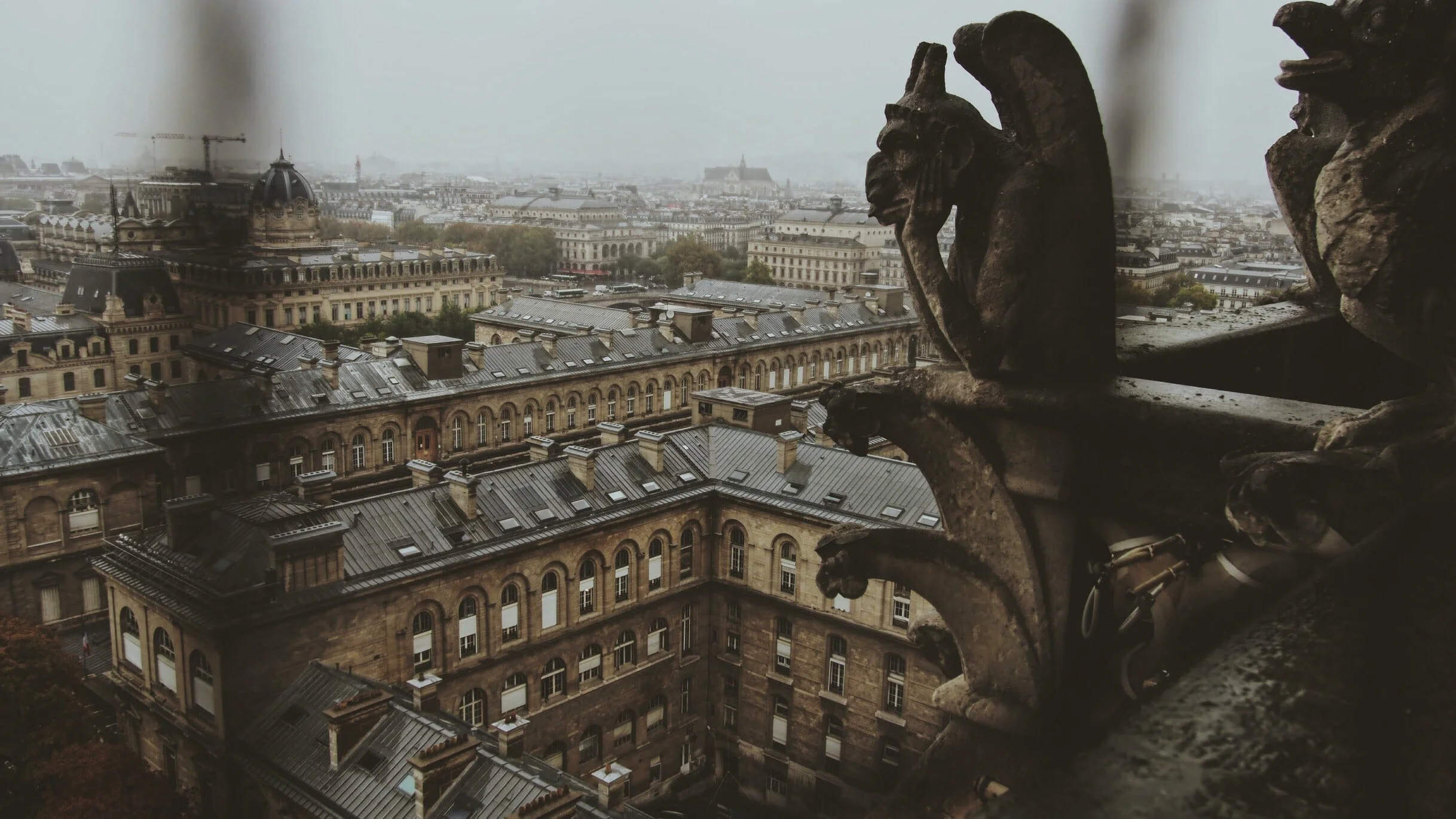
The last October before the world stopped, I spent Halloween in the labyrinth of bones beneath the city of Paris. It was my first visit to the city, and my first Halloween spent out of the country. My husband and I wanted to do something special, unforgettable.

We walked to the catacombs from our hotel in the 6th arrondissement. It had been raining but that morning was cool and cloudy, the air sweet and sharp. The day before we’d visited Père Lachaise, the trees lining the stone paths of the cemetery crowned with gold and orange. Jim Morrison’s grave was surrounded by a fence, the ground nearby strewn with gifts, offerings. On the way out we passed a mausoleum with its door partially ajar; in the dark, we could see cigarette butts, an empty liquor bottle, and, stretched stark white against the stark white marble, a large bone that looked like a femur. Shocked, we looked away. “Someone’s been partying here,” I said. “Some French kids.” 

But who can say who threw that party? Who can say who was invited, who attended? Nothing’s ever completely dead.

At the catacombs that Halloween morning, we could be certain more bones awaited us in that dank darkness beneath the city of light, down that endlessly spiraling staircase, through that electric torch-lit tunnel, on the other side of the archway that demarcates the start of that self-proclaimed Empire of Death. The catacombs sprawl like veins beneath the skin of the city, a second Paris that is far less lively but no less full of lives, or at least the earthly remains of those who once lived them.

I had never been in an ossuary before, and once I adjusted to the darkness, to the feeling of being so far underground, what struck me most was how peaceful it was. How quiet. How the skulls stacked almost to the ceiling felt both very relatable, very human — alas, poor Yorick! — but also so far removed from the one on my own shoulders, atop my own spine, that held the organ that made all of my hopes and dreams and loves and fears and observances and sensory perceptions possible. Every skull in those catacombs had once held a brain like a precious jewel, every bone signified a human soul that had walked the streets above us, the streets where we were so charmed and beguiled by the romance and mystery of Paris.

Are the catacombs scary? Of course not, although I wouldn’t want to be trapped down there alone. So I suppose I might concede that the tunnels, the darkness, have the capacity to frighten. But the bones? Those are beautiful.

Are the catacombs scary? Of course not. Nothing’s ever completely dead.

Autumn’s lull would take on a different meaning for me the following year, and the one after that: The pandemic forced a different kind of pause, a different kind of reflection, a different kind of encounter with death than I’d ever experienced before. I remembered our Halloween in the catacombs often that October, sometimes with sadness as I wondered if I would ever have the opportunity to travel internationally again, but always with gratitude for the experience we’d shared.

This year, at the tail end of a summer that so far refuses to end, refuses to concede its loss to the looming autumn, my heart again wanders back to those cool dark halls coiled beneath Paris. I walk there in my mind like a meditation, relishing the mystery, wondering at my own mortality. No matter how strong we may feel, fall is a time of year where the crunch of a leaf, the singe of burning pumpkin, the thrill or sadness of a sunset that comes sooner than we were expecting, reminds us that to live is to know that our hearts are limned with lines like a cracked teacup, that the veil between worlds is tissue-thin, spread soft against stone, could tear at any time.

And it reminds us: Do not fear. 

Do not fear. Nothing is ever completely dead.


Melissa Pleckham
is a Los Angeles-based writer, actor, and musician. Her work has been featured in numerous publications, including Flame Tree Fiction, Luna Luna, Hello Horror, Under the Bed Magazine, and FunDead Publications’ Entombed in Verse poetry collection. She is a member of the Horror Writers Association. Her short screenplay "Moon-Sick" was awarded Best Werewolf Short Script at the 2020 Hollywood Horrorfest and was a Finalist at the 2021 Shriekfest Horror Film Festival. She also plays bass and sings for the garage-goth duo Black Lullabies. You can find her online at melissapleckham.com and on social media at @mpleckham.

In Personal Essay, Place, Poetry & Prose, Magic Tags Melissa Pleckham
Comment

I Have The Cat (A Ghost Story) by Nikki Reimer

November 3, 2022

By Nikki Reimer


I Have The Cat

Moving day brought an explosion of ladybugs. They were all over our belongings stacked on the front lawn, crawling on the desk, four and six and eight on each box. For any other insect I’d have called it an infestation, but the word didn’t match this saccharine state of things. Bright red spotted walking gumdrops blanketing the objects in the yard. Like in one of my childhood colouring books or the opening scene to a Disney film; an infestation of twee. 

 It’s a bright early October day. The air is crisp. The light slants through the air like through glass and I’m trying to feel my body in the world but reality warps and bends away from my touch. My brother has been dead one year, seven months and 14 days. My husband and I are moving house for the third time since the day Chris didn’t wake up. My arrhythmia acts up from the stress. Heartbeat fluttering up into my chest. Mothwings.

 The first move was in June 2012, four months after he died. My husband packed up our apartment into a U-Haul. Two cats in two carriers went next. Little ginger tabby Amy buckled into the back seat, her big sister Bella on my lap. For thirteen months we lived in my parents’ basement. Four traumatized adults and three cats trying to negotiate a grief both shared and alone. My brother’s grey Adidas runners neatly stowed behind the door where he left them the night he died. 

 I had thought we might find a way to process together, but my parents drank in front of the tv every night, and no one wanted to talk. Eventually I gave up and joined their boozy stupor. 

The second move was in July 2013. I had found us a house, a post WWII saltbox with a rent so low it should have given me pause. The shingles were in rough shape, and there was an electric wall heating unit instead of a furnace. This is what’s known as ‘foreshadowing’.

 After my brother, my cat Bella was my best friend. I adopted her soon after I moved out of my parents’ house, and we grew up together. She was a beautiful medium-haired tortoiseshell with green eyes and a throaty voice. We bonded like only two misfits who grow up together can. At night I held her tight to my body like a teddy bear. She was 16 and she’d survived the move from the coast, and the year with my parents, but a month after we moved into the saltbox she got sick and we had to let her go. Summer turned to fall and the saltbox turned out to be improperly heated. We broke the lease and found another rental. Moved for the third time in October.  

***

Boxes line the long hallway, shadowed and eerie. There’s no ceiling light in the oversized living room and we don’t seem to have enough lamps, so half the house is shrouded in darkness. 

 I’m navigating the maze poorly. Hit my shin, say fuck. I don’t know where anything is, and the long painting boxes are giving me ominous vibes. I’ve never been a fan of horror movies but I know the tropes, and it occurs to me why so many horror movies open with the move to a new house. It’s the embodiment of liminal space. Airless and destabilized. A deconstructed house lets the ghosts roam freely.

 Amy’s a sweet baby girl but it’s too quiet without Bella. I've moved away again from the spaces that held my dead and it’s breaking something inside me that can’t be put back together. One night I fall apart completely, wail and scream on the couch, demand my poor husband tell me where Bella has gone. 

“Where do cats go? Where did she go?”

“I don’t know, baby,” he says softly.  

I can’t be consoled. I won’t be consoled. I want to be dead myself. 

*** 

The Facebook message from my friend Matt the following week was surprising. We were super tight in junior high and high school. I used to call him my big brother. But he’d moved out east and we’d lost contact. It happens.

I need to talk to you. Can we talk on the phone?

He's only recently learned about Chris, and he’s so sorry. Sorry that my baby brother is dead, and sorry that we’ve fallen so far out of touch that it took him so long to hear about it. 

I don’t mind. I understand. It’s comforting to hear from him. I only feel close to ok when I’m with people who knew Chris too.

Matt explains that his wife is into what my psychic friend Jen would lovingly call 'woo.' For their anniversary they’d gone to a medium together. 

They were trying to make contact with Matt’s wife’s dead grandmother, when someone pushed her aside. The medium described the interloper’s appearance. It’s my brother.

He said, I bet you’re surprised to see me.

The medium tells them that Chris is there because he’s worried about his sister and her mental health.

Through the medium he says, Don’t worry about me, I’m ok.

 It seems both implausible, and entirely plausible. My brother was sweet and cynical, sarcastic and joyful and loving. His empathy was boundless. If you were hurting he’d do anything he could to let you know you were loved. Pushing an old lady out of the way to make sure I knew he was alright was in character for him, though he'd be apologizing profusely to her afterwards. I want to believe this visitation could be real.

Then, said Chris, through the medium, through Matt, I have the cat.

 And Matt said, “Does that mean anything to you?”

Nikki Reimer (she/they) is a multimedia artist and writer, and chronically ill neurodivergent prairie settler currently living in Calgary / Mohkinstsis. She has been involved with art and writing communities, primarily in Calgary and Vancouver, for over 20 years. They are the author of three books of poetry and multiple essays on grief. GRIEFWAVE, a multimedia, web-based, extended elegy, was published in February 2022. Visit reimerwrites.com.

In Personal Essay, Magic Tags Nikki Reimer, ghost stories
Comment

The Hanged One Season, by Meg Wall Jones

October 6, 2022

BY MEG JONES WALL

The Hanged One Season


I don’t understand sleep: how it works, where people go, how anyone learned to travel in this manner. The closing of eyes, the quieting of mind and body, the ability to sink into that strange unknown world of mystery and memory, weaving souvenirs from our consciousness into tangled webs of sense and nonsense — it’s a skill I lack, a capacity for release that I have never been able to master. 

Photo by Meg Wall Jones

Sleep is a forced pause, a time of stillness and surrender. It’s a liminal space that still manages to feel commonplace for most; a regular part of daily cycles that provides comfort, recovery, clarity. Every night is an opportunity to slip into darkness, to find a gentle temporary death, to embrace liminality and adventure to far-off, unknown spaces within the self.

But most nights, I lie awake, alone, listening to sirens and alarms, the stirrings of the city outside my window, the side effects of so many people living in such a relatively small space. Most nights, I watch the stars come and go, the moon rise and fall, wait patiently for the sun to break the horizon and usher in a new morning. Most nights, I fail to find that strange, mysterious place, unable to reach the beckoning grasp of slumber and make my way into those shadowed lands.

Sleep doesn’t make sense to me. There’s no map to reference, no hand to hold, no path to follow. It’s just me and my insomnia against the eternal night, the twinkling stars and city lights, watching one another, uncertain of what to do next. Sometimes days go by before I find rest, before my body is so exhausted that it drags me under, before I stumble into that unfamiliar place and hope that eventually I’ll be able to claw my way out again.

Photo by Meg Wall Jones

In autumn, when the veil is thin, when the shadows have lengthened, when the nights slowly gobble up the hours and greedily swell with excess, sleeplessness becomes seasonal. The heaviness and humidity of the air slipping into crisp coolness, leaves slowly rotting into spectacular decay, shadows thickening and loosening. It feels correct to bear witness to the longer nights, to consciously wander through thoughts and ideas rather than getting swept up into memory. The world feels restless and I can explore my own mysteries, can make my own liminal space, can serve as a guide for those who haven’t been to this particular crossroads before. We all hover at the veil together, contemplating how and when we will pass through. 

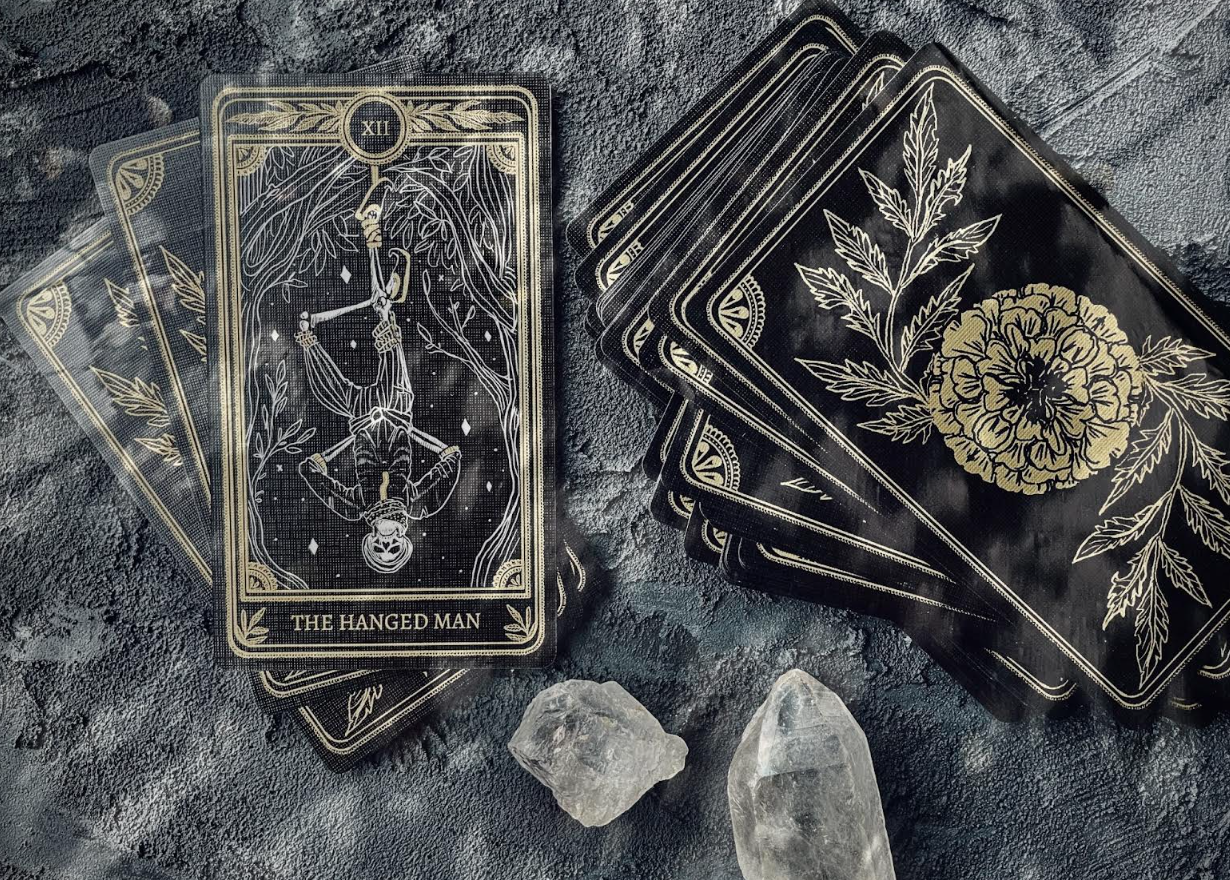
It’s Hanged One season, autumn: a time of sacrifice and release, an opportunity to let something wither in the most beautiful way so that new growth can eventually emerge. The Hanged One is a necessary, inevitable clearing; the pause before winter’s Death, the moment when expansion ceases, when we observe what happens when our movement halts and our effort stills. It’s the deep breath before hibernation, the slackening of muscles, the willingness to take brittle air into our lungs and let it simultaneously soothe us and wake us up. What have we been doing, building, becoming? What have we been working towards, and where does this pause land in our own personal cycle? Who did we used to be? Where are we being called to let go of a dream, a pursuit, a version of self? And what happens if we don’t give that thing up easily, if we refuse to surrender?

Autumn is for harvest, for celebration – but it’s also for slowing down, releasing, honoring. Winter may be the full stop, the recovery, but autumn hints at the bend in the road, gives us daily reminders to contemplate the slow rot and decay that surrounds us. All that blooms eventually returns to the earth, dust to dust, year after year. Whether we cling desperately to summer or welcome winter with open arms, we have no control over the cycle, the seasons, the change. Either way, we become the Hanged One, powerless and patient, silent, observing: waiting for whatever comes next, even if we already know what is ending.

Photo by Meg Wall Jones

It’s strange but beautiful, not unlike all of those orderly, sleepy little deaths. Autumn isn’t bothered by our feelings or desires, our fears or uncertainties, and neither is sleep. It simply comes when it’s time, holds us in our waiting, lets us feel whatever we need to feel. Autumn lets us stand quietly, in awe of its power and grace, whether we’re ready to slow down or not.

Sleep, seasons, stillness, all feel out of my grasp these days. This strangeness that I feel every night when I crawl into bed, lying still, hoping that slumber won’t notice me creeping around the edges and trying to slip in silently, stealing a few hours of temporary death: it’s uncomfortable, difficult to define or describe. My mind and body, fighting a battle I don’t understand, unwilling to accept the reality of the Hanged One, wishing somehow to overcome exhaustion and live beyond cycles, beyond sleep.

Autumn reminds me that rebirth is always around the corner, that an awakening beyond the physical can happen at any part of the cycle, that giving up control can be a necessary breaking point rather than something to fear. 

Every morning, and every night, is a new chance to surrender. And perhaps this year, autumn’s shadows will help clear out my own.


In Poetry & Prose, Personal Essay, Magic Tags magic, tarot
Comment

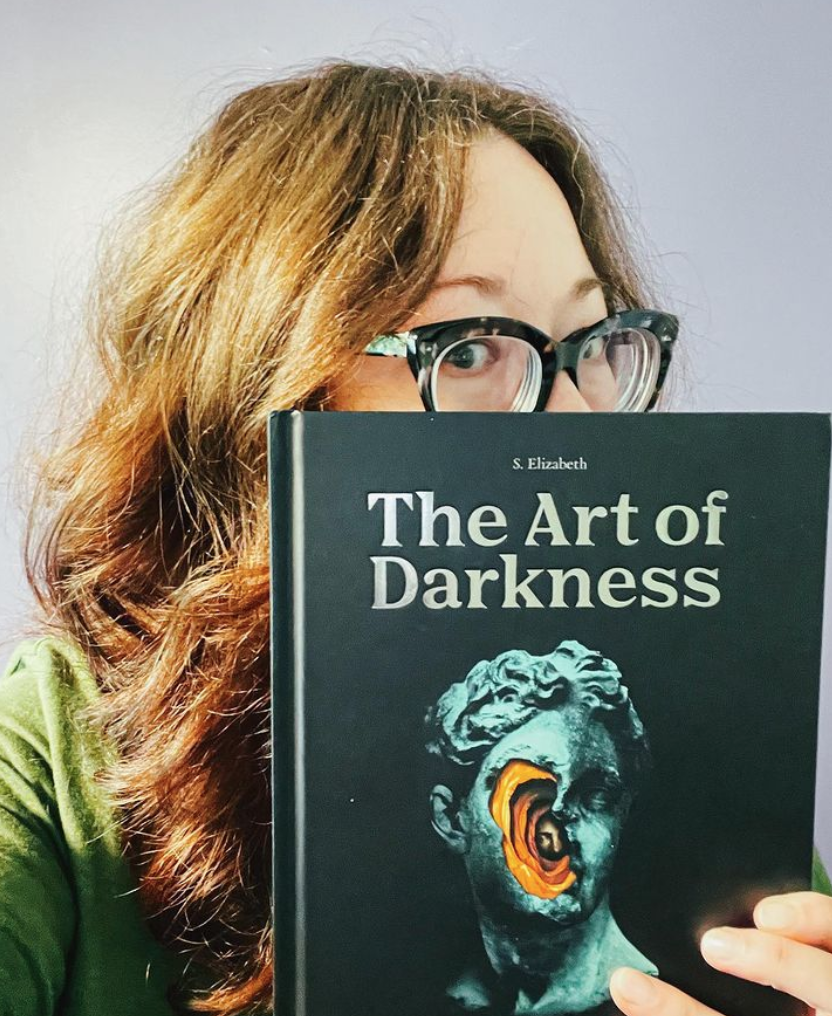
S. Elizabeth on The Art of Darkness, Publishing, and Taurean Delights

August 12, 2022

An interview with S. Elizabeth
by Lisa Marie Basile

This interview is part of our new Creator Series, a series of Q&Aa designed to help you get to know people who are writing, making, and doing beautiful things.

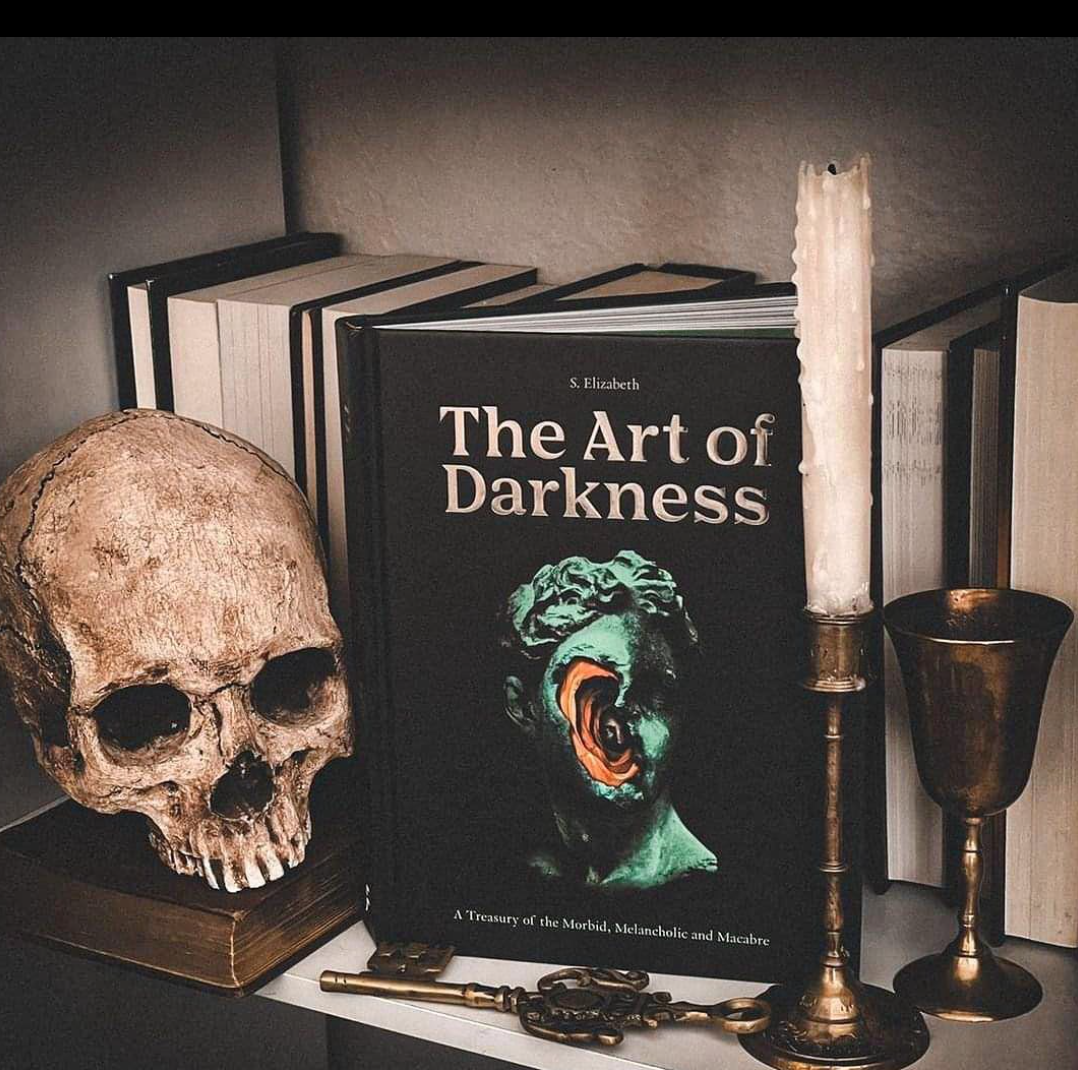
I first discovered S. Elizabeth’s brilliance years ago, when stumbling onto their radiantly macabre, meticulously curated blog, Unquiet Things — a space that I consider a sort of post-graduate education in darkness. The author of two books, The Art of Darkness: A Treasury of the Morbid, Melancholic and Macabre and The Art of the Occult: A Visual Sourcebook for the Modern Mystic, I wanted to ask S. Elizabeth about their influences and inspirations. I hope you’ll enjoy this delightfully detailed, magical, and delicious conversation. I have to say, this is one of my favorite interviews ever done.

Sit by the window, grab a cup of berry-flavored tea or an elderberry spritz and dive in.

Lisa Marie Basile: I’d love to hear more about your book, The Art of Darkness: A Treasury of the Morbid, Melancholic and Macabre. I adored your first book, The Art of the Occult: A Visual Sourcebook for the Modern Mystic (and it’s a cool bonus that we’re press siblings!). What inspired this one? As a self-professed darkling, I want to hear every luscious detail — and I think our Luna Luna readers do, too. I can’t think of a better person to have created this compendium for us.

So the short answer is that The Art of Darkness: A Treasury of the Morbid, Melancholic and Macabre is a beautiful book densely packed with visual arts of the haunting, harrowing, and horrifying variety, and which asks the question "what comfort can be found in facing these demons?" It is inspired by a lifetime's worth of obsession with the dark and what can be found seething in the shadows when we stop being too frightened to peek. Or when we embrace these fears and anxieties, and we peer into the void, anyway!

When I was a child, I loved things all fairy and "flowerdy" (my 5 year old term for heaps of blossoms and blooms). think I was a cottage core early adopter, hee hee! I was terrified of ugly, scary, angry, wild things: Lou Ferrigno as the Incredible Hulk; the feral alien otherworldly vibe of my cousin's freaky KISS posters, and honestly, as silly as it sounds, George Hamilton as some vampire guy in a film called Love at First Bite scared the shit out of me! And I think that was meant to be a comedy! And Scooby Doo? Man, that gave me nightmares.

But somewhere along the way, that panic and fright regarding the bloodsuckers and monsters from outer space began to give way to fascination, and whereas I would once hide my face behind a pillow when something scary was happening, I now began to feel the itchy urge to peek. As I grew older, the fascination with fearsome things slowly turned into an obsession, and, much like a nerdy vampire creep myself, I began to gobble up and devour every bit of frightening or creepy media that came my way.

From literature and film, to music and art, from that time forward, I was hungry for all things unearthly and strange, ghastly and ghostly, gruesome and grotesque. I also grew up in a household with a mother who was an astrologer, who had tarot cards tucked into every nook and cranny, and mysterious artworks hung on every wall. All of her relationships, whether friends or romantic entanglements, were with bohemian weirdos and heavily tinged with magic and mysticism.

My former stepfather for a long time ran a small rare occult book business; I worked with him for a spell many years ago, and it was an incredible experience. Just me and these beautiful old books full of magic and witchcraft and demonology all day long! For a bookworm introvert with a penchant for the esoteric and obscure, that was as close to paradise that I will ever get! These interests and inclinations festered and blossomed and grew alongside me, inside me, over the years and are now what inform and inspire my writing, most of which can be found at my blog Unquiet Things, where I ramble about art, music, fashion, perfume, anxiety, and grief–particularly as these subjects intersect with horror, the supernatural, and death.

There's A LOT of art there. Art is another longtime fascination of mine. These two obsessions—art and darkness—became so deeply entwined for me over time that to celebrate them in a book seemed like the most obvious thing in the world.

“I’ve always felt like such an invisible nothing...and I know that I give away of myself more than I will ever get back in return...it’s the sharing of these little pieces of myself in all of these different places that somehow, paradoxically, builds me back up.”
— S. Elizabeth

Lisa Marie Basile: With such a brilliant mind, your trail of inspiration must run deep. Can you tell us what sets you ablaze?

It's funny—this is a question I love to ask artists and creatives when I am the one doing the interviewing, but it turns out that it's not easy to put into words! Or rather, while I can definitely list some inspirations, I'm hesitant to say as to whether or not they are even apparent in my own writing. Dracula by Bram Stoker and Daphne du Maurier's Rebecca were two books that I read when I was 11 years old or so, and I was thrilled to read the intense gloominess and atmosphere of excessive dread and mystery that each of these stories conjured for me.

By that age, I had also read and re-read Louise Fitzhugh's Harriet the Spy a dozen times and while I knew even then that Harriet was a pretty flawed character, I loved her and wanted to BE her with her notebook and nosiness and creeping into people's houses just to see what sort of boring things that they get up to. In college, I discovered Sei Shōnagon. This Heian-era mean girl and OG blogger sorta felt like an adult, more polished Harriet who moved up in the world. I have long loved the writings of this Japanese author, poet, and a court lady : her elegant lists, her acerbic observations, her beautifully intimate and wonderfully catty diaries–all of her anecdotes and opinions and inner dialogue, from the excruciating minutiae of everyday life, to the exquisite poetry she composed connecting and expanding these trifling, fragmented instances to the broader aspects of lived human experience; these strangely random and tangential stories have informed and inspired my own writings for many, many years now.

Also, I’d probably be remiss in leaving out that frustrating old H.P. Lovecraft. His stories are dense with florid description and also packed with racism and xenophobia but he is a part of my past self and I can’t pretend I never read his writings or that his concepts of madness-inducing cosmic horrors haven’t inspired some of my favorite contemporary authors–writers who have taken these ideas and improved upon them immeasurably.

Also, I won’t lie. When I am writing a review for a particularly odious perfume, I may employ the use of a internet Lovecraftian adjective generator for my purposes. Cinematically, I love the works of Jean Rollin and Dario Argento–the former, visual poetry of sensual horror, uncanny beauty and perverse, morbid delights, (read: swoony lesbian vampires) and the latter a creator of gorgeously lurid giallo films. All of these movies are equally absurd and nonsensical, but dang are they pretty. If it’s got exquisite humans wearing breathtaking fashion and swanning about castles or stately manors or even glittering discos or murky alleyways–I am all-in.

Conversely, I do love the gentle, heartwarming charm of a beautifully animated Studio Ghibli film. I love both King Diamond and Weird Al. Lana del Rey and Anna von Hausswolff. Golden age illustrations of elegantly levitating fairies in a lush vibrant summer garden and the gothic charcoal rendering of melancholy moth singed by a candle’s flame. My own writing is probably some strange patchwork of all of these things, the sentimental, the spooky, the silly.

Sometimes I can even channel a less-talented, dopier Mary Oliver:

7am garden poem
Burying elderberry seeds
in the fog of last night’s rain,
mosquito bit, caterpillar cursed,
a spider looked at me sideways—
I know my business, bugs!
Tend to your own!

Lisa Marie Basile: How does the muse inhabit you? Give us a peek at your creative process — the good and the challenging.

For a very long time my process involved being too terrified and paralyzed with the thought of failure to begin a project, making myself miserable for a number of days/weeks/months dreading doing anything about it while not doing anything about it, and then zipping it all together at the last minute because the only thing worse than failing is not coming through with a thing you had promised to do.

The ONLY thing that lit a fire under me and made me write the thing was that I didn’t want someone upset with me for not having written it. Nowadays I’ve come to the conclusion that I hate the feeling of that dread—it takes up so much space and energy and it sucks all of the life out of everything else you’re doing in the meantime!—more than I fear the failure.

I do whatever it takes to get myself in front of my computer and work on the thing every single day, even if it’s just a few minutes. It always turns out to be longer than that, but the trick is, I was able to get myself there because I promised myself “you only have to do the bare minimum today.”

Somehow, that makes it not so scary for me, and as cheesy as it sounds, those snippets add up over time and by the time your deadline rears its head you’re like “oh, I only need to make a few tweaks, everything I need is all already here!”

Another trick (yes, I have to trick myself a lot) is something I read in an interview with one of the big deal writers for The Simpsons. He said something along the lines of just sit down and get it all out on paper or the computer monitor or whatever, no matter how bad it is, just write it and come back to it again later. The next day, it’s already there. Like a crappy little elf wrote it for you overnight. It’s turned the process of doing something that feels impossible (beginning a thing from nothing) into something that feels more bearable (re-writing/editing a thing that’s already there.)

Something else I’ve learned is that if I am stuck, just walk away. Banging my head against the wall and agonizing about it never helps? But you know what does? For me, anyway? Going on a walk. There is something deeply meditative about placing one foot in front of the other and carrying yourself forward. You don’t have to think about anything else about making it to the next mailbox or the next block or around the neighborhood or whatever.

The funny thing is…that’s when all of the thoughts sneak in! I’ve read a few articles on how walking engages some sort of cognitive function in your brain that just isn’t activated from sitting at our desks. Our sensory systems work at their best when they’re moving about the world. So for me, taking a walk helps. I end up planing my day, I compose poems and emails and silly tweets for Twitter. I daydream and let my imagination run away with me.

Sometimes, in the mindlessness of steps walked becoming miles traveled, the inner paths my ruminations take will lead me to interesting places with new ideas or present solutions to problems I was subconsciously working out. I come up with my best interview questions, my favorite article titles, and my most intriguing lines of inquiry during these strolls. For other people that might mean stepping away from their project to work on a puzzle or do some gardening or make a quiche or whatever. Do anything for an hour or so that is NOT the writing that is stressing you out.

Lisa Marie Basile: Do you have any creative rituals? Do tell.

I always have to have my hair tied back. I have some weird sensory issues and if I get overstimulated from a stray hair tickling my nose, I get to the point where I want to sweep everything off my desk in a fit of melodrama and lay on the floor and sob.

Perfume is a must! If I’m trying to get serious about a piece I am writing, I will wear something with a bit of gravitas, like Serge Lutens Gris Clair, a sort of somber, sedate lavender. Or, for example, right now I am writing a book about fantasy art and I am wearing Celestial Gala from Scent Trunk, all milky gossamer wings stardust’s effervescent chill. I keep close at hand a notebook full of scribblings…words or turns of phrase from the books I’ve been reading, passages that are beautiful or strange or that I want to look into further. This is a precious little book of inspiration that sometimes sparks an idea for a whole new thing or that can maybe just serve to fill in a blank or two.

Lisa Marie Basile: Whenever I read your words, your descriptions (especially in your fragrance series, Midnight Stinks), or even these responses, I think, ‘damn, you are SO Taurean!’ Please indulge me — how does Taurus move through your life?

Taurus sun/Capricorn rising/Libra moon, here. When I was a child, my chief obsessions were flowers, glittering jewelry, pretty dresses, and watching my grandmother cook. Before the age that others begin to make an impression on me; before I learned to read and discovered other interests through the characters inhabiting the worlds of those pages; before I realize my mother is an astrologer who has apparently charted my every move well in advance—before all of those things, I was a kid who liked to be by myself, who was quiet and reserved and slow to warm to others.

I loved to help my grandmother roll pie crusts, and form doughy dumplings to drop into broth from the tip of a spoon; I liked to crawl into my mother's garden and play with the snapdragons and marigolds (although I really hated getting dirty!) and I loved—LOVED—playing "dress up" and planning fancy tea parties.

As an adult, all of those things remain true. Of course, my selective absorption of all of my mother's Linda Goodman books (I really only ever read about my own zodiac sign, ha!) probably solidified much it at an impressionable age. I continue to move through the world in the most Taurean of ways, I think. I love my solitude and I am still quite reticent and aloof when it comes to being in groups of people.

I'm not unfriendly, it's just...I can't handle more than one person at a time! So I'm afraid I retreat into myself on those occasions. And the memes are painfully true—I do have stupidly expensive taste. No matter what it is, I mean I could be walking into Petsmart for cat food or at the hardware store (even though I hate the hardware store!) and somehow zero in on the most expensive cat treats or toilet seat or whatever. It's not a helpful superpower!

I love both luxury and comfort; I have got a cabinet full of probably thousands of dollars worth of perfume, and yet I sleep in a ratty old tee shirt that's got holes in the armpits because it's so beautifully, perfectly worn-in, and cozy. I love to cook and I love to eat, and you can see that in my soft, round body. But you can also see that in the way I enjoy feeding people something delicious, that makes them feel good. I still love flowers and I still hate getting dirty, so while you may see me in my garden, gingerly digging in the dirt to plant something small, or harvest a tomato or two, generally my thumb is not particularly green and you'll never see me camping. I am not "outdoorsy!"

I'm in my head a lot—I am a pro-daydreamer, but it's not especially high-brow or cerebral up in there. I don't have scholarly, academic, or philosophical leanings. Although certainly lots of pre-writing work and fleeting bits of poetry and wordplay swirl around in there. Still, I have to coax all of that out onto a computer screen or a notepad and get it all tangibly in front of me to make sense of it.

I don't know if that's particularly Taurean, but I imagine my Capricorn rising gives me a weird ambitious/competitive streak that is probably a good and necessary contrast in order to motivate me to do anything with any nonsense that does make it out of my brain.

TLDR; because in typical, plodding, make-a-long-story-longer Taurean fashion, I am taking a long time to get to the point: I love food and beauty and luxury and comfort; I'm reserved and in my head a lot and I didn't mention it above but yes I can absolutely hold a grudge forever but if I love you, I am probably going to love you forever, too.

Oh. And I am absolutely OBSESSED with Scorpios. While I don’t mean to generalize, I can say that in my experience, there are two types of Scorpios: the one that is Very A Lot, they don’t hold back, you always know what they are thinking and they practically flay themselves open for you. They want you to have all of them, even and especially the ugly and scary bits. They wear their shadow side on their sleeve and their shadows aren’t very subtle, either.

The other kind of Scorpio is not exactly the secretive, silent-type, but their shadows are shrewd and sharp and you might not get to see them right away; you always recognize they are there and you are inexplicably drawn to them like a moth to flame.

I am the furthest thing from a Scorpio, but I am also a secret Scorpio.

“Before the age that others begin to make an impression on me; before I learned to read and discovered other interests through the characters inhabiting the worlds of those pages; before I realize my mother is an astrologer who has apparently charted my every move well in advance—before all of those things, I was a kid who liked to be by myself, who was quiet and reserved and slow to warm to others. ”
— S. Elizabeth

Lisa Marie Basile: I am always curious as to how someone’s background, culture, identity, or belief system shapes their work. Can you share a bit about this?

I think my work is hugely informed by my identity in terms of invisibility. It’s a strange/scary thing to talk about because I don’t want anyone to ever think I am somehow mocking their experience as being a nonbinary person, for example, but I was having a conversation with a friend a few months ago after they had come out as nonbinary. I admitted to them that I have never felt like a woman/girl, like a she/her — but that he/him and they/them feel wrong too. I had previously said this to my sister, who responded with “so…do we call you IT?” She was only half serious, but I almost started weeping.

This is going to sound weird and probably very wrong because who wants to be referred to as “it”? Me. I do. That felt perfect to me after a lifetime of living as me, as one who doesn’t feel like a “someone.” I don’t even feel like a person, much less a man or a woman.

I don’t feel like this thing or that thing, because most of the time I don’t even feel here, as a thing that exists. I think my writing and what I put of myself out into the world is very reflective of these feelings of impalpability and unreality, even though I’ve never any of this out loud, in these words.

Lisa Marie Basile: Who do you look up to? I’m so curious about contemporary writers and artists who inspire you.

Three writers and friends who continuously inspire me are Sonya Vatomsky (@coolniceghost ) whose poetry is swoony and sharp and sly and whose essays and other writings are so, so fucking smart; Maika (@liquidnight ) whose words are always so compassionate and thoughtful and perceptive–even when writing about their own experiences, you, the reader feel so breathtakingly, heartbreaking seen; and Nuri McBride (@deathandscent ) a perfumer, writer, and curator whose work centers on olfactive cultural education, and anything she creates is going to be an astonishingly researched, illuminating, insightful journey. Sonya, Maika, and Nuri have all bolstered, supported, and encouraged me in the most gentle and relentless of ways, and they are each deeply special, wondrous humans.

Lisa Marie Basile: I am curious about your thoughts on publishing, promoting, and merging the professional with your, well essence — of creativity and beauty and exploration. I have truly struggled with it all.

In fact, I feel changed — perhaps not always positively — by the experience of publishing. It has taken time to rebuild my Artist self, to step back from going and doing and making and simply rest or take stock. I think once you (or I) share with the world, something dies a little (#scorpio) and you have to work to resurrect it. What are your thoughts on it all?

I thought I would feel more changed by the process of publishing, to be honest. I thought having a book I had written out in the world, on people's shelves, in their hands, would somehow...I don't know...make me feel less sad about having a complicated relationship with my dead mom? Less traumatized by a past relationship full of abuse and gaslighting and manipulation where my identity and self-esteem were ground into the dirt, into nothing? Less shitty about having a less-than-ideal-looking human body that I've been shamed for ever since I can remember? Less scared of everything, all of it, all the time?

Turns out: nope. Having published a book, having published—two books—by this time next month, just means I am all of those things still, but also with some publications out in the world. I still work the same day job I've had for the past 17 years; I don't love it, but in typical Taurean fashion I like my stability and I don't feel comfortable with the idea of just quitting my job and trying to write full-time.

I don't want to "hustle," I don't want to have to agree to write about things I am not interested in so that I can afford to pay my bills. I am just not into any of that. While I am doing as much promoting of my books as I can, I'm not doing anything that feels disingenuous, that doesn't feel like me: you'll never see me doing book tours or speaking on panels or even live-AMAs or anything like that. I promoted them by interviewing the artists in them. I worked them into perfume reviews or little fashion ensemble collages that I then share on social media, or sharing playlists of music inspired by them. These are all things I enjoy doing, and would do anyway, and it was actually a treat to include my book and writings in them. And along with that, I guess I haven't felt anything inside me die because—except for the writing of the book—I don't think I gave *every* piece of myself to the process.

And that's not me patting myself on the back. It's me being boring and practical. I have a job to fall back on. If this book or that book flops, it's not going to kill me. Maybe my ego. But not financially. I'm not rich, I don't have a lot of money. And the money I have made from these books is negligible (that's another thing people need to know about writing books, I think.

There's just...not a lot of money in it.) I know that's not a very exciting or beautiful answer but I do think it is a genuine, practical, Taurus answer. I did exactly what was required of me for these books, in exactly the way I wanted to do it, and no more. Although...I did at one point say that I was NEVER going to be on a podcast (too scary!) but then over the course of the next six months I was interviewed on four podcasts, so ...so much for that, I guess.

I don't know if I adequately answered that question. I've been burnt out, sure. Since 2019 I have written three books (well, I am working on my third) I continue to blog and write for other platforms when it interests me, I post regularly on social media, I started a Patreon that I try to write for once a week, I started and grew a TikTok account where I share perfume reviews almost every day, I put together a press kit, I am in the midst of developing a newsletter and while all of these things sound like professional tools, to me, it's just a lot of fun.

I love doing stuff like this, it's all a beautiful exploration to me. It's A LOT and I need a break every once in a while but I'd probably be doing all of that even if I never published a book! As crappy as social media makes me feel sometimes, the comparison aspect of it, that is, I LOVE it. I really do.

As shy and squirrely as I am, this is how I share and connect with people. I love all of the like-minded souls and kindred spirits that I have encountered through all of these platforms. I've always felt like such an invisible nothing...and I know that I give away of myself more than I will ever get back in return...it's the sharing of these little pieces of myself in all of these different places that somehow, paradoxically, builds me back up.

S.Elizabeth is a writer, curator, and frill-seeker. Her essays and interviews focusing on esoteric art have appeared in Haute Macabre, Coilhouse, Dirge Magazine, Death & The Maiden, and her occulture blog Unquiet Things, which intersects music, fashion, horror, perfume, and grief. She is the cocreator of The Occult Activity Book Vol. 1 and 2 and the author of The Art of the Occult (2020), The Art of Darkness (2022), and The Art of Fantasy (2023)

Lisa Marie Basile is the founding editor of Luna Luna Magazine. She’s also the author of a few books of poetry and nonfiction, including Light Magic for Dark Times, The Magical Writing Grimoire, Nympholepsy, Andalucia, and more. She’s a health journalist and chronic illness advocate by day. By night, she’s working on an autofictional novella for Clash Books.

Her work has been nominated for several Pushcart Prizes and has appeared in Best Small Fictions, Best American Poetry, and Best American Experimental Writing. Her work can be found in The New York Times, Atlas Review, Spork, Entropy, Narratively, and more. She has an MFA from The New School.


In Interviews, Magic Tags S. Elizabeth, the art of the occult, the art of darkness, macabre, unquiet things, books
Comment
mediterranean nature

Andi Talarico on Magic, Writing, and Italian Inspiration

August 8, 2022

An Interview with Andi Talarico
by Lisa Marie Basile

This interview is part of our new Creator Series, a series of q&as that are designed to help you get to know people who are writing, making, and doing beautiful things.

Andi Talarico (she/her) is a Brooklyn-based writer, poet, and self-proclaimed witchy poo (astrology, tarot, ritual work). She’s the co-founder of Writing The Cosmos (which I have the great fortune of running with her). As an endlessly fascinating human with a great deal of knowledge about all things literary, magical, and mystical, I wanted to chat with her about her creative inspirations and her upcoming workshop Luna Le Vag, a holistic spa in Brooklyn, NY.

In this interview, we discuss her workshop, influencers, inspiration, and how her culture shapes her work.

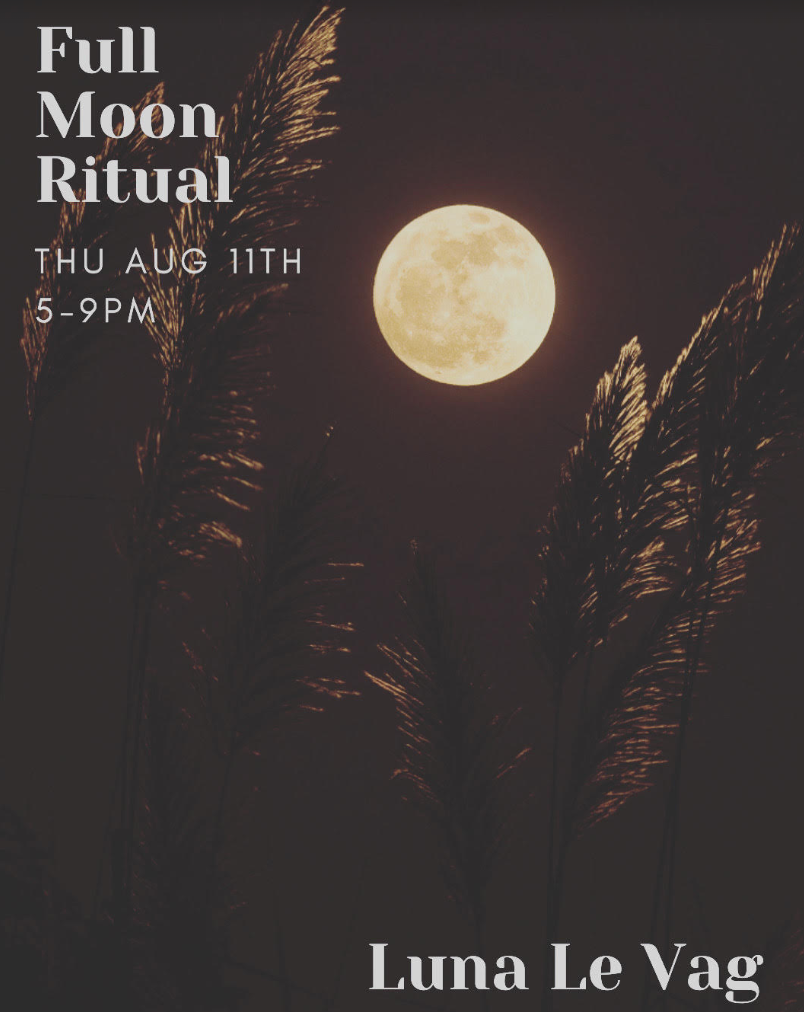
Lisa Marie: Tell us a bit about your recent creative project, the Full Moon Ritual workshop you’re holding in Brooklyn this month.

The idea for this workshop came from my frequenting of this lovely Brooklyn business called Luna Le Vag, a holistic spa in Brooklyn that’s run by two inspiring young women, Jordan and Naomi. Their spa does a lot of work with natural care (and pampering!) for the vagina (hence their name) but there’s more to it than that - I could tell that they cared about community-building, networking with other businesses run by women and people of color, and I started to think about a way that I could possibly contribute. I noticed that Luna Le Vag was already offering classes in workshops in areas of interest to me: healing arts, reiki, energy readings, intentional cannabis use, and more.

Because my hobbies revolve around things like the study of astrology, tarot, and ritual, I thought it could be useful - and hopefully fun! - to offer a workshop based around the Full Moon and ways to harness its energy for use in reflection, self-care, and intentionality. All of these practices are beneficial, but I find it especially important to have conversations around and engage with these rituals as part of building community. The more we practice intentionality, the more we participate in our lives fully and authentically. The idea for the workshop is twofold:

First, we’ll be performing ritual as a group, which is its own healing and community-building modality, but Second, I’ll be sharing ways in which all of these practices can be personalized to benefit each person, so they can take these skills and apply them authentically in their own lives, whether alone or with others.

All of this is done in tandem with the good people of Luna Le Vag who will be there to participate, contribute, host, and share their beautiful space with us, as well as their food and refreshments, as this workshop will run all evening, in order to give us time to relax into things in a more organic way. To sum that all up, I’m running a Full Moon Ritual workshop on Thursday, August 11th, from 5-9pm, at Lune Le Vag at 1096 Broadway in Brooklyn. Attendees are encouraged to bring their own tarot deck but we will have extras on hand. No prior knowledge of tarot, astrology, or spirituality is needed to participate.

Lisa Marie Basile: Who are some of your creative favorites? Who lights you up?

Oh wow, what an enormous (and great) question! As it relates to my ritual-craft, I find a lot of inspiration in the words and writing of people like Patti Smith, Maggie Nelson, Anne Carson, Sappho, Jeanette Winterson, Kim Addonizio, Diane di Prima, Gabriel Garcia Marquez, Toni Morrison, Isabelle Allende - people who suffuse their work with a type of magic and openness, who use language as a way to get to truths both known and not. The reading of tarot is a narrative structure; the joy of Astrology comes from mining its depths for meaning; a guided meditation is a way to marry language and imagination. At the bedrock of all of these things is language, incantation, possibility — my love of writing directly feeds my study of the esoteric and magical, and vice versa.

“The reading of tarot is a narrative structure; the joy of Astrology comes from mining its depths for meaning; a guided meditation is a way to marry language and imagination. At the bedrock of all of these things is language, incantation, possibility — my love of writing directly feeds my study of the esoteric and magical, and vice versa.”
— Andi Talarico

Lisa Marie Basile: I’d love to hear about your writing process, struggles, or any rituals you turn to when creating. How are things going?

It definitely depends. There are days when all I need is to take my laptop to a coffeehouse and immerse myself in the din of the city to feel inspired. Other days, it’s much more introverted: I need every single detail of my home to be in order before I’m able to sit down, light some incense, turn on some beautiful, wordless music, make myself the perfect cup of coffee, and then sidle up to the page. Some days I need to write by hand.

Other days I feel the need to type. I try to listen to my needs and balance them with what I’m trying to get done. I do think I write more now, in these past few years, than I used to, likely because I started practicing better life habits more intentionally and tracking them.

It also became easier when I (mostly) shut off the constant inner critic and understood that Prolific usually beats the hell out of Perfection. If I don’t consider every word precious, I can let them all spill out onto the page and then parse them later. You can’t edit from nothing, but you can always edit from an imperfect something.

Lisa Marie Basile: Tell us a bit about how culture, identity, place, or belief inspires or influences your work?

I believe my heritage deeply informs my work - and by work, I mean writing as well as magic-making as well as the way in which I move through the world. While I’m proudly of mixed ethnicity and heritage, I was raised Catholic with a strong emphasis on our Italian-American side of the family, and though I’ve loooong been lapsed in the practice of the Catholic religion, I do still carry an abiding love for ritual, ambience, the mysteries of the spirit, even prayer as it corresponds to incantation. And incense. That one definitely stuck, haha. There’s a certain type of bloody passion that exists at the heart of Catholicism that still speaks to me and through me.

Though my craft has many influences and forms, the majority of the rituals that I practice come from the folk magic traditions of southern Italy. I’ve always felt more attached to the folk magic that took places in kitchens and gardens and bedrooms than the high magic traditions, especially those which exist within a hierarchy. And frankly, if I wanted some man wearing fancy robes to tell me how to live my life, I would have just stayed in the church. I respect the freedom, feminism, and resourcefulness of folk traditions and that love informs much of how I live and work.

Lisa Marie Basile: Who are some contemporary creators, writers, or peers that you look up to on the regular?

I think we’re in a really interesting time in history as far as witchcraft and ritual are concerned and I find a lot of inspiration from the people sort of heading up that public discourse. The work of Pamela Grossman comes to mind, as does Mary-Grace Fahrun, the astrological writings of Chani Nicholas and Gala Mukomolova. I deeply appreciate the life work and educational offerings from Marybeth Bonfiglio at Radici Siciliani, Herban Cura, and Mallorie Vaudoise.

Andi Talarico (Cancer sun/Pisces moon/Sagittarius rising, she/her) is a Brooklyn-based writer, poet, and general witchy poo (astrology, tarot, ritual work.) She’s taught and coached poetry/performance in classrooms as a rostered artist, as well as tarot and astrology workshops through WORD Bookstore and more. In 2003, Paperkite Press published her chapbook, Spinning with the Tornado, and Swandive Publishing included her in the 2014 anthology, Everyday Escape Poems. She also penned a literary arts column for Electric City magazine, and curated the NYC-branch of the international reading series, At the Inkwell, from 2016-2019. Her work has appeared in The Poetry Project, Luna Luna Magazine, Brokelyn, Yes, Poetry, amongst others.

Lisa Marie Basile is the founding editor of Luna Luna Magazine. She’s also the author of a few books of poetry and nonfiction, including Light Magic for Dark Times, The Magical Writing Grimoire, Nympholepsy, Andalucia, and more. She’s a health journalist and chronic illness advocate by day. By night, she’s working on an autofictional novella for Clash Books.

Her work has been nominated for several Pushcart Prizes and has appeared in Best Small Fictions, Best American Poetry, and Best American Experimental Writing. Her work can be found in The New York Times, Atlas Review, Spork, Entropy, Narratively, and more. She has an MFA from The New School.


In Interviews, Magic, Poetry & Prose Tags Creator series, andi talarico, italian folk magic, Writing, astrology
Comment
Unsplash/Canva

Unsplash/Canva

Join Our Witchy Book Challenge!

September 3, 2021

This autumn, join our witchy Instagram & Twitter book challenge!


WHAT TO DO:

To celebrate autumn, we’re asking you to take a picture of your fave witchy read (any book you love, or that you’ve written) and tag #LLWitchyReads on Instagram and/or Twitter so we can find and see it. Bonus if you share a bit about why you love it and tag the author if possible. Authors love the love.


TAG:

Tag as many pics with #LLWitchyReads as you’d like. Just be sure you drop the hashtag in the caption, not the comment. You can also tag @lunalunamag.


WHAT COUNTS:

Nonfiction, grimoires, magazines, academic works, fiction, poetry - it’s all welcome! And hell, even though we’re focusing on reads, you can tag podcasts too! We’ll share them as well.

You can share books you love, books you’ve written yourself (please do!), and books that are brand new or canonical or basically unknown. Folk magic, trad witchcraft, poems inspired by the archetype of the witch — it all works; this is pretty open!

WHAT IS THIS FOR?

Book love, basically. Community. Crowdsourcing recommendations. We’ll be sharing & reposting these pics of books simply to send them love — *and* we’ll be compiling some of them in an article published in October, which aims to share our community’s fave witchy reads. We’ll be linking to those books on @bookshop_org so you can pick ‘em up.

NOTE: For some reason, tagging hashtags in Instagram comments is not letting us see them, so you’ve got to take a pic and use the hashtag on IG in the caption. You can post to Twitter too!

We’re hoping to see new books, your fave classics, & works by BIPOC & LGBTQIA+ authors, who are underrepresented in the witchy world of books.

Let’s spread some magic. 🤎🍂🙏🏽

In Poetry & Prose, Magic Tags Witchy Books, #LLWitchyReads
Comment
wilhelm-gunkel-ZIQb1OkI7Ss-unsplash.jpg

Spoonie Witch Magic and Wordcraft

March 2, 2021

BY LISA MARIE BASILE

I spend a lot of time thinking about disability and accessibility in our sacred or creative practices, and how our lives are affected by, informed by, or intersected by our bodies and our wellness. A few examples: Do places of worship offer a wheelchair ramp? Can we modify more meditation classes for folks who can’t sit down at all or for long periods (me!)? Do we feel encouraged to create altar spaces that are tiny, portable, and simple...so we can take it to bed during flare-ups? Do poetry conferences or literary reading spaces make accessibility a priority?

View this post on Instagram

A post shared by 🗝 ritual poetica 🗝 (@ritual_poetica)

I believe that we should all feel encouraged and inspired to practice, pray, or tap into sacredness in a way that works for our minds and bodies — and to use our body/pain/individual experiences as a strength or energy source?

These Spoonie Witch ideas, insights, and prompts are intended to get you thinking about your magic and your power — in ways that work for you. They are designed to help you send love to yourself and reclaim your narrative. Whatever that is, and wherever you may be in the process.

PS: I live with ankylosing spondylitis, a degenerative spinal disease that affects pretty much everything, from my heart to my gut. I can’t POSSIBLY speak to everyone’s experience, but this comes from my own.

My next book, City Witchery, is coming out later this year — and deals largely with finding accessible ways to tap into sacredness in a city environment, and inside of an apartment/shared space/small space.

finding empowerment

Where there are perceived or real limitations, there are also opportunities for growth. Pain often gives us empathy. Loneliness can make us creative. Frustration can drive real social change. Using that big, potent energy in your own magical practice can create change and push toward transformation. Isn't that the goal? To change, to grow? To lean into the power? Don’t be afraid to transmute those big feelings — frustration at broken systems, social isolation due to chronic flare-ups — into your magic.

Sometimes, when the feelings are overwhelming, I work with candle magic — pushing all those ideas into the flame, watching them dance and flicker and turn into something stronger.

tuning into the body

Spending so much time tuned in to your body — and tending to its needs — can be exhausting. But it also means that you are damn good at tapping into your body more readily. Where do you feel energy, anxiety, power, or sensuality? Where do you feel anger or empathy? Pull from that source and use it in your spells or visualizations.

finding what works for you

What form of magic feels right to you? Some of us can't move/perform/concentrate, etc like others. That is okay. Make a list of what feels right to you. Is It breathwork, sex magic, visualization, concentration, writing? Embrace the notion that YOU can adapt rituals or practices to your strengths. You have the right to choose.

creating accessible altars

The idea that we need certain tools or fancy objects or an immaculate, rose-adorned space to perform our sacred practice is outdated. Not everything is Instagrammable; that’s just not realistic. Make a small box or bag and fill it with a few power Items (a candle, tarot, salts, or stones). Keep your journal or grimoire with it. Keep it at your bedside for flare days. That's more than magical enough. Shout out to Ryn’s Ramblings for their awesome ideas around magic and chronic illness (and Altoid box altars!).

shadow working pain

We all hate pain and discomfort. What if we listened to it, gave it compassion, and gave it attention (rather than seeking distraction)? This is a form of shadow work. The pain is not separate from you. It Is a part of you. This gives you the ability to notice it, transmute it, use it, and find strength in it. Pain can be an energy source; you get to choose when and how.

body poetics

Write a poem to your body, to your brain fog, to your Insomnia, to your limited mobility, to your grief, to your reflection, to your bruised arms, your shaking legs, your scars, your distracted mind. What would a love poem to yourself look like? What would a rage poem sound like? How would an ode to your beautiful neurodiversity read? What does it sound like when we write the narrative, and when we reclaim our story?

Read it aloud and feel the power in your words. 

Need some inspiration? Be sure to work through these chronic illness journaling prompts I’ve created right here.

A note on magic and wellness

While ritual can help us center ourselves and find empowerment, autonomy, and magic, it is not a cure for chronic illness. Reach out for professional help. Seek medication. Know that social and political oppression can directly affect you in ways that spells or prayers can’t vanquish. Take care of your body. Seek community. And know that you’re not alone.


—

Lisa Marie Basile (she/her) is a poet, essayist, editor, and chronic illness awareness advocate living in New York City. She's the founder and creative director of Luna Luna Magazine and its online community, and the creator of Ritual Poetica, a curiosity project dedicated to exploring the intersection of writing, creativity, healing, & sacredness.

She is the author of THE MAGICAL WRITING GRIMOIRE, LIGHT MAGIC FOR DARK TIMES, and a few poetry collections, including the recent NYMPHOLEPSY, which is excerpted in Best American Experimental Writing 2020. Her essays and other work can be found in The New York Times, Narratively, Sabat Magazine, We Are Grimoire, Witch Craft Magazine, Refinery 29, Self, Healthline, Entropy, On Loan From The Cosmos, Chakrubs, Catapult, Bust, Bustle, and more. She is also a chronic illness advocate, keeping columns at several chronic illness patient websites. She earned a Masters's degree in Writing from The New School and studied literature and psychology as an undergraduate at Pace University. You can follow her at lisamariebasile.

In Wellness, Magic Tags spoonie witch, spoonie, chronic illness, ankylosing spondylitis, chronic pain, witchcraft, sick witch
Comment

Ritual for Transforming Your Space in the New Year

January 4, 2021

Kailey Tedesco is the author of These Ghosts of Mine, Siamese (Dancing Girl Press) and the forthcoming full-length collection, She Used to be on a Milk Carton (April Gloaming Publications). She is the co-founding editor-in-chief of Rag Queen Periodical and a member of the Poetry Brothel. She received her MFA in creative writing from Arcadia University, and she now teaches literature at several local colleges. Her poetry has been nominated for the Pushcart Prize. You can find her work in Prelude, Bellevue Literary Review, Sugar House Review, Poetry Quarterly, Hello Giggles, UltraCulture, and more. For more information, please visit kaileytedesco.com.

Read More
In Magic Tags ritual, magic
Comment
elia-pellegrini-TKI53qncsXc-unsplash.jpg

Magical Thinking: Finding a Way Back to the Body

November 12, 2020

BY JENNIFER BROUGH

“To tell the truth is to become beautiful, to begin to love yourself, value yourself. And that's political, in its most profound way.”

Autumn arrives, at last, in explosions of red, orange, and yellow. Night creeps in sooner and small crackles of change electrify the air. Leaves fall echoing circular motions of death and, soon enough, gentle rebirth. In a year so fractured with continual threats to life, through health and politically corrupt structures worldwide, the seasonal shift and recently passed samhain provide much-needed anchors in times that are easy to feel adrift in.

Realising that the year is almost over, I am - as I imagine others will be - still trying to find footing against a backdrop of low-level anxiety, violence on a global scale, and fears of what the future will unveil. As the natural world is entering its cycle of decay, I feel a growing sense of invigoration. In addition to enjoying my favourite season and kindling flames of inspiration from the work of activists, artists, and writers, I am now fully recovered from a long-awaited operation for endometriosis. As my body is expanding in its range of capabilities, I feel not a sense of return to myself, but a new series of openings slowly unfolding.

Dissociation

Many chronic illness sufferers will be familiar with Susan Sontag’s Illness as Metaphor, and the “kingdom of the well and the kingdom of the sick”. The former is all around us, institutionalised in gyms, doctors’ surgeries, stores, and diet plans. The wellness industrial complex has extended its tendrils into every area of consumable content, promising continual health - or the idea of it - in exchange for clean eating, charcoal, burpees, and multiple other methods. This kingdom feels even larger when you stand outside its drawbridge, and my ushering into the other, bleaker realm was not a gentle one.

Six years ago, I woke in blistering pain. I showered, vomited, and, bent double, phoned the National Health Service helpline for advice. A suspected ruptured appendix later became a twisted fallopian tube cutting off the blood supply to my right ovary. An uncommon, deeply uncomfortable event. That night in the hospital bed, as I swam in a tramadol haze, the pain suddenly stopped. The surgery was the following morning, but by then the ovary had ‘died’, as the surgeon told me post-op. She explained that, “a normal ovary is white, like a golf ball, but yours…” then showed me a photograph of a purple apple-sized mass. “Oh, right,” I replied, mentally adrift. “You can still have children,” she assured me, but it was hard to accept this token of relief. I asked what they did with the ovary, wondering if it had already been burned away or was floating in a jar somewhere. I don’t remember her exact answer, but the word disposed bubbles up.

Since that incident something internal had shifted and, a year later, the pain resumed. The officious surgeon I sat across from mentioned the possibility of endometriosis and scheduled another operation. She was right. The endometriosis was mild, ablated away, and I was stitched up and sent home. I remember taking the bus back from the hospital feeling that familiar separation. After another physical removal of infected tissue, I felt a mental removal from myself. I tried not to dwell in that darkening space.

The problem with endometriosis, however, is that it can grow back at any time - even if managed with hormones. I, like many other people living with it, have become a minor expert in this condition, advocating for bodily autonomy and the best course of treatment. The process is disheartening and tiring, and can make the body feel like an uncooperative machine. In living with endometriosis, alongside fibromyalgia, my body became a source of blame. It was the reason my social life suffered, intimacy became strained, and it acted as a brake on any form of spontaneity. Only recently, after much therapy, I realised the need to reclaim my body, to learn to live in it, as well as with it, anew.

Division

After my most recent laparoscopy, suspended between waking and dreaming, I saw two dark green frogs sat on my chest. Their glassy eyes looked up unblinking. When I came around properly, I searched for what the appearance of frogs in dreams mean - transformation and renewal. Sometimes metaphors write themselves.

Despite the chronic nature of this illness, transforming my thinking beyond a binary approach to wellness has been necessary to keep going. Pain and its management are seldom either/or states. Instead pain is shades of a spectrum; some days are manageable and I am active, others are better suited to staying in bed. I initially resisted identifying myself as ‘disabled’, believing I was unworthy of the designation. Part of this emerges from a need to categorise phenomena in our search for meaning - to define something as this or that - but also a lifelong struggle with being ‘enough’. Redefining how I see and accept myself is overdue, an act that won’t be completed quickly. 

Part of this redefinition extends outside of self-care to how I’ve come to define the concept of care as a collective verb. Feminist movements have been historically predicated on group efforts, in which each person has a role and is supported by others. As the pandemic presses on the most vulnerable in our society, mutual aid groups have organised food parcels, rent strikes, and fundraising in the absence of meaningful action from governments. The patient/doctor experience also operates on a similar top-down structure, and I have been bolstered by finding virtual communities and friends through online spaces of care. We’ve exchanged tips and tricks when in those medical offices, signed each other’s petitions, and created art centred around disability. The latter especially has been particularly restorative. Not only do these projects offer artistic and experiential solidarity, but give us the room to indicate towards the worlds we desire, a vague map of how we write them into existence. 

The three division mark scars I bear on my pelvis serve as a reminder of the necessity to collapse separation between several areas; be it the medical either/or of the kingdoms of the well and the sick; the dissociation between acknowledging and responding to the needs of my body; or the experience of sickness as an individual, instead of a part of a shared group.

Deep Diving

Outside of these groups and creative practices, two friends and I have formed a coven. A place where we mostly watch horror films, discuss tarot, and share memes and art. On the day of the most recent new moon, my friend led a ritual of letting go and rebirth. Over Whatsapp, we spent half an hour meditating, writing down what we hoped for, and what we wanted to purge ourselves of. After folding our papers up tightly, we burned each piece. I felt my body move as I breathed, where pain niggled and how it sat in relation to the rest of my being. Something shifted.   

Perhaps not as intense as The Craft, but our coven’s ritual proved deeply emotional nonetheless. Not just because of the things we ablated, but the act of carving out time for oneself and others frees the subconscious to become unstuck. Allowing oneself to take time and reveal desires to ourselves forfeits certainty. More so, it allows vulnerability. To feel what it means to really inhabit the bodies we are in. In these small sacred acts, there is room for the chaotic, the uncontrolled, and this is deeply liberating.

A few days after the ritual, I came across a line from the poet June Jordan:

“To tell the truth is to become beautiful, to begin to love yourself, value yourself. And that's political, in its most profound way.”

I interpret telling the truth as a continual, reflective act, a mode of being to carry in each place we occupy - alone or as part of a group. Telling the truth about how the world is, and how you are within it, allows the lines of stability and categoriSation to blur. Telling the truth is, as Jordan says, a process of becoming. For me, it has been recognising that while I have muted these inner feelings of loss or disappointment, they always catch up. In leaning into the darker parts through meditative moments and online spaces, I can feel the raw nerve endings of bodily acceptance pulsing, and possibility glitters. 

Jennifer Brough is a writer and editor living in London. Her work has most recently appeared in perhappened, Artsy, and Barren Magazine. She curates creative submissions for Sisters of Frida, an experimental collective of disabled women. You can find her on Twitter @jennifer_brough or jenniferlbrough.com.

In Body Ritual, Wellness, Personal Essay, Magic Tags endometriosis, ritual, chronic illness
Comment
Photos by LISA MARIE BASILE

Photos by LISA MARIE BASILE

A holy little thing: writing and ancestral magic

October 20, 2020

BY LISA MARIE BASILE


Editor’s Note: This was first published in Ritual Poetica


LISA MARIE BASILE

LISA MARIE BASILE

My grandmother — or nonna — was born Concetta Maria Lipari. She went by the name Mary, at least in the United States. She emigrated with her sisters, by sea, from Palermo, Sicily.

“I saw Mussolini’s men under the lemon trees,” she told me once when I was in my mid-twenties. It would be one of the last times I saw her, her wrinkled hands held in my father’s palms. I was too young, too distracted, and too naive, to ask her for more memories.

The idea of her living under that regime becomes more real to me as I grow older, wiser, and more interested in how identities and places change due to oppression and ideology. How Sicily was ruled and conquered more than anywhere else, how all that change, fear, culture, and belief exists in my blood today. How it shows up in America, too. The salt and all the tides of time. And how we reckon with it.

I also think of the lemons. Those beautiful bright gifts from heaven; how, years after her death, I’d step foot onto Italian soil to taste their sweetness, to wander limoncello-drunk down Duomo steps and through piazzas and little streets. I started in the North on Lago Maggiore and made my way down through Naples to the Amalfi Coast. I still haven’t tasted Palermo, drank of my own blood.

There is magic in nature. In salt and lemon and water. And I think my grandmother knew this, although she wouldn’t refer to it as such. She was a devout Catholic — she’d go to church every day, maybe twice per day. She and my grandfather attended the Saint Gianna Beretta Molla Parish down in South Jersey, and when I attended both of their funerals, with the same funereal rites — the songs and smoke and procession — I felt that same intoxication I did as a child. I was again reminded of the power of ritual. The institution and its rites are overwhelming, luminous, frightening, and not a bit complicated. That tendency toward ritual, toward the magic and mysticism of action and intent, is etched into me. The primordial Paganism that was rewritten with fear and shadow — and yet I found some comfort in it.

I recall my grandmother doing a few things that bewildered me as a younger person. First, she pulled out a box of her own long, thick black hair — darker than my own — and waved it over our cake as we sat eating. My aunt promptly said, “Mom — we can put that away?!” But it was something about preserving her youth, reclaiming her power, keeping memories, staying safe. It was, I suppose, a spell of sorts. She lived well into her 90s.

LISA MARIE BASILE

LISA MARIE BASILE

My other memories are of altars and shrines — over the television, on shelves, in corners covered in embroidered cloth, candles, sacred images, tiny statuettes (one of which I took for myself, or was given; I can’t remember), crucifixion triptychs, figurines, vials, relics, holy water collected in old Cola bottles, taped with pictures of Jesus or the saints. I can almost evoke the scent of their home. Perfume, something dry and old, incense, the smell of the air in South Jersey—a specific mix of something and trees. It has all become mythology to me.

And upon the altars were scrolls — dozens of tiny scrolls, etched with prayers and blessings, wishes, and words in both Sicilian and in English. She’d slip the scrolls in between statues of saints and figurines, roll them up under hanging rosaries. Once, when I knew it was the end, I stole two of the papers. I felt she would forgive me. I wanted something of hers, something handwritten. Something beautiful. As a writer, it felt only right. Or perhaps that’s me romanticizing everything.

My grandmother wasn’t a warm woman. She had seven children and dozens of grandchildren — and she brutally picked favorites. The fear of God led her to judgment and cruelty in many ways, and we were not close for many reasons. As a child, she didn’t hold me in her lap or stroke my hair or care for me. She visited, we made dishes and dishes of food, she told me I was too skinny, and she sent me scapulars and bottles of holy water. She also warned me about the Devil and told me ghost stories. They were violent and strange and they haunt me today — the man who killed himself in her basement. The child swinging on a chandelier. The old woman dressed in black who came in and out of the house.

These stories were always told or spoken about at family dinners. The consensus was that Grandma Mary had ‘lost her marbles,’ or always been a bit off, that perhaps having seven children had worn her down. Perhaps it was emigration and a loss of her culture, assimilation, her marriage, the wars, or mental health issues. I think it is a mix.

LISA MARIE BASILE

LISA MARIE BASILE

But I am not so sure it wasn’t something else, too. Something divine or ghastly. I don’t know what I think of the afterlife, but I know my grandmother was tuned in to something. Some otherness. Some else-ness. She seemed to have existed in a magical realist realm. It seemed only loosely tethered to here and now. Of course, only in retrospect can you see these truths for what they are.

My mother, who isn’t Sicilian, always says, “You’re just like your grandmother Mary.” I can’t tell if it’s a good thing, but it’s a potent thing. I do have her pale olive skin, her dark hair. We are both water signs.

In this way, intuiting the power of the word was passed down to me. I now use scrolls on my own altars. I have been doing it before I knew I was doing it — before I thought of myself as a word witch or an alchemist of letters or a poet, and before I believed in anything at all.

I have always kept journals and wrote letters and I would throw wishes into rivers at a child. The writing felt Important to me. Performing poems aloud felt like I was achieving something, casting something out. Exorcising, incanting, making, even if I didn’t have the words for it nor the conscious cognisance of intention and belief.

I think of my grandmother’s use of scrolls as a Benedicaria, a (purposefully?) vague and recent term for Southern Italian or Sicilian traditions of blessings. Benedicaria is at its core Catholic, yet it operates without explicit language, without much ado. In Campania, where I traveled alone last year, it’s translated into do a little holy thing (Fa Lu Santuccio).

In my limited understanding, it is an innate, religious understanding of things you just do — in your house or with your family or in your kitchen. It’s intuited, not fancy, and detached from glossaries and definitions. It’s not stregheria, either. It’s something different.

It’s sacramentals and olive oil and warding off the evil eye. Saving hair and writing scrolls. It isn’t magical, and she wouldn’t want to see it that way. It’s just what you do.

Ironically, given this entire post and its emphasis on the Word, what my grandmother was doing — and what I do — doesn’t have a specific name. I may call it magic or witchcraft, and she may have called it prayer (especially writing in her mother tongue, which was, in many ways, taken from her). But it’s just what feels natural.

Writing is part of who I am. It is my sacredness and my profanity. My prayer and my craft. My impact, my wound, and my reclamation. A product of a divinity or a call to it. An ancestral power that I’ve tapped into, but one that feels, somewhat, on loan to me. I am a recipient of a message. I am a vessel. Maybe it comes from a God, or a saint. Maybe it comes from history’s echoes, some sort of ancestral hum. Maybe it’s a gene. Maybe it is a gift. Or maybe not at all.

I will fill my own life, and this world, with a sea of letters, stained by lemon and sunlight, and hope that it washes something beautiful to shore. It’s just a holy little thing, writing. It creates something from nothing. It’s my meaning. It is my thank you to existence.

Lisa Marie Basile is the founding creative director of Luna Luna Magazine, & the author of a few books of poetry and nonfiction, including Light Magic for Dark Times and The Magical Writing Grimoire. She's written for or been featured in The New York Times, Entropy, Grimoire Magazine, Sabat Magazine, Giallo Lit, Catapult, The Atlas Review, Best American Experimental Writing, and more. 

In Poetry & Prose, Magic Tags benedicaria, folk magic, italian, sicilian, italian folk magic
Comment
candles on windowsill

First Comes the Egg

October 20, 2020

Burning just the tip of a newspaper in an ear to relieve pain. Burying tiny sculptures of santos in the front yard to ward off evil spirits. Limpias from a shaman when hope is finite. I no longer live where I grew up—there’s no neighborhood curandera to visit me.

Read More
In Poetry & Prose, Personal Essay, Magic Tags Victoria Buitron
Comment
Image by Lisa Marie Basile

Image by Lisa Marie Basile

autumn beloveds: DIY Moon Water Space Cleansing Spray

October 11, 2020

BY LISA MARIE BASILE

For the entire month of October, I will be posting daily to Luna Luna about all things magical, witchy, spooky, and spoopy. From books and tarot decks to films and random research or rituals I happen upon, I’ll be offering up a little taste of the shadow.

Today, I wanted to share something that I make to cleanse my space of negative or stagnant energies — and to protect it. Since I live in an apartment (and anyone who lives in a city or an apartment knows how many disparate energies and feelings are floating around) it is often easier for me to do this than to use smoke. I also just adore the ritual of it.

Before engaging in ritual or any sort of sacred act (like journaling or visualization) it’s a good idea to cleanse yourself  — and the space of any dull or stagnant or harmful energies. 

An easy-to-make apartment-friendly space-cleansing elixir

You’ll need:

  • Large bowl or mason jar of water

  • Organic herbs (especially those bought locally or those which are embraced by your ancestors or practice; I like to use rosemary — for its cleansing properties — or lavender — for its soothing and healing scent) or organic essential oils. Try to ethically source your goods if possible and be mindful of pets and roommates’ allergies.

  • A water-safe crystal (optional) that I’ll use is rose quartz —to promote love in your space — or clear quartz (within the water) — to clear negative energies.

  • A few pinches of salt (any salt will do; many use coarse or sea salt as it’s often on-hand, and some use black salt, which is said to absorb negative energies). Salt is oft-used in protective and cleansing acts across practices.

  • A spray bottle with an atomizer. I like to use glass, but anything will do. You can also keep the water in a jar (I also do this often) and use your fingers to spray the water; some of us also like to be physical and use our hands. 

Let the water sit under the moonlight for a whole evening (if you live in an apartment, a windowsill or hidden area where it won’t be disturbed will do). You may place a crystal within the water to soak up the energy of the crystal. Cover the jar or bowl. When placing it under the moonlight, I always ask that the water be blessed and programmed to cleanse, protect, and purify my space. 

You can say this (or, better yet — of course — write your own incantation!): 

May this water be blessed by the light of the moon; that it becomes as the moon is — luminous, capable of the tides of change. May this water be used to cleanse, purify, and create harmony in my space.

PS:
You can write this out and tape it to the bottle, too, or draw a sigil on the bottom of the bottle.

Oh, and direct moonlight is hard to come by; my window really only faces another building. If you can’t find the moonlight, just having access to the night sky is enough. In the morning (it’s okay if you get up after dawn breaks, though some folks get up before the first light), collect the water and pour it into a cleansed bottle.

You may drop a few drops of essential oils (careful with pets) or stick a few sprigs of herbs into the bottle. If you have a small enough crystal, you can drop it in as well. Use this spray when the energy, air, or ‘traffic’ becomes stuck, stagnant or tiresome. I recommend opening a window and using this spray elixir in each room and space you inhabit — especially before a ritual or journaling. You can even keep a smaller bottle near your door — with which to spray upon your being when coming in from outside.

Of course, any intentional act is only made better with beautiful, intentional words. If you were to recite an incantation every time you used the spray, what would you say?

You might start with: With this sacred water, this space becomes______, free from _______. 


Lisa Marie Basile (she/her) is a poet, essayist, editor, and chronic illness awareness advocate living in New York City. She's the founder and creative director of Luna Luna Magazine and its online community, and the creator of Ritual Poetica, a curiosity project dedicated to exploring the intersection of writing, creativity, healing, & sacredness. She regularly creates dialogue and writes about intentionality and ritual, accessibility, creativity, poetry, foster care, mental health, family trauma, healing, and chronic illness. She is the author of THE MAGICAL WRITING GRIMOIRE, LIGHT MAGIC FOR DARK TIMES, and a few poetry collections, including the recent NYMPHOLEPSY, which is excerpted in Best American Experimental Writing 2020.

Her essays and other work can be found in The New York Times, Narratively, Sabat Magazine, We Are Grimoire, Witch Craft Magazine, Refinery 29, Self, Healthline, Entropy, On Loan From The Cosmos, Chakrubs, Catapult, Bust, Bustle, and more. Her work has been nominated for several Pushcart Prizes (most recently for her work in Narratively). Lisa Marie has led poetry, writing, and ritual workshops at HausWitch in Salem, MA, Manhattanville College, and Pace University, and she's led ritual and writing events, like Atlas Obscura's renowned Into The Veil. She is also a chronic illness advocate, keeping columns at several chronic illness patient websites. She earned a Masters's degree in Writing from The New School and studied literature and psychology as an undergraduate at Pace University. You can follow her at @lisamariebasile 

In Magic Tags autumn beloveds, moon water, moon water cleansing spray
Comment
Older Posts →
Featured
‘in the glitter-open black' — poetry by Fox Henry Frazier
'poet as tarantula,  poem as waste' — poetry by  Ewen Glass
'poet as tarantula, poem as waste' — poetry by Ewen Glass
'Hours rot away in regalia' — poetry by Stephanie Chang
'down down down the hall of mirrors' — poetry by Ronnie K. Stephens
'Grew appendages, clawed towards light' — poetry by Lucie Brooks
'do not be afraid' — poetry by Maia Decker
'The darkened bedroom' — poetry by Jessica Purdy
'I am the body that I am under' — poetry by Jennifer MacBain-Stephens
instagram

COPYRIGHT LUNA LUNA MAGAZINE 2025