• Home
  • indulge
  • new poetry
    • About Luna Luna
    • resources
    • search
  • editor
  • dark hour
  • submit
Menu

luna luna magazine

  • Home
  • indulge
  • new poetry
  • About
    • About Luna Luna
    • resources
    • search
  • editor
  • dark hour
  • submit
delicious new poetry
'the doors of the night open' — poetry by Juan Armando Rojas (translated by Paula J. Lambert)
Nov 29, 2025
'the doors of the night open' — poetry by Juan Armando Rojas (translated by Paula J. Lambert)
Nov 29, 2025
Nov 29, 2025
'we can be forlorn women' — poetry by Stevie Belchak
Nov 29, 2025
'we can be forlorn women' — poetry by Stevie Belchak
Nov 29, 2025
Nov 29, 2025
'I do whatever the light tells me to' — poetry by Catherine Bai
Nov 29, 2025
'I do whatever the light tells me to' — poetry by Catherine Bai
Nov 29, 2025
Nov 29, 2025
‘to kill bodice and give sacrament’ — poetry By Kale Hensley
Nov 29, 2025
‘to kill bodice and give sacrament’ — poetry By Kale Hensley
Nov 29, 2025
Nov 29, 2025
'Venetian draped in goatskin' — poetry by Natalie Mariko
Nov 29, 2025
'Venetian draped in goatskin' — poetry by Natalie Mariko
Nov 29, 2025
Nov 29, 2025
'the long sorrow of the color red' — centos by Patrice Boyer Claeys
Nov 28, 2025
'the long sorrow of the color red' — centos by Patrice Boyer Claeys
Nov 28, 2025
Nov 28, 2025
'Flowers are the offspring of longing' — poetry by Ellen Kombiyil
Nov 28, 2025
'Flowers are the offspring of longing' — poetry by Ellen Kombiyil
Nov 28, 2025
Nov 28, 2025
'punish or repent' — poetry by Chris McCreary
Nov 28, 2025
'punish or repent' — poetry by Chris McCreary
Nov 28, 2025
Nov 28, 2025
'long, dangerous grasses' — poetry by Jessica Purdy
Nov 28, 2025
'long, dangerous grasses' — poetry by Jessica Purdy
Nov 28, 2025
Nov 28, 2025
'gifting nighttime honey' — poetry by Nathan Hassall
Nov 28, 2025
'gifting nighttime honey' — poetry by Nathan Hassall
Nov 28, 2025
Nov 28, 2025
'A theory of pauses' — poetry by Jeanne Morel and Anthony Warnke
Nov 28, 2025
'A theory of pauses' — poetry by Jeanne Morel and Anthony Warnke
Nov 28, 2025
Nov 28, 2025
'into the voluminous abyss' — poetry by D.J. Huppatz
Nov 28, 2025
'into the voluminous abyss' — poetry by D.J. Huppatz
Nov 28, 2025
Nov 28, 2025
'an animal within an animal' — a poem by Carolee Bennett
Nov 28, 2025
'an animal within an animal' — a poem by Carolee Bennett
Nov 28, 2025
Nov 28, 2025
‘in the glitter-open black' — poetry by Fox Henry Frazier
Oct 31, 2025
‘in the glitter-open black' — poetry by Fox Henry Frazier
Oct 31, 2025
Oct 31, 2025
'poet as tarantula,  poem as waste' — poetry by  Ewen Glass
Oct 31, 2025
'poet as tarantula, poem as waste' — poetry by Ewen Glass
Oct 31, 2025
Oct 31, 2025
'my god wearing a body' — poetry by Tom Nutting
Oct 31, 2025
'my god wearing a body' — poetry by Tom Nutting
Oct 31, 2025
Oct 31, 2025
'Hours rot away in regalia' — poetry by Stephanie Chang
Oct 31, 2025
'Hours rot away in regalia' — poetry by Stephanie Chang
Oct 31, 2025
Oct 31, 2025
'down down down the hall of mirrors' — poetry by Ronnie K. Stephens
Oct 31, 2025
'down down down the hall of mirrors' — poetry by Ronnie K. Stephens
Oct 31, 2025
Oct 31, 2025
'Grew appendages, clawed towards light' — poetry by Lucie Brooks
Oct 31, 2025
'Grew appendages, clawed towards light' — poetry by Lucie Brooks
Oct 31, 2025
Oct 31, 2025
'do not be afraid' — poetry by Maia Decker
Oct 31, 2025
'do not be afraid' — poetry by Maia Decker
Oct 31, 2025
Oct 31, 2025
'The darkened bedroom' — poetry by Jessica Purdy
Oct 31, 2025
'The darkened bedroom' — poetry by Jessica Purdy
Oct 31, 2025
Oct 31, 2025
'I am the body that I am under' — poetry by Jennifer MacBain-Stephens
Oct 31, 2025
'I am the body that I am under' — poetry by Jennifer MacBain-Stephens
Oct 31, 2025
Oct 31, 2025
goddess energy.jpg
Oct 26, 2025
'Hotter than gluttony' — poetry by Anne-Adele Wight
Oct 26, 2025
Oct 26, 2025
'As though from Babel' — poetry by Fox Henry Frazier
Oct 26, 2025
'As though from Babel' — poetry by Fox Henry Frazier
Oct 26, 2025
Oct 26, 2025
'See my wants' — poetry by Aaliyah Anderson
Oct 26, 2025
'See my wants' — poetry by Aaliyah Anderson
Oct 26, 2025
Oct 26, 2025
'black viper dangling a golden fruit' — poetry by Nova Glyn
Oct 26, 2025
'black viper dangling a golden fruit' — poetry by Nova Glyn
Oct 26, 2025
Oct 26, 2025
'It would be unfair to touch you' — poetry by grace (ge) gilbert
Oct 26, 2025
'It would be unfair to touch you' — poetry by grace (ge) gilbert
Oct 26, 2025
Oct 26, 2025
'Praying in retrograde' — poetry by Courtney Leigh
Oct 26, 2025
'Praying in retrograde' — poetry by Courtney Leigh
Oct 26, 2025
Oct 26, 2025
'To not want is death' — poetry by Letitia Trent
Oct 26, 2025
'To not want is death' — poetry by Letitia Trent
Oct 26, 2025
Oct 26, 2025
'Our wildness the eternal now' — poetry by Hannah Levy
Oct 26, 2025
'Our wildness the eternal now' — poetry by Hannah Levy
Oct 26, 2025
Oct 26, 2025

Trouble by Catherine Kyle

November 15, 2022

BY CATHERINE KYLE


Trouble

I dreamt I was a tree, deep in a forest. My roots were wound around a boulder covered with moss and needles I had shed. A voice in the dream said, “See—you’ve become so accustomed to this pain, you’ve grown yourself around it.” 

Even then, my roots did not let the boulder go. Even then, they clung to it like a precious creature sheltered, a satchel held close to the chest.

*

I do not know how to speak about this. I do not know the word for watching someone I love become, voluntarily and involuntarily, swallowed by a garment they put on. I do not know the cry to make as the fur grows over their hands. I do not know what plea to scream as the collar grows over their face. As the line between the sleeve and their skin disappears. 

A thing that transcended words. Words, the most reliable life raft I had known. 

*

I dreamt I was battling a beast in the woods. Snow made crystals on the ground. In the dream, I was flat on my back, lifting a shield with one exhausted arm. The beast pounded on it, scratched at it, knocking its jewels loose. It roared terribly, shaking snow from the bare branches. Its body moved, reckless and relentless. But the eyes were those of someone I loved. In anguish. As horrified as I was.

The eyes spoke in words I do not know. The beast’s breaths, rising through the cold air in puffs, were words I do not know. 

*

I do not know what to say when someone I love says, voice shaking, “If it is here, I will drink it”—then goes to the market, returns home, and fills the shelves with it. When my questioning of this, soft as a sparrow, is met with snarls and barks.

Whom am I speaking to, in these moments? The person, or the beast? 

* 

How many monsters can a heart contain? How many selves can dwell there? I imagine myself the way the beast must have seen me—a hindrance, a noisy gnat. 

I imagine myself the way the person must have seen me, but here, there is only a void. I imagine myself as two eyes pleading, the silence of lifting a shield. 

*

When everything explodes, when the powder keg of the home finally flashes into cinders, I dream I am hanging from a single board of its wreckage, dangling over a cliff. Smoke pours from the ruins of the home. The board I am gripping is charcoal. A voice in the dream whispers to me, “All you have to do is let go.” 

I know I will hit every rock on the way down. I know the sea is there to catch me. 

I unlock my fingers like roots from the board. I fall and fall and fall. 

* 

Foam and salt slice every red wound. I float on my back, gaze skyward. I have no name for the pillar of smoke at the cliff’s edge that used to be a home. I have no name for the absence of a figure that might have stood there and gazed back. 

I swim because the stars have no language, just presence. I swim because the waves have no words, just a pulse. I swim because my own heart is present and pulsing. I let these things carry me on. 

Catherine Kyle is the author of Fulgurite (Cornerstone Press, forthcoming), Shelter in Place (Spuyten Duyvil, 2019), and other poetry collections. She was the winner of the 2019-2020 COG Poetry Award, a finalist for the 2021 Mississippi Review Prize in poetry, and a finalist for the 2021 Pinch Literary Awards. She works as an assistant professor at DigiPen Institute of Technology, where she teaches creative writing.
In Poetry & Prose Tags Catherine Kyle
Comment

Checking my Dead Mother’s Horoscope by Alicia Turner

November 15, 2022

BY ALICIA TURNER


“the dead / borrow so little from / the past / as if they were alive.”

A Little White Shadow — Mary Ruefle


Shadow Work (on Checking my Dead Mother’s Horoscope)


It’s a Tuesday morning.
I am scrolling through an online obituary guestbook to relive my mother’s life.

She’s immortalized on the top of the page — the photo a scanned copy of a Polaroid from a throwaway camera that I once begged her to develop.

She’s wearing a solid white t-shirt — one that she changed out of just moments after the photo was taken, in fear of spilling something on it.

I always remember the minor moments, but not the mess. And I hate that about myself.

My mother went missing and was declared dead on the same day: Tuesday, October 17th, 2006.

Her body wasn’t found until weeks later, in the passenger seat of my uncle’s beaten-down, blue truck, nestled in muddy water and the river’s rage —

which is to say that she gave herself back to the earth and is the reason the earth has something to grieve.

Then, at fourteen, I colored it painfully ironic – that blue was her favorite color, and she never stopped moving, and she loved to swim. I was sure when the truck accelerated that she saw the sky in the rear view. Tested time, balled up her fists, and fought fate. Told fate to “Go fuck itself,” like she’d tell anyone who held her down, who told her to be still.

My mother was a twisting, turning thing. My mother was reckless in still water.


***


I’ve always said with certainty that October 17th was “blue.” On that day, the rain was relentless. I didn’t bring an umbrella to school because no one predicted it —

not even the weekly forecast in the back of the countertop magazines (* that my mother would refuse to get rid of solely for the horoscope sections). She was a real-life laugh track and a heavy heart (a proclaimed Leo rising), who loved to have her life be read back to her.

But not me, no — all Virgo. I’ve always been too afraid of flying off the page, to show up for life, to slow down. I’ve always been too careful to go puddle jumping for the fear of tracking messes – but my mother encouraged it. She liked predicted chaos, as simple and complex as it was.


***

This is the part where I transition into telling you that I tracked her body for weeks. And I tell you that the water was too elevated to find her. That October 17th was blue because it bruised me like a punch to the gut. Like a gut feeling. And you want to tell me that “it’s not [my] fault,” but I am not a blameless God. I am no God at all.

But on that day the moon was in Virgo.

And the moon controls the tides.

And rivers eventually end up flowing into oceans.

I make-believe that the sky helped me intuit the words she needed to her — and trust that I had the best view of her life.

While irrational, I wish I would’ve called it sooner. Not waited for her to call.

Not pretended to believe in underwater voyages where I spent whole days holding my breath.

Because now I think of her every time I find a phone book.

I think of her every time it’s bright out and twice when it rains.

I always check the weather before I leave the house, because I like predictions. Predictability.

And I always check my horoscope.


***

Today, it tries to teach me the difference between surface and depth:

“There’s a grand water configuration mysteriously guiding your hand.

Have you heard the water is still rising?”

From somewhere behind the shadow work, my mother’s starry-eyed news reads:

“Dear, Leo: Be cautious. Water is the only element that can extinguish your flame. But do not fear — your life is loud, all blazing. You are an incessantly-lit cigarette – no ashes. The river’s mouth is always hungry for more — but so are you.

You will never be caught dead in a white t-shirt, to be a stain on your own life.”


Alicia Turner holds an MA in English and is a grant writer & storyteller. She can be found writing confessional, conversational poetry in an over-priced apartment somewhere in WV. Her work is featured or forthcoming in Four Lines (4lines), CTD's ‘Pen-2-Paper’ project, Voicemail Poems, FreezeRay Poetry, Defunkt Magazine, Sybil Journal, The Daily Drunk, ExPat Press, Rejection Letters Press, Screen Door Review, J Journal Literary Magazine, Sledgehammer Lit, Screenshot Lit, Taint Taint Taint Magazine, Cartridge Lit., Space City Underground, époque press, among others.

In Poetry & Prose, Personal Essay, Magic Tags Alicia Turner
Comment

After Life by Aimée Keeble

November 15, 2022

By Aimée Keeble


After Life


When I die, I'm reunited with my parents for thousands of years. I look exactly like I did at twelve and my mom looks thirty-five which makes her happy. My dad is kind of a blur between thirty-seven and eighty. The cocker spaniel is back and so is the cat that ate my hamster. But he's outside because he was always outside. We have a great time, all four of us. There are always half-fizzy two liters of 7Up in the fridge and I wonder if there is any significance to this. We play board games a lot, especially Splat which I think disappeared from retail sometime in the early 90s. It feels good to be in memory. Mary Poppins comes on the TV a lot during the Holidays, and we normally make time to sit down together and watch it. Outside the windows, the sky is gold and moving.

Supercalifragilisticexpialidocious, my dad says to me.

Can you spell it?

S, I start.

No, he says.

S, I say again.

Wrong! He cries out.

I say S a few more times and he's looking at me with his forever eyes, smiling like he's always known he's smarter than me. And I'm so glad about that.

Can you spell it? He asks again.

I look at my mother but she's holding the cocker spaniel like a baby and Dick Van Dyke is talking to penguins. Animals can be distracting.

Can you spell it?

I give up, I tell my dad. I want to fall asleep on the sofa before the movie ends.

I,T! He yells. He's delighted.

I get it, I say. That's so stupid.

The movie ends but I'm awake, trying to backtrack my mind into getting to the answer.

Move on, my dad says.

I can't, my brain won't let me, I answer.

It's dark now and I stand in the doorway calling the cat's name. He doesn't come and so I go further into the yard and say his name a few more times. I turn back and close the front door and stand in the hallway, enjoying the safe night feeling. In life, the cat was the first to go. My dad would have been proud of him.

Aimée Keeble has her Master of Letters in Creative Writing from the University of Glasgow and is represented by Ayla Zuraw-Friedland at the Frances Goldin Agency. Aimée lives in North Carolina and is working on her second novel.

In Personal Essay, Poetry & Prose, Magic Tags Aimée Keeble, ghosts, afterlife, autumn
Comment

A Visit to El Cementerio Viejo by Isa Guzman

November 15, 2022

BY ISA GUZMAN

A Visit to El Cementerio Viejo
for Titi Paula


Before the trip, I drew the Ten of Swords.

It was the first time going back to La Isla for close to ten years. The first time I would be there as a woman. The last time I was on the island, I was saying my goodbyes to Titi. It has been years, but it was too difficult to imagine the island without her. It wasn't possible to acknowledge it. In my mind, I could still envision her living her life at her house in Ceiba Sur. Feeding the stray chickens, or dogs, or people with whatever she had left in her small kitchen. There was no other truth.

As expected, the trip started out rough. We had to go from San Juan, in the northern part of the island, to Juana Diaz, a town well on the southern coast. We were expecting a long drive, but because of some complications, we only left the capital as the sun was going down. We would drive into the night.

I had gone to the island with my chosen family, and we all had our plans to reconnect with the aspects of island life that always eluded us. Puerto Rico is a place we so desperately want to call home. Distance and time estrange us. I think it is easier for the rest to say this is home, but not me.

Watching the island from the passenger window, I couldn't help but feel each sword pierce me. Who could ignore the failing infrastructure? Unlit and incomplete highways? The empty buildings? The for-sale signs on dozens of houses? That unrelenting thought that I was just a visitor, or worse, an intruder, with no business being here? Even the mountains appeared to turn their faces away from me.

I carried these swords over the next few days and nights. It was difficult to appreciate the views, the sounds, and the calm. There was an impending collapse inside my chest and mind. I spent Sunday night wasted on the balcony of our rental, overlooking a mountainside covered in trees. In the worst of it, a hallucination overwhelmed me with images of figures walking back and forth through the trees. An army of ghosts who refused to approach the house, but would stand in the middle of the road and stare up at me.

Then my turn came. We agreed to a day to take a few hours to drive to Juncos, and make that all important visit. I wanted to visit my family house, but first I had to pay respects to my Titi and the rest of my familia at the Cementerio Viejo.

The day was rain. At least, all I can recall is the rain that poured as we approached the town. My heart jumped at the first houses we saw. The basketball court. The cemetery itself. Little had changed. In fact, the area was doing well compared to many other towns on the island. As soon as we stopped, I got out of the car and began walking straight to my destination with only the graveyard attendant called after me to take his umbrella.

As always, I wandered around the painted white stones. Every time my parents and I would visit the island, we always set time to pay our respects. Every visit was a strange incident. Often, we got lost. My thoughts were racing with memories of under-cooked chicken, lullabies, mosquito nets, quenepa trees by her driveway, the stray dogs she took in, and her coffee I never got to taste. I was lost. Lost, lost. Right until I noticed the unmarked grave, apparently occupied by a witch, situated right next to my family's tomb.

The rain hadn't let up. A trembling took over my limbs. It overwhelmed me with the quiet and finality of the moment. The first time presenting myself as the woman I am. The tears came easily, but I hadn't expected how clear my voice would be. I began speaking in fluent Spanish. Something I had never done. My Spanish is beyond rota. I began talking to my great aunt, my grandmother, and everyone else interred in that tomb. Spoke with them about my struggles with my gender and all the horrible experiences I’ve gone through and hidden. Spoke with them about all my hopes and dreams. Spoke with them in earnest about the hopelessness that defined these two years of both the pandemic and my transition.

It wasn't a confession. I was searching for acknowledgment. A sign that I could be accepted and loved. So many regrets had tangled themselves inside my body. My self-imposed silence being the most prominent. As the words kept flowing out, the silence of the area finally eased me. I felt as if I was being listened to. I was being listened to. At my last words, a plea to protégeme y cuídame, the rain let up. Some sun broke through the clouds. It was the cue to leave in peace. A moment of tremendous love. Not only for the possibility of the acceptance from my family, but a tremendous self love that brought me to this moment. To speak myself without fear.

Isa Guzman is a poet and recent Brooklyn College MFA graduate from Los Sures, Brooklyn. Dedicating her work to the hardship, traumas, and political struggle within the Boricua Diaspora, especially the LGBTQ+ (Boriquir) communities within it. Isa helps lead several projects including: The Titere Poets Collective, The Pan Con Titeres Podcast, La Esquina Open Mic, and La Cocina Workshop! She have published her work through several magazines, including The Acentos Review, The Bridge, Public Seminar, and also appears in several anthologies, such as The Other Side of Violet, Birds Fall Silent in the Mechanical Sea, and The Breakbeat Poets Vol. 4: LatiNext. You can follow her through their social media: @Isa_Writes.

In Poetry & Prose, Personal Essay, Magic Tags Isa Guzman
Comment

Poetry by Kathy Paul

November 15, 2022

By Kathy Paul

Kathryn Paul is a survivor of many things, including cancer and downsizing. Her poems have appeared in The Examined Life; Last Leaves; Abandoned Mine; Rogue Agent; Intima Journal of Narrative Medicine; Hospital Drive; The Ekphrastic Review; Lunch Ticket; Stirring; and Pictures of Poets. Kathy lives in Albuquerque, NM

In Poetry & Prose Tags Kathy Paul
Comment

Peak Hurricane Season by Laura Andrea

November 15, 2022

By Laura Andrea

Peak Hurricane Season

Fall eeks into the tropics during sunset. Six in the afternoon beats its way inside through the blades of the box fan on my bedroom window. It’s still too hot to rip apart childhood novels and high school textbooks in a newfound passion for collage. It will be until at least late November. The poetry will have to find itself, black out itself. 

I don’t remember locking the bedroom door. A habit stuck in a cycle of breaking and reforming, a specter onto itself. It’s the only way to assure the stillness promised by autumn. Hurricane season is entering its peak and the greens are greener. From the right angle—surrendered on the ground—they can cover up most of the sky. The blue is the giveaway but only if you’ve bragged to an expired lover about it. 

Reaccustoming myself to perpetuity is taking some getting used to. If the seasons don’t change the people less so. The door is always swung a smidge, not that we need more than a crack or keyhole to breach back into something better left. Death here isn’t cyclical, seasonal, or expected—but violent. Purposeful. No skeletal trees and marigold yellow leaves to remind us rebirth is normal. Rebirths are suspect. 

We can play at it though. Midday sun yells at me for traversing the busy street. It’s not my fault the sidewalks are parallels, never to cross paths. Refuge takes the form of a good ol’ American store seasonally defined even at this perfect latitude. I hold a baby’s long-sleeved flannel, soft and flat and perfectly orange. The store is empty save from employees stocking the clothes that won’t sell in this heat. The shirt is cheap because it’s small. Would make a worthwhile shoplifting story. It’ll never get lost in my hands, so I hang it back on the rack. They have clean bathrooms; the crying should happen there. 

If only the beer would stay chilled in my hand, nightfall could trick me. Like a fake engagement ring worn only to bed. It fits better on my thumb anyway (freakish knuckles). The humidity induced sweat activate the ink. The green ring stain around the wrong finger is embarrassingly permanent. More green. More goddamn green. 

Relentless. A metaphor too confused to seduce anyone. Greed, innocence, nature, jealousy. 

It’s all gotta go. 

The pile is intrusive. Moved from desk chair to bed to nightstand back to desk chair, like stubborn laundry. A dry erase marker, a trio of little alien men, an alcohol wipes package, two shirts, a hat, a palm tree tapestry. On occasion the pile will decorate the floor, but it imitates a hill too well. Putting everything back makes me scream so I tape them to the empty teal wall. It’s green enough to be punished too. 

The wall faces two windows. After long enough it might yellow the assortment of plastic. 

Midnight welcomes light storming. It’s finally dark enough drown the green even though I still feel it there. The window doesn’t even feel cold under my hands pressing against it. I must look like an apparition, the blackout curtains draping my back. Every flash of lightning forces me to blink. To hide the phantoms roaming the green. 

It’s been a year or maybe a day. Time keeps folding in on itself and looping around. Bedroom furniture shifts around again but there’s nowhere else to put these old books except under the bed. Not enough pictures of 17-year-old me were taken so she rips herself from those pages and stands at the foot of the bed. She’d roam, but there’s little space for foot traffic and doesn’t want to get yelled at. 

If I win tonight, she’ll join the green, below. If I don’t, we’ll stare at each other through the mirror usually covered with the tapestry. If she’s especially willful, she’ll wear me and visit the house. It’s slightly off and exactly the same as she left it. 

Lately it only rains at night. It’s almost cold. Almost fooling. It’s hard too. Reminder of what is to come, the danger zone we’re about to enter and how the past months’ heat was a warning. Summer is a ghost haunting the Caribbean. Autumn is its white bedsheet. 

Laura Andrea is a writer and educator from Carolina, Puerto Rico. They hold an MFA in Creative Writing from the University of Texas at El Paso. Her work can be found in Contrapuntos, Acentos Review, and Boundless Anthology, among others. They’re the author of ‘genderbi’ (Ghost City Press, 2022) a poetry microchap, and writes the column 'Monsterfucker' for Final Girl Bulletin Board. You can follow their day-to-day on Instagram & Twitter @lauranlora

In Poetry & Prose Tags Laura Andrea
Comment

A Child of Air by Ruth Nakamura

November 15, 2022

By Ruth Nakamura

A Child of Air

A large part of me connects to earth. I am solid ground, cannot swim well, though I enjoy being in gentle shallow water. I am rounder, heavier, curvier. Give me bread, wheat-stalks of the earth, ground and transformed, fluffy, give me a few slices of buttered bread, French bread from the market, oven bread from the Pueblos, let me use it to mop up red chile ladled atop over-easy eggs as a meal, mini harvest, and I am happy. 

But I am also a child of air. Give me the moon in a jar, an imaginative work of art or story, let me wallow, introverted, in creative writing, journaling, dream records. As the season changes, I look to the sky. Easily, I float there, follow the migratory birds. I can picture their journey, the temperature of the wind over each feather. The subtle colors they bend into the cooling evenings, ghosts of lavender, soft rills of pink. 

The long lines of Canadian geese traveling south along the Rio Grande river bring autumn in their wings, in their songs, a trill I grew up hearing, down in in our river valley home. A thread of sound to weave that feeling of changing light, a rounder, softer, dimmer gold, into my bones, a siren call to lift stifling heat, carry it away on monsoon clouds.

What is it about the season that makes creativity so prolific for me? Many of my poems unfold in the rite of autumn, her ritual of leaf flame. The entire world I inhabit steps into a kind of nostalgia, settling deeper into itself as I sink my feet into muddied banks of Guadelupe River, stand on the sluggish brown bank, become still as a snowy egret hunting the moon, her feathers speared with light of cottonwood gold. I wear the mask of Dia de Los Muertos. Think of marigolds and monarchs while there is still gilt to be seen, I too am filtered through the lens of dying leaves. 

It must be that I am witness to death. All around, insects are on their last flight, they glitter more than ever, the blaze of cicadas, the leap of grasshoppers, the gathering songs of butterflies, frantic, edged, then slowed and dulled, the last of the leaf chomp on my giant sunflowers, a feast for birds. 

It must be that I am witness to leaving. I take down the hummingbird feeders, they need to travel south with their colors and their songs, while wrapping myself in sweaters against desert chill, or tapestried jackets, don long sleeve ware to knit the warmth they must travel to find. The bluebirds. Gone. The geese, heralds, take weeks and are far more visible, bodies and bodies, a mass exodus. 

It must be that I am witness to gathering. The preparation of winter birds, they fatten themselves at the birdfeeders, gorge upon my giant sunflowers, grown from twenty-year-old seeds my dad gave me. Squirrels in the mountains run up ponderosa trunks with fattened cheeks. Mammalian fur thickens. The chile is roasted in front of grocery stores or we buy it in bulking sacks, pounds of it, peel, roast, repeat. Its splinters of smoky sharp smell breathe fall into the air. It is our leaving-summer-song. 

I stand here fully welcoming the season. Preparing for the stew with buttered bread, the early dark, the stacks of wood, the morning frost, smell of cedar woodsmoke sharp and clean as a blessing beneath starlight. A break from wildfires. Sometimes from the wind. Sheltered in the valley of mountains. A longer sleep. An assessment of memory and dream brought on by the call of the great horned owl at 2 a.m. 

It must be that all these things, they are old hand mirrors we hold up to peer within, finding ourselves inside, on the fringes. If we allow true sight, we find the connection to the world we walk. We are not separate from Her natural rhythm. 

Things go to ground, to inner sanctum. And so do we.  

In Poetry & Prose Tags Ruth Nakamura
Comment

The Dark Lull by Melissa Pleckham

November 13, 2022

By Melissa Pleckham

The Dark Lull


Nothing’s ever completely dead.

In the 1971 film Let’s Scare Jessica to Death — a film so slow, so subtle that one hesitates to call it a horror film, let alone a vampire film, although that’s exactly what it is — this line is uttered by the pale, red-haired woman whom the titular Jessica is surprised to find squatting in the farmhouse she’s recently acquired with her husband and friend. The trio have just crossed the fog-veiled Connecticut countryside in a black hearse with the word “LOVE” scrawled in crimson on its door; Jessica, fragile as fine china after a mental health episode only vaguely alluded to, demands the hearse stop at a weed-choked cemetery for grave rubbings. She hangs the headstone-sized tissue paper trophies around her bed, runs her fingers across them delicately. This, we are shown, is a woman for whom death is a part of life in a very tangible way.

So when the red-haired woman suggests a seance one night after dinner, and responds to Jessica’s friend’s skepticism with this line that calls into question the very existence of death itself, or at least death as any sort of permanent or all-encompassing state, Jessica seems to smile in agreement, readily playing the part of medium when beseeched. There are no Victorian parlor theatrics in this film, but the scene — and the line — have stayed with me just the same. It’s a film that I like to revisit as the heat and chaos of late summer begin to melt imperceptibly into the dark lull of autumn. But this year, the line resonated with me more than ever. I kept it in my mind, I ran my fingers over it like Jessica with her grave rubbings.

Is it true that death is a myth? A fairy tale? Does anything, anyone, ever die completely?

The last October before the world stopped, I spent Halloween in the labyrinth of bones beneath the city of Paris. It was my first visit to the city, and my first Halloween spent out of the country. My husband and I wanted to do something special, unforgettable.

We walked to the catacombs from our hotel in the 6th arrondissement. It had been raining but that morning was cool and cloudy, the air sweet and sharp. The day before we’d visited Père Lachaise, the trees lining the stone paths of the cemetery crowned with gold and orange. Jim Morrison’s grave was surrounded by a fence, the ground nearby strewn with gifts, offerings. On the way out we passed a mausoleum with its door partially ajar; in the dark, we could see cigarette butts, an empty liquor bottle, and, stretched stark white against the stark white marble, a large bone that looked like a femur. Shocked, we looked away. “Someone’s been partying here,” I said. “Some French kids.” 

But who can say who threw that party? Who can say who was invited, who attended? Nothing’s ever completely dead.

At the catacombs that Halloween morning, we could be certain more bones awaited us in that dank darkness beneath the city of light, down that endlessly spiraling staircase, through that electric torch-lit tunnel, on the other side of the archway that demarcates the start of that self-proclaimed Empire of Death. The catacombs sprawl like veins beneath the skin of the city, a second Paris that is far less lively but no less full of lives, or at least the earthly remains of those who once lived them.

I had never been in an ossuary before, and once I adjusted to the darkness, to the feeling of being so far underground, what struck me most was how peaceful it was. How quiet. How the skulls stacked almost to the ceiling felt both very relatable, very human — alas, poor Yorick! — but also so far removed from the one on my own shoulders, atop my own spine, that held the organ that made all of my hopes and dreams and loves and fears and observances and sensory perceptions possible. Every skull in those catacombs had once held a brain like a precious jewel, every bone signified a human soul that had walked the streets above us, the streets where we were so charmed and beguiled by the romance and mystery of Paris.

Are the catacombs scary? Of course not, although I wouldn’t want to be trapped down there alone. So I suppose I might concede that the tunnels, the darkness, have the capacity to frighten. But the bones? Those are beautiful.

Are the catacombs scary? Of course not. Nothing’s ever completely dead.

Autumn’s lull would take on a different meaning for me the following year, and the one after that: The pandemic forced a different kind of pause, a different kind of reflection, a different kind of encounter with death than I’d ever experienced before. I remembered our Halloween in the catacombs often that October, sometimes with sadness as I wondered if I would ever have the opportunity to travel internationally again, but always with gratitude for the experience we’d shared.

This year, at the tail end of a summer that so far refuses to end, refuses to concede its loss to the looming autumn, my heart again wanders back to those cool dark halls coiled beneath Paris. I walk there in my mind like a meditation, relishing the mystery, wondering at my own mortality. No matter how strong we may feel, fall is a time of year where the crunch of a leaf, the singe of burning pumpkin, the thrill or sadness of a sunset that comes sooner than we were expecting, reminds us that to live is to know that our hearts are limned with lines like a cracked teacup, that the veil between worlds is tissue-thin, spread soft against stone, could tear at any time.

And it reminds us: Do not fear. 

Do not fear. Nothing is ever completely dead.


Melissa Pleckham
is a Los Angeles-based writer, actor, and musician. Her work has been featured in numerous publications, including Flame Tree Fiction, Luna Luna, Hello Horror, Under the Bed Magazine, and FunDead Publications’ Entombed in Verse poetry collection. She is a member of the Horror Writers Association. Her short screenplay "Moon-Sick" was awarded Best Werewolf Short Script at the 2020 Hollywood Horrorfest and was a Finalist at the 2021 Shriekfest Horror Film Festival. She also plays bass and sings for the garage-goth duo Black Lullabies. You can find her online at melissapleckham.com and on social media at @mpleckham.

In Personal Essay, Place, Poetry & Prose, Magic Tags Melissa Pleckham
Comment

Poetry by Valentina España Orta

October 28, 2022

BY VALENTINA ESPAÑA ORTA

Es cara bajo


My body is a hematoma.
I want to kick up sand with my legs 
like an escarabajo, 
dig into the cool earth 
and rest still

underground

get spent in the digging,
stop to feel 
the blanket over the bruise,
tickle me silent.

My sister has been eating frutas maceradas 
left in a jar inside your fridge.
Me voy a comer a mi mamá!
she said on the phone when I asked how she was doing.
You'd always bake that special fruit cake 
for her to eat the whole thing in a day.

But we'd lived too many years in different countries 
and your voice was the only thing I'd eat
so let me drop inside the earth,
drown out all that's become noise 
and hear my body disintegrate
as I find your ash in every river 
— drink all of that water.

In Poetry & Prose Tags Valentina España Orta
Comment

Dream Me by Daphne Maysonet

October 28, 2022

BY DAPHNE MAYSONET

Dream Me

In my dreams, when an emotion jabs low, my nerves ripple from that single bruise of joy or fear. The intensity—how the story feels—triggers my mind, punching a hole through the fiction. This is how Dream Me is born into consciousness. She is moonstruck and comes alive, like a werewolf under cryptic orders. But instead of losing her humanity, she gains it. Dream Me is not lupine, but lucid, interrogating the dream’s logic with an agency that somehow fought sleep’s little death to arrive. 


* * *

I think it happens because I’m too neurotic to give my mind away to synapse-firing fantasy. It’s partly why I don’t do drugs. My imagination is unpredictably hostile. It’s not one through which to take a playful stroll with reckless abandon. Being in my brain necessitates the armor of the faculties to swat dark recollections and wrenching feelings. Having survived a trying childhood, it’s not lost on me that this mind patrol caretaker may be working around the clock to keep me from true life stories for my own good. 

I once went to a trauma counselor who described how his patients acted out their memories with each other in elaborate psychodramas to uncover erased details. I pictured sitting around with other troubled adults in feathered wigs and fake Dominican accents, helping me recast dysfunction and fuzzy abuse in new technicolor horror. I can never imagine knowing more about the casual violence in my family history than I do until the next time my mother or sisters drop another tragic story on me in broad daylight. As far back as I can recall, I’ve wanted to know less. People have asked if I think I’ve suppressed memories. If so, I’m grateful to the superego wolfmadré who’s protected me all these years. Someone should. Might as well be me.

* * *

When I am asleep and Dream Me is summoned, one of two things happen:

1. If the dream is good, I leverage my newfound autonomy to do what I want. And with this wondrous freedom—to fly, to travel to the world’s ends, to swim without breathing—all I ever want is love. Plain, everyday love. There is no greater supernatural force, no more mysterious treasure. The bounty of a dream kiss is always the most I can achieve. Dream Me could write my next billion hours of sleep with romantic endings, and it would never fill the bottomless hole from which all fire to do anything at all burns Dream Me with greed. 

But the second option is when Dream Me really shines. 

2. It goes like this: I’m the bad guy. I have committed some heinous crime—sometimes murder, preposterously bloody ones—and I’m caught. The monster of my own nightmare. Sometimes it happens while I’m already on trial, and other times the transgression has only just begun. It doesn’t matter. My overwhelming fear of what I’ve done is too much. Dream Me awakens in her way, bringing the relief that reality so rarely provides: absolution. The revelation is powerful enough to bring me to full consciousness, and I wake, sweaty in a cradle of bedsheets, birthed into the dumb gratitude of someone experiencing a miracle. A guilty woman walking free.


* * *

Dream Me rejects the church of sleep and has my baby photo on her altar surrounded by white rose petals. Dream Me prays for me to me. Dream Me stretches an impossibly large wing over my entire body so that night cannot see me, and I cannot see myself.

Daphne Maysonet is a Caribbean-American writer whose poetry has appeared in Southern Indiana Review, Chautauqua and The Acentos Review, and whose prose has appeared in alternative newsweekly The Memphis Flyer. She received her MFA from the University of Memphis, where she served as lead poetry editor for The Pinch. She is currently working on a collection of poetry, leading community workshop Memphis Writers and teaching college.

In Poetry & Prose Tags Daphne Maysonet
Comment

Poetry by Ana María Caballero

October 28, 2022

BY ANA MARÍA CABALLERO


Birthright

I sat with every good witch in Bogotá  
just to dispel your rage—

Elsa, Elizabeth, Nelly, Camila, 
Lucy, Ernesto, Sergio, and Blasta. 
Upon each cot, upon each couch,
concurring truths voiced 
by deliberate mouths.

For a year, I performed the prescribed tasks:
scrub the joints with rosewater seeped 
in sea salt during tea tree, eucalyptus, 
sandalwood baths.

At home, spray each door with licorice 
mist. At work, sulfate, alcohol, sage 
ablaze on a pan. 

My homework last month to recite 
on the road, the Ho’oponopono 
Hawaiian forgiveness song:
No, you are not pain:
you are my brother, 
my beloved Master of 
Grace.

The future, present, past cast 
by Blasta’s stars. She points to Saturn, to Mars 
in hard aspect in my chart’s family house. 
My sign is Cancer. I am 
gentle, gentle as crab.

Yet, Blasta confirms your cut is not my claw:
just you and I born under every guise—
Husband & Wife, Father & 
Daughter, Mother & Son.
Brother & Sister, our latest run, 
our latest crack, 
at one more slight life 
toward wise.

I sat with every good witch in Bogotá  
just to dispel your rage—

Elsa’s filters, Lucy’s needles, Nelly’s Reiki 
massage. Feldspar, pyrite, your printed name 
blurred by water beneath 
clean glass.  

I brew parsley, beetroot, cardamom, wheatgrass,
and browsed online 
for clay emanations 
of Hindu gods. 

One by one, I trace Elizabeth’s steps: 
on yellow cardboard sketch a musical 
clef, then set seven candles each in purple, 
white, green onto the symbol’s circular cores.
White for light, green for mind to materialize, 
and purple to burn 
emotional sores.

God box, angel cards, universal tarot:
Hierophant beside the Hanged Man both laid 
in reverse.

A tepid yes, then, an absolute no
below 
Camila’s jasper 
pendulum swirl.

Upon the first sign of new sun, 
I murmur the Gayatri mantra’s numinous chant
(Om bhur buvah swaha…)
while at the first sign of new moon,
a hired hand performs a lemon peel stab.

I sat with every good witch in Bogotá  
just to dispel your rage—

Sergio draws my gemological map.
Each gem a pattern, a specific instruction 
dialed by the earth for me to 
extract. 

I call after the second and third amethysts crack—
Dig a hole, he says. Their job is done.
Bury the crystals, return them to land. 

Water slaps by Ernesto’s clan of urban gnomes,
before sitting down to his tobacco ring of smoke, 
water dripping from my head while I read King David’s psalms
until, in the chimney room, 
the black cigar jar finally snaps.

But, when your sickness came, I seek surgical 
help via Lezahlee, the head witch of Carmel—
I swear, I say, I already forgave. 
Besides, my craft is not there, 
yet.

She burps, as she does when she knows:
The tumor is old. This lesson is his, 
not yours. 

True, your tumor is message,
indictment of flesh
from its source. 
But it’s as much mine as it is yours, 

for you are the story
I am born to rewrite. 

Mother likes to tell how, at three, 
I selected your name.  

Forever my birthright—I am bound 
to you 
by spell.

Ana María Caballero is a first-generation Colombian-American poet and artist. Her first book of poetry, Entre domingo y domingo, won Colombia’s José Manuel Arango National Poetry Prize and was second place in the nationwide Ediciones Embajales Prize. She graduated with a magna cum laude degree from Harvard University and has been a runner-up for the Academy of Amercian Poets Prize. A Petit Mal was awarded the International Beverly Prize and was also a finalist for the Kurt Brown Prize, the Tarpaulin Sky Press Book Awards, the Essay Press Prize, the Split/Lip Press reading cycle and longlisted for the 2022 Memoir Prize.

In Poetry & Prose Tags Ana Maria Caballero is a first-generation Colombian-American poet and artist. Her first book of poetry, Entre domingo y domingo, won Colombia’s José Manuel Arango National Poetry Prize and was second place in the nationwide Ediciones Embajales Prize. She graduated with a magna cum laude degree from Harvard University and has been a runner-up for the Academy of Amercian Poets Prize. A Petit Mal was awarded the International Beverly Prize and was also a finalist for the Kurt Brown Prize, the Tarpaulin Sky Press Book Awards, the Essay Press Prize, the Split/Lip Press reading cycle and longlisted for the 2022 Memoir Prize., Ana Maria Caballero
Comment

3 Poems by Sharon Mesmer

October 27, 2022

BY SHARON MESMER

Sharon Mesmer's most recent poetry collection is Greetings From My Girlie Leisure Place (Bloof Books). She's also the author of several fiction collections, most recently, Ma vie à Yonago, in French translation from Hachette. Her essays have appeared in the New York Times, New York Magazine/The Cut, the Paris Review, American Poetry Review and Commonweal. She teaches creative writing at NYU and the New School.

In Poetry & Prose Tags Sharon Mesmer
Comment

Mary-Alice Daniel: "I Think of Poetry as Remaking An Original Cosmology"

October 21, 2022

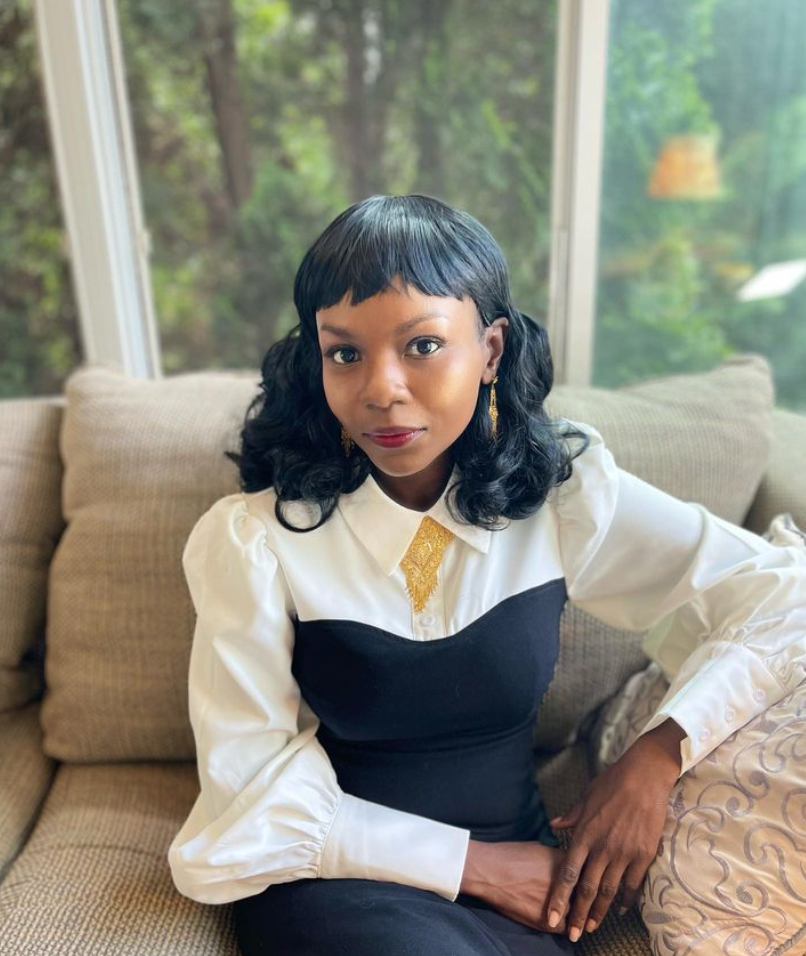
An interview with Mary-Alice Daniel
by Lisa Marie Basile


I would love to hear all about your recent creative journey and pursuits and, of course, your coming books, A Coastline Is an Immeasurable Thing and Yale Younger Poets Prize winner Mass for Shut-ins. I love talking to writers who work across genres, especially. So let’s dive in. What’s happening creatively right now?

I considered myself primarily a poet till 3 years ago when I started my first book of prose, a nonfiction work that accidentally morphed into a memoir. It began as an inquiry into the hidden Black history behind the state of California, which was named after a Black warrior queen from 16th-century Spanish mythology. The book came to include the origin stories of my West African ancestors—then sprawled to encompass my immediate family’s migrations across 3 continents. A Coastline Is an Immeasurable Thing will be published by HarperCollins/Ecco Press on November 29th. It’s now available for preorder at major and independent bookstores.

While I was in the intensive editing endgame of my memoir, Rae Armantrout sent an email that changed my life. Mass for Shut-Ins, my first book of poems, and a project spanning a decade, won the Yale Younger Poets Prize. It’s coming out in March 2023, and I’m now in the frantic final stage of its own editorial process. Three warning signs illustrated within the manuscript headlined the press release announcing my win. Perhaps concerningly, that number has doubled to 6. I offer something obsessive, ominous. My favorite observation about the volume is: “What drew me to your book—the darkness made it stand out. True darkness.”

Mary-Alice Daniel via Instagram

Wow, what a response: “What drew me to your book—the darkness made it stand out. True darkness.”

As both a reader and writer, I have always been drawn to darkness myself, to the layers beneath what we reveal, to the uncomfortable, to the almost ineffable language of sorrow. How do you manage the dark when writing? Do you ground yourself, do you dive head-first into it, or does it alchemize into something else when you write about it?

For some reason, when I read this question, I was immediately reminded of a cheesy Bane quote in the last movie of the Dark Knight trilogy. Tom Hardy says, "You think darkness is your ally. But you merely adopted the dark. I was born in it, molded by it."

Probably because of the fundamentalist tenor of my religious upbringing, it's the nature of my brain to perceive everything as a preamble to the prospect (promise?) of Hell. I keep my fingers crossed that I'm wrong about that eventuality, but... it's a concern. Writing is one way I sift through the ideas of damnation and doomsday that I've internalized.

Can you tell us a bit about your general creative process? I’m interested in the quirks and rituals and obsessions writers have. Or, you know, maybe it’s mundane. Basically, how does the Muse exist within you?

I start worrying about some little idea that perplexes me. An absurd aspect of human nature; the oddity that is the English language (my second); the internal logic of a conspiracy theory or cult practice. I then spend literal years unpuzzling it, piece by piece. I’ll spend one whole day fussing over the punctuation of a single line; I’ll waste the entirety of the next day changing everything right back. There’s a natural byproduct of this waste, though; I learn things.

And what about your inspirations? Who are they, and how do they influence your work as a writer or creative? How might they have influenced your recent work?

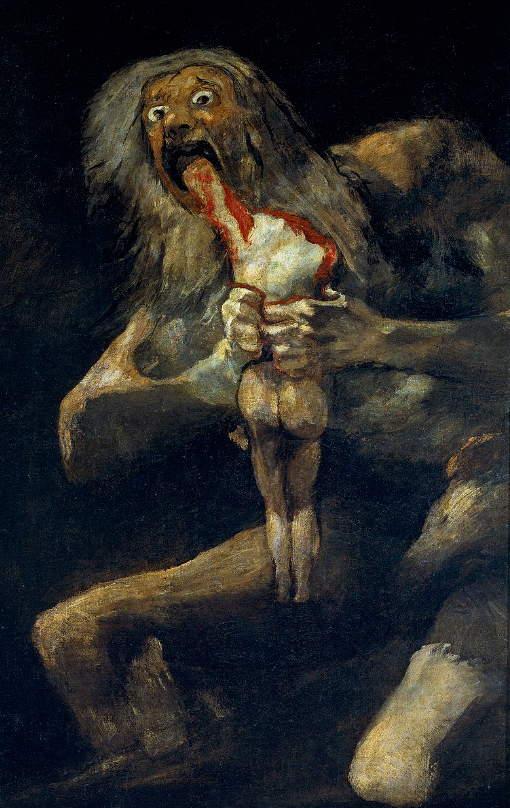
Francisco Goya’s Saturn Devouring His Son.

My favorite musician now is Sufjan Stevens. When I listen to him, I feel that connection between those who inherited an imposed faith, a fraught relationship with the spirits. It’s been with us both since birth, seen in our relatively unusual names. He was the Midwestern kid with a Muslim name; I have a Christian one despite my overwhelmingly Islamic ethnic group, the Fulani of Niger/Nigeria.

The most magnificent work of art I’ve ever seen is Goya’s Saturn Devouring His Son. A+ nightmare fuel.

The one book I recommend to people (I generally don’t) is Sum by David Eagleman. It presents 40 possible versions of an afterlife, written from the perspective of a neuroscientist with a sublime imagination, a whimsical style. When I’m up all night, harassed by the dread of death—I really, truly, honestly have to die one day?—every once in a while, I get almost excited for some great ride ahead.

Deadpan stand-up comedy is the soundtrack to all my writing sessions.

“I’ll spend one whole day fussing over the punctuation of a single line; I’ll waste the entirety of the next day changing everything right back. There’s a natural byproduct of this waste, though; I learn things. ”
— Mary-Alice Daniel

Throughout this interview series, I’ve been asking writers to share a bit about how their religion, culture, or heritage shows up in their work. What about for you?

If I do a reverse engineering of my work, I see that one of its most significant elements is syncretism, which I define as “the phenomenon of disparate religious traditions colliding.” My native tribe is nearly synonymous with Islam, but I was raised by Evangelical parents in what they made a field of “spiritual warfare.”

Around the ill-defined edges of this apocalyptic battlefield, the indigenous religions of Nigeria survive—within my family, mostly in the form of superstition and credence in curses. I think of poetry as remaking an original cosmology from these contrastive influences.

This is so powerful: "Around the ill-defined edges of this apocalyptic battlefield, the indigenous religions of Nigeria survive—within my family, mostly in the form of superstition and credence in curses. I think of poetry as remaking an original cosmology from these contrastive influences.”

Can you share one or two lines, or even a poem, that inhabits/gives life to this merging of influences?

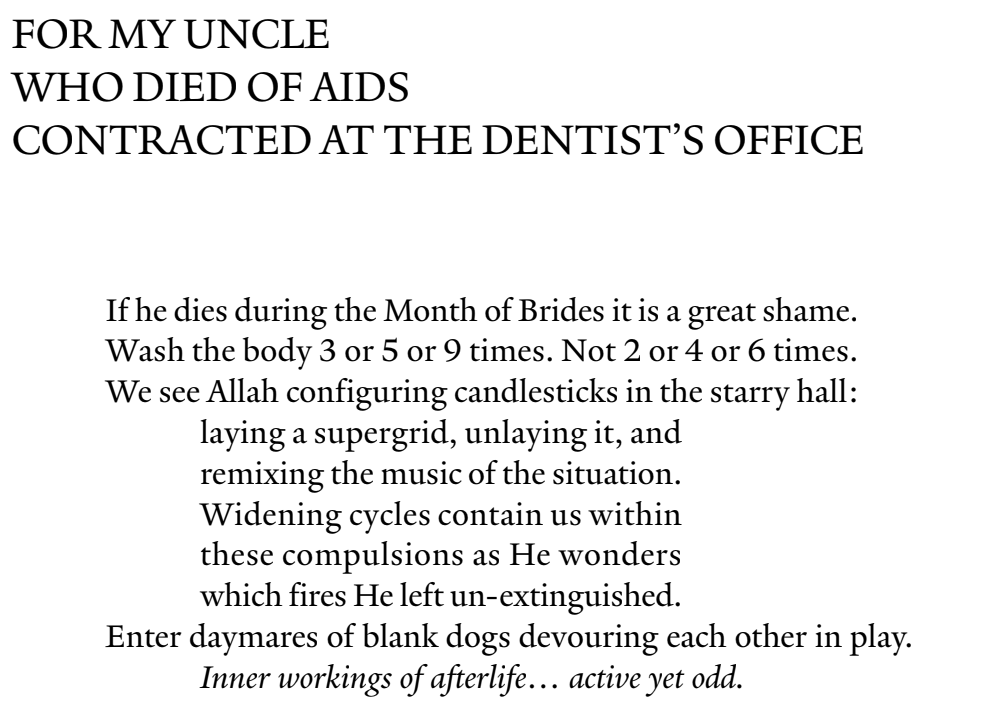
Mary-Alice Daniel: Here is an excerpt from "For My Uncle Who Died of AIDS Contracted at the Dentist's Office.”

Was there an a-ha moment that led you to write or create? Was there an experience that reaffirmed what you do and why?

“Around the ill-defined edges of this apocalyptic battlefield, the indigenous religions of Nigeria survive—within my family, mostly in the form of superstition and credence in curses. I think of poetry as remaking an original cosmology from these contrastive influences. ”
— Mary-Alice Daniel

When I lived in Connecticut for 3 of my tween years, I walked home in half-light. After school, 4 p.m., it was already getting dark. My portable CD player got me through those depressing walks: inside it spun the songs of Joni Mitchell, Paul Simon, and Fela Kuti. I wanted to sing lines like theirs. I can’t sing, so I write.

Who are a few contemporaries/mentors/writers who have made an impact on you?

Only 3? This is a really hard question. Of dozens, the first who come to mind are: poet Safiya Sinclair, who is my role model even though we’re the same age; Kwame Dawes at Prairie Schooner, who champions my work; Elizabeth Scanlon at American Poetry Review, who likes my weirdest stuff.

And finally, what might be your biggest piece of advice to a writer?

Find critics of your work who practice radical honesty. We all have blind spots; they are dangerous.


Mary-Alice Daniel was born in northern Nigeria and raised in England and Tennessee. After attending Yale University, she received an MFA from the University of Michigan and a PhD in English Literature and Creative Writing from the University of Southern California. Mass for Shut-Ins, her debut poetry collection, won the 2022 Yale Series of Younger Poets Prize. Her first book of prose, A Coastline Is an Immeasurable Thing: A Memoir (HarperCollins/Ecco Press) will be released on November 29, 2022.

In Interviews, Poetry & Prose Tags Mary-Alice Daniel, Yale Younger Poets Series, A Coastline Is an Immeasurable Thing: A Memoir
Comment

Poetry by Audrey Gidman

October 20, 2022

BY AUDREY GIDMAN

pillow talk


a crest of areola just above a hemline. plum cotton. window cracked open. lace curtains. my lover painting on the floor. paper cranes. silk thread. gold chain on her ankle. a bowl of dried roses. collarbones.

whiskey. a storm. a storm & a boat. when they leave. when they come back. striated granite. a ribcage.

gravestones. wrists. sparrows on a telephone wire. 4 o’clock in the morning. snow.

blood. chrysanthemums. heartbeats. snow.

birch trees. bare feet. their eyelashes. home. their eyelashes. home. a river.

stubbed toes. dry mouth. childhood.

a bowl of water on the ground. a bowl of water catching grief. a bowl catching grief like rainwater. bowl of water catching. catching water. catching grief. catching grief in a bowl. catching grief in a bowl like rainwater water. catching grief. hands full of water. catching it and then letting go.

bluebirds. a bluebird in a maple. a cardinal. birthing. then letting go.

loons on a lake at sunrise. accordions cutting loose over water. cutting loose through mountains. banjos plucking by a campfire. a long hug after such a long time. then letting go.

I turned myself into myself & was

—a lighthouse

—a locket

—a sinking ship

—water

—crows drifting by on their backs

—starting fires in the dark

—braiding dandelions into chains & unbraiding them

—a corridor

—a condor

—a window

—a field

—something else


note: title borrowed from a line in Nikki Giovanni’s “Ego Tripping (there may be a reason).”

Audrey Gidman is a queer poet living in Maine. She serves as chapbooks editor for Newfound and assistant poetry editor for Gigantic Sequins. Her chapbook, body psalms, winner of the Elyse Wolf Prize, is forthcoming from Slate Roof Press.

In Poetry & Prose Tags audrey gidman, nikki giovanni
Comment

Poetry by April Lim

October 20, 2022

BY APRIL LIM

Sonnet for the Cambodian Boat People


We are nothing but clouds stuck in the sea,
Whispering for winds that may never come,
How far do boats sail when they have to flee?
Keep the whispers to a quiet, no hums.

If we are caught, they kill us—No mercy,
Wild pirates with no laws at their core,
So keep mute, stay sharp, throats dry and thirsty,
They’ll slay the men and keep women as whores.

We’re almost ashore, 12 days and 12 nights—
Strangers at first, tied together by luck,
If we reach land, we’ll scatter: bird in flights,
To experience salvation awestruck.

Over jasmine and chrysanthemum sips,
I know our story will land on false lips.

Refugee Alchemy


Escape: 1.5oz of gold per body,
no guarantee of an intact soul, Conscious can never 
revert: War will 
transmute a human's mind.

Received: a familiar body that cannot essence
the same. Cannot pray without lying, without spilling 
tears into land: one 
exhumed of your father. 

Forge: matriarchal heirloom— 
gold wire, pebble gems.
Earth to your daughter's wrist. If she has to flee,
she will pay with this. 

Charm: silk spun red rioting
incense and gilded prayers, tighten
twines, blood slips loose snarling legacy
into her veins⁠— 

She: elixir of         salt      forest      prayers,
wears trauma like a birthright. Palms cradling full
moon spilling from lakeside reflection, she pools   
    into her skin.

April Lim is a Chinese Cambodian American writer from Houston, TX. She has a B.A. in Creative Writing from the University of Houston where she was awarded the Howard Moss Prize in Poetry and the Bryan Lawrence Prize in Poetry. She has received fellowships and scholarships from Tin House, Kenyon Review Writers Workshop, The Watering Hole, Martha's Vineyard Institute of Creative Writing, and elsewhere. Her poems have appeared or are forthcoming in Palette Poetry, Sweet: A Literary Confection, Bayou Magazine, and elsewhere. She is currently pursuing an MFA in Poetry at Oklahoma State University where she is an Editorial Assistant for the Cimarron Review.

In Poetry & Prose Tags April Lim
Comment
Older Posts →
Featured
‘in the glitter-open black' — poetry by Fox Henry Frazier
'poet as tarantula,  poem as waste' — poetry by  Ewen Glass
'poet as tarantula, poem as waste' — poetry by Ewen Glass
'Hours rot away in regalia' — poetry by Stephanie Chang
'down down down the hall of mirrors' — poetry by Ronnie K. Stephens
'Grew appendages, clawed towards light' — poetry by Lucie Brooks
'do not be afraid' — poetry by Maia Decker
'The darkened bedroom' — poetry by Jessica Purdy
'I am the body that I am under' — poetry by Jennifer MacBain-Stephens
instagram

COPYRIGHT LUNA LUNA MAGAZINE 2025