























• Home
  • indulge
  • new poetry
    • About Luna Luna
    • resources
    • search
  • editor
  • dark hour
  • submit
Menu

luna luna magazine

  • Home
  • indulge
  • new poetry
  • About
    • About Luna Luna
    • resources
    • search
  • editor
  • dark hour
  • submit
delicious new poetry
'the doors of the night open' — poetry by Juan Armando Rojas (translated by Paula J. Lambert)
Nov 29, 2025
'the doors of the night open' — poetry by Juan Armando Rojas (translated by Paula J. Lambert)
Nov 29, 2025
Nov 29, 2025
'we can be forlorn women' — poetry by Stevie Belchak
Nov 29, 2025
'we can be forlorn women' — poetry by Stevie Belchak
Nov 29, 2025
Nov 29, 2025
'I do whatever the light tells me to' — poetry by Catherine Bai
Nov 29, 2025
'I do whatever the light tells me to' — poetry by Catherine Bai
Nov 29, 2025
Nov 29, 2025
‘to kill bodice and give sacrament’ — poetry By Kale Hensley
Nov 29, 2025
‘to kill bodice and give sacrament’ — poetry By Kale Hensley
Nov 29, 2025
Nov 29, 2025
'Venetian draped in goatskin' — poetry by Natalie Mariko
Nov 29, 2025
'Venetian draped in goatskin' — poetry by Natalie Mariko
Nov 29, 2025
Nov 29, 2025
'the long sorrow of the color red' — centos by Patrice Boyer Claeys
Nov 28, 2025
'the long sorrow of the color red' — centos by Patrice Boyer Claeys
Nov 28, 2025
Nov 28, 2025
'Flowers are the offspring of longing' — poetry by Ellen Kombiyil
Nov 28, 2025
'Flowers are the offspring of longing' — poetry by Ellen Kombiyil
Nov 28, 2025
Nov 28, 2025
'punish or repent' — poetry by Chris McCreary
Nov 28, 2025
'punish or repent' — poetry by Chris McCreary
Nov 28, 2025
Nov 28, 2025
'long, dangerous grasses' — poetry by Jessica Purdy
Nov 28, 2025
'long, dangerous grasses' — poetry by Jessica Purdy
Nov 28, 2025
Nov 28, 2025
'gifting nighttime honey' — poetry by Nathan Hassall
Nov 28, 2025
'gifting nighttime honey' — poetry by Nathan Hassall
Nov 28, 2025
Nov 28, 2025
'A theory of pauses' — poetry by Jeanne Morel and Anthony Warnke
Nov 28, 2025
'A theory of pauses' — poetry by Jeanne Morel and Anthony Warnke
Nov 28, 2025
Nov 28, 2025
'into the voluminous abyss' — poetry by D.J. Huppatz
Nov 28, 2025
'into the voluminous abyss' — poetry by D.J. Huppatz
Nov 28, 2025
Nov 28, 2025
'an animal within an animal' — a poem by Carolee Bennett
Nov 28, 2025
'an animal within an animal' — a poem by Carolee Bennett
Nov 28, 2025
Nov 28, 2025
‘in the glitter-open black' — poetry by Fox Henry Frazier
Oct 31, 2025
‘in the glitter-open black' — poetry by Fox Henry Frazier
Oct 31, 2025
Oct 31, 2025
'poet as tarantula,  poem as waste' — poetry by  Ewen Glass
Oct 31, 2025
'poet as tarantula, poem as waste' — poetry by Ewen Glass
Oct 31, 2025
Oct 31, 2025
'my god wearing a body' — poetry by Tom Nutting
Oct 31, 2025
'my god wearing a body' — poetry by Tom Nutting
Oct 31, 2025
Oct 31, 2025
'Hours rot away in regalia' — poetry by Stephanie Chang
Oct 31, 2025
'Hours rot away in regalia' — poetry by Stephanie Chang
Oct 31, 2025
Oct 31, 2025
'down down down the hall of mirrors' — poetry by Ronnie K. Stephens
Oct 31, 2025
'down down down the hall of mirrors' — poetry by Ronnie K. Stephens
Oct 31, 2025
Oct 31, 2025
'Grew appendages, clawed towards light' — poetry by Lucie Brooks
Oct 31, 2025
'Grew appendages, clawed towards light' — poetry by Lucie Brooks
Oct 31, 2025
Oct 31, 2025
'do not be afraid' — poetry by Maia Decker
Oct 31, 2025
'do not be afraid' — poetry by Maia Decker
Oct 31, 2025
Oct 31, 2025
'The darkened bedroom' — poetry by Jessica Purdy
Oct 31, 2025
'The darkened bedroom' — poetry by Jessica Purdy
Oct 31, 2025
Oct 31, 2025
'I am the body that I am under' — poetry by Jennifer MacBain-Stephens
Oct 31, 2025
'I am the body that I am under' — poetry by Jennifer MacBain-Stephens
Oct 31, 2025
Oct 31, 2025
goddess energy.jpg
Oct 26, 2025
'Hotter than gluttony' — poetry by Anne-Adele Wight
Oct 26, 2025
Oct 26, 2025
'As though from Babel' — poetry by Fox Henry Frazier
Oct 26, 2025
'As though from Babel' — poetry by Fox Henry Frazier
Oct 26, 2025
Oct 26, 2025
'See my wants' — poetry by Aaliyah Anderson
Oct 26, 2025
'See my wants' — poetry by Aaliyah Anderson
Oct 26, 2025
Oct 26, 2025
'black viper dangling a golden fruit' — poetry by Nova Glyn
Oct 26, 2025
'black viper dangling a golden fruit' — poetry by Nova Glyn
Oct 26, 2025
Oct 26, 2025
'It would be unfair to touch you' — poetry by grace (ge) gilbert
Oct 26, 2025
'It would be unfair to touch you' — poetry by grace (ge) gilbert
Oct 26, 2025
Oct 26, 2025
'Praying in retrograde' — poetry by Courtney Leigh
Oct 26, 2025
'Praying in retrograde' — poetry by Courtney Leigh
Oct 26, 2025
Oct 26, 2025
'To not want is death' — poetry by Letitia Trent
Oct 26, 2025
'To not want is death' — poetry by Letitia Trent
Oct 26, 2025
Oct 26, 2025
'Our wildness the eternal now' — poetry by Hannah Levy
Oct 26, 2025
'Our wildness the eternal now' — poetry by Hannah Levy
Oct 26, 2025
Oct 26, 2025
depression workbook

This Friendly Depression Workbook Provides Support & Actionable Steps

October 11, 2018

BY LISA MARIE BASILE

As World Mental Health Day trends across social media, I’ve felt both sorrowful and appreciative. On one hand, it’s hard to see just how many people suffer with various forms of mental illness. On the other, I know intimately how damaging it can be to shame and silence those who suffer, and I’m glad we’re changing that. That suffering can be passed down, internalized, neglected. It rots away at us, our families, our communities, and our cultures.

It seems we will always battle with mental illness, whether it’s chemical or triggered by one’s experiences, or both—but there are options. From medication to mindfulness, from simply speaking as a way to release the albatross, to learning to work with your own triggers and cycles (I think of it as intuiting when the sea is coming to flood shore), everyone will explore different approaches, unique to their needs.

And if we are always fighting against the illness, the least we can do is create an judgment-free and compassionate environment for one another.

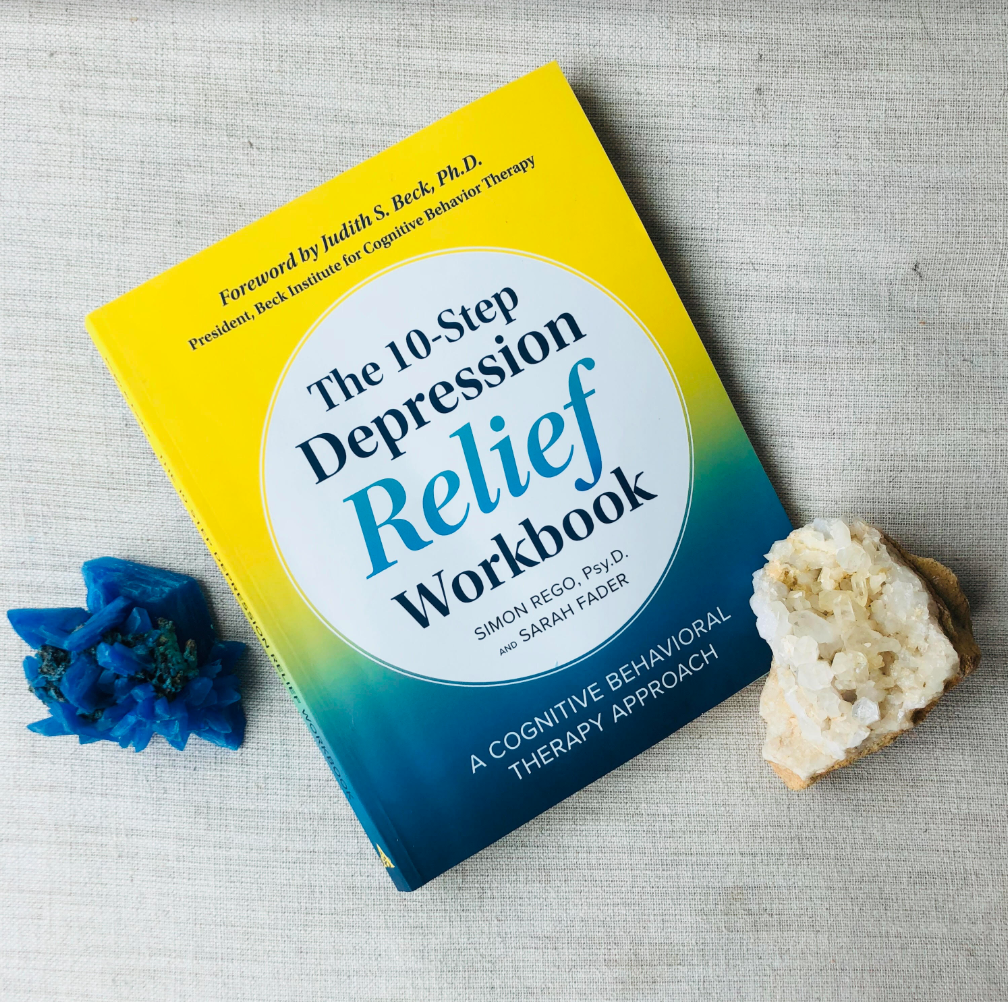
I recently received The 10-Step Depression Relief Workbook: A Cognitive Behavioral Therapy Approach, written by Simon Rego, Psy. D. and Sarah Fader, my friend and also the creator of Stigma Fighters. The book creates that environment.

I was so glad to have received it as well, as I’ve always lived with a lingering anxiety and depression. My mental health challenges are deeply tied to life changes and times of powerlessness, rooted in my past: As a kid, both of my parents suffered with addiction, and we lived in homeless shelters and then we went into foster care. I’ve come to recognize what may set my depression and anxiety off (moving home or job, being thrown for a loop, not feeling cared for or supported), and living with these issues is like walking on a tight rope. I’ve come to force myself to understand that it’s all a balancing act, and that that’s just the truth. That said, I’m grateful to have been able to manage my symptoms.

When I received this book, I was in the middle of a move. Perfect, right? I hadn’t fallen into the depths, but I was feeling it. That undercurrent, its surging, its quiet little hum. And so, I turned to the workbook, which I appreciated very much because of its kindness and its approach.

First off, the book starts off with an intro that makes it clear that depression is a real illness—not just a bit of melancholy that sometimes makes us feel blue. It also notes the very real risks of depression—including the physical. Because chronic depression can lead to heart attacks, diabetes and stroke—all of which have been verified by science.

Next, it discusses the barriers to treatment that many people and countries face—limited access to therapy, medical treatments, or a lack of trained healthcare providers. (Just take a look at this study around the prevalence of Brazilians living without depression treatment). For this reason, the workbook uses a cognitive behavioral therapy step-by-step approach, which can help find a workaround to some of those barriers. It specifically mentions that it may be best suited for those with mild depression or people who are hesitant about medical treatment.

Written in a friendly and clear voice, it helps the reader first get honest with themselves: What is depression, what are the symptoms? What are your symptoms? It also offers some glimpses of Sarah's own experiences—and asks the reader to share theirs. This feels very much like a loving conversation rooted in both gentleness and serious action.

It then moves to discussing the therapeutic process—and CBT, which offers action items for managing depression. CBT, defined, means, "Cognitive-behavioral therapy (CBT) is a form of psychotherapy that treats problems and boosts happiness by modifying dysfunctional emotions, behaviors, and thoughts. Unlike traditional Freudianpsychoanalysis, which probes childhood wounds to get at the root causes of conflict, CBT focuses on solutions, encouraging patients to challenge distorted cognitions and change destructive patterns of behavior."

The book goes on to discuss other therapies as well, just so you know the differences—which I appreciated. Following chapters include recognizing and workshopping problem areas (like replacing negative thoughts, and enhancing objective thoughts), making a plan for yourself, learning to not procrastinate when it comes to tasks and self-care, and learning to develop lifestyle skills and finding gratitude.

What I like most about the book is that it very much sounds like a kind and objective friend who wants you to help yourself and be happy, in whatever small step feels right for you. Its focus on both the short-term (immediate behaviors) and the long-term (learning mindfulness and maintaining wellness, even when not depressed), is important. The fact that is acts as both a triage and a holistic coach is so key, I think. This helps the reader get some relief while thinking about the bigger picture.

I recommend this book to anyone who wants to peer inward, discover healthful and pragmatic tools to manage depression and create a step-by-step approach to taking action.

I also recommend checking out CEO Sarah Fader's Stigma Fighters, which is a mental health non-profit organization (founded in 2014) dedicated to helping real people living with mental illness.

As the site says, "There are teachers, doctors, lawyers, psychologists, actors, writers all living with mental illness. These are the stories that need to be told; the people who seem to be “regular” or “normal” people but are actually hiding a big secret. They are living with an invisible illness. They are struggling to function like the rest of society. It is Stigma Fighters’ mission to raise awareness for people who are seemingly “normal” but actually fighting hard to survive. If you are living with mental illness and you want to share your story, please fill in the form HERE. We look forward to fighting the stigma of mental illness one story at a time."

i hope that whatever your path, and whatever pain you're feeling, you take the time to care for yourself. You deserve it.

SUICIDE HOTLINE
1-800-273-8255

Click here if you have difficult hearing and need help.


Lisa Marie Basile is the founding creative director of Luna Luna Magazine--a digital diary of literature, magical living and idea. She is the author of "Light Magic for Dark Times," a modern grimoire of inspired rituals and daily practices. She's also the author of a few poetry collections, including the forthcoming "Nympholepsy." Her work encounters the intersection of ritual and wellness, chronic illness, magic, overcoming trauma, and creativity, and she has written for The New York Times, Narratively, Grimoire Magazine, Sabat Magazine, The Establishment, Refinery 29, Bust, Hello Giggles, and more. Lisa Marie earned a Masters degree in Writing from The New School and studied literature and psychology as an undergraduate at Pace University

Sarah Fader is the CEO and Founder of Eliezer Tristan Publishing Company, where she is dedicated to sharing the words of authors who endure and survive trauma and mental illness. She is also the CEO and Founder of Stigma Fighters, a non-profit organization that encourages individuals with mental illness to share their personal stories. She has been featured in The New York Times, The Washington Post, The Atlantic, Quartz, Psychology Today, The Huffington Post, HuffPost Live, and Good Day New York.

Dr. Simon Rego, a licensed clinical psychologist with close to 20 years of experience in Cognitive Behavior Therapy (CBT) and other evidence-based psychological treatments, is currently Chief Psychologist, Director of Psychology Training, and Director of the CBT Training Program at Montefiore Medical Center and an Associate Professor of Psychiatry and Behavioral Sciences at Albert Einstein College of Medicine in New York

In Wellness, Social Issues, Lifestyle Tags depression, mental illness, mental health, The 10-Step Depression Relief Workbook, stigma fighters, sarah faders
Comment
Sarah Fader

Sarah Fader

Support Stigma Fighters: In Conversation About Mental Health Support With Sarah Fader

April 27, 2017

BY LISA MARIE BASILE

Stigma Fighters is a mental health non-profit organization dedicated to helping real people living with mental illness. Stigma Fighters has been featured on Good Day New York, Psychology Today, Women’s Health Magazine, and The Washington Post. You can support the current anthology by donating here. 

LMB: What I love the most about your work with Stigma Fighters is not only that you're pushing for awareness in general, you're pushing for awareness in the everyday. I think that's where the conversation slips through the cracks: the high-functioning person with anxiety, the role model or public figure with panic disorder, the happy-go-lucky people-person with quiet depression. This is what I am so thankful for — because, as a public-facing person, I am always wondering when and if my cracks with show, and what will happen if they do. How did you approach this goal? What message do you want to tell?

SARAH FADER: I can relate to the high-functioning person from personal experience. I grew up in the 90’s when it was shameful to speak candidly about living with depression or anxiety, both of which I experienced on a chronic basis since age 15. I became adept at hiding my illnesses, and I was an excellent actress. This continued into adulthood, and I was hyper-fixated on other people being able to tell if I was "normal." I wanted to call attention to this type of situation in particular because it's one that people don't speak about often.

We are surrounded by people who have mental health issues, but whether or not they speak about them openly is debatable. That is one of the main reasons I started Stigma Fighters is to provide an open forum for people who have been dying to speak their truth about living with mental illness but haven't found the right area to do so. Now people who have a variety of mental illnesses have a place to tell their stories. Whether you are living with Borderline Personality Disorder or Panic Disorder, Stigma Fighters is here for you.

LMB: Can you talk a little about the history of building SF? It seems like a huge undertaking!

SARAH FADER:  Stigma Fighters began as a blog series. I reached out to people in the blogging community who I knew were open about living with mental illness and I invited them to share their stories on www.stigmafighters.com. It grew and grew and eventually it was a burgeoning mental health community.

One day, my life changed for the better when I met Allie Burke, who became my business partner. Allie lives with paranoid schizophrenia, but she is so much more than her illness. She is a best-selling author and writes a column for Psychology Today. She has been featured in Women's Health Magazine and runs The OCH Literary Society. Allie and I took Stigma Fighters from being a blog and transformed it into a 501C3 non-profit organization. My inside joke with Allie is that my anxiety loves her paranoia. I adore her and with her leadership and my tenacity we were able to make Stigma Fihters what it is today. We were featured on the front page of The Washington Post! 

LMB: What will the anthology feature? How can people support it and your organization? 

SARAH FADER: The third volume of The Stigma Fighters Anthology features stories from people living with a variety of mental illnesses. It tells the stories of people who have been continually silenced by our society. I am fortunate to be able to unify so many voices into a volume of text. I want to tell the stories of people who have been told (in one way or another) that they do not matter. Society tells people with mental illness that we are burdens, that we are people to "put up with," and that we shouldn't speak about our challenges. These are all falsehoods and I want to make sure we debunk these statements simply by telling our stories.

LMB: What would you say to the person who may want to contribute to SF by sharing their story, but might be afraid?

SARAH FADER: First I would say, you can tell your story anonymously if you are not ready to share it with your name on it. If you want your name attached to your words, I encourage you to speak your truth. You don't know how many people you are reaching by telling your story. Think about the person who is suffering from depression right now who could benefit from knowing that she is not alone. Mental illness can be inherently isolating. When you open up about your experience, you give hope to people who are yearning for it.

LMB: How can we, in the everyday world, create an environment that is compassionate and kind to those around us (who we either may or may not know are living with mental illness)?

SARAH FADER: We need to speak openly about mental illness period. It's important to combat against the shame associated with having any sort of mental illness. You are a human being first and foremost with feelings and a soul. You have a right to your story and no one can take that away from you. The more we speak openly about mental illness, the more normalized it becomes in society. Next, people who are listening to a friend or loved one who has a mental illness, truly hear what they are telling you.

Maybe you've never experienced bipolar disorder, that doesn't mean you can't be empathetic toward a friend who has it. Lastly, empower the person who has mental illness to know that they CAN when they think they CAN'T. When I say that they can, I mean that sometimes knowing you can means asking for help. Simon and Garfunkle claimed that they were both a rock and an island, but I disagree with that. We are not islands, we are people and we need to ask others for help sometimes.

Want to fight against the stigma? Donate here.


Sarah Fader is the CEO and Founder of Stigma Fighters, a non-profit organization that encourages individuals with mental illness to share their personal stories. She has been featured in The Washington Post, The Atlantic, Quartz, Psychology Today, The Huffington Post, HuffPost Live, and Good Day New York. Sarah is a native New Yorker who enjoys naps, talking to strangers, and caring for her two small humans and two average-sized cats. Like six million other Americans, Sarah lives with panic disorder. Through Stigma Fighters, Sarah hopes to change the world, one mental health stigma at a time.

Lisa Marie Basile is the founding editor-in-chief of Luna Luna Magazine and moderator of its digital community. Her work has appeared in The Establishment, Bustle, Bust, Hello Giggles, Marie Claire, Good Housekeeping and Refinery 29, among other sites. She is the author of Apocryphal (Noctuary Press), war/lock (Hyacinth Girl Press), Andalucia (The Poetry Society of New York) and Triste (Dancing Girl Press). Her work can be found in PANK, the Tin House blog, The Nervous Breakdown, The Huffington Post, Best American Poetry, PEN American Center, The Atlas Review, and the Ampersand Review, among others. She has taught or spoken at Brooklyn Brainery, Columbia University, New York University and Emerson College. Lisa Marie Basile holds an MFA from The New School. She is an advocate for foster youth. @lisamariebasile

In Social Issues, Politics, Interviews Tags mental health, stigma fighters
Comment
Featured
‘in the glitter-open black' — poetry by Fox Henry Frazier
'poet as tarantula,  poem as waste' — poetry by  Ewen Glass
'poet as tarantula, poem as waste' — poetry by Ewen Glass
'Hours rot away in regalia' — poetry by Stephanie Chang
'down down down the hall of mirrors' — poetry by Ronnie K. Stephens
'Grew appendages, clawed towards light' — poetry by Lucie Brooks
'do not be afraid' — poetry by Maia Decker
'The darkened bedroom' — poetry by Jessica Purdy
'I am the body that I am under' — poetry by Jennifer MacBain-Stephens
instagram

COPYRIGHT LUNA LUNA MAGAZINE 2025