Serena Chopra has a PhD in Creative Writing from the University of Denver and an MFA from the University of Colorado at Boulder. She is the author of two full-length books of poems, This Human (Coconut 2013) and Ic (Horse Less Press 2017), as well as two chapbooks, Penumbra (Flying Guillotine Press 2012) and Livid Season (Free Poetry 2012). She is a Kundiman Fellow and a 2016-2017 Fulbright Scholar, for which she is composing hybrid writing informed by her research with queer women in Bangalore, India. She is a multidisciplinary artist, working as a professional dancer, theater/performance artist and visual artist. She is a co-founder and actor in the poet’s theater group, GASP and worked with Denver’s Splintered Light Theater on a full-length production of Ic, for which she composed the soundscore. She has an ongoing text/image collaboration, Memory is a Future Tense, with artist Lu Cong. Serena currently teaches in the MFA program at Naropa University’s Jack Kerouac School of Disembodied Poetics.
Read More
The Astrolushes Podcast: Skeptics, Cosmic Lessons, & Authenticity
Astrolushes is a podcast at the intersection of astrology and literature, ritual, wellness, pop culture, creativity — and, of course, wine. Expect guests, giveaways, & games — and get ready to go deep with us.
The water-sign hosts are Andi Talarico, poet, book reviewer and Strega (@anditalarico) & Lisa Marie Basile, poet, author of Light Magic for Dark Times, & editor of Luna Luna Magazine (@lisamariebasile + @lunalunamag). You can the astrolushes on Twitter, too, here.
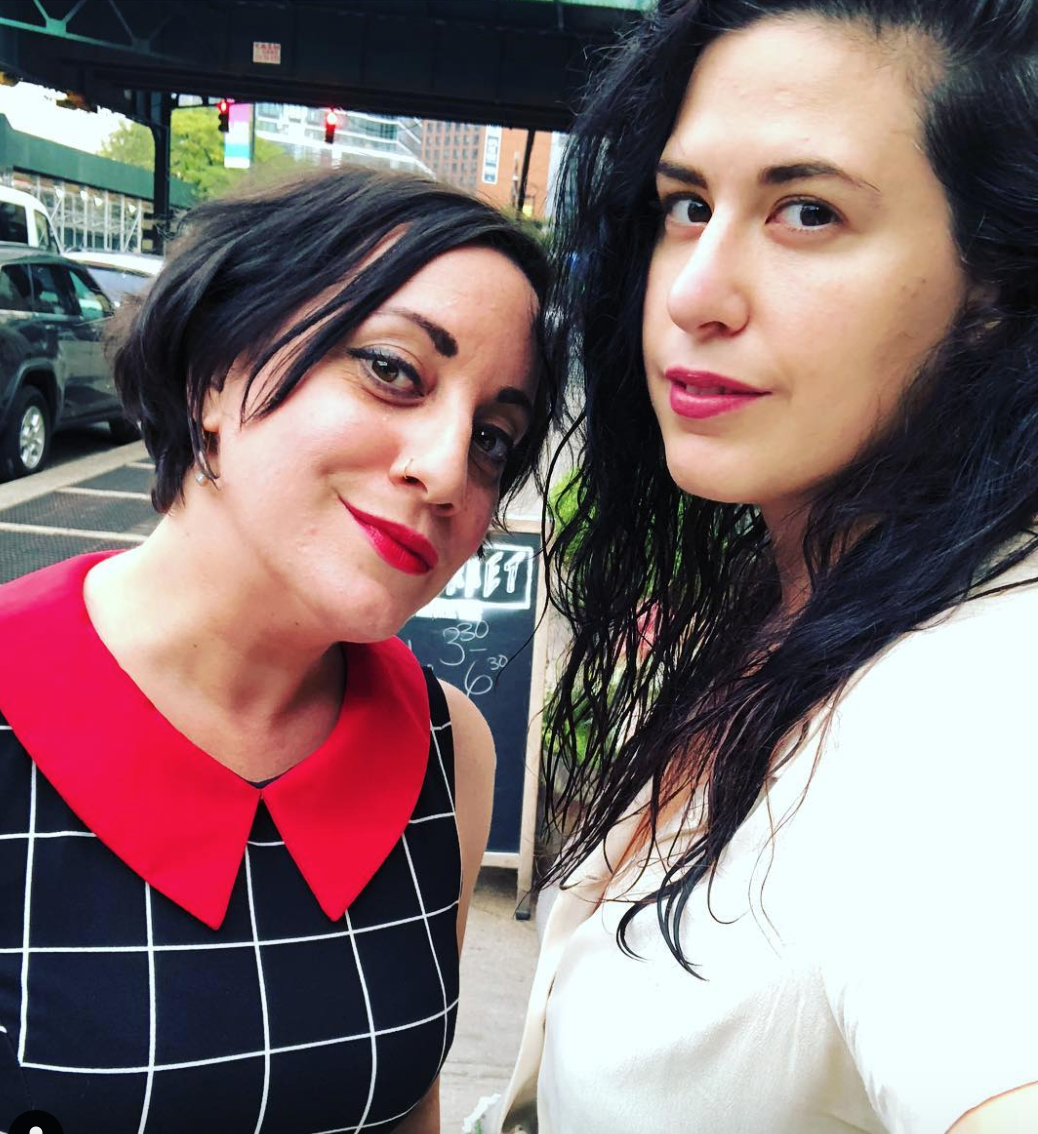
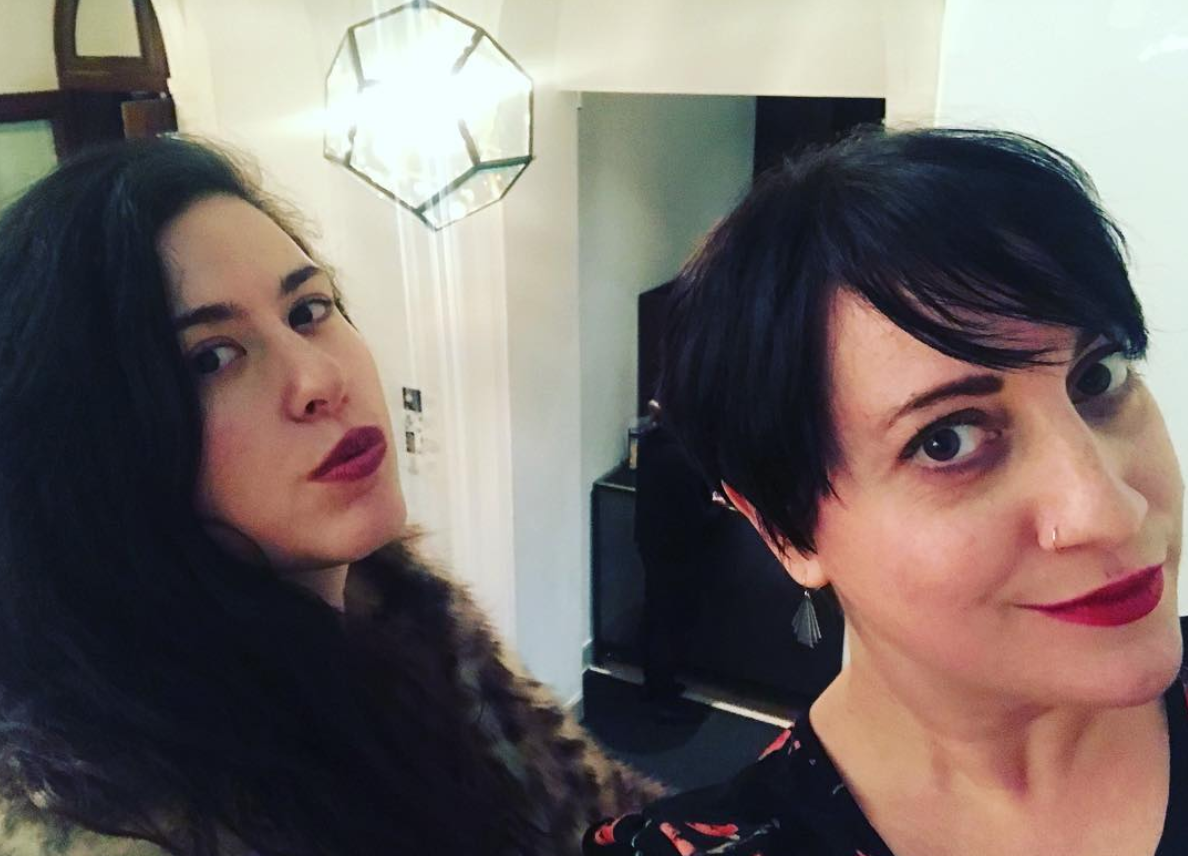
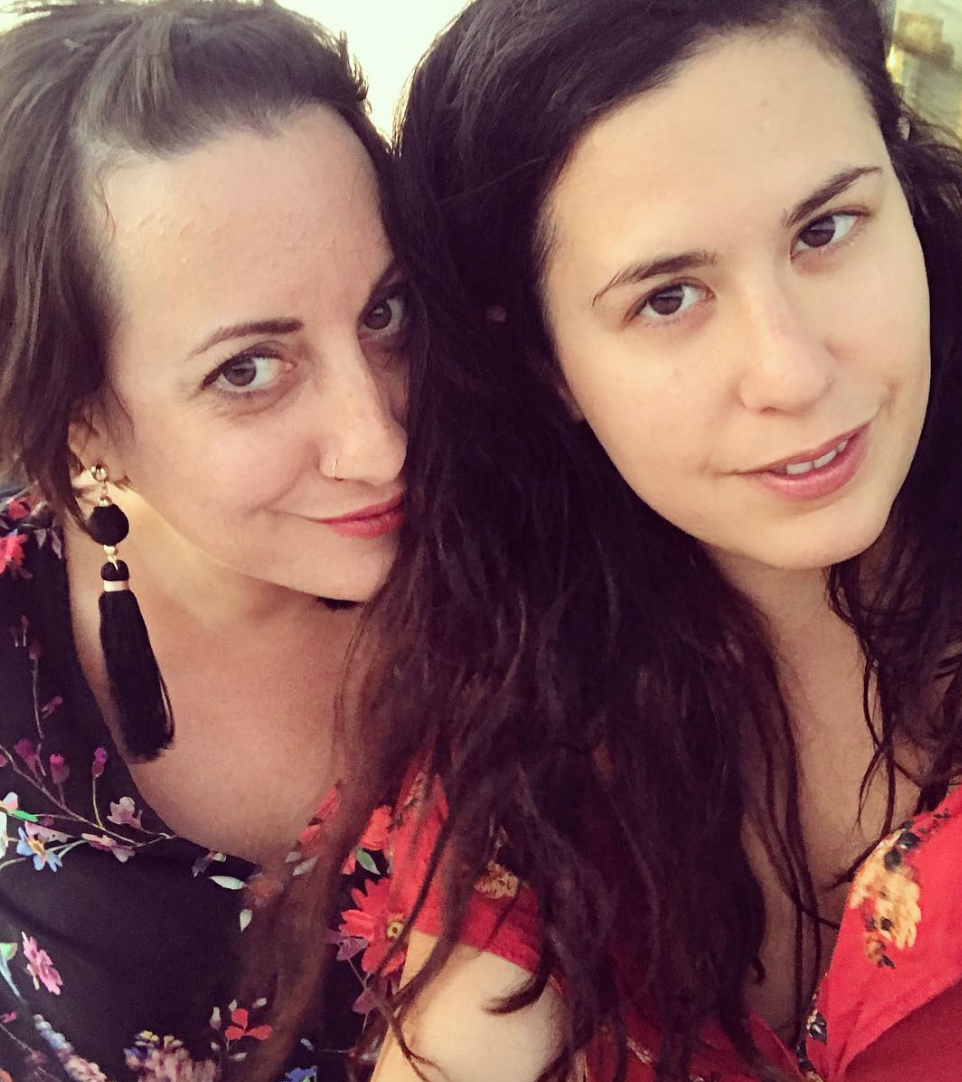
LISA MARIE BASILE: Let’s chat about the birth of AstroLushes! I think it sort of started on a drive we took to Salem, MA, where we witched out for a weekend and visited HausWitch for my Light Magic for Dark Times writing workshop. In the car, I threw celebrity and literary names at you and had you guess their big 3 signs. You were amazingly on point! I'm wondering, besides having fun with it, what do you personally think the 'use' or 'reason' for this astro-knowledge is? I think people are generally fascinated, but we both know there's more to it.
ANDI TALARICO: That road trip and our time in Salem definitely feels like the genesis of this show! It started with us guessing celebrity's charts and now it's just a part of all of our conversations. I feel like now we're constantly wondering about writers and actors and philosophers through the lens of their astrological placements. It's a fun game but I think it also allows for a possibly deeper understanding of the art and culture that we engage with.
And engagement was how I came to astrology. My mother always read our horoscopes from the paper when I was growing up; she's a mystical Pisces who has visited psychics, believes in prophetic dreams, and finds herself fascinated by the moon. I inherited a lot of my curiosity from her. But by age 12 our household had changed considerably and it became a harder place to exist and grow in. So it's no surprise to me, looking back, why that was the time I started studying astrology.
It was a way of making sense of the world. It also gave me an opportunity to talk to people about themselves (and to keep the focus off of myself.) It made me feel like I had some sort of agency, a voice, a new authority. Now, the language of astrology, to me, is less about telling people about themselves and actually, much like my tarot practice, using the themes and ideas as lessons that we can use to fully become our best, most authentic selves. That's where it crosses over into self-care as well.
How do you feel about people who think astrology is bogus, Lisa?
Astrology…much like tarot practice, uses the themes and ideas as lessons that we can use to fully become our best, most authentic selves. That's where it crosses over into self-care as well. — Andi Talarico
LISA MARIE BASILE: I love that you say it's an engagement with everything around us. And that, as a child, it helped you navigate a very difficult world. It truly is a language we learn and then we speak, and that can bring people together in an instant. And it can help us focus on the many characteristics of ourselves. In my life, processing the trauma I've experienced through the filter of the Scorpio has been amazingly beneficial; I now look on it all as transformative, rather than destructive.
It's also really interesting to give a name to the various inclinations and motivations for people's art or behaviors. Especially when you look at creative people, or really evil people, and you start seeing how many of them fit into a certain astrological sign, or element. It may not be scientifically proven, but that’s the sort of mystery and liminality that we derive meaning from.
I am a scientific person. I believe that reason, empirical evidence, and research is important. I live with a chronic illness, and I'm a health writer as a day job. It's important to me that information is disseminated accurately, or, say, that the injections I take have been proven both effective and safe, and that sometimes, you need medication over meditation, in order to heal.
At the same time — people need to know there’s more to health and wellness than big pharma. And there’s more to this world than what we can see. I think the zodiac allows us to approach the liminal, the intuitive, the subterranean. It does exist outside of 'objective science' and that's okay. It allows us to dive headfirst into the shadows of this world and our lives, and I think that's the key to the feeling whole — straddling both sides. Science has a place, but so does the esoteric. You can't prove love, but we all feel it. So, it's the same thing. Some things we just explore knowing that it may be obscure. I am grateful to be able to take part in the world from both stances.
What do you think about how people can use the zodiac as a healing tool, or in daily ritual?
There more to this world than what we can see. I think the zodiac allows us to approach the liminal, the intuitive, the subterranean. It exists outside of 'objective science' and that's okay. It allows us to dive headfirst into the shadows of this world and our lives, and I think that's the key to the feeling whole — straddling both sides. Science has a place, but so does the esoteric. You can't prove love, but we all feel it. — LISA MARIE BASILE
ANDI TALARICO: I definitely look through several horoscopes during the morning to see what my day/week might bring me. I mean, the basis of horoscopes are transits, what the movement of the current celestial journey means in my zodiac placements, and I love that about horoscopes — how it's a constant reminder that everything changes, nothing stays still, and how cyclical life can be, for good or bad.
I like to look to the planets/celestial bodies and their assigned western astrological associations for greater personal meeting. Like, what does it mean to be represented, as I am, by the Moon? The Moon shines because it reflects the light that is given to it. I feel the same way, again, for good and bad. I also shine brightest when I'm basking in the the light of stimulating conversation and affection. I turn inward and dark when I'm not given light to work with.
Also, since the Moon transits more often than other bodies, since it's constantly waxing or waning, it serves as a beautiful remind to keep pushing forward, that this moment isn't forever, to enjoy the view and perspective before it changes yet again. It's why I have a little crescent moon tattooed on my finger — my constant reminder that the only constant is change.
How do you feel connected or represented by Pluto, Lisa? Pluto is such a symbolically important planet of creative destruction, I'd love to hear your thoughts on that!
What does it mean to be represented, as I am, by the Moon? The Moon shines because it reflects the light that is given to it. I feel the same way, again, for good and bad. I also shine brightest when I'm basking in the the light of stimulating conversation and affection. I turn inward and dark when I'm not given light to work with. — ANDI TALARICO
LISA MARIE BASILE: Oh, that’s so beautiful! When you say, “I turn inward and dark when I'm not given light to work with,” I feel that in my core! I love the idea of this cosmic duality, how it represents the shadowy quietude and the display of light. It reminds me that we are all just star stuff. It’s why I started Luna Luna!
It’s funny you mention the tattoo, because I have one that also reminds me that things change; it’s an ampersand. Maybe that’s why you and I are so drawn astrology? That it provides a foundation we can find stability in but the fluidity we need to always be growing.
I think the fact that Pluto has been considered a planet, a not-planet, an exoplanet and whatever else, is very beautiful—a perfect and living representation of Pluto as a symbol: it dies and is reborn, and yet it remains this beautiful archetype of transformation, weathering the storms of idea and rule and order. Could literally anything be more perfect?
Pluto is my beautiful ruler, and I am indebted to its reminders. I have always been able to die and rise. I lean into the dark and then I die. I go into dark periods of change and emerge. I almost need it more than the light. But I suppose, that is my language. The darkness becomes a kind of light that makes sense.
I think that’s the beauty of this cosmic story. No matter what you believe or feel skeptical about, astrology’s narrative, symbolism and reminder to explore the grandness of human emotion and circumstance is all splayed out up there. We just need to look up.
What do you think about people who say they they believe in astrology and make Huge Life Decisions around it? Do you think it’s important to figure astrology into your day to day? Jobs? Dates? Etc? Or do you think it serves its best purpose as a tool for introspection, rather than a rulebook?
No matter what you believe or feel skeptical about, astrology’s narrative, symbolism and reminder to explore the grandness of human emotion and circumstance is all splayed out up there. We just need to look up. — LISA MARIE BASILE
ANDI TALARICO: LOVE this: "...Pluto as a symbol: it dies and is reborn, and yet it remains this beautiful archetype of transformation, weathering the storms of idea and rule and order. "
As for me, I don't make huge life decisions based on astrology in the sense, that, say, I won't work with people of certain signs or judge them based on their natal chart. The idea of not dating this sign or that sign is a prejudice to me, and unfair. Even knowing someone's chart information is an act of intimacy — that's private knowledge — and to use it against someone or to think you know everything about a person based on it...hell no. Absolutely not.
Can it help you locate potential challenges? Yes, I believe that. Is is exciting when your synastry is in alignment and looks positive? Of course. But we're all much more than our natal charts. We're our upbringing, we're our ancestors, we're survivors, we're our good days and bad days, we're what we've been allowed to be and what we've rebelled against. Our zodiac signs matter but they don't make or break us.
I WILL make decisions based on transits and the moon's phases, though. Like, new beginnings during the new moon — that just makes sense to my entire being, both my physical and spiritual self. I definitely believe in harnessing the new energy at the start of a new zodiac phase — focus on good communication at the start of Gemini season! Make those spreadsheets in honor of Virgos everywhere! Get real sexy at Scorpio time!
But, would I, say, not send an important email when Mercury's in Retrograde? No, I try not to rely THAT heavily on astrology. I try to use it more as a guide and tool for learning than a strict rulebook. But...I also hate rules and authority in general. I naturally bristle against those who think they have the exact answers, at least in areas that don't involve exactitude and true yes or no areas. I'm a skeptical human, in many ways.
Is is exciting when your synastry is in alignment and looks positive? Of course. But we're all much more than our natal charts. We're our upbringing, we're our ancestors, we're survivors, we're our good days and bad days, we're what we've been allowed to be and what we've rebelled against. Our zodiac signs matter but they don't make or break us. — ANDI TALARICO
FANCY THE COSMOS, WINE, AND A COZY CONVERSATION BETWEEN FRIENDS? LISTEN TO THE ASTROLUSHES PODCAST HERE
The Witch Is a Symbol of Justice
Genevieve Pfeiffer is Assistant Director at Anomaly where she is curating a folio on reproductive justice and its intersections (she urges you to submit). She is a writer and poet, and facilitates workshops with survivors of sexual assault and harassment. Her work is forthcoming or has been published in Erase the Patriarchy, Juked, So to Speak, Stone Canoe, and more. She blogs about outdoor wanderings and herbal birth control’s intersections with witches, colonization, and personal and bioregional health at: https://medium.com/@GenevieveJeanne
Read More
Body Ritual: Journal Prompts for Chronic Illness Exploration
BY LISA MARIE BASILE
Body Ritual is Lisa Marie Basile's column about wellness, chronic illness and finding healing and autonomy in ritual. You can follow her on Instagram for more on this topic.
If you live with a chronic illness, or if you love someone who has one, you know the delicate balancing act it requires. Living on that liminal precipice, between doing just enough and doing too much, requires an almost spiritual focus. And it’s tiring. I know, as I have ankylosing spondylitis, a degenerative, incurable spinal disease.
Who we feel we are within our minds is not always what our bodies reflect. And sometimes, that very lack of reconciliation rewires us. We start to believe we cannot, are not, will not.
We can, we are, and we will embrace the wholeness of our limitations and our magic. It doesn’t matter if people want us to stay quiet, go away, or stop complaining. We have a right to explore what it means to experience life as we do.
Stigma, lack of education, and fear make it hard to exist in a body that exists on the margins. Sometimes all the noise and suffering keeps us at a distance from ourselves. We often are so tired from the pain or insomnia or anxiety that we smile and pretend everything is okay. We sometimes allow ourselves to be taken advantage of just so we can seem “normal.” We push the limits of our bodies and lose grip on our boundaries. Sometimes, we get through the day, and that’s it. Sometimes it’s hard to feel empowered, to feel enough, to feel that we can and are and will.
The deep and important work that goes into healing the trauma of illness is often ignored. Instead, we focus on the day to day needs. We keep our heads above the water — but the secret is that we must become the sea.

Recently I decided to go inward and empower myself to make time and space for my voice and needs as someone with chronic illness. Instead of trying to blend in or assure everyone that, “I’m fine, really,” I stared down into visit the abyss. I decided to take my time, for no reason but my own needs, and look my chronic illness in its eyes.
I cut through the noise and the stigma and the denial. My body, alight and in focus.
To do this, I made a list of chronic illness journal prompts and chose a beautiful journal strictly for these questions (or you may want to type these out or dictate your answers).
So, I wrote down several questions in my journal, and attempted to answer them. At times I answered one a day. Sometimes I answered several in one go. The important thing is that you take the time to be honest with yourself.
What I learned from answering the below questions astonished me; I was able to advocate better for my needs, recognize and make space for joy and gratitude, and find the parts of myself, like glass shards, I thought I’d lost. I didn’t lose them, it turns out. They simply changed form.
Chronic Illness Journal Prompts
Who am I without my chronic illness?
Who am I with my chronic illness?
How did I change when I was diagnosed?
How did I not change when diagnosed?
How is my pain level today? How is my fatigue?
Are my basic needs met? How can I facilitate this?
What positive thing have I learned about myself while actively experiencing symptoms or side effects?
What negative thing have I learned about myself while actively experiencing symptoms or side effects?
What do I do during periods of remission?
What do I do or feel when I’m in a flare-up?
Are there any ways at all to bridge the gap between feeling good and not feeling good?
How do others make me feel about my chronic illness?
Who understands my illness and supports me in my experience of it?
How can I help others understand my illness?
What do I not feel comfortable explaining about my illness?
Where are my boundaries?
Where can I be more receptive or open? Is it in receiving love? Is it in talking about my needs?
How do my finances play into my illness?
Are there areas in which I am privileged and thus, have gratitude?
Are there community resources or other resources I can tap into for help?
How does my race, gender, or educational background impact my experience of chronic illness?
How does my illness impact my job?
How does my illness impact my social and/or sex life?
Are there other intersecting issues that impact my chronic illness?
What do I love about my body?
What do I need to feel happy on a day to day basis?
What do I need to feel sustainably happy in the long term?
Among the things I need, which do I have?
What are three things I am thankful for right now, in this very instance?
If I am not happy, what is in my power to change that?
What work — no matter how seemingly ‘small’ — can I do to advocate for or contribute the wellness of others who may be suffering? Would this feel gratifying?
What gives me hope?
Also read:
BODY RITUAL: 12 VERY REAL THINGS I LEARNED ABOUT CHRONIC ILLNESS
BODY RITUAL: GRATITUDE MAGIC
AT THE INTERSECTION OF CHRONIC ILLNESS & RITUAL
Lisa Marie Basile is a poet, essayist and editor living in New York City. She's the founding editor of Luna Luna Magazine, an editor at Ingram’s Little Infinite, and co-host for the podcast, AstroLushes. Most recently, she is the author of LIGHT MAGIC FOR DARK TIMES (Quarto Publishing/Fair Winds Press), a collection of practices and rituals for intentional and magical living, as well as a poetry collection, NYMPHOLEPSY . Her second book of nonfiction, WORDCRAFT, will be published by Quarto/Fair Winds Press in April 2020. It explores the use of writing as ritual and catharsis. Her essays and other work can be found in The New York Times, Chakrubs, Catapult, Narratively, Sabat Magazine, Refinery 29, Healthline, Entropy, Bust, Bustle, The Establishment, Hello Giggles, Ravishly, and more. She studied English and psychology as an undergraduate at Pace University, and received a Masters in writing from NYC’s The New School. Want to learn more? She’s been featured at Amy Poehler’s Smart Girls, HelloGiggles, The Cools, and more.
AstroLushes: A New Podcast for Astrology Lovers Everywhere
ASTROLUSHES is a podcast at the intersection of astrology and literature, ritual, wellness, pop culture, creativity — and, of course, wine. Hosted by Luna Luna editor-in-chief Lisa Marie Basile and contributor Andi Talarico (both water signs!), you can expect guests, giveaways, book reviews, and more. You’ll have fun, but you’ll also go deep.
Episode 1 is an introductory episode during which the hosts chat about astrology’s impact in their own lives, plus they tackle the ideas of reductive astrology memes, pop culture (Rihanna lyrics!), folk magic, family lineage and trauma. They also a Rapid Fire Round of Guess That Sign (which sign is Poe?).
For now, you can listen to ASTROLUSHES on Anchor.Fm (there’s an app and also a website), but the podcast will soon be available on iTunes, Spotify, and everywhere else podcasts can be found. If you like what you hear, leave them a clap or star the show on Anchor. You can also listen below!
You can tweet them at @astrolushes.
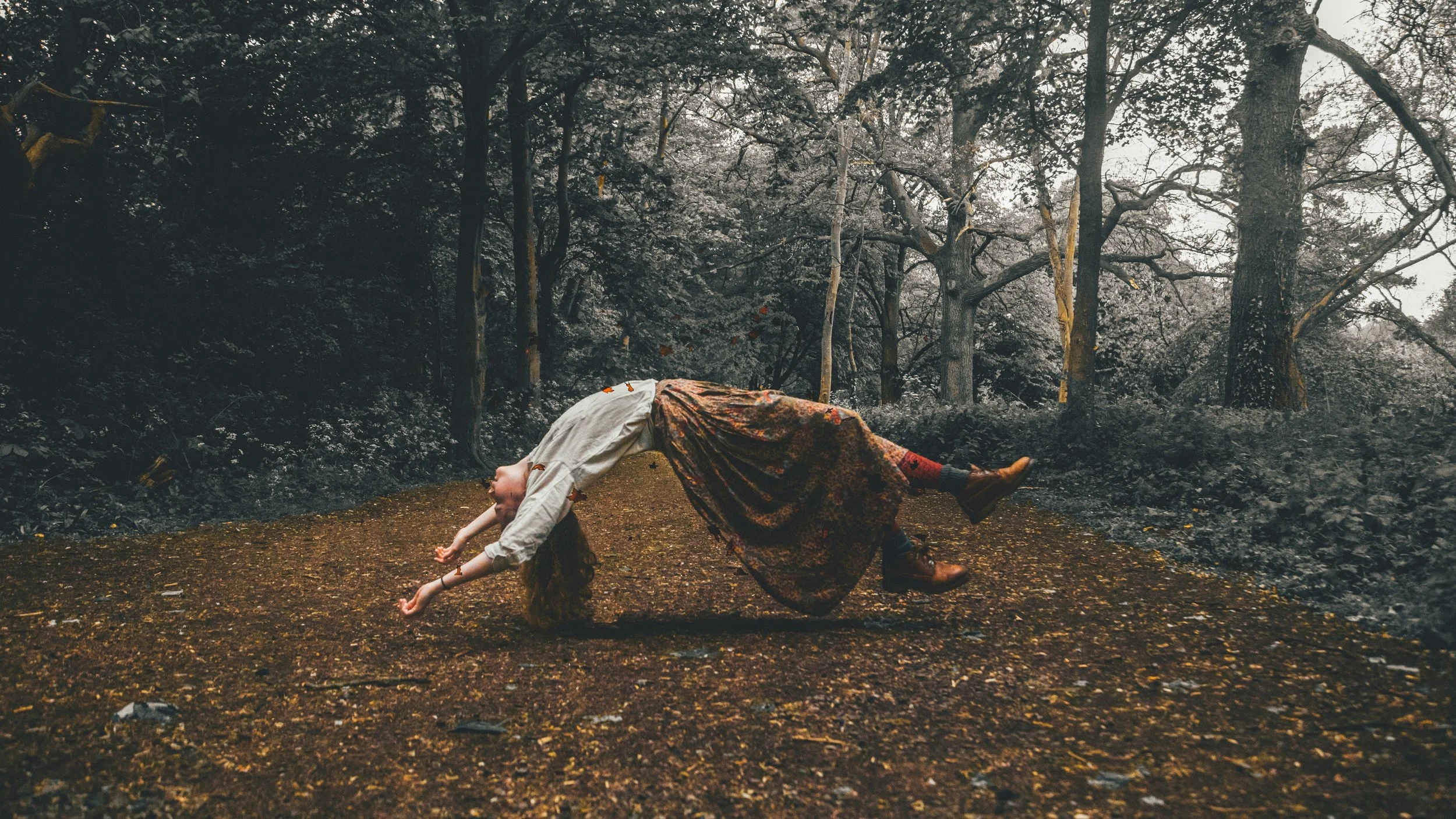
Photo by Rob Potter on Unsplash
Healer or Trickster? On Healers Taking Advantage of The Vulnerable
BY LISA MARIE BASILE
In a recent article in The Daily Dot, a popular influencer was called out for their “blurry” beliefs and work, overpriced but not actually handmade goods (as claimed) and abusive tendencies toward employees. The overarching message of the piece: Not every healer or influencer out there — no matter their follower numbers or beautiful Insta-curation — is worth their salt. Some, in fact, are downright theives.
I’ve always taken issue with people selling promises of healing without any real sense of accountability. Grandiose and often empty words (“light and love heals everything,” “all you have to do is manifest hard enough!” and “you have to invest in X to find abundance”) are distracting to people in rough situations. These are — I have been, and will be — people who want to be seen, validated, and healed.
I just can’t get past overpriced abundance rituals, the refusal to acknowledge the importance of shadow work, or concepts that aren’t grounded in reality. Because love and light and abundance rituals do not solve racism or poverty. And because telling people your cheap, badly-produced goods are ethically sourced hurts everyone at every level.
The thing is, it’s hard to tell the frauds from the sincere folks. I started noticing this several years ago, when I created Luna Luna (which obviously has a vertical around magic and ritual). I’d come across healers and gurus and guides who seemed to have it all together: Beautiful photos. Money. Bestselling books. They’d sell full moon serums or crystal-infused oils. They’d sell you candles that would attract money or heal a disease or find you a lover. How could one parse the capitalist who appropriates spirituality from the person who genuinely cared? And how can one ethically tout an object that ‘cures’ social and physical/mental ills, without acknowledging the many variables at play?
I would consider myself spiritual in specific ways, but this wasn’t always the case. I identify with the archetype of the witch, and I have carved space for ritual and meditation in my life, but it took a long time for me to get there. For one, I have leftover trauma from childhood catholicism; adhering to strict beliefs and associations (this color represents this outcome, for example) doesn’t quite sit right with me. I prefer chaos. I prefer to go off my gut. I prefer to study, learn, and then take what feels good for me. My practice these days is mostly based on meditation, journaling, and connecting with nature.
So when I see someone make grand promises, that you have to do this to do this, or believe this to achieve this, or buy this to get this— especially to the vulnerable: the poor, the sick, the disabled, the traumatized, the abused — it doesn’t sit right with me.
Sometimes those promises come in the form of feigned care and support, when at the bottom of it all was an Instagram strategy and some pretty words.
I don’t believe that any one person can have the answers. And I don’t believe that anyone should peddle goods to people when they don’t have the integrity to back it up.
Among those promises would be actual spiritual advice despite questionable stuff, like the not-so-ethical production of goods, plagiarism of both products and feel-good quotes, and employee mistreatment. This likely happens a lot, but all of this came up in the Daily Dot article about this one specific person.
So what do we do about it all?
I wrote a book about self-care and regenerative rituals, so I spent a lot of time thinking about this sort of thing. When writing my book I wanted to make sure it was a guidebook, not a rulebook. That any practice I wrote of wasn’t from a closed culture — and that anything referenced I cited in the Resources section.
I wanted to make sure my book was a byproduct of my experience, not a way or promise or path. That the reader would be self-healing using my prompts, that I would not — and could not — be healing them. That, if anything, the book and the reader would enter into a conversation about healing together.
That’s the thing about healing. It has to happen in a safe space. Before I started really working to heal my lasting trauma from childhood — the obsessive memories of homeless shelters, assault as a child, family addiction, foster care, chronic illness — I found comfort in all sorts of untoward things.
This included drinking all night with friends who thought getting obliterated was the answer. I found comfort in false friendships or relationships, where people wanted to be loved more than they want mutual loving care. I turned to fraudulent psychics here and there for advice, and of course there were those who’d want to dig into my pockets rather than genuinely help.
The point is, we take comfort and care wherever we can find it — and sometimes, because of pain, loneliness, poverty we turn a blind eye to gut feelings. I’s hard to know if it’s helping or prolonging the wound.
The Internet version of this really is the abundance of healers and guides out there. Many of them are wonderful — and many are my friends, who take special care to create products and books and ideas around self-care and healing products — but many are there for fame and fortune, not to help.
They want to preach at you, not have a conversation. They claim to know the answers, rather than admit that they’re always going to be searching. They lack self-awareness, charging big money to people who literally are seeking magic work because they’re on the verge of eviction.
It’s hard to know what sort of intentions people have. Sadly, there’s just no cut or dry answer. How could there be? I think our gut has to do the work. But for the gut to work we have to have self-compassion and give ourself the space and time to let our intuition work. This is a process — a process damaged by hope being dashed by scammers.
We could spend $45 on a healing candle from someone with 50,000 followers and a beautiful Instagram page, someone who hasn’t provided insight or vulnerability elsewhere or even a glimpse into their own real lives. Or we can buy a tarot session or a book or a crystal from someone who is less concerned with a perfect, sort of distant, who-are-you-really? branding, whose track record shows an active interest in trauma recovery or healing or helping others before they started earning money from it. And even the above is an oversimplification.
If something doesn’t feel right, even if that something has a quarter of a million followers or is quoted in wellness articles, you are by no means obliged to look to it for wisdom.
I say all of this because I think on my own mother, my own friends, and myself — and all the times we needed a hand, a source of inspiration, a talisman of hope, or a guide to getting back to ourselves. It would be a real shame to get a candle or a reading or a downloadable guide that came from someone who wasn’t sincerely invested in our care, who only wanted to make money, and who used unethical means to produce a product, from conception to production.
I read a piece the other day by Kaitlin Coppock for Sphere + Sundry. It’s a comprehensive look at fraud-work in the spiritual and healing communities, and it goes into much better detail than I can. It covers:
“Tips for distinguishing real practitioners of astrology, witchcraft, and spirituality from self-serving charlatans taking advantage of the mounting witch-strology renaissance. And lastly, recommendations for how professionals (or aspiring professionals) can navigate related ethical considerations.”
I recommend reading the above and asking questions for yourself. Stay alert, be good to yourselves, and don’t let influencer numbers drown out your intuition.
Lisa Marie Basile is the founding creative director of Luna Luna Magazine—a digital diary of literature, magical living and idea. She is the author of "Light Magic for Dark Times," a modern collection of inspired rituals and daily healing practices. She's also the author of a few poetry collections, including 2018's "Nympholepsy." Her work encounters the intersection of ritual, wellness, chronic illness, overcoming trauma, and creativity, and she has written for The New York Times, Narratively, Sabat Magazine, Healthline, The Establishment, Refinery 29, Bust, Hello Giggles, and more. Her work can be seen in Best Small Fictions, Best American Experimental Writing, and several other anthologies. Lisa Marie earned a Masters degree in Writing from The New School and studied literature and psychology as an undergraduate at Pace University.
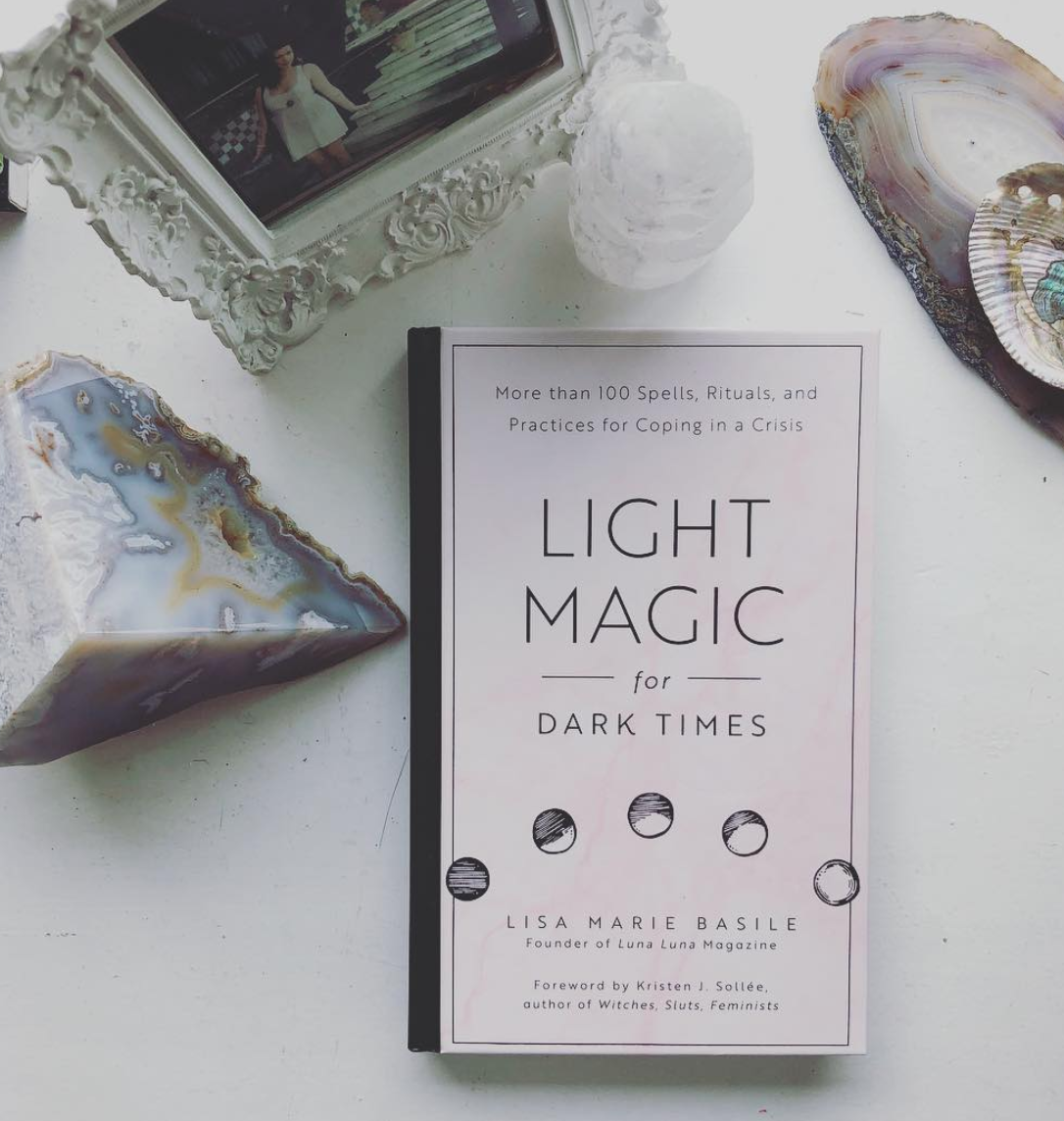
A Grimoire For Self-Love: A Peek At Light Magic for Dark Times
BY LISA MARIE BASILE
Welcome to a sneak peak of my grimoire of self-development and ritualized living!
Though the archetype of the witch is part of what inspired LIGHT MAGIC FOR DARK TIMES, it’s also a book of what inspired me about people I love and care for, like my mother, who has had to grow and regrow several times over; like the people I know who have used their voice for personal and community change in the face of systemic oppression. It’s a book of love and care, of rebellion, of reclamation, and growth. That energy is magic.
I wrote LMDT after an editor actually spied a ritual of mine here at Luna Luna and asked me to expand on it— and so it is, in many ways, the unofficial Luna Luna grimoire.
Here are all the places you can pick up the book. And here’s a look at what’s inside:
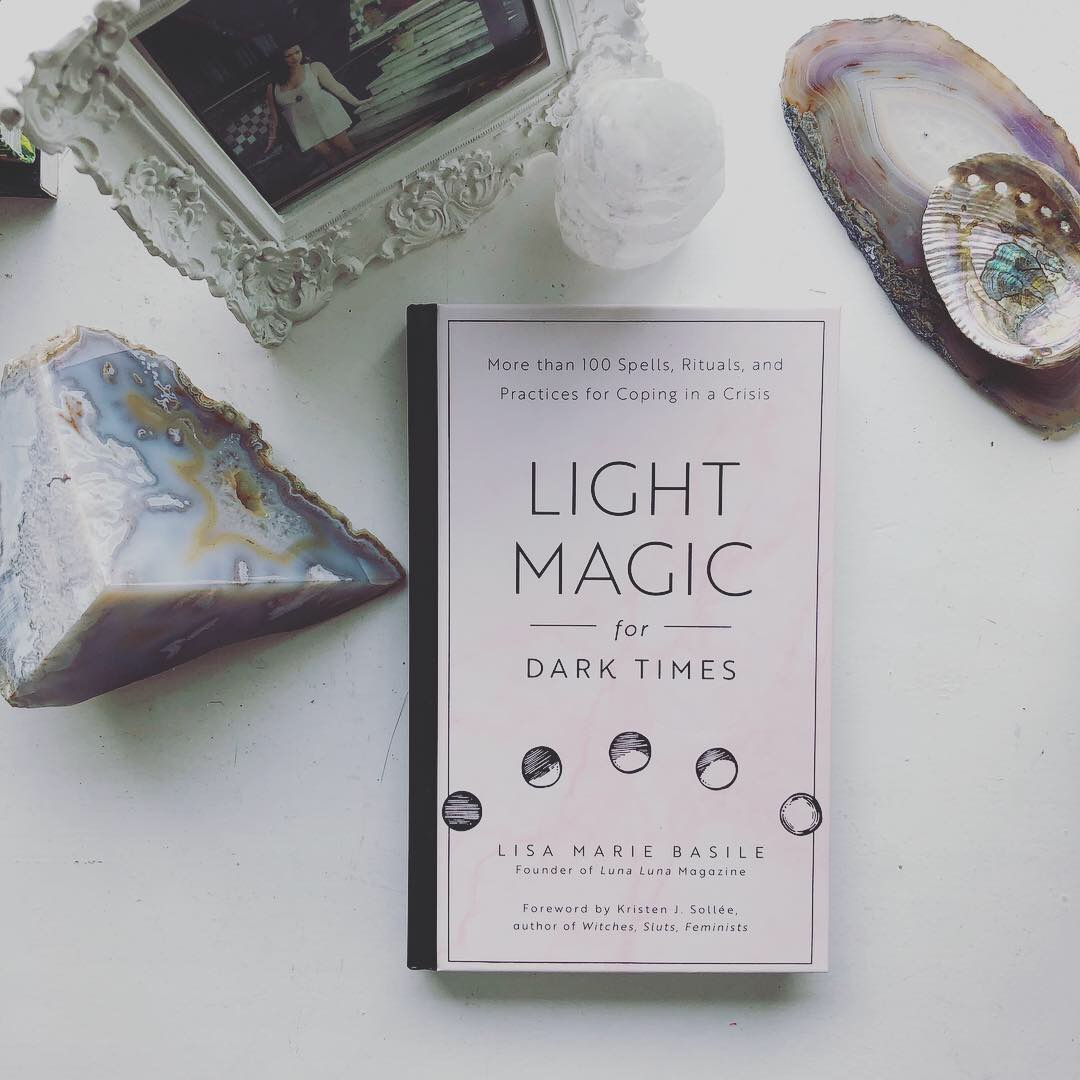
Light Magic for Dark Times is all about ritualizing your life and finding your inner magic — by embracing the light and the shadow together.
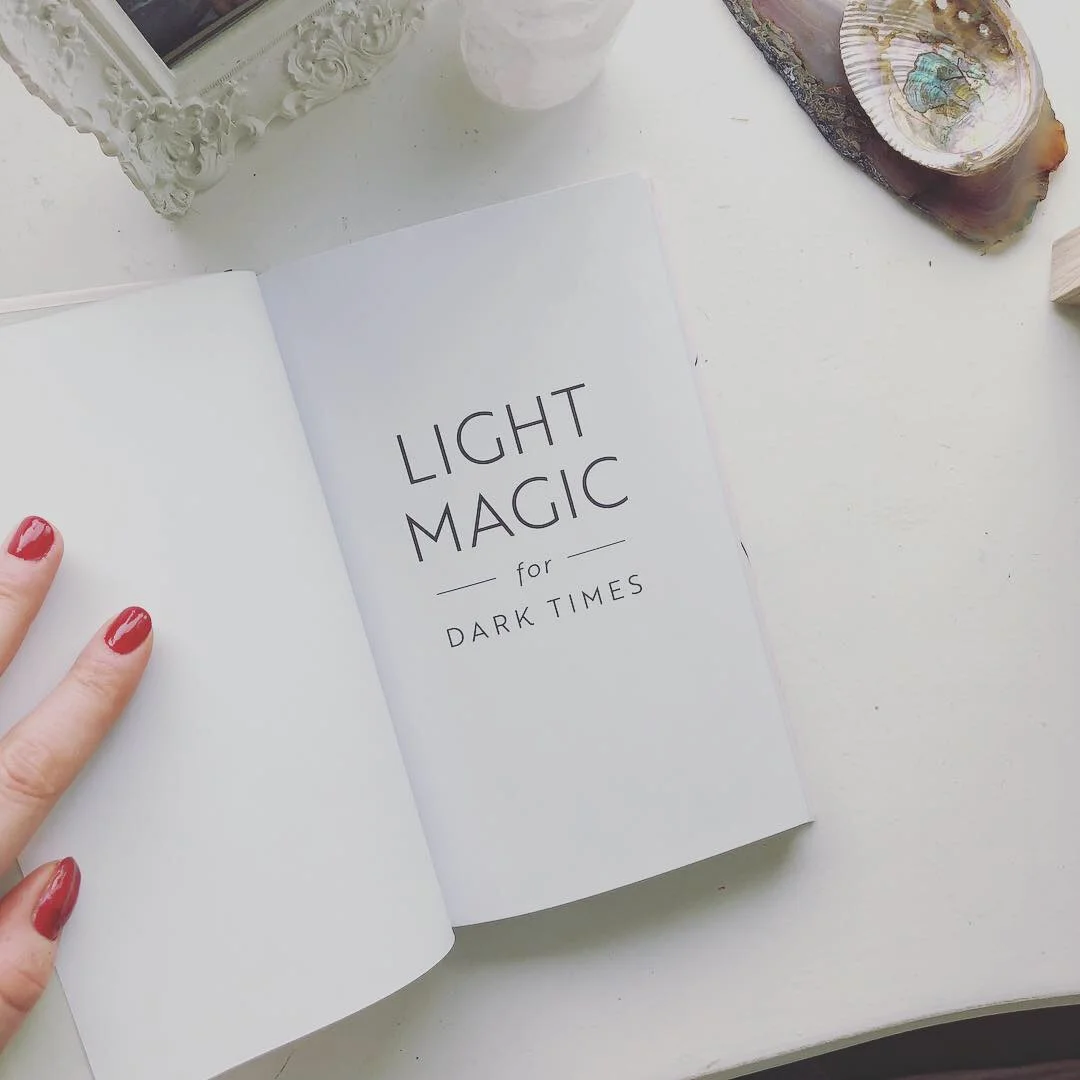
It was written as a guide through the self.
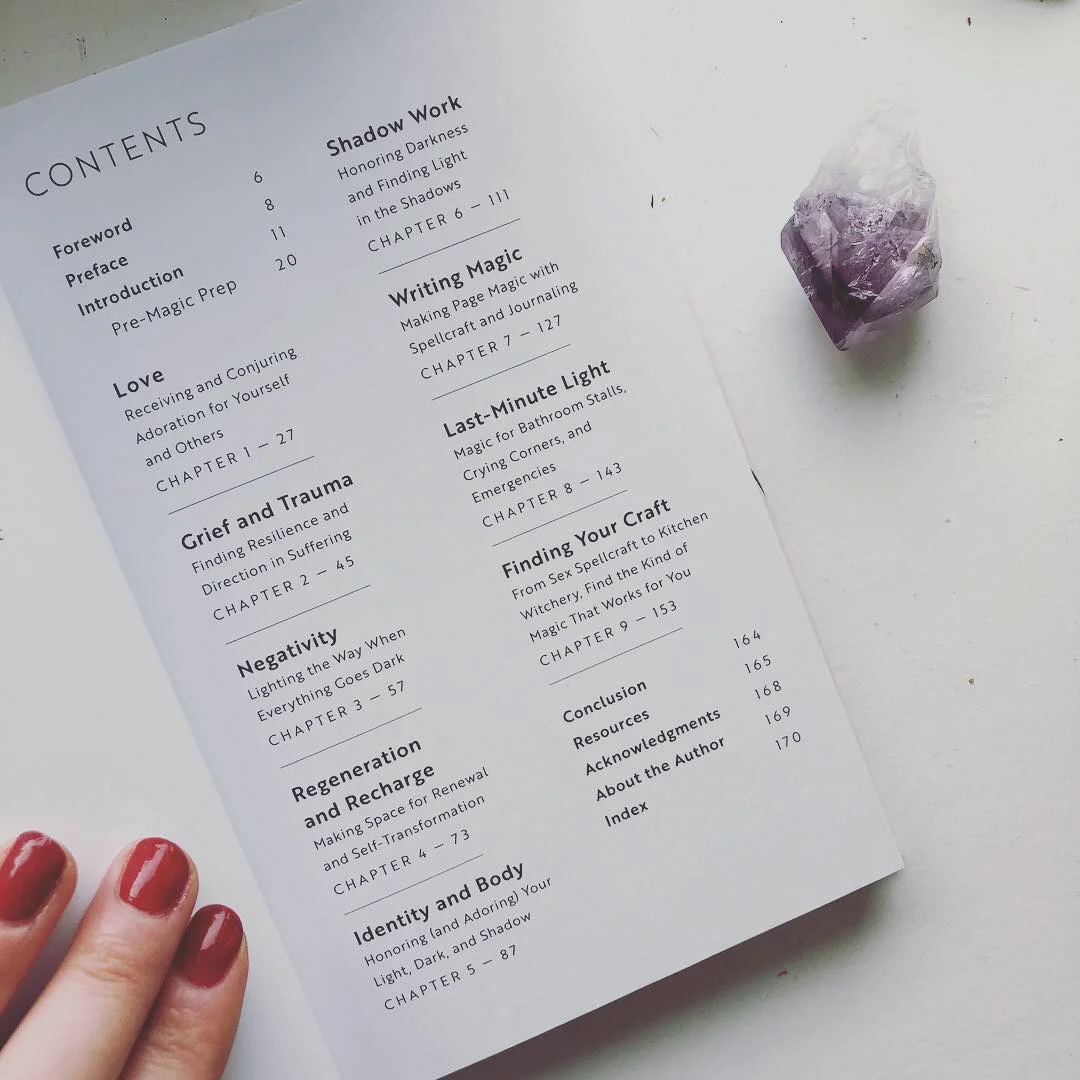
The chapters cover everything from journaling and sigil creation to finding your own personal magic and integrating daily ritual.
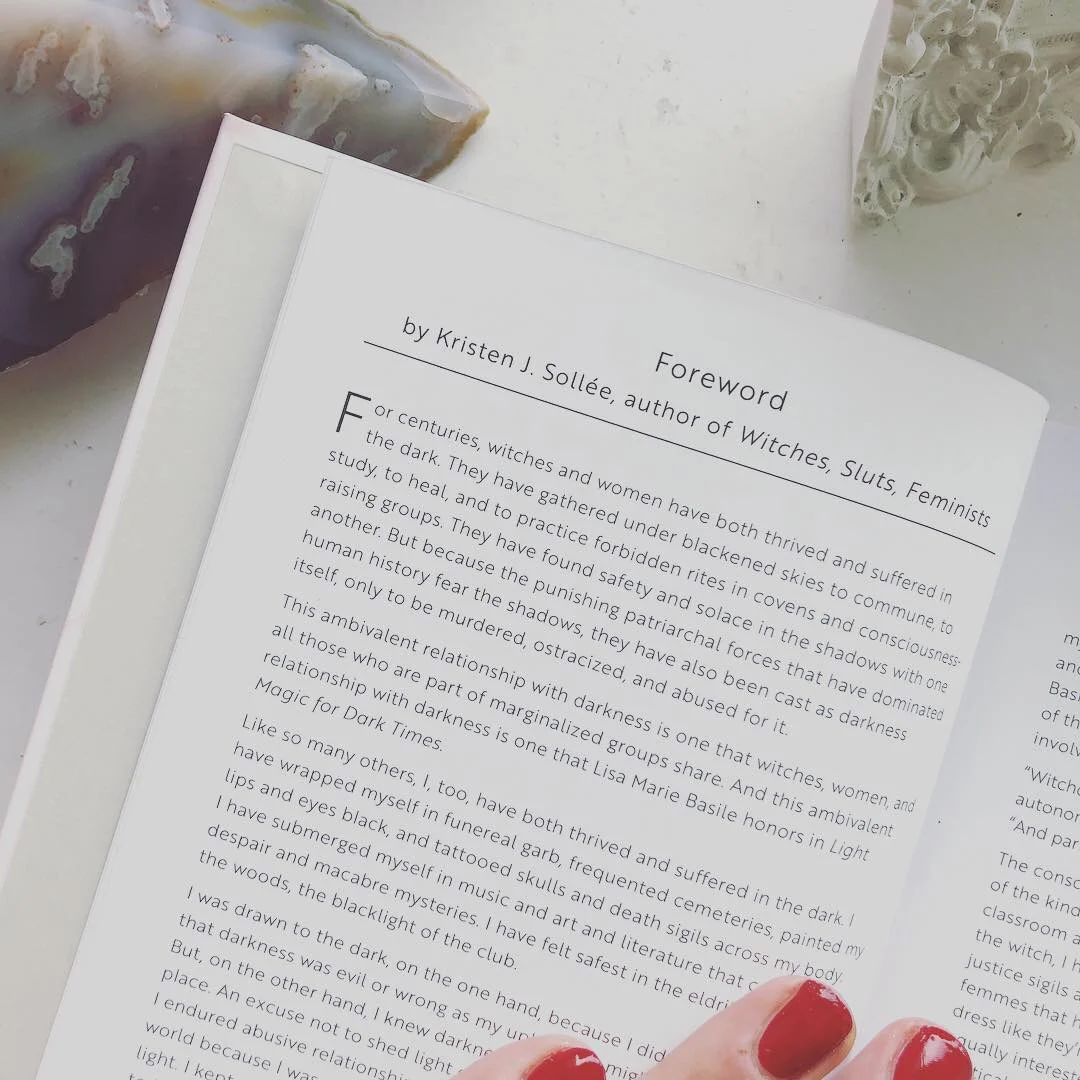
The foreword was written by the inimitable Kristen J. Sollée. You should read her book, Witches, Sluts, Feminists: Conjuring The Sex Positive.

Because I’m a poet, you’ll see a lot of literary references woven throughout the book.
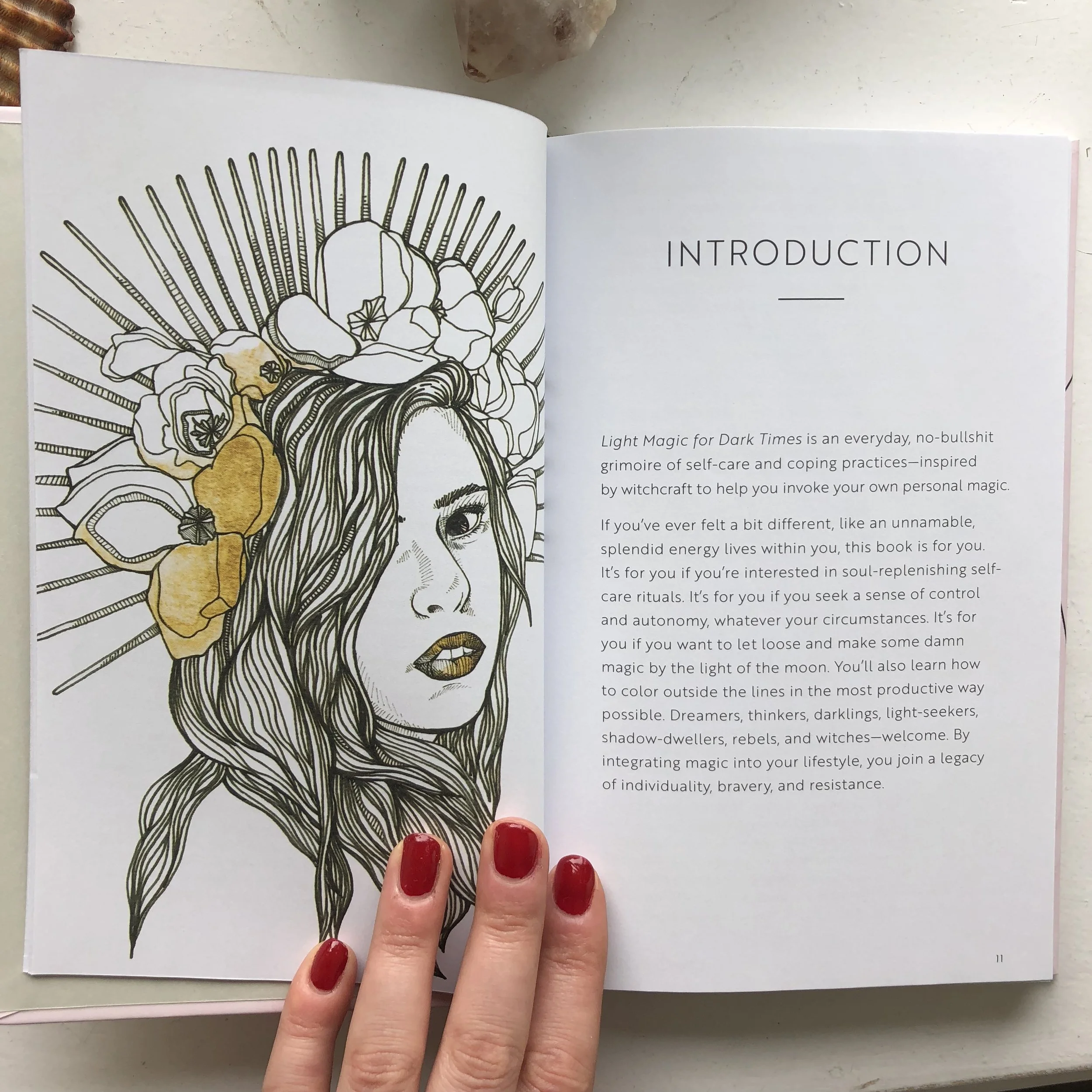
Light Magic for Dark Times is for the rebels, dreamers, shadow-dwellers, thinkers, darklings, & light-seekers amongst us.

You can find more inside peeks below
Lisa Marie Basile is the founding creative director of Luna Luna Magazine and the most recently the author of "Light Magic for Dark Times” and "Nympholepsy." Her work encounters the intersection of ritual, wellness, chronic illness, overcoming trauma, and creativity, and she has written for The New York Times, Narratively, Sabat Magazine, Healthline, The Establishment, Refinery 29, Bust, Hello Giggles, and more. Her work can be seen in Best Small Fictions, Best American Experimental Writing, and several other anthologies. Lisa Marie earned a Masters degree in Writing from The New School and studied literature and psychology as an undergraduate at Pace University.
This Friendly Depression Workbook Provides Support & Actionable Steps
BY LISA MARIE BASILE
As World Mental Health Day trends across social media, I’ve felt both sorrowful and appreciative. On one hand, it’s hard to see just how many people suffer with various forms of mental illness. On the other, I know intimately how damaging it can be to shame and silence those who suffer, and I’m glad we’re changing that. That suffering can be passed down, internalized, neglected. It rots away at us, our families, our communities, and our cultures.
It seems we will always battle with mental illness, whether it’s chemical or triggered by one’s experiences, or both—but there are options. From medication to mindfulness, from simply speaking as a way to release the albatross, to learning to work with your own triggers and cycles (I think of it as intuiting when the sea is coming to flood shore), everyone will explore different approaches, unique to their needs.
And if we are always fighting against the illness, the least we can do is create an judgment-free and compassionate environment for one another.
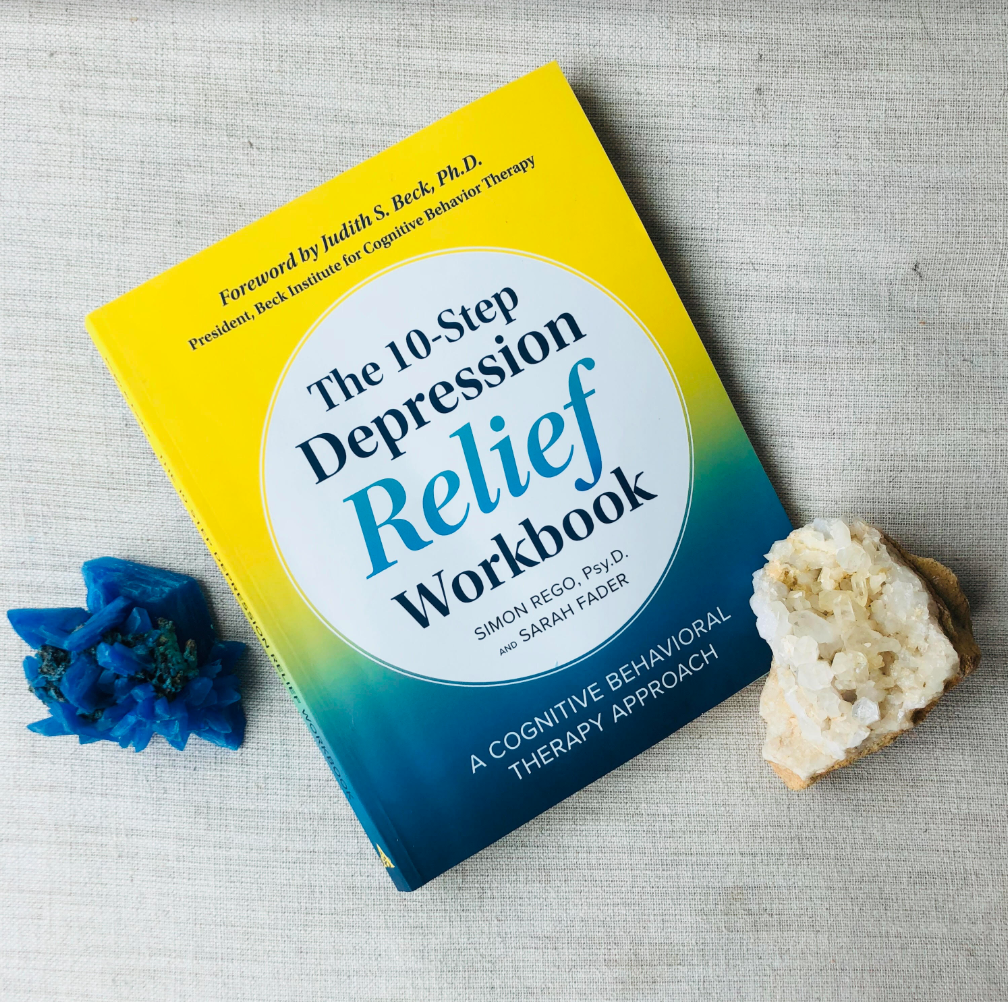
I recently received The 10-Step Depression Relief Workbook: A Cognitive Behavioral Therapy Approach, written by Simon Rego, Psy. D. and Sarah Fader, my friend and also the creator of Stigma Fighters. The book creates that environment.
I was so glad to have received it as well, as I’ve always lived with a lingering anxiety and depression. My mental health challenges are deeply tied to life changes and times of powerlessness, rooted in my past: As a kid, both of my parents suffered with addiction, and we lived in homeless shelters and then we went into foster care. I’ve come to recognize what may set my depression and anxiety off (moving home or job, being thrown for a loop, not feeling cared for or supported), and living with these issues is like walking on a tight rope. I’ve come to force myself to understand that it’s all a balancing act, and that that’s just the truth. That said, I’m grateful to have been able to manage my symptoms.
When I received this book, I was in the middle of a move. Perfect, right? I hadn’t fallen into the depths, but I was feeling it. That undercurrent, its surging, its quiet little hum. And so, I turned to the workbook, which I appreciated very much because of its kindness and its approach.
First off, the book starts off with an intro that makes it clear that depression is a real illness—not just a bit of melancholy that sometimes makes us feel blue. It also notes the very real risks of depression—including the physical. Because chronic depression can lead to heart attacks, diabetes and stroke—all of which have been verified by science.
Next, it discusses the barriers to treatment that many people and countries face—limited access to therapy, medical treatments, or a lack of trained healthcare providers. (Just take a look at this study around the prevalence of Brazilians living without depression treatment). For this reason, the workbook uses a cognitive behavioral therapy step-by-step approach, which can help find a workaround to some of those barriers. It specifically mentions that it may be best suited for those with mild depression or people who are hesitant about medical treatment.
Written in a friendly and clear voice, it helps the reader first get honest with themselves: What is depression, what are the symptoms? What are your symptoms? It also offers some glimpses of Sarah's own experiences—and asks the reader to share theirs. This feels very much like a loving conversation rooted in both gentleness and serious action.
It then moves to discussing the therapeutic process—and CBT, which offers action items for managing depression. CBT, defined, means, "Cognitive-behavioral therapy (CBT) is a form of psychotherapy that treats problems and boosts happiness by modifying dysfunctional emotions, behaviors, and thoughts. Unlike traditional Freudianpsychoanalysis, which probes childhood wounds to get at the root causes of conflict, CBT focuses on solutions, encouraging patients to challenge distorted cognitions and change destructive patterns of behavior."
The book goes on to discuss other therapies as well, just so you know the differences—which I appreciated. Following chapters include recognizing and workshopping problem areas (like replacing negative thoughts, and enhancing objective thoughts), making a plan for yourself, learning to not procrastinate when it comes to tasks and self-care, and learning to develop lifestyle skills and finding gratitude.
What I like most about the book is that it very much sounds like a kind and objective friend who wants you to help yourself and be happy, in whatever small step feels right for you. Its focus on both the short-term (immediate behaviors) and the long-term (learning mindfulness and maintaining wellness, even when not depressed), is important. The fact that is acts as both a triage and a holistic coach is so key, I think. This helps the reader get some relief while thinking about the bigger picture.
I recommend this book to anyone who wants to peer inward, discover healthful and pragmatic tools to manage depression and create a step-by-step approach to taking action.
I also recommend checking out CEO Sarah Fader's Stigma Fighters, which is a mental health non-profit organization (founded in 2014) dedicated to helping real people living with mental illness.
As the site says, "There are teachers, doctors, lawyers, psychologists, actors, writers all living with mental illness. These are the stories that need to be told; the people who seem to be “regular” or “normal” people but are actually hiding a big secret. They are living with an invisible illness. They are struggling to function like the rest of society. It is Stigma Fighters’ mission to raise awareness for people who are seemingly “normal” but actually fighting hard to survive. If you are living with mental illness and you want to share your story, please fill in the form HERE. We look forward to fighting the stigma of mental illness one story at a time."
i hope that whatever your path, and whatever pain you're feeling, you take the time to care for yourself. You deserve it.
SUICIDE HOTLINE
1-800-273-8255
Lisa Marie Basile is the founding creative director of Luna Luna Magazine--a digital diary of literature, magical living and idea. She is the author of "Light Magic for Dark Times," a modern grimoire of inspired rituals and daily practices. She's also the author of a few poetry collections, including the forthcoming "Nympholepsy." Her work encounters the intersection of ritual and wellness, chronic illness, magic, overcoming trauma, and creativity, and she has written for The New York Times, Narratively, Grimoire Magazine, Sabat Magazine, The Establishment, Refinery 29, Bust, Hello Giggles, and more. Lisa Marie earned a Masters degree in Writing from The New School and studied literature and psychology as an undergraduate at Pace University
Sarah Fader is the CEO and Founder of Eliezer Tristan Publishing Company, where she is dedicated to sharing the words of authors who endure and survive trauma and mental illness. She is also the CEO and Founder of Stigma Fighters, a non-profit organization that encourages individuals with mental illness to share their personal stories. She has been featured in The New York Times, The Washington Post, The Atlantic, Quartz, Psychology Today, The Huffington Post, HuffPost Live, and Good Day New York.
Dr. Simon Rego, a licensed clinical psychologist with close to 20 years of experience in Cognitive Behavior Therapy (CBT) and other evidence-based psychological treatments, is currently Chief Psychologist, Director of Psychology Training, and Director of the CBT Training Program at Montefiore Medical Center and an Associate Professor of Psychiatry and Behavioral Sciences at Albert Einstein College of Medicine in New York
The Realities of Sexual Harassment & Assault in Professional Communities
Joanna C. Valente is a human who lives in Brooklyn, New York. They are the author of Sirs & Madams (Aldrich Press, 2014),The Gods Are Dead (Deadly Chaps Press, 2015), Marys of the Sea (Operating System, 2017), Sexting Ghosts (Unknown Press, 2018), Xenos (Agape Editions, 2016), and the editor of A Shadow Map: Writing by Survivors of Sexual Assault (CCM, 2017). They received their MFA in writing at Sarah Lawrence College. Joanna is the founder of Yes Poetry and the managing editor for Luna Luna Magazine. Some of their writing has appeared in Brooklyn Magazine, Prelude, BUST, Spork Press, and elsewhere. Joanna also leads workshops at Brooklyn Poets. joannavalente.com / Twitter: @joannasaid / IG: joannacvalente
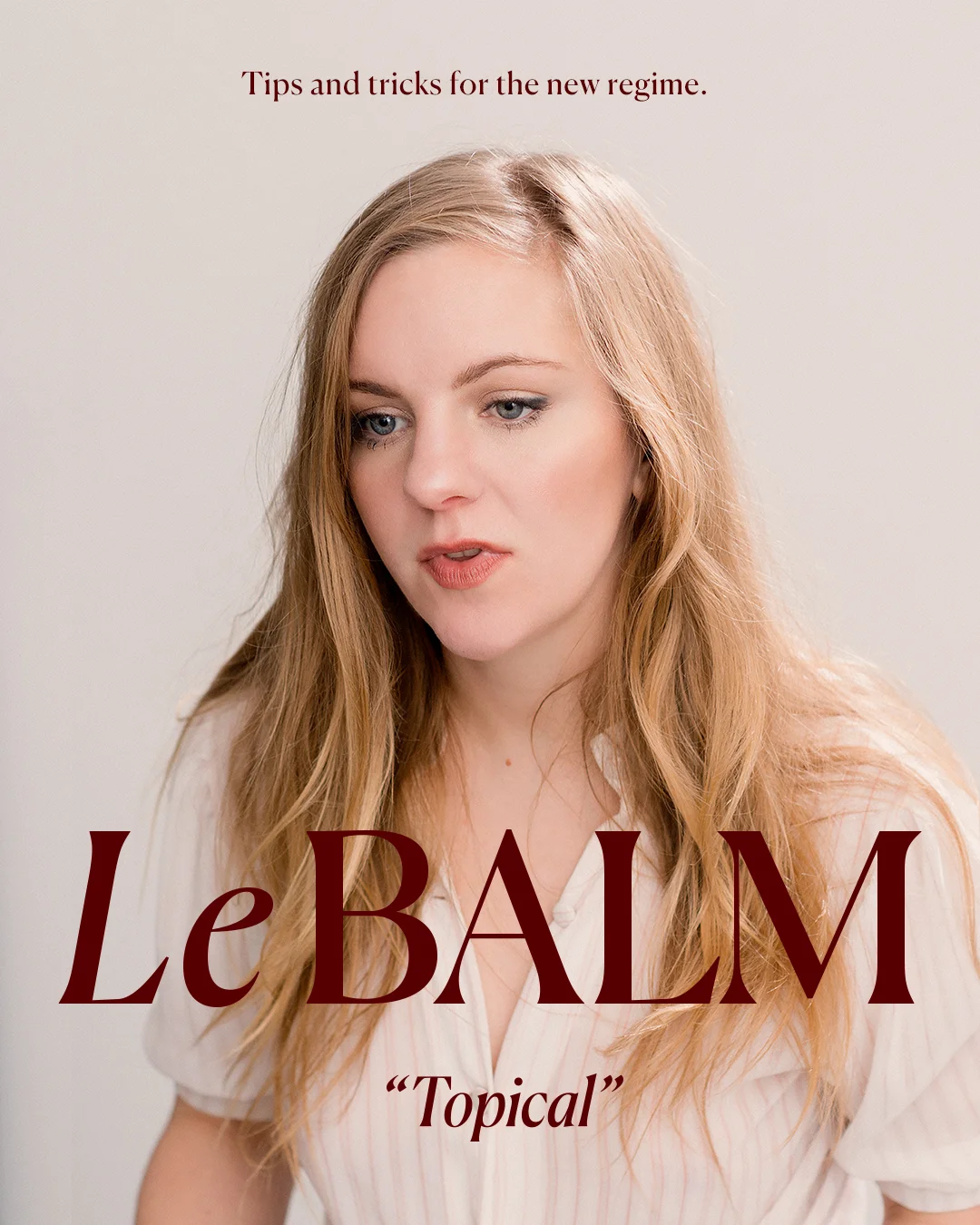
An Interview with Le Balm’s Cecilia Corrigan & Monica Nelson
BY DEIRDRE COYLE
When I watched the first episode of Le Balm—the new web series by Cecilia Corrigan and Monica Nelson—I cackled, then anxiously touched my face to check the quality of my skin, then cackled some more. Le Balm follows a makeup vlogger named Madeleine who decides, after the 2016 presidential election, to convert her many followers into radical activists by smuggling coded messages about overthrowing the regime into her beauty product reviews and tutorials.
In the past year, women's media has been full of articles on self-care as both coping mechanism and radical act. Le Balm questions the validity of this rhetoric with dark humor and compassion. As Corrigan wrote to me in an email, "Dealing with questions about complicity, beauty standards, and the privilege of self-care in a time of political disruption, the series brings together the worlds of our current political climate of anxiety and the messages of women's beauty culture."
Despite a shaky connection between New York and Los Angeles, I video chatted with Cecilia and Monica in the hours before their West Coast launch party.
So I first wanted to ask how you came together to work on this project, and where you’re both coming from?
Cecilia: I met Monica when we were both working on another short film, Crush, which was another piece that played with dark comedy to critique a certain sector of culture—in that case, the art world. We have pretty different backgrounds—my background is academic, and I started out in poetry, now I write and perform weird comedy, and Monica has been working in branding and advertising for years.
Monica: Different backgrounds, for sure. But we share an interest in using narrative and humor to make a cultural critique, that’s sort of the space where every idea we tossed around landed. Cecilia is amazing at creating these intuitive comedic characters that mirror back a very honest reality.
Cecilia: One of the things I like about this character is that she’s almost uncomfortably familiar, like she’s just taking the idea that self-care can be a radical political act to its natural conclusion. So even though it’s parody, it also feels uncanny. I think we were interested in that discomfort.
Monica: Yeah, and there is truth to it as well. The idea for Le Balm started at a women’s group that was organized the week after the election. Everyone was trying to figure out how to respond. Then Cecilia was kind of joking about doing a beauty guru character who’s having a political awakening after the election, and I was like "we should actually do that." That’s how Le Balm got started.
Cecilia: Yeah, that group was cool; I know a few similar groups cropped up that winter. This one was called Feminists Against Fascism—it was all women, a lot of them worked in media, many of them were activists. I found myself thinking about the beauty industry and "women’s media" a lot at that time, and about the idea of a coastal elite. The election brought so much misogyny to the surface, but also revealed so many of the limitations of a feminist politics that isn’t intersectional.
In a way, is this character in Le Balm also grappling with these questions?
Monica: Yeah, in her own way. She’s just taking it very, very literally.
Cecilia: It definitely comes from a relatable place. I first got the idea in a moment of recognizing my own ridiculousness, when I caught myself deeply stressing out about whether I should switch my moisturizer with the changing climate, and simultaneously freaking out about the terrifying political changes that seemed to be already affecting vulnerable people in a really immediate way. I was like, "wow I’m the worst." And you know, I think one of the things that saves me from going crazy is laughing at myself.
Monica: The idea of using what we know, and our own personal experiences seemed really important. I was shaken by the way that women were receiving information, and how it was being framed. All of a sudden all women’s media outlets turned to women’s causes, and you would literally read an article about a social justice cause and a moisturizer in the same typeface and tone. I still have screenshots from that time period that we would send back and forth. Literally posting these headlines that were like, "Are you bleary eyed because of the news? Here are some eye brightener tips."
RELATED: Interview with Sarah Forbes, the Curator of Sex
I did want to ask about the character. We don’t actually learn much about her background in the show, her story before she deleted all of her social media and then restarted it. But clearly she’s a privileged character: a young, attractive white woman able to make her living vlogging (she talks about her sponsorships in the first episode). Could you talk a little about how this character’s conception of "radical activism" is informed by these advantages?
Monica: This girl is earnest. That’s something that’s really important to us. This character did kind of exist in this bubble before the election. She was very sheltered and was able to create this whole ecosystem that was just hers. Her aesthetic was probably a little more decadent, or kitsch. But then her world was sort of blown. When we were briefing the team for the shoot, I would say "Imagine a girl that discovered politics and Garance Doré in the same day."
Cecilia: Yeah. She was definitely in a bubble before. I think a lot of people with a certain kind of privileged complacency felt like they had to become political, become "woke," right after the election. I imagined that whatever was going on with her in the lead-up to this moment, like whatever happened between the election and her new videos, was probably pretty messy. I think this is more than just a re-brand for her: I think she imagines that she’s going to be a real activist now. And in these videos we’re just watching her struggle to make makeup tutorials into political statements, about causes she just found out about and barely understands.
But I also find that struggle endearing: she’s striving to be better, she’s trying to use her influence for good, with, I think it’s called "cringe-worthy results?" She’s been in the business of selling self-improvement for a while, but now she wants to do a make-over on her soul, like Cher in Clueless (who, incidentally, is also a privileged white woman). It’s easy to make fun of people like her, but we decided not to make it a total mockery. It’s a complex situation, right? She’s trying to get involved, but she doesn’t know what she’s doing. And in the last episode I think we see her realizing that she might not actually be offering any useful advice, or helping anyone, by telling them that if they have self-confidence and look good it’s going to protect them from real political and legislative threats to their safety.
Monica: She’s just like, "the show must go on!" And, just like everyone, she’s trying to find new meaning and purpose in what she’s doing. She’s thinking, "I have this audience I could educate about these things."
Cecilia: Monica’s direction really helped bring that out, for me, when I was trying to find the character in the performance. At first I was doing her in a really over-the-top, you know, like, "Hiiii Guys!", like, vocal fry, totally kind of bug-eyed and scary, which is actually—you do see a lot of that. But Monica was like, "This person should be someone that you like. You have sympathy for her, she’s really different, and she has all these different interests, but she’s basically someone that you might know, or meet at a party, that you have empathy for." I do feel empathy for her.
Monica: I thought it was really important that she have depth, and that those things came through. That it felt like she was an actual woman struggling with these things.
Cecilia: Basically what I’m saying is that Monica was like, "Try doing good acting. Like that, except with acting."
Are you worried about the NSA watching the series?
Cecilia: Um. No.
Monica: It’s more like what if the beauty industry NSA sees it. But, actually it’s been funny having interviews with beauty brands. I show them a few episodes and they are laughing and fully understanding what we are doing, but then they say, "This is so funny, it’s amazing, we could never do anything like this."
Cecilia: And we knew that. The reason that we didn’t really pursue doing this like for a brand or even a magazine per se, is because we wanted it to exist on its own in a modular way, which adds an uncanny tone. It looks and feels like a beauty vlog. But at the same time it’s dark, character-based comedy. And the intersection of those things is unusual: it’s just its own thing. Hopefully in an enticing way.
Did you want people to initially view it as a real beauty vlog?
Cecilia: I think that the primary way to read it is as comedy, at least that's our intention. But it's presented in a coy way. But if people read it as a beauty vlog, that’s awesome.
In an email, you’d mentioned wanting to work in a "venn diagram of beauty journalism, political commentary, and unhinged comedy." Could you talk more about how those ideas overlap in Le Balm?
Monica: We had so many conversations about how we wanted to put it out. And at the end of the day, we just said, "This is original content." It’s scripted, but it’s playing with meta-reality. There are heightened moments, but it could be real, on some level. Nothing we’re talking about is fantasy. And I think that realism is something both of us are interested in exploring, that essayistic quality. We’re both interested in creative work as a critical practice. But then again, this piece goes back to some of the things we know best. Performance for Cecilia, and for me, creating "content." Le Balm uses those two things to write an essay about this very specific sector of our culture.
Cecilia: Absolutely: the performance of branded content creation. Le Balm is an imitation of vlogger culture, and a tribute to it. It’s comedy about beauty content and it also is actual beauty content, in a way. It’s an expression of this weird moment we’re living through, rendered through this really simple and clear concept. It feels very conceptual to me in that way.
Monica: I think it asks its viewer to imply the depth, and to read into it. I think that’s the type of content that I’m most excited about.
Cecilia: Yeah. I’ve always really loved stuff that lives in a certain frame but does something different inside of that frame. The work that excites me the most lives in a certain context but plays with people’s expectations. A lot of the ideas in Le Balm are everywhere right now, and there’s been some amazing journalism recently about the strange relationship between contemporary politics and beauty culture. Of course, Le Balm isn’t journalism, even if it is kind of essayistic.
Monica: I think it is rooted in documenting a real phenomenon. Now, beauty is a really powerful category, much more powerful than fashion, because of its ability to create such personal change. Historically, beauty industries have always boomed during political turmoil because beauty is something you can control. Like Elizabeth Arden and all these brands being like, "Red lipstick is empowering!" We have an episode about that. Maybe there is an innate truth to it, because you feel better. It’s a real feeling.
Cecilia: It does seem like there’s so much emotion attached to that space now, so much public feeling around beauty, skincare, makeup. It’s like the final market where people believe buying the right products could actually make them better people. So the character represents something I think is a huge part of life in America and the developed world right now. The new form of aspirational luxury is self-improvement: you want your skin to look better, you want to spiritually be better, politically be better. I think this character wants to believe what we all want to believe, to some extent, that we can have control over our lives and that we can prevent chaos from enfolding us by focusing on self-improvement.
Monica: Beauty is definitely an exercise in control.
Will there be more Le Balm, either in this form or another, in the future?
Cecilia: I’m working on a pilot that’s an expansion of this world.
Monica: I think we also like the idea of using it as a discussion piece. That’s the thing I’m the most excited about, is seeing what people get out of it. It’s been really fun to hear the reactions of people from different backgrounds. There are these funny signifiers that trigger things for people.
Cecilia: Yeah, one of the things I’ve noticed in comedy is that people, when things hit too close to home, tend to be kind of repulsed, they’re like, "Ugh, I hate that character," if they identify too much. Whereas if you’re more distant from the character, you just laugh.
Deirdre Coyle is a writer and goth living in Brooklyn. Her work has appeared in Electric Literature, Lit Hub, The New Republic, Hobart, Joyland, and elsewhere. Find her on Twitter at @DeirdreKoala.
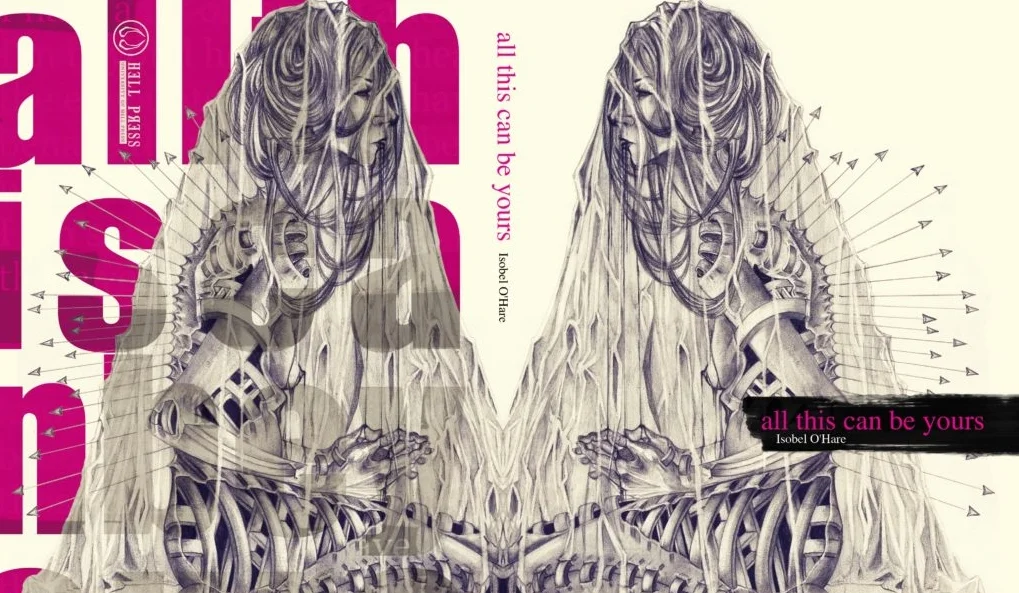
Poet and essayist Isobel O’Hare is saying more with less in the recently released all this can be yours.
The Text Is My Enemy: Erasing The Patriarchy With Isobel O'Hare
"The erasures are transformational, I think, in that they mutate the original messages of the statements into my own vision of the truth behind them. It’s sort of like wetting a sheet of paper covered in invisible ink and seeing the message hidden there."
Read More
Alice Teeple
Dear Jesse, by Andi Talarico
BY ANDI TALARICO
Dear Jesse,
Happy 29th birthday in prison.
Dear Jesse,
I write this to you on your 29th birthday, which you’ll spend in prison.
Dear Jesse,
Happy Birthday, little brother, in prison.
Dear Jesse,
I meant half-brother. It matters.
Dear Jesse-
I don’t know how to write this letter. I don’t know how to do it.
Dear Jesse-
I’m sorry.
Dear Jesse,
I hate you.
Dear Jesse,
Her life mattered too.
Dear Jesse,
She was 23. She was 23 and you gunned her down over $60 worth of shit heroin. You did that.
Dear Jesse,
I hate you.
I hate you for making this family the wrong kind of poor. A snarl of statistics on rural poverty, a tragedy so common, so small, you’re not even a footnote in the 10 page New Yorker article on the opioid epidemic. I read it on the train to work. I read a clinical article on the pharmaceutical industry on the train to work in New York City. In my ears, airpods scanned the highs and lows of Chet Baker. The most distant mirror.
I read about your world at arm’s length. I thought of you saying-
“Fuck you, Andrea, and your perfect fucking life.”
“Give me 20 bucks, Andrea. I know you got it.”
“You’re not better than me.”
I’m not.
I am.
I’m not.
Dear Jesse,
I watch your arrest on the news. They show a picture of the dead girl on the bottom right corner of the screen. The reporter asks you what you have to say for yourself. You snarl,
“Get out of my face.”
I am.
I’m not.
I am.
Dear Jesse,
I know you’re no broken branch on a perfect family tree. Not even a tree, really, a snarl of a thorny bush, really, a tangle of blighted limbs, really. To call anything that happens here cyclical is to bestow too much order upon it. Really.
Dear Jesse,
We have different fathers. Yours was not a great man. Let’s say that. Let’s remember that when his chemicals crested or cratered, the wrong pill, say, the wrong smoke, the wrong spike, the wrong sniff, it usually ended badly for our mother. You’re too young to remember her broken arm. You’re too young to remember when he still drank. I watched him pour a beer over her head during an argument. I watched her hurl a glass ashtray at his face and almost blind him.
Dear Jesse,
I remember.
Dear Jesse,
I was seven when you were born, barely not a baby myself. I learned how to love a new human through you, your bright brown eyes reflecting everything you saw around you, new and holy through you. You, on my hip. You, taking the bottle in my hand. You, a small version of me. You, making a big sister of me. You. You named me DeeDee. I named you Young King. I wanted to give the world to you. You.
Dear Jesse,
Our mother joked that she named you for Jesse James. She always liked the bad boys best.
Dear Jesse,
Your father was one of the worst.
Dear Jesse,
I know it was right after he died that you spent your first bout in Juvie. What were you, twelve? Thirteen?
Dear Jesse,
I know that you chose violence over grief, or violence through grief, or violence as grief, or that maybe violence is a grief, or that maybe grief is a violence in that it can murder the person bearing the weight of it.
Jesse,
It is not lost on me that your drug of choice is a pain-killer.
Dear Jesse,
I love you.
Dear Jesse,
I hate you.
Jesse,
That poor woman. I grieve for her life.
Jesse,
You poor child. I grieve for yours as well.
Jesse,
The letter I send will say just this,
“Dear Jesse,
Try to have a happy birthday. You know I’m here if you need books. Love you, little brother.”
Andi Talarico is a Brooklyn-based writer and reader. She’s the curator and host of At the Inkwell NYC, an international reading series whose New York branch meets at KGB Bar. She's taught poetry in classrooms as a rostered artist, and acted as coach and judge for Poetry Out Loud. In 2003, Paperkite Press published her chapbook, Spinning with the Tornado, and Swandive Publishing included her in the 2014 anthology, Everyday Escape Poems. She also penned a literary arts column for Electric City magazine for several years. When she’s not working with stationery company Baron Fig, she can be found reading tarot cards, supporting independent bookstores, and searching for the best oyster Happy Hour in NYC.
Michael Ramstead
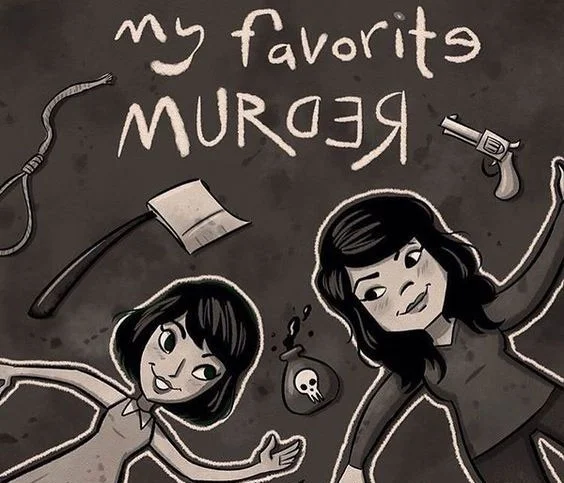
Community, Murder & Feminism on the Podcast My Favorite Murder
I have discovered a pretty well known podcast called My Favorite Murder. Two women, Georgia Hardstark and Karen Kilgariff, host the show. It’s considered a comedy podcast. Most people wonder: Where’s the humor in murder? Most would also argue that there is none. However, the humor comes from somewhere else. It’s part of this idea that in order to understand something better we have to get close it. In order to understand why people like Dennis Rader kill we have to pay attention and get closer. So, the humor then, it comes from a place of trying to conquer fear and come to a point of understanding.
Read More
Every Single Reason You Should Brag Your Pushcart Nominations
All the petty energies expended on downtalking the nominations or defending your own excitement is better spent, I promise. Like on resistance. Or supporting people. Or writing more
Read More
Yes, This is a Goddamned Witchhunt
BY LISA MARIE BASILE
I’m not trying to write a researched post or a think piece. I’m just writing to you, as a person. As an appeal.
I want to talk about the "witch hunt" against men by women and non binary folks. And about the way we talk about assault.
Many of us keep hearing people say that NOT ALL MEN (oh for the love of god, not again) have done "equally bad" things. Like, taking your dick out isn't the same as rape or wielding power or money over someone so they fuck you isn't the same as touching someone. There are lots of KINDS of assault, of course. We all know this. Although there are vastly different levels of short- and long-term trauma involved, what makes something that's nonviolent and space-invading okay if the other person didn't ask for it? There is a consent issue even if the body is not involved directly. Can we update this thinking, please?
Yes. There is difference between raping someone and staring at someone, both legally and ethically, but the fact of the matter is that ALL of these behaviors have gone un-checked for a long time and both require consequences. Different consequences, but consequences nonetheless.
The baseline consequence is that these assailants must look into the abyss and have it look back. They must know that they are predatory; they must live with it; they must die knowing it. Other consequences are legal, social, familial, professional, etc.
For society to be healthy, we need to tell our kids and men and boys (and everyone) that abuse of power is not okay in any way.
I’ve have heard a LOT of people saying that many of these stories coming out against Spacey, Weinstein, Louis, etc., are "bandwagon" stories. That they're tiring, not constructive, repetitive...and, the worst, "done for attention." (Because sexual assault attention is SO fun and validating, right?).
I have briefly considered these wayward opinions, which I have seen proliferated both by men as well as by smart, compassionate, and trusted feminists, women, and non binary folks.
But I disagree with these ideas.
If it feels like a "bandwagon" or a "witch hunt" it's because it is. For so long, women/non binary people have been told—either out loud, or quietly, through small, uncomfortable gaslighting moments and fucked up interactions—that our stories don't matter. Fuck yes, we have a hunt going. Do we sit inside while others ravage through the night for change? Or do we (those of us that can or want to) finally join, as we maybe have wanted to for so long? Remember: some of us stay silent for safety purposes. So we have to fight for everyone, even if they can’t for themselves.
I have two stories I’d like to share. About molestation and harassment. Both deal with sexual assault in different ways.
I’m saying it because I’ve been feeling safer—safe enough to do so. (I’ve already got all the attention I would need, thanks, so it’s not for that. #EyeRoll).
RELATED: Should We Use Witchcraft Against Rapists?
This is about being touched: At a young age—right before adolescence, I slept over a friend's house. The stepfather touched me as I slept. He touched my friend too. She was in the space as I was. I woke up. I told the friend in the morning what her stepfather had done. I told my mother. We went to the police. The youngest daughters said he'd raped them. The oldest, 16, said it wasn't true. Their mother called me a liar. The court case against him was lost. The two girls said they had lied. There was so much disbelief and so much attack against me (they'd said I was projecting my own lack of a father figure onto him) that the girls had just given in and tried to keep the peace and said it wasn't true. With all my heart, this shit was fucking true. He had me sit on his lap in the dark multiple times. But it was the 90s, a small town, and no one fought for me and my experience. I don't speak about this much, but do not for one second think it doesn't bother me that people like this get away with this fuckery. EVERY. DAY.
This is about being harassed: A few years ago I was in a management role at a startup. Another manager hit on me, tried to touch me, made advances at me. I told my young, "hip" boss what happened and he told me "that guy does that to everyone." He asked me not to speak up. They were selling the company. They didn't want to fuck shit up. I told the HR director who was leaving. This wasn't a silent situation. What happened? NOTHING.
Both are real and bad. And worth discussing in their own way. Both are systemic. Both are caused by society feeding ideas of (mostly) male power and dominance.
So if we are bandwagoning—whether in Hollywood OR in our lives in small towns and big cities away from the silver screen—it's because we're taking a chance we feel we are not alone in taking. Who wants to stand up and shout what happens all alone? It's bad enough most of us repress it just to be able to deal.
So, have some patience. Know that people are trying to find their way around in the dark. Know that this is the way to change. It's not perfect. If there were a manual for "how to finally make it known that male toxicity is a disease and is fucking everyone up since forever" maybe we'd know how to handle it. So, if you must critique a movement, consider the reasons it may be flawed first. Emotion is not perfect.
We see all these stories and all these admissions and we think it’s strictly a women’s issue or an issue done TO people (all people I might add: people of color, cis-het people, non binary folks, and people in the LGBTQIA community, every body, shape and size, everyone) instead of BY people.
But it’s more than that. This is a MEN's issue, mostly. It’s an assailant’s issue. The survivors can’t figure your shit out for you.
What this means: if you ARE in the demographic that hasn't abused your power or treated us like objects or raped us or even made us feel super uncomfortable or told us our allegations weren't real, then speak out. Speak out to other men and spread the fucking word. What kind of human are you if you don't?
And if you are those men: stand up, take responsibility and do the work to stare yourself in the eye and come to terms with how your wound wounded others. Fix this.
We cannot all heal unless we do it together.
Lisa Marie Basile is the founding editor-in-chief and creative director of Luna Luna Magazine. She is also the moderator of its digital community. Her work has appeared in The Establishment, Bustle, entropy, Bust, Hello Giggles, Marie Claire, Good Housekeeping, greatist, Cosmopolitan and The Huffington Post, among other sites. She is the author of Apocryphal (Noctuary Press), war/lock (Hyacinth Girl Press), Andalucia (The Poetry Society of New York) and Triste (Dancing Girl Press). her book, nympholepsy, was a finalist in the 2017 tarpaulin sky book awards.
Her work can be found in PANK, the Tin House blog, The Nervous Breakdown, The Huffington Post, Best American Poetry, PEN American Center, The Atlas Review, and tarpaulin sky, among others. She has taught or spoken at Brooklyn Brainery, Columbia University, New York University and Emerson College. Lisa Marie Basile holds an MFA from The New School. @lisamariebasile