









BY LYDIA A. CYRUS
I was ten years old when the infamous BTK killer was finally caught and sent off to prison. Dennis Rader was active between the years of 1974 and 1991, killing ten people in the process. He was caught in 2005 after sending letters to the police as an "anonymous" tipper. I remember standing in the kitchen while my mother watched the news about his arrest. I remember it well, that day, and the feeling of security knowing that this mysterious man was locked away for good. My mother loved true crime shows. Sometimes we watched them together, but the need to "know" about crime, murder, and violence subsided for me for a long time. I was more interested in other things—normal things.
I grew up in a small town where (cue the irony) nothing ever happens. All of my neighbors know who I am, knew my parents, and some of them even know my grandparents. The bus driver always dropped me off right in front of the house. I never felt anything other than safe there. We left our car keys in the car overnight, left the doors to our home unlocked too. The only stories I ever heard about anything unusual were actually tame compared to what most people experience. Several years ago, a neighborhood man and his daughter were walking in the snow together on the night of the super bowl. The man was hit and killed by a speeding car and the driver took off immediately after he realized what he had done. He took his license plate off of the car and ran but was soon caught by other local men who told him, "You can come with us alive or not. That’s your choice, but you’re coming."
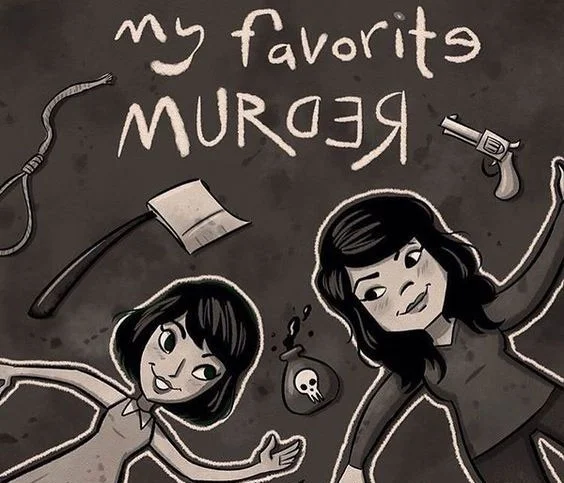
I have discovered a pretty well known podcast called My Favorite Murder. Two women, Georgia Hardstark and Karen Kilgariff, host the show. It’s considered a comedy podcast. Most people wonder: Where’s the humor in murder? Most would also argue that there is none. However, the humor comes from somewhere else. It’s part of this idea that in order to understand something better we have to get close it. In order to understand why people like Dennis Rader kill we have to pay attention and get closer. So, the humor then, it comes from a place of trying to conquer fear and come to a point of understanding.
In 1978 a young woman named Mary was determined to get home. Like a lot of others in that time she decided to hitchhike. Along came a man named Lawrence Singleton. Singleton offered Mary a ride and drove off with her. Mary just wanted to go home. The encounter proved to almost end Mary’s life and in a sense did end the way of life she was accustomed to. Lawrence Singleton raped and mutilated Mary, going so far as to sever parts of her arms, thinking that her body could not be identified without fingerprints. He dumped her body and took off. Mary, however, survived the encounter and crawled to the roadway from where she was dumped. By the time someone found her she was nearly dead.
Mary survived and ended up becoming a victim’s advocate: She strives to protect those who have felt unsafe, who have lost their way of life at the hands of others. Years after Mary’s attack Lawrence Singleton was released from prison because a law that allowed prisoners who had worked while in prison to get a year loped off of their sentence. Following his release, he moved to Florida where he ended up killing a woman. Mary, years older and changed, went out to Florida and testified against Lawrence once more. During his first trial, the one where he was charged for his crimes against Mary, he reportedly looked right at Mary as she left the courtroom and said, "I’ll finished the job if it’s the last thing I do." But when this other woman fell victim to Lawrence…Mary didn’t wait or ponder. She testified.
I know lots of women who are obsessed with serial killers. In fact, I’d venture to say it’s something every woman secretly talks about. Since listening to MFM and becoming a fan, I’ve joined lots of Facebook groups full of thousands of people who talk about it in the open. Some of my closest friends were finally able to admit that they had this secret obsession too. I burned through seventy episodes of MFM within two or three weeks before I started my summer teaching job and could not get enough of it. Georgia and Karen find ways to talk about darkness that makes it less horrifying. If you can laugh then you can heal, that much I know.
In my own life I have survived many things. Nothing like what Mary Vincent went through, but things that nearly killed me all the same. Karen and Georgia are big proponents of therapy and constantly talk about their experiences with medication and therapy sessions. The normalizing of murder isn’t the only thing going on there: They talk about mental health the way mainstream society should. They have provided a welcoming community for women (and men) where they are able to communicate about their disorders. The way I thought about surviving and the word "survivor" changed drastically when I was published in an anthology of essays about a popular television show. The editor, a lovely woman, took care to write the most amazing introduction to the book and in it she wrote that I was a "survivor." I had heard that word before, who has not? But I had never heard that word used to describe me. She was telling readers that I had survived abuse for much of my life and lived to talk about it.
Mary Vincent’s story is not uncommon. I don’t need to inform anyone of statistics: Women fall victim to lots of things and seldom do we get justice. In Mary’s case, she was able to become extraordinarily resilient and she stands for other women like her: She stands for us. The way Georgia and Karen tell the stories of survivors is always enduring and magic in a way. In a previous episode they told the story of a woman who survived a brutal attack by one of the men who was supposed to serve as a guard for the building she lived in. The woman narrowly escaped after fighting off her attacker and was later featured on the television show I Survived. I can’t remember now which woman, Karen or Georgia, told the story. However more recently, that same woman they had spoken of caught wind of the podcast. She listened to the episode about her attack and became a fan of the show. She showed up to a live show and came on stage to talk to the hosts. The thing I’ll never forget about it was the moment she said you talked about me like you were my friends.
RELATED: Ma Says Monsters are Real
Karen and Georgia didn’t know that woman at all prior to that. They didn’t have to. Giving a woman proper respect and talking about her as though she matters despite what she has endured is exactly the sort of thing My Favorite Murder is about, is for. Karen and Georgia give space to victims that is otherwise lost. When we talk about Dennis Rader we talk about just that: Dennis Rader. We don’t talk about the ten people he killed, their lives, what they lost. When it comes to people of color who become victims too their lives get lost somewhere in the headlines and breaking news too. Through the podcast, I have learned the names of people who survived. Through them, I have learned the spirit of what it means to rise and show up. Show up for myself and for others.
In March of 2017 a young woman was attacked while running. She had been running for several miles before she stopped to use the restroom. There she was assaulted by a man who had been hiding in a stall, waiting. The woman, Kelly Herron, had recently taken self-defense classes and she knew what to do. She fought her attacker tooth and nail and later stated that all she could think of during the attack was, "Not today, Motherfucker!" She successfully fought the man off and though she walked away with stitches and bruises she said that she was still in tact. Later, Kelly took to Instagram to make a statement. She said, "I couldn’t remain the silent, anonymous victim—there is a message of survival that is too important to remain untold." She said that she hoped her story would inspire other women to keep fighting.
My Favorite Murder is infamous for catch phrases. At the end of the first episode one of them jokingly said, "Stay sexy and don’t get murdered!" That phrase now has spread like wildfire. I wear a black baseball cap decorated with sunflowers that says SSDGM. For anyone who listens to the podcast those five letters at the quickest way to recognize a fellow murderino (someone who follows MFM or true crime). But what does it mean exactly? Well, there’s not one answer for that. It means a lot of things. For Mary Vincent it meant testifying against her attacker again and again. For Kelly Herron it meant physically fighting off her attacker.
There is no shortage of "rules" women are supposed to follow. Dress a certain way, behave a certain way. In an age post-Brock Turner, women now have to be afraid of not just what could happen if they drink but the backlash they will later receive for having been drunk. What was she wearing? She was asking for it. When a woman falls victim to something horrendous she also stands to be dehumanized by others. I witnessed this once when someone made reference to a young woman who committed suicide after photos of her unconscious body went viral. She was raped while passed out by boys at the party. Those same boys bragged about their exploits and sent photos of her body to others. The young woman has a name: Audrie Pott. The person who made reference to her death never once mentioned her name.
Almost every woman I know carries two things: Either a rape whistle and/or pepper spray and the ever present fear of being assaulted. When I started listening to My Favorite Murder I marveled at how fearless Karen and Georgia are. They’ve seen some shit in their own lives that translates in the way they offer wisdom to others. Over the course of one hundred episodes, the podcast has come to represent so many things for so many people. In addition to the iconic SSDGM, the show now has many catchphrases. Among them is my personal favorite, "You’re in a cult, call your dad." That one came from an episode I no longer remember but the line stuck. It took me going to college to finally understand that the religious trauma and abuse I endured all of my life were not normal. One of the first friends I made in college used to joke to other people that, "Lydia was raised in a cult." We laughed about it, but I know now (partially thanks to therapy) that it’s true. I can’t call my dad though because he is also in the cult.
There’s also two other phrases that stick with me: "Here’s the thing: Fuck everyone" and most importantly, "Fuck politeness." The first line came from the episode where Karen and Georgia talked about a young girl whose family had been murdered while at sea by the captain of the ship. The little girl escaped by raft and history forever remembers her as the black and white photograph of a girl sitting in a raft out at sea. While talking about how the girl should have felt safe with the captain, one of the women added, "Here’s the thing: Fuck everyone." Fuck everyone indeed. Statistics show a woman is more likely to be raped by someone she knows. In my own life, I was abused by family members. If you think abuse or assault are horrible thing unto themselves, try imagining being the victim of one of those things all the while knowing that you abuser or attacker was someone you trusted.
"Fuck politeness," has seemingly become the new "Towanda." Fans of the film Fried Green Tomatoes will remember the line Kathy Bates yells at different times in the film. It’s a rally cry, a way of admitting your strength and the idea of not giving a fuck. Too many times in a woman’s life she will be polite to someone who does no deserve her kindness. It happens because women are afraid of what will happen when we aren’t kind or polite. Think Margaret Atwood’s dark line, "Men are afraid that women will laugh at them. Women are afraid that men will kill them." How many bad dates have you said yes to because you were afraid of letting the man down? I’ve done it. I’ve saved face by saying nothing when I should have said fuck you instead.
Perhaps my favorite story about MFM came from the now wildly popular Facebook group. A woman took to the group to share her story about murder, community, and feminism. The woman had stopped to get something for dinner for her and her sick (also absent) boyfriend. As she exited the restaurant she was stopped by another woman who excitedly said, "Hey! How are you? It’s so good to see you!" The woman was confused she had no idea who this person was. That’s when the friendly stranger whispered in her ear, "There’s a man hiding behind your car." They decided to walk to the woman’s car together because there was strength in numbers. When the man saw this he got up from his hiding spot and walked away. Before they parted the woman who had saved the day said, "Stay sexy and don’t get murdered." Not today, Motherfucker!
Lydia A. Cyrus is a creative nonfiction writer and poet from Huntington, West Virginia. Her work as been featured in Thoreau's Rooster, Adelaide Literary Magazine, The Albion Review, and Luna Luna. Her essay "We Love You Anyway," was featured in the 2017 anthology Family Don't End with Blood which chronicles the lives of fans and actors from the television show Supernatural.
She lives and works in Huntington where she spends her time being politically active and volunteering. She is a proud Mountain Woman who strives to make positive change in Southern Appalachia. She enjoys the color red and all things Wonder Woman related! You can usually find her walking around the woods and surrounding areas as she strives to find solitude in the natural world. Twitter: @lydiaacyrus