• Home
  • indulge
  • new poetry
    • About Luna Luna
    • resources
    • search
  • editor
  • dark hour
  • submit
Menu

luna luna magazine

  • Home
  • indulge
  • new poetry
  • About
    • About Luna Luna
    • resources
    • search
  • editor
  • dark hour
  • submit
delicious new poetry
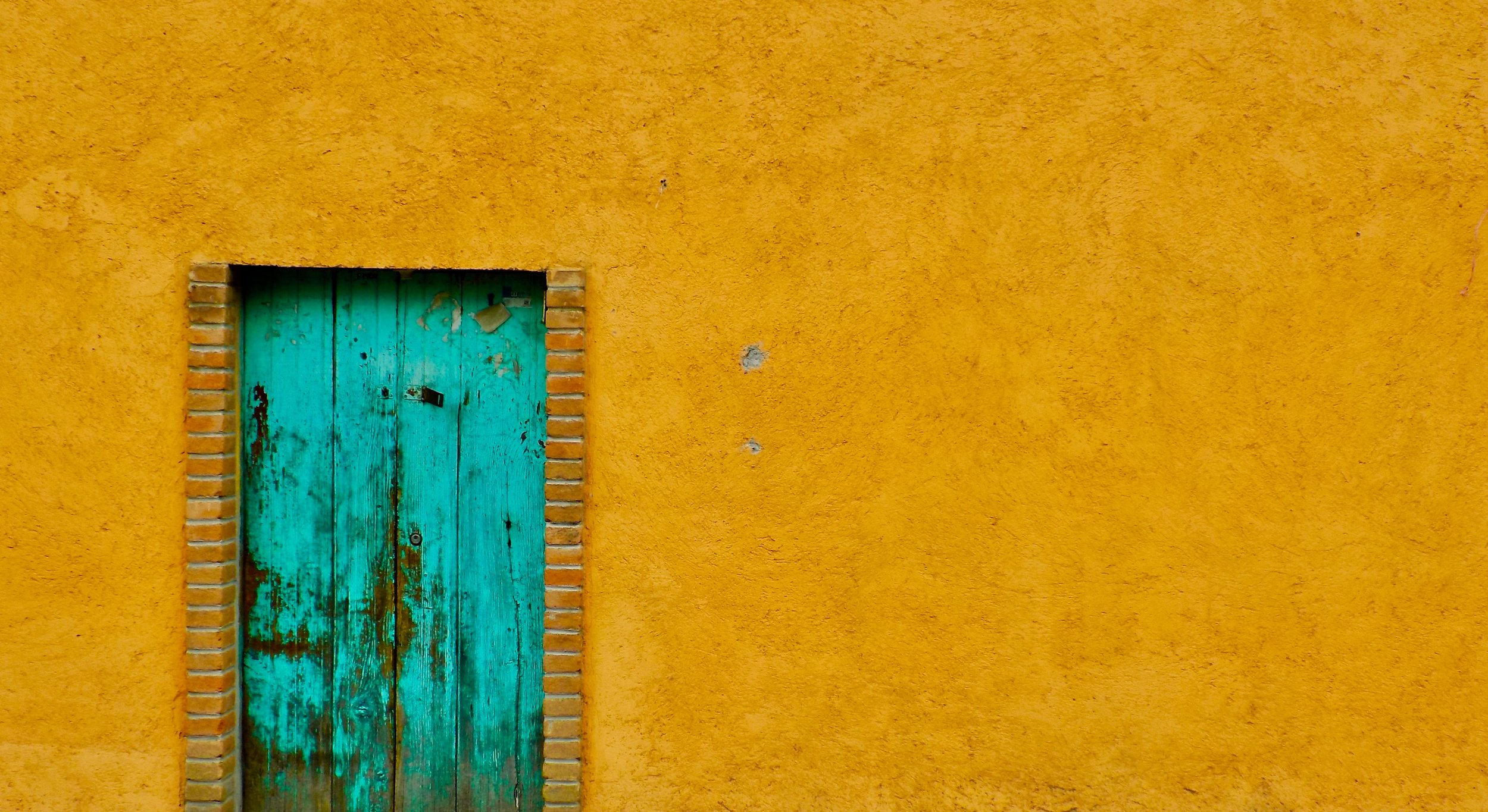
'the doors of the night open' — poetry by Juan Armando Rojas (translated by Paula J. Lambert)
Nov 29, 2025
'the doors of the night open' — poetry by Juan Armando Rojas (translated by Paula J. Lambert)
Nov 29, 2025
Nov 29, 2025
'we can be forlorn women' — poetry by Stevie Belchak
Nov 29, 2025
'we can be forlorn women' — poetry by Stevie Belchak
Nov 29, 2025
Nov 29, 2025
'I do whatever the light tells me to' — poetry by Catherine Bai
Nov 29, 2025
'I do whatever the light tells me to' — poetry by Catherine Bai
Nov 29, 2025
Nov 29, 2025
‘to kill bodice and give sacrament’ — poetry By Kale Hensley
Nov 29, 2025
‘to kill bodice and give sacrament’ — poetry By Kale Hensley
Nov 29, 2025
Nov 29, 2025
'Venetian draped in goatskin' — poetry by Natalie Mariko
Nov 29, 2025
'Venetian draped in goatskin' — poetry by Natalie Mariko
Nov 29, 2025
Nov 29, 2025
'the long sorrow of the color red' — centos by Patrice Boyer Claeys
Nov 28, 2025
'the long sorrow of the color red' — centos by Patrice Boyer Claeys
Nov 28, 2025
Nov 28, 2025
'Flowers are the offspring of longing' — poetry by Ellen Kombiyil
Nov 28, 2025
'Flowers are the offspring of longing' — poetry by Ellen Kombiyil
Nov 28, 2025
Nov 28, 2025
'punish or repent' — poetry by Chris McCreary
Nov 28, 2025
'punish or repent' — poetry by Chris McCreary
Nov 28, 2025
Nov 28, 2025
'long, dangerous grasses' — poetry by Jessica Purdy
Nov 28, 2025
'long, dangerous grasses' — poetry by Jessica Purdy
Nov 28, 2025
Nov 28, 2025
'gifting nighttime honey' — poetry by Nathan Hassall
Nov 28, 2025
'gifting nighttime honey' — poetry by Nathan Hassall
Nov 28, 2025
Nov 28, 2025
'A theory of pauses' — poetry by Jeanne Morel and Anthony Warnke
Nov 28, 2025
'A theory of pauses' — poetry by Jeanne Morel and Anthony Warnke
Nov 28, 2025
Nov 28, 2025
'into the voluminous abyss' — poetry by D.J. Huppatz
Nov 28, 2025
'into the voluminous abyss' — poetry by D.J. Huppatz
Nov 28, 2025
Nov 28, 2025
'an animal within an animal' — a poem by Carolee Bennett
Nov 28, 2025
'an animal within an animal' — a poem by Carolee Bennett
Nov 28, 2025
Nov 28, 2025
‘in the glitter-open black' — poetry by Fox Henry Frazier
Oct 31, 2025
‘in the glitter-open black' — poetry by Fox Henry Frazier
Oct 31, 2025
Oct 31, 2025
'poet as tarantula,  poem as waste' — poetry by  Ewen Glass
Oct 31, 2025
'poet as tarantula, poem as waste' — poetry by Ewen Glass
Oct 31, 2025
Oct 31, 2025
'my god wearing a body' — poetry by Tom Nutting
Oct 31, 2025
'my god wearing a body' — poetry by Tom Nutting
Oct 31, 2025
Oct 31, 2025
'Hours rot away in regalia' — poetry by Stephanie Chang
Oct 31, 2025
'Hours rot away in regalia' — poetry by Stephanie Chang
Oct 31, 2025
Oct 31, 2025
'down down down the hall of mirrors' — poetry by Ronnie K. Stephens
Oct 31, 2025
'down down down the hall of mirrors' — poetry by Ronnie K. Stephens
Oct 31, 2025
Oct 31, 2025
'Grew appendages, clawed towards light' — poetry by Lucie Brooks
Oct 31, 2025
'Grew appendages, clawed towards light' — poetry by Lucie Brooks
Oct 31, 2025
Oct 31, 2025
'do not be afraid' — poetry by Maia Decker
Oct 31, 2025
'do not be afraid' — poetry by Maia Decker
Oct 31, 2025
Oct 31, 2025
'The darkened bedroom' — poetry by Jessica Purdy
Oct 31, 2025
'The darkened bedroom' — poetry by Jessica Purdy
Oct 31, 2025
Oct 31, 2025
'I am the body that I am under' — poetry by Jennifer MacBain-Stephens
Oct 31, 2025
'I am the body that I am under' — poetry by Jennifer MacBain-Stephens
Oct 31, 2025
Oct 31, 2025
goddess energy.jpg
Oct 26, 2025
'Hotter than gluttony' — poetry by Anne-Adele Wight
Oct 26, 2025
Oct 26, 2025
'As though from Babel' — poetry by Fox Henry Frazier
Oct 26, 2025
'As though from Babel' — poetry by Fox Henry Frazier
Oct 26, 2025
Oct 26, 2025
'See my wants' — poetry by Aaliyah Anderson
Oct 26, 2025
'See my wants' — poetry by Aaliyah Anderson
Oct 26, 2025
Oct 26, 2025
'black viper dangling a golden fruit' — poetry by Nova Glyn
Oct 26, 2025
'black viper dangling a golden fruit' — poetry by Nova Glyn
Oct 26, 2025
Oct 26, 2025
'It would be unfair to touch you' — poetry by grace (ge) gilbert
Oct 26, 2025
'It would be unfair to touch you' — poetry by grace (ge) gilbert
Oct 26, 2025
Oct 26, 2025
'Praying in retrograde' — poetry by Courtney Leigh
Oct 26, 2025
'Praying in retrograde' — poetry by Courtney Leigh
Oct 26, 2025
Oct 26, 2025
'To not want is death' — poetry by Letitia Trent
Oct 26, 2025
'To not want is death' — poetry by Letitia Trent
Oct 26, 2025
Oct 26, 2025
'Our wildness the eternal now' — poetry by Hannah Levy
Oct 26, 2025
'Our wildness the eternal now' — poetry by Hannah Levy
Oct 26, 2025
Oct 26, 2025

Poetry by April Lim

October 20, 2022

BY APRIL LIM

Sonnet for the Cambodian Boat People


We are nothing but clouds stuck in the sea,
Whispering for winds that may never come,
How far do boats sail when they have to flee?
Keep the whispers to a quiet, no hums.

If we are caught, they kill us—No mercy,
Wild pirates with no laws at their core,
So keep mute, stay sharp, throats dry and thirsty,
They’ll slay the men and keep women as whores.

We’re almost ashore, 12 days and 12 nights—
Strangers at first, tied together by luck,
If we reach land, we’ll scatter: bird in flights,
To experience salvation awestruck.

Over jasmine and chrysanthemum sips,
I know our story will land on false lips.

Refugee Alchemy


Escape: 1.5oz of gold per body,
no guarantee of an intact soul, Conscious can never 
revert: War will 
transmute a human's mind.

Received: a familiar body that cannot essence
the same. Cannot pray without lying, without spilling 
tears into land: one 
exhumed of your father. 

Forge: matriarchal heirloom— 
gold wire, pebble gems.
Earth to your daughter's wrist. If she has to flee,
she will pay with this. 

Charm: silk spun red rioting
incense and gilded prayers, tighten
twines, blood slips loose snarling legacy
into her veins⁠— 

She: elixir of         salt      forest      prayers,
wears trauma like a birthright. Palms cradling full
moon spilling from lakeside reflection, she pools   
    into her skin.

April Lim is a Chinese Cambodian American writer from Houston, TX. She has a B.A. in Creative Writing from the University of Houston where she was awarded the Howard Moss Prize in Poetry and the Bryan Lawrence Prize in Poetry. She has received fellowships and scholarships from Tin House, Kenyon Review Writers Workshop, The Watering Hole, Martha's Vineyard Institute of Creative Writing, and elsewhere. Her poems have appeared or are forthcoming in Palette Poetry, Sweet: A Literary Confection, Bayou Magazine, and elsewhere. She is currently pursuing an MFA in Poetry at Oklahoma State University where she is an Editorial Assistant for the Cimarron Review.

In Poetry & Prose Tags April Lim
Comment

Before I Was Born by Kate Leffner

October 19, 2022

BY KATE LEFFNER

[content warning: domestic violence]

Before I Was Born

I finally left home when I was twenty-two. My father moved me to Boston so I could attend a master’s program and in two days, drove us six states in a pick-up truck from Wisconsin to Boston. I didn’t know how to drive and still don’t have a license, but since I’d always lived in cities as an adult, it never seemed to matter. It was summer when we left and when we passed through Chicago, hot and congested with tourists and buses, I started to roll down the window. Don’t, my dad told me. I’ll put on the air conditioner. I didn’t know how to say that I also just wanted to suck in breath from the city, just one last time. I attended undergrad in Chicago and I felt my chest tighten when we passed the apartment where I lived alone.

The apartment, more of a room than anything else, had felt like the inside of my mind. I kept it so clean, in the hopes of mitigating my panic attacks, that it barely looked like I lived there. I was obsessive about my eating, I thought that food was something that could also be kept clean, and only ate eggs, spinach, avocados, or nothing at all. When I first toured it with my father, the real estate woman whispered to me, “Seems like your daddy takes care of his little princess,” a line straight out of a B-rated movie.

“Are you sure you want to go?” my dad asked me. Right before I left, my mother raced out of the house with a weekend bag she had recently bought for herself. She pressed it to me with tears in her eyes. Take it, she said as memories flooded in. I saw her explaining Kierkegaard to me when I was a kid, drawing with pastels in the kitchen. I saw her screaming and my father punching a wall but when I blinked they were gone, buried deep. I thanked her and pressed the bag close.


Before I went to Chicago for college, my father said he’d get his shotgun during an argument. Afterward, I was claustrophobic and would take the stairs instead of the elevator, convinced strangers had guns in their pockets. In my first year of college, I sent my mother an email that said that I wouldn’t come home until my father went to therapy.

My mother told me to bring it up with my father. I did not. Instead, I would wait for my parents to pick me up for the holidays in the lobby with my bags under my arm and fresh cookies in a Ziploc bag.


In the parking lot of a gas station in Ohio, with the lamplight flickering on and off, my father nodded off. I read a romance novel my mother packed into my bag. It was about a woman who escaped a domestic violence relationship with her husband and fell in love with a policeman in a beach town. My mother read a lot of these books.

When the woman was in the bath, the ex-husband snuck into her house. The policeman appeared and pointed a gun at the ex-husband. The woman cried and the policeman held her gently and told her he loved her as the ex-husband was carted off to jail. When I was a kid, my mother closed the curtains when my father started to raise his voice. When I suggested we leave, go to a shelter, or call the police she told me that I didn’t understand what it was like out there, in those places. Even when he called us cunts and charged, sending us spiraling to the

floor, even then she told me not to call. Having a home, and private schools, gave us a certain safety, and the love we had for him, the intense empathy that started conversations: he was tired. He was overworked. He didn’t know how to handle his feelings because of the way he was raised. He didn’t hit us like that. At times, I would convince myself of these things and ask her to stay, fearful of the outside world, only to spiral into a panic that we had to leave, and then into a deep suffocating sense that there was nowhere we could go.

Often, I felt sorry for him because he couldn’t control himself. I remember holding him while he cried.

“Where are we?” my father said in his sleep. I shushed him. He told me to just leave him alone, God, why wouldn’t I just shut up? He needed to sleep.


I had a difficult time making friends. I felt that I was always missing cues, and the closeness I felt in my family felt impossible to replicate. How would anyone understand the incredible safety of hearing my mother affectionately call my father an asshole after a fight and hearing him laugh instead of scream? Or understand the fierce loyalty I felt toward my brother when he shoved my dad when he went to hit me?

My mother, when she was feeling particularly resentful, would say I was cold to others. When she was feeling more generous, she said I just didn’t know how to let people in. This changed in my first year of college. I fell in love with a woman in my Russian literature class. She was in her junior year and had a full-time job, gave out practical advice, and had a dry sense of humor. We wrote each other letters in the summer about Checkhov, Putin, and Dostoevsky, which felt like discussing my unformed thoughts, unspeakably intimate. Once one of the letters arrived right before my father started getting worked up and I remember holding the letter tight to my chest like a talisman while he shouted. I felt that the way my friend loved me and the way my father loved me were inexplicably different but I didn’t know how to articulate it. At night, I started Googling phrases I previously ignored: learned helplessness, Stockholm Syndrome, trauma. I circled around the word abuse but could not land. That was something that had happened to my mother and my grandma, to other women, to people whose fathers’ didn’t move them into apartments or cook them dinner at night. Wasn’t I too functioning to be abused? Wasn’t I too privileged?


The first time my father hurt me, I was five. It is one of the clearest memories I have. I was sick and my throat was scratchy. My parents were renovating their bedroom and were sleeping in the living room on a pull-out bed. I shook my father’s bare sweaty shoulder and his hand shot out and gripped my neck. He stood up fast and held me up in the air. I grabbed his hand and tried to speak, but couldn’t get anything out. His eyes were open but he made no sound and eventually my mother woke up and said his name. He let me down. Sleep apnea, my mother said the next day after furiously researching.


There was a bridge to pass over to get from New York to Massachusetts. My father laughed in a nervous way. He hated heights but loved nature and the mountains we passed through looked like something out of a magazine, green and purple, close enough to touch.

“It’s beautiful,” he said. “Why don’t we do more things like this?”

“I'm hungry,” I said, digging through my backpack.

“You are a brave, brave girl,” he said to me. He was crying. “How are you so sure?”

“I believe in God,” I said, though I didn’t and the words felt false on my lips. But it was something to say, something with power behind it. If I told him I believed in myself, it didn’t feel like something he would understand.

“You are braver than me,” he said. The comment should have made me feel closer to him, flattered even. Instead, it made me angry. I could feel him leaving in the way he didn't look in my eyes. I didn’t realize it would be this easy, all I would have to do was not need him, and suddenly he would become small and quiet.


In the apartment, he set up my DVD player and bed as I put away groceries.

“It’s ugly,” he said. “I can’t leave my daughter in a place like this.”

“I like it,” I said. “It’s okay.”

“It’s not,” he said. His face was red and it seemed as though I was both the daughter he wanted to protect and the one who put her in danger. I was both an extension of him and an enemy.

“Why are you never happy?” I said. At that moment I remembered a story I heard on a holiday with his family. When he was a kid, he wrapped his younger brother up in a blanket and threw him out of a window. Often I can’t tell what my father did or has done, there are too many stories that shift in his or his family’s retelling, and the uncertainty and the love I had for him kept it shrouded with confusion. But there was something about his reddening face that made me think of this story at that moment.

He stopped fighting his brother when he grew up. I had thought this was a sign of maturity, but now I wondered if it was because he could fight back. I had taken it so personally when he wanted to hurt me. I thought it was because I had been pushy or demanding. It was clear now watching him and the familiar narrowing lips that he had been battling something long before I was born.

When he left, he told me to text but I could see something had changed in his eyes.

“Sure,” I said and locked the door.


Years later, after my parent’s separation and his jail time, I learned to sleep in my bed throughout the night and got a new phone number. After I became someone else, poorer but self-efficient, an average girl fading into a street of people like at the end of a Meg Ryan film, it finally feels safe to let myself remember the things I liked about him: cooking squash and watching TV. In the aftermath, I let myself miss him.


Please consider making a donation to the National Coalition Against Domestic Violence.

Kate Leffner is a writer and marketing specialist in Boston, MA. Her writing focuses on intergenerational trauma, grief, queerness, and radical self-care. She has an MFA from Emerson College and has featured in The Femme Edition and The Dillydoun Review. She lives with her girlfriend and their two cats, Orchard and Phoebe.
In Poetry & Prose, Personal Essay Tags Kate Leffner
Comment

Poetry by Jordan Cameron

October 19, 2022

BY JORDAN CAMERON

imagined teacups

how can you see a memory that doesn’t belong to you?

with an earthbound combination of intuition and influence
thin floral air inspires blood / vessels for someone else to speak—
my very own seance

i listen and create a picture of a self i never knew
alone and pointing
know without thinking that she understands something you cannot

ask me to describe the smell of lilac
and i can only offer you the memory of open windows

Ask me about the taste of chamomile
and I can only describe the feeling it leaves in my newly warmed mouth
after it has disappeared down my throat.

I have imagined teacups
pink milk glass once served in your home

I breathe deep and answer with honey crackling from my throat
Redefined ectoplasm

The sweetness smothers me

But I am not afraid of drowning as you press your hands against my shoulders and whisper gurgling I
love yous

Until I return, gasping fresh lilac air
And rinse meaningful dregs from my cup


i came from the garden

“I feel a thousand capacities spring up in me….I am rooted but I flow.” - Virginia Woolf, The Waves

I reach into the soil, searching for bursting seeds
buried deep beneath the surface.
The soft and mealy earth parts around my fingers
and I am tangled in roots.

They return my grasp;
we are inseparable &
Underneath my skin
the roots substitute my veins

Someone else planted me here
Wanting more of a good thing
Heavy-headed pink returns, nodding to sleep in the rain

Long after the gardener left her home
I became part of the design
Like the painting in the stairwell
And the stains on the floor
I was there to see everything else change

How can I go on without spilling any blood?
The ritual calls for a sacrifice
and I oblige from below lilies of the Valley

I rise from the soil, searching for rolling skies
stretching far beyond the horizon.
The warm and crumbling earth clings to my hardened skin
and roots are tangled in me.


Jordan Cameron is a New Englander living in Philadelphia. She is a photographer and writer, exploring and expanding perception. Her work has been featured in Dream Pop Journal, Eclipse Lit, Ghost City Review, and elsewhere. She has exhibited her photography in Philadelphia and Abington, PA and her poetry has been nominated for the Pushcart Prize. You can find her on instagram and twitter at jordanofjune and on any given night walking around with a camera at sunset.

In Poetry & Prose Tags Jordan Cameron
Comment

The Hanged One Season, by Meg Wall Jones

October 6, 2022

BY MEG JONES WALL

The Hanged One Season


I don’t understand sleep: how it works, where people go, how anyone learned to travel in this manner. The closing of eyes, the quieting of mind and body, the ability to sink into that strange unknown world of mystery and memory, weaving souvenirs from our consciousness into tangled webs of sense and nonsense — it’s a skill I lack, a capacity for release that I have never been able to master. 

Photo by Meg Wall Jones

Sleep is a forced pause, a time of stillness and surrender. It’s a liminal space that still manages to feel commonplace for most; a regular part of daily cycles that provides comfort, recovery, clarity. Every night is an opportunity to slip into darkness, to find a gentle temporary death, to embrace liminality and adventure to far-off, unknown spaces within the self.

But most nights, I lie awake, alone, listening to sirens and alarms, the stirrings of the city outside my window, the side effects of so many people living in such a relatively small space. Most nights, I watch the stars come and go, the moon rise and fall, wait patiently for the sun to break the horizon and usher in a new morning. Most nights, I fail to find that strange, mysterious place, unable to reach the beckoning grasp of slumber and make my way into those shadowed lands.

Sleep doesn’t make sense to me. There’s no map to reference, no hand to hold, no path to follow. It’s just me and my insomnia against the eternal night, the twinkling stars and city lights, watching one another, uncertain of what to do next. Sometimes days go by before I find rest, before my body is so exhausted that it drags me under, before I stumble into that unfamiliar place and hope that eventually I’ll be able to claw my way out again.

Photo by Meg Wall Jones

In autumn, when the veil is thin, when the shadows have lengthened, when the nights slowly gobble up the hours and greedily swell with excess, sleeplessness becomes seasonal. The heaviness and humidity of the air slipping into crisp coolness, leaves slowly rotting into spectacular decay, shadows thickening and loosening. It feels correct to bear witness to the longer nights, to consciously wander through thoughts and ideas rather than getting swept up into memory. The world feels restless and I can explore my own mysteries, can make my own liminal space, can serve as a guide for those who haven’t been to this particular crossroads before. We all hover at the veil together, contemplating how and when we will pass through. 

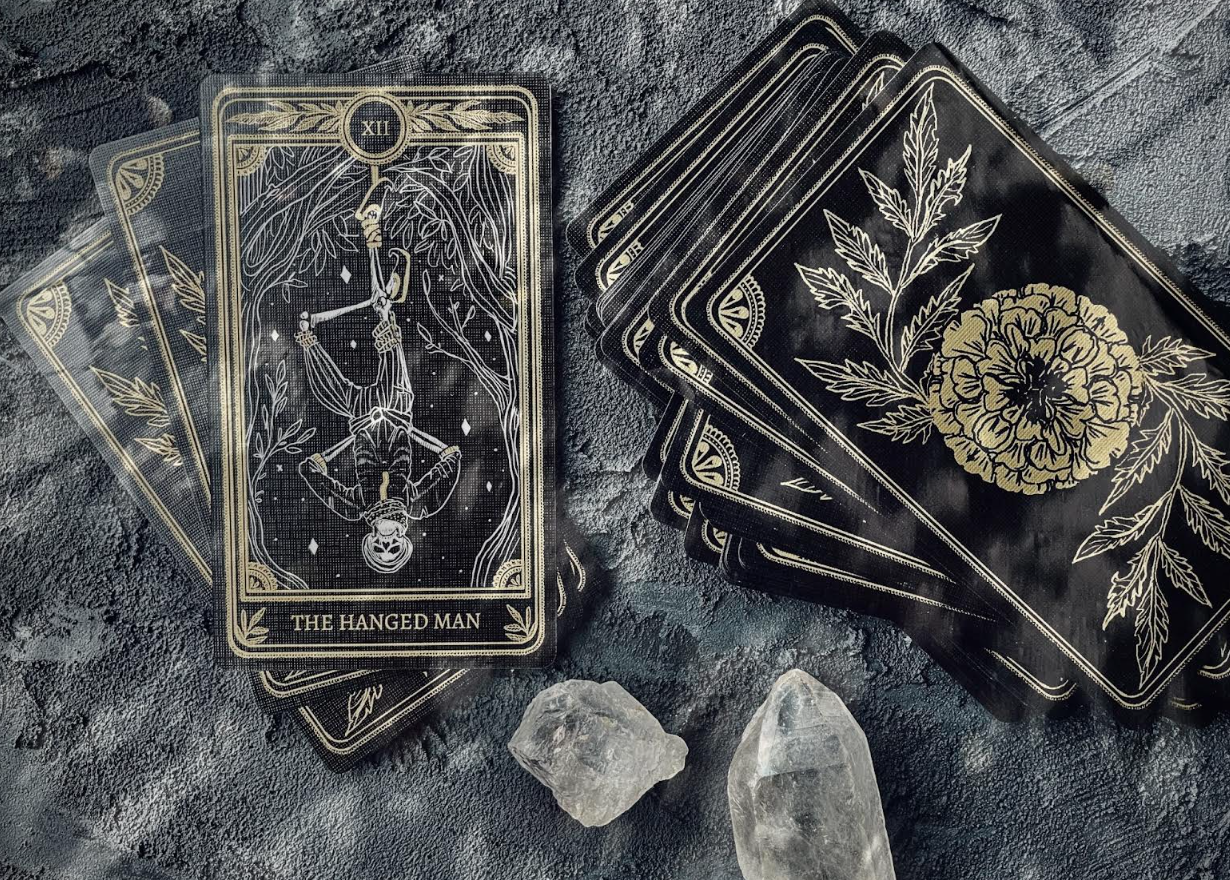
It’s Hanged One season, autumn: a time of sacrifice and release, an opportunity to let something wither in the most beautiful way so that new growth can eventually emerge. The Hanged One is a necessary, inevitable clearing; the pause before winter’s Death, the moment when expansion ceases, when we observe what happens when our movement halts and our effort stills. It’s the deep breath before hibernation, the slackening of muscles, the willingness to take brittle air into our lungs and let it simultaneously soothe us and wake us up. What have we been doing, building, becoming? What have we been working towards, and where does this pause land in our own personal cycle? Who did we used to be? Where are we being called to let go of a dream, a pursuit, a version of self? And what happens if we don’t give that thing up easily, if we refuse to surrender?

Autumn is for harvest, for celebration – but it’s also for slowing down, releasing, honoring. Winter may be the full stop, the recovery, but autumn hints at the bend in the road, gives us daily reminders to contemplate the slow rot and decay that surrounds us. All that blooms eventually returns to the earth, dust to dust, year after year. Whether we cling desperately to summer or welcome winter with open arms, we have no control over the cycle, the seasons, the change. Either way, we become the Hanged One, powerless and patient, silent, observing: waiting for whatever comes next, even if we already know what is ending.

Photo by Meg Wall Jones

It’s strange but beautiful, not unlike all of those orderly, sleepy little deaths. Autumn isn’t bothered by our feelings or desires, our fears or uncertainties, and neither is sleep. It simply comes when it’s time, holds us in our waiting, lets us feel whatever we need to feel. Autumn lets us stand quietly, in awe of its power and grace, whether we’re ready to slow down or not.

Sleep, seasons, stillness, all feel out of my grasp these days. This strangeness that I feel every night when I crawl into bed, lying still, hoping that slumber won’t notice me creeping around the edges and trying to slip in silently, stealing a few hours of temporary death: it’s uncomfortable, difficult to define or describe. My mind and body, fighting a battle I don’t understand, unwilling to accept the reality of the Hanged One, wishing somehow to overcome exhaustion and live beyond cycles, beyond sleep.
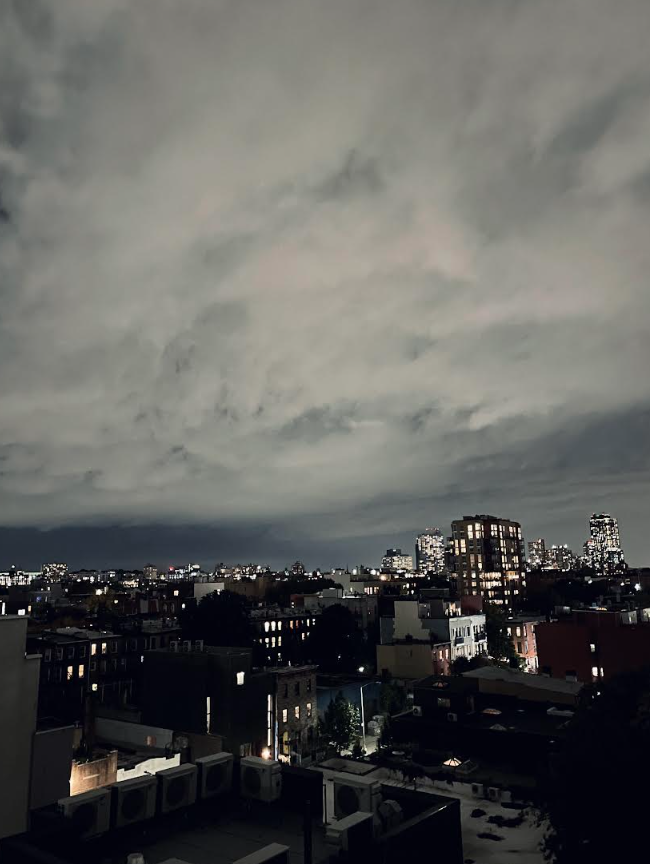
Autumn reminds me that rebirth is always around the corner, that an awakening beyond the physical can happen at any part of the cycle, that giving up control can be a necessary breaking point rather than something to fear. 

Every morning, and every night, is a new chance to surrender. And perhaps this year, autumn’s shadows will help clear out my own.


In Poetry & Prose, Personal Essay, Magic Tags magic, tarot
Comment

Caroline Hagood on Weird Girls and the Inner Monster

October 2, 2022

An interview with Caroline Hagood
by Lisa Marie Basile

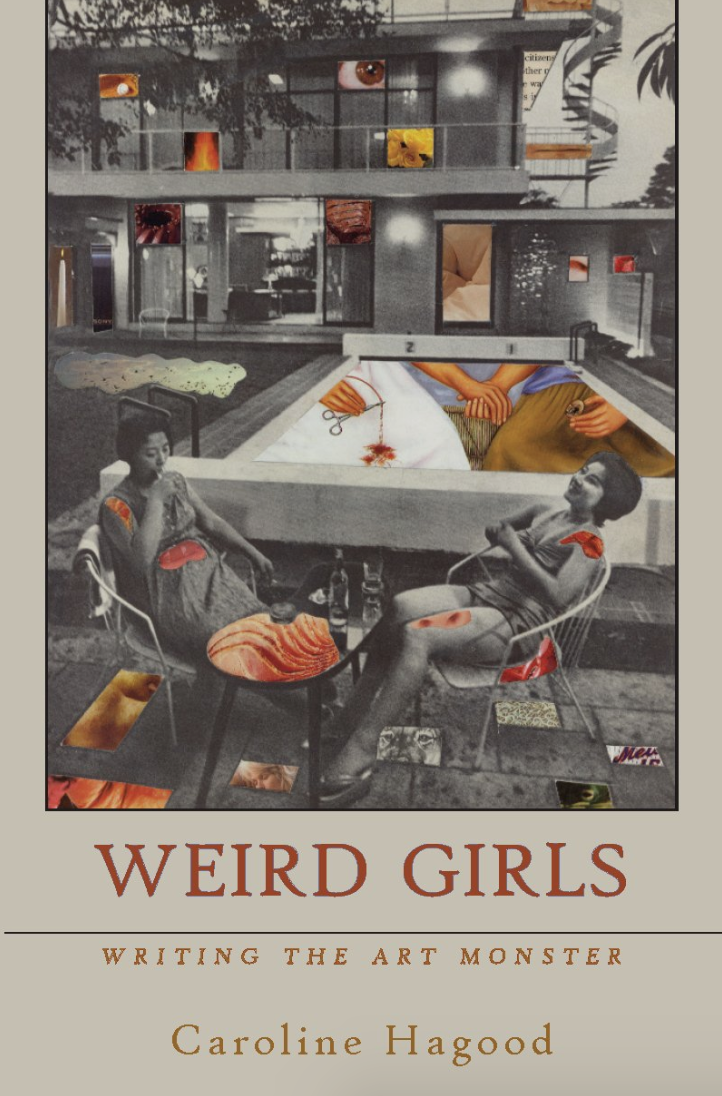
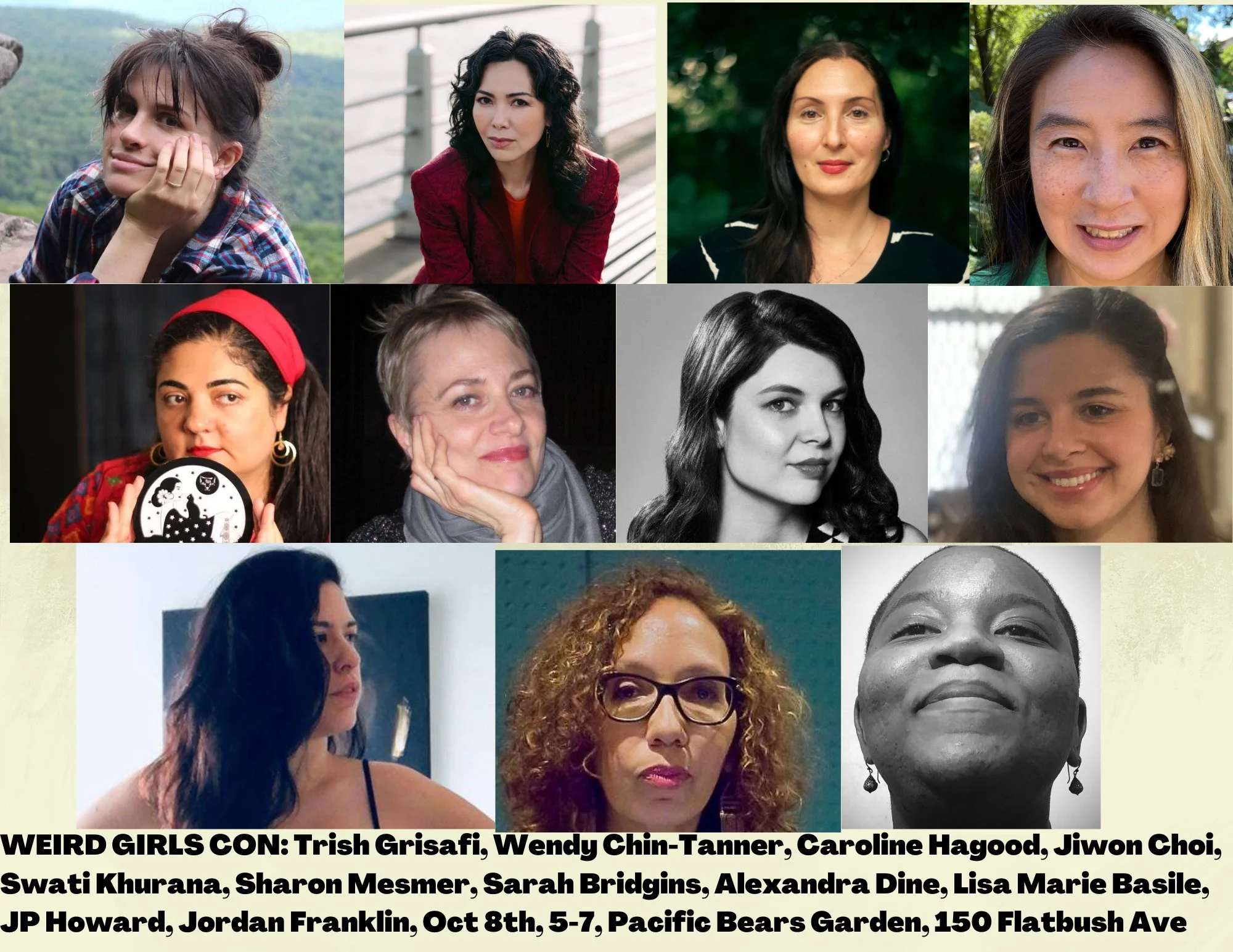
Lisa Marie Basile: Can you tell us all about Weird Girls: Writing The Art Monster? I am so intrigued by it (as a self-professed weird girl, of course) and so excited to read it. I’m also excited to read with you (and so many other incredible talents) at your reading event, Weird Girls Con.

Caroline Hagood: WEIRD GIRLS: WRITING THE ART MONSTER is an essay collection or book-length essay, depending on how you see it. It's a collection of different essays, but they all overlap, and circle back on one another. I was inspired to write the book since I've always been a weird girl, haha. But, seriously, after reading Jenny Offill's Dept of Speculation, I saw that so very many women writers were suddenly writing about the "art monster," or the writer who gets to focus monomaniacally, monstrously on his or her own work—but the catch was that the ones who usually got to do this were men. I have always been obsessed with the topics of creativity and monstrosity, and so this book came to be.
Ah! I'm so interested in the inner art monster — how it shows up, how it's praised, how it's rejected (so oft by men), and why it's so alluring. Sometimes, I think the inner monster is the only thing that keeps me writing — that fiendishness, that obsession. I especially sync with the art/creativity monster as a Capricorn Rising, the archetype that is often associated with obsessive Doing. It's interesting because on one hand, there's the oft-critiqued "girl boss" archetype — yet on the other, the obsessive, frenzied woman who wants to learn and do more is something that should be embraced. Why do you think so many people are exploring woman as art monster?
I love these questions so much. Yes, I absolutely share your fascination with the inner monster/the obsessive and passionate pursuit of art. It’s at the core of my writing practice. I think the woman who has had to fight tooth and nail for her creativity, and even the concept of the art monster, is as old as time, but I think Jenny Offill put a name (and connected story) to it in her 2016 novel Dept of Speculation.

Since 2016 I’ve been seeing women/femme/nonbinary writers grappling with this concept constantly. Then I think movements such as #metoo and sociocultural situations such as the way women and mothers have been impacted by COVID-19, for instance, coalesced with the whole art monster narrative to form a super-monster that’s trying to claw its way out of every text I pick up these days. I always pull this art monster out of there, and I’m so happy to see her.

Who are some of your artistic influences, and how do they appear or work their way into your own work?

I guess I would say I'm a fan of the obsessives when it comes to literature and creativity in general—the creators who just don't know where to stop, who exist in ways that are determined to be "too much," who write or film or paint in ways deemed to be "too much," and so forth.

I also love my hybrid people, those who write things where you go, "wait, is this a poem, a novel, an essay, and do I even need to know? Nope!" Those are my favorite works of art. I used to co-run a reading series called Kill Genre, and I have an upcoming panel with the same title because I guess that's my thing. :)

I also love hybrid people. I'm over strict genre separation and definitions, although I see why people often turn to them. What would you tell a writer who is anxious about or hesitant to cross-play or blend genres?

I would be like, “Wait, what is this genre you speak of? I’ve never heard of it.” Then I would quote Lady Gaga, “So there's nothing more provocative than taking a genre that everybody who's cool hates—and then making it cool.”

But seriously, I would invite this writer to step out of this limiting way of thinking of writing. I would say not to worry about playing with genre and, ideally, to focus on inventing her/his/their own new genre.

How does lineage or culture shape your work? It’s a question I ask every writer. I love to see how the threads come together.

My mother is a very powerful, wonderful, difficult woman who worships literature, and I really do think of myself as carrying on this piece of our family heritage. She was a businesswoman who wrote and painted on her own time and would take me outside to look at the moon at night to get inspired. I love her for this.

Can you share with us some of your writing rituals? What are the little things you do to collaborate with the Muse?

Well (and I'm pretty sure nobody at all will care about this little detail) I absolutely must have my hair up. I can't explain it, but I cannot write without this whole situation being taken care of. Then I really like to listen to weird jazz without lyrics because it inspires me without distracting me with words.

Then I know it always sounds creepy, but I like to look at the photographs I have of women writers around my work area, such as the one of Mary Shelley writing with a quill. If I don't feel in the mood to write, I just look over at them and it gets me going. They are my coven, and they don't even know they serve this purpose for me (the living ones I mean). I promise I"m not as creepy as I sound.

Um, looking at women writers. NOT CREEPY AT ALL. Gasp! I love it. This is a certain kind of summoning, an odd little ritual where you call forth their essence. Can you tell me why the Mary Shelley image speaks to you so much? Paint the moment for us. 

 I just love the concept of Shelley being dared to write a ghost story and creating this book about a monster who epitomizes the way I view creativity itself: monstrous, sewn together from the “bodies” of so many different artifacts, well-read, obsessive, creative, poetic, tender, full of longing, misunderstood, comedic, lonely.

Who are some contemporaries who have inspired or helped you in your creative journey?

When I was at Fordham, I felt very inspired and supported by what I called my creative writing ladies, professors who participated in the dark arts of, well, creative writing: Elisabeth Frost, Heather Dubrow, and Sarah Gambito.

Then, lately, I've been working with Patricia Grisafi on some really fun witchy projects. I was also recently bowled over by the kindness of Erika Wurth. I've never met her in person (we are "social media" close), but she was still incredibly generous with literary advice and contacts because that's what she believes in. And it's what I believe in, too, very much so.

Join the WEIRD GIRLS CON event
Saturday, October 8th from 5-7 PM EST
Pacific Bears Community, Brooklyn, NY

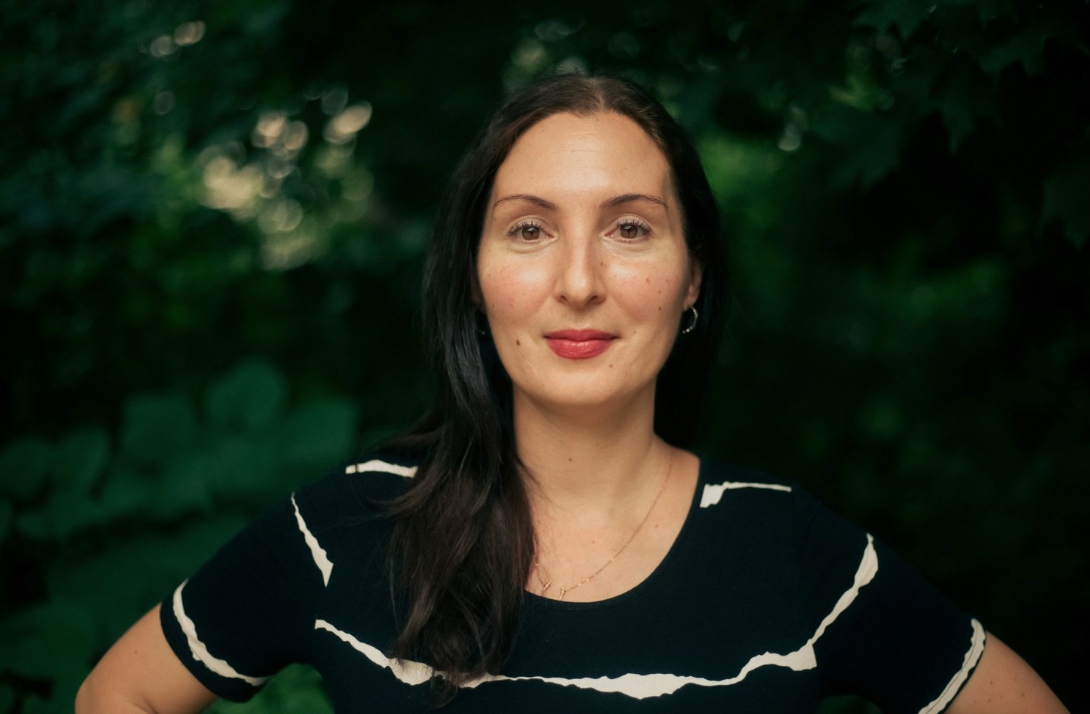
Caroline Hagood is an Assistant Professor of Literature, Writing and Publishing and Director of Undergraduate Writing at St. Francis College in Brooklyn. She is the author of the poetry books, Lunatic Speaks (2012) and Making Maxine’s Baby (2015), the book-length essay, Ways of Looking at a Woman (2019), and the novel, Ghosts of America (2021). Her book-length essay Weird Girls is forthcoming from Spuyten Duyvil Press in November. Her work has appeared in publications including Creative Nonfiction, LitHub, the Kenyon Review, Hanging Loose, the Huffington Post, the Guardian, Salon, and Elle.

In Poetry & Prose, Politics, Social Issues, Interviews Tags Caroline Hagood, Weird Girls, Weird Girls: Writing The Art Monster, Hybrid, Writing, Mary Shelley
Comment

Poetry by Robin Sinclair

September 29, 2022

BY ROBIN SINCLAIR


A Farewell Letter

One day, sooner than we're willing to prepare for

there will be one diagnosis too many for bones to carry

and the flesh will tumble to the floor.

Wooden railroad ties overtaken by the forest and

Annabelle, below the garden.

An eight line poem in a pocket, in an armoire,

perhaps tucked away within the wooden parlor grand

where I sang myself to sleep.

Robin Sinclair (they/them) is a queer, trans writer of poetry, fiction, and nonfiction. Their chapbook, SOMEONE ELSE’S SEX (Bull City Press, 2023), is about living and surviving as a damaged trans person in a damaged world. It is about sex, the commodification of queer history, the collateral damage of the closet, bigotry, finding love, and trying to heal. It is about queer liberation. All author proceeds are donated to the Transgender Legal Defense & Education Fund. RobinSinclairBooks.com

In Poetry & Prose Tags Robin Sinclair
Comment

A Playlist for Fall

September 7, 2022

We could all use some new tunes to celebrate my favorite upcoming season. From Cate Le Bon to Thee Sacred Souls, there’s a little something for everyone.

Read More
Comment

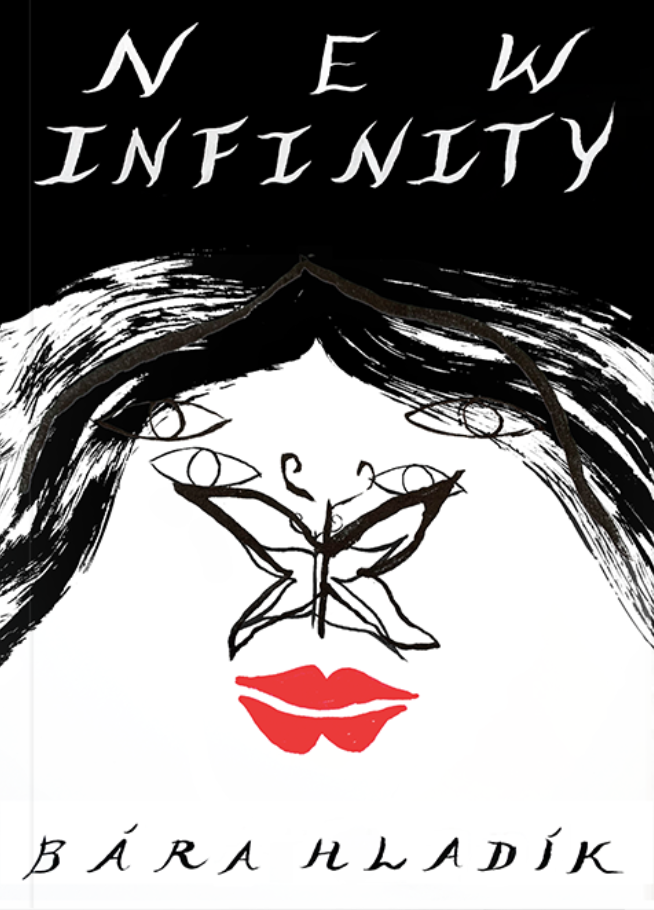
Bára Hladík on 'New Infinity,' Disability, & Folklore

September 2, 2022

AN INTERVIEW WITH BÁRA HLADÍK
BY LISA MARIE BASILE

Your newest book, New Infinity, so deeply speaks to me — not just as a reader and writer (and human!) but also as someone with Ankylosing Spondylitis. It’s so rare to see the very thing that’s changed one’s life come to shape in a literary setting — and done so beautifully. Can you tell us all about it?

My latest book is a hybrid experimental novella about a woman living with Ankylosing Spondylitis, a disease that I also live with. It is an ode to the existential experience of degenerative disease and a philosophical reckoning of a woman in pain. It chronicles moments of her life as she tries and fails to connect, have relationships and make ends meet. It ponders the meaning of existence, life, and failure as she gathers notes from medical literature and self-help books to understand her existence.

The book is inspired by ten years of living with the disease myself, and although fictionalized, the story draws from my own experiences. I created a nameless woman as a way to revisit myself, as well as observe her from a distance. The book blends surrealist stories with poems created from found medical literature, self-help books, books about the cosmos, and journals.

I was inspired to create a literary work that centred the woman in pain as philosophically and existentially significant. I wanted to take her out of the attic, and out of the trope of 'hypochondriac woman' so common in the history of literature, and create a literary work that not only expressed her experience accurately, but portrayed it as a radical experience that challenges the very structures of our society and philosophies.

I can't tell you how affirming it is to speak to another writer with Ankylosing spondylitis — and your writing about it is so potent! 

I've personally found the disease really hard to write about. At first, I thought "this is too specific to really share; no one will 'get' it." Over the years, though, I've realized how the disease had filled in so many of the cracks of my life....and it was nearly impossible to avoid writing about. 

This disease feels like it wants to trap you, physically and emotionally, and that is something that I have felt drawn to exploring in a literary sort of way. But it's been a long journey in figuring out how. What's the lesson? What's underneath the desire? How did you come to write about AS and pain and women, specifically, and was it hard for you to share something so intimate and challenging with the world? 

It means so much to me to hear that, thank you! Seeing your work about AS encouraged me to write more specifically about the disease and share publicly. It is definitely a challenge to write about the realities of Ankylosing Spondylitis. Most of the time I don't want to even share with the closest people in my life, so writing publically about it is hard.

But as you said, it is nearly impossible not to write about it. There are so many silencing and isolating aspects of living with this disease that in some ways I have a need to express a primordial scream of this unrelenting physical and emotional pain. Just as birds who made it through another night of darkness call out to each other in the morning, writing is a way to express existence. 

I turned to reading more and more as my illness took hold and I found I was reading a lot of philosophy. At the same time, most of the stories I encountered about illness, women were framed as 'hysterical' or 'hypochondriacs.' I wanted to challenge this narrative and write a story that centered the sick woman as a philosopher. A story where the experience of sickness was in fact a philosophical act that gives insight into the very meaning of existence. So while the disease is specific, the questions about existence are universal. 

Do you ever feel like disability gives you a new lens, a sort of expanded eye, through which to see the world anew? While illness may bind us (and others) in many ways, it also sort of necessarily stretches how we approach creativity and expansion.

For me, yes. I often feel that although my illness is difficult and painful, it also forces me to stop and deeply consider my place on this earth and in the cosmos pretty regularly. If it wasn't for the fact that at times I have to spend a lot of time recovering from basic tasks, I would be a pretty different person. I have become wiser, resilient, and in some ways more at peace with the chaos of the world.

It forces me to find transformation in the most minute of movements or motions, such as creativity or dreaming or simply breathing. Because I can't 'go for a run' to clear my head, I have to find other ways to move through emotions. This is the source of much of where my creativity is born. It is often in moments of pain in which I can only express existing.

Who or what are some of your recent influences?

This book is heavily influence by Slavic writers - Franz Kafka, Karel Čapek, Jana Benova, as well as surrealist/magic realist writers such as Jorge Luis Borges and Gabriel Garcia Marquez. My linguistic style definitely draws from the fact that Czech is my first language, and the way we play with structure, sarcasm and storytelling is much for fluid and malleable than english. I grew up reading Czech folk stories that blended magic and realism, and Czech new wave films that masterfully played with nihilism, sarcasm and surrealism. These influences all bleed into my work.

I love to learn about how culture or identity shapes a writer’s creative approach and work. I’d love to hear more.

My parents fled occupied Czechoslovakia shortly before I was born. Growing up in rural so-called Canada, my culture was often misunderstood as scary. I learned to walk through several co-existing worlds, always turning back and searching for where I came from. I grew up watching and reading Czechoslovakian books and movies, which are so creative, dark, mystical and wise. My parents are creative and resilient people, and I am constantly inspired by them. There is a saying, that Czechoslovakians have 'golden hands', in that we can create something out of nothing. This is from where I create, creating something out of nothing so that we may learn where we came from and where we are going.

What are some of the Czech folk stories that stayed/stays with you, and perhaps influences you as of late?

There are so many! Czechs are truly folklore encyclopedias. One of my favourites is the Vodník, who is a mythical slavic water spirit. He is a toad-like man, usually dressed in a tweed suit, who sits by the edge of a pond waiting for children to wander by so he can capture their spirits in tiny porcelain pots at the bottom of the pond. There are many great Czechoslovakian films about Vodník and his family, with shots of water people appearing out of sinks and toilets in tailored suits perfectly dry.

Do you turn to any sort of writing rituals or practices? I’m always so interested in how people approach their work and what that process looks like, especially when the writer creates across genres.

Much of this work was written in my head. With my illness, I am often bound by the limits of my body and must spend large amounts of time recovering. This means I am unable to move much for several days. So in these moments, I dream and write in my head. I imagine stories, themes, images. Often, the story is very formed once I hit the paper. I jot down notes of themes or ideas I want to weave throughout and then I sit down and write it start to finish. I then leave it be as I think through problems, and then I ruthlessly edit. Poetry is different. For me it is more of a ritual or practice. Many of the poems in my book were created by physically cutting up books that I found at the thrift store for under 5$.

I found medical books, self-help books, stories and beyond, then cut out individual words or sections of words. I did this all with meditation or images in mind. Then I would mix them into a special wine glass, and draw the cut words into a divinatory reading, similar to drawing playing cards or tarot cards. This practice is very specific and personal to my artistic work so this is all I will share here, but eventually, a poem would come to life.

Was there an certain ‘a-ha’ moment that led you to writing or creating? Was there an experience that reaffirmed what you do and why?

A babysitter once told me that I told her I was going to be a novelist when I was 7 years old. In grade 5, I was writing a story and every week the class would ask me to read the new chapter. It was a story about a family of six women surviving world war 3. Following these years I had a lot of doubt and anxiety as to where I was going or what I was doing, but thinking back to these moments always reminds me that this is part of me whether I resist it or not.

Who are some of the people you look up to or admire?

Thank you to disabled writers @leahlakshmiwrites @bighedva @pchza.

I’d love to hear one piece of writing advice that you think is essential for other writers.

Focus in on your work, your voice, your style. As much as we can learn from others, stay true to your vision. Be confident that what you are creating is important, even if you don't quite see how, yet. Do it for yourself. You're own satisfaction, sanity, passion, whatever. Do it for you.

Bára Hladík is a Czech-Canadian author, artist and facilitator.

Lisa Marie Basile is the founding editor of Luna Luna Magazine. She’s also the author of a few books of poetry and nonfiction, including Light Magic for Dark Times, The Magical Writing Grimoire, Nympholepsy, Andalucia, and more. She’s a health journalist and chronic illness advocate by day. By night, she’s working on an autofictional novella for Clash Books.

Her work has been nominated for several Pushcart Prizes and has appeared in Best Small Fictions, Best American Poetry, and Best American Experimental Writing. Her work can be found in The New York Times, Atlas Review, Spork, Entropy, Narratively, and more. She has an MFA from The New School.

In Poetry & Prose, Interviews Tags Bára Hladík, disability, ankylosing spondylitis, disability poetics, novella, new infinity
Comment

Candice Wuehle on 'Monarch,' Ritual, and Rejecting Writing Rules

August 29, 2022

An Interview with Candice Wuehle
by Lisa Marie Basile

Lisa Marie Basile: Tell us all about your new work. I am a huge fan of your gorgeous poetry and prose, from your genre-shifting/blending to your exploration of the glittery and the gritty. Can you tell us about your newest work, Monarch?

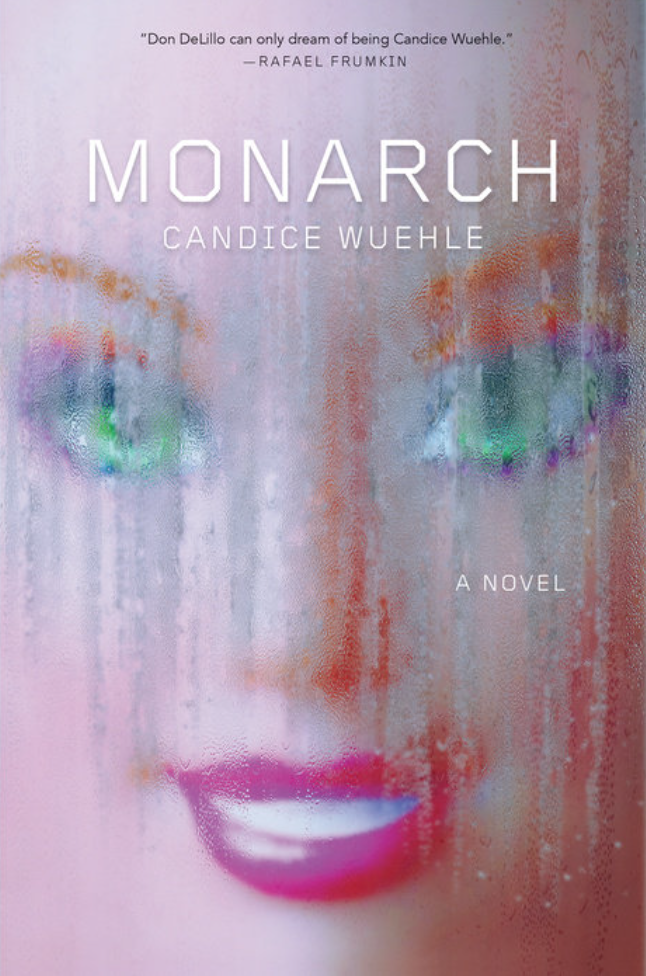
Candice Wuehle: My most recent novel, MONARCH came out in March. The idea for it came from an actual conspiracy theory that claims MKUltra has a secret division called Project MONARCH that recruits children and teens from beauty pageants to become sleeper agents.

They specifically recruit beauty pageant contestants because of their natural (or studied!) charm, conventional attractiveness, physical aptitude and stamina, and their strong propensity for obedience. This theory asserts that MONARCH agents are programmed using trauma-based mind control techniques. I was just finishing up my dissertation on memory and trauma studies for my PhD and the MONARCH theory became a perfect metaphor for a lot of what I’d been thinking about regarding how much of consumer culture (especially culture aimed at women and body image in the ‘90s) is a kind of trauma-based social programming.

The first beauty pageant contestant I always think of—the one imprinted on my own psyche—is JonBenét Ramsey. A plot about a teen queen reminiscent of Ramsey, but who has lived, grown up, and is now seeking revenge captured my imagination.

The real quest of MONARCH, though, is the main character’s journey to figure out who she is—what part of her is really “her” when it seems so much of her personality has been programmed.

For me, the technology that delivers that answer comes through divinatory practices, so there are scenes of tarot and especially séance in MONARCH that are intended to get at the occulted side of the self. Not occulted as in spooky, but occulted as in: hidden even from yourself.

Currently, I’m working on a collection of short stories that’s a sort of Internet gothic—haunted apps, poltergeist algorithms, a GPS that leads to another dimension.

Lisa Marie Basile: What are some creations that light you up? How do they influence your work as a writer or creative?

Candice Wuehle: For the last few years, I’ve been really inspired by contemporary fiction (mostly written by women). For me, there was a bit of a shift in the literary landscape after Eileen by Ottessa Moshfegh was published that made room for the kind of books I’ve really wanted to read all my life.

Many of my favorite books of all time have come out in the last ten years—books that are often marked as “unhinged” but that are irreverent, angry, hilarious, politically and culturally subversive, and deeply intelligent. I’m so inspired by creators who can dialogue with the current moment, or, more likely, who are willing to say something so out of the moment—out of any moment—that when it arrives it feels utterly new.

To name just a few, I love A Touch of Jen by Beth Morgan, New Animal by Ella Baxter, Luster by Raven Leilani, Nightbitch by Rachel Yoder, Self Care by Leigh Stein, the novels of Lucy Ives and Melissa Broder and Mona Awad.

Reading very recent work that has an intentional disregard for certain craft conventions, that refuses to be totally “done” or to “make sense” gives me a sense of community and makes me feel more tethered in time than I normally am.

Poets write collections that include aporia, void, and contradiction and that’s understood, but it’s rarer to see that kind of insistence on the truth of personal expression—of a writer’s inherently complex and often incompatible belief systems—represented in the novel form.

“Poets write collections that include aporia, void, and contradiction and that’s understood, but it’s rarer to see that kind of insistence on the truth of personal expression—of a writer’s inherently complex and often incompatible belief systems—represented in the novel form. ”
— Candice Wuehle

Lisa Marie Basile: You shift between genres and seem to do it very naturally. I think a lot of writers feel they must select a lane and stick to it. 

And, as you said, "Poets write collections that include aporia, void, and contradiction and that’s understood, but it’s rarer to see that kind of insistence on the truth of personal expression—of a writer’s inherently complex and often incompatible belief systems—represented in the novel form."

Perhaps there are a few questions here, but how do you approach the concept of genre, and how do you approach giving the same permissions to the novel as poets might inherently have? (I say that as someone who has complex thoughts on what 'genre' means). 

Candice Wuehle: Thank you for this question. So, the truth is I write what I write, and then I see what genre it seems to look like after. The other truth (and I’m going to contradict myself immediately, but that’s part of my point) is I don’t write poetry and prose at the same time.

I haven’t written any lineated poetry since 2019. It doesn’t worry me. I never thought I’d write prose, then I tried to write a poem that showed up as a novel. I’m sure I’ll sit down one day with an expectation to write in one genre and end up doing something else. It seems like most people write to express themselves or to understand themselves. I understand that and I love that and I find kinship and solace and truth in writers who write from that place. But I write to surprise myself.

Since this is Luna Luna, I know readers will understand it when I say I write to see my shadow. That’s meaningful to me because I know others see my shadow and recognize it in themselves; that my work is shadow work for me and for others. What does that have to do with genre? I guess just that if you go into shadow work expecting to see shapes you already know, you aren’t prepared.

So I let the narrative shape arrive the way it presents itself and then I make choices on the second draft that might lend the shape to something more recognizable to a reader, but only if I think that serves the highest goal of the project.

“I write to see my shadow. That’s meaningful to me because I know others see my shadow and recognize it in themselves; that my work is shadow work for me and for others.”
— Candice Wuehle

Lisa Marie Basile: Can you tell us a bit about your general creative process? What sort of rituals or practices do you adopt? Or, you know, have you struggled with creativity at all as of late?

Candice Wuehle: The pandemic has been devastating for my ritual practice, to be honest. During my most creative periods, my ritual was a walk to the university library where I would sit with a cold brew in a jelly jar while listening to colored noise and write (or not write). Equally important to the ritual was the walk back home. I didn’t know that at the time—that the walk back home after writing was the same as Shavasana for me.

A period where what I had worked on integrated into me and began to braid into the next time I wrote. Now, my walk is simply to my home office, a space I love but that I haven’t fully imbued with the elements I think of as important to a sacred space.

I think it has a lot to do with buffering between acts of creation, which is hard to do when there are no imposed restrictions on how long I can write or when.

To put this in kind of crass sports terminology—I’m trying to figure out “how to get in the zone” but it’s tough because the zone is everywhere. Both my psychic and spiritual hygiene have been taxed by the upheaval of the world over the last few years, I suppose.

Lisa Marie Basile: It is clear that you're very interested in the liminal, the magical, the numinous — do you ever approach writing through a divinatory or occult lens/means?

Candice Wuehle: Yes, always, but my practice is very simple. I believe in the vibrations of a space, so light, sound, and the flow of air is important to me. Candles and incense create a sort of spiritual hygiene, while sounds help me to keep my mind flowing at an even pace. I usually listen to pink or white noise to try to stay engaged in flow state. The most significant aspect of my divinatory practice, however, is something I learned from the woman who taught my yoga teacher training, which is whenever you can’t figure something out just sit until it comes to you.

Once I started doing this, I noticed how important gazing is to me. I keep an obsidian egg and a quartz globe on my desk to look at. In other words, most of the time I spend writing looks like doing nothing. Which is, I guess, a sort of trance state.

Lisa Marie Basile: And how does how culture/identity/place/belief bleed into what you write?

Candice Wuehle: For the last few years, ideas of culture, identity, and belief have really consumed my work in the sense that I’ve been fixated on how we come to accept cultural beliefs as integral to our identities, especially in a late Capitalist culture that largely only presents beliefs intended to get us to buy stuff and conform to a dominant narrative that benefits…those already dominant. A lot of my sense of self and spirituality is born of trying to DIY ways to avoid these pervasive belief systems.

So, for example, I heard an interview with former The X-Files’ researcher and current paranormal investigator, John E.L. Tenney, where he said that beings or events we term supernatural (ghosts, UFOs, witchcraft) are actually ultra-natural in the sense that they’re more real than what we perceive to be real. He says, for this reason, they’re desperate to be seen and remembered; to inscribe themselves in space or narrative.

I think the threads of my work — and especially of MONARCH — pull together out of a desire to reflect a more ultra-natural world. A lot of MONARCH is about how our bodies remember what we don’t and how “the body keeps the score” as the trauma researcher Bessel van der Kolk would say.

In this sense, messages from the body that come out as anxiety or physical ailments might feel like they come from nowhere when in fact, they’re realer than what we’ve told ourselves is real in the sense that these messages are coming from an experience we haven’t yet processed.

I think a lot of cultural messaging also works in this way—folklore and fairy tales as examples of commonly held, deeply integrated beliefs about familial and romantic relationships that have a blatant falseness to them: Eternal sleep, love at first sight, talking animals. We accept those elements as fantastic, but weirdly not the messaging behind them.

So, this is a little bit of a backward answer to your question in the sense that I’m saying belief systems and culture influence my work in a sort of inverse way; that I’m really more invested in unraveling and questioning than I am in determining any kind of personal or cultural or spiritual Truth.

Who are the writers making an impact on you right now?

Candice Wuehle: Currently, I’m really inspired by Jessica DeFino, a beauty culture critic and author of the newsletter “The Unpublishable.” Her ability to deconstruct the beauty and wellness industry in order to point to its colonialist, patriarchal, and capitalist roots/motivations is just so precise and breathtaking.

Much of what she argues about how denatured our ideas of beauty are—how, for example, makeup is often an erasure similar to the death drive—resonates so deeply with what I was thinking through in MONARCH.

Another Jessica—tarot reader/social worker Jessica Dore. Her wonderful book Tarot for Change and her Instagram account are such a gift. She integrates philosophy, clinical psychology, and myth in order to interpret Pamela Coleman Smith’s deck with such fresh, mind-bendingly deep interpretations.

A friend gave me one of her classes for my birthday last year. In the class, she said something about the intersection of social work and tarot reading that I’ve applied to my own life in a radical way: “you should never be working harder than the client.” Which I took as a mantra while I was teaching creative writing—as in, you can’t do someone else’s creative or emotional work. You can only listen and try your best to hear what they’re trying to express.

Finally, I want to mention Beth Morgan and her novel A Touch of Jen again! There’s a list of things I think about all the time, but I don’t know why (a Buzzfeed “Who Said It” quiz that listed quotes from Don Draper and Sylvia Plath that I failed; Britney Spear’s thousand sit-ups a day; the time my high school English teacher wore a veil to teach Hawthorne).

Anyway, A Touch of Jen is on the list of things that I think of every day. This book is so compelling, so funny and smart, yet it refuses to adhere to a single genre convention while obviously being aware of every genre convention. It’s a book that makes perfect effectual sense, and very little logical sense. Like life!

“When I finally stopped trying to write what I thought a poem or a novel was supposed to look like and wrote what I’d really want to read—which for me meant beauty culture, witchcraft, rage, trash, unlikable emotions, and philosophy presented in a way that some people find pretentious—I felt like I had touched the source.”
— Candice Wuehle

Lisa Marie Basile: Finally, what is one piece of writing advice you live by and would give others?

Candice Wuehle: This is so simple that it doesn’t feel like advice to me, but I notice students and lots of other writers don’t seem to follow this philosophy, so here it is: only write what you really want to read. I come from the most traditional possible writing environment and I became a writer with the idea that only the “major themes” are worthy of “serious literature.”

When I finally stopped trying to write what I thought a poem or a novel was supposed to look like and wrote what I’d really want to read—which for me meant beauty culture, witchcraft, rage, trash, unlikable emotions, and philosophy presented in a way that some people find pretentious—I felt like I had touched the source. I become obsessed with returning to my creative work and it took on a devotional quality.

Candice Wuehle is the author of the novel MONARCH (Soft Skull, 2022) as well as the poetry collections Fidelitoria: Fixed or Fluxed (11:11, 2021); 2020 Believer Magazine Book Award finalist, Death Industrial Complex (Action Books, 2020); and BOUND (Inside the Castle Press, 2018). Her writing has appeared in Best American Experimental Writing 2020, The Iowa Review, Joyland, Black Warrior Review, Tarpaulin Sky, The Volta, The Bennington Review, and The New Delta Review. She holds an MFA in poetry from the Iowa Writers’ Workshop and PhD in Creative Writing from the University of Kansas.

Lisa Marie Basile is the founding editor of Luna Luna Magazine. She’s also the author of a few books of poetry and nonfiction, including Light Magic for Dark Times, The Magical Writing Grimoire, Nympholepsy, Andalucía, and more. She’s a health journalist and chronic illness advocate by day. By night, she’s working on an auto-fictional novella for Clash Books.

Her work has been nominated for several Pushcart Prizes and has appeared in Best Small Fictions, Best American Poetry, and Best American Experimental Writing. Her work can be found in The New York Times, Atlas Review, Spork, Entropy, Narratively, and more. She has an MFA from The New School.

In Interviews, Poetry & Prose Tags Candice Wuehle, Monarch, Genre, Writing rituals, Iowa, Fidelitoria
Comment

Jonny Black on Writing What Feels Right To *You*

August 16, 2022

An Interview with Jonny Black
by Lisa Marie Basile

This interview is part of our new Creator Series, a series of Q&As designed to help you get to know people who are writing, making, and doing beautiful things.

I discovered Jonny Black’s poetry in an issue of Ghost Bible — a truly gorgeous literary journal — and was immediately struck by her lush language and her bio’s mention of poltergeists (yes, please, always poltergeists). I was lured in!

Jonny Black is currently working on a novel (I secretly think poets make the best novelists, shh), and can be found at @jonnyblackwrites. In this chat, we discuss her influences, inspirations, and writing the kind of work that truly matters to you, despite what might be popular or expected of you.

I know you write in a few genres, so what are you working on at the moment?

I've got this novella/novelette that I've been working on for what seems like a third of my life at this point! I've been calling it Death and The Necromancer for lack of a better title. It's about Death seeking out a Necromancer to resurrect a cat. I wanted to write something that didn't take itself too seriously, something that was silly even, and it ended up being too real, especially during the pandemic.

I've only just come back to it after about a year. I'm also working on a poetry collection called The Apocalypse Journals. I have about four in the collection and they all happened to be written while listening to Daft Punk's Random Access Memories. I was sad to hear about the dissolution of the band earlier this year. I realized that I'd unintentionally written odes to many of their songs, so I want to keep writing a few more and dedicate it to the band. Each poem is an entry in the various journals of those who have survived the apocalypse and are wandering about the deadened earth and its empty cities.

I am always interested in learning about how writers approach their craft. I think we all get caught up in these ideas of a perfect writing ritual, sharing only when we’re prolific—but I’ve been asking writers to share even the messy parts. What’s your creative process?

Well, I used to write every day in college in my black notebook and I miss doing that. When I was working at a beauty store, I used to eat breakfast in the Del Taco across the street.

I would sit there for an hour or two sometimes, because I had to share a car with my mother, so I arrived very early.

I'd order their chorizo breakfast wrap, cheddar potato poppers (God, please bring those back soon!) and the huge 1-dollar iced tea. Then I'd write until my shift started.

Usually, I had my earphones in and either Kiasmos, Daft Punk, or Rhye blasting away. Now, I try to just write down thoughts I have whenever I get something good. Sometimes I'm able to make the time to write, but working remotely has made it hard for me to compartmentalize my time—I'm often distracted by other things I think I should be doing, and other ways I think I should be productive. I hope that I can get the courage again to go out, sit somewhere way too early in the morning, order some greasy breakfast food, and write.

Who are some of your influences?

Well, Daft Punk is definitely in my top ten, if not top five! Blade Runner, Tron and Tron: Legacy are also huge aesthetic inspirations. I've also been heavily influenced by Sonya Vatomsky's work: Salt is For Curing was my first real poetry book that I dove into and tried to understand.

My insta feed is also a huge inspiration: @brookedidonato, @KylejThompson and Madeline Garner are big ones. I'm also inspired by the cinema and art installations in general. One of the big things I've tried to do with my poetry is make choices like I would if I were directing a film: I think about aesthetic and drama and movement. I try to create a 3D experience with my work.

How does your culture or identity shape your work?

I got the impression that if I didn't write about my brown pain, I wasn't... representing myself, or that I wasn't enough as a writer.

OH BOY, do I have some thoughts. During my education — both high school and college — I got the impression that if I didn't write about my brown pain, I wasn't... representing myself, or that I wasn't enough as a writer.

I struggle with connecting to my own culture and identity because I'm what my sister (and many chicana/o's) calls a "coconut" — brown on the outside, white on the inside. And I'm not very interested in writing about that. I want to write about apocalypse worlds and vampires and gods that live in backyard ponds!

But I'm all too familiar with the concept of poetry as therapy, so I'm sure I'll get there someday. Most of the stories I write do have indigenous main characters, though. It's important to me that I write about characters like myself. And if I can't do it in poetry, I can at least do it in fiction, vicariously, through a character — you know?

With regards to faith, I like to think of myself as a combination of Jane Eyre and Emily Dickinson. She wrote a poem about how her church was out in nature. That really resonated with me. I have a small collection of poetry that is something of a...mary sue fan-fiction take on a chapter in the bible. It's very small, and it was written a very long time ago, but I'll revisit it someday.

Who are some of your mentors or contemporaries?

Reading Salt is For Curing was like a revelation, and I knew that if Sonya could write like this, with this much gothic drama and color, then so could I. I didn't have to write "contemporary" poetry that I'd seen in journals. I could write mine.

I've already mentioned Sonya Vatomsky! I just really just adore their work. Reading Salt is For Curing was like a revelation, and I knew that if Sonya could write like this, with this much gothic drama and color, then so could I. I didn't have to write "contemporary" poetry that I'd seen in journals. I could write mine.

A huge mentor for me has been Nalo Hopkinson because she was my professor at UCR! I wrote my thesis (also includes an apocalypse, ha!) under her guidance and took both a class on comics and class on fantasy fiction with her. she's such a wealth of knowledge and truly a joy to learn from.

I had another professor — I don't know if I should list her name — at a community college, my first poetry professor. I wrote my first real poems in her class. She gave us such a welcoming and warm environment to learn and write in and I learned so much about what could be done with the form in her class. I feel like I was born there. No, I came into my own there and found my voice.

I have very fond memories from that class, including looking out the dark windows into the near-empty parking lot, espresso chocolate cookies, writing my first chapbook, and very lovely classmates.

Jonny Black is a writer living and working in SoCal. She’s been published in Ghostbible Zine, The Roadrunner Review, and The Spectre Review. When she isn’t working on her novel, she’s usually curled up with a good crochet project watching Vincent Price movies. More of her work can be found on Instagram, @jonnyblackwrites.

In Interviews, Poetry & Prose Tags Jonny Black
Comment

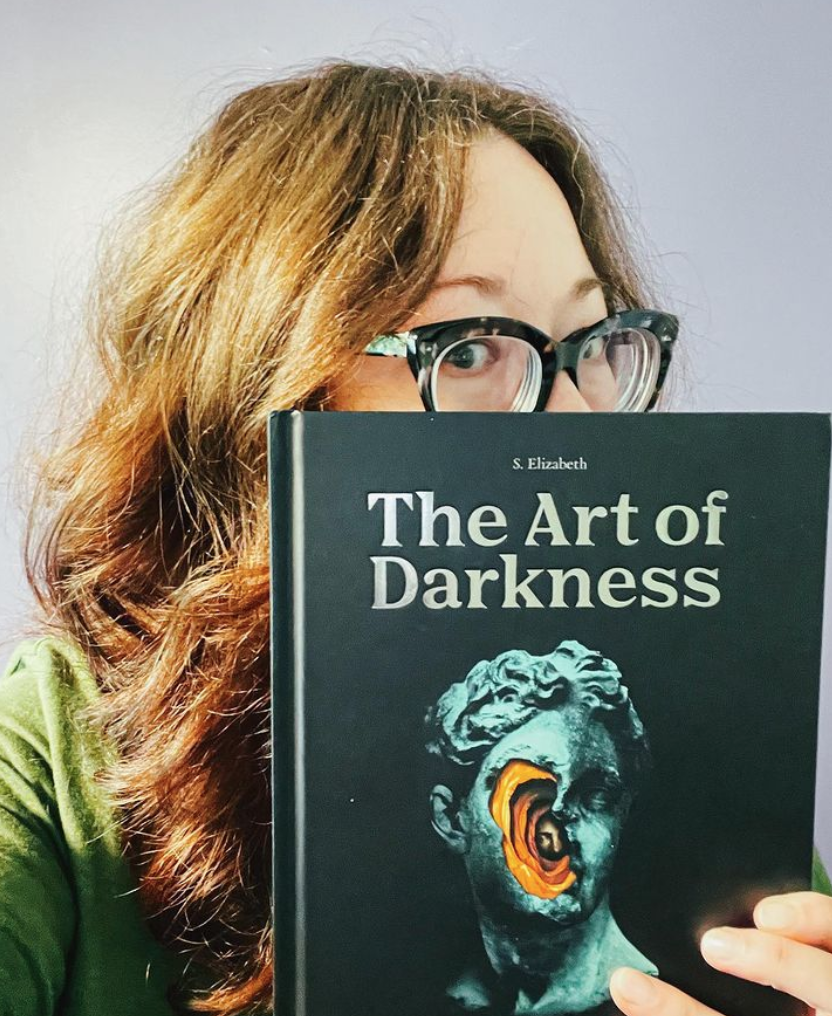
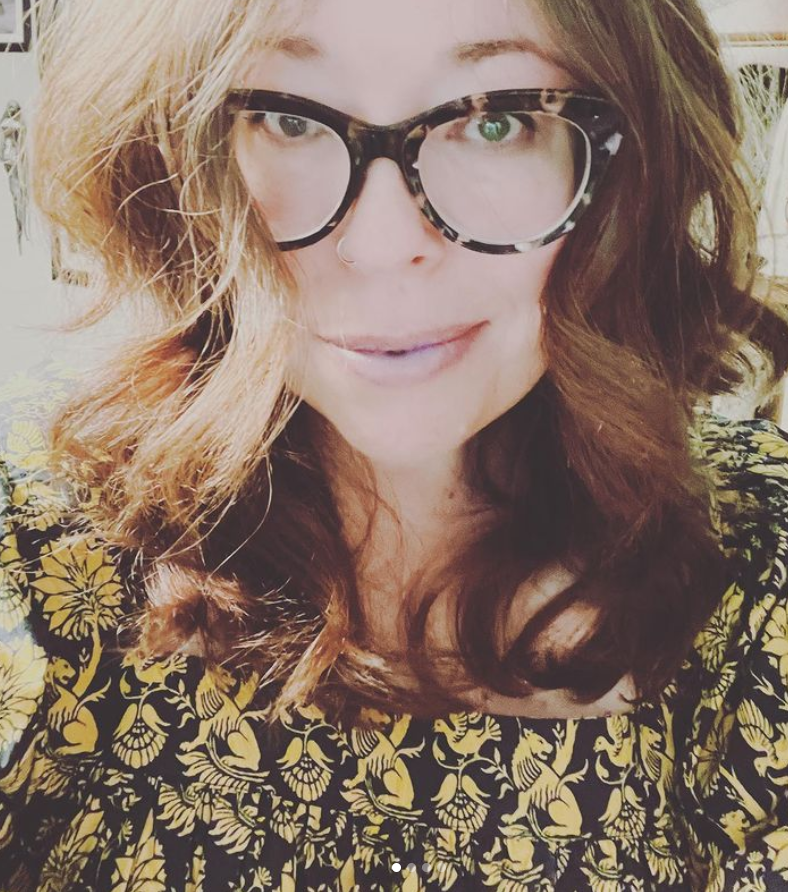
S. Elizabeth on The Art of Darkness, Publishing, and Taurean Delights

August 12, 2022

An interview with S. Elizabeth
by Lisa Marie Basile

This interview is part of our new Creator Series, a series of Q&Aa designed to help you get to know people who are writing, making, and doing beautiful things.

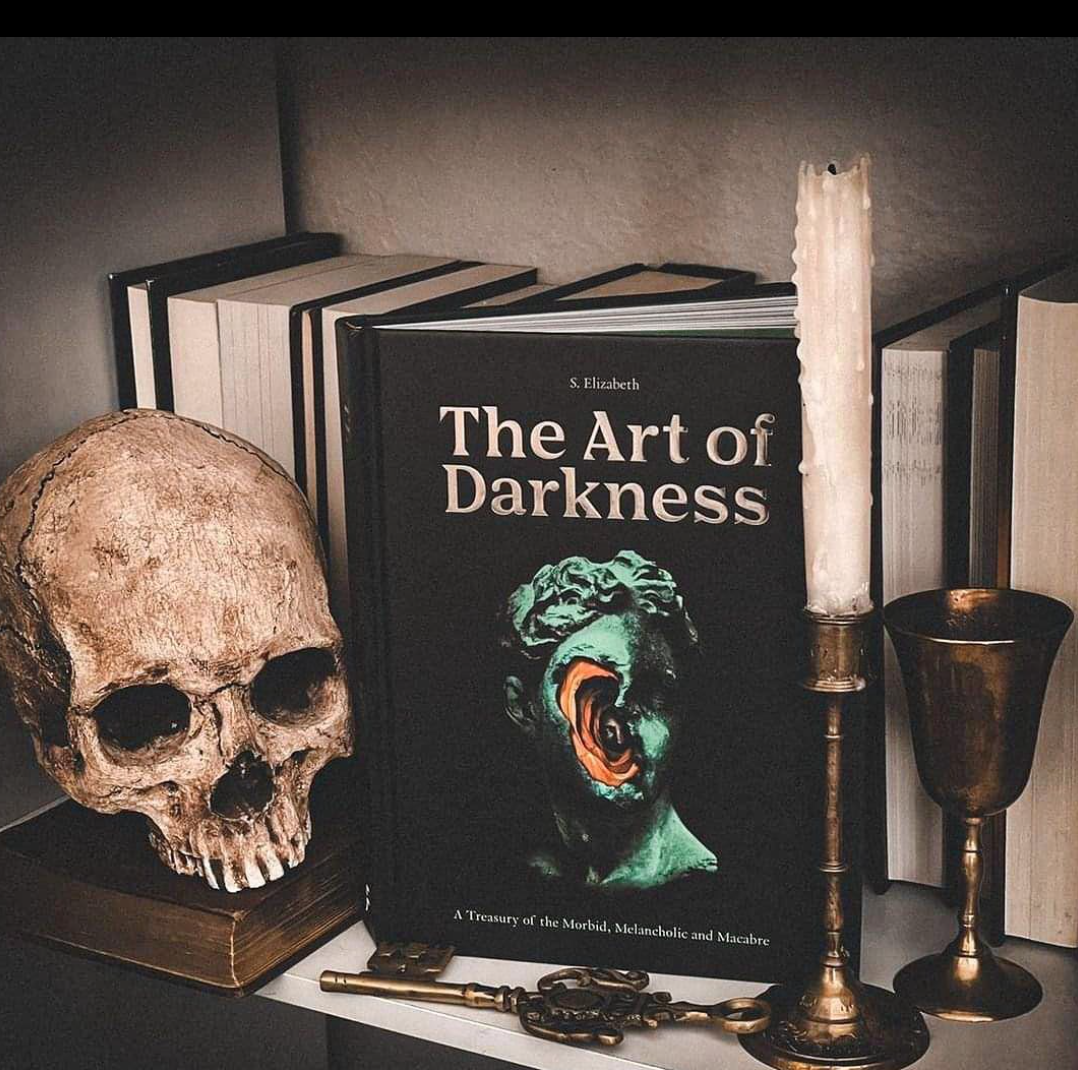
I first discovered S. Elizabeth’s brilliance years ago, when stumbling onto their radiantly macabre, meticulously curated blog, Unquiet Things — a space that I consider a sort of post-graduate education in darkness. The author of two books, The Art of Darkness: A Treasury of the Morbid, Melancholic and Macabre and The Art of the Occult: A Visual Sourcebook for the Modern Mystic, I wanted to ask S. Elizabeth about their influences and inspirations. I hope you’ll enjoy this delightfully detailed, magical, and delicious conversation. I have to say, this is one of my favorite interviews ever done.

Sit by the window, grab a cup of berry-flavored tea or an elderberry spritz and dive in.

Lisa Marie Basile: I’d love to hear more about your book, The Art of Darkness: A Treasury of the Morbid, Melancholic and Macabre. I adored your first book, The Art of the Occult: A Visual Sourcebook for the Modern Mystic (and it’s a cool bonus that we’re press siblings!). What inspired this one? As a self-professed darkling, I want to hear every luscious detail — and I think our Luna Luna readers do, too. I can’t think of a better person to have created this compendium for us.

So the short answer is that The Art of Darkness: A Treasury of the Morbid, Melancholic and Macabre is a beautiful book densely packed with visual arts of the haunting, harrowing, and horrifying variety, and which asks the question "what comfort can be found in facing these demons?" It is inspired by a lifetime's worth of obsession with the dark and what can be found seething in the shadows when we stop being too frightened to peek. Or when we embrace these fears and anxieties, and we peer into the void, anyway!

When I was a child, I loved things all fairy and "flowerdy" (my 5 year old term for heaps of blossoms and blooms). think I was a cottage core early adopter, hee hee! I was terrified of ugly, scary, angry, wild things: Lou Ferrigno as the Incredible Hulk; the feral alien otherworldly vibe of my cousin's freaky KISS posters, and honestly, as silly as it sounds, George Hamilton as some vampire guy in a film called Love at First Bite scared the shit out of me! And I think that was meant to be a comedy! And Scooby Doo? Man, that gave me nightmares.

But somewhere along the way, that panic and fright regarding the bloodsuckers and monsters from outer space began to give way to fascination, and whereas I would once hide my face behind a pillow when something scary was happening, I now began to feel the itchy urge to peek. As I grew older, the fascination with fearsome things slowly turned into an obsession, and, much like a nerdy vampire creep myself, I began to gobble up and devour every bit of frightening or creepy media that came my way.

From literature and film, to music and art, from that time forward, I was hungry for all things unearthly and strange, ghastly and ghostly, gruesome and grotesque. I also grew up in a household with a mother who was an astrologer, who had tarot cards tucked into every nook and cranny, and mysterious artworks hung on every wall. All of her relationships, whether friends or romantic entanglements, were with bohemian weirdos and heavily tinged with magic and mysticism.

My former stepfather for a long time ran a small rare occult book business; I worked with him for a spell many years ago, and it was an incredible experience. Just me and these beautiful old books full of magic and witchcraft and demonology all day long! For a bookworm introvert with a penchant for the esoteric and obscure, that was as close to paradise that I will ever get! These interests and inclinations festered and blossomed and grew alongside me, inside me, over the years and are now what inform and inspire my writing, most of which can be found at my blog Unquiet Things, where I ramble about art, music, fashion, perfume, anxiety, and grief–particularly as these subjects intersect with horror, the supernatural, and death.

There's A LOT of art there. Art is another longtime fascination of mine. These two obsessions—art and darkness—became so deeply entwined for me over time that to celebrate them in a book seemed like the most obvious thing in the world.

“I’ve always felt like such an invisible nothing...and I know that I give away of myself more than I will ever get back in return...it’s the sharing of these little pieces of myself in all of these different places that somehow, paradoxically, builds me back up.”
— S. Elizabeth

Lisa Marie Basile: With such a brilliant mind, your trail of inspiration must run deep. Can you tell us what sets you ablaze?

It's funny—this is a question I love to ask artists and creatives when I am the one doing the interviewing, but it turns out that it's not easy to put into words! Or rather, while I can definitely list some inspirations, I'm hesitant to say as to whether or not they are even apparent in my own writing. Dracula by Bram Stoker and Daphne du Maurier's Rebecca were two books that I read when I was 11 years old or so, and I was thrilled to read the intense gloominess and atmosphere of excessive dread and mystery that each of these stories conjured for me.

By that age, I had also read and re-read Louise Fitzhugh's Harriet the Spy a dozen times and while I knew even then that Harriet was a pretty flawed character, I loved her and wanted to BE her with her notebook and nosiness and creeping into people's houses just to see what sort of boring things that they get up to. In college, I discovered Sei Shōnagon. This Heian-era mean girl and OG blogger sorta felt like an adult, more polished Harriet who moved up in the world. I have long loved the writings of this Japanese author, poet, and a court lady : her elegant lists, her acerbic observations, her beautifully intimate and wonderfully catty diaries–all of her anecdotes and opinions and inner dialogue, from the excruciating minutiae of everyday life, to the exquisite poetry she composed connecting and expanding these trifling, fragmented instances to the broader aspects of lived human experience; these strangely random and tangential stories have informed and inspired my own writings for many, many years now.

Also, I’d probably be remiss in leaving out that frustrating old H.P. Lovecraft. His stories are dense with florid description and also packed with racism and xenophobia but he is a part of my past self and I can’t pretend I never read his writings or that his concepts of madness-inducing cosmic horrors haven’t inspired some of my favorite contemporary authors–writers who have taken these ideas and improved upon them immeasurably.

Also, I won’t lie. When I am writing a review for a particularly odious perfume, I may employ the use of a internet Lovecraftian adjective generator for my purposes. Cinematically, I love the works of Jean Rollin and Dario Argento–the former, visual poetry of sensual horror, uncanny beauty and perverse, morbid delights, (read: swoony lesbian vampires) and the latter a creator of gorgeously lurid giallo films. All of these movies are equally absurd and nonsensical, but dang are they pretty. If it’s got exquisite humans wearing breathtaking fashion and swanning about castles or stately manors or even glittering discos or murky alleyways–I am all-in.

Conversely, I do love the gentle, heartwarming charm of a beautifully animated Studio Ghibli film. I love both King Diamond and Weird Al. Lana del Rey and Anna von Hausswolff. Golden age illustrations of elegantly levitating fairies in a lush vibrant summer garden and the gothic charcoal rendering of melancholy moth singed by a candle’s flame. My own writing is probably some strange patchwork of all of these things, the sentimental, the spooky, the silly.

Sometimes I can even channel a less-talented, dopier Mary Oliver:

7am garden poem
Burying elderberry seeds
in the fog of last night’s rain,
mosquito bit, caterpillar cursed,
a spider looked at me sideways—
I know my business, bugs!
Tend to your own!

Lisa Marie Basile: How does the muse inhabit you? Give us a peek at your creative process — the good and the challenging.

For a very long time my process involved being too terrified and paralyzed with the thought of failure to begin a project, making myself miserable for a number of days/weeks/months dreading doing anything about it while not doing anything about it, and then zipping it all together at the last minute because the only thing worse than failing is not coming through with a thing you had promised to do.

The ONLY thing that lit a fire under me and made me write the thing was that I didn’t want someone upset with me for not having written it. Nowadays I’ve come to the conclusion that I hate the feeling of that dread—it takes up so much space and energy and it sucks all of the life out of everything else you’re doing in the meantime!—more than I fear the failure.

I do whatever it takes to get myself in front of my computer and work on the thing every single day, even if it’s just a few minutes. It always turns out to be longer than that, but the trick is, I was able to get myself there because I promised myself “you only have to do the bare minimum today.”

Somehow, that makes it not so scary for me, and as cheesy as it sounds, those snippets add up over time and by the time your deadline rears its head you’re like “oh, I only need to make a few tweaks, everything I need is all already here!”

Another trick (yes, I have to trick myself a lot) is something I read in an interview with one of the big deal writers for The Simpsons. He said something along the lines of just sit down and get it all out on paper or the computer monitor or whatever, no matter how bad it is, just write it and come back to it again later. The next day, it’s already there. Like a crappy little elf wrote it for you overnight. It’s turned the process of doing something that feels impossible (beginning a thing from nothing) into something that feels more bearable (re-writing/editing a thing that’s already there.)

Something else I’ve learned is that if I am stuck, just walk away. Banging my head against the wall and agonizing about it never helps? But you know what does? For me, anyway? Going on a walk. There is something deeply meditative about placing one foot in front of the other and carrying yourself forward. You don’t have to think about anything else about making it to the next mailbox or the next block or around the neighborhood or whatever.

The funny thing is…that’s when all of the thoughts sneak in! I’ve read a few articles on how walking engages some sort of cognitive function in your brain that just isn’t activated from sitting at our desks. Our sensory systems work at their best when they’re moving about the world. So for me, taking a walk helps. I end up planing my day, I compose poems and emails and silly tweets for Twitter. I daydream and let my imagination run away with me.

Sometimes, in the mindlessness of steps walked becoming miles traveled, the inner paths my ruminations take will lead me to interesting places with new ideas or present solutions to problems I was subconsciously working out. I come up with my best interview questions, my favorite article titles, and my most intriguing lines of inquiry during these strolls. For other people that might mean stepping away from their project to work on a puzzle or do some gardening or make a quiche or whatever. Do anything for an hour or so that is NOT the writing that is stressing you out.

Lisa Marie Basile: Do you have any creative rituals? Do tell.

I always have to have my hair tied back. I have some weird sensory issues and if I get overstimulated from a stray hair tickling my nose, I get to the point where I want to sweep everything off my desk in a fit of melodrama and lay on the floor and sob.

Perfume is a must! If I’m trying to get serious about a piece I am writing, I will wear something with a bit of gravitas, like Serge Lutens Gris Clair, a sort of somber, sedate lavender. Or, for example, right now I am writing a book about fantasy art and I am wearing Celestial Gala from Scent Trunk, all milky gossamer wings stardust’s effervescent chill. I keep close at hand a notebook full of scribblings…words or turns of phrase from the books I’ve been reading, passages that are beautiful or strange or that I want to look into further. This is a precious little book of inspiration that sometimes sparks an idea for a whole new thing or that can maybe just serve to fill in a blank or two.

Lisa Marie Basile: Whenever I read your words, your descriptions (especially in your fragrance series, Midnight Stinks), or even these responses, I think, ‘damn, you are SO Taurean!’ Please indulge me — how does Taurus move through your life?

Taurus sun/Capricorn rising/Libra moon, here. When I was a child, my chief obsessions were flowers, glittering jewelry, pretty dresses, and watching my grandmother cook. Before the age that others begin to make an impression on me; before I learned to read and discovered other interests through the characters inhabiting the worlds of those pages; before I realize my mother is an astrologer who has apparently charted my every move well in advance—before all of those things, I was a kid who liked to be by myself, who was quiet and reserved and slow to warm to others.

I loved to help my grandmother roll pie crusts, and form doughy dumplings to drop into broth from the tip of a spoon; I liked to crawl into my mother's garden and play with the snapdragons and marigolds (although I really hated getting dirty!) and I loved—LOVED—playing "dress up" and planning fancy tea parties.

As an adult, all of those things remain true. Of course, my selective absorption of all of my mother's Linda Goodman books (I really only ever read about my own zodiac sign, ha!) probably solidified much it at an impressionable age. I continue to move through the world in the most Taurean of ways, I think. I love my solitude and I am still quite reticent and aloof when it comes to being in groups of people.

I'm not unfriendly, it's just...I can't handle more than one person at a time! So I'm afraid I retreat into myself on those occasions. And the memes are painfully true—I do have stupidly expensive taste. No matter what it is, I mean I could be walking into Petsmart for cat food or at the hardware store (even though I hate the hardware store!) and somehow zero in on the most expensive cat treats or toilet seat or whatever. It's not a helpful superpower!

I love both luxury and comfort; I have got a cabinet full of probably thousands of dollars worth of perfume, and yet I sleep in a ratty old tee shirt that's got holes in the armpits because it's so beautifully, perfectly worn-in, and cozy. I love to cook and I love to eat, and you can see that in my soft, round body. But you can also see that in the way I enjoy feeding people something delicious, that makes them feel good. I still love flowers and I still hate getting dirty, so while you may see me in my garden, gingerly digging in the dirt to plant something small, or harvest a tomato or two, generally my thumb is not particularly green and you'll never see me camping. I am not "outdoorsy!"

I'm in my head a lot—I am a pro-daydreamer, but it's not especially high-brow or cerebral up in there. I don't have scholarly, academic, or philosophical leanings. Although certainly lots of pre-writing work and fleeting bits of poetry and wordplay swirl around in there. Still, I have to coax all of that out onto a computer screen or a notepad and get it all tangibly in front of me to make sense of it.

I don't know if that's particularly Taurean, but I imagine my Capricorn rising gives me a weird ambitious/competitive streak that is probably a good and necessary contrast in order to motivate me to do anything with any nonsense that does make it out of my brain.

TLDR; because in typical, plodding, make-a-long-story-longer Taurean fashion, I am taking a long time to get to the point: I love food and beauty and luxury and comfort; I'm reserved and in my head a lot and I didn't mention it above but yes I can absolutely hold a grudge forever but if I love you, I am probably going to love you forever, too.

Oh. And I am absolutely OBSESSED with Scorpios. While I don’t mean to generalize, I can say that in my experience, there are two types of Scorpios: the one that is Very A Lot, they don’t hold back, you always know what they are thinking and they practically flay themselves open for you. They want you to have all of them, even and especially the ugly and scary bits. They wear their shadow side on their sleeve and their shadows aren’t very subtle, either.

The other kind of Scorpio is not exactly the secretive, silent-type, but their shadows are shrewd and sharp and you might not get to see them right away; you always recognize they are there and you are inexplicably drawn to them like a moth to flame.

I am the furthest thing from a Scorpio, but I am also a secret Scorpio.

“Before the age that others begin to make an impression on me; before I learned to read and discovered other interests through the characters inhabiting the worlds of those pages; before I realize my mother is an astrologer who has apparently charted my every move well in advance—before all of those things, I was a kid who liked to be by myself, who was quiet and reserved and slow to warm to others. ”
— S. Elizabeth

Lisa Marie Basile: I am always curious as to how someone’s background, culture, identity, or belief system shapes their work. Can you share a bit about this?

I think my work is hugely informed by my identity in terms of invisibility. It’s a strange/scary thing to talk about because I don’t want anyone to ever think I am somehow mocking their experience as being a nonbinary person, for example, but I was having a conversation with a friend a few months ago after they had come out as nonbinary. I admitted to them that I have never felt like a woman/girl, like a she/her — but that he/him and they/them feel wrong too. I had previously said this to my sister, who responded with “so…do we call you IT?” She was only half serious, but I almost started weeping.

This is going to sound weird and probably very wrong because who wants to be referred to as “it”? Me. I do. That felt perfect to me after a lifetime of living as me, as one who doesn’t feel like a “someone.” I don’t even feel like a person, much less a man or a woman.

I don’t feel like this thing or that thing, because most of the time I don’t even feel here, as a thing that exists. I think my writing and what I put of myself out into the world is very reflective of these feelings of impalpability and unreality, even though I’ve never any of this out loud, in these words.

Lisa Marie Basile: Who do you look up to? I’m so curious about contemporary writers and artists who inspire you.

Three writers and friends who continuously inspire me are Sonya Vatomsky (@coolniceghost ) whose poetry is swoony and sharp and sly and whose essays and other writings are so, so fucking smart; Maika (@liquidnight ) whose words are always so compassionate and thoughtful and perceptive–even when writing about their own experiences, you, the reader feel so breathtakingly, heartbreaking seen; and Nuri McBride (@deathandscent ) a perfumer, writer, and curator whose work centers on olfactive cultural education, and anything she creates is going to be an astonishingly researched, illuminating, insightful journey. Sonya, Maika, and Nuri have all bolstered, supported, and encouraged me in the most gentle and relentless of ways, and they are each deeply special, wondrous humans.

Lisa Marie Basile: I am curious about your thoughts on publishing, promoting, and merging the professional with your, well essence — of creativity and beauty and exploration. I have truly struggled with it all.

In fact, I feel changed — perhaps not always positively — by the experience of publishing. It has taken time to rebuild my Artist self, to step back from going and doing and making and simply rest or take stock. I think once you (or I) share with the world, something dies a little (#scorpio) and you have to work to resurrect it. What are your thoughts on it all?

I thought I would feel more changed by the process of publishing, to be honest. I thought having a book I had written out in the world, on people's shelves, in their hands, would somehow...I don't know...make me feel less sad about having a complicated relationship with my dead mom? Less traumatized by a past relationship full of abuse and gaslighting and manipulation where my identity and self-esteem were ground into the dirt, into nothing? Less shitty about having a less-than-ideal-looking human body that I've been shamed for ever since I can remember? Less scared of everything, all of it, all the time?

Turns out: nope. Having published a book, having published—two books—by this time next month, just means I am all of those things still, but also with some publications out in the world. I still work the same day job I've had for the past 17 years; I don't love it, but in typical Taurean fashion I like my stability and I don't feel comfortable with the idea of just quitting my job and trying to write full-time.

I don't want to "hustle," I don't want to have to agree to write about things I am not interested in so that I can afford to pay my bills. I am just not into any of that. While I am doing as much promoting of my books as I can, I'm not doing anything that feels disingenuous, that doesn't feel like me: you'll never see me doing book tours or speaking on panels or even live-AMAs or anything like that. I promoted them by interviewing the artists in them. I worked them into perfume reviews or little fashion ensemble collages that I then share on social media, or sharing playlists of music inspired by them. These are all things I enjoy doing, and would do anyway, and it was actually a treat to include my book and writings in them. And along with that, I guess I haven't felt anything inside me die because—except for the writing of the book—I don't think I gave *every* piece of myself to the process.

And that's not me patting myself on the back. It's me being boring and practical. I have a job to fall back on. If this book or that book flops, it's not going to kill me. Maybe my ego. But not financially. I'm not rich, I don't have a lot of money. And the money I have made from these books is negligible (that's another thing people need to know about writing books, I think.

There's just...not a lot of money in it.) I know that's not a very exciting or beautiful answer but I do think it is a genuine, practical, Taurus answer. I did exactly what was required of me for these books, in exactly the way I wanted to do it, and no more. Although...I did at one point say that I was NEVER going to be on a podcast (too scary!) but then over the course of the next six months I was interviewed on four podcasts, so ...so much for that, I guess.

I don't know if I adequately answered that question. I've been burnt out, sure. Since 2019 I have written three books (well, I am working on my third) I continue to blog and write for other platforms when it interests me, I post regularly on social media, I started a Patreon that I try to write for once a week, I started and grew a TikTok account where I share perfume reviews almost every day, I put together a press kit, I am in the midst of developing a newsletter and while all of these things sound like professional tools, to me, it's just a lot of fun.

I love doing stuff like this, it's all a beautiful exploration to me. It's A LOT and I need a break every once in a while but I'd probably be doing all of that even if I never published a book! As crappy as social media makes me feel sometimes, the comparison aspect of it, that is, I LOVE it. I really do.

As shy and squirrely as I am, this is how I share and connect with people. I love all of the like-minded souls and kindred spirits that I have encountered through all of these platforms. I've always felt like such an invisible nothing...and I know that I give away of myself more than I will ever get back in return...it's the sharing of these little pieces of myself in all of these different places that somehow, paradoxically, builds me back up.

S.Elizabeth is a writer, curator, and frill-seeker. Her essays and interviews focusing on esoteric art have appeared in Haute Macabre, Coilhouse, Dirge Magazine, Death & The Maiden, and her occulture blog Unquiet Things, which intersects music, fashion, horror, perfume, and grief. She is the cocreator of The Occult Activity Book Vol. 1 and 2 and the author of The Art of the Occult (2020), The Art of Darkness (2022), and The Art of Fantasy (2023)

Lisa Marie Basile is the founding editor of Luna Luna Magazine. She’s also the author of a few books of poetry and nonfiction, including Light Magic for Dark Times, The Magical Writing Grimoire, Nympholepsy, Andalucia, and more. She’s a health journalist and chronic illness advocate by day. By night, she’s working on an autofictional novella for Clash Books.

Her work has been nominated for several Pushcart Prizes and has appeared in Best Small Fictions, Best American Poetry, and Best American Experimental Writing. Her work can be found in The New York Times, Atlas Review, Spork, Entropy, Narratively, and more. She has an MFA from The New School.


In Interviews, Magic Tags S. Elizabeth, the art of the occult, the art of darkness, macabre, unquiet things, books
Comment

Gustavo Barahona-Lopez: On Poetry, Masculinity, and Heritage

August 11, 2022

An interview with Gustavo Barahona-Lopez
by Lisa Marie Basile

This interview is part of our new Creator Series, a series of Q&As designed to help you get to know people who are writing, making, and doing beautiful things.

Gustavo Barahona-López is a writer and educator from Richmond, California. He is the author of the poetry chapbook, "Loss and Other Rivers That Devour,” and in 2023 his debut full-length collection will be published by FlowerSong Press. I wanted to chat with him about his work and influences.

Lisa Marie Basile: Tell us a bit about what you’ve written — and what we can expect from you going ahead.

My chapbook, “Loss and Other Rivers that Devour” centers on my mourning my father’s death and how my identity and sense of self shifted along with the process of grieving. I wanted to write about the complexity of our relationship and my grief. Just as there is love so too is there hurt and actively pulling away from my father’s example.

I never felt that I fit my father’s narrow view of masculinity and part of my journey of grieving included forging my own sense of manhood.

In 2023 I will also publish my debut full-length collection with FlowerSong Press. It centers on themes of language, heritage, colonial erasures, trauma, and some speculative imaginings of the future.

Lisa Marie Basile: Can you tell us a little more about how identity or culture plays into your work?

I am the son of Mexican immigrants to the United States and that has a huge influence on my writing. This is in terms of language (in my case Spanish), cultural references, and experiences. Growing up as part of this community has also inspired me to write about the many abuses perpetrated against migrants to the United States.

For instance, I wrote a microchap centered on migrant children dying on the U.S.-Mexico border. Additionally, I write a lot about masculinity and how I have sought to undo a lot of the gendered socialization that my parents impacted upon me.

Lisa Marie Basile: Looking back to your point about gendered socialization, you said, "I never felt that I fit my father’s narrow view of masculinity, and part of my journey of grieving included forging my own sense of manhood."

I'm wondering, as a poet, does writing about the complexity of family, grief, and gender (re)open these wounds, or does it help you confront, synthesize, or articulate the nuances of it all? I know some poets find writing about traumatic issues cathartic while others find it tricky — a sort of Pandora's box, if you will.

It’s a mixture of both for me. Writing poetry has been key for me to process my feelings around my father’s death and my relationship to his teachings on gender. Since part of my socialization was to repress my feelings to the point that I have trouble recognizing them, expressing myself in my poetry led me to realizations about my own emotions.

While in some ways it is cathartic to write about past trauma there have been multiple times where I have cried after writing a line or a poem because I touched a particularly tender part of my past.

“Since part of my socialization was to repress my feelings to the point that I have trouble recognizing them, expressing myself in my poetry led me to realizations about my own emotions. ”
— Gustavo Barahona-Lopez


Lisa Marie Basile: Are there other authors who you enjoy and who also handle masculinity in a way that resonates with you?

The author that comes to mind when thinking about complicating masculinity is the work of Tomas Moniz and his book “Big Familia.”

Lisa Marie Basile: And what does your writing process look like? I’m always curious to hear how other writers tend to their craft.

I write best when I have an extended period of time to myself. Preferably this would be outside of my home like a local coffee shop. Since my wife and I’d baby, Issa, was born a year ago though time to myself has been scarce so I usually write late night after the kids have gone to bed these days.

Lisa Marie Basile: Can you share some of your general inspirations and influences with us?

My literary influences include Martin Esparza, Tomas Rivera, Sandra Cisneros, Eduardo Corral, Vanessa Angelica Villarreal, Jose Olivares, Marcelo Castillo Hernandez, Alan Chazaro, Muriel Leung, Lupe Mendez, Pablo Neruda, Federico Garcia Lorca, and Gloria Anzaldua.

Lisa Marie Basile: And who are some contemporary creators, writers, or peers that you look up to on the regular?

Muriel Leung, Alan Chazaro, and Gustavo Hernandez.

Gustavo Barahona-López is a writer and educator from Richmond, California. In his writing, Barahona-López draws from his experience growing up as the son of Mexican immigrants. His poetry chapbook, "Loss and Other Rivers That Devour," was published by Nomadic Press in February 2022. Barahona-López was a finalist for the 2021 Quarterly West poetry prize and was awarded a Sundress Academy for the Arts (SAFTA) residency fellowship. A member of the Writer's Grotto and a VONA alum, Barahona-López's work can be found or is forthcoming in Quarterly West, Iron Horse Literary Review, Puerto del Sol, The Acentos Review, Apogee Journal, Hayden’s Ferry Review, among other publications.

Lisa Marie Basile is the founding editor of Luna Luna Magazine. She’s also the author of a few books of poetry and nonfiction, including Light Magic for Dark Times, The Magical Writing Grimoire, Nympholepsy, Andalucía, and more. She’s a health journalist and chronic illness advocate by day. By night, she’s working on an autofictional novella for Clash Books.

Her work has been nominated for several Pushcart Prizes and has appeared in Best Small Fictions, Best American Poetry, and Best American Experimental Writing. Her work can be found in The New York Times, Atlas Review, Spork, Entropy, Narratively, and more. She has an MFA from The New School.


In Interviews, Poetry & Prose, Place Tags Gustavo Barahona-Lopez, mexico, masculinity, poetry
Comment
mediterranean nature

Andi Talarico on Magic, Writing, and Italian Inspiration

August 8, 2022

An Interview with Andi Talarico
by Lisa Marie Basile

This interview is part of our new Creator Series, a series of q&as that are designed to help you get to know people who are writing, making, and doing beautiful things.

Andi Talarico (she/her) is a Brooklyn-based writer, poet, and self-proclaimed witchy poo (astrology, tarot, ritual work). She’s the co-founder of Writing The Cosmos (which I have the great fortune of running with her). As an endlessly fascinating human with a great deal of knowledge about all things literary, magical, and mystical, I wanted to chat with her about her creative inspirations and her upcoming workshop Luna Le Vag, a holistic spa in Brooklyn, NY.

In this interview, we discuss her workshop, influencers, inspiration, and how her culture shapes her work.

Lisa Marie: Tell us a bit about your recent creative project, the Full Moon Ritual workshop you’re holding in Brooklyn this month.

The idea for this workshop came from my frequenting of this lovely Brooklyn business called Luna Le Vag, a holistic spa in Brooklyn that’s run by two inspiring young women, Jordan and Naomi. Their spa does a lot of work with natural care (and pampering!) for the vagina (hence their name) but there’s more to it than that - I could tell that they cared about community-building, networking with other businesses run by women and people of color, and I started to think about a way that I could possibly contribute. I noticed that Luna Le Vag was already offering classes in workshops in areas of interest to me: healing arts, reiki, energy readings, intentional cannabis use, and more.

Because my hobbies revolve around things like the study of astrology, tarot, and ritual, I thought it could be useful - and hopefully fun! - to offer a workshop based around the Full Moon and ways to harness its energy for use in reflection, self-care, and intentionality. All of these practices are beneficial, but I find it especially important to have conversations around and engage with these rituals as part of building community. The more we practice intentionality, the more we participate in our lives fully and authentically. The idea for the workshop is twofold:

First, we’ll be performing ritual as a group, which is its own healing and community-building modality, but Second, I’ll be sharing ways in which all of these practices can be personalized to benefit each person, so they can take these skills and apply them authentically in their own lives, whether alone or with others.

All of this is done in tandem with the good people of Luna Le Vag who will be there to participate, contribute, host, and share their beautiful space with us, as well as their food and refreshments, as this workshop will run all evening, in order to give us time to relax into things in a more organic way. To sum that all up, I’m running a Full Moon Ritual workshop on Thursday, August 11th, from 5-9pm, at Lune Le Vag at 1096 Broadway in Brooklyn. Attendees are encouraged to bring their own tarot deck but we will have extras on hand. No prior knowledge of tarot, astrology, or spirituality is needed to participate.

Lisa Marie Basile: Who are some of your creative favorites? Who lights you up?

Oh wow, what an enormous (and great) question! As it relates to my ritual-craft, I find a lot of inspiration in the words and writing of people like Patti Smith, Maggie Nelson, Anne Carson, Sappho, Jeanette Winterson, Kim Addonizio, Diane di Prima, Gabriel Garcia Marquez, Toni Morrison, Isabelle Allende - people who suffuse their work with a type of magic and openness, who use language as a way to get to truths both known and not. The reading of tarot is a narrative structure; the joy of Astrology comes from mining its depths for meaning; a guided meditation is a way to marry language and imagination. At the bedrock of all of these things is language, incantation, possibility — my love of writing directly feeds my study of the esoteric and magical, and vice versa.

“The reading of tarot is a narrative structure; the joy of Astrology comes from mining its depths for meaning; a guided meditation is a way to marry language and imagination. At the bedrock of all of these things is language, incantation, possibility — my love of writing directly feeds my study of the esoteric and magical, and vice versa.”
— Andi Talarico

Lisa Marie Basile: I’d love to hear about your writing process, struggles, or any rituals you turn to when creating. How are things going?

It definitely depends. There are days when all I need is to take my laptop to a coffeehouse and immerse myself in the din of the city to feel inspired. Other days, it’s much more introverted: I need every single detail of my home to be in order before I’m able to sit down, light some incense, turn on some beautiful, wordless music, make myself the perfect cup of coffee, and then sidle up to the page. Some days I need to write by hand.

Other days I feel the need to type. I try to listen to my needs and balance them with what I’m trying to get done. I do think I write more now, in these past few years, than I used to, likely because I started practicing better life habits more intentionally and tracking them.

It also became easier when I (mostly) shut off the constant inner critic and understood that Prolific usually beats the hell out of Perfection. If I don’t consider every word precious, I can let them all spill out onto the page and then parse them later. You can’t edit from nothing, but you can always edit from an imperfect something.

Lisa Marie Basile: Tell us a bit about how culture, identity, place, or belief inspires or influences your work?

I believe my heritage deeply informs my work - and by work, I mean writing as well as magic-making as well as the way in which I move through the world. While I’m proudly of mixed ethnicity and heritage, I was raised Catholic with a strong emphasis on our Italian-American side of the family, and though I’ve loooong been lapsed in the practice of the Catholic religion, I do still carry an abiding love for ritual, ambience, the mysteries of the spirit, even prayer as it corresponds to incantation. And incense. That one definitely stuck, haha. There’s a certain type of bloody passion that exists at the heart of Catholicism that still speaks to me and through me.

Though my craft has many influences and forms, the majority of the rituals that I practice come from the folk magic traditions of southern Italy. I’ve always felt more attached to the folk magic that took places in kitchens and gardens and bedrooms than the high magic traditions, especially those which exist within a hierarchy. And frankly, if I wanted some man wearing fancy robes to tell me how to live my life, I would have just stayed in the church. I respect the freedom, feminism, and resourcefulness of folk traditions and that love informs much of how I live and work.

Lisa Marie Basile: Who are some contemporary creators, writers, or peers that you look up to on the regular?

I think we’re in a really interesting time in history as far as witchcraft and ritual are concerned and I find a lot of inspiration from the people sort of heading up that public discourse. The work of Pamela Grossman comes to mind, as does Mary-Grace Fahrun, the astrological writings of Chani Nicholas and Gala Mukomolova. I deeply appreciate the life work and educational offerings from Marybeth Bonfiglio at Radici Siciliani, Herban Cura, and Mallorie Vaudoise.

Andi Talarico (Cancer sun/Pisces moon/Sagittarius rising, she/her) is a Brooklyn-based writer, poet, and general witchy poo (astrology, tarot, ritual work.) She’s taught and coached poetry/performance in classrooms as a rostered artist, as well as tarot and astrology workshops through WORD Bookstore and more. In 2003, Paperkite Press published her chapbook, Spinning with the Tornado, and Swandive Publishing included her in the 2014 anthology, Everyday Escape Poems. She also penned a literary arts column for Electric City magazine, and curated the NYC-branch of the international reading series, At the Inkwell, from 2016-2019. Her work has appeared in The Poetry Project, Luna Luna Magazine, Brokelyn, Yes, Poetry, amongst others.

Lisa Marie Basile is the founding editor of Luna Luna Magazine. She’s also the author of a few books of poetry and nonfiction, including Light Magic for Dark Times, The Magical Writing Grimoire, Nympholepsy, Andalucia, and more. She’s a health journalist and chronic illness advocate by day. By night, she’s working on an autofictional novella for Clash Books.

Her work has been nominated for several Pushcart Prizes and has appeared in Best Small Fictions, Best American Poetry, and Best American Experimental Writing. Her work can be found in The New York Times, Atlas Review, Spork, Entropy, Narratively, and more. She has an MFA from The New School.


In Interviews, Magic, Poetry & Prose Tags Creator series, andi talarico, italian folk magic, Writing, astrology
Comment

A Playlist for Spring

March 30, 2022

BY JOANNA C. VALENTE

We can ring in spring through using music as a spiritual, meditative, and reflective tool.

In Music Tags music, playlist
Comment

A Review of Hannah Emerson’s ‘The Kissing Of Kissing: Poems’

February 1, 2022

Kate Horowitz is an autistic and disabled poet, essayist, and science writer in Maine. Her work has appeared in Rogue Agent, The Atlantic, and bitch magazine; on tarot cards and matchboxes; and in anthologies on inanimate objects, pop culture, and the occult. You can find her at katehorowitz.net, on Twitter @delight_monger, and on Instagram @kate_swriting. She lives by the sea.

Read More
In Poetry & Prose Tags kate horowitz, hannah emerson, poetry, Review
Comment
← Newer Posts Older Posts →
Featured
‘in the glitter-open black' — poetry by Fox Henry Frazier
'poet as tarantula,  poem as waste' — poetry by  Ewen Glass
'poet as tarantula, poem as waste' — poetry by Ewen Glass
'Hours rot away in regalia' — poetry by Stephanie Chang
'down down down the hall of mirrors' — poetry by Ronnie K. Stephens
'Grew appendages, clawed towards light' — poetry by Lucie Brooks
'do not be afraid' — poetry by Maia Decker
'The darkened bedroom' — poetry by Jessica Purdy
'I am the body that I am under' — poetry by Jennifer MacBain-Stephens
instagram

COPYRIGHT LUNA LUNA MAGAZINE 2025