

Claire L. Smith is an Australian author, poet and filmmaker. Centered in genres such as gothic horror and dark fantasy, her work has been featured in Moonchild Magazine, Dark Marrow, Peculiars Magazine, The Horror Tree and more. Her debut novella entitled 'Helena' will be released via Clash Books in October 2020.
Read More
Poetry by Olivia Cronk
BY OLIVIA CRONK
To mouth such sickness such intense discomfort (but mere discomfort, not something grander), just very pervasive consuming intrusive, the stomach bad of thinking of
having sprayed perfume in the vicinity of a glass of water
the water on a lower surface
a lower cylinder of flat silk on which things could get caught
not “things,” rather: droplets of the perfume: chemical, bodily
worrying over had the water’s silk lip caught the spray, could the water no longer be drunk.
Then the sickness of knowing it’d be
simply poured out,
both possible directions of water-movement
absolutely upsetting
nauseating in fact
~
Even in knowing in the dream that all books already contain the world miniature,
I was more convinced by more thrilled by impressed with
the machine:
it was an xray machine that mapped the skeleton in some way comparable to how the
chalk line snaps down when one is employing a chalk reel in an as yet uncomposed space
a kind of flash-puff of definition
and somehow I thought this to replace books and other gossip
but language that is used to gawk must be made sculptural
and an erased distance instantly produces a kind of archive:
my ma and I sitting at a bank desk, having not slept, my father dead for a mere twenty hours, we told the eyeball-ish lady sitting across from us that we just needed to change the paperwork
in an awful but intoxicating tunnel of shimmer-noise, I can somehow see, in the far away, a kind of microscope/telescope image:
slow old scarlet lips
right next to, as if looking at,
a 1950s christmas elf doll on a brass shelf
in a nest of tinsel
lips looking at it
Olivia Cronk is the author of Womonster (Tarpaulin Sky, June 2020), Louise and Louise and Louise (The Lettered Streets Press, 2016), and Skin Horse (Action Books, 2012). With Philip Sorenson, she co-edits The Journal Petra.
Photo: Joanna C. Valente
An Excerpt of Constantine Jones' Book 'In Still Rooms'
Constantine Jones is a Greek-American thingmaker raised in Tennessee & currently housed in Brooklyn. They are a member of the Visual AIDS Aritst+ Registry & teach creative writing at CCNY. Their work has been performed or exhibited at various venues across the city & their debut hybrid haunted house novel, IN STILL ROOMS, is forthcoming via The Operating System on March 4th, 2020. It is currently available for preorder.
Read More
Poetry by Kristian Macaron
Kristian Macaron resides in Albuquerque, NM, but is often elsewhere. Her poetry chapbook collection is titled, Storm. Other fiction and poetry publications can be found in The Winter Tangerine Review, Ginosko Literary Journal, Medusa’s Laugh Press, The Mantle Poetry, Philadelphia Stories, Gaygoyle Magazine, and Asimov’s Science Fiction. She is a co-founding editor of the literary journal, Manzano Mountain Review. View her work at Kristianmacaron.com
Read More
Tiffany Lin In Conversation With Vi Khi Nao
TIFFANY LIN IN CONVERSATION WITH VI KHI NAO
VI KHI NAO: In your video presentation, you said at 3:33 that “as artists you have to come from an authentic place.” How do you define authentic here, Tiffany? And, what is an example of inauthenticity in an artist? When I think of authentic, I think of sincerity, meaning it arrives or derived from the heart.
TIFFANY LIN: I define authentic as something derived from a lived experience. Every creative endeavor should be produced from a place of honesty. Creating any type of cultural artifact should be done in earnest. The world is already too cluttered with lies manufactured by disingenuous and profit-driven motivations. Keeping your creative space true is an exercise in freedom.
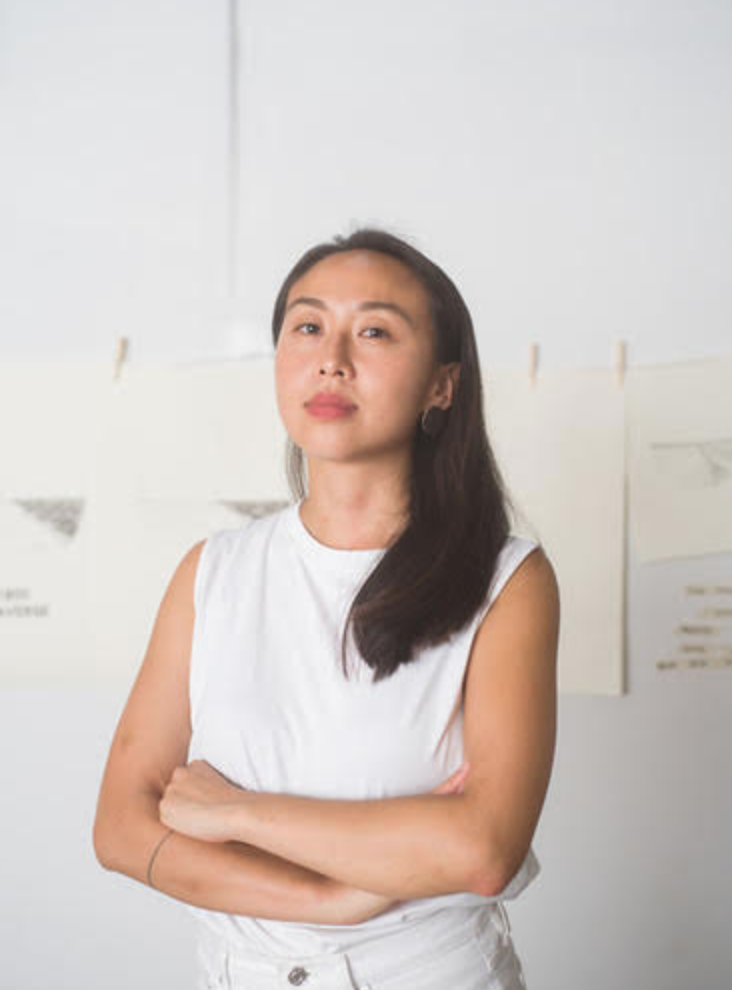
Photo by Jeff Barnett-Winsby
In this particular video, the question was asked specifically in reference to the Illustration courses I am teaching this semester. Illustration is often spoken about as an entirely separate discipline from contemporary art. Maybe this happens because it’s perceived as being too commercial or a willing player in the capitalist machine. Or perhaps its subject matter deemed too trivial and visual execution frivolous and decorative. But if that is what speaks to the artist in question, and it offers an avenue for creative release, my role as an educator is to support and steer them through that independent journey. When I say inauthentic, a broad example is a creative brief from an art director that deadens your soul. It is something to be executed - a means to an end - and serves the client, but may not necessarily challenge the artist or consumer. There are those who are content with this relationship, but it does not align with my personal ideas of what it means to be an artist. In successful commercial projects, the artist has found positive symbiosis with the larger vision that matches their visual language.
On a personal note, I’ve taken on a few projects I didn’t care about or were misaligned with my moral values; it was very apparent in the outcome. I’m now in a position where I have more agency in the projects I choose to take on. And I understand that in itself is a type of privilege, to be able to perform outwardly in an “authentic” fashion as opposed to taking on a voice that is not my own.
(I don’t know if that made any sense).
VKN: (It does make sense) What were those projects, Tiffany? Could you describe them? What have you learned from that misalignment? And, could it have been prevented? If one were to arrive from a place devoid of necessary privilege? Could you foresee an artist be both capitalistic and authentic? Or are they paradoxical and oxymoronic?
TL: I worked on a few fashion-related projects where I was told to respond to explicit “target audiences” / “demographics” that were determined by the art director. Everything was based on market trends. At one point, I was told I drew “too much like a man” and that this would not do well in women’s apparel. I found this creative direction troubling as it suggested that women had a “natural” tendency toward a particular aesthetic, one of frills, curves, and maximalism. I find this view repulsive. Common sense should lead us to conclude that none of this is innate or specific to gender, rather companies have found ways to profit off of antiquated views of gender with bogus “for her” branding. Have you ever been frustrated by gendered marketing “for her,” where functional objects are embellished with extraneous accents because they think they’ll sell better? And that a young woman, seeing the male-counterpart-item, streamlined and plain, comes to understand her place in the world as an accessory. I take no issue with people who prefer this, but it should not be bound to gender.
This attitude can be prevented if we have art directors and creative people who can push beyond gender normativity and dare to think beyond profit margins. Yes, I think an artist can be both capitalistic and authentic, though I probably would probably keep them at arm’s length. Artists face the most difficult Faustian bargains. For some it does not sit well and completely disrupts their creative process. For others, the financial success outweighs the optics of “selling-out” and from a practical level, may allow them to live more comfortably and provide form themselves/their progeny in a better way. For others, fame, glory, and attainment of wealth is all they ever wanted.
VKN: In your bio, it’s written that “through drawing, writing, and performance, her [Tiffany Lin] work investigates the nebulous distinction between want, need, and desire in context of political and capitalist spectacles. What have you discovered, so far, about want, need, and desire? Has your investigation surprised you? Redefine your aesthetics? Or has it ever misguided you? What kind of growth do you imagine for a consumer of your work to experience through your investigation? Do you wish that they de-consume? Or overconsume?
TL: I’ve discovered that one of the unifying themes between want, need, and desire is hurt. Or a sense of loss, emptiness. Whether it is for want of food, water, shelter to the more surface desires such as luxury goods, there is a sense that without said object that the subject is lacking and incomplete. I specify political/capitalist spectacle because I think it’s important to contextualize my practice in the 21st century where the amount of advertising we consume is unfathomable. Codes are created to predict our behavior. The market wants to be our psychiatrist. They know are deepest insecurities and a greatest wish; if they don’t, they’ll try to manufacture it in the deepest recesses of your mind. These psychological operations are not new, but they have reached new levels of saturation with advances in technology and communication.
My investigation has surprised me but not in ways I anticipated. Many of my works are derived from formal/informal interviews with leading questions, and the impact of Donald Trump’s election in 2016 was palpable in people’s responses to what they “wanted” out of a President, or what they “needed” to happen to fulfill their lives. These conversations often turned ugly because there is a thread within the American psyche that suggests all good things come to those who work for it. Though that dream has proven to be a fallacy over and over again, I find that the working class (like my parents, who fully believe in the Dream) do not ever discredit the state or larger systems. An easier psychological solution to pivot their anger and resentment toward their fellow man. My initial response was to balk and grow angry, but I learned from this logic that our narratives of want are rooted in so much more than consumer goods and quality of life, but rather notions of agency that allows the ideal “American citizen” to fully self actualize. What is a citizen anyway?
I have been misguided for sure, mostly in that the conversations were almost always emotional in having to contend with heavy realities - drug addiction, food and housing insecurity - what could an artist truly offer to resolve these problems? Can a work of art feed the hungry? There are days where I think art is useless. Other days I think it is the only thing that will save and outlive us.
My hope is that people view my artwork and feel greater empathy toward others. That somehow, through the reinterpretation of public vs. private sector vernacular, people question their relationship to consumerism and nation. Yes, generic beauty pageant response but I believe in WORLD PEACE. Once people develop more genuine connections with one another they may ultimately “de-consume” material objects as interpersonal relations take priority, but that is not my explicit goal.
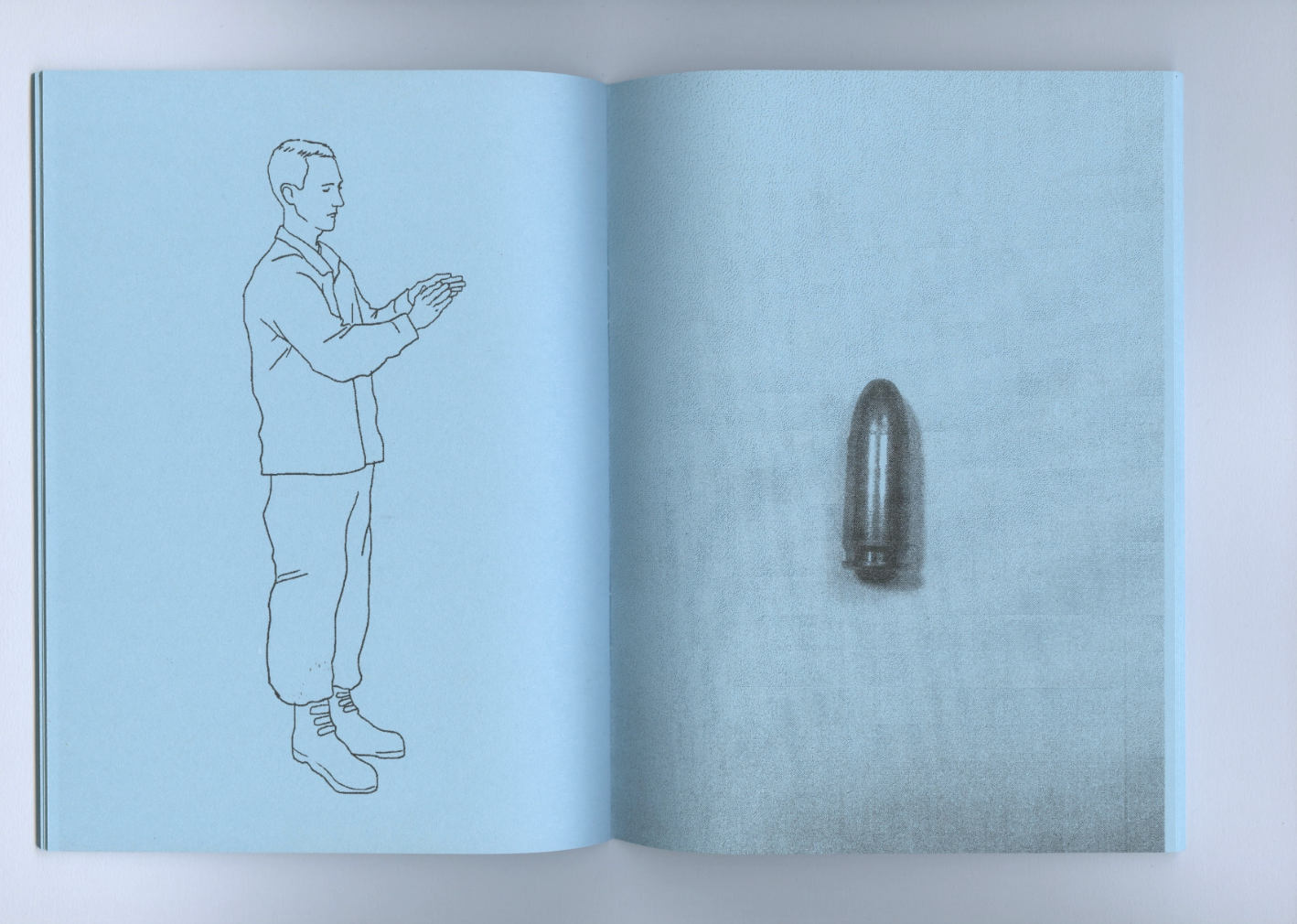
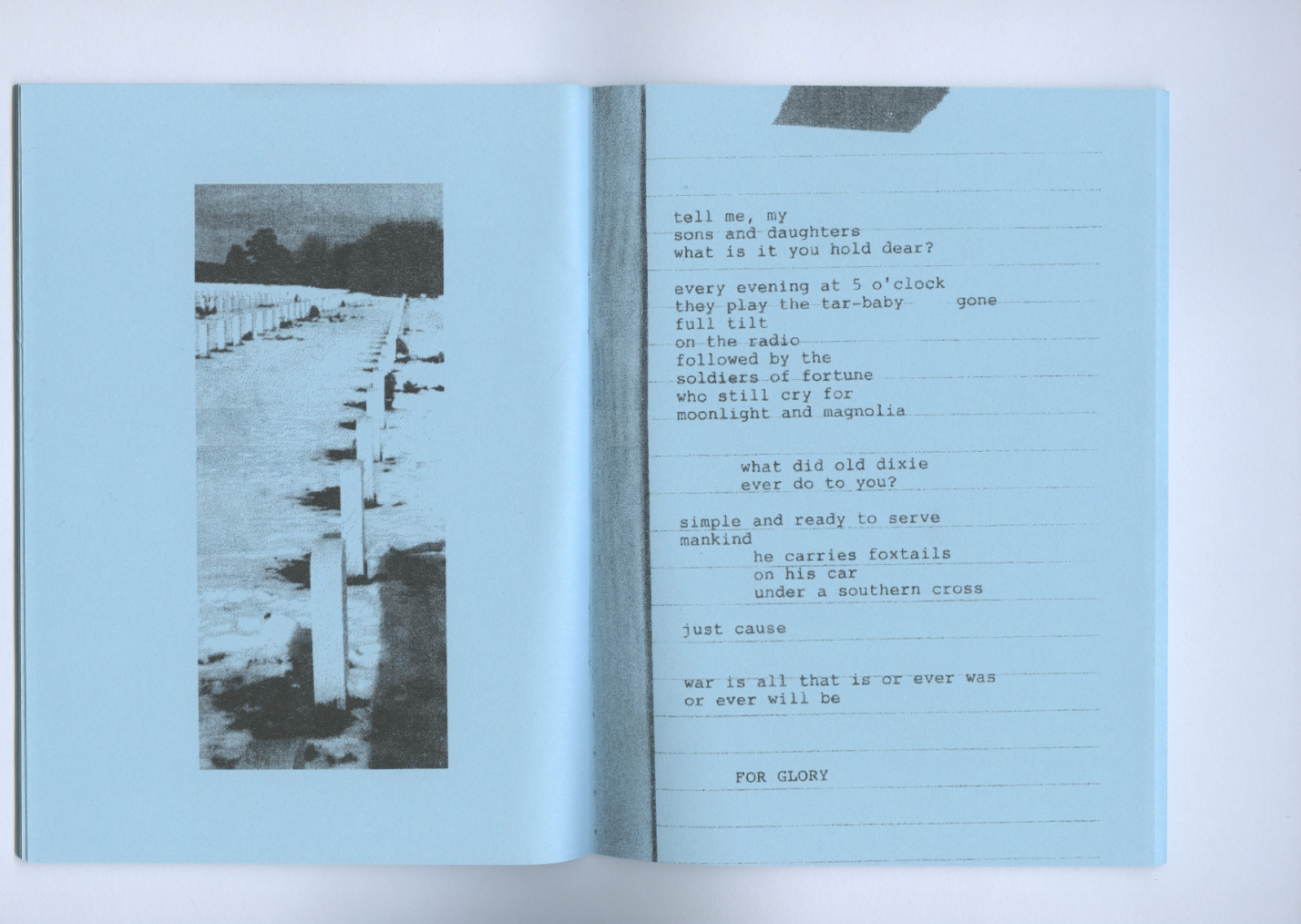
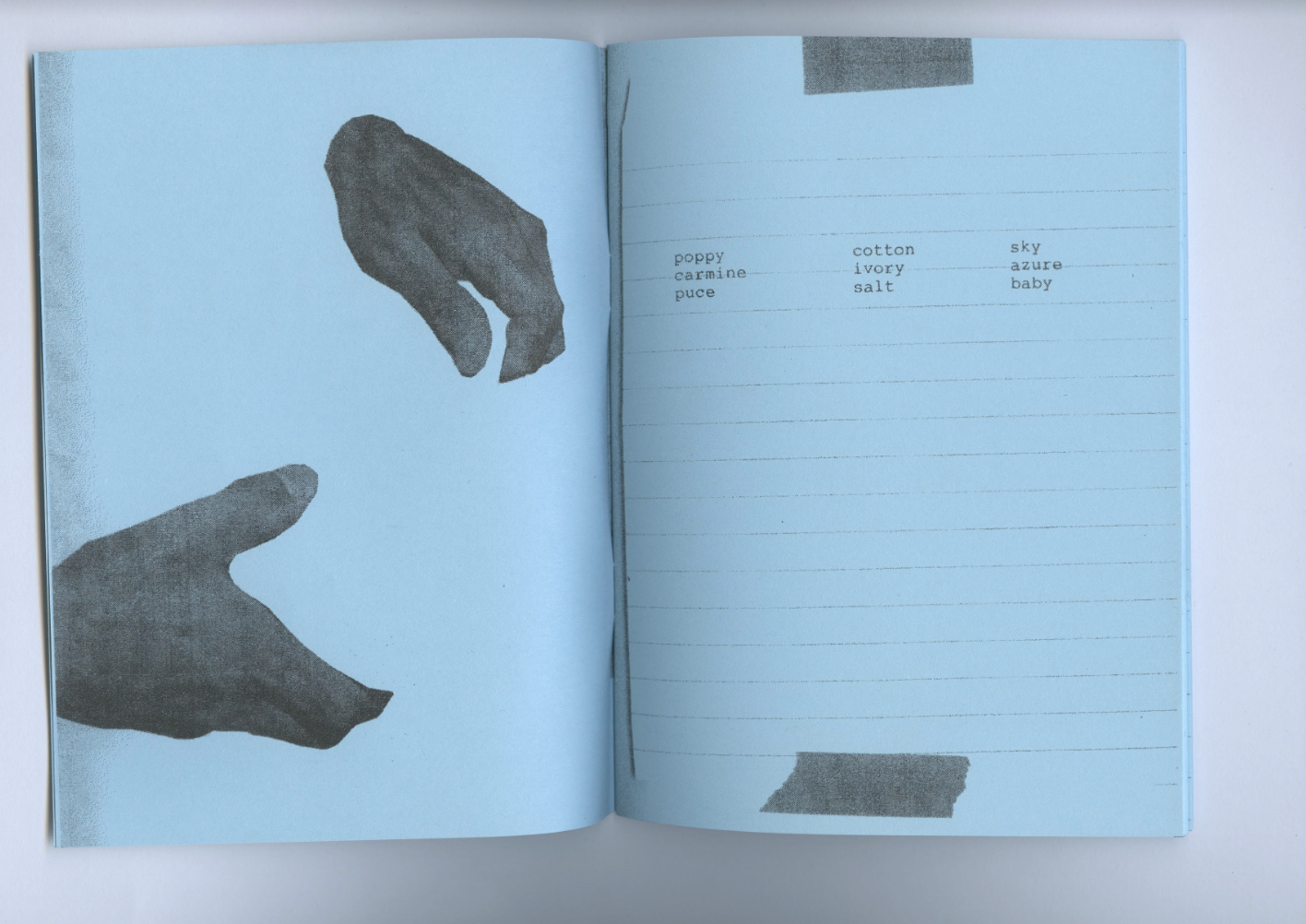
VKN: Your visually performative, “patriotic” chaplet “A Manual by Codes” is both tender and technical, visually ascetic and sharp, didactic and irreverent, and exhibits many shades of political and personal inquiries and it (possibly rhetorically) asks, “tell me, my sons and daughters what is it you hold dear? So if I may ask the book to ask you: tell me, Tiffany Lin, what is it you hold dear?”
TL: I hold dear the elements to which I belong. I like to remember we’re carbon made - my found family, blood family, strangers. When making the chaplet, I wanted to rethink justifications surrounding war and violence. When is sacrifice acceptable? What loss hurts the most and why? The book is a reminder that at the end of the day, you, like me, like her, like him, like they, like it - shit, piss, bleed, and will die. Mortality anchors the work.
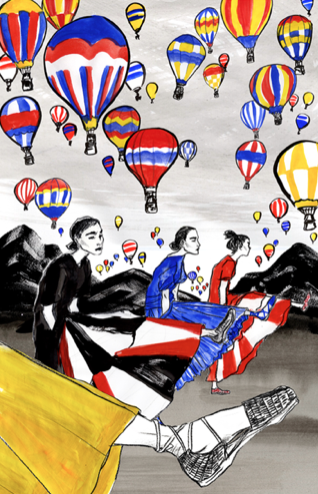
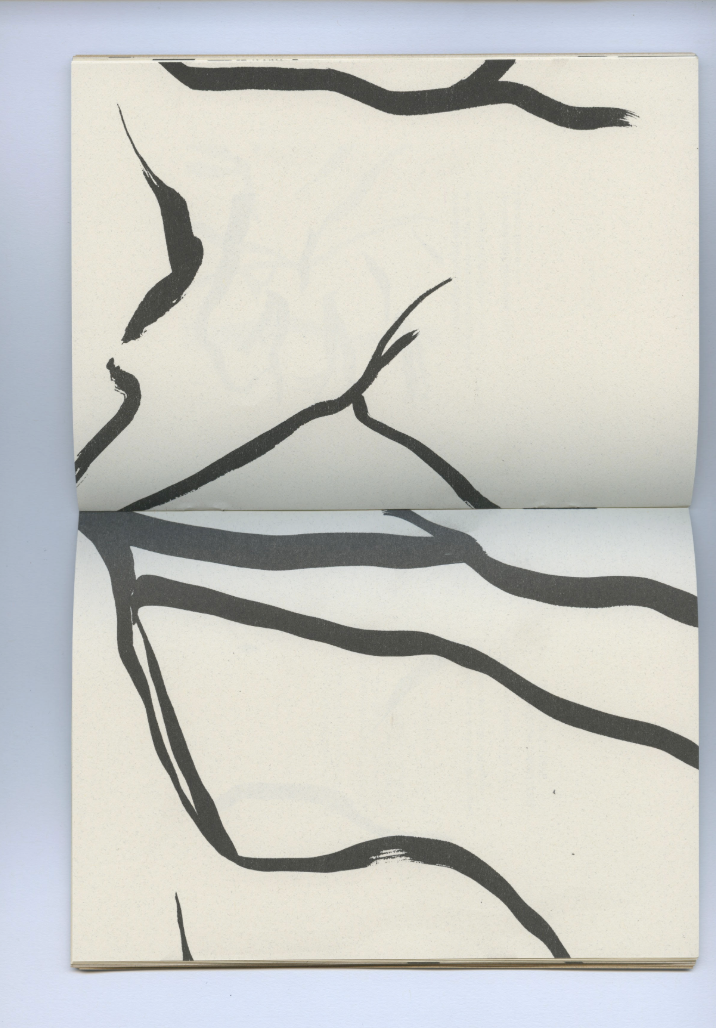
VKN: Can you talk about this illustration? Can you talk to us about your process of creativity? From the seed of conception to its end product? What is the one thing that you have learned from the process? Or what would empower you to refrain? Or do you tackle all of your visual works with some impulsion and immediacy?
TL: This editorial work was created as a response to a Lifestyle Illustration assignment in graduate school. I chose to work with Hermes’ Resort 2017 line (here). Each work (illustration, performance, writing) starts with drawing as a meditative and experimental practice. In this case, since I was responding to a prompt, I was more cognizant of color palettes and visual ambiance that would not distract from the clothing and elevate it in a playful and appetizing way.
I first work in analogue media and scan each component for more creative flexibility when I transfer it to a digital platform. Especially when working with a client that may change their mind quickly about placement, colors, or nitpick angles and stray hairs, it’s nice to be able to edit the piece quickly without tearing your hair out about having to redo an entire painting from scratch.
Impulse and immediacy are words that resonate with me. There is something critical in that first mark - conviction and confidence become lost the more you belabor the form. My media of choice is ink, crayon, charcoal, and gouache. Textures are often done by hand and retain a feeling of a living, breathing image to an otherwise dead mark rendered soulless by digital software. However, integrating digital tools into illustration has allowed me to continue working in this manner while still being efficient in the way things are moved around. Think of it as constant digital collage.
VKN: You work in a variety of mediums (lithography, drawing, painting, performance, a census collector), which one could you live without? Meaning, which medium or medium of expression would make the engine of existence worthy of adding more fuel, spare parts, or appetite for posterity. I used to think art is dead, but when I sit with your work, I have arrived to a small conclusion that art doesn’t always have to be overarching or dramatic - that it could speak or excel in the language of subtlety. An excellent example of this is your chaplet/chapbook titled “BECOMING, a letter” - it’s very poetic, compassionate with an element of un-enslaved detachment, and massively encouraging in the sense, place, and its time of acceptance. Can you talk about this book? Can you talk about the design of the cover? Two circles in ochre(?) and two smaller circles connected by one line? Does it reflect or is it in conversation with this linguistic line, “Two necessary shifts in orbit.” And, could you talk more about the significance of this tenderness, “Darling, There are no lies between us, only nervous hesitation toward an awakening.”
TL: I can’t live without drawing - it is the foundation of everything I do. I’m a big fan of sketchbook experimentation. It is how I think out loud.
In terms of what is more has fallen out of use, I have not worked as a true printmaker (as in working collaboratively with another artist) in a few years. I realize I am better suited to executing my own projects. However, lithography taught me important life lessons about patience, process, consistency, and the art of failure.
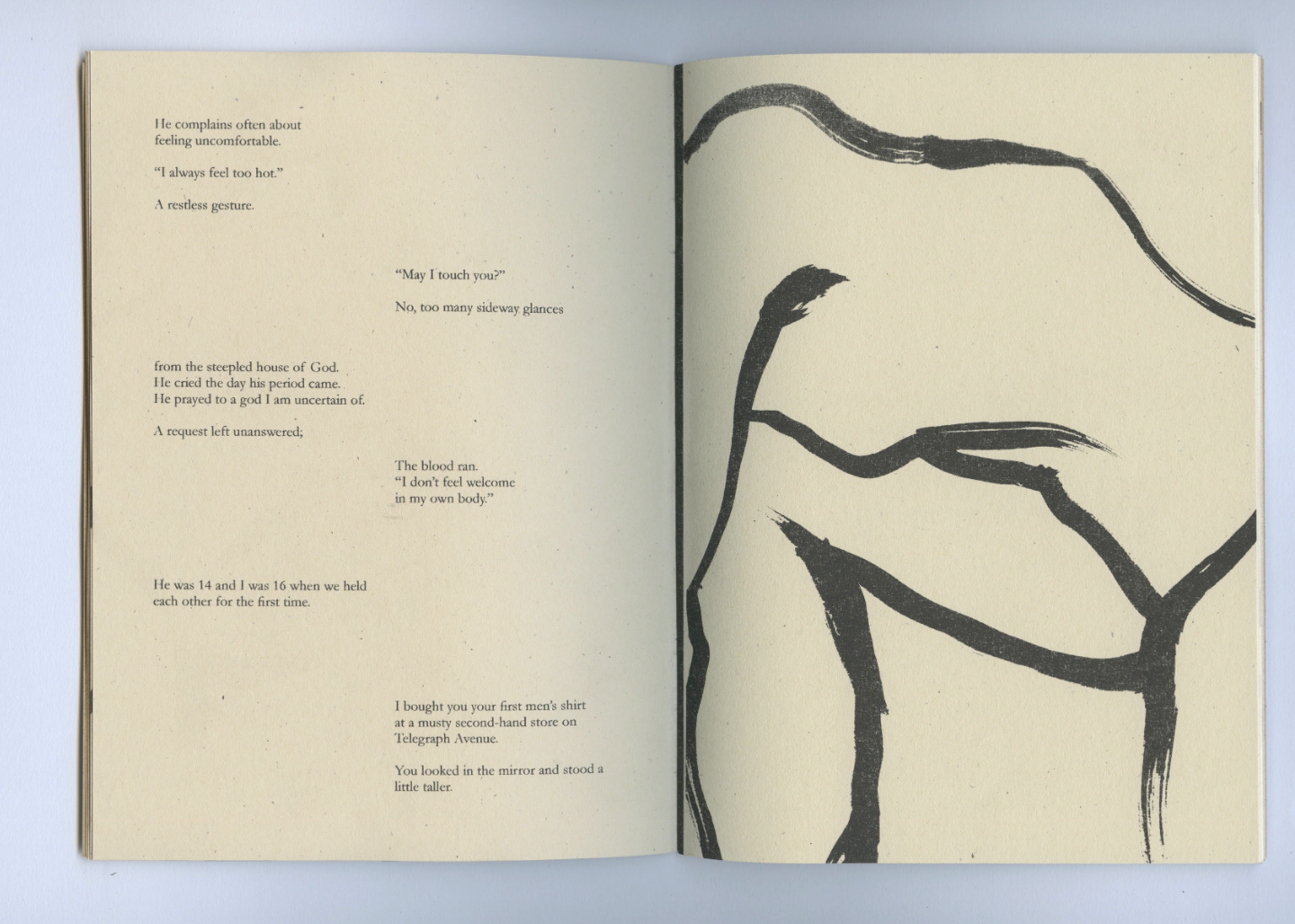
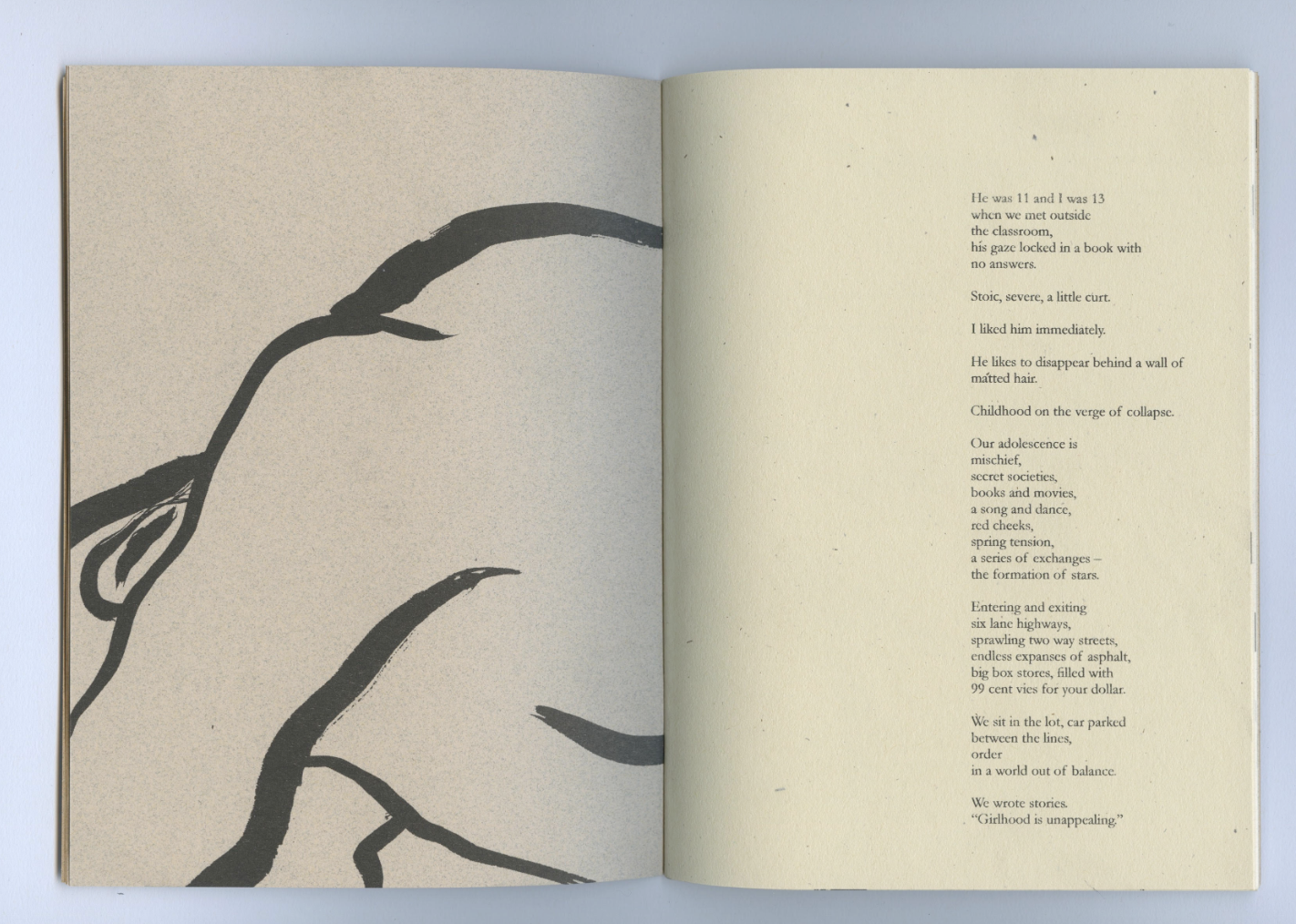
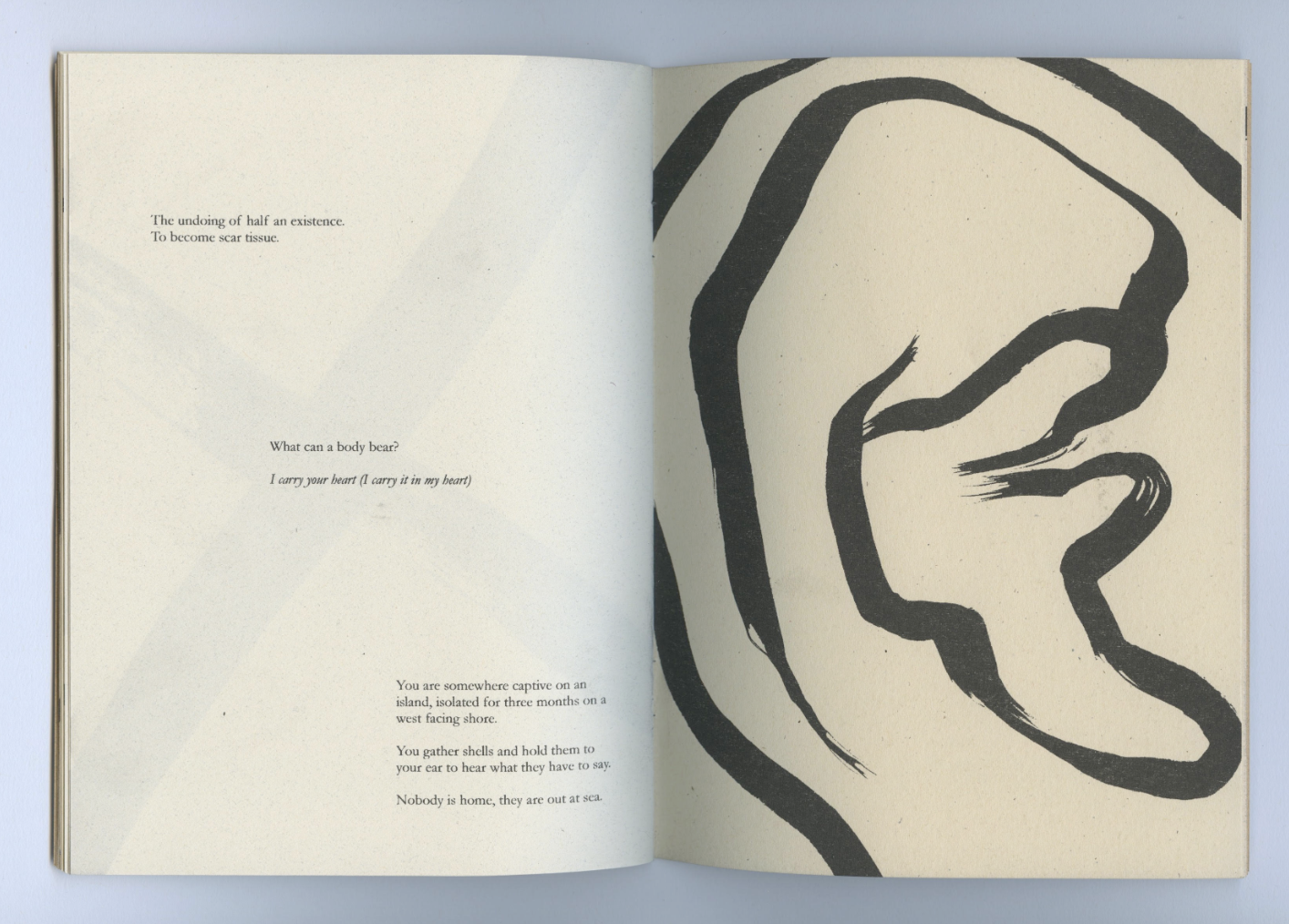
The book is probably my most emotional and intimate work to date. I wrote the initial text in 2015 when my partner (at the time) was at a major psychological low in grappling with his gender dysphoria. I wrote the essay as a way to acknowledge his desire to transition from female to male, to live his life as a man. I remember him telling me that transitioning is an imperfect solution to one’s material reality.
The cover is a diagram of binary stars, meaning two stars that orbit around a central mass. Our universe is dominated by multiple star systems, meaning the stars are bound together by gravitational force, even after they die. From our vantage point, they appear as one star but are actually two (or more) in constant rotation. I think it is an apt metaphor for me and my ex-partner’s relationship. We still remain very close to this day.
It’s a relationship I have difficulty defining, especially in conventional (see: BASIC) predominantly heterosexual/straight spaces. How to describe a love that is so completely and utterly unconditional? To me it speaks of the power of queer love that transcends bodily reality. Yes, the diagram is in conversation with that line as the orbits never truly “shift” but they may grow further apart or closer together over time, sometimes transferring mass to the other.
That last line is about intuition and knowing. We separated in Philadelphia in the summer of 2016 and he left behind a letter apologizing for “lying” to me about his desire to transition. But I do not see it as a lie. I see him for who he is, who he desires to be. We both knew something was amiss but neither of us had the language or resources at the time to articulate what he needed to “awaken” and arrive at his true expression of self. We grew up together. He is my best friend. He is a much more joyous person following his transition and that has been an amazing experience to see.
VKN: If I may extract some practical wisdom from you, what is the best way to deal with economic hardship, Tiffany? If you could advise from an artist to another?
TL: I don’t have a good answer to this one. The best thing I can advise is to stay honest with yourself, surround yourself with good people (and I mean ACTUALLY GOOD PEOPLE - it will take time to intuit), keep creating work and follow what feels right. Your confidence will waver from time to time, that’s ok. Acknowledge that the path of an artist is difficult; it is not linear and therefore infinite in possibility. It is possibly the most overwhelming industry to be in. Yes, you’ll have to hustle. Know that some days you will have to compromise but always take care of yourself. Too much top ramen will destroy you. Couch surfing will eventually wear you down. When I was working five (stupid) jobs in San Francisco, a mentor kept telling me that “The sword is forged in the fire.” If I were to get really nitty gritty, I would say find a job that can get you by but never lose focus. Wait tables, gut the gig economy for whatever it's worth, pawn your jewelry, roll the dice - but remember to nourish and feed your creative process. Persist!!
VKN: If Andy Warhol kept your most brilliant art piece and then informed you later that he lost it when in fact he didn’t, would you shoot him with a pistol like Valerie Solanas? What would you do to him for betraying you or leading you on? In other words, what is the best enactment of (nonchalant) revenge on another? Another artist? If there is such a thing as a casual, nonchalant venom.
TL: Yes, I would shoot him. But maybe that would be too easy.
Perhaps it would be more poetic to concoct a more elaborate plot, a long term defamation campaign.
But in more seriousness, I’d probably let it go. Revenge and bitterness take up too much mental energy. I’d rather redirect my energy into happier things. But therein lies the nonchalant revenge you speak of - achieving success despite the setbacks and thievery!
VKN: Which one would you choose? A door a window? In other words, what is your ideal romantic love? TL: Door. Clear entrance and exit strategy.
Two people coming together and understanding the terms of engagement.
Secure infrastructure.
VKN: Do you don’t think the window has the same clear exit strategy?
TL: It involves too much glass shattering.
VKN: What is your favorite kind of sofa? Or what is the sexist art object you have ever laid eyes on? In your eyes, what is the best Asian artist working on any medium today? This is non-sequitur, but I was preparing for this interview and I accidentally studied this other woman’s art/design (http://www.tiflindesign.com) who shared the same first and last name with you (lol), and I did wonder for a second if you have ever reached out to other Tiffany Lins in the world and ask if they are willing to collaborate with you on an artistic feat/project?
TL: [ UPDATE! ] Since conducting this interview, I caved and bought a sofa off of craigslist. It’s very modern and has shaker furniture elements. It is not very practical for sleeping on but is firm and keeps me alert while I read.
Sexist art object… is everywhere… I can’t decide. Am I supposed to sit on it?
Haha, yes, down the line I would like to create a video series around “common” names, mostly among 1st and 2nd generation Americans - popular combinations like Tiffany Lin or Christine Lee, Grace Kim, Maria Rodriguez, Andrea Gutierrez, etc. I would have them face the camera and say “My name is [INSERT NAME HERE] and I am a public menace.” My twin is named Tiffany Lin, she is 5 days older than me and grew up in the same neighborhood. She currently works as a nurse. Our parents are derived from the same practical Taiwanese stock, giving us names that were easy to pronounce and would allow us to assimilate more easily into American society.
Best Asian artist… Mel Chin is a pretty cool dude.
Tiffany Lin is an interdisciplinary artist, educator, and wordsmith. Her projects investigate nebulous distinctions between want, need, and desire in context of capitalist spectacle and corporeal intimacy. She holds an MFA from the Maryland Institute College of Art in Illustration Practice and a BA in Gender & Women’s Studies and Psychology from the University of California, Berkeley. Lin currently lives and works in Las Vegas, NV where she joins the Department of Art at the University of Nevada, Las Vegas.
VI KHI NAO is the author of Sheep Machine (Black Sun Lit, 2018) and Umbilical Hospital (Press 1913, 2017), and of the short stories collection, A Brief Alphabet of Torture, which won FC2’s Ronald Sukenick Innovative Fiction Prize in 2016, the novel, Fish in Exile (Coffee House Press, 2016), and the poetry collection, The Old Philosopher, which won the Nightboat Books Prize for Poetry in 2014. Her work includes poetry, fiction, film and cross-genre collaboration. Her stories, poems, and drawings have appeared in NOON, Ploughshares, Black Warrior Review and BOMB, among others. She holds an MFA in fiction from Brown University, where she received the John Hawkes and Feldman Prizes in fiction and the Kim Ann Arstark Memorial Award in poetry.

Poetry by Alex Vigue
Alex Vigue is a queer writer from a small town in Washington State. He has a bachelor’s degree in creative writing from Western Washington University and has been recently published in Peach Mag, Chronotope, and Homology Lit. His debut chapbook “The Myth of Man” was published by Floating Bridge Press. He is the co-host of Literary Merit, a queer podcast about celebrating guilty pleasures in media.
Read More
Poetry by Laura Linart
Laura Linart is a poet and writer based in New York City. Her poems have appeared or are forthcoming in publications such as Green Mountains Review, The Rumpus, Pembroke Magazine and 580Splits. Say hi to her on Twitter or IG @Pennyscientist
Read More
Marcus Jade
Listen to Marcus Jade's Chilling New Album
Joanna C. Valente is a human who lives in Brooklyn, New York. They are the author of several books, including Marys of the Sea, #Survivor (2020, The Operating System), and Killer Bob: A Love Story (2021, Vegetarian Alcoholic Press). They are the editor of A Shadow Map: Writing by Survivors of Sexual Assault and received their MFA in writing at Sarah Lawrence College. Joanna is the founder of Yes Poetry and the senior managing editor for Luna Luna Magazine. Some of their writing has appeared in The Rumpus, Them, Brooklyn Magazine, BUST, and elsewhere. Joanna also leads workshops at Brooklyn Poets. joannavalente.com / Twitter: @joannasaid / IG: joannacvalente / FB: joannacvalente
Read More
Get Cozy with This Winter Playlist
Joanna C. Valente is a human who lives in Brooklyn, New York. They are the author of several books, including Marys of the Sea, #Survivor (2020, The Operating System), and Killer Bob: A Love Story (2021, Vegetarian Alcoholic Press). They are the editor of A Shadow Map: Writing by Survivors of Sexual Assault and received their MFA in writing at Sarah Lawrence College. Joanna is the founder of Yes Poetry and the senior managing editor for Luna Luna Magazine. Some of their writing has appeared in The Rumpus, Them, Brooklyn Magazine, BUST, and elsewhere. Joanna also leads workshops at Brooklyn Poets. joannavalente.com / Twitter: @joannasaid / IG: joannacvalente / FB: joannacvalente
Read More
5 Books I'm Excited for in 2020
BY JOANNA C. VALENTE
Here’s a small peak into what 2020 has in store for us, thanks to these wonderful authors and small/indie presses (and of course, stay tuned for more lists for upcoming books). Check out this list for five other books.
Kelly Grace Thomas - Boat Burned (YesYes Books)
It’s hard not to be excited by a book blurbed by Paige Lewis, sam sax, Jennifer Givhan, and Tiana Clark - all poets I adore. Sax wrote, “In this remarkable inaugural collection, Kelly Grace Thomas reminds us water is where we are from, water is what we are made of, and water is where we’ll return.” That’s enough to convince me.
Read an excerpt here:
“They say tell me
a story and you never know
the right way to spill.
This is the one where you
and your father tied
yourselves to dark. Sailed
all night to make it
to Florida. Holding only a memory
of sleep. This was the biggest
goodbye.”
Nelson Simón (translated by Lawrence Schimel) - Itinerario del olvido / Itinerary of Forgetting (Skull + Wind Press)
I’m so excited about this collection (and this press!). As the press wrote on the site, the book is “ a sixteen-part series from Nelson Simón’s award-winning collection A la sombra de los muchachos en flor, which won both the Julián del Casal Poetry Prize from La Unión de Escritores y Artistas de Cuba and later the Premio de la Crítica Literaria. Itinerary of Forgetting is Simón’s first publication in English and has been translated by Lawrence Schimel. Simón’s work tackles both homosexuality & politics (an act both bold and brave for an openly gay writer in Cuba in the late 90s) while at the same time situating itself within the lyric traditions of both Cuba and the larger Spanish-speaking world.”
Kerrin McCadden - Keep This to Yourself (Button Poetry)
McCadden’s collection deals with family and grief, which is a world all of us know well. Her poetry cuts through the body like a knife slicing an apple that isn’t an apple. You can experience this for yourself, and read a poem here:
“Sometimes I pray. Want to know what else? That first day?
I stayed home and left my students with a substitute
who got mad at them when they cried. I also did that. “
Arhm Choi Wild - Cut to Bloom (Write Bloody)
I’ve been a reader of Wild’s work for some time now, and it’s always been powerful, full of wisdom, and unafraid. So, naturally, I’m excited for this monumental collection to come out. The book centers around identity, survival, trauma, and what it means to be American.
Read a poem of Wild’s here:
“It is for the cost of loving this country,
of finally feeling like I fit in,
like I have found the people
to whom I belong.
Gay people don’t exist in Korea,
and I am holding back a tongue
that could break this mirage
because seeing men not afraid to hold hands
and fix each other’s ties is too beautiful—
beautiful like a kiss
in the naked soft of morning,
beautiful like a mother
welcoming her daughter home.”
Abayomi Animashaun (editor) - Far Villages: Welcome Essays for New and Beginner Poets (Black Lawrence Press)
Give more more books about writing. They’re so essential for everyone at every stage in their writing life, and are so often underrepresented and/or talked about. For beginners, we all need a guide. But for writers of experience, they can get us out of own heads.
Joanna C. Valente is a human who lives in Brooklyn, New York. They are the author of Sirs & Madams, The Gods Are Dead, Marys of the Sea, Sexting Ghosts, Xenos, No(body), #Survivor: A Photo Series (forthcoming), and A Love Story (Vegetarian Alcoholic Press, 2021). They are the editor of A Shadow Map: Writing by Survivors of Sexual Assault and the illustrator of Dead Tongue (Yes Poetry, 2020). They received their MFA in writing at Sarah Lawrence College, and Joanna is the founder of Yes Poetry and the senior managing editor for Luna Luna Magazine.
5 Books to Watch Out for in 2020
Joanna C. Valente is a human who lives in Brooklyn, New York. They are the author of several books, including Marys of the Sea, #Survivor (2020, The Operating System), and Killer Bob: A Love Story (2021, Vegetarian Alcoholic Press). They are the editor of A Shadow Map: Writing by Survivors of Sexual Assault and received their MFA in writing at Sarah Lawrence College. Joanna is the founder of Yes Poetry and the senior managing editor for Luna Luna Magazine. Some of their writing has appeared in The Rumpus, Them, Brooklyn Magazine, BUST, and elsewhere. Joanna also leads workshops at Brooklyn Poets. joannavalente.com / Twitter: @joannasaid / IG: joannacvalente / FB: joannacvalente
Read More
A Review of Kristin Garth's 'Shut Your Eyes, Succubi'
BY MONIQUE QUINTANA
Kristin Garth’s chapbook, shut your eyes, succubi ( Maverick Duck Press, 2019) , is both delightful and frightening, a conjuring of girlhood with a form inclined to romance-- the sonnet. A prolific sonneteer in a digital age, Garth understands that while some memories seem as distant as old TV sets and radio fuzz, certain characters are bright and alive and fun in our psyche and they turn up in the most opportune places.
This was the first time I read poetry with handwritten annotations, which added a poignant whimsy to the experience. As I moved further and further into the poems, each character seemed to be linked together by the same dark energy. In “Eat Me”, objects, fashion, and delicacies push each line to a sexual moment. There is no meek girl Alice of yesteryear, rather a woman who has autonomy in a scene. Stripped of masquerade, she dominates and commands as a true queen of hearts.
Two other standout sonnets are “ Claudia” and “Veruca Wants”. Both pieces reckon with the image and the sentiments of the brat girl, a girl decked with material things, who is much too grown-up for the world that she lives in. “Claudia” tells of Interview with the Vampire’s doomed enfant, a character who remains elusive in both Rice’s novel and the cinematic dreamscape of Neil Jordan’s 1994 take: “ Resolve to keep her safe at hand, but she / is something you don’t understand .”
The poem seems to acknowledge that we, the grand audience, both love and detest Claudia because she’s an unlikable girl, but also our beloved. Like “Claudia”, “Veruca Wants” made me take pause and look back at my girlhood. When I was small and I asked for material things or complained about things that were making me unhappy, my grandmother called me “Veruca” and waited for the sweet and stoic parts of me to return. Garth’s sonnet carries the want for decadence over to womanhood: “ Men / who’ll jump before she screams.” The sonnet plays with the idea that we create the very decadence that we need. It’s not the reaching for rich things, but when we’re compelled to articulate desire to the point of screaming.
Monique Quintana is the author of Cenote City (Clash Books, 2019) and holds an MFA in Creative Writing from CSU Fresno. Her work has appeared in Winter Tangerine, Queen Mobs Tea House and Acentos Review, among other publications. She is a Senior Editor at Luna Luna Magazine, Fiction Editor at Five 2 One Magazine, and writes about Latinx literature at her blog, Blood Moon. You can find her at moniquequintana.com
Every Body Has Ghosts by Cate McGowan
BY CATE MCGOWAN
Every Body Has Ghosts
Below a yellowed tree,
weeds fringe the driveway’s
borders. Anoles pump.
They jut, and the bigger
lizards skitter along
the yard’s edge. While
daylight’s needles stitch
threads up the spathodea,
seven DeKay’s snakes slue
like scarves through
the new ivy. Though
it’s already five o’clock,
I haven’t heard from you
yet. Not this week.
Not this month. You’re
gone without a word.
So far, only green silence.
Someone next door opens
a second floor window,
and a toddler shrieks
and shatters the stillness.
The child’s cry skylarks
the mimosa, shrinks,
then dissipates through
the evening’s haze. I shake
out our wet clothes.
In the breeze, the clothesline
snaps my red blouse
as it dances, my empty sleeves
waving in the wind to no one.
Cate McGowan is a fiction writer, essayist, and poet. Her work appears or is forthcoming in Norton's Flash Fiction International, Glimmer Train, Crab Orchard Review, Tahoma Literary Review, Crab Fat Magazine, Ellipsis Zine, Barrelhouse, Shenandoah, Into the Void, Louisville Review, Atticus Review, Vestal Review, Unbroken, and elsewhere. A native Georgian, McGowan's an Assistant Fiction Editor for Pithead Chapel and is pursuing her Ph.D. She won the 2014 Moon City Short Fiction Award for her debut short story collection, True Places Never Are, published in 2015, and her debut novel, These Lowly Objects, is forthcoming from Gold Wake Press.
Setting, Nourishing, And Ritualizing Intentions That Stick
BY LISA MARIE BASILE
I’ve always responded poorly to “resolutions.” To me, change is always best when it’s gradual and backed up by deep emotional reasoning rather than, “well, it’s a new year. I better overhaul something.” Also, I’m a rebel and a known self-sabotager, so if you’re like me, that approach probably feels too authoritarian and unnatural.
So I decided instead to set several small intentions — all of which will add to a vision. They’re not hard or fast or misaligned with my ethics or values; rather, they’re small ideas that I can add to my each and every day.
My intentions for this year is to spend at least a portion of each day on stress management or self-care (this is naturally open-ended) and to recalibrate my health behaviors around food and alcohol (again, no hard or fast rules; rather, the intention is to be aware and to make changes). So, every day I ask myself: Why am I doing this? What is the emotional connection for me?
I did this because being a writer, editor, author, and freelancer is hard when I am managing a chronic illness and a relationship. I did this because in all of that I’ve lost myself a bit and, along the way, I lost a sense of healthfulness.
So, from me to you, here are the guidelines I keep in mind when setting and managing intentions.
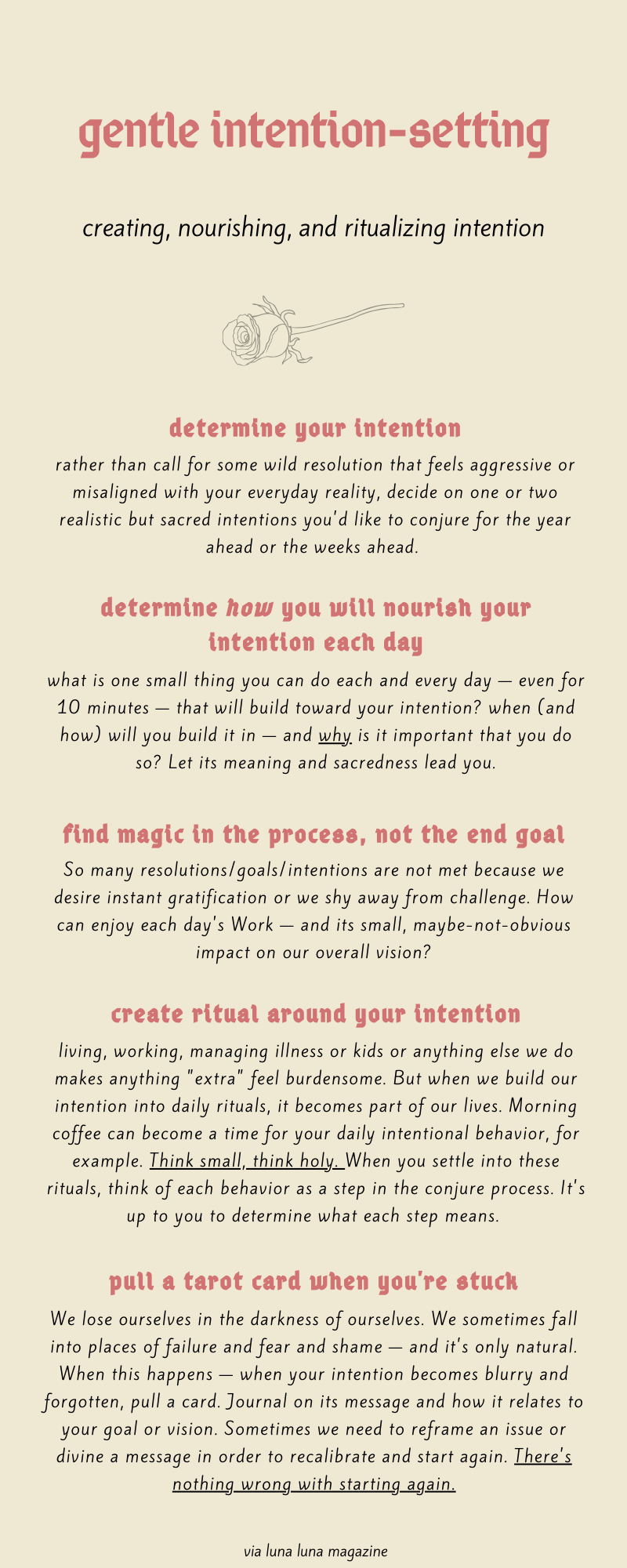
What are your intentions for the year ahead? Below, a downloadable infographic to use and keep on your end.
determine your intention
rather than call for some wild resolution that feels aggressive or misaligned with your everyday reality, decide on one or two realistic but sacred intentions you'd like to conjure for the year ahead or the weeks ahead.
determine how you will nourish your intention each day
what is one small thing you can do each and every day — even for 10 minutes — that will build toward your intention? when (and how) will you build it in — and why is it important that you do so? Let its meaning and sacredness lead you.
find magic in the process, not the end goal
So many resolutions/goals/intentions are not met because we desire instant gratification or we shy away from the challenge. How can we enjoy each day's Work — and its small, maybe-not-obvious impact on our overall vision?
create ritual around your intention
living, working, managing illness or kids or anything else we do makes anything "extra" feel burdensome. But when we build our intention into daily rituals, it becomes part of our lives. Morning coffee can become a time for your daily intentional behavior, for example. Think small, think holy. When you settle into these rituals, think of each behavior as a step in the conjure process. It's up to you to determine what each step means.
pull a tarot card when you're stuck
We lose ourselves in the darkness of ourselves. We sometimes fall into places of failure and fear and shame — and it's only natural. When this happens — when your intention becomes blurry and forgotten, pull a card. Journal on its message and how it relates to your goal or vision. Sometimes we need to reframe an issue or divine a message in order to recalibrate and start again. There's nothing wrong with starting again.
A Guide For Witches and Writers: "The Magical Writing Grimoire"
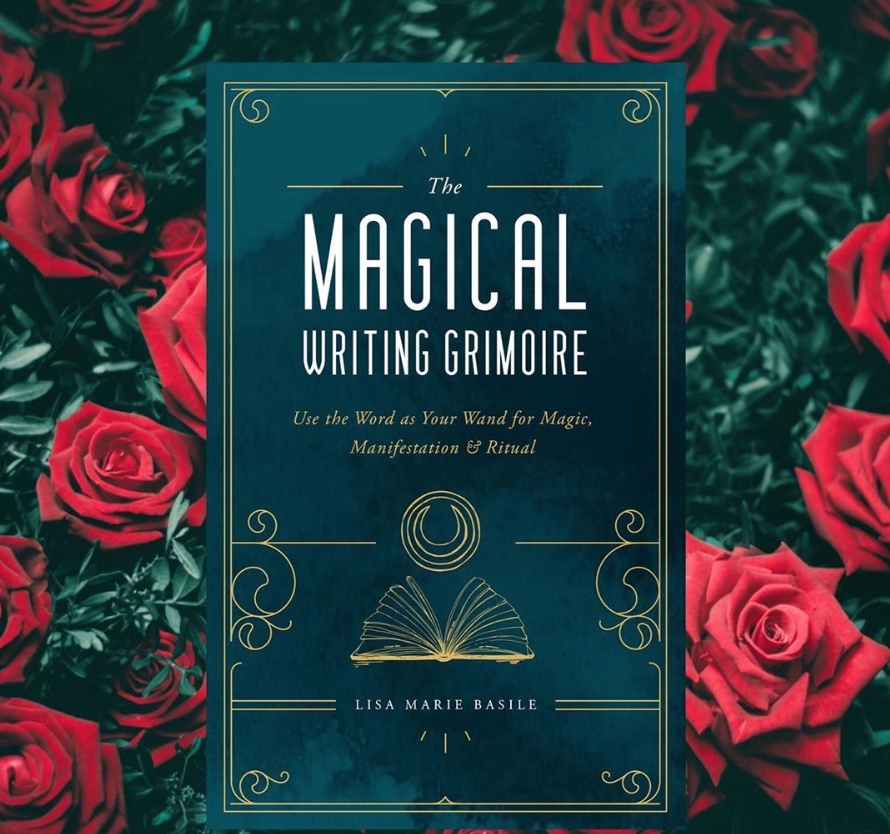
What Is The Magical Writing Grimoire? Is it for witches or writers — or both?
The Magical Writing Grimoire is a book of inclusive and accessible rituals and writing prompts for anyone who feels called to using words as a source of healing, empowerment, joy, generativity, and self-exploration. It is designed to integrate ritualistic living and to incorporate sacredness into our lives in meaningful and easy ways.
It’s for witches and non-witches (including people with secular beliefs, like myself), although of course it’s heavily based off the archetype of the witch: The witch, to me, is strong, rebellious, empowered, empathic, and bold as fuck. The witch is also conscious — of the self and others and the earth. So, it works heavily with archetypes and symbols, but it invites people who have specific beliefs to incorporate their beliefs into the work.
Really, the book is about tapping into and using your own power, your own voice, your own ideas.
It’s for writers and non-writers — anyone who is interested in the sacred, beautiful power of poetry or journaling or letter-writing, or timing writing practices to nature’s ebb and flow.
It also focuses heavily on shadow work — or unearthing the silenced, dark, shadowy parts of the self.
What will readers find within its pages?
Lots of rituals, lots of writing prompts, meditations, quotes from the most inspirational and wonderful people and writers, poems I wrote myself, glimpses into my personal life, and so much more. Plus, it’s really beautifully illustrated.
What is the inspiration behind The Magical Writing Grimoire?
The book was gestating in my mind for several years, but I didn’t know what its shape until the past year or so; I knew I wanted to write a writing guide — one that balanced the ritualistic with the pragmatic and every day, one that used writing as a form of magic. More than using the occult in order to generate writing, it’s about using writing to make your life more magical.
It starts with the word and ends with the word.
It’s deeply rooted in recovering from pain and trauma. When I was younger, the number one thing that got me through times of extreme trauma (family separation, foster care, CPTSD, financial instability, chronic illness) was writing. Writing gave me my voice back. It was a tool for reclamation. But more so, it was a tool for joy, creativity, and empowerment.
The ability to write is a privilege for many of us, but it’s also a free tool that can help save us. I’ve seen writing help women in domestic shelters, college students move through self-esteem issues, and incarcerated individuals tell their story. It is something sacred in itself because with our words we are taking nothing and making it into something.
So I wanted to design a gentle but effective book that people — especially any marginalized community — could use to tap into their truth and self, in a way that felt right for them. It’s guided, but it allows space for reinterpretation and individuality so that anyone can tap in.
Is it similar to Light Magic for Dark Times?
It is, and it’s not. Like Light Magic for Dark Times, it is grounded in accessibility and inclusivity. It also offers different (but looser) chapter focuses, like manifestation, mindfulness, healing, conjuring your voice, creating a grimoire, and more.
Unlike Light Magic for Dark Times, it provides a much deeper dive in terms of the rituals and the writing prompts, and it’s filled with poetry and quotes to meditate on. It’s also much more about the process of long-term self-exploration (and excavation!) than about quick, one-off rituals for different purposes. I think the two actually pair super well together!
What are your beliefs?
I’m secular (for lack of a better, more nuanced word), so I don’t work with or believe in gods, goddesses, angles or other deities. However, I work closely with the natural world (especially the power and energy of water), shadow work, energy, archetypes, and symbols. For example, I see the elements as powerful tools, offering lessons and glimpses of the purity of aliveness — and I see the astrological signs as symbols of the human condition.
When does the book come out?
It’s born on April 21, so it’s a Taurus! But let’s be honest — it was finalized and sent to the printer during Scorpio season. It’s very much a Scorpio book — it’s dark, intense, powerful, and transformative. But, like a Taurus, it wants to find beauty, comfort, and artistry. And because it comes out in the Spring, it’s a great way to kick off the new year with energy, creation, and rebirth.
People are already saying some really kind things about it, and it’s included in a few Most Anticipated lists, like in Cunning Folk and over at Patheos by Mat Auryn.