• Home
  • indulge
  • new poetry
    • About Luna Luna
    • resources
    • search
  • editor
  • dark hour
  • submit
Menu

luna luna magazine

  • Home
  • indulge
  • new poetry
  • About
    • About Luna Luna
    • resources
    • search
  • editor
  • dark hour
  • submit
delicious new poetry
'the doors of the night open' — poetry by Juan Armando Rojas (translated by Paula J. Lambert)
Nov 29, 2025
'the doors of the night open' — poetry by Juan Armando Rojas (translated by Paula J. Lambert)
Nov 29, 2025
Nov 29, 2025
'we can be forlorn women' — poetry by Stevie Belchak
Nov 29, 2025
'we can be forlorn women' — poetry by Stevie Belchak
Nov 29, 2025
Nov 29, 2025
'I do whatever the light tells me to' — poetry by Catherine Bai
Nov 29, 2025
'I do whatever the light tells me to' — poetry by Catherine Bai
Nov 29, 2025
Nov 29, 2025
‘to kill bodice and give sacrament’ — poetry By Kale Hensley
Nov 29, 2025
‘to kill bodice and give sacrament’ — poetry By Kale Hensley
Nov 29, 2025
Nov 29, 2025
'Venetian draped in goatskin' — poetry by Natalie Mariko
Nov 29, 2025
'Venetian draped in goatskin' — poetry by Natalie Mariko
Nov 29, 2025
Nov 29, 2025
'the long sorrow of the color red' — centos by Patrice Boyer Claeys
Nov 28, 2025
'the long sorrow of the color red' — centos by Patrice Boyer Claeys
Nov 28, 2025
Nov 28, 2025
'Flowers are the offspring of longing' — poetry by Ellen Kombiyil
Nov 28, 2025
'Flowers are the offspring of longing' — poetry by Ellen Kombiyil
Nov 28, 2025
Nov 28, 2025
'punish or repent' — poetry by Chris McCreary
Nov 28, 2025
'punish or repent' — poetry by Chris McCreary
Nov 28, 2025
Nov 28, 2025
'long, dangerous grasses' — poetry by Jessica Purdy
Nov 28, 2025
'long, dangerous grasses' — poetry by Jessica Purdy
Nov 28, 2025
Nov 28, 2025
'gifting nighttime honey' — poetry by Nathan Hassall
Nov 28, 2025
'gifting nighttime honey' — poetry by Nathan Hassall
Nov 28, 2025
Nov 28, 2025
'A theory of pauses' — poetry by Jeanne Morel and Anthony Warnke
Nov 28, 2025
'A theory of pauses' — poetry by Jeanne Morel and Anthony Warnke
Nov 28, 2025
Nov 28, 2025
'into the voluminous abyss' — poetry by D.J. Huppatz
Nov 28, 2025
'into the voluminous abyss' — poetry by D.J. Huppatz
Nov 28, 2025
Nov 28, 2025
'an animal within an animal' — a poem by Carolee Bennett
Nov 28, 2025
'an animal within an animal' — a poem by Carolee Bennett
Nov 28, 2025
Nov 28, 2025
‘in the glitter-open black' — poetry by Fox Henry Frazier
Oct 31, 2025
‘in the glitter-open black' — poetry by Fox Henry Frazier
Oct 31, 2025
Oct 31, 2025
'poet as tarantula,  poem as waste' — poetry by  Ewen Glass
Oct 31, 2025
'poet as tarantula, poem as waste' — poetry by Ewen Glass
Oct 31, 2025
Oct 31, 2025
'my god wearing a body' — poetry by Tom Nutting
Oct 31, 2025
'my god wearing a body' — poetry by Tom Nutting
Oct 31, 2025
Oct 31, 2025
'Hours rot away in regalia' — poetry by Stephanie Chang
Oct 31, 2025
'Hours rot away in regalia' — poetry by Stephanie Chang
Oct 31, 2025
Oct 31, 2025
'down down down the hall of mirrors' — poetry by Ronnie K. Stephens
Oct 31, 2025
'down down down the hall of mirrors' — poetry by Ronnie K. Stephens
Oct 31, 2025
Oct 31, 2025
'Grew appendages, clawed towards light' — poetry by Lucie Brooks
Oct 31, 2025
'Grew appendages, clawed towards light' — poetry by Lucie Brooks
Oct 31, 2025
Oct 31, 2025
'do not be afraid' — poetry by Maia Decker
Oct 31, 2025
'do not be afraid' — poetry by Maia Decker
Oct 31, 2025
Oct 31, 2025
'The darkened bedroom' — poetry by Jessica Purdy
Oct 31, 2025
'The darkened bedroom' — poetry by Jessica Purdy
Oct 31, 2025
Oct 31, 2025
'I am the body that I am under' — poetry by Jennifer MacBain-Stephens
Oct 31, 2025
'I am the body that I am under' — poetry by Jennifer MacBain-Stephens
Oct 31, 2025
Oct 31, 2025
goddess energy.jpg
Oct 26, 2025
'Hotter than gluttony' — poetry by Anne-Adele Wight
Oct 26, 2025
Oct 26, 2025
'As though from Babel' — poetry by Fox Henry Frazier
Oct 26, 2025
'As though from Babel' — poetry by Fox Henry Frazier
Oct 26, 2025
Oct 26, 2025
'See my wants' — poetry by Aaliyah Anderson
Oct 26, 2025
'See my wants' — poetry by Aaliyah Anderson
Oct 26, 2025
Oct 26, 2025
'black viper dangling a golden fruit' — poetry by Nova Glyn
Oct 26, 2025
'black viper dangling a golden fruit' — poetry by Nova Glyn
Oct 26, 2025
Oct 26, 2025
'It would be unfair to touch you' — poetry by grace (ge) gilbert
Oct 26, 2025
'It would be unfair to touch you' — poetry by grace (ge) gilbert
Oct 26, 2025
Oct 26, 2025
'Praying in retrograde' — poetry by Courtney Leigh
Oct 26, 2025
'Praying in retrograde' — poetry by Courtney Leigh
Oct 26, 2025
Oct 26, 2025
'To not want is death' — poetry by Letitia Trent
Oct 26, 2025
'To not want is death' — poetry by Letitia Trent
Oct 26, 2025
Oct 26, 2025
'Our wildness the eternal now' — poetry by Hannah Levy
Oct 26, 2025
'Our wildness the eternal now' — poetry by Hannah Levy
Oct 26, 2025
Oct 26, 2025
klemen-vrankar-hLTgmHtE9l4-unsplash.jpeg

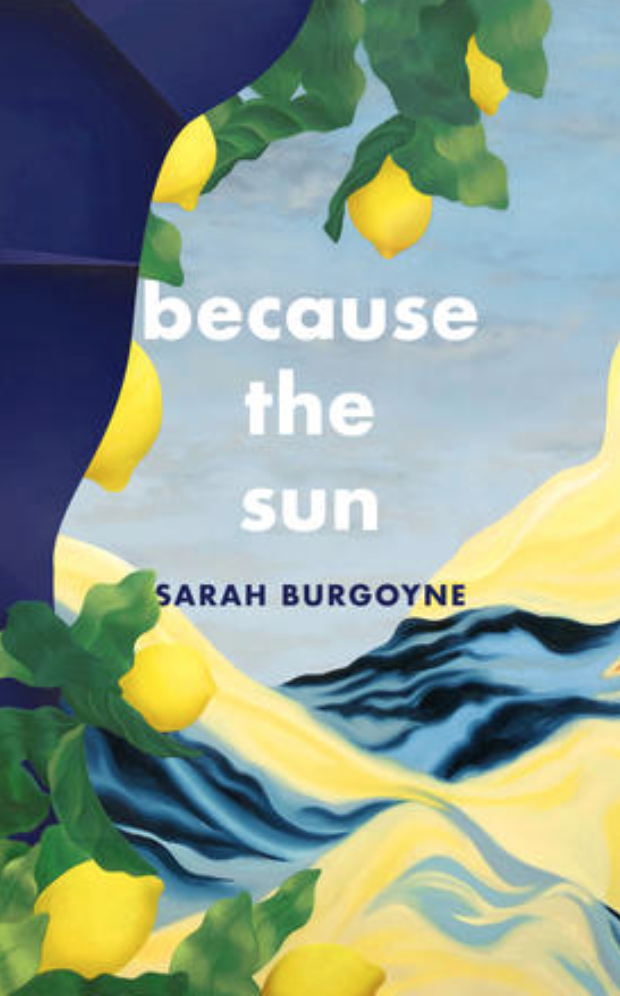
Sarah Burgoyne In Conversation With Vi Khi Nao

April 13, 2021

BY VI KHI NAO & SARAH BURGOYNE

There’s beauty in the things that ultimately do not “amount” or become a mount, be it a mountain to gaze at or a horse to ride off on, because they connect us to each other if we let them.  

VI KHI NAO: You are in Montreal and I am in Iowa City as this interview is being unfolded - it is quite sunny and bright here. What is the weather like there? Is it heliotropic? The last time I was in Montreal - it rained (nearly) nonstop or my memory of it at least. 
Screen Shot 2021-04-13 at 12.23.37 PM.png

SARAH BURGOYNE: Sadly, it snowed today! A friend of mine emailed me describing it as an April Fool’s Day joke, since it has been unseasonably (which always means ‘unreasonably’) warm lately. I’m sorry to hear you had a rainy time in Montreal--it’s normally not a rainy city, like Vancouver, where I’m from. 

VKN: What was it like growing up in Vancouver? Is it the birth home of your poetry? 

SB: I was born in Vancouver, but I left when I was four years old. Or, my parents left and took me along. I grew up in Langley, in the suburbs I guess, but suburbs adjacent to massive, gorgeous cranberry fields, so very close to farms. But I was on a track team so I feel like I grew up in the Suburbs. Langley is the birth home of my poetry--a writing class I took in high school where we were asked to write one hundred poems in one month, as an assignment. I remember having written forty-nine the day before the due date and asking the teacher if I was doomed. He said I had probably written more than anyone else, so it was fine. I think being forced to immerse myself so completely in poetry piqued my interest. But because all the poetry I had been learning in English class was nineteenth-century work, there were a lot of “thees” and “thous” in my work. I still try to pop in a “thee” every now and then… 

VKN: For nostalgic sake, I assume. 49 is still a lot! I love rain. I didn’t mind it. I mentioned the weather because the title of your collection is very weather oriented or rather solarly “accusatory” - if that is the right word --  due to the conjunction of “because” - often a title doesn’t offer itself or open itself for reason or elucidation. The content of this book’s unraveling is structured/outlined by a quote you pulled from Camus: ‘I count. I say: one, the sea; two, the sky (ah, how beautiful it is); three women; four, flowers (ah, how happy I am).’ Can you share with us the intentions behind the omission of the content in parentheses?  Are beauty and happiness not a part of Camus’ sun? Did you want them implied? 

SB: These are great questions, first of all. And I want to say that “solarly-accusatory” is an excellent description of the title. It’s actually the reason Meursault gives in l’Etranger during his trial for having shot the man on the beach: “c’était à cause du soleil.” Not the most convincing excuse… but every time the sun is at that low angle and burning right into my eyes I think of that scene. As for the beauty and happiness--yes--I believe they are very much part of Camus’ sun. The reason I scoured his notebooks was because I knew he must be obsessed with the sun, and even though it isn’t always written about in conjunction with beauty and happiness, (at one point he talks about ‘the real climate of tragedy’ being not the night but ‘the heat on the quays’), one doesn’t usually obsess over something unless one is somewhat in love with it… 

VKN: I read l’Etranger maybe twenty years ago - I still recalled the sun pulling the trigger - or “having been accused of pulling the trigger” -  squinting having hands - & I remember Meursault in prison - with the priest at the end. Did you want your collection to have the same heliotropic/existential effect for the reader as the sun to Meursault? Say for instance, “Because of Sarah Burgoyne’s Because the Sun that I fell into a well ( three stories below) or plucked five roses from my neighbor’s garden. What did you want the reader(s) to be properly (if there is such a thing) accused of upon reading your work? 

SB: I would be honoured if my book became an excuse for certain subversive acts (hopefully not falling into a well since that sounds very painful), but what interested me about the sun in this case was that it precisely was not the sun that caused Meursault to pull the trigger, and yet it also was. It felt symbolic of what I call “ambient violence” or circumstances around us causing us so much pain that we redirect it (unfairly) at others.

I would be honoured if my book became an excuse for certain subversive acts (hopefully not falling into a well since that sounds very painful), but what interested me about the sun in this case was that it precisely was not the sun that caused Meursault to pull the trigger, and yet it also was.

VKN: In the notes section of your collection, you wrote, “What is it that moves Louise to pull the trigger on Thelma’s assailant after Thelma is safe? In both cases, the sun is a material symbol of pain.” And, I keep on revisiting this thought logic and I wonder what you meant by “material symbol of pain.” What kind of pain is that? What kind of material is the sun on the moral ethics of its human customer? I also thought perhaps Louise pulled the trigger because Thelma’s assailant has become the escapable sun: violent, blinding, forcing Louise to squint, leaving her body to chance, and when chance has been given permission to be at the right place at the right time - the consequence is inevitable: she pulls the trigger - something in her has been wanting to do this for a long time now.

Just as Meursault has been, I assume (also), wanting to as well. I also think about the arrival of death on a particular species’ soul. Is the sun a way of managing that delay? And, why the pain? When the sun, one of the designated marker of time, tells everything arbitrary that its purpose has arrived? 

SB:  You’re right when you say the sun is the “marker of time.” As the “marker of time” it is involved in our every action and also we can project everything we want to onto the sun. When I write that the sun is a “material symbol of pain” I am thinking of how the sun appears in Thelma & Louise and also l’Étranger. I was fascinated by the genre “film soleil” when I wrote the book, which is like film noir but all of the devastating events take place under the midday sun instead of at night through the Venetian blinds, and so when I speak of the sun as a symbol I am thinking also of the particular authors of these works, Callie Khouri and Camus, respectively, and how they perceived the sun or how it became a character in their artworks.

Growing up, to go back to your earlier question about Vancouver, in a very temperate climate, my experience with the sun had been much more mild. I rarely experienced its incredible heat. So, you’re absolutely right when you say Louise had wanted to pull the trigger for a long time, and Meursault also. For Louise, she had been harbouring so much pain and saw her own assault in Thelma’s--like Thelma’s assault was the symbolic moment for Louise. But after that moment the sun reigns in the film; it’s the constant reminder that they’re under pressure and maybe doomed.

For Meursault, the sun pushed him over the edge, so he says. So in these cases, I think of the sun as an eye… this ultimate image of relentless oppression (as in hot, hot heat) but also this watcher who sort of soaks up the affect of the characters, who are negative images of us who experience pain (relentlessly) every day. 

VKN: When I think of automatic - I think of violence. Do you often do automatic writing? To give a textual voice to your poetry? Do you, from time to time, think automatic writing is a type of ritual carried out by a poet at a shooting range? & the poet just locks in her ammunitions of word & let the current of bullets ride towards a ubiquitous target? 

Do you, from time to time, think automatic writing is a type of ritual carried out by a poet at a shooting range? & the poet just locks in her ammunitions of word & let the current of bullets ride towards a ubiquitous target? 

SB: I love this question. I absolutely cannot write without automatic writing. One of my earliest poetry mentors, Tim Lilburn, called this exercise “emptying the hands.” The way you phrase the question makes me realize how many bullets are actually packed into our hands, without us even knowing. Automatic writing brings them out. Sadly, not every shot is on target (I’ve never felt the impulse to burn my writing as intensely as when I do a burst of automatic writing), but for me it’s a necessary practice to keep afield or just ahead of that pesky, judgmental editing mind who’s galloping at our heels.

VKN: If one of your poems has to sit (be pinched) on a clothes hanger or perch like a bird on an electrical wire, which poem from this collection would you choose? To dry overnight or rest before taking flight again? 

SB: “A bird on a wire” makes me think of Leonard Cohen, a fellow Montreal poet. My poem that is a bird on a wire, or as he would say is a “drunk in a midnight choir” is called “What You Have.” I wonder if you also have a poem that you like more than the others you have written but doesn’t happen to be the most popular one? This is that poem for me. It was originally called “How Do You Like What You Have”. To me this is the most important poem in the collection, and I’d like it to hang on everyone’s clotheslines. I want it to be the alien that invites you to its ship.

VKN: I hope it rains profusely overnight so they stay longer on the clothesline - making ambient noises nocturnally. It goes without saying that sound is important in poetry, but your work pays more exquisite lucid attention to the word “sound” - is sound a type of “ambient violence” you desire? You wrote “like every person become sound: (p.14).  Assuming that you are a person, what is the sound of Sarah Burgoyne’s existence? Are you a needle falling into a pile of cotton? Are you a “bruised foot” or a “bargain” or “some empty bottles”? What do you think is the function of poetry in a place surrounded by the sound of pain and violence? 

SB: A word that sparked this book was “relentlessness” which is the feeling of oppressive heat, of harassment, and also of incessant noise, and in the book I tried to translate “relentlessness” into sound, particularly in the final section “Four, Flowers” which doesn’t let the reader breathe very much. The sound of my existence...hmm...this is an excellent question. I first thought of how a friend of mine describes the music I like as “kitten yodel,” but that’s not quite it. I think dogs and dogs barking show up a lot in my work in general, but not like hostile dog barking, like the dog in a far-off field barking at dusk--do you know that dog? It makes me think of Juliana Spahr’s description of the function of poetry in the context of protest: at a protest she was at, there were dogs barking alongside the people who had gathered. She described what those dogs were doing at the protest as what poetry can do. 

VKN: When I first read your line “the number six woke me up from a feeling” (pg.18)   – I had imagined a small child or rabbit hovering near your bed, shaking you lightly. If poetry can wake one up out of bed or for a protest and the number 6 woke you, did number 5 and 4 fail to have the same effect? Is there a significantness to that particular number? Or can it be as purposefully arbitrary as someone being murdered by the sun’s overwhelming potency? 

SB: I like to think about numbers a lot and how they are such a big part of our everyday lives so much so that we forget that they are just numbers. When I think about money, I often wonder how strange it is that dollars are just numbers and you only have so many of them at a given time. “That will cost twenty-five numbers, please.” Same with time.

When I wrote the line you mention about the number 6 waking me up, I was thinking of my alarm clock, which went off at 6AM the day I wrote that poem. Or maybe I had just woken up and it happened to be 6 on the dot. I was struggling a lot with insomnia during the writing of this book and oddly I happened to wake up at very precise (frequent) numbers. I was defamiliarizing time because it feels strange (in my world and of course in the world of the insomniac) to have numbers doing or not doing all this stuff for you and having such high stakes yet they’re just little numbers.

VKN: Do you have a favorite number? 

SB: I’ve always had a fondness for number 2. 

VKN: Why is that?

SB: I like the way it looks as a word: “two” is adorable to me. I am the second child of my parents. I think a lot about twins and doubles. I like that it has a couple aliases in English (“to” and “too”). I like that in French it’s a sign of familiarity: “tu.” I’ve always just kind of liked it.

VKN: 2 looks like a swan to me - it’s not my favorite number in the world - but I can see how its hookedness can hook someone into its efficient world. Has the first child of your parents read your collection yet? Do you have a compelling relationship with your parents’ first child? Have your parents read your work?

SB: What’s your favourite number?

VKN: 3, 6, and 9. They are all the same - I see it as one number. 

SB: Because they stack into each other like Russian dolls?

VKN: No - like one is beside the other and other – like linear translucency. I also like geometry.

SB: I love geometry. And circle theorems. As for my sister, I wish we had a compelling relationship. I wrote a poem for her in my first collection, “The Unhad Backyard,” but I’m not sure she read it. My parents have read my first book, but they haven’t had the chance to read Because the Sun yet. 

VKN: Well, what is your favorite geometric shape then? How come it is not compelling? May I assume that the circle is your favorite shape? Given that section three in your collection is very solarly imbued? Is that the right word? While visual poetry can act as both a catalyst and vehicle,  I think poetry can be extraordinarily potent if one uses negative space well in poetry - where the absence of word/sound - where form and content join forces on the page to dictate and command the vector of a poem’s ontological identity - I believe section 3 of this collection reflects this paradigm well.  

I see in that section - the violent nature of the sun, the nature of Harlan’s violence - The black and white sun alternating between darkness and light -gives me these meta triptyched feeling (the readers and for Thelma and Louise too) - that these alternating solar erasures depict the absence and also presence of bullets - these exit wounds - these unspoken bullet wounds born from assault. Given that this collection is so methodically and tightly edited, designed, and structured, I want to ask about your relationship with synchronicity - did you see this collection’s content before you see its form - which arrives first? Or, like an epiphany - they all arrive together at this party called Because the Sun because you sent the invitation ahead of time or planned this party for so many years. 

SB: In my writing, I feel like form and content need to arrive together, or are never separate, like your 3, 6 and 9. I’ve tried taking the “content” of a poem and pouring it into a new shape and it just gets ruined...like an aspic that doesn’t set and so can no longer be called an aspic but is more like a pile of sad organs. So I’ve learned my lesson a few times over on that point. This connects to geometry, but I also just love shapes and the visual aspect of poetry. I’m glad you saw both the sun and the bullet holes in the Thelma & Louise section… the black and white circles, in my mind, are meant to be both.

Lisa Robertson, who was around during the genesis of this project but then also ended up editing the collection, gave me the idea of putting a little blank square in the centre of the prose poems, which cause the poems to sort of glitch out when you read them. I decided a circle would be better for the reasons you mentioned. And also, in the film, the movement from night to scorching day where the sun is at its peak happens right after Thelma’s assault and Harlan is shot and, to me, this connects with Camus’ observation about ‘the real climate of tragedy’ — we had moved from the night, which is often a dangerous time for women, to the day, in which the real tragedy unfolded, which was that the legal system could not protect Thelma or Louise, despite their being victims, which renders Thelma and Louise’s violated bodies like negative images from which thousands of positive copies can and would emerge. This is also where Sara Ahmed comes in.

In The Cultural Politics of Emotion she writes, “Hate has effects on the bodies of those who are made into its objects,” and  “we cannot assume we know in advance what it feels like to be the object of hate.” Louise shoots Harlan after Thelma is safe (the final dark bullet hole in part three of my book), and we come to understand later that Louise was also a rape victim and her own private pain surfaced at that fatal moment. Because the legal system cannot recognize this—a wound that is invisible (Louise’s) as opposed to a wound that is visible (Harlan’s corpse)--they had to go on the run. The circle was my favourite shape for this book, but I’m not sure it’s my favourite shape in the world...though I tend to like the shapes that have equal sides. They please me. As for my sister… that’s a Gretchenfrage I dare not answer! Not here anyway. But it has to do with unequal sides, maybe. 

VKN: Your section 1 and 2 and 4  - the poetry in those sections are more abstract - in the way their worlds unravel - their words have more volition to take momentum.  Yet, section 3 - the most violent section of your collection - is more controlled, guided by a plot, and more supervised by a precise vision. They move quite organically in and out of each other - complementing each other’s antipodic impulses - is this section the hardest section for you to write? While it can be self-evident that a “camera” becomes the third eye for a film or the meta-angle of a film, what is the “camera” like equivalent for poetry do you think, Sarah?   

SB: I actually started writing the Thelma & Louise section not as a section of this book at first but as a totally separate project. I watched the film for the first time in 2016, and then decided it’d be funny if I just wrote out everything that happens. (I tried this out first for a French film called Plein Soleil  but it never made it into the manuscript). I meant it sort of as a joke at first, like the Borges character Pierre Menard who decides he’s going to write Don Quixote exactly as it is already written. I love that story. I think because I was having fun with it, it was the easiest part to write.

Even though it ends when Harlan is shot in Because the Sun, I actually wrote out much more of the film. It took forever and had become a physical exercise more than anything by the time I stopped--once it took me an hour to write out thirty seconds of the film. What is the camera equivalent for poetry… what is the third eye of the poem…? For me, I think it’s that odd thing about poetry seeming closer to non-fiction than to fiction. Whether we like it or not the poem is haunted by the author, I’d like to say more readily than in fiction, but I could be wrong. Maybe it’s what Celan was getting at in his speech “The Meridian”--the poem is always in transit… it’s always moving away from you toward some other. I think that this ghostliness is the “invisible camera” in the poem or the mechanism at work that’s moving our consciousness around. 

 For me, I think it’s that odd thing about poetry seeming closer to non-fiction than to fiction. Whether we like it or not the poem is haunted by the author, I’d like to say more readily than in fiction, but I could be wrong.

VKN: By capturing something that is still moving - which is what poetry can do - the third eye also shifts with it - in motion - cannot be pinned down when it is still moving.

SB: Yes. “The poem is lonely. It is lonely and en route. Its author stays with it.” That’s what Celan said. I’m equating the camera with the author in this case.

VKN: Yes. Well, Garielle Lutz did say that “The sentence is a lonely place to be.” So, it’s quite reasonable that a poem is lonely too |  https://believermag.com/the-sentence-is-a-lonely-place/

 SB:  Do you find? 

VKN: Do I find?

SB: Do you find the sentence a lonely place to be?

VKN: No, I don’t. Humans are though. Sentences, generally, are very social creatures. They are nomadic and live in strange residencies - mostly squared and boring -  but they are not lonely creatures. 

SB: How about the poem?

VKN: The poem - well -  that is harder to define the spectrum of its loneliness or its destitution.  The poem is complicated. What about you? Do you think a sentence is a lonely place to be? 

SB: I agree with you--a sentence I find to be a sort of jubilant place to be, often. And if it isn’t, I feel that it has become a poem by accident. Not that poems can’t be jubilant, but there’s that sort of “clunk-feeling” when you accidentally stumble across a poem and fall into its three-story well. I remember coming across a line in a student’s paper once that I don’t think she meant to be a poem but it was one. She wrote: “What has happened will always remain happened.” I fell into the well of that sentence-poem.  

A sentence I find to be a sort of jubilant place to be, often. And if it isn’t, I feel that it has become a poem by accident.

VKN: Ah, I like that very much! Your student suddenly becomes a poet. 

SB: Yes. I always thought of her after that as the “wise student” though I don’t think she was particularly invested in the class...

VKN: There is one of many lines, I love, from your collection that is an antidote to loneliness ( for a poem or a for a sentence) - From page 46 of your titled “THE SUN’S CITIZENS ARE SOLAR NOTES” -  and it’s this line “sun-lung, my tea is cold” - I don’t know why I find that line so compelling. One of my favorite questions to ask a poet is if they are willing to break down one of their poems for us/readers. Where were you when you wrote that poem? What was your state of mind? I also love this line “be serious/ hand me a beer” - perhaps I did not expect “a beer” to appear as a nocturnal figure in something I feel so diurnal.

SB: You can’t see me but I’m chuckling at that line, because I wrote it as a way to poke fun at myself. How serious can she be?, one might ask…I ask this to myself a lot.

VKN: I mean if Albert Camus wrote ’Etranger and then you reply, “Be serious/hand me a beer.”  The juxtaposition of casualness/ nonchalant vernacular -next to existentialism! I feel a beer is most fitting, yes?   

SB: Definitely! Humour is really important to me in poetry, and in life too, and I don’t think it dilutes sadness in any way, but can actually work to amplify it, like salting a dish. That poem is a lonely poem, in my view, despite its moments of levity. The title references something I learned while I was writing the book which is that the sun sings--we can’t hear it, but there is a lot of sound happening inside the sun. I find that fact so gorgeous and so lonely.

And-- I don’t think I’ll be able to ‘break down’ the poem but I can hand you some of its flowers— the poem feels a lot like self-talk to me. Not just personal self-talk but self-talk we all engage in. Even the sun is always talking to itself. And we are always arguing with ourselves--chastising ourselves, encouraging ourselves, feeling sorry for ourselves--until that rupture where we break the cycle in search of the new but also as a means of having something to do with our pain—to find a “house to perfume it with sundown.” Something to anoint, so that it wasn’t all for naught. I think the sun does the same thing--has these moments of rupture built from self-talk, and this desire to use imperatives to somehow exorcise these thoughts that endlessly ricochet around in our minds and ultimately aren’t useful (except for lonely poems, it seems). 

VKN: I don’t have any green fingers - or green thumb - so I hope these flowers won’t die after I place them in a vase. I hope you walk by sometimes and remember to water them or change them out. 

SB: I’m not sure if they are sufficiently bloomed…

VKN: Even neophytal things have a pre-bloomed period before being fully bloomed - though this is not a measurement - this sentence- of their maturation.  Is there a page from your collection that you wish for close inspection? It’s hard with a full-length - I always feel with an interview - a question or two or ten moves like stones skipping across water - not fully diving into its infinite depths. Is there a page or clusters of pages that you wish that I toss such stone and it lands more deeply - instead of skimming its surface?

SB: Well, I feel like I handed you a wilted flower in response to your last question so maybe I should give “breaking it down” another go.

VKN: It’s not wilted. For sure. Let me try to remember my other questions -  I lost my footings very early on in this interview and am still trying to find my shoes. 

SB: I think it’s more that the question of breaking down a poem makes me afraid, for some reason. Not because I do not want to —

VKN: Why are you afraid of?

 SB: I think it’s a combination of a few things. There’s a Gretchenfrage element (which is that it feels personal and it makes me sad to think back on the context of this poem), and also a fear of forcing it into a shape the poem might not want to take, like capturing it in a photograph while it is running, which I read of recently as giving something a “flat death” (though I think this term is also kind of funny, more road-kill adjacent than photography adjacent). But I also know there’s a way for me to break down the poem and have it open up as opposed to shutting down. I feel like I’m feeling the bookcase for the secret book I have to pull so that it becomes a door through which I can enter and have you follow me.

VKN: Can one be cryptic and also vulnerable? Or is it like water and oil - where they cannot be mixed? 

SB: Yes--I think one can. I think the little word that opens the poem, for me, might be the word “amount.” Amount, not as a noun, but as a command. Why can’t some experiences amount to something? Or, the desire for what feels like something that was uselessly violent that happened to you can’t amount to something spiritual or profound or transcendent. Why do some things just plain suck, and not really amount to anything? You know? It questions the fantasy of hardship as something that makes us wiser or stronger or more worldly not… coming to fruition. Not amounting. So there’s this voice in our heart yelling amount, amount, amount! Maybe this is also what it feels like to be a poet every time you sit down to write. I think this is also what Louise felt. 

So there’s this voice in our heart yelling amount, amount, amount! Maybe this is also what it feels like to be a poet every time you sit down to write

VKN: I see so many mountains in that word “amount” - just the mere existence of something being fruitless feels fruitful somehow. Perhaps it’s futile to nail a butterfly to a branch with three or two splotches of ink - but if futility is a fruit one grows by sitting - I like the idea of something spilling over - even if it is not ripe or never designed to be ripe. 

SB: I love that idea.

VKN: Well, Sarah, we barely scratch the surface of your collection. Not that my lungs are tea-cold or too old to clarify the sound of your work, but I think a lot about the readers -   as they work through your collection -  as they find their way to your work - or on their way to finding your work or your voice -  on their table or kitchen sink -  where the sun may or may not reside - & they are taking a break - to come to this ravine/lake/river of this interview -  I want them to walk into something they have not yet discovered within themselves -  I don’t want them to just linger were “the two owls with their backs turned”  - I want them to go a bit blind or deaf -  from the sun’s soprano voice -   but, you, what do you want the readers to do?    

SB: On the contrary, I feel like there is more than a scratched surface here… you held a magnifying glass between the sun and the book and somehow its very core has started to smoke, speaking of fruitful. I definitely want the readers to feel that ‘relentlessness’ I was talking about earlier, or at least invite that relentlessness to tea and not be frightened by it, and also I want them to “ferry along in the light” at the bottom of its pool.

One of my favourite things about the sun is what it does to pools or any bodies of water at particular angles, and makes these wild electric-looking light shows of it, known as “caustics.” I want people to notice those patterns also. Like what you were saying earlier about Camus’s sun — it’s the antagonist but it is also the lover or the beloved, rather. There’s beauty in the things that ultimately do not “amount” or become a mount, be it a mountain to gaze at or a horse to ride off on, because they connect us to each other if we let them.  

Sarah Burgoyne is an experimental poet. Her second collection, Because the Sun, which thinks with and against Camus’ extensive notebooks and the iconic outlaw film Thelma & Louise, was published with Coach House Books in April 2021. Her first collection Saint Twin (Mansfield: 2016) was a finalist for the A.M. Klein Prize in Poetry (2016), awarded a prize from l'Académie de la vie littéraire (2017), and shortlisted for a Canadian ReLit Award. Other works have appeared in journals across Canada and the U.S., have been featured in scores by American composer J.P. Merz and have appeared with or alongside the visual art of Susanna Barlow, Jamie Macaulay, and Joani Tremblay. She currently lives and writes in Montreal.
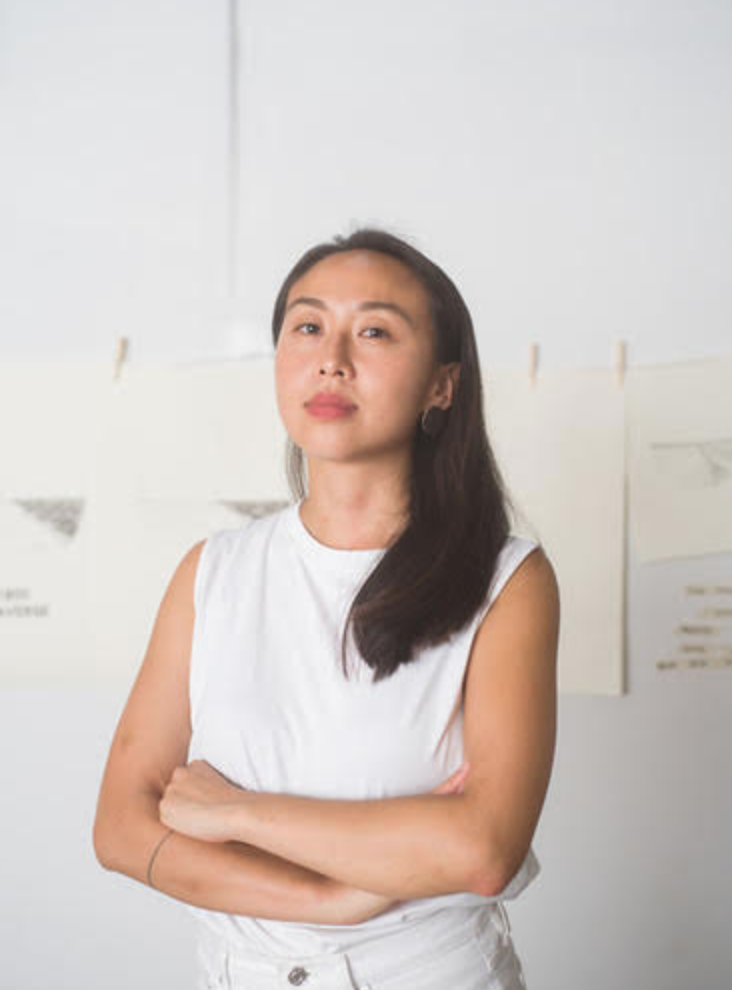
In Poetry & Prose Tags Vi Khi Nao, Sarah Burgoyne, Because the sun, Camus, poetry
Comment
tiffany lin

Tiffany Lin In Conversation With Vi Khi Nao

February 17, 2020

TIFFANY LIN IN CONVERSATION WITH VI KHI NAO

VI KHI NAO: In your video presentation, you said at 3:33 that “as artists you have to come from an authentic place.” How do you define authentic here, Tiffany? And, what is an example of inauthenticity in an artist? When I think of authentic, I think of sincerity, meaning it arrives or derived from the heart.

TIFFANY LIN: I define authentic as something derived from a lived experience. Every creative endeavor should be produced from a place of honesty. Creating any type of cultural artifact should be done in earnest. The world is already too cluttered with lies manufactured by disingenuous and profit-driven motivations. Keeping your creative space true is an exercise in freedom.

Photo by Jeff Barnett-Winsby

Photo by Jeff Barnett-Winsby

In this particular video, the question was asked specifically in reference to the Illustration courses I am teaching this semester. Illustration is often spoken about as an entirely separate discipline from contemporary art. Maybe this happens because it’s perceived as being too commercial or a willing player in the capitalist machine. Or perhaps its subject matter deemed too trivial and visual execution frivolous and decorative. But if that is what speaks to the artist in question, and it offers an avenue for creative release, my role as an educator is to support and steer them through that independent journey. When I say inauthentic, a broad example is a creative brief from an art director that deadens your soul. It is something to be executed - a means to an end - and serves the client, but may not necessarily challenge the artist or consumer. There are those who are content with this relationship, but it does not align with my personal ideas of what it means to be an artist. In successful commercial projects, the artist has found positive symbiosis with the larger vision that matches their visual language.

On a personal note, I’ve taken on a few projects I didn’t care about or were misaligned with my moral values; it was very apparent in the outcome. I’m now in a position where I have more agency in the projects I choose to take on. And I understand that in itself is a type of privilege, to be able to perform outwardly in an “authentic” fashion as opposed to taking on a voice that is not my own.

(I don’t know if that made any sense).

VKN: (It does make sense) What were those projects, Tiffany? Could you describe them? What have you learned from that misalignment? And, could it have been prevented? If one were to arrive from a place devoid of necessary privilege? Could you foresee an artist be both capitalistic and authentic? Or are they paradoxical and oxymoronic?

TL: I worked on a few fashion-related projects where I was told to respond to explicit “target audiences” / “demographics” that were determined by the art director. Everything was based on market trends. At one point, I was told I drew “too much like a man” and that this would not do well in women’s apparel. I found this creative direction troubling as it suggested that women had a “natural” tendency toward a particular aesthetic, one of frills, curves, and maximalism. I find this view repulsive. Common sense should lead us to conclude that none of this is innate or specific to gender, rather companies have found ways to profit off of antiquated views of gender with bogus “for her” branding. Have you ever been frustrated by gendered marketing “for her,” where functional objects are embellished with extraneous accents because they think they’ll sell better? And that a young woman, seeing the male-counterpart-item, streamlined and plain, comes to understand her place in the world as an accessory. I take no issue with people who prefer this, but it should not be bound to gender.

This attitude can be prevented if we have art directors and creative people who can push beyond gender normativity and dare to think beyond profit margins. Yes, I think an artist can be both capitalistic and authentic, though I probably would probably keep them at arm’s length. Artists face the most difficult Faustian bargains. For some it does not sit well and completely disrupts their creative process. For others, the financial success outweighs the optics of “selling-out” and from a practical level, may allow them to live more comfortably and provide form themselves/their progeny in a better way. For others, fame, glory, and attainment of wealth is all they ever wanted.

Screen Shot 2020-02-17 at 5.31.28 PM.png Screen Shot 2020-02-17 at 5.31.34 PM.png Screen Shot 2020-02-17 at 5.31.39 PM.png Screen Shot 2020-02-17 at 5.31.44 PM.png Screen Shot 2020-02-17 at 5.31.49 PM.png Screen Shot 2020-02-17 at 5.31.54 PM.png Screen Shot 2020-02-17 at 5.32.09 PM.png


VKN: In your bio, it’s written that “through drawing, writing, and performance, her [Tiffany Lin] work investigates the nebulous distinction between want, need, and desire in context of political and capitalist spectacles. What have you discovered, so far, about want, need, and desire? Has your investigation surprised you? Redefine your aesthetics? Or has it ever misguided you? What kind of growth do you imagine for a consumer of your work to experience through your investigation? Do you wish that they de-consume? Or overconsume?

TL: I’ve discovered that one of the unifying themes between want, need, and desire is hurt. Or a sense of loss, emptiness. Whether it is for want of food, water, shelter to the more surface desires such as luxury goods, there is a sense that without said object that the subject is lacking and incomplete. I specify political/capitalist spectacle because I think it’s important to contextualize my practice in the 21st century where the amount of advertising we consume is unfathomable. Codes are created to predict our behavior. The market wants to be our psychiatrist. They know are deepest insecurities and a greatest wish; if they don’t, they’ll try to manufacture it in the deepest recesses of your mind. These psychological operations are not new, but they have reached new levels of saturation with advances in technology and communication.

My investigation has surprised me but not in ways I anticipated. Many of my works are derived from formal/informal interviews with leading questions, and the impact of Donald Trump’s election in 2016 was palpable in people’s responses to what they “wanted” out of a President, or what they “needed” to happen to fulfill their lives. These conversations often turned ugly because there is a thread within the American psyche that suggests all good things come to those who work for it. Though that dream has proven to be a fallacy over and over again, I find that the working class (like my parents, who fully believe in the Dream) do not ever discredit the state or larger systems. An easier psychological solution to pivot their anger and resentment toward their fellow man. My initial response was to balk and grow angry, but I learned from this logic that our narratives of want are rooted in so much more than consumer goods and quality of life, but rather notions of agency that allows the ideal “American citizen” to fully self actualize. What is a citizen anyway?

I have been misguided for sure, mostly in that the conversations were almost always emotional in having to contend with heavy realities - drug addiction, food and housing insecurity - what could an artist truly offer to resolve these problems? Can a work of art feed the hungry? There are days where I think art is useless. Other days I think it is the only thing that will save and outlive us.

My hope is that people view my artwork and feel greater empathy toward others. That somehow, through the reinterpretation of public vs. private sector vernacular, people question their relationship to consumerism and nation. Yes, generic beauty pageant response but I believe in WORLD PEACE. Once people develop more genuine connections with one another they may ultimately “de-consume” material objects as interpersonal relations take priority, but that is not my explicit goal.

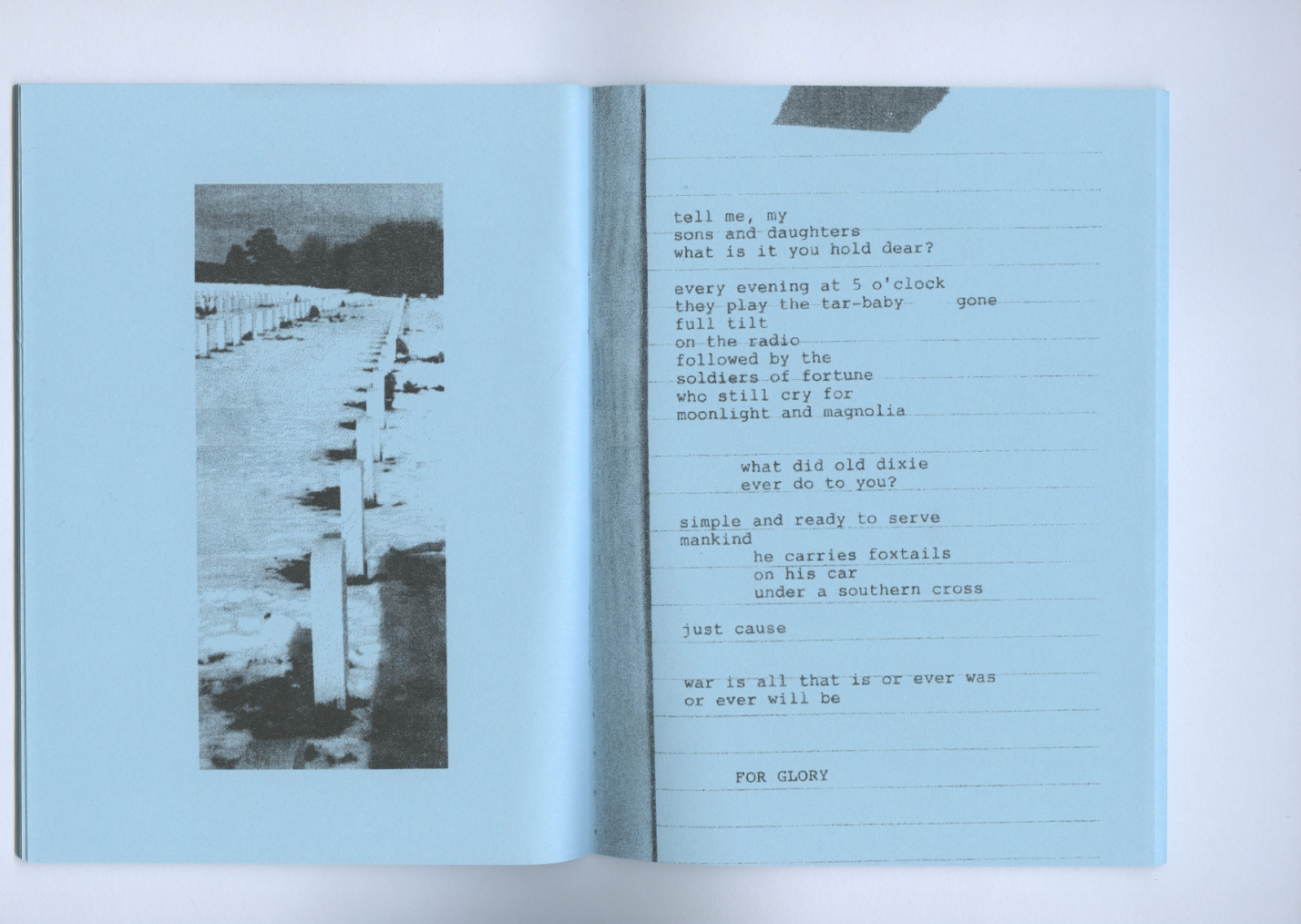
VKN: Your visually performative, “patriotic” chaplet “A Manual by Codes” is both tender and technical, visually ascetic and sharp, didactic and irreverent, and exhibits many shades of political and personal inquiries and it (possibly rhetorically) asks, “tell me, my sons and daughters what is it you hold dear? So if I may ask the book to ask you: tell me, Tiffany Lin, what is it you hold dear?”

TL: I hold dear the elements to which I belong. I like to remember we’re carbon made - my found family, blood family, strangers. When making the chaplet, I wanted to rethink justifications surrounding war and violence. When is sacrifice acceptable? What loss hurts the most and why? The book is a reminder that at the end of the day, you, like me, like her, like him, like they, like it - shit, piss, bleed, and will die. Mortality anchors the work.

Screen Shot 2020-02-17 at 5.35.42 PM.png

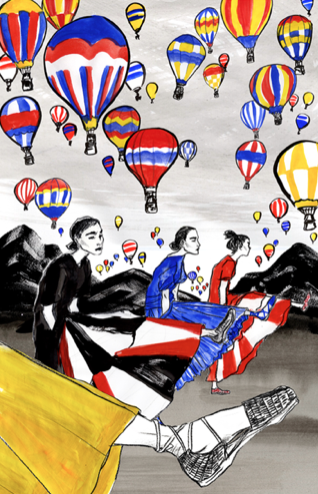
VKN: Can you talk about this illustration? Can you talk to us about your process of creativity? From the seed of conception to its end product? What is the one thing that you have learned from the process? Or what would empower you to refrain? Or do you tackle all of your visual works with some impulsion and immediacy?

TL: This editorial work was created as a response to a Lifestyle Illustration assignment in graduate school. I chose to work with Hermes’ Resort 2017 line (here). Each work (illustration, performance, writing) starts with drawing as a meditative and experimental practice. In this case, since I was responding to a prompt, I was more cognizant of color palettes and visual ambiance that would not distract from the clothing and elevate it in a playful and appetizing way.

I first work in analogue media and scan each component for more creative flexibility when I transfer it to a digital platform. Especially when working with a client that may change their mind quickly about placement, colors, or nitpick angles and stray hairs, it’s nice to be able to edit the piece quickly without tearing your hair out about having to redo an entire painting from scratch.

Impulse and immediacy are words that resonate with me. There is something critical in that first mark - conviction and confidence become lost the more you belabor the form. My media of choice is ink, crayon, charcoal, and gouache. Textures are often done by hand and retain a feeling of a living, breathing image to an otherwise dead mark rendered soulless by digital software. However, integrating digital tools into illustration has allowed me to continue working in this manner while still being efficient in the way things are moved around. Think of it as constant digital collage.

VKN: You work in a variety of mediums (lithography, drawing, painting, performance, a census collector), which one could you live without? Meaning, which medium or medium of expression would make the engine of existence worthy of adding more fuel, spare parts, or appetite for posterity. I used to think art is dead, but when I sit with your work, I have arrived to a small conclusion that art doesn’t always have to be overarching or dramatic - that it could speak or excel in the language of subtlety. An excellent example of this is your chaplet/chapbook titled “BECOMING, a letter” - it’s very poetic, compassionate with an element of un-enslaved detachment, and massively encouraging in the sense, place, and its time of acceptance. Can you talk about this book? Can you talk about the design of the cover? Two circles in ochre(?) and two smaller circles connected by one line? Does it reflect or is it in conversation with this linguistic line, “Two necessary shifts in orbit.” And, could you talk more about the significance of this tenderness, “Darling, There are no lies between us, only nervous hesitation toward an awakening.”

TL: I can’t live without drawing - it is the foundation of everything I do. I’m a big fan of sketchbook experimentation. It is how I think out loud.

In terms of what is more has fallen out of use, I have not worked as a true printmaker (as in working collaboratively with another artist) in a few years. I realize I am better suited to executing my own projects. However, lithography taught me important life lessons about patience, process, consistency, and the art of failure.

The book is probably my most emotional and intimate work to date. I wrote the initial text in 2015 when my partner (at the time) was at a major psychological low in grappling with his gender dysphoria. I wrote the essay as a way to acknowledge his desire to transition from female to male, to live his life as a man. I remember him telling me that transitioning is an imperfect solution to one’s material reality.

The cover is a diagram of binary stars, meaning two stars that orbit around a central mass. Our universe is dominated by multiple star systems, meaning the stars are bound together by gravitational force, even after they die. From our vantage point, they appear as one star but are actually two (or more) in constant rotation. I think it is an apt metaphor for me and my ex-partner’s relationship. We still remain very close to this day.

It’s a relationship I have difficulty defining, especially in conventional (see: BASIC) predominantly heterosexual/straight spaces. How to describe a love that is so completely and utterly unconditional? To me it speaks of the power of queer love that transcends bodily reality. Yes, the diagram is in conversation with that line as the orbits never truly “shift” but they may grow further apart or closer together over time, sometimes transferring mass to the other.

That last line is about intuition and knowing. We separated in Philadelphia in the summer of 2016 and he left behind a letter apologizing for “lying” to me about his desire to transition. But I do not see it as a lie. I see him for who he is, who he desires to be. We both knew something was amiss but neither of us had the language or resources at the time to articulate what he needed to “awaken” and arrive at his true expression of self. We grew up together. He is my best friend. He is a much more joyous person following his transition and that has been an amazing experience to see.

VKN: If I may extract some practical wisdom from you, what is the best way to deal with economic hardship, Tiffany? If you could advise from an artist to another?

TL: I don’t have a good answer to this one. The best thing I can advise is to stay honest with yourself, surround yourself with good people (and I mean ACTUALLY GOOD PEOPLE - it will take time to intuit), keep creating work and follow what feels right. Your confidence will waver from time to time, that’s ok. Acknowledge that the path of an artist is difficult; it is not linear and therefore infinite in possibility. It is possibly the most overwhelming industry to be in. Yes, you’ll have to hustle. Know that some days you will have to compromise but always take care of yourself. Too much top ramen will destroy you. Couch surfing will eventually wear you down. When I was working five (stupid) jobs in San Francisco, a mentor kept telling me that “The sword is forged in the fire.” If I were to get really nitty gritty, I would say find a job that can get you by but never lose focus. Wait tables, gut the gig economy for whatever it's worth, pawn your jewelry, roll the dice - but remember to nourish and feed your creative process. Persist!!

VKN: If Andy Warhol kept your most brilliant art piece and then informed you later that he lost it when in fact he didn’t, would you shoot him with a pistol like Valerie Solanas? What would you do to him for betraying you or leading you on? In other words, what is the best enactment of (nonchalant) revenge on another? Another artist? If there is such a thing as a casual, nonchalant venom.

TL: Yes, I would shoot him. But maybe that would be too easy.

Perhaps it would be more poetic to concoct a more elaborate plot, a long term defamation campaign.

But in more seriousness, I’d probably let it go. Revenge and bitterness take up too much mental energy. I’d rather redirect my energy into happier things. But therein lies the nonchalant revenge you speak of - achieving success despite the setbacks and thievery!

VKN: Which one would you choose? A door a window? In other words, what is your ideal romantic love? TL: Door. Clear entrance and exit strategy.

Two people coming together and understanding the terms of engagement.

Secure infrastructure.

VKN: Do you don’t think the window has the same clear exit strategy?

TL: It involves too much glass shattering.

VKN: What is your favorite kind of sofa? Or what is the sexist art object you have ever laid eyes on? In your eyes, what is the best Asian artist working on any medium today? This is non-sequitur, but I was preparing for this interview and I accidentally studied this other woman’s art/design (http://www.tiflindesign.com) who shared the same first and last name with you (lol), and I did wonder for a second if you have ever reached out to other Tiffany Lins in the world and ask if they are willing to collaborate with you on an artistic feat/project?

TL: [ UPDATE! ] Since conducting this interview, I caved and bought a sofa off of craigslist. It’s very modern and has shaker furniture elements. It is not very practical for sleeping on but is firm and keeps me alert while I read.

Sexist art object… is everywhere… I can’t decide. Am I supposed to sit on it?

Haha, yes, down the line I would like to create a video series around “common” names, mostly among 1st and 2nd generation Americans - popular combinations like Tiffany Lin or Christine Lee, Grace Kim, Maria Rodriguez, Andrea Gutierrez, etc. I would have them face the camera and say “My name is [INSERT NAME HERE] and I am a public menace.” My twin is named Tiffany Lin, she is 5 days older than me and grew up in the same neighborhood. She currently works as a nurse. Our parents are derived from the same practical Taiwanese stock, giving us names that were easy to pronounce and would allow us to assimilate more easily into American society.

Best Asian artist… Mel Chin is a pretty cool dude.


Tiffany Lin is an interdisciplinary artist, educator, and wordsmith. Her projects investigate nebulous distinctions between want, need, and desire in context of capitalist spectacle and corporeal intimacy. She holds an MFA from the Maryland Institute College of Art in Illustration Practice and a BA in Gender & Women’s Studies and Psychology from the University of California, Berkeley. Lin currently lives and works in Las Vegas, NV where she joins the Department of Art at the University of Nevada, Las Vegas.

VI KHI NAO is the author of Sheep Machine (Black Sun Lit, 2018) and Umbilical Hospital (Press 1913, 2017), and of the short stories collection, A Brief Alphabet of Torture, which won FC2’s Ronald Sukenick Innovative Fiction Prize in 2016, the novel, Fish in Exile (Coffee House Press, 2016), and the poetry collection, The Old Philosopher, which won the Nightboat Books Prize for Poetry in 2014.  Her work includes poetry, fiction, film and cross-genre collaboration. Her stories, poems, and drawings have appeared in NOON, Ploughshares, Black Warrior Review and BOMB, among others. She holds an MFA in fiction from Brown University, where she received the John Hawkes and Feldman Prizes in fiction and the Kim Ann Arstark Memorial Award in poetry. 


In Art, Interviews Tags Vi Khi Nao, Tiffany Lin, art
Comment
italia

Giovan Coppola & Vi Khi Nao Talking Italian Poets, Cats and Place

March 25, 2019

by VI KHI NAO
in conversation with GIOVAN COPPOLA

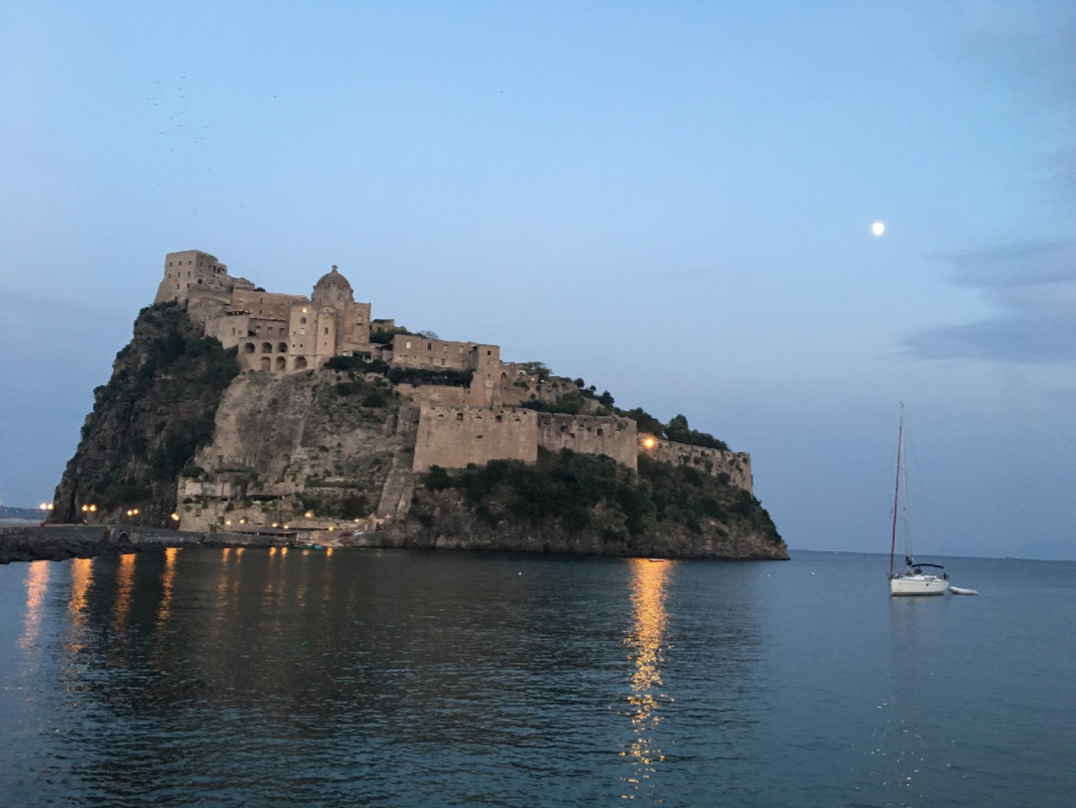
VI KHI NAO: Will you depict the landscape of Ischia. What is it like today?

GIOVAN COPPOLA: I’m looking out the bedroom window and I see a sliver of the sea between the trees. The sun is setting and the clouds are bathing. And the wind has started. Tomorrow it’s supposed to be windy. I wish I could tell you which wind it is, but I’m still learning their names.

VKN: The way you lovingly and lyrically depict this filled my heart with love for your Ischia. If you were to invent a name or two for that wind, what would you call it? Also, if you had an ideal poet life, what would that writing life look like?

GC: I remember you once told me that ‘eloigne’ was your favourite word. Wait, I don’t think that’s the right word. Do you remember it?

VKN: Eloign. Without the “e”, but I prefer your invention.

GC: I would name the wind Eloign.

VKN: I noticed that you were reading Rabbit by Sophie Robinson, which recently came out. How is it so far? Will you talk about the current landscape of the poetry world? You have read internationally from Brit lit and American. What do you think make a poet great in this Brexit, Trump era? What are some of the criteria or traits for such poets? In other words, what kind of linguistic or lyrical materials seduce your soul the most?

GC: I’ve loved Sophie Robinson’s poetry for a few years now. Her poems make me feel like it’s morning and I’ve just woken up and realised that something has happened to me during the night that has changed everything. Like during the night I was lassoed and pulled to a group of stars that have pumped their gumption into me and I will now become a better braver person in the waking world. Her poems have fish bone teeth and crime. They break open the pain and make something new.

Second question: I don’t know what makes a poet great in this Brexit - Trump era. A poet that keeps writing, keeps wanting to know, I guess. A poet that keeps loving. A poet that takes care of herself and the winds.

Third question: What materials seduce my soul? Poems that live where they want to live. Poems that make room. Poems that love things.

VKN: That is so gorgeously depicted “lassoed and pulled to a group of stars.” She is so lucky to have you as a reader ! If you were to interview her, what would be one question you would like to ask?

GC: Once your poems pull through the pain, where do they lay down their heads?

VKN: Can you talk about the poems or any translations you are working on? What is the process like for you? And, what direction do you foresee your own journey with your work? Would you like your process to be more accelerated? Where it infuses everything you touch and cook?

GC: Thank you for all of these questions, Vi. They inoculate me.

I recently came back from FILL, the Festival of Italian Literature in London, and I did a reading with a group of poets. We were all included in the anthology Wretched Strangers (Boiler House Press) as non-UK poets who contributed to the poetry world in the UK. The anthology was put together in response to Brexit and the current political upheaval making way for powerful responses from the far right against refugees and immigration. Four of the poets that read were non-native English speakers writing in English and also mixed in other languages into their English poems. And I thought how wonderful that was and wondered why I didn’t think I could do the same in Italian? It made me think about how the English language can be a symbol of progress. That you learn English, you move to an English speaking country, you transform yourself in a different language. What does that mean about me moving back to Italy where my parents have come from? Would me writing in Italian be seen as progress? Or is it pedalling counter-clockwise? Or is it turning into a seed?

I want to write in Italian or mix English and Italian. I think my poems, at least when I read them out loud, sound tough, like hard cheese rinds before you throw them in the soup. And my New York accent comes out. <dawg> I’d like to see what happens in Italian. I’d like to dissolve in Italian. I don’t think I’d have to dismantle anything, but I think it means when I go for walks I would have to push myself onto people. Linger and talk to them. Even to the Jehovah Witnesses, although I don’t want to talk about Jesus.

You know one thing I noticed that I really liked? When I was in London for the Italian Literature Festival, I sat next to a lady. She was an academic that studied post-war Neapolitan literature written by women. At one point she gave me a candy. A few days later, I took one of my cats to the vet and the vet offered me a gummy worm from a bag. I really love eating candy with Italian women.

VKN: I want to eat Starbursts with Italian women too !What are the poets you read with were like? Are they different from you or similar? Will you introduce us to a few great Italian poets that everyone must read or else their existence on earth would seem meaningless otherwise?

GC: The poets I read with at FILL were really diverse. I wish I could have talked to them more or asked more interesting questions during the Q&A, but I suspect like many people, I’m always shy after readings and there doesn’t seem to be enough time to calm down afterwards and talk. I wish after a reading there was always dinner. Food disarms people and makes people trust each other. You can’t take yourself seriously when you have food in your mouth. Like eating candy with people. The next poetry reading I’m going to bring candy.

But yes, some Italian poets I really love and that I’ve got to meet during poetry readings or have been recommended to me are Carla Mussi, Roberto Minardi, Alessandro Mistrorigo, Chandra Livia Candiani, Alessandro Burbank, Andrea Inglese, Giovanni Asmundo, Fabia Ghenzovich, I want to know so many more.

VKN: I am not familiar with these poets. Will you please give me a little introduction to one or two poets you mentioned? Are they contemporary? Old-fashioned? Dead? Alive but obscure? Alive and gregarious? Dreadfully enticing in their form, but wouldn't take a dog out for a walk?

GC: They are alive and contemporary, some I’ve met, some I’ve just read. Some are young and shy and delicate and others are robust in their sexuality. Some are travelers and some like to stay home. There are so many people to know about and read! I’m still learning about what’s out there and letting things carry me to where they want to go. Carla Mussi’s latest book of poetry is Sconto di Pena (Puntoacapo, 2016) roughly translated as ‘Reduced sentence’ and it’s about a murder trial of a woman who has killed her husband from the woman’s point of view. Each poem is like a holographic statement, phrases that cut, the woman is like a genius wild animal.

Then there are Roberto Minardi and Alessandro Mistrorigo. Roberto Minardi’s La citta’ che c’entra (ZONAcontemporanea, 2015) are about living in an urban landscape. There are people, birds and cats, public transportation, sandwiches and dinner in front of the television. The poems give you a perspective of solitude where many things happen. Roberto and I have translated a few poems for each other which was really fun. That was my first time translating poetry and he was lovely to work with, encouraging and patient. Alessandro Mistrorigo’s Stazioni (Ronzani Editore, 2018) were written in various places across Europe and Asia. Characters that all come from somewhere else, temporary people and places and it makes me think about how we become a place, how we can blend into the space around us. Reading the poems reminded me of the Alexandria Quartet by Lawrence Durrell.

VKN: What was life in UK like for you before you moved back to Italy? Do you miss the poetry landscape there? And, if you were to create your own here in Italy, a poetry club, what kind of baking or culinary dishes would you make to seduce those who already love the sea to consistently come? Would you ever run or host a regular reading series?

GC: I loved London for many reasons and I loved the poetry landscape there. I met many poets and writers and there were many writers that would pass through to give readings. All kinds of readings to party style reading slam poetry jams to sit down quiet readings to poetry as performance art to elevated academic readings to rock concert style readings, so many kinds so you didn’t have to feel like every single one of them had to have a meaning. I mean you didn’t feel the pressure to have a great time or to even listen. It was okay to be bored because you were still going to get something out of it.

I miss that, but not enough to go back. I like it here and I want to hold dinner party poetry readings in the garden. I want poets to come over and eat and read poems. How do I invite people that don’t know me to come over and eat? A no-pressure environment. If they want to, they could use big words and talk about the PhD they’re working on. And they could also talk about how many times a week they wash their hair. I’d like to read poems where anything can happen and I want to read poems that change you. I want to eat things while reading poems.

VKN: The question you asked Sophie R earlier in our interview, if you were to answer that question on her behalf, how would you reply to it? I don’t know if she would mind, but let us pretend that she wouldn’t.

GC: I think her poems rest on her cat and they watch television together. Maybe her cat is a little wheezy and the poem who has done all the heavy breathing in the lines, can now show her cat how to slow down. They teach each other about the aftermath.

VKN: You are a cat lover. This is obvious on your Instagram posts. Do cats make great poets based on your observation of them? Or they make better ice cream, left too long in the sun and they would melt.

GC: I don’t think cats melt. They imitate their dry little turds in the sand. I think cats are spectacular poets. Have you read The History by Elsa Morante? There is a character Usepe, who is a little boy that suffers from epileptic seizures. He’s a little boy and he’s a poet and he doesn’t write them down, he just says them. Shouts them into the air. He talks to the trees and tells them a poem or tells the river a poem. He’s a lonely boy. I think cats are like Usepe. They say the poems, but it’s not necessary to preserve them. I think that’s why wherever they are it feels like home. That’s why they make home feel like home.

VKN: If you have a dish you made that looks like a walking example of poetry, will you share that pic with us?

GC: Good question. Let me check the files.

I have to find a picture of it, but maybe I didn’t take the picture of what I have in my mind. I made roasted tomatoes over the summer that I loved. I had bought an electric oven because my gas oven is shit. So the tomatoes were the first thing I made. I think I roasted them for two hours. I set up the oven in the garden so it wouldn’t heat up the house. I sliced the tomatoes, sprinkled fresh thyme on them, some salt and olive oil and then I put them in the oven. I sat in the kitchen while they roasted outside, keeping an eye on the cats in case they toppled over the oven. They were still kittens then and I anticipated constant trouble. I wore a green striped house dress and sweated my guts. The tomatoes were delicious. Carmelised. I put them on top of bread.

VKN: You take amazing photographs, Giovan! And, I just want the world to see through your eyes. Will you share one that you are able to access? So that we have some sense of your aesthetics?

GC: Let me look for one. What would you like to see?

VKN: Photos of Ischia? Or places you went for your morning, afternoon, or evening walk? Maybe some pictures of your cats, languishing like supermodels?

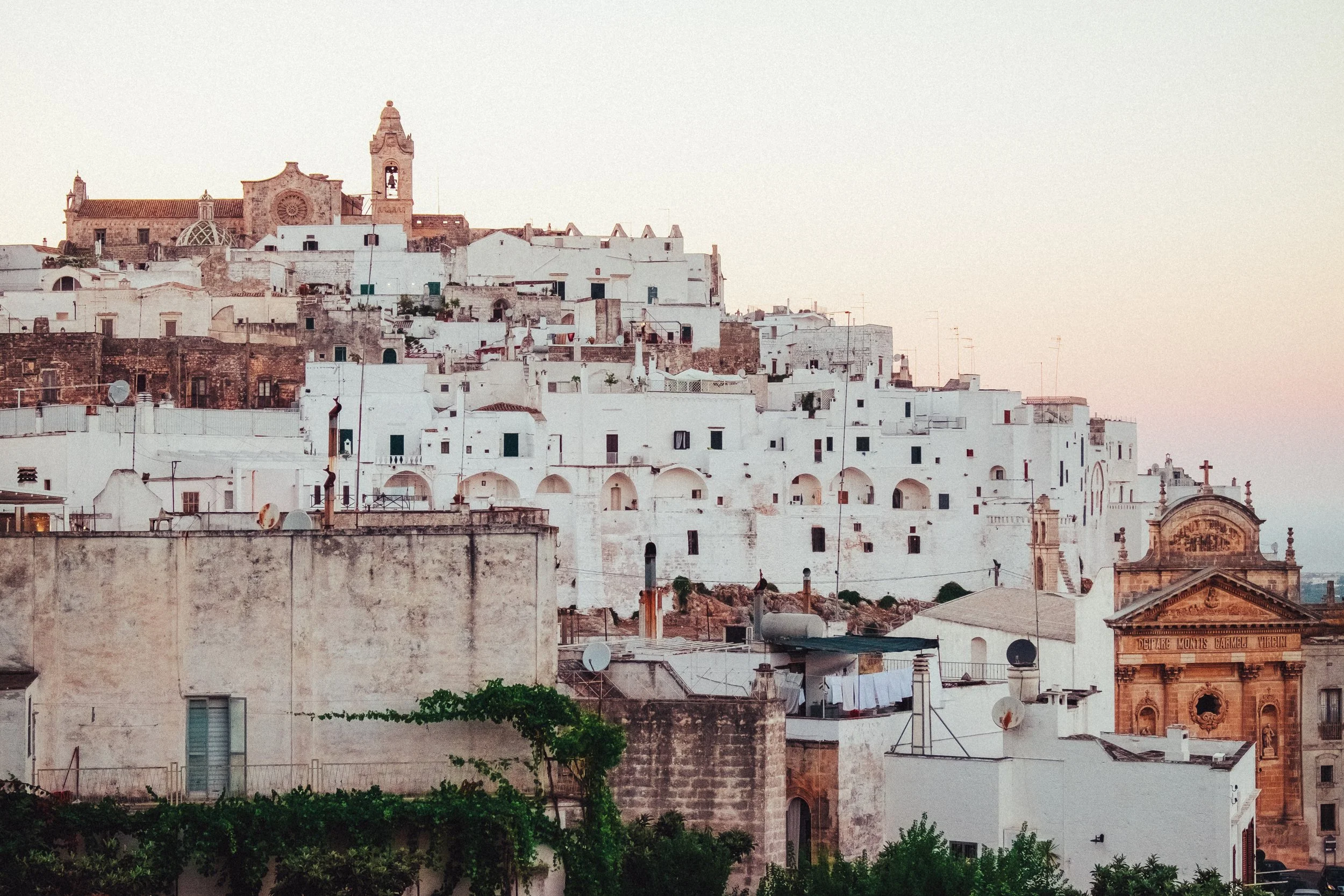
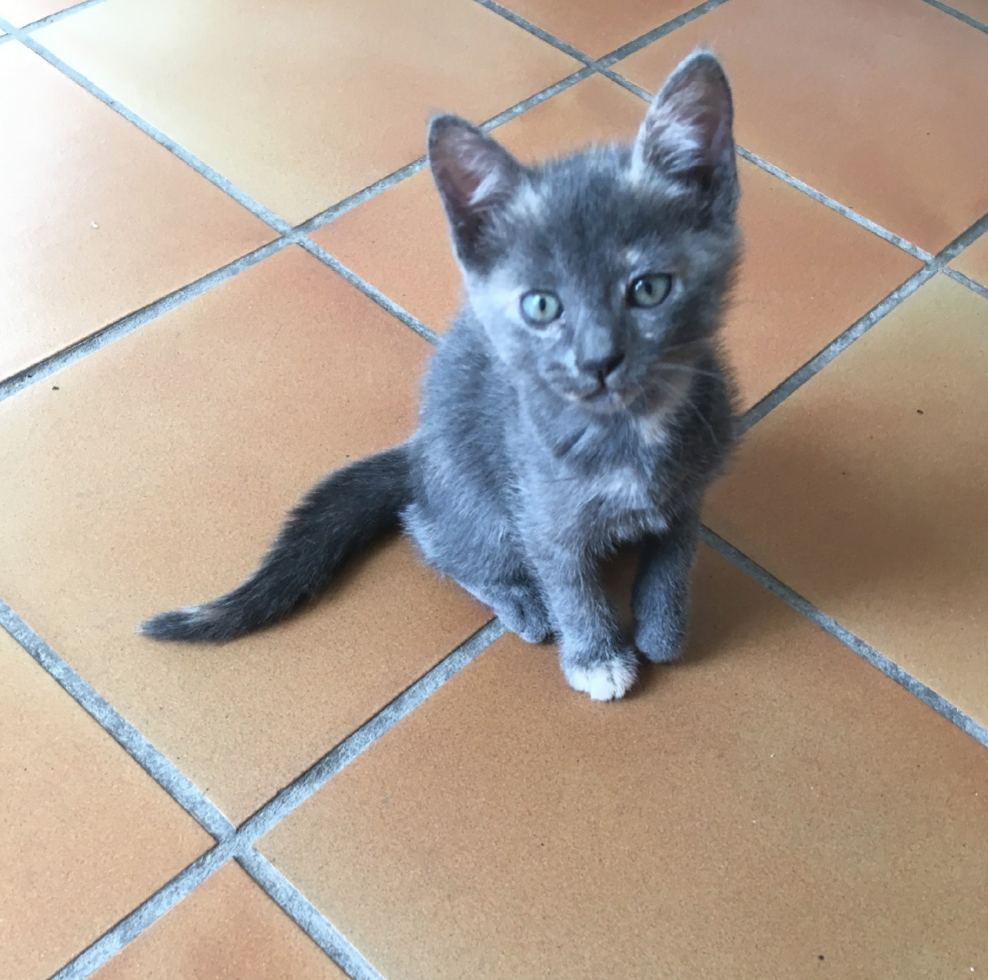
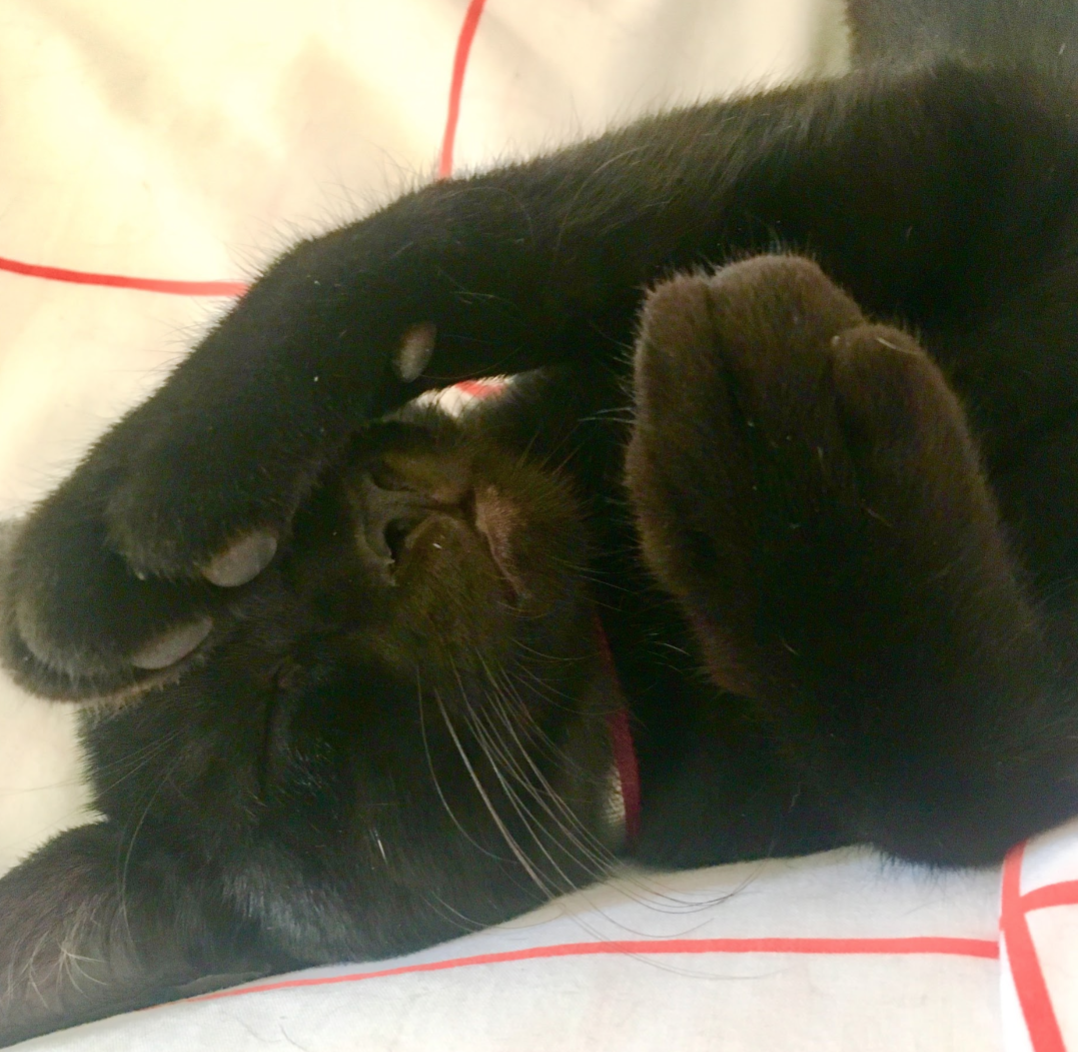
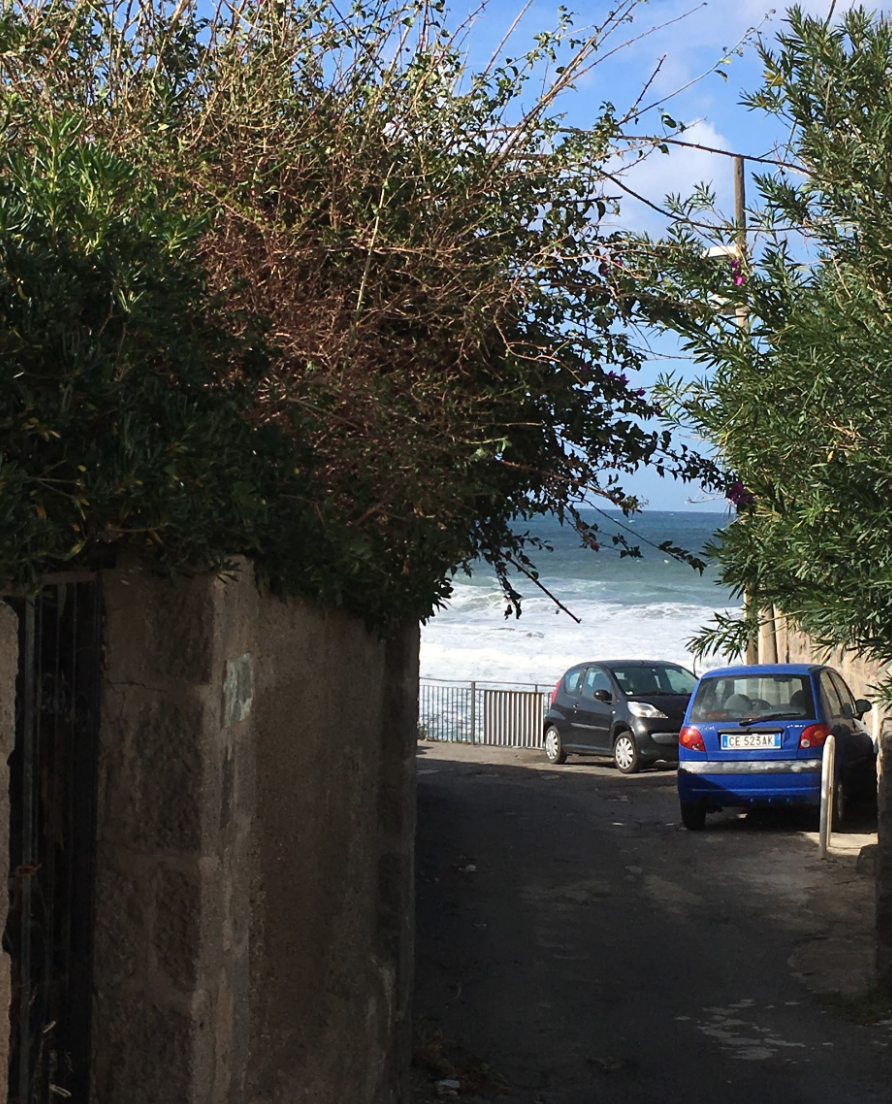
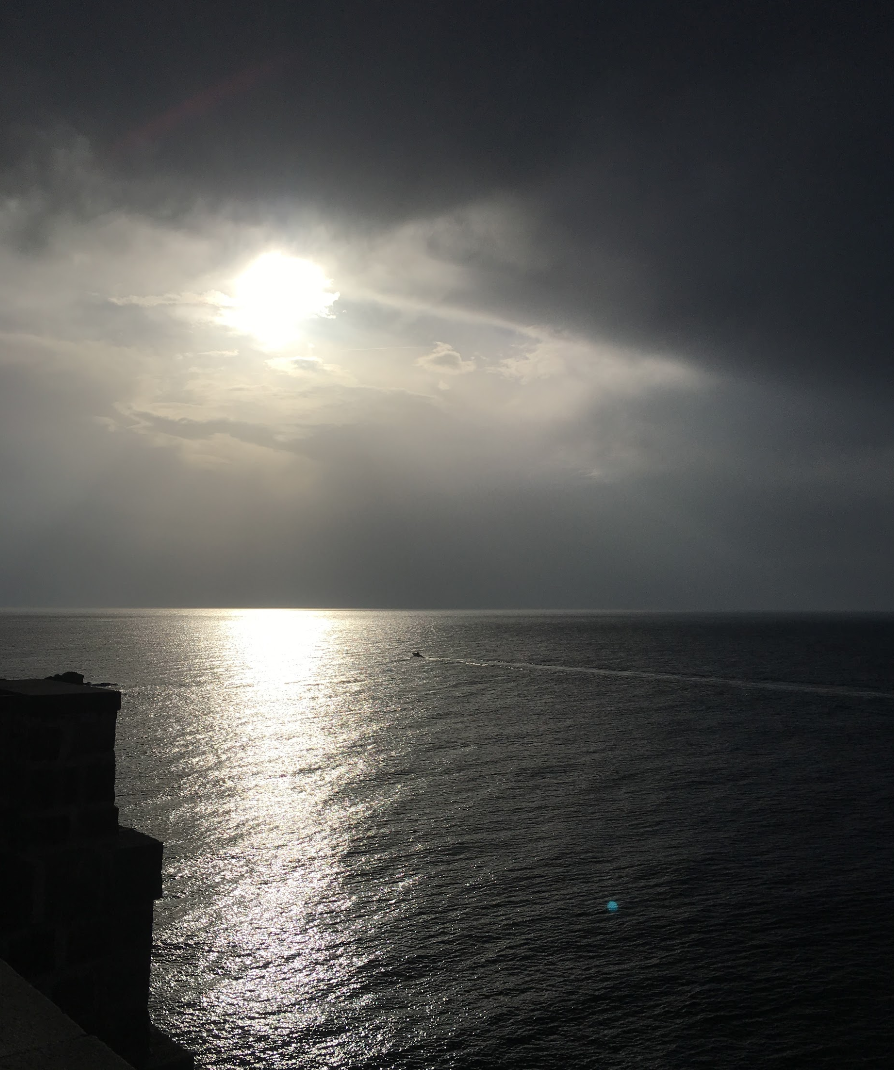
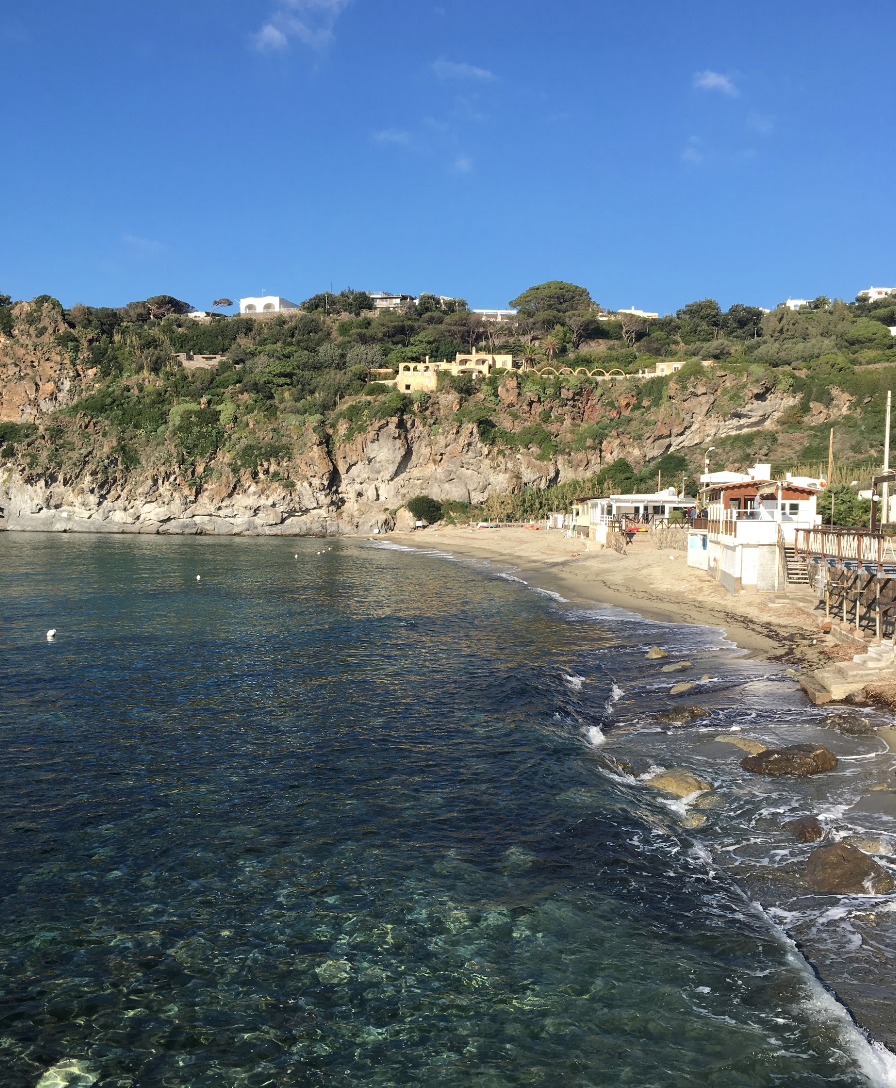
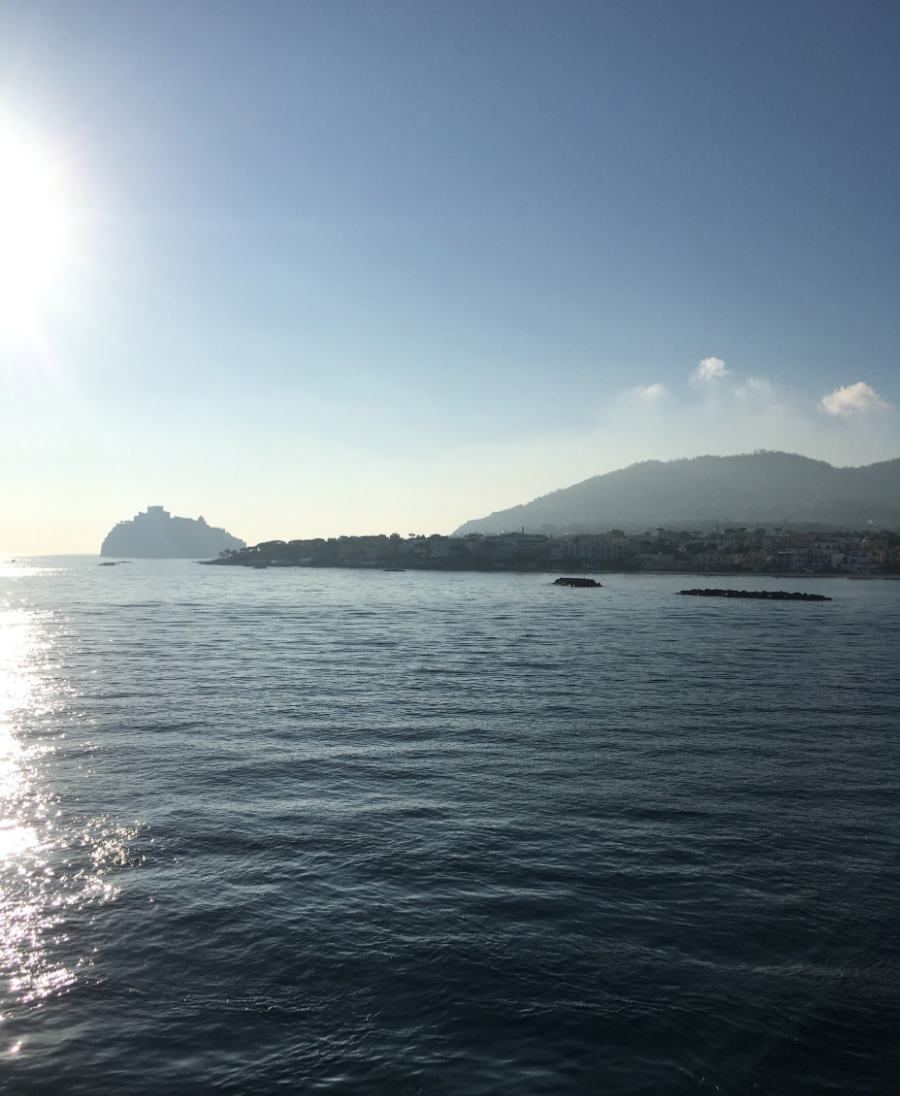
GC: See below

Screen Shot 2019-03-25 at 3.06.50 PM.png
Screen Shot 2019-03-25 at 3.06.57 PM.png
Screen Shot 2019-03-25 at 3.07.04 PM.png
Screen Shot 2019-03-25 at 3.07.20 PM.png
Screen Shot 2019-03-25 at 3.07.30 PM.png
Screen Shot 2019-03-25 at 3.07.43 PM.png
Screen Shot 2019-03-25 at 3.07.54 PM.png


VKN: How are your cats? Some were ill the last few times I spoke to you. Why do you think they fall ill? Which one is potentially most poetic? And, what is writing poetry for a felinic entity? If they had to work like us homo sapiens, which profession do you think they would excel in? Oraclers? Philosophers? Dancers? Bartenders?

GC: My cats are wonderful. I love them more and more every day. Indy has had a bad cough that she’s been taking medicine for. I even put her in the cat carrier, wrapped it in plastic, and stuck in a tube that steamed out a medicinal vapor. She didn’t like that. So then I decided to leave her alone and now she’s getting better. I think she got sick because I went away to New York and she got sad. All of them are poetic, some days one is more poetic than the others.

If cats had a human job, I could see Sesto as a garbage collector and have a lot of fun doing it. He looks like he’d enjoy a union. Indy would be a research scientist. Rose would be a talk show host, she loves to gossip. Mucca would be a creepy neighbour who collects cans. Pippo would be a basketball player and have a large sneaker collection.

VKN: My god! Their profession so wild ! There was one project about stinking nuns you were eagerly and excitedly pursuing. How is it going so far? Are these nuns really stinky like durians? Or different stinkiness? Is your project a collection of essays or poems? Or a combination of personal anecdotes of your post-nomadic life or something else? How would you like to work or rework on this?

GC: That’s funny you asked Vi. Now that I quit my job, I want to work on the stinking nun. My poet friend Ariadne Radi Cor, who lives in Blacksburg, Virginia is starting a writing group. It is a collection of 6 of us and we will have a monthly deadline to share work with each other and then do a skype call where we can both talk about shit and serious things. So my plan is to use the writing group to work on the stinking nun and let it be whatever it wants to be. Right now it’s like a poetic novella, but I’d like to write some parts in Italian and see what happens.

VKN: You have made so many life-altering changes in the last year or so, can you talk about the emotional thoughts or intuitive courage that drove your soul to make these transformative paths?

GC: It’s been almost exactly a year since I moved to Italy and if I remember myself a year ago, I was terrified and I ate a lot of burgers and fries. One week I ate McDonalds two days in a row and then the third day I ate 5 hot dogs for a snack.

So many emotions and so much fear. I had never been as terrified doing something because it felt like there was no way back. And I imagined all the terrible things that could happen. I felt like I was doing something I wasn’t supposed to be doing. Like I was making my ancestors angry by going back to Italy, doing the impossible, going back to live in the place that they had to leave. I could hear their voices and voices of other Italians in London, like it was a bourgeouis american expat fantasy, that my desire to live where I wanted to live was invalid.

But I kept pushing through and the burgers and hot dogs gave me temporary relief. And each step that I took, it was like someone smiled back at me. Like at the airport check in the airline person let us go through without paying for our overweight luggage. And slowly, even if there were difficult times and frustrating moments, things were okay. Neither of us were punished or yelled out or threatened to get kicked out.

But if I think about what kept me going was that I was doing what I wanted and then as soon as we moved into our yellow house, a pregnant cat showed up and decided to move in. And she had her babies. And then once my residency permit was ready (after 8 months of waiting) a little abandoned kitten showed up in the garden. And then, as soon as I decided to quit my job and work on the stinking nun, another little kitten showed up in the garden.

That cats make me feel like this is home. And also that I can’t leave that we need to take care of each other now.

VKN: You are so brave, Giovan! Thank you for sharing your process with us. If there were an omelet or a piece of fruit or a poem to depict you today or a famous actor or actress in the black and white era who could cat-ure (capture) your emotional composition today, what would that object be?

GC: Hm, let me think. Anna Magnani they say was a gattarda, meaning a cat lady, someone who loves cats. She would feed the stray cats in Rome. But she wore her scars like a dress. I’m not sure I’m as strong as her. Her fury was smoldering.

I think I would be broken clementine peels on a powder blue table today. A diaphanous dress. An eloign wind. Smack face down on the couch, lazing like wax.

VKN: You are currently in Ischia, Italy and I am in Iowa City when this interview takes place, if you could teleport one cat who could pretend to be my secretary for a day, which one of your cats would you deploy for this service? I would pay your cat naturally. One poppy or peony to his/her owner per hour.

GC: Hah! I would send you Pippo. He could help you organise your receipts.

Screen Shot 2019-03-25 at 3.14.37 PM.png

Giovanna Coppola (New York, 1979) is a poet and writer. After living in London for 10 years, she recently moved to Naples, Italy. She has performed at events and poetry festivals in the US, UK and Italy recently including the Festival of Italian Literature in London (FILL 2018), La Palabra en el Mundo Venesia (2018) and the European Poetry Festival (2018). Her work (poems, short stories, essay) have been published in Crab Fat Magazine, The Stockholm Review of Literature, Journal 69, JSTOR Daily and in the anthologies Millets (2017, Zeno Press) and Wretched Strangers (2018, Boiler House Press).

VI KHI NAO is the author of Sheep Machine (Black Sun Lit, 2018) and Umbilical Hospital (Press 1913, 2017), and of the short stories collection, A Brief Alphabet of Torture, which won FC2’s Ronald Sukenick Innovative Fiction Prize in 2016, the novel, Fish in Exile (Coffee House Press, 2016), and the poetry collection, The Old Philosopher, which won the Nightboat Books Prize for Poetry in 2014.  Her work includes poetry, fiction, film and cross-genre collaboration. Her stories, poems, and drawings have appeared in NOON, Ploughshares, Black Warrior Review and BOMB, among others. She holds an MFA in fiction from Brown University, where she received the John Hawkes and Feldman Prizes in fiction and the Kim Ann Arstark Memorial Award in poetry. 

In Poetry & Prose Tags Giovanna Coppola, Vi Khi Nao, italy, cats, italian poetry, italian poets
Comment

Poetry Weekly: Jill Mceldowney, Christina Olivares, Vi Khi Nao

March 25, 2019

Joanna C. Valente is a human who lives in Brooklyn, New York. They are the author of Sirs & Madams, The Gods Are Dead, Marys of the Sea, Sexting Ghosts, Xenos, No(body) (forthcoming, Madhouse Press, 2019), and is the editor of A Shadow Map: Writing by Survivors of Sexual Assault. They received their MFA in writing at Sarah Lawrence College. Joanna is the founder of Yes Poetry and the senior managing editor for Luna Luna Magazine. Some of their writing has appeared in The Rumpus, Them, Brooklyn Magazine, BUST, and elsewhere. Joanna also leads workshops at Brooklyn Poets. joannavalente.com / Twitter: @joannasaid / IG: joannacvalente / FB: joannacvalente


Read More
In Poetry & Prose Tags poetry, roundup, Jill Mceldowney, Christina Olivares, Vi Khi Nao
Comment
Featured
‘in the glitter-open black' — poetry by Fox Henry Frazier
'poet as tarantula,  poem as waste' — poetry by  Ewen Glass
'poet as tarantula, poem as waste' — poetry by Ewen Glass
'Hours rot away in regalia' — poetry by Stephanie Chang
'down down down the hall of mirrors' — poetry by Ronnie K. Stephens
'Grew appendages, clawed towards light' — poetry by Lucie Brooks
'do not be afraid' — poetry by Maia Decker
'The darkened bedroom' — poetry by Jessica Purdy
'I am the body that I am under' — poetry by Jennifer MacBain-Stephens
instagram

COPYRIGHT LUNA LUNA MAGAZINE 2025