

• Home
  • indulge
  • new poetry
    • About Luna Luna
    • resources
    • search
  • editor
  • dark hour
  • submit
Menu

luna luna magazine

  • Home
  • indulge
  • new poetry
  • About
    • About Luna Luna
    • resources
    • search
  • editor
  • dark hour
  • submit
shadow
A Writing Spell: Honoring Your Many Selves
Mar 1, 2021
A Writing Spell: Honoring Your Many Selves
Mar 1, 2021
Mar 1, 2021
An 11-Line Poetry Spell For Healing
Mar 1, 2021
An 11-Line Poetry Spell For Healing
Mar 1, 2021
Mar 1, 2021
How To Write Powerful Poetry Spells
Feb 28, 2021
How To Write Powerful Poetry Spells
Feb 28, 2021
Feb 28, 2021
Here Is Your Scorpio Homework This Season
Oct 25, 2020
Here Is Your Scorpio Homework This Season
Oct 25, 2020
Oct 25, 2020
3 Transformative Life Lessons Scorpio Teaches Us
Oct 25, 2020
3 Transformative Life Lessons Scorpio Teaches Us
Oct 25, 2020
Oct 25, 2020
Restorative Grief: Letters To The Dead
Oct 23, 2020
Restorative Grief: Letters To The Dead
Oct 23, 2020
Oct 23, 2020
A Santa Muerte Rebirth Ritual + A Tarot Writing Practice
Oct 6, 2020
A Santa Muerte Rebirth Ritual + A Tarot Writing Practice
Oct 6, 2020
Oct 6, 2020
Witches, Here Are The New Books You Need
Nov 14, 2019
Witches, Here Are The New Books You Need
Nov 14, 2019
Nov 14, 2019
3 Dream Magic Rituals And Practices
Nov 12, 2019
3 Dream Magic Rituals And Practices
Nov 12, 2019
Nov 12, 2019
How To Use Tarot Cards for Self-Care
Nov 11, 2019
How To Use Tarot Cards for Self-Care
Nov 11, 2019
Nov 11, 2019
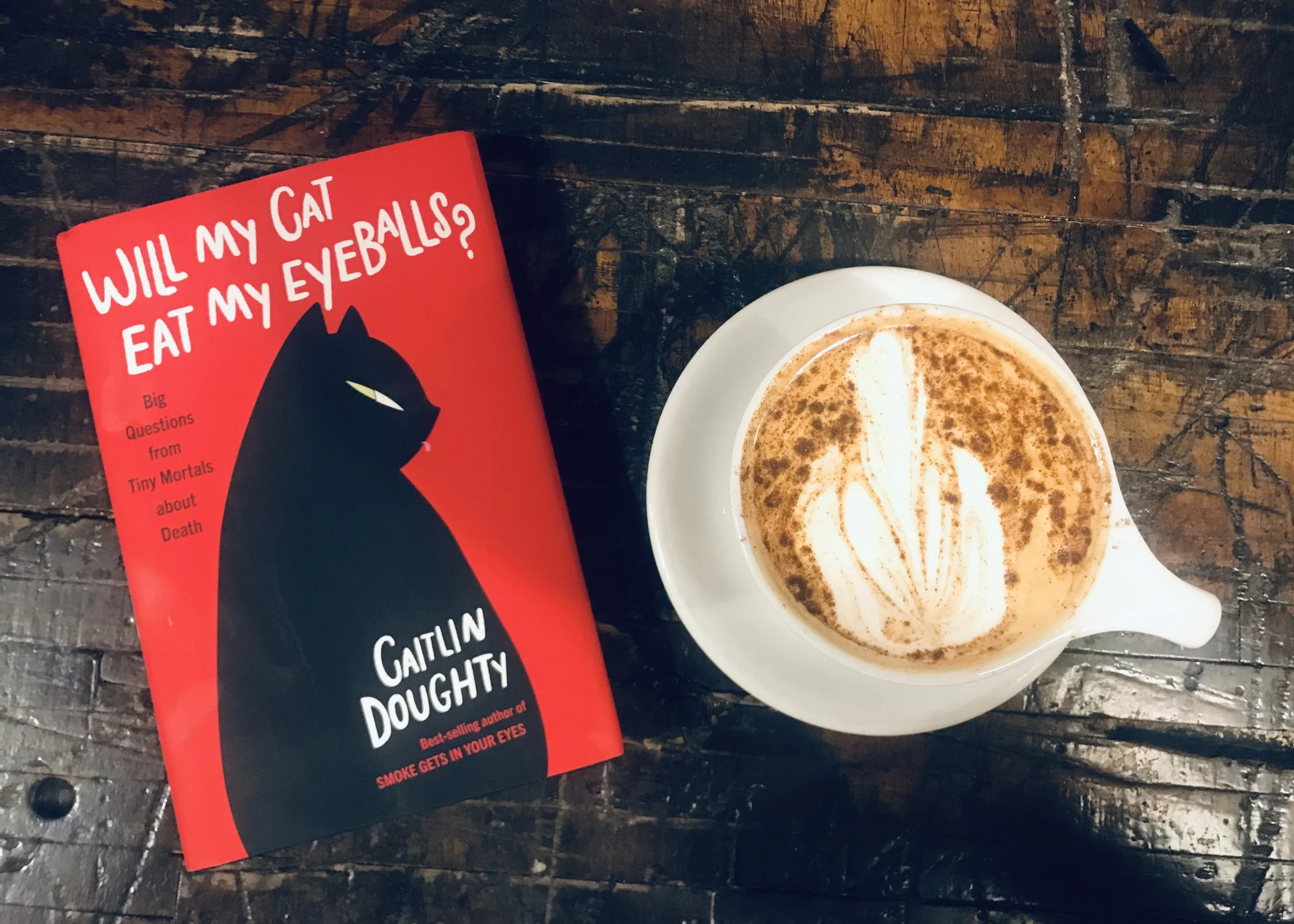
A Review of Caitlin Doughty's 'Will My Cat Eat My Eyeballs?'
Oct 25, 2019
A Review of Caitlin Doughty's 'Will My Cat Eat My Eyeballs?'
Oct 25, 2019
Oct 25, 2019
Nimue, The Deity, Came To Me In A Dream
Sep 17, 2019
Nimue, The Deity, Came To Me In A Dream
Sep 17, 2019
Sep 17, 2019
Astrological Shadow Work: Healing Writing Prompts
Sep 9, 2019
Astrological Shadow Work: Healing Writing Prompts
Sep 9, 2019
Sep 9, 2019
The Witches of Bushwick:  On Cult Party, Connection, and Magic
Jul 23, 2019
The Witches of Bushwick: On Cult Party, Connection, and Magic
Jul 23, 2019
Jul 23, 2019
7 Magical & Inclusive New Books Witches Must Read
May 15, 2019
7 Magical & Inclusive New Books Witches Must Read
May 15, 2019
May 15, 2019
Working Out As Magic & Ritual: A Witch's Comprehensive Guide
May 14, 2019
Working Out As Magic & Ritual: A Witch's Comprehensive Guide
May 14, 2019
May 14, 2019
Letters to the Dead: Shadow Writing for Grief & Release
Feb 8, 2019
Letters to the Dead: Shadow Writing for Grief & Release
Feb 8, 2019
Feb 8, 2019
How to Add Magic to Your Every Day Wellness Routine
Feb 5, 2019
How to Add Magic to Your Every Day Wellness Routine
Feb 5, 2019
Feb 5, 2019
Ritual: Writing Letters To Your Self — On Anais Nin, Journaling, and Healing
Jan 31, 2019
Ritual: Writing Letters To Your Self — On Anais Nin, Journaling, and Healing
Jan 31, 2019
Jan 31, 2019
How Rituals Can Help You Gain Confidence
Jan 17, 2019
How Rituals Can Help You Gain Confidence
Jan 17, 2019
Jan 17, 2019
Hearthcraft & the Magic of Everyday Objects: Reading Arin Murphy-Hiscock's 'House Witch'
Jan 14, 2019
Hearthcraft & the Magic of Everyday Objects: Reading Arin Murphy-Hiscock's 'House Witch'
Jan 14, 2019
Jan 14, 2019
True to The Earth: Cooper Wilhelm Interviews Kadmus
Nov 26, 2018
True to The Earth: Cooper Wilhelm Interviews Kadmus
Nov 26, 2018
Nov 26, 2018
Between The Veil: Letter from the Editor
Oct 31, 2018
Between The Veil: Letter from the Editor
Oct 31, 2018
Oct 31, 2018
Shadow Work with Light Magic for Dark Times
Oct 31, 2018
Shadow Work with Light Magic for Dark Times
Oct 31, 2018
Oct 31, 2018
2 Poems by Stephanie Valente
Oct 31, 2018
2 Poems by Stephanie Valente
Oct 31, 2018
Oct 31, 2018
A Poem in Photographs by Kailey Tedesco
Oct 31, 2018
A Poem in Photographs by Kailey Tedesco
Oct 31, 2018
Oct 31, 2018
Photography by Alice Teeple
Oct 31, 2018
Photography by Alice Teeple
Oct 31, 2018
Oct 31, 2018
A Simple Spell to Summon and Protect Your Personal Power
Oct 31, 2018
A Simple Spell to Summon and Protect Your Personal Power
Oct 31, 2018
Oct 31, 2018
November and Her Lovelier Sister
Oct 31, 2018
November and Her Lovelier Sister
Oct 31, 2018
Oct 31, 2018
A Spooky Story by Lydia A. Cyrus
Oct 31, 2018
A Spooky Story by Lydia A. Cyrus
Oct 31, 2018
Oct 31, 2018
antonia-felipe-Tg3IDFoJqos-unsplash.jpg

Restorative Grief: Letters To The Dead

October 23, 2020

BY LISA MARIE BASILE


I’ve been thinking about how we, as a species, are collectively and individually grieving for our fellow humans — perhaps they are strangers or maybe they are our family members or friends — during this COVID-19 crisis. In the midst of the terror, it’s hard to slow down and say goodbye, especially on the global, collective level. It is a prolonged state of waiting to grieve because the turmoil rolls on and on. For me, that’s very difficult. I feel an urge to mourn for those lost, even if I didn’t know them.

For many families, a proper goodbye wasn’t or won’t be possible. And for others, the heaviness of worldwide grief (and the chronic anticipatory loss) accumulates within our cells, changing us from the inside, as a species.

A friend of mine said she’d lost her beloved grandmother to COVID-19. It was sudden and horrifying. She hadn’t been able to process it and feels she didn’t have a way to say goodbye. I felt utterly helpless and told her so, but offered her my shoulder and my phone line for whenever she needed a friend.

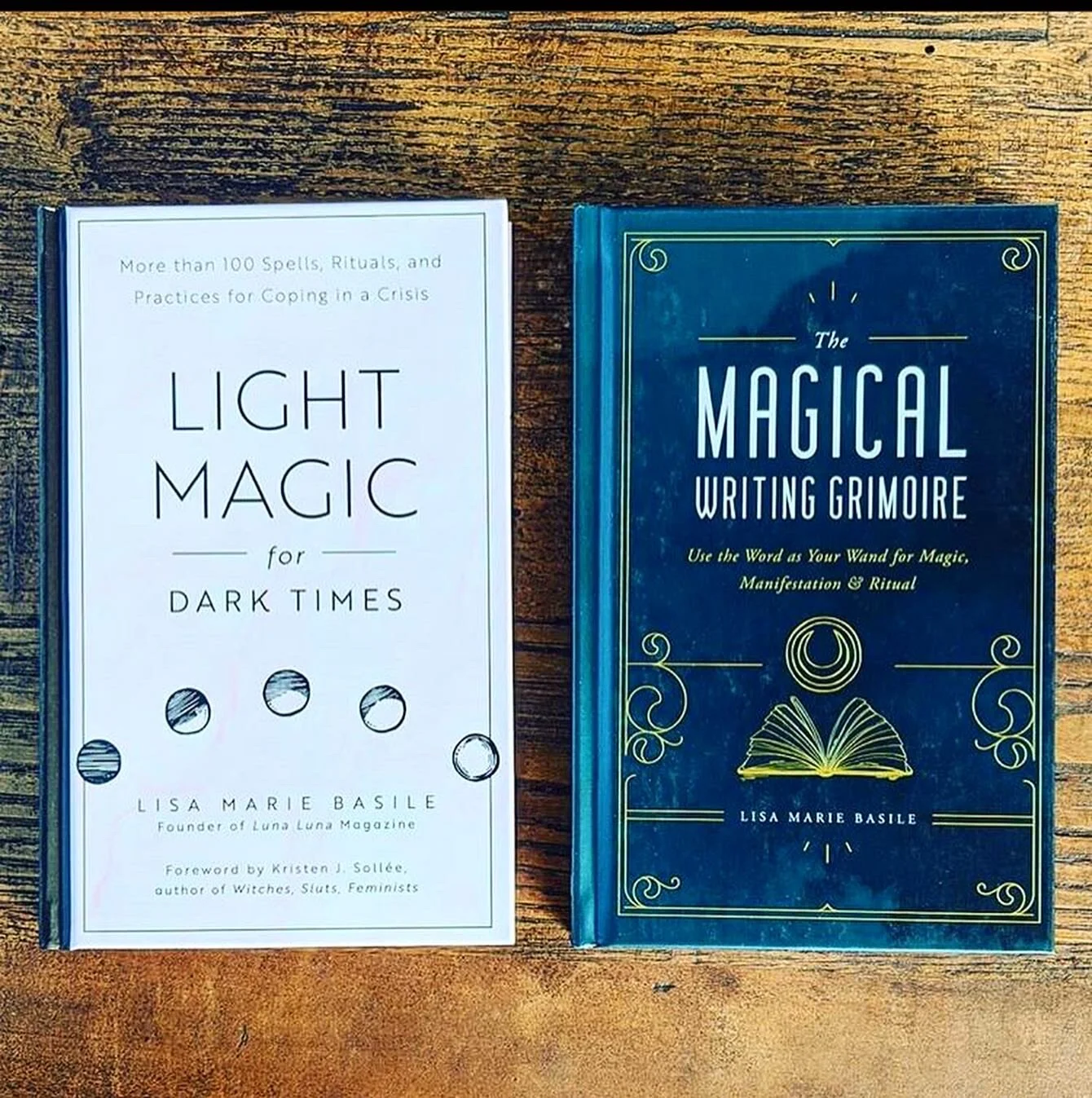
Prior to COVID-19, I’d been dealing with the aftershocks of a year of death (2017) that forever changed me. It pushed me to explore and meditate on grief and loss, and I’ve deeply integrated that into my writing. I still have fewer answers and more questions. I still hurt. In my poetry and in my nonfiction books, including Light Magic for Dark Times and The Magical Writing Grimoire, I offer grief rituals.

There is no way to skip over or lessen the impact of grief. Truly. The only way out is through, I believe now. More so, both ritual and journaling aren’t solutions or cures or magic elixirs for the sludge of grief. The sting of loss is part of the condition of being alive, and you may mourn hard for a lifetime. But there are small things we can do that can help us navigate our pain, find clarity, and work toward a semblance of closure or a space of finality — and science tells us that writing about grief works for many people (although it’s not a replacement for therapy).

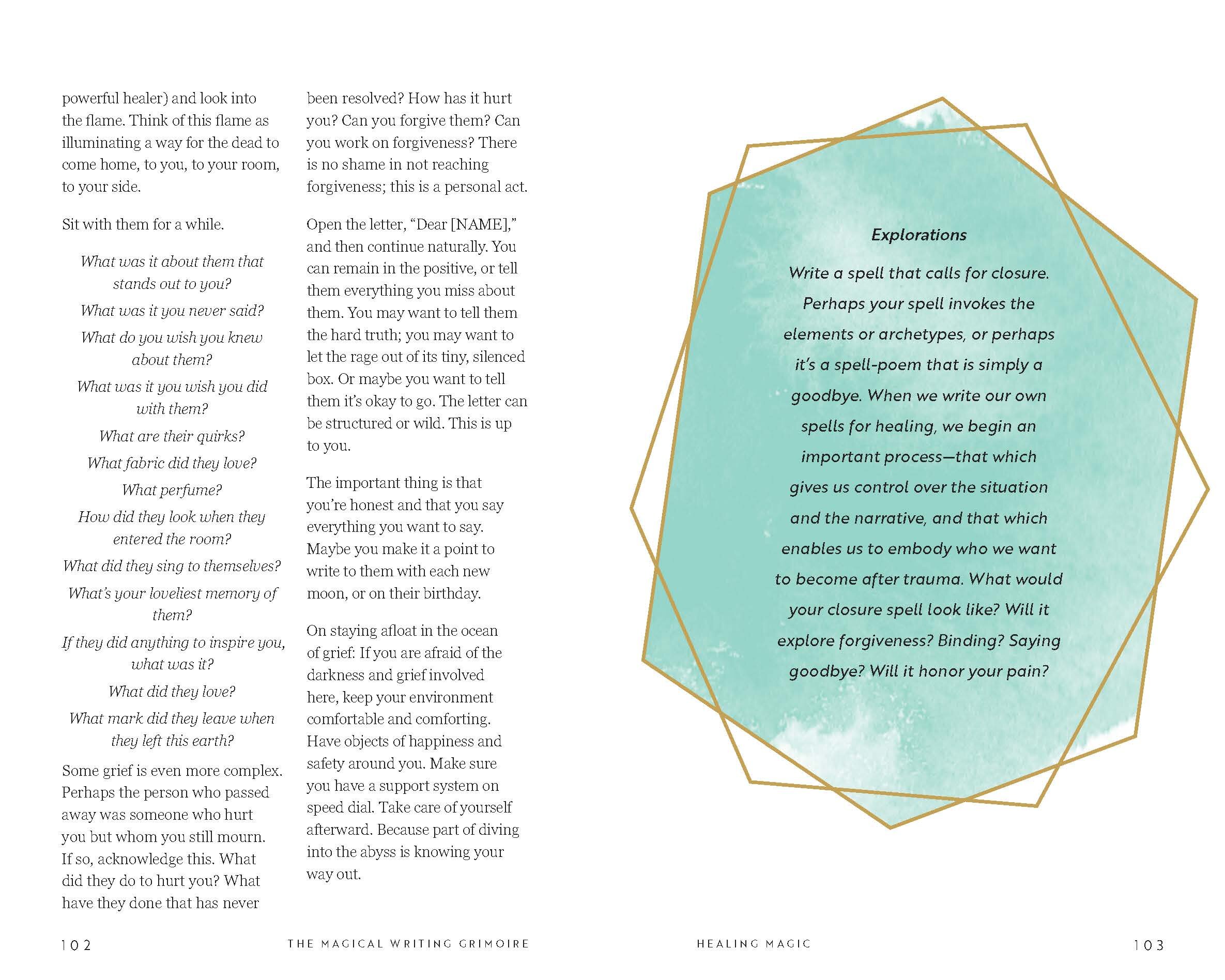
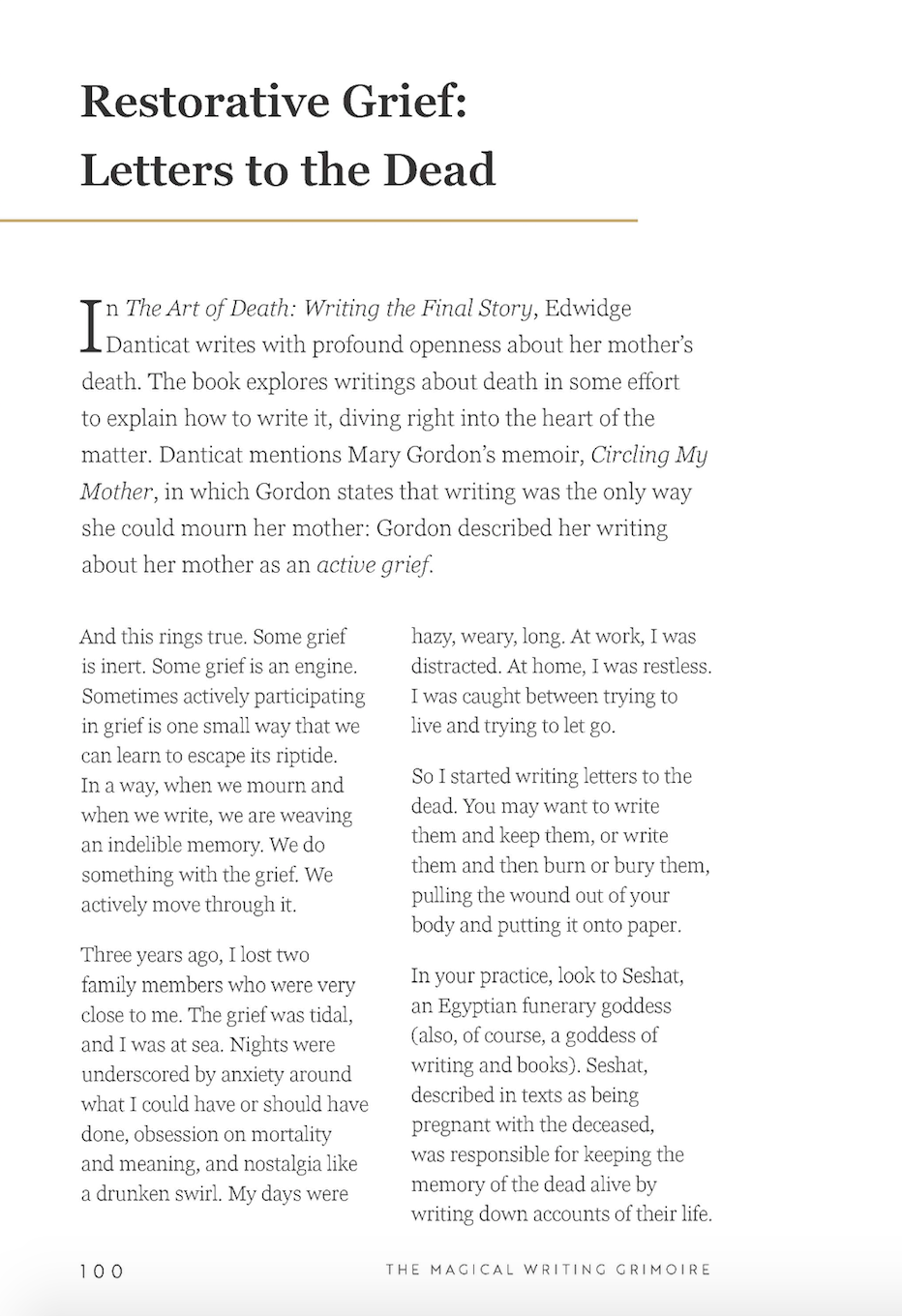
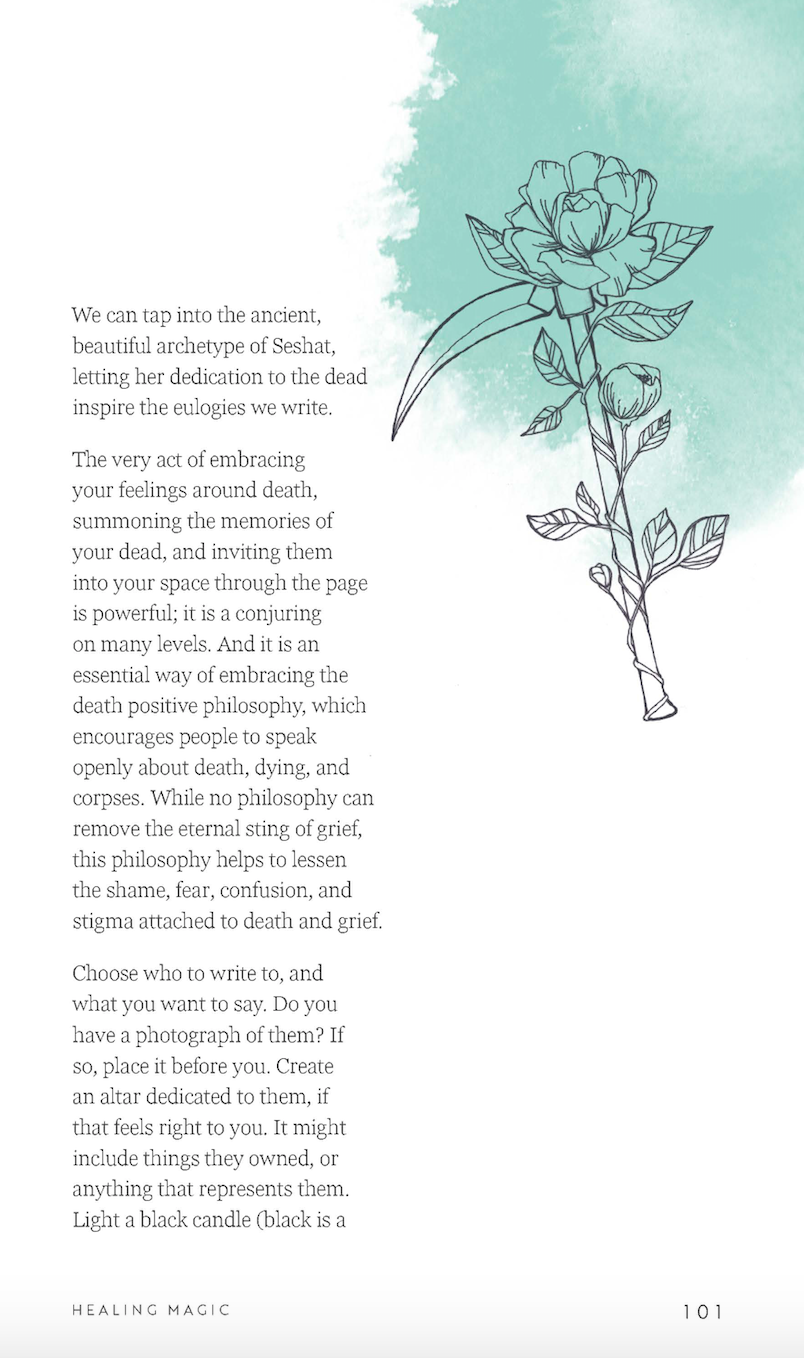
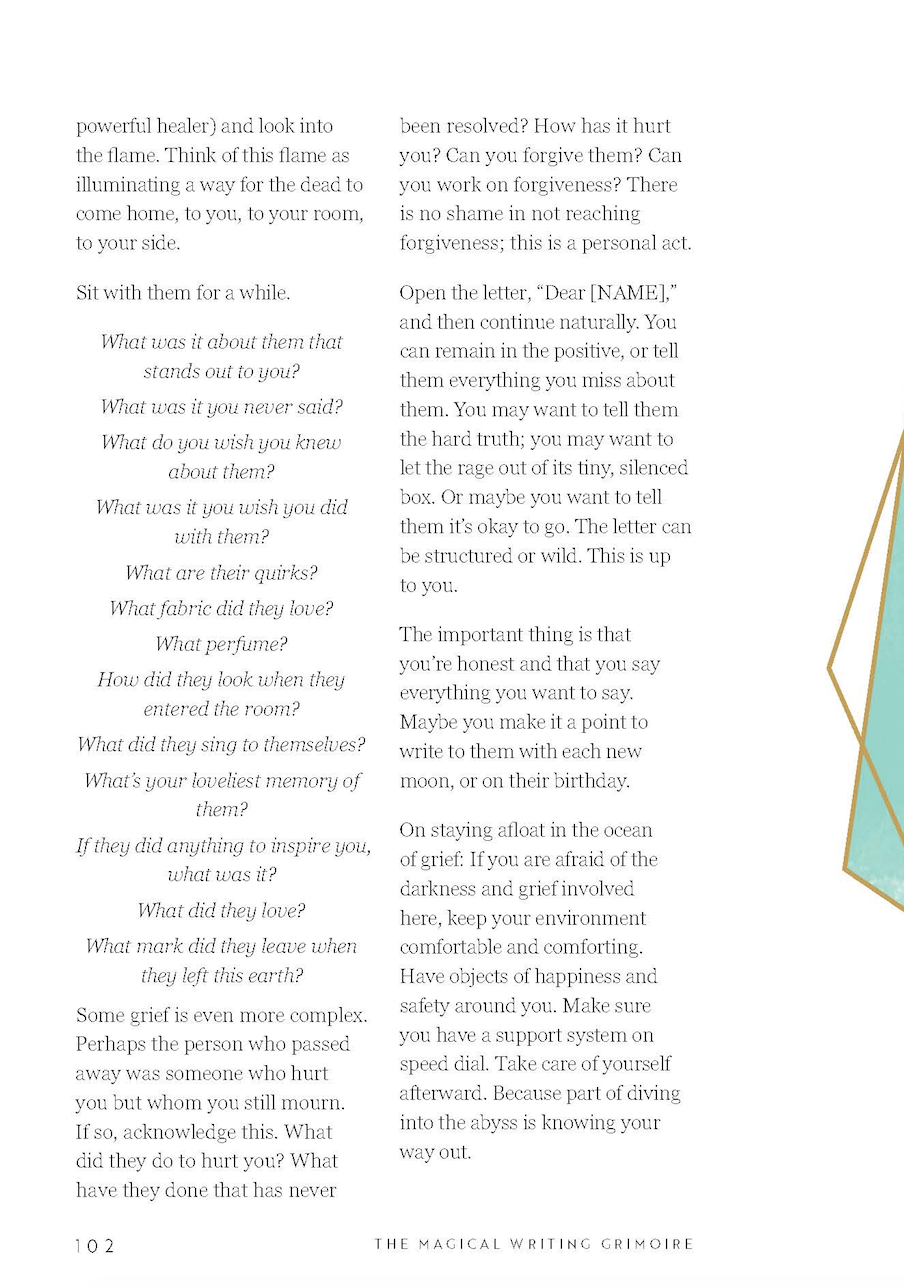
For this reason, I’ve included a ritual — Restorative Grief: Letters to the Dead — from my book, The Magical Writing Grimoire below. Maybe you’ll use it for someone you’ve lost in the past, or perhaps you’ll write a letter to the collective dead, to the many who have lost their lives in your city or community. Whatever you use it for, I hope it helps you find some stability and insight.

Below, I’ve included the original text for the ritual, along with the final pages from my book. Feel free to share and copy/download them.

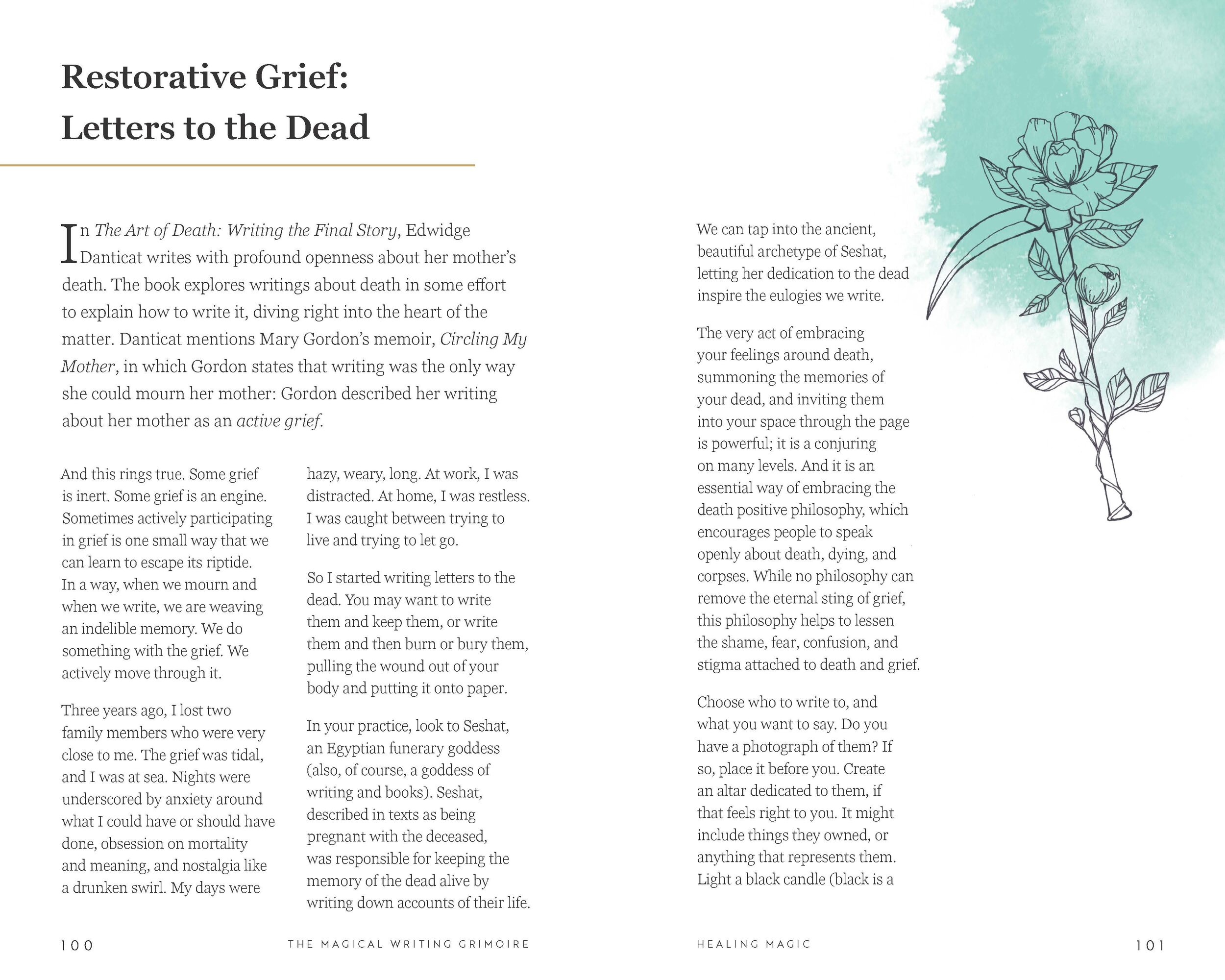
Restorative Grief: Letters to the Dead

InThe Art of Death: Writing the Final Story, Edwidge Danticat writes with profound openness about her mother’s death. The book explores writings about death in some effort to explain how to write it, diving right into the heart of the matter. Danticat mentions Mary Gordon’s memoir, Circling My Mother, in which Gordon states that writing was the only way she could mourn her mother. Gordon described her writing about her month as an active grief.

And this rings true. Some grief is inert. Some grief is an engine. Sometimes actively participating in grief is one small way that we can learn to escape its riptide. In a way, when we mourn and when we write, we are weaving an indelible memory. We do something with the grief. We actively move through it. 

Three years ago, I lost two family members who were very close to me. The grief was tidal, and I was at sea. Nights were underscored by anxiety around what I could have or should have done, obsession on mortality and meaning, and nostalgia like a drunken swirl. My days were hazy, weary, long. At work, I was distracted. At home, I was restless. I was caught between trying to live and trying to let go.

Grief is a sickness that grows without a cure. It affects more than the body, more than the mind. It affects the essence of us, our starstuff, our souls, our hearts, our energy. It metastasizes over a lifetime, and with each new death, it takes a new organ. 

So I started writing letters to the dead. You may want to write them and keep them or write them and then burn or bury them, be pulling the wound out of your body, and putting it onto paper.

I like to look to Seshat, an Egyptian funerary goddess (also, of course, a goddess of writing and books). Seshat, described in texts as being pregnant with the deceased, was responsible for keeping the memory of the dead alive by writing down accounts of their life. We can tap into the ancient, beautiful archetype of Seshat, letting her dedication to the dead inspire the eulogies we write.

The very act of embracing your feelings around death, summoning the memories of your dead, and inviting them into your space through the page is powerful; it is a conjuring on many levels. And it is an essential way of embracing the death positive philosophy, which encourages people to speak openly about death, dying, and corpses. While no philosophy can remove the eternal sting of grief, this philosophy helps to lessen the shame, fear, confusion, and stigma attached to death and grief.

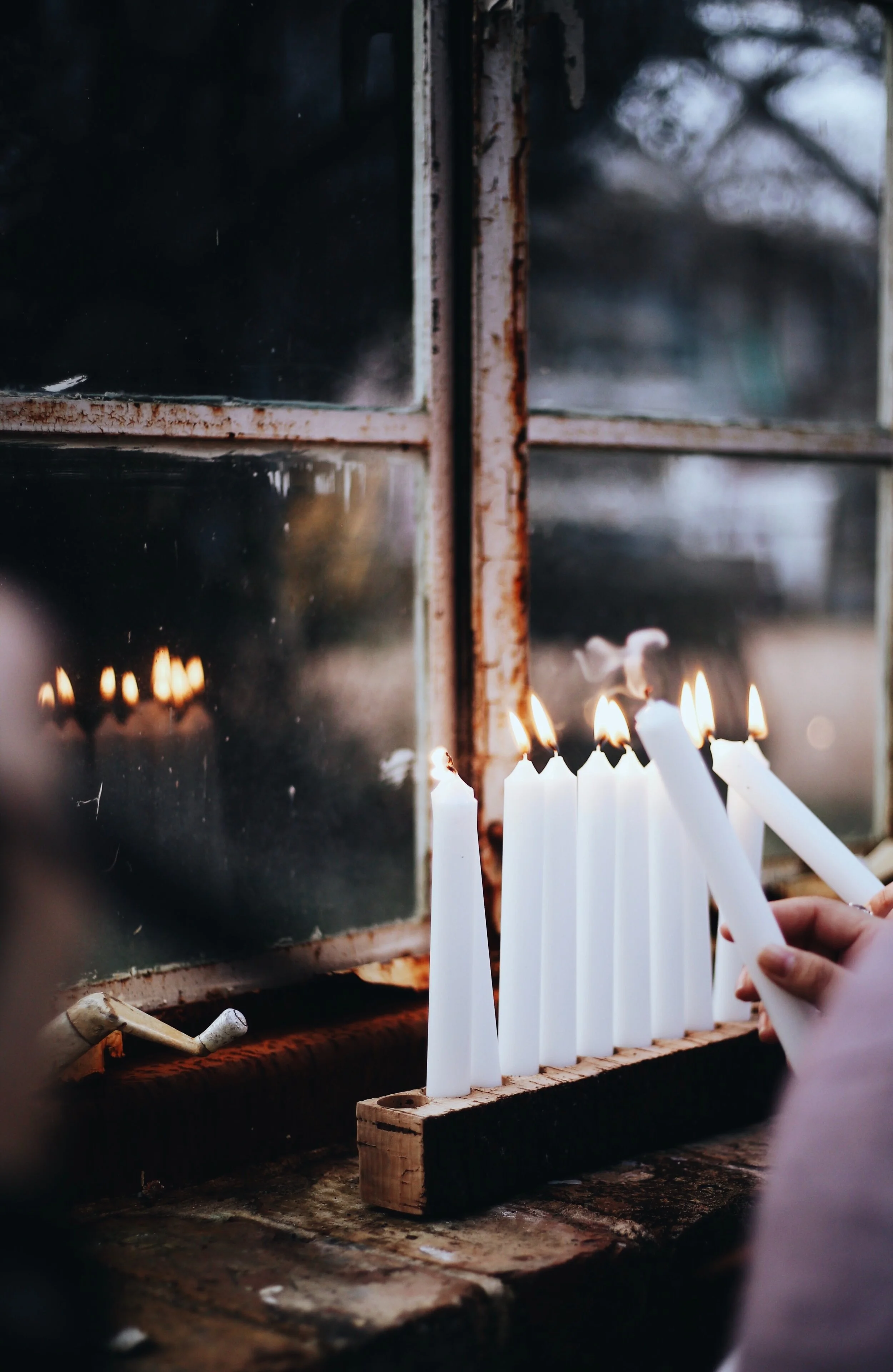
Choose who to write to, and what you want to say. Do you have a photograph of them? If so, place it before you. Create an altar dedicated to them, if that feels right to you. It might include things they owned, or anything that represents them. Light a black candle (black is a powerful healer) and look into the flame. Think of this flame as illuminating a way for the dead to come home, to you, to your room, to your side.

Sit with them for a while. 

What was it about them that stands out to you? What was it you never said? What do you wish you knew about them? What was it you wish you did with them? What are their quirks? What fabric did they love? What perfume? How did they look when they entered the room? What did they sing to themselves? What’s your loveliest memory of them? If they did anything to inspire you, what was it? What did they love? What mark did they leave when they left this earth? 

Some grief is even more complex. Perhaps the person who passed away was someone who hurt you but whom you still mourn. If so, acknowledge this. What did they do to hurt you? What have they done that has never been resolved? How has it hurt you? Can you forgive them? Can you work on forgiveness? There is no shame in not reaching forgiveness; this is a personal act. 

Open the letter, “Dear [NAME],” and then continue naturally. You can remain in the positive, or tell them everything you miss about them. You may want to tell them the hard truth; you may want to let the rage out of its tiny, silenced box. Or maybe you want to tell them it’s okay to go. Perhaps they felt they had to stay? Perhaps they suffered? Maybe you simply want to know what it’s like to be dead. The letter can be structured or wild. This is up to you.

The important thing is that you’re honest and that you say everything you want to say. Maybe you make it a point to write to them with each new moon, or on their birthday.

On staying afloat in the ocean of grief: If you are afraid of the darkness and grief involved here, keep your environment comfortable and comforting. Have objects of happiness and safety around you. Make sure you have a support system on speed dial. Take care of yourself afterward. Because part of diving into the abyss is knowing your way out.

A prompt

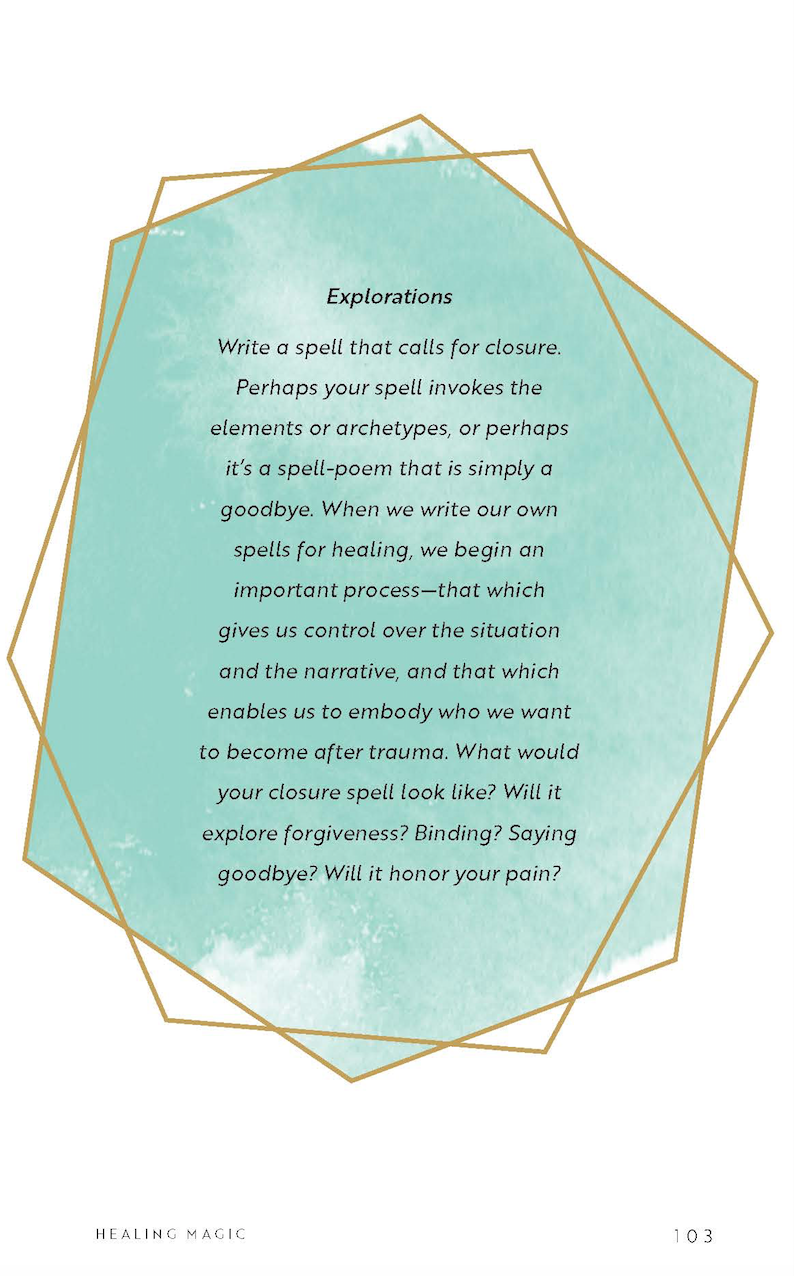
Write a spell that calls for closure. Perhaps your spell invokes the elements or archetypes, or perhaps it’s a spell-poem that is simply a goodbye. When we write our own spells for healing, we begin an important process—that which gives us control over the situation and the narrative, and that which enables us to embody who we want to become after trauma. What would your closure spell look like? Will it explore forgiveness? Binding? Saying goodbye? Will it honor your pain?

Feel free to download the keep the following pages:
Restorative Grief_Page_1.jpg
Restorative Grief_Page_2 (1).jpg
Screen Shot 2020-04-22 at 3.13.25 PM.png
Screen Shot 2020-04-22 at 3.13.33 PM.png
Screen Shot 2020-04-22 at 3.14.23 PM.png
Screen Shot 2020-04-22 at 3.14.33 PM.png
In Occult, Books Tags death, grief, Rituals, Ritual, the magical writing grimoire, light magic for dark times, lisa marie basile, grief rituals, healing, loss, covid-19, coronavirus
Comment
Photo by Estée Janssens

Ritual: Writing Letters To Your Self — On Anais Nin, Journaling, and Healing

January 31, 2019

BY LISA MARIE BASILE

During my mid-20s, I first delved deeply into the work of the writer Anaïs Nin. Before then, I’d read bits and pieces of her work—always knowing that I would, when ready, return to it. As it is with most of the great works of our lives, she found me when the time was right, when I could incubate her emotion and resuscitate myself through her abundance. I was always too guarded, too busy, too scattered to sit down and let the velvety intensity of her work move through me.

This is because Nin’s work is audaciously honest. It is at once shadowy and nude. Erotic. Wild. Feverishly introspective. Showy. Always vulnerable.

You may have read her diaries or her letters to Henry Miller. Within these works lives a whole entire world of expression and bravery (and ego and mania and trauma and desire and more). In the 1940s, she was writing explicitly about topics such as sexual desire and abortion—words that were kept silent, for they were unthinkable, punishable. She was widely mocked, often deplored by critics for both her personal life (she—gasp!—had two husbands) and her literary works—and yet she has earned her place as the literary patron saint we adore now. (She would be so pleased). Over time (and largely posthumously), as time is wont to do, she has become both a feminist icon and a literary muse. She’s certainly my literary witch archetype.

Anais Nin writes to Henry Miller in A Literate Passion: Letters of Anaïs Nin Henry Miller, 1932-1953,

“It is true that I create over and over again the same difficulties for myself in order to struggle over and over again to master them [but] to continually struggle against the same problem and to continually fail to dominate it brings a feeling of frustration and a kind of paralysis. What is necessary to life, to livingness, is to move on, in other words to move from one kind of problem to another.”


Reading her works, I have always wondered: How did writing her feelings and desires and fears in letter or diary form change her relationship to those feelings? Without writing all of this down, would she have realized her tendencies toward creating difficulties for herself?

View this post on Instagram

🖤 I talked with the wonderful @ragqueenperiodical + @kaileytedesco about how light and darkness is the throughline in all of my work, including my forthcoming book and my poetry and other work: “The grimoire is concerned with the same things as my work as a poet and essayist: death, forgiveness, the self as something to be worshipped, sex, creating beauty and honoring the shadow.” LINK IN BIO.🖤 #LightMagicDarkTimes

A post shared by Lisa Marie Basile (@lisamariebasile) on May 19, 2018 at 10:20am PDT

Is there a certain quality to letter writing or diary keeping that inspires the confessional? I believe so. Our words are our magic. Once the words are thought, intent exists.

Once the words are spoken, they become an incantation. And once the words are written down, the spell is cast.

The truth is staring back at you—asking you to make a change or bury it or let it go. Whatever it is, the garden has begun to grow, and it must be tended to in some way or other.

That’s the silent promise you make to the page and to yourself; when you write, your mind floods and you become a vessel for the truth (or whatever version of the truth needs to exist at that moment).

The mind is the translator, the page is the vehicle, and something more intangible — something divine, the self everlasting, perhaps the soul — is the ultimate recipient. That something changes you and upends your reality.

When we write specifically for the page, or for one reader, we wield a massive responsibility to uphold a deep truth.

We stop writing for success or Instagram likes or money. We start to write for ourselves, or for the intimacy between ourselves and the reader. This is the case even if the letter will never be delivered (that’s not to say Nin wasn’t ecstatic when her personal journals became a best seller de rigeuer).

Only after reading your own words do you discover patterns and themes that perhaps you would have missed in your everyday life. In letter writing, there is a vulnerability that takes place necessarily; why write a letter if you won’t show up for it?

Why express anything at all—in such a delicate, deliberate, and painstaking manner? After all, a letter is not a passing thought or a forgettable text message; it’s a statement, a declaration, a confession. It’s a storm.

Ritualizing your words

For this ritual and writing prompt, you will be examining the inherent power of letter writing—as a tool for reconciliation, healing, closure, acceptance, and honor. But you can also write letters to express rage, jealousy, and fear.

It can feel as though we’ve lived many lifetimes. To prep, think on your childhood, your teen years, and who you are now. What was lost? What remains? Who we are now has changed so much from who we were. At the same time, there are things that having a lasting impact, good and bad. Ghosts linger. Sometimes that ghost is you.

Our traumas, our growth, our pain, our losses, our loves, our whimsies, our accomplishments—these are the things we’ll be writing to in this practice.

I have written letters to the girl I was at 15. She was so lost, so sad. She moved from homeless shelter to shelter, to a foster home and then another — always looking for an anchor. Within her heart lived thousand hopes and goals. She was excited to write, to study, to live—and yet always felt held back by a need to survive her trauma. She couldn’t simply be, as she was struggling. In her, a darkness grew.

That darkness was her fuel, but it also hurt her. She had self-esteem issues, felt alone often, felt unworthy. In my letters to her, I tell her what she’s accomplished—what her steadfast determination did for her. I tell her what her pain gave her—art! Empathy! A softness. An ability to adapt. A leaning-into the malleable, the liminal. Through her pain she found magic and ritual and poetry, and all of this carved a life she’d love today.

Writing these letters to her allowed me to heal her, and as a ripple in space-time, I largely healed myself today. I am not perfect, but I am better.

The Ritual: writing a letter to your younger self

View this post on Instagram

🌻I included a few peeks inside my book Light Magic for Dark Times over at @lunalunamag - lunalunamagazine.com. It’s full of rituals, practices and writing exercises and it’s all about resilience, self-care, trauma recovery, accountability and magic. 🌻

A post shared by Lisa Marie Basile (@lisamariebasile) on Jan 29, 2019 at 1:22pm PST

Light a candle. Look into the flame and take note of what thoughts arise when you think upon your younger self.

As you look at the flame, conjure the person you were. Quietly welcome them into the room; sit with them. What are they wearing? What are they feeling?

Choose a memory or a era in your life and write a letter to yourself. What’s the goal? Is it to remind your younger self of the love they have but never felt? Is it to congratulate them on their resilience? Is it to say that their weakness and struggles were beautiful? Perhaps you will pull a tarot card to find illumination or specificity in this process. Perhaps you will think on how your birth chart influenced the person you were.

Life goes by so quickly. We are so busy existing in the middle of it that we rarely look back and study what happened:

What went right?

What went wrong?

What just was?

What would you tell your younger self?

What does the room look like?

What were you wearing?

What do you want them to know?

What do you want them to let go of?

Write all of this down.

Honor it.

Keep it in a place where you can let it go, or return to it.

If you want to work more with journaling magic, I include lots of it in my book, Light Magic for Dark Times. & follow me on Instagram for more prompts and literary goodness.


Lisa Marie Basile is the founding creative director of Luna Luna Magazine—a digital diary of literature, magical living and idea. She is the author of "Light Magic for Dark Times," a modern collection of inspired rituals and daily practices. She's also the author of a few poetry collections, including 2018's "Nympholepsy." Her work encounters the intersection of ritual, wellness, chronic illness, overcoming trauma, and creativity, and she has written for The New York Times, Narratively, Sabat Magazine, Healthline, The Establishment, Refinery 29, Bust, Hello Giggles, and more. Her work can be seen in Best Small Fictions, Best American Experimental Writing, and several other anthologies. Lisa Marie earned a Masters degree in Writing from The New School and studied literature and psychology as an undergraduate at Pace University.

In Occult, Books Tags Anais Nin, Journaling, Healing, Writing, Diary, Henry Miller, Ritual
1 Comment
Image taken from Wolves of Mercy Falls

Image taken from Wolves of Mercy Falls

4 Dreamy Stones To Keep By Your Bedside

March 22, 2018

It is perhaps the most simple part of my nightly routine. These little stones just sit there on my nightstand, exuding their beauty and tiny imperfections, and that is where they stay. Thier role is just to rest there beside me. Yet, their simple presence is so meaningful to the ritual as a whole...the only one I can seem to keep on a regular basis.    

Read More
In Occult Tags Stones, Ritual, Trista Edwards, self-care
Comment
Oscar Keys via Unsplash

Oscar Keys via Unsplash

Body Ritual: Gratitude Magic

February 16, 2018

BY LISA MARIE BASILE

Body Ritual is Lisa Marie Basile's weekly column about wellness and finding healing and autonomy in ritual. You can follow her
 on Instagram for more on this topic. You can read the first installment, on Chronic Illness, here.

One of the things I’ve learned to accept about having a degenerative chronic illness is that I’ll always feel slightly different. You may feel this too, especially when subject to the stigma of being ill or dealing with friends, family, employers or lawmakers who don’t get it.

This is also true for anyone who has suffered some sort of body trauma, whether it is an illness or an accident or something else that happened to you. We have to manage the huge spectrum of emotion that comes along with it, be it emotional or physical. We have this animal inside of us, this strange galloping creature who wants to get out and trample the garden and go wild. That same creature is also sometimes left dejected, wandering, wilted. It’s us, and also not us—so how do you manage that? It has feelings you don’t want to have. It has needs you don't have the energy to meet. 

But it also has powers you can tap into.

I wrote in my piece, Body Ritual: 12 Things I Learned About Chronic Illness piece, that feelings around the body aren’t fixed, objective or, at times, rational. But that’s to be expected—we live in these houses for our entire lives, they’re our shells, they’re the place we retreat.

That difference — the feeling of not-quite-ness, or slightly gone-bad, overripe, like a little a sachet of broken bones, like being burdened with the weight of messy genetics and ancestral trauma—is also the very core of magic, at least to me. It’s where we hold those most intense energies and feelings that can be transmuted and transformed.

Those feelings might be anger, shame, exhaustion, rage. All of them, no matter your experience, take up a huge amount of psychic space, gnawing away at your foundation—even if others can’t see. Those energies are seriously powerful, like Hecate at the gate-powerful, like the storm at sea powerful. Use them. It’s free!

Magic is the ability to direct energy, put simply. That concept is simple enough for anyone, witch or not, atheist or not, to put to use. It’s that invisible something that happens when we decide to effect change. With our will and intention, with the energy we put out and direct.

When I’m feeling overwhelmed about my illness, I try and redirect body negativity into body love, gratitude and empowerment. I won’t lie and say YAY GUYS IT ALWAYS WORKS but it does work a lot of the time. And a lot of the time it works with a bit of a magical touch.

Recognize & speak out against ableism

The first problem with how we talk about bodies is that we often insert ableism into the picture. We talk about bodies like they’re all the same, capable of the same things. They’re not. And recognizing and respecting your body and body experience as one notch on the spectrum is key—just as key as recognizing others' experiences.

You also may be chronically ill but able-bodied, and if that's the case, recognize it and fight against ableism for others. Erasing ableism from your vocabulary and mindset will allow you to better support others. Because people suffer, are sick, have disabilities, and are often made to feel alone because of this, gratitude doesn’t have to stop at gratitude. You can support others by listening to them, loudly advocating for their cause, donating your time to them or an organization, and developing ways to include them in the larger conversation. There’s magic in empathy.

Read more about ableism and disability here, by Alaina Leary and watch this video about witchcraft and disability right here. 

Spend time practicing gratitude for yourself

I didn’t say “feeling” or “being grateful”—and that’s because it takes practice! Sometimes I like to jot down a few positive aesthetic and also functional things I feel about my body in a day: my thick wavy hair that I got from my Mediterranean family, my newly-formed quad muscles (from swimming), my strong biceps, my crooked teeth—I think they’re cute, and the way my body feels after stretching. I am grateful I can move, have a full range of mobility (one day I could be disabled due to my illness), and that my pain levels are somewhat manageable. I like to focus on those things and remember them when times get tough. 

What do you like about yourself? Is it your resiliency? Your endless compassion for others? Your desire to eat healthy and stay fit? Do you try to walk for an hour every day? Do you love your sense of style? Find something, remember it. 

Make an altar for your body

Use pictures of yourself as a centerpiece, decorate with pieces of clothing, makeup you use, your oils or perfumes—and light a few candles. Write a letter to yourself and leave it the altar. You’d be surprised by the fulfilling experience of ritualizing self care. Here's a piece I wrote about creating an altar for self-care and setting intentions. 

Train yourself to look at the positive

When you get down and start feeling powerless, reroute your mentality in the moment: “what can I do?” (Versus “what can’t I do?” The 100%-serious reality here is that this won’t magically fix anything, but it will get you into the habit of self empowerment. If we have to live with body trauma or illness, learning to manage it is key.

Tap into your needs

Let yourself have what you need—at least some of the time. Rest of you need rest. Go out if you feel like you’re itching for a party. Stretch it you’re knitted up. See a doctor when you know need help. Use complementary therapies if your gut is telling you to try them.

Take a magical bath

One of the rituals I wrote about in my book, Light Magic for Dark Times (September 2018, Quarto Books) I do when I’m feeling stuck—afraid, powerless, rigidly tied down to my illness—is I get in the bathtub, maybe with a few crystals (I have a love for rose quartz; it feels so soft and pure and kind, and for smoky quartz because it is a great facilitator of wading between the darkness and the light), some Epsom salts and essential oils, and a few candles, and I just conjure the archetype of a mermaid or a sea creature—their fluid bodies, their knowledge of the depths, their ability to move between coral and wild sea flowers and threats. I like to imagine all my worries and pain as a small black ball; then I close my eyes and focus on it dissipating, floating away. It’s not easy, weirdly enough, to visualize. It’s difficult. But when you do, it’s incredibly empowering to feel yourself letting it go, and to focus on being cleansed by the water.

Shadow work

Another practice that I love but would not necessarily recommend for everyone (just because it may not resonate in a healthy way for certain folks) is visiting a cemetery—especially if you have family there. Connecting with death, being still and silent with the tombstones, is not only death-positive, helping you to reframe your experience and perception of death, but magical; you are there, with the earth, standing in a place that is the very representation of the natural human cycle. There is a realization that we all die, but that right now we are alive and living and experiencing and capable in whatever way we are capable. There is a beautiful sense of gratitude to be found here. 

I say this is a way of performing shadow work because it is an experience that forces you to go in, go deeper, look into that abyss where you hold the greatest fear and uncertainty—and then sit with that, let it bloom, let it morph into a sort of peace. It can put you at peace with your body, even if it seems, on the surface, morbid.

Remember that your body is you, it is not separate. Treat it, yourself, with love. You’re a body of magic.


LISA MARIE BASILE

Lisa Marie Basile is the founding editor-in-chief and creative director of Luna Luna Magazine and community. She is the author of a few books of poetry, including a full-length collection, Apocryphal. Her book Nympholepsy (co-authored with Alyssa Morhardt-Goldstein), will be published by Inside the Castle in November 2018 and was a finalist in the 2017 Tarpaulin Sky Book Awards. She is also working on her first novella, to be released by Clash Books in 2019. Her first nonfiction book, Light Magic for Dark Times, will be published by Quarto Books in 2018. 

Lisa Marie's work has appeared in the New York Times, Narratively, Refinery 29, Greatist, Bust, Bustle, Marie Claire, The Establishment, Hello Giggles, Ravishly, Marie Claire, and more. You can catch her on the podcasts Into the Dark, Essie's Hour of Love, and Get Lit With Leza. She recently received two Pushcart nominations—for her work in Narratively and The Account. She received an MFA from The New School in NYC. 

In Occult Tags ableism, Chronic Illness, disability, ankylosing spondylitis, Body Ritual, Ritual
Comment
photograph by Gary Kenney  

photograph by Gary Kenney  

Let This Scorpio Walk You Through Scorpio Season

October 31, 2017

BY LISA MARIE BASILE

I don’t care whether you believe it or not, the Scorpio exists. If it’s not a personality carved out by the celestial, then it is most certainly an archetype born out of real-life human beings, the kind—like me—that drinks, breathes and moves about attached to some chthonic place. We are the people who were born rummaging through the dark. We were the kids who weren’t like the others. We were the adults who realized our strangeness is actually power. Grew into our wings.

Scorpios, I’m talking to you here—but if you love someone who is a Scorp, it’ll benefit you too: It is like we cipher what we need from the darkness just in order to make it through the day. It could be that we drain a crowd of its mass energy—taking just a little bit from you there, and you there, and you over there so that no one aches for what went missing, or it could be that we consistently keep one foot in the otherworld, always dreaming, always obsessing, always plotting. It could be that we expertly speak the language of endings. Because we know endings mean something comes next.

Ruled by Pluto, lorded over by death and sex, we are intrinsically linked to the body—the body as sigil, the body as engine, the body as an immutable thing, and, of course, the body as a thing with an end-date. We can’t seem to ever really live here, on earth, in our town, in our houses, in our workplaces—because a part of us always off somewhere bent over in a corner, meddling, whispering, hiding, licking our wounds, or opening them.

Sure, for the secular among us, it could be that the zodiac is nothing more than a tool for suggestion. Like some view Tarot, for example, astrology provides a map for meditation—rather than being a stone-cold, steadfast, set-in-stone reality. (I mean, hello, "13 signs"—no Scorpio is going to fucking budge, no way). When you’re a scorp, you know it. It’s not like the Aquarius who says "Yes, I am eclectic!" or the Leo who chants, "Look upon me!" Or even the dreamy Pisces, who, like the three water signs (Scorp included) is also always attached to otherworlds. A Scorp is a Scorpio is a Scorpia. Even if you don’t want to be a Scorpio anymore, you’re stuck with us. Trying to hide it is akin to being drunk. You might be able to get around, but you’ll never feel quite right.

Scorp might even influence you if it’s in your chart or, say, your moon sign. Either way you know it. You can feel its pincer spread inside you. You can feel its poison push through you whether you want it or not. When Scorp  has you, she has you. I can’t tell you differently. 

So brings us to Halloween season—scorpio season. This time of year has always been magical for me (surprise, surprise). I was born November 3—right after all the beautiful festivities honoring the dead (were I to be a Halloween child, well, I curse the universe for failing me…). I’ve always felt most alive now, and with all the talk of Scorpio season, I feel at home, like I’m understood, like I’m seen—not just banished to the shadows of scorn and sex and wound and water and darkness.

But the scorpio is more than Scorpio season. And we’re more than the qualities we’re usually defined by. As sexy and intimidating and intoxicating as we seem, I believe that Scorp is, in equal measure, made from darkness and light. Capable of immense transformation and instrospection, this sign—and its wild season—is a time when we can confront the shadow and find good it in. Find a home in it. Become comfortable with our discomforts. Especially around loss, grief, fear, body, desires, and identity. Do not worry that this season will bring out your ghosts and leave you scared and haunted and overwhelmed—because you can harness all of that and use it to your benefit. (And just think: For some of us, it’s always Scorpio Season. If you don’t live in this place in perpetuity, consider yourself, well, lucky?). 

But for just this season, transient and ending, you can indulge.

Some of the indulgence tips I include below are therapeutic in a very DIY way. I encourage you to seek professional help if you feel you need it, though. Working through your pain or grief on your own is one thing, but if you feel you need help, do ask for it. The Scorpio would want you to be good to yourself, even if she doesn’t always express it.

Here are some ways Scorpio Season can be curative—if you work it, rather than fear it.

1.Keep a shadow journal.

Here is where you’ll write down all those secrets, all those fears, all that loss, all those people you miss, all that pain. You want it out, and down. You want to sit with it, read it, accept it, and know that these secrets are safe (the scorpio is very secretive, which can make her sick). But mostly, being able to feel a little more comfortable with your wounds can actually lessen their sting.

2. Power your transformation.

If you want to be the person who stops showing up late, or the person who finally lets himself feel loved, or the person who wants to speak up when you think you ought to, scorpio season is the time to make those efforts. With scorpio’s intense transformative powers, this is the time to apply all that energy. You might here of scorpio’s death wish, but really it’s the fact that scorpio feels the need to transmorph, to kill a part of themselves off (give birth to another) and send it to the grave. 

3. Talk to the dead.

Scorpio is the sign of the dead, sure. We all know that. And while that might mean Scorpios are busy walking that liminal space, it doesn’t mean you can’t join them. Whether the veils are literally or metaphorically open—because many people and Scorps are secular and don’t really believe this season is really a time of spirits—it’s still a good time to meet grief head-on. (Again, see note above around seeking professional help if you can’t move through grief on your own).

I like to write letters to my dead, sometimes I like to bury those letters, and sometimes I like to visit those graves or places where the dead are and just talk. I took part in something called Into the Veil a few weeks ago, where I recited poetry in a graveyard. The event was produced by Atlas Obscura, and was a truly death positive evening in that it allowed visitors to discover art and transformative ritual around death. The more we sit with it, the more we acknoelege it, the less power it holds over us—at least that’s the theory. It may be hard to stomach (for me, it was), but being surrounded by all those tombstones meant something: Life regenerates, life moves, life ends, memory lives, memories mean something, and that we ought to to live while we have the chance—live for our loved ones who cannot. Who didn’t get a long enough chance. This scorpio season, sit with the dead, or your dead, and just try to find a way to make peace. It’s probably different for all of us, that way, but it can yield beautiful results.


Lisa Marie Basile is the founding editor-in-chief and creative director of Luna Luna Magazine. She is also the moderator of its digital community.

Her work has appeared in The Establishment, Bustle, entropy, Bust, Hello Giggles, Marie Claire, Good Housekeeping, greatist, Cosmopolitan and The Huffington Post, among other sites. She is the author of Apocryphal (Noctuary Press), war/lock (Hyacinth Girl Press), Andalucia (The Poetry Society of New York) and Triste (Dancing Girl Press). her book, nympholepsy, was a finalist in the 2017 tarpaulin sky book awards.

Her work can be found in PANK, the Tin House blog, The Nervous Breakdown, The Huffington Post, Best American Poetry, PEN American Center, The Atlas Review, and tarpaulin sky, among others. She has taught or spoken at Brooklyn Brainery, Columbia University, New York University and Emerson College. Lisa Marie Basile holds an MFA from The New School. @lisamariebasile

In Confession, Occult, Sex Tags Zodiac, Ritual, Scorpio Season, Death, Scorpio, Atlas obscura, Lisa Marie Basile, Into the veil
Comment
PHOTO CREDT: Recreational Witchcraft

PHOTO CREDT: Recreational Witchcraft

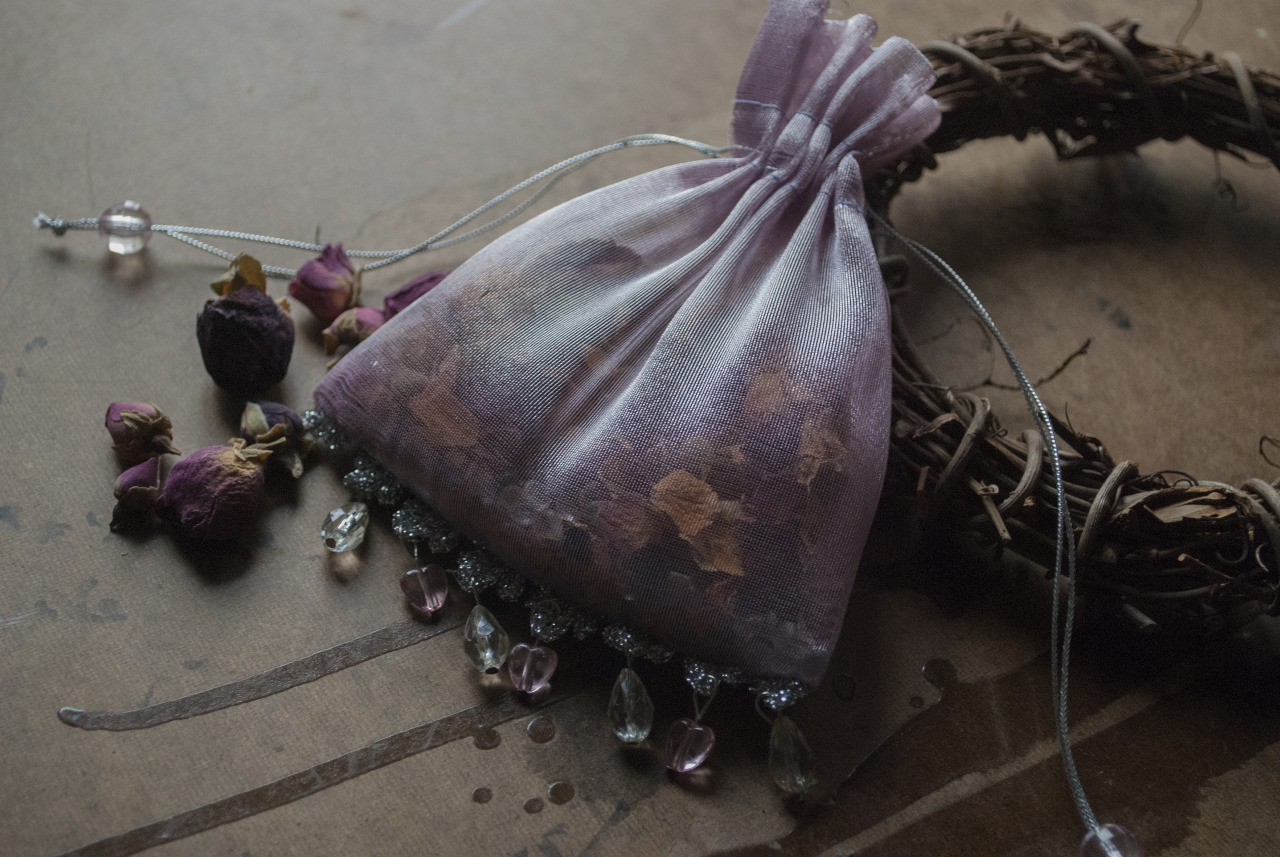
How to Make Magickal Sachets with Herbs

November 28, 2016

Especially now, in the country’s current political climate, real, constructive, and physical action is essential to combating hatred and fighting for civil rights. I do not intend or expect the herbs to carry the work that I must do. In many ways, constructing the sachets serve me in the same way tarot does—as a tool to gain perspective, a new way to see my story, and how situations in my life are operating. 

Read More
In Occult Tags occult, Herbs, Rituals, magick, Ritual
Comment

9 Nature-Centric Summer Solstice Rituals

June 20, 2016

BY LISA MARIE BASILE

[Via IngenueX.com]

Midsummer
(during the summer solstice), is here, you lovelies. This is such a glorious time of year for everyone here in the Northwestern Hemisphere – everything we worked through during the long winter and Spring is now behind us, and we can use the rejuvenating days of summer to prepare, build on or resurrect something – whether that is a material or tangible thing or an idea, mindset or self-healing path. 

This year's strawberry moon (or rose moon, as I prefer calling it) makes Midsummer even more glorious, and even more potent. There are so many things we can do to commemorate this time of year – to tap into nature and yourself. 

Read the 9 rituals here. 

Tags summer solstice, rituals, magic, sun magic, midsummer, Ritual
Comment
via The Darkest Forest

via The Darkest Forest

Cleansing Your Home For The New Year

January 14, 2016

You can bind the herbs as a stick, light the end and then promptly put it out so the end is smoking. The process is called smudging and you direct the stick in all corners of the house. Imagine the negative energy is being blown out of the house. If it’s not to cold throw open the windows and watch the smoke drift out the window. Say some positive words as you do this, either out loud or in your head.

Read More
In Occult Tags Cleansing, Ritual, Macey Lavoie
Comment

The Power Of The Herbal Household

November 1, 2015

BY SOPHIE MOSS

For most of us, the home is our safe haven. It’s the space in which we sleep, create, cook, nurture relationships, create art, celebrate successes, think our most private thoughts and feel our most deepest feelings, and is a space to be honoured. Just as we respect our homes by dusting away dirt and cleaning up messes, it is also helpful to clean away the energies and vibrations that harbour in our homes over time.

To extend the metaphor, there can be little doubt that an untidy, dirty, cluttered house takes its toll on our happiness and wellbeing, leaving us feeling stagnant, unhappy, and unhealthy. The energies that exist in our home are no different: allowing negative, stagnant energies to manifest in our safe, personal spaces can have a detrimental effect on our professional, personal and creative wellbeing, and it is important that we cleanse these spaces of unwanted energies in order to allow us to fulfill our utmost potential.

There are many ways one can cleanse the home, and these can vary from culture to culture, religion to religion. Using herbs, for instance, has played a major role in magick, religion and divination throughout history, and remains one of the most widely used tools for magick and healing today. In old magickal books, elaborate and strange herbal ingredients were often called upon to create a host of recipes and spells, such as adder’s tongue and the heart of a baboon (which are actually just unusual code names for plantain and oil of lily), and herbs have been historically used for homeopathy, natural medicine, and magickal applications such as health, healing and cleansing.

Below, we have created an easy, cost effective, do-it-yourself guide to using herbal magick to cleanse the home of cosmic nasties and invite health, happiness and prosperity into your household.

The Way of Herbs

There is no easier, cheaper and failsafe method of inviting prosperity into the household (and banishing negativity from it) than to use herbal magick, and I am absolutely fascinated with it. For me, there is something so inexplicably comforting and organic about placing one’s trust in the very Earth itself and, in turn, having this trust rewarded with love and protection.

The great thing about using herbal magick is that a) there are so many ways to use herbs, and b) we can use them for so many different purposes:

  • When it comes to inciting general positive vibrations into the home, a really easy way to do this is to incorporate herbal magick into your household decor. Buying small pouches or sachets from the store and filling them with different herbs, for example, is an easy way to not only spruce up the come with kitsch decor, but also to incite positive vibrations and a host of positive magical properties.

  • Hang a sachet filled with chamomile flowers from the doorknob in your bedroom to calm the nerves and promote natural sleep, or place a chestnut in the corner of your bedside table to bring love and peace into the bedroom. Similarly, you can sprinkle cumin seeds into a pouch and hang it from the doorknob of your kitchen cupboard as a general home blessing.

  • An interesting way to incorporate herbal magick into your household and inspire positive, protective vibrations is via a locket. Sprinkle fennel seeds into a locket and hang from your bedpost, nightstand, or even your jewelry stand to bring protection, purification, healing, passion, courage and strength. Alternatively, wear it around your neck and carry the good energies with you.

  • Sprinkle allspice in all four corners of the home, or burn it as incense. It is thought to attract success in both personal and business life.

  • After going through a difficult break up, moving into a new property, or embarking on a new venture, it is important to rebalance and realign the energies in a household, and an efficient way to do this is by performing a sage cleansing ritual. To perform this, purchase a sage smudge stick (I typically buy mine from natural food or new age stores) and set it over a flame-resistant bowl. With every window and door in the house open, light the stick, blow it out and watch as it begins to smoke. Visualising your intention, wave the stick gently and watch as the smoke glides through the room. As the smoke ghosts towards the far corners of the room… along the ceiling… around the windows… up the fireplace… imagine it absorbing the negativity, toxicity and harmful energies from the space, taking any cosmic nasties with it as it dissipates out the open windows. When you have cleansed each room of the house, extinguish the sage smudge stick and discard.

  • Research the different properties of different herbs, and see which ones are relevant to your needs and requirements, using as necessary. Remember, thorough research is absolutely imperative, as some herbs can be toxic once ignited or ingested.

A Magickal Garden  

Indeed, if you are lucky enough to live in an area that affords you garden space (or, even, a window-box on a balcony area), you might want to take advantage of this blessing and plant a garden, grow some herbs, and harvest some plants. However, before jumping right into creating a magickal garden and earning your green thumb status, it is important to keep in mind the general magickal rules for gardening.

In her widely acclaimed book, Solitary Witch: The Ultimate Book of Shadows for the New Generation, magickal practitioner Silver Ravenwolf details a host of astrological rules and considerations for growing a successful magickal garden:

  • When collecting seeds, for instance, it’s better to do so when the moon is full, or in a fire or air sign — Aries, Sagittarius, Leo, Aquarius, Libra or Gemini.

  • If you are growing plants that will produce crops above ground (perfect for those of us who live in apartment buildings), it is important that they are sown the day after the new moon and up until the first quarter.

  • Growing plants that will produce crops below the ground, however, will require plantation during the day after the full moon.

  • When it comes to harvesting, the smallest harvests and fresh flowers needed for immediate ritual (or recreational! Or culinary!) use should be done in the evening, during which time the plants have maximum food reserves. Herbs and flowers that will be dried and preserved should be cut mid-morning, once the morning dew has cleared. Also, it is better to harvest fruit and vegetables during the waning moon, and when the moon is in the barren (or semi-barren) air or fire signs of Aries, Sagittarius, Leo, Aquarius, Libra or Gemini.

  • When cutting flowers, always try and cut the stem at a slant. This way, the stem can continue to absorb water and nutrients.

  • During the Autumn, when the last of the herbs, fruits, and vegetables have been harvested, the last of the dead leaves and plants should be cleared away. It is when the last of the dead plants have been swept that you can perform an Autumn Blessing. To perform this blessing is simple. Firstly, you stand in your garden and ignite a white candle, taking in your surroundings and giving thanks to the year’s harvest. When you feel ready, or when the candle has extinguished, simply bury it somewhere on your property. (Important: please, please take extra care with this if you have animals or small children and bury the candle in a place where children and animals won’t be able to find it. If this isn’t possible, keep it somewhere safe within the household.)

Solitary Witch also contains an incredibly helpful gardening guide to help you with your astrological timings when growing, planting or harvesting, such as being careful to plant beans in the second quarter when the moon is in Taurus, and planting house plants in the first quarter when the moon is in Libra, Cancer, Scorpio or Pisces. Seriously, that book is 590 pages of pure magickal wisdom.


Sophie E. Moss is a dark witch & literary maven. She writes essays for LunaLuna and poetry for all the people she used to be. @Sophiedelays

In Occult Tags Herbs, Magic, Witchcraft, Ritual, ritual
Comment
Featured
‘in the glitter-open black' — poetry by Fox Henry Frazier
'poet as tarantula,  poem as waste' — poetry by  Ewen Glass
'poet as tarantula, poem as waste' — poetry by Ewen Glass
'Hours rot away in regalia' — poetry by Stephanie Chang
'down down down the hall of mirrors' — poetry by Ronnie K. Stephens
'Grew appendages, clawed towards light' — poetry by Lucie Brooks
'do not be afraid' — poetry by Maia Decker
'The darkened bedroom' — poetry by Jessica Purdy
'I am the body that I am under' — poetry by Jennifer MacBain-Stephens
instagram

COPYRIGHT LUNA LUNA MAGAZINE 2025