










• Home
  • indulge
  • new poetry
    • About Luna Luna
    • resources
    • search
  • editor
  • dark hour
  • submit
Menu

luna luna magazine

  • Home
  • indulge
  • new poetry
  • About
    • About Luna Luna
    • resources
    • search
  • editor
  • dark hour
  • submit
shadow
A Writing Spell: Honoring Your Many Selves
Mar 1, 2021
A Writing Spell: Honoring Your Many Selves
Mar 1, 2021
Mar 1, 2021
An 11-Line Poetry Spell For Healing
Mar 1, 2021
An 11-Line Poetry Spell For Healing
Mar 1, 2021
Mar 1, 2021
How To Write Powerful Poetry Spells
Feb 28, 2021
How To Write Powerful Poetry Spells
Feb 28, 2021
Feb 28, 2021
Here Is Your Scorpio Homework This Season
Oct 25, 2020
Here Is Your Scorpio Homework This Season
Oct 25, 2020
Oct 25, 2020
3 Transformative Life Lessons Scorpio Teaches Us
Oct 25, 2020
3 Transformative Life Lessons Scorpio Teaches Us
Oct 25, 2020
Oct 25, 2020
Restorative Grief: Letters To The Dead
Oct 23, 2020
Restorative Grief: Letters To The Dead
Oct 23, 2020
Oct 23, 2020
A Santa Muerte Rebirth Ritual + A Tarot Writing Practice
Oct 6, 2020
A Santa Muerte Rebirth Ritual + A Tarot Writing Practice
Oct 6, 2020
Oct 6, 2020
Witches, Here Are The New Books You Need
Nov 14, 2019
Witches, Here Are The New Books You Need
Nov 14, 2019
Nov 14, 2019
3 Dream Magic Rituals And Practices
Nov 12, 2019
3 Dream Magic Rituals And Practices
Nov 12, 2019
Nov 12, 2019
How To Use Tarot Cards for Self-Care
Nov 11, 2019
How To Use Tarot Cards for Self-Care
Nov 11, 2019
Nov 11, 2019
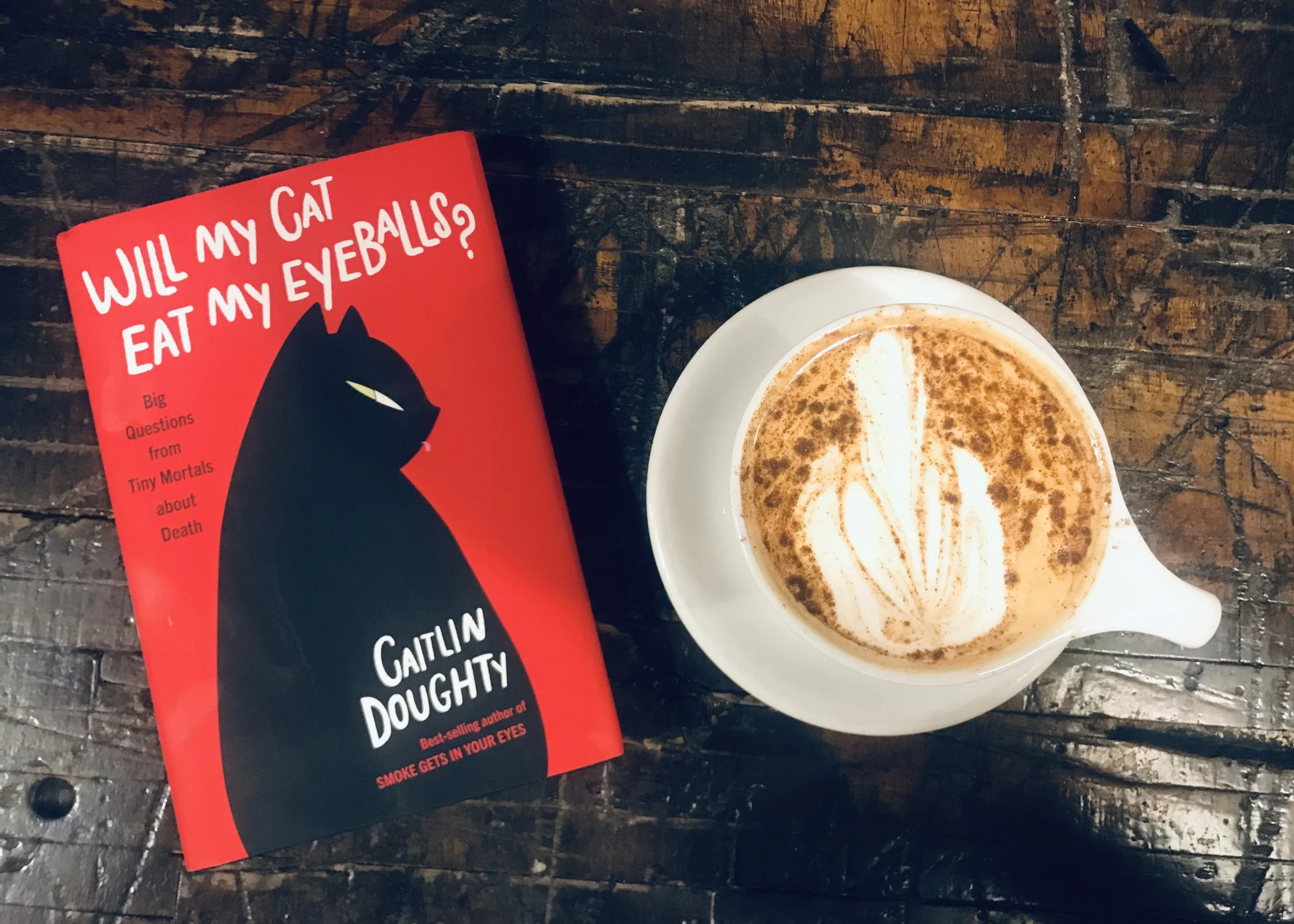
A Review of Caitlin Doughty's 'Will My Cat Eat My Eyeballs?'
Oct 25, 2019
A Review of Caitlin Doughty's 'Will My Cat Eat My Eyeballs?'
Oct 25, 2019
Oct 25, 2019
Nimue, The Deity, Came To Me In A Dream
Sep 17, 2019
Nimue, The Deity, Came To Me In A Dream
Sep 17, 2019
Sep 17, 2019
Astrological Shadow Work: Healing Writing Prompts
Sep 9, 2019
Astrological Shadow Work: Healing Writing Prompts
Sep 9, 2019
Sep 9, 2019
The Witches of Bushwick:  On Cult Party, Connection, and Magic
Jul 23, 2019
The Witches of Bushwick: On Cult Party, Connection, and Magic
Jul 23, 2019
Jul 23, 2019
7 Magical & Inclusive New Books Witches Must Read
May 15, 2019
7 Magical & Inclusive New Books Witches Must Read
May 15, 2019
May 15, 2019
Working Out As Magic & Ritual: A Witch's Comprehensive Guide
May 14, 2019
Working Out As Magic & Ritual: A Witch's Comprehensive Guide
May 14, 2019
May 14, 2019
Letters to the Dead: Shadow Writing for Grief & Release
Feb 8, 2019
Letters to the Dead: Shadow Writing for Grief & Release
Feb 8, 2019
Feb 8, 2019
How to Add Magic to Your Every Day Wellness Routine
Feb 5, 2019
How to Add Magic to Your Every Day Wellness Routine
Feb 5, 2019
Feb 5, 2019
Ritual: Writing Letters To Your Self — On Anais Nin, Journaling, and Healing
Jan 31, 2019
Ritual: Writing Letters To Your Self — On Anais Nin, Journaling, and Healing
Jan 31, 2019
Jan 31, 2019
How Rituals Can Help You Gain Confidence
Jan 17, 2019
How Rituals Can Help You Gain Confidence
Jan 17, 2019
Jan 17, 2019
Hearthcraft & the Magic of Everyday Objects: Reading Arin Murphy-Hiscock's 'House Witch'
Jan 14, 2019
Hearthcraft & the Magic of Everyday Objects: Reading Arin Murphy-Hiscock's 'House Witch'
Jan 14, 2019
Jan 14, 2019
True to The Earth: Cooper Wilhelm Interviews Kadmus
Nov 26, 2018
True to The Earth: Cooper Wilhelm Interviews Kadmus
Nov 26, 2018
Nov 26, 2018
Between The Veil: Letter from the Editor
Oct 31, 2018
Between The Veil: Letter from the Editor
Oct 31, 2018
Oct 31, 2018
Shadow Work with Light Magic for Dark Times
Oct 31, 2018
Shadow Work with Light Magic for Dark Times
Oct 31, 2018
Oct 31, 2018
2 Poems by Stephanie Valente
Oct 31, 2018
2 Poems by Stephanie Valente
Oct 31, 2018
Oct 31, 2018
A Poem in Photographs by Kailey Tedesco
Oct 31, 2018
A Poem in Photographs by Kailey Tedesco
Oct 31, 2018
Oct 31, 2018
Photography by Alice Teeple
Oct 31, 2018
Photography by Alice Teeple
Oct 31, 2018
Oct 31, 2018
A Simple Spell to Summon and Protect Your Personal Power
Oct 31, 2018
A Simple Spell to Summon and Protect Your Personal Power
Oct 31, 2018
Oct 31, 2018
November and Her Lovelier Sister
Oct 31, 2018
November and Her Lovelier Sister
Oct 31, 2018
Oct 31, 2018
A Spooky Story by Lydia A. Cyrus
Oct 31, 2018
A Spooky Story by Lydia A. Cyrus
Oct 31, 2018
Oct 31, 2018
Screen Shot 2021-02-27 at 11.34.05 PM.png

An 11-Line Poetry Spell For Healing

March 1, 2021

BY LISA MARIE BASILE

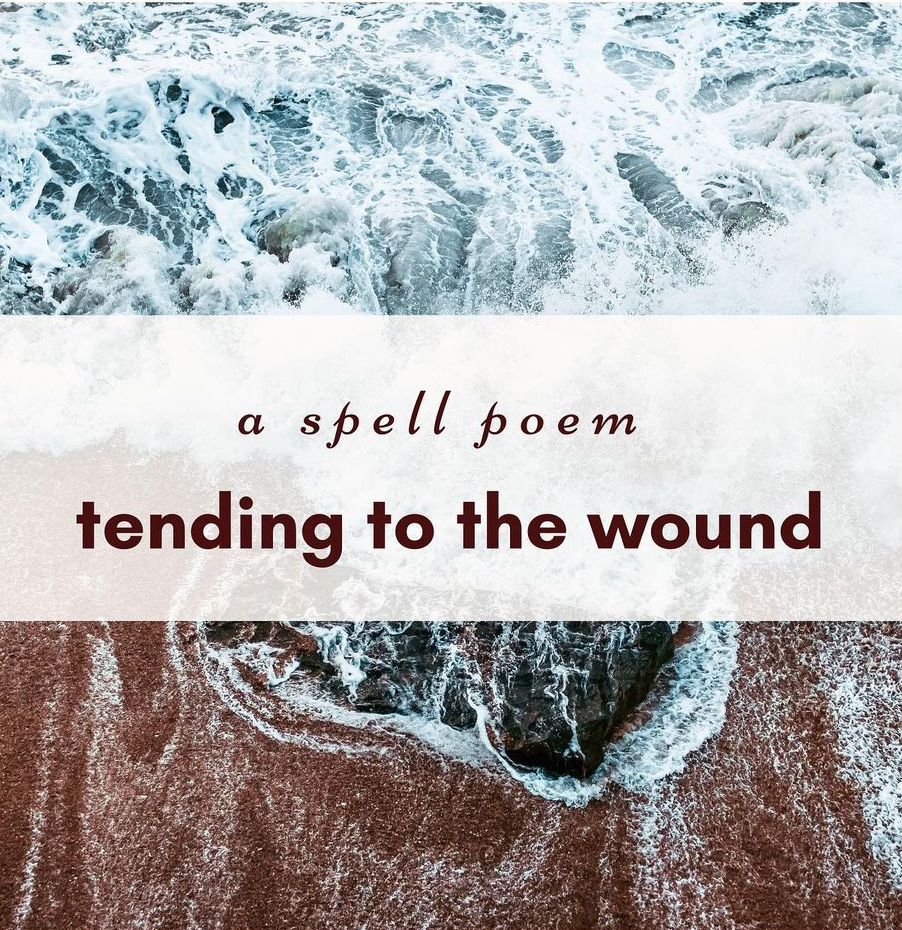
This is a writing ritual that includes an 11-line spell-poem recipe (which you will write) and a meditation. The goal? Tending to the wound.

In this healing spell poem (which functions as both a method of shadow working and as a spell, as it is your will and emotion which powers it) you will acknowledge the wound — whatever that wound might be; it could be today’s anxiety or yesterday’s lingering fear. It could be physical or immaterial. Self-honesty is key

You will also write the medicine.

I believe we all hold some form of medicine, or the key, within ourselves. Perhaps the medicine is external — systemic change, a new world? It’s okay to write to that, too. It’s okay to want big, beautiful, powerful global change just as much as it’s okay to write toward the practical or the mundane, or the small ways we forge ahead in our own healing.

I invite you to tend to the wound with me. I’ve done this a few times and each time it carries the potential to be transformative. It is simple, but that doesn’t mean it’s always easy.

As with all of my prompts (many of which are over at my Instagram account @Ritual_Poetica), I recommend that you make sure you’re in a safe, supportive environment while working through this. Maybe that means grounding in a space that feels safe and light and having someone to talk to if you need support.

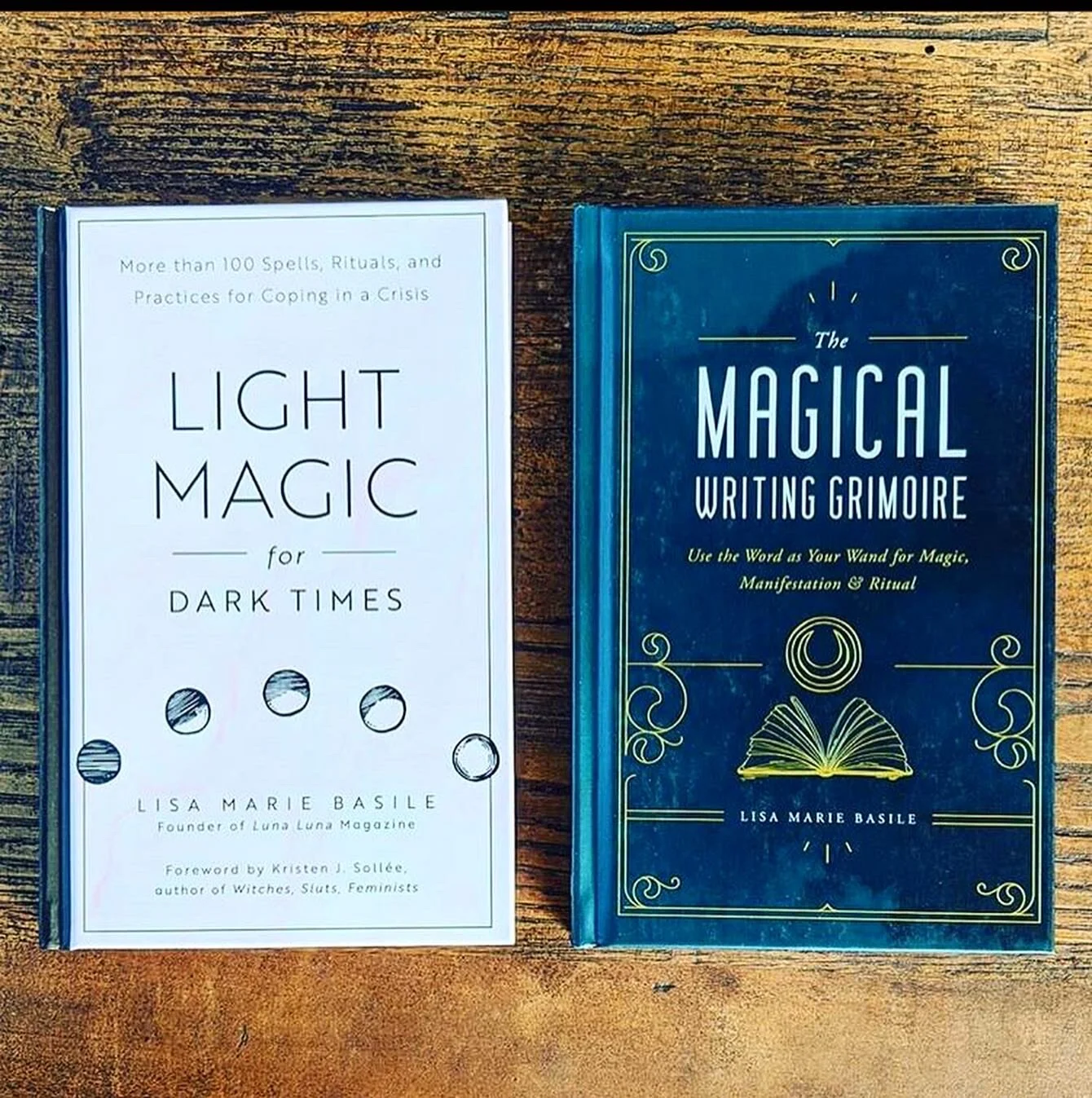
If you’d like more ideas about that, my book, The Magical Writing Grimoire, goes into detail on how to create a sacred and safe writing environment.

The Pre-Writing Meditation

Become soft. Let your heart bloom. Sigh wholly, loose and beautiful. Shut the door to fear, or listen to what the fear has to say. Walk into the room of Self, that great gilded palace. Feel the waters of truth cleanse your feet, your hands, your softness. Stand before the mirror and stare into your wound. Meet it with grace and compassion. The scars soften. The tissue expands to be held and to hold you. This is the kingdom of the heart.

What does it feel like to acknowledge the wound?

This is the time to write.

The writing practice: A healing spell poem for tending to the wound — in 11 lines

  • First, describe the wound in five lines. What are its colors, shapes, moods? Is it blue, & is it frightening? Is it bone-tired? Is it the beast of poverty, of loneliness, of blood?

  • Next, describe the medicine in five lines. Is it sunlight on the lake? Is it a burial? A refusal? An acceptance? A new home? A medication? Your voice? This is up to you. You know intuitively what heals you.

  • Finally, write your last line; this is when you cast your spell. It's what you tell the ocean about your pain. It's your greatest hope. It's your belief in self, in relief, in healing. give this everything you have.

—

Lisa Marie Basile (she/her) is a poet, essayist, editor, and chronic illness awareness advocate living in New York City. She's the founder and creative director of Luna Luna Magazine and its online community, and the creator of Ritual Poetica, a curiosity project dedicated to exploring the intersection of writing, creativity, healing, & sacredness.

She is the author of THE MAGICAL WRITING GRIMOIRE, LIGHT MAGIC FOR DARK TIMES, and a few poetry collections, including the recent NYMPHOLEPSY, which is excerpted in Best American Experimental Writing 2020. Her essays and other work can be found in The New York Times, Narratively, Sabat Magazine, We Are Grimoire, Witch Craft Magazine, Refinery 29, Self, Healthline, Entropy, On Loan From The Cosmos, Chakrubs, Catapult, Bust, Bustle, and more. She is also a chronic illness advocate, keeping columns at several chronic illness patient websites. She earned a Masters's degree in Writing from The New School and studied literature and psychology as an undergraduate at Pace University. You can follow her at lisamariebasile.
In Writing Magic Tags poem-spell, poem spell, spells, poetry magic, Writing, wordcraft, word witchery, healing spells, lisa marie basile
Comment
karly-jones-BaByyW3Oy9Q-unsplash.jpg

How To Write Powerful Poetry Spells

February 28, 2021

BY LISA MARIE BASILE

Poetry is magic. And poems are spells. The spirituality of poetry is clear — but it’s not always obvious; like many paths and practices (especially witchcraft, folk magic, or other spiritual paths), poetry is a way toward self-reclamation, finding autonomy, understanding yourself and the world, and getting in touch with the divine, mysterious force within us — creativity.

And like a spell, a poem is born of intent and uses specific ingredients. Poetry is shadow work, a way of mining the depths. And through that act, it is a torch of illumination.

If we are the soil, the poetry is the rose that blooms. And the magic — that’s what brings it to the surface.

But why poetry? Poetry moves and slides and breaks rules; in fact, we make the rules as we write it. It defies structure, as it is a living art form, ever-changing. Its power lies in what it contains, what it doesn’t, what it gives, and what it hides in its white spaces — and it thrives in liminal spaces. It’s witchcraft.

It says, “I won’t tell you the truth, but I’ll tell you a part of it.” Poetry gives you clues. It asks you to think. It reveals according to its own rules. That’s why we always ask, “But what is it about?”

And that mystery makes it so beautiful — both to read and to write. It helps us stretch our imaginations, get out of our comfort zones, and offers a glimpse of something that one might never see or realize or pay attention to.As a poet and teacher of poetry, I think that is magical. In fact, I wrote a whole book about it: The Magical Writing Grimoire.

Like one’s magical craft, poetry asks us to return to the process. It asks us to spend time with it, nurture it, and go deeper. You are never done with learning as a practitioner of any sort. There are always more questions and always more epiphanies — and there are always more poems to download, to meditate over, and to write.

Poets are the alchemists of the page.

As witches, we carry — and work with — the great energy within us. We are always aware of, directing, or manipulating energy and emotion. This is such an incredible thing — it allows us to make the choices that enable us to be free, find relief, find purpose, find power, find clarity. To divine. To grow. Poets do this too, even if unconsciously; we bring energy and emotion to the page. We manipulate that energy and emotion — deeply aware of its powers and its meaning. How we are changing with every line we write.

We create our altars on the page, pulling together our tools and objects — words and sounds and space — to cast our spells. And just like witches, poets love our rituals: wine, a cigarette, a cleansed space to work, a quieting.

Each word is meticulously selected as an ingredient or power object. Each stanza is a breath of purpose, a standing in the crossroads. Each turn of phrase, a candle lit by the wick of another. And when read aloud, all at once, a spell cast.

How to write poetry spells & practice wordcraft

Image by Lisa Marie Basile

Image by Lisa Marie Basile

There are many ways to write poetry spells. The poem itself can work as a spell through its language (calling on what you want or releasing something), or through its structure and pacing (emphasizing breath work and musicality can create a prayer-like experience).

You can also create poetry spells by focusing each line or section on a specific intention, color, archetype, or goal.

By the way, don’t feel constrained or pressured by ideas of “good poetry,” or popular poetry. These are poems for you; they’re magic. They’re your essence. They’re not meant to be published or shared with the world. Write the poetry that speaks to you. In your voice. In whatever language you want to write in.

Here are some of my favorite techniques.

Writing consciously

Whether we realize it or not, when we write poetry, we are programming our creation with our intention. Like drawing a sigil, a poem is the shape and sound of our intent. Is it a poem of personal power? Is it a poem of memory? Is it a poem that recalls love? Is it a poem of reclamation? Being conscious of what you’re feeling — and programming your poem to achieve a certain goal when it’s read aloud or finished — you imbue your poem with power. It is a spell cast.

And like an incantation or a mantra, we can read a poem anytime to evoke the energy we programmed to it. It will always be there, encapsulated at the moment we created it. It can transport us, infuse us, remind us. 

Write a poetry spell with a certain number of lines or stanzas

You’ll dedicate each line or stanza to a specific idea or feeling you’d like to conjure, let go of, or release. Each line, in effect, will give you the opportunity to focus your intention and energy. This is where poetry spells really get powerful since you can focus stanzas or lines on archetypes, gods, goddesses, guides, ancestral symbols, power colors, sacred sounds, or goals and conjurings.

Want to try one? This 11-line poetry spell for healing is accessible and potent.

Write automatically

On the other end of writing with conscious intention, automatic writing is a way of writing — freely, without censorship or goal — in a sort of trance state. Think of yourself as a vessel, downloading the information and translating it to the page. Writing a poem this way means writing anything that comes to mind — and then deciphering that when you’re in a more conscious state.

Write the liminal

Write a poem that speaks of the in-between, the crossroads, the liminal. What does it look at dusk? What does it feel like to be almost touched, almost loved, almost lost? How you capture what feels to straddle the liminal — in a poem?

Word Worship

A book of poetic spells, The Lost Words, aimed to reclaim and celebrate natural words that were taken out of the Oxford Junior Dictionary. These words, acorn, adder, bluebell, dandelion, fern, heron, otter, and willow were replaced with words like blog, broadband, bullet-point, cut-and-paste, and voice-mail.  

What words mean something to you? What words speak to your memories and personal power? Are there words that speak to your identity, your resistance, your body, your journey? Choose five of these words and write a 5-stanza poem using each of them, or write five poems (as a set to be read aloud together) utilizing each. When you speak them aloud, you can call on these qualities.

Dream poetry

When we wake up, our minds are loose and fluid, capable of magic — still tethered to other conscious states. Once away, tap into that dream space and write a poem about your dream. Let its contradictions and messiness and weirdness soak into your poetry.

What is the dream’s message? Write that message into your poem. In this way, you are divining from the subconscious mind, mining the dreamscape, and channeling it from the ether into a physical thing to be explored and tapped into. Dedicate a whole section of your grimoire to dream poetry and you’ll watch the themes and messages unravel — allowing you to swim in a literary sea of the self.

Herbal poetics

Are you a fan of cannabis or mugwort? Both are used for spiritual purposes, opening a sort of mental portal. In a high state, write what comes to mind. Don’t bother making sense or trying to define meaning right away; just let the feelings guide you. Ride the wave of the self, and let your words slip onto paper, unregulated. Light your joint with the flame from a candle lit in your sacred space.

These poems capture the experience of liminality, highness, and the dream state. As you write, you are channeling, translating, and creating a space of sacred connection. A spell is an active, dynamic thing — one that is created as it is cast. Every time you read the poem aloud afterward, it can call on that same energy.

You can read more about weed witchcraft right here — Weed Witchcraft: A Ritual With The High Priestess of Smoke by Moxie McMurder, who writes, “Smoking the holy herb is a spiritual act, one that puts you in touch with the four elements and when practiced correctly can lift the veil reveal and nature's secrets.” Just remember to stay safe, be legal, and talk to a doctor before using any psychoactive substance. 

Parts of this article were excerpted from The Magical Writing Grimoire.

—

Lisa Marie Basile (she/her) is a poet, essayist, editor, and chronic illness awareness advocate living in New York City. She's the founder and creative director of Luna Luna Magazine and its online community, and the creator of Ritual Poetica, a curiosity project dedicated to exploring the intersection of writing, creativity, healing, & sacredness.

She is the author of THE MAGICAL WRITING GRIMOIRE, LIGHT MAGIC FOR DARK TIMES, and a few poetry collections, including the recent NYMPHOLEPSY, which is excerpted in Best American Experimental Writing 2020. Her essays and other work can be found in The New York Times, Narratively, Sabat Magazine, We Are Grimoire, Witch Craft Magazine, Refinery 29, Self, Healthline, Entropy, On Loan From The Cosmos, Chakrubs, Catapult, Bust, Bustle, and more. She is also a chronic illness advocate, keeping columns at several chronic illness patient websites. She earned a Masters's degree in Writing from The New School and studied literature and psychology as an undergraduate at Pace University. You can follow her at lisamariebasile.

In Occult, Spell poems, Writing Magic Tags how to write poetry spells, poetry spells, spell poems, writing magic, word witchcraft, word witchery, wordcraft, lisa marie basile, poetry prompts, Witchcraft
Comment
antonia-felipe-Tg3IDFoJqos-unsplash.jpg

Restorative Grief: Letters To The Dead

October 23, 2020

BY LISA MARIE BASILE


I’ve been thinking about how we, as a species, are collectively and individually grieving for our fellow humans — perhaps they are strangers or maybe they are our family members or friends — during this COVID-19 crisis. In the midst of the terror, it’s hard to slow down and say goodbye, especially on the global, collective level. It is a prolonged state of waiting to grieve because the turmoil rolls on and on. For me, that’s very difficult. I feel an urge to mourn for those lost, even if I didn’t know them.

For many families, a proper goodbye wasn’t or won’t be possible. And for others, the heaviness of worldwide grief (and the chronic anticipatory loss) accumulates within our cells, changing us from the inside, as a species.

A friend of mine said she’d lost her beloved grandmother to COVID-19. It was sudden and horrifying. She hadn’t been able to process it and feels she didn’t have a way to say goodbye. I felt utterly helpless and told her so, but offered her my shoulder and my phone line for whenever she needed a friend.

Prior to COVID-19, I’d been dealing with the aftershocks of a year of death (2017) that forever changed me. It pushed me to explore and meditate on grief and loss, and I’ve deeply integrated that into my writing. I still have fewer answers and more questions. I still hurt. In my poetry and in my nonfiction books, including Light Magic for Dark Times and The Magical Writing Grimoire, I offer grief rituals.

There is no way to skip over or lessen the impact of grief. Truly. The only way out is through, I believe now. More so, both ritual and journaling aren’t solutions or cures or magic elixirs for the sludge of grief. The sting of loss is part of the condition of being alive, and you may mourn hard for a lifetime. But there are small things we can do that can help us navigate our pain, find clarity, and work toward a semblance of closure or a space of finality — and science tells us that writing about grief works for many people (although it’s not a replacement for therapy).

For this reason, I’ve included a ritual — Restorative Grief: Letters to the Dead — from my book, The Magical Writing Grimoire below. Maybe you’ll use it for someone you’ve lost in the past, or perhaps you’ll write a letter to the collective dead, to the many who have lost their lives in your city or community. Whatever you use it for, I hope it helps you find some stability and insight.

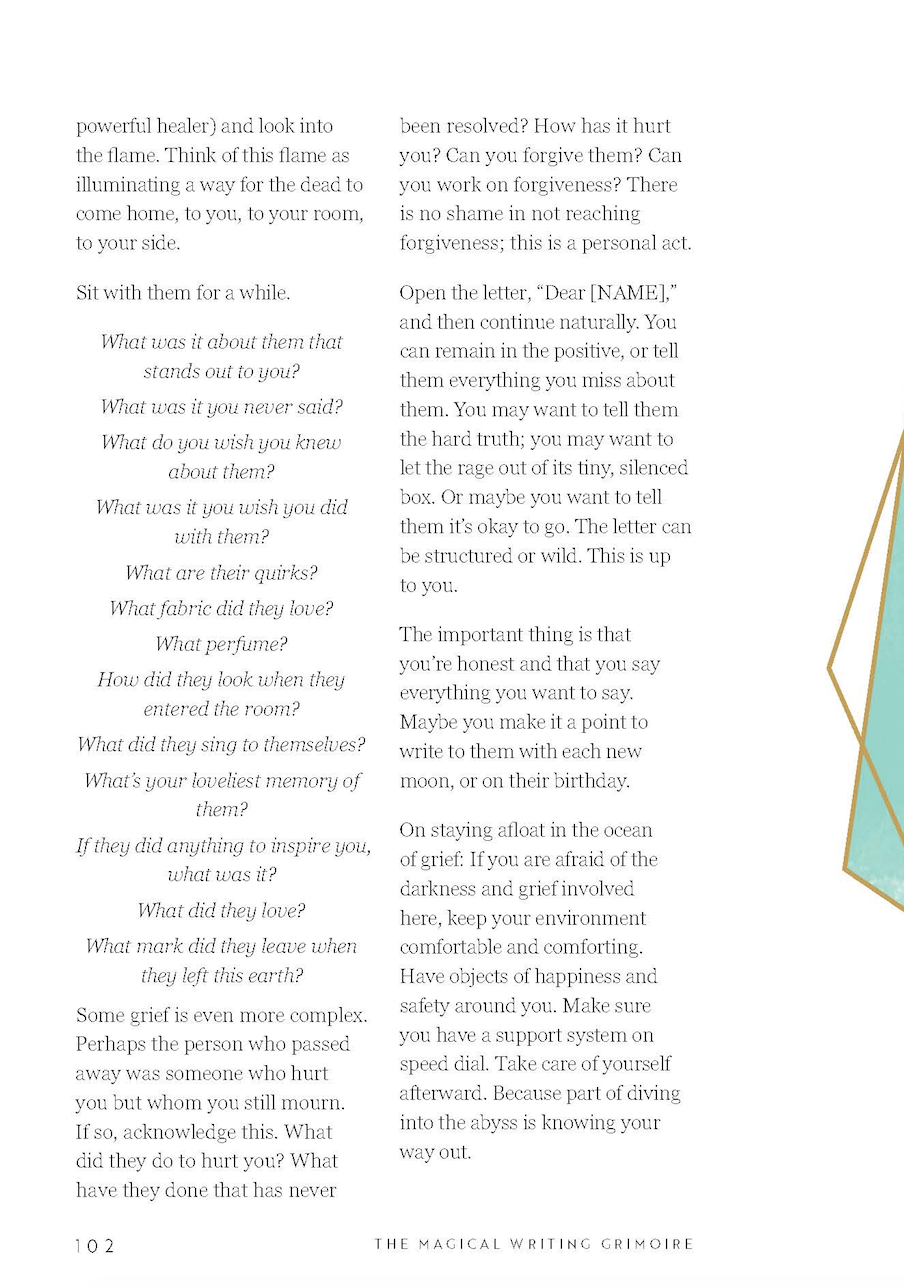
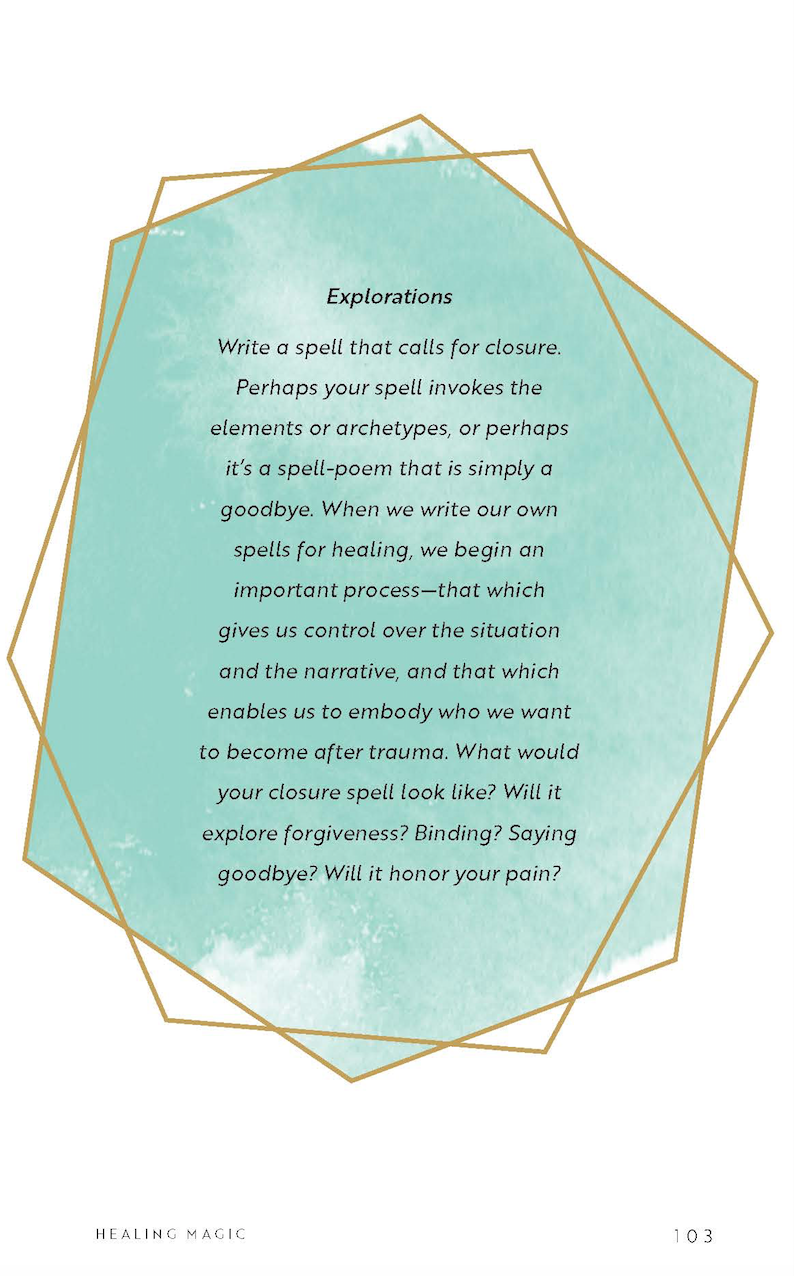
Below, I’ve included the original text for the ritual, along with the final pages from my book. Feel free to share and copy/download them.

Restorative Grief: Letters to the Dead

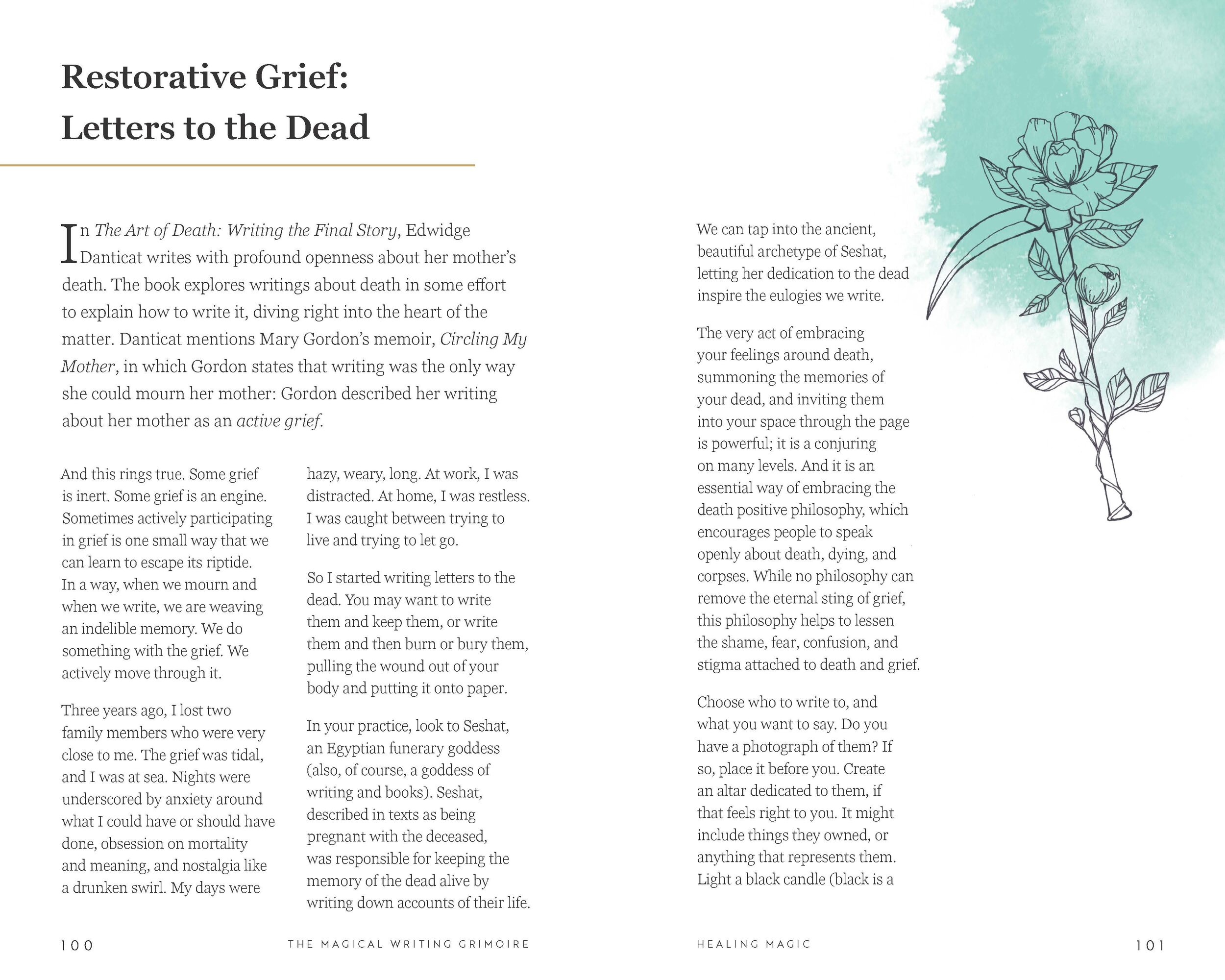
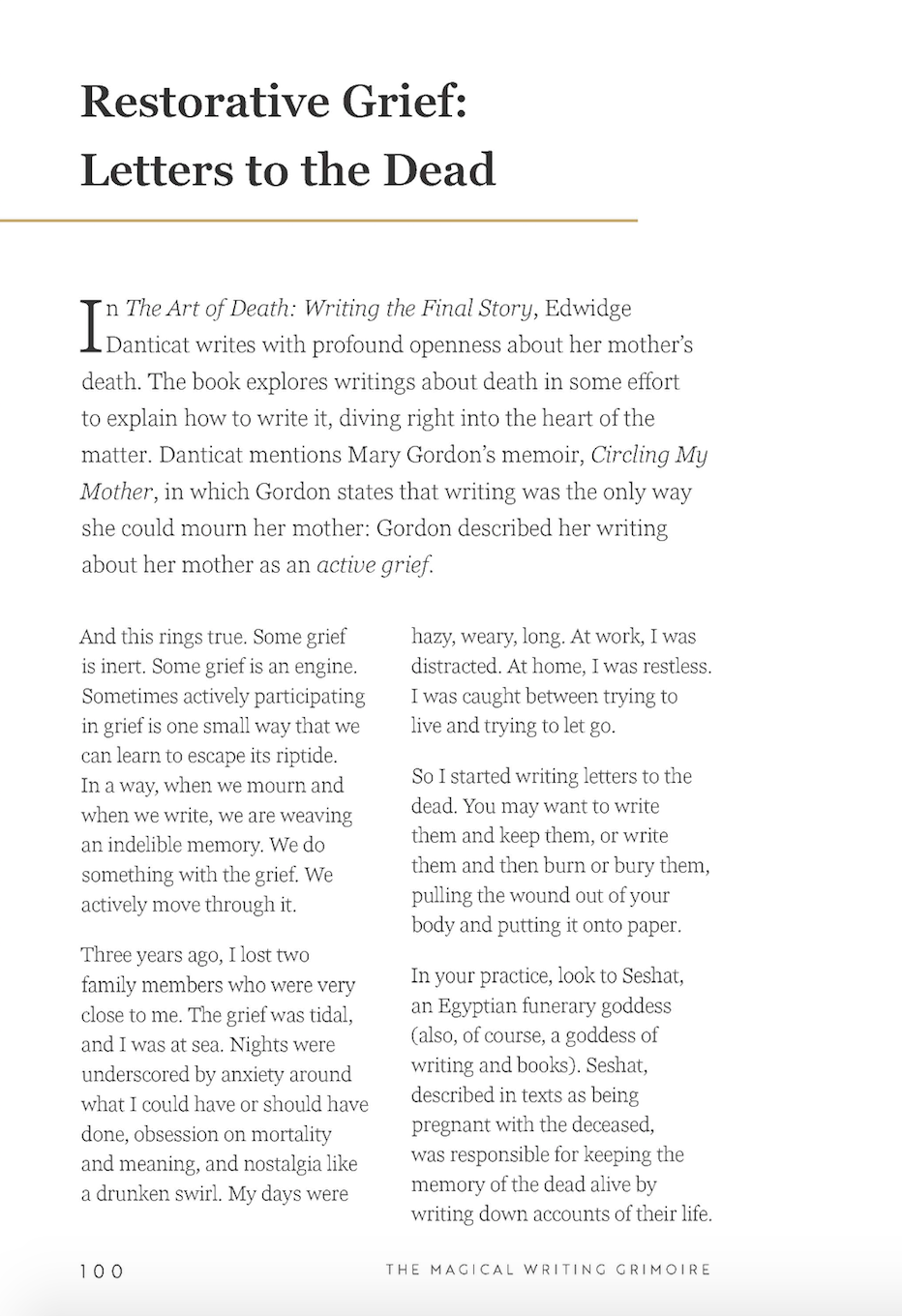
InThe Art of Death: Writing the Final Story, Edwidge Danticat writes with profound openness about her mother’s death. The book explores writings about death in some effort to explain how to write it, diving right into the heart of the matter. Danticat mentions Mary Gordon’s memoir, Circling My Mother, in which Gordon states that writing was the only way she could mourn her mother. Gordon described her writing about her month as an active grief.

And this rings true. Some grief is inert. Some grief is an engine. Sometimes actively participating in grief is one small way that we can learn to escape its riptide. In a way, when we mourn and when we write, we are weaving an indelible memory. We do something with the grief. We actively move through it. 

Three years ago, I lost two family members who were very close to me. The grief was tidal, and I was at sea. Nights were underscored by anxiety around what I could have or should have done, obsession on mortality and meaning, and nostalgia like a drunken swirl. My days were hazy, weary, long. At work, I was distracted. At home, I was restless. I was caught between trying to live and trying to let go.

Grief is a sickness that grows without a cure. It affects more than the body, more than the mind. It affects the essence of us, our starstuff, our souls, our hearts, our energy. It metastasizes over a lifetime, and with each new death, it takes a new organ. 

So I started writing letters to the dead. You may want to write them and keep them or write them and then burn or bury them, be pulling the wound out of your body, and putting it onto paper.

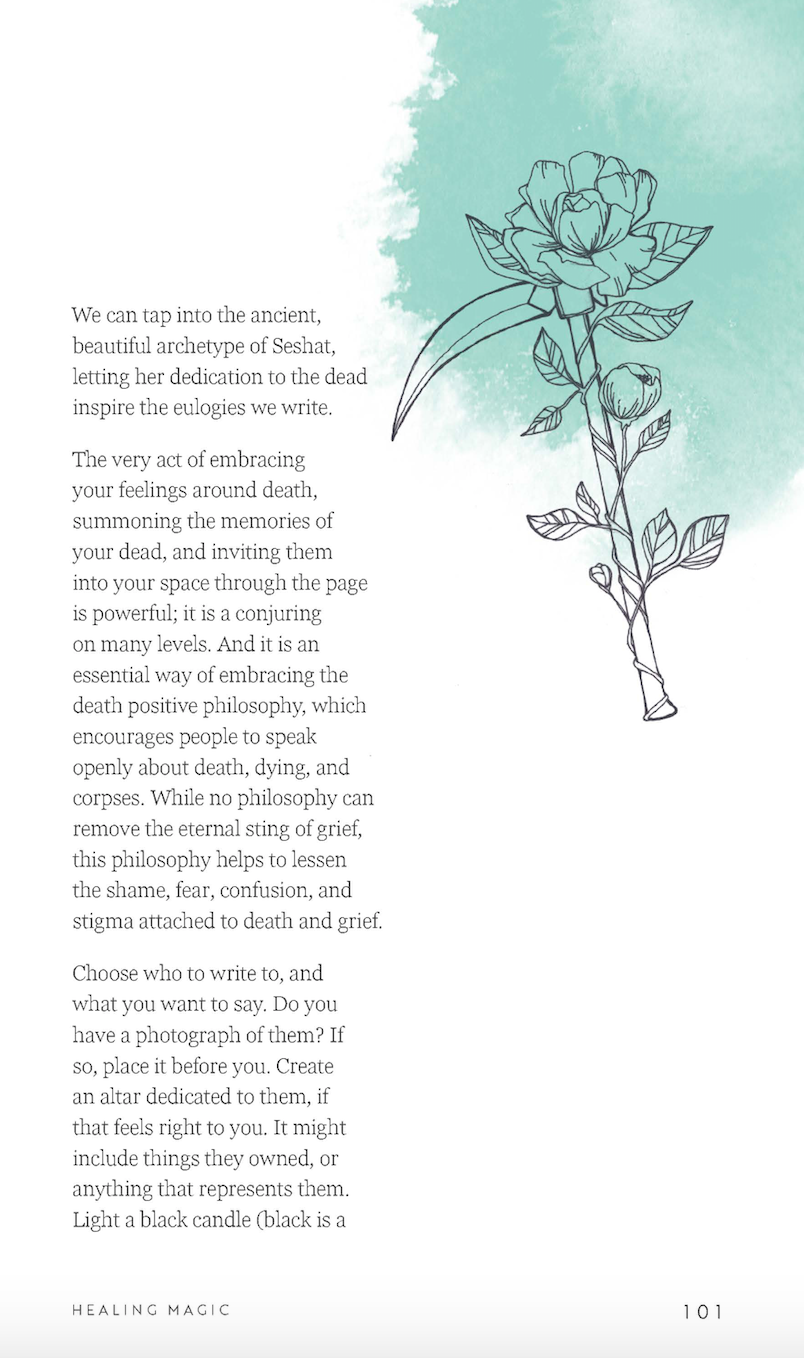
I like to look to Seshat, an Egyptian funerary goddess (also, of course, a goddess of writing and books). Seshat, described in texts as being pregnant with the deceased, was responsible for keeping the memory of the dead alive by writing down accounts of their life. We can tap into the ancient, beautiful archetype of Seshat, letting her dedication to the dead inspire the eulogies we write.

The very act of embracing your feelings around death, summoning the memories of your dead, and inviting them into your space through the page is powerful; it is a conjuring on many levels. And it is an essential way of embracing the death positive philosophy, which encourages people to speak openly about death, dying, and corpses. While no philosophy can remove the eternal sting of grief, this philosophy helps to lessen the shame, fear, confusion, and stigma attached to death and grief.

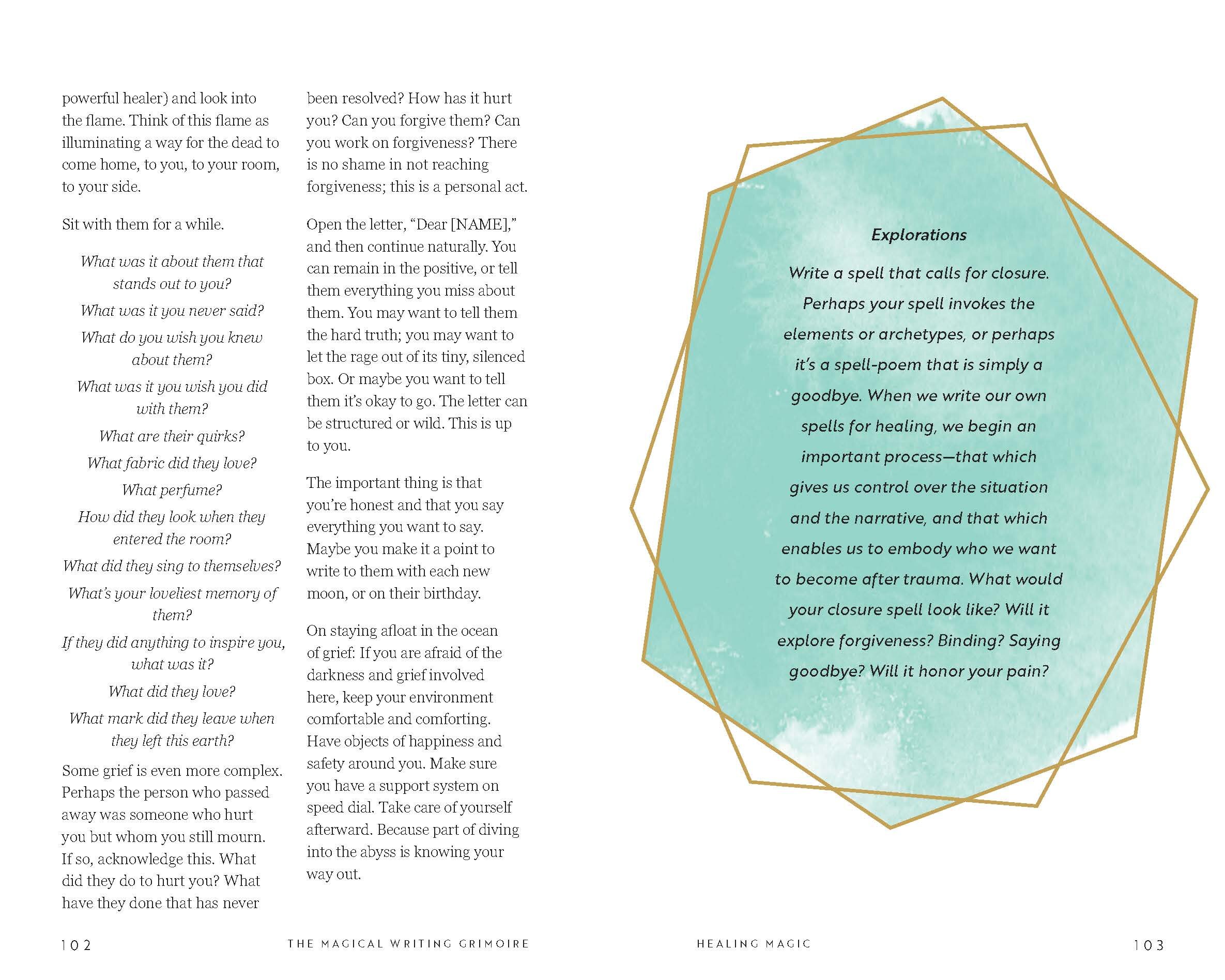
Choose who to write to, and what you want to say. Do you have a photograph of them? If so, place it before you. Create an altar dedicated to them, if that feels right to you. It might include things they owned, or anything that represents them. Light a black candle (black is a powerful healer) and look into the flame. Think of this flame as illuminating a way for the dead to come home, to you, to your room, to your side.

Sit with them for a while. 

What was it about them that stands out to you? What was it you never said? What do you wish you knew about them? What was it you wish you did with them? What are their quirks? What fabric did they love? What perfume? How did they look when they entered the room? What did they sing to themselves? What’s your loveliest memory of them? If they did anything to inspire you, what was it? What did they love? What mark did they leave when they left this earth? 

Some grief is even more complex. Perhaps the person who passed away was someone who hurt you but whom you still mourn. If so, acknowledge this. What did they do to hurt you? What have they done that has never been resolved? How has it hurt you? Can you forgive them? Can you work on forgiveness? There is no shame in not reaching forgiveness; this is a personal act. 

Open the letter, “Dear [NAME],” and then continue naturally. You can remain in the positive, or tell them everything you miss about them. You may want to tell them the hard truth; you may want to let the rage out of its tiny, silenced box. Or maybe you want to tell them it’s okay to go. Perhaps they felt they had to stay? Perhaps they suffered? Maybe you simply want to know what it’s like to be dead. The letter can be structured or wild. This is up to you.

The important thing is that you’re honest and that you say everything you want to say. Maybe you make it a point to write to them with each new moon, or on their birthday.

On staying afloat in the ocean of grief: If you are afraid of the darkness and grief involved here, keep your environment comfortable and comforting. Have objects of happiness and safety around you. Make sure you have a support system on speed dial. Take care of yourself afterward. Because part of diving into the abyss is knowing your way out.

A prompt

Write a spell that calls for closure. Perhaps your spell invokes the elements or archetypes, or perhaps it’s a spell-poem that is simply a goodbye. When we write our own spells for healing, we begin an important process—that which gives us control over the situation and the narrative, and that which enables us to embody who we want to become after trauma. What would your closure spell look like? Will it explore forgiveness? Binding? Saying goodbye? Will it honor your pain?

Feel free to download the keep the following pages:

Restorative Grief_Page_1.jpg
Restorative Grief_Page_2 (1).jpg
Screen Shot 2020-04-22 at 3.13.25 PM.png
Screen Shot 2020-04-22 at 3.13.33 PM.png
Screen Shot 2020-04-22 at 3.14.23 PM.png
Screen Shot 2020-04-22 at 3.14.33 PM.png
In Occult, Books Tags death, grief, Rituals, Ritual, the magical writing grimoire, light magic for dark times, lisa marie basile, grief rituals, healing, loss, covid-19, coronavirus
Comment
Featured
‘in the glitter-open black' — poetry by Fox Henry Frazier
'poet as tarantula,  poem as waste' — poetry by  Ewen Glass
'poet as tarantula, poem as waste' — poetry by Ewen Glass
'Hours rot away in regalia' — poetry by Stephanie Chang
'down down down the hall of mirrors' — poetry by Ronnie K. Stephens
'Grew appendages, clawed towards light' — poetry by Lucie Brooks
'do not be afraid' — poetry by Maia Decker
'The darkened bedroom' — poetry by Jessica Purdy
'I am the body that I am under' — poetry by Jennifer MacBain-Stephens
instagram

COPYRIGHT LUNA LUNA MAGAZINE 2025