








• Home
  • indulge
  • new poetry
    • About Luna Luna
    • resources
    • search
  • editor
  • dark hour
  • submit
Menu

luna luna magazine

  • Home
  • indulge
  • new poetry
  • About
    • About Luna Luna
    • resources
    • search
  • editor
  • dark hour
  • submit
shadow
A Writing Spell: Honoring Your Many Selves
Mar 1, 2021
A Writing Spell: Honoring Your Many Selves
Mar 1, 2021
Mar 1, 2021
An 11-Line Poetry Spell For Healing
Mar 1, 2021
An 11-Line Poetry Spell For Healing
Mar 1, 2021
Mar 1, 2021
How To Write Powerful Poetry Spells
Feb 28, 2021
How To Write Powerful Poetry Spells
Feb 28, 2021
Feb 28, 2021
Here Is Your Scorpio Homework This Season
Oct 25, 2020
Here Is Your Scorpio Homework This Season
Oct 25, 2020
Oct 25, 2020
3 Transformative Life Lessons Scorpio Teaches Us
Oct 25, 2020
3 Transformative Life Lessons Scorpio Teaches Us
Oct 25, 2020
Oct 25, 2020
Restorative Grief: Letters To The Dead
Oct 23, 2020
Restorative Grief: Letters To The Dead
Oct 23, 2020
Oct 23, 2020
A Santa Muerte Rebirth Ritual + A Tarot Writing Practice
Oct 6, 2020
A Santa Muerte Rebirth Ritual + A Tarot Writing Practice
Oct 6, 2020
Oct 6, 2020
Witches, Here Are The New Books You Need
Nov 14, 2019
Witches, Here Are The New Books You Need
Nov 14, 2019
Nov 14, 2019
3 Dream Magic Rituals And Practices
Nov 12, 2019
3 Dream Magic Rituals And Practices
Nov 12, 2019
Nov 12, 2019
How To Use Tarot Cards for Self-Care
Nov 11, 2019
How To Use Tarot Cards for Self-Care
Nov 11, 2019
Nov 11, 2019
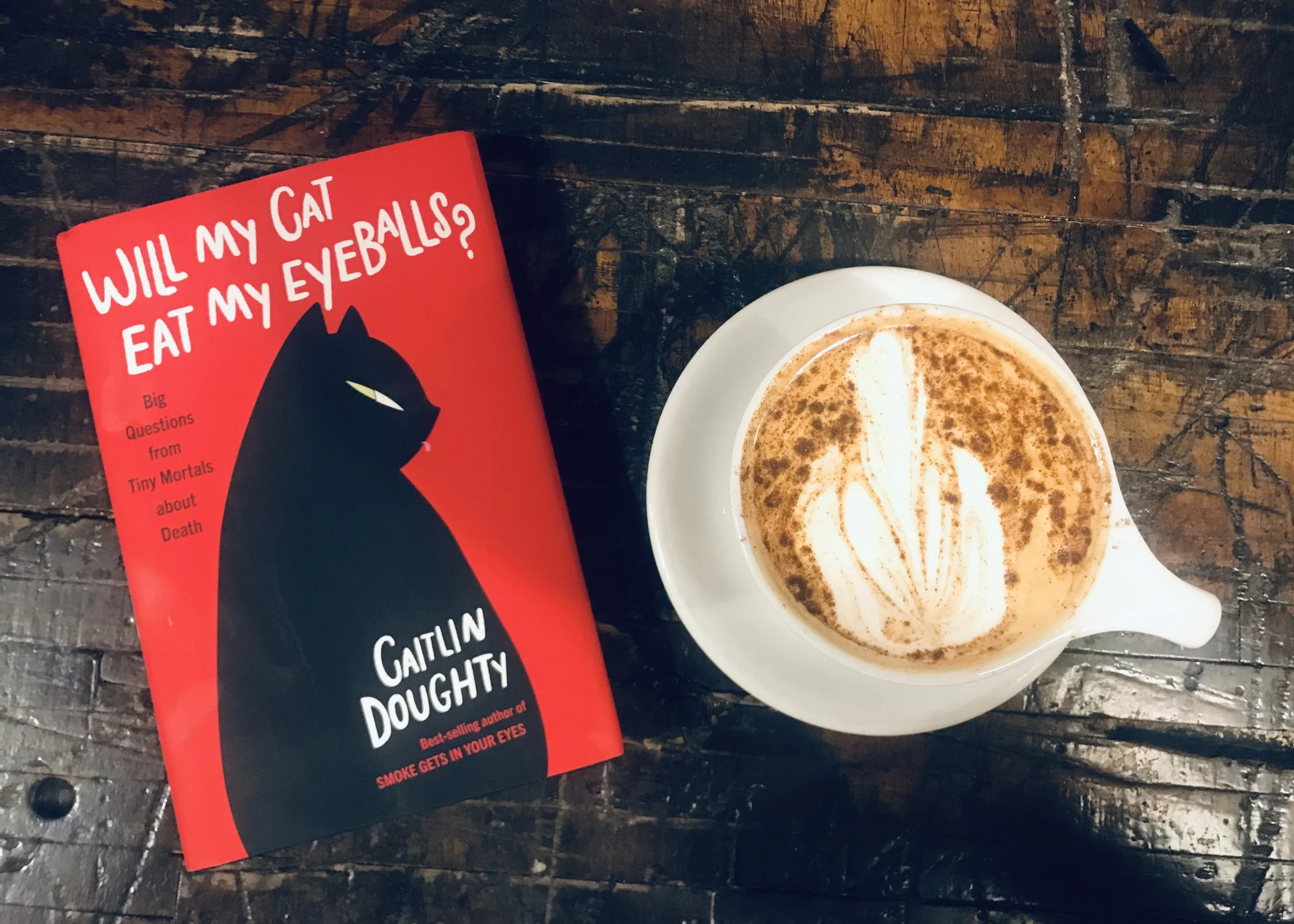
A Review of Caitlin Doughty's 'Will My Cat Eat My Eyeballs?'
Oct 25, 2019
A Review of Caitlin Doughty's 'Will My Cat Eat My Eyeballs?'
Oct 25, 2019
Oct 25, 2019
Nimue, The Deity, Came To Me In A Dream
Sep 17, 2019
Nimue, The Deity, Came To Me In A Dream
Sep 17, 2019
Sep 17, 2019
Astrological Shadow Work: Healing Writing Prompts
Sep 9, 2019
Astrological Shadow Work: Healing Writing Prompts
Sep 9, 2019
Sep 9, 2019
The Witches of Bushwick:  On Cult Party, Connection, and Magic
Jul 23, 2019
The Witches of Bushwick: On Cult Party, Connection, and Magic
Jul 23, 2019
Jul 23, 2019
7 Magical & Inclusive New Books Witches Must Read
May 15, 2019
7 Magical & Inclusive New Books Witches Must Read
May 15, 2019
May 15, 2019
Working Out As Magic & Ritual: A Witch's Comprehensive Guide
May 14, 2019
Working Out As Magic & Ritual: A Witch's Comprehensive Guide
May 14, 2019
May 14, 2019
Letters to the Dead: Shadow Writing for Grief & Release
Feb 8, 2019
Letters to the Dead: Shadow Writing for Grief & Release
Feb 8, 2019
Feb 8, 2019
How to Add Magic to Your Every Day Wellness Routine
Feb 5, 2019
How to Add Magic to Your Every Day Wellness Routine
Feb 5, 2019
Feb 5, 2019
Ritual: Writing Letters To Your Self — On Anais Nin, Journaling, and Healing
Jan 31, 2019
Ritual: Writing Letters To Your Self — On Anais Nin, Journaling, and Healing
Jan 31, 2019
Jan 31, 2019
How Rituals Can Help You Gain Confidence
Jan 17, 2019
How Rituals Can Help You Gain Confidence
Jan 17, 2019
Jan 17, 2019
Hearthcraft & the Magic of Everyday Objects: Reading Arin Murphy-Hiscock's 'House Witch'
Jan 14, 2019
Hearthcraft & the Magic of Everyday Objects: Reading Arin Murphy-Hiscock's 'House Witch'
Jan 14, 2019
Jan 14, 2019
True to The Earth: Cooper Wilhelm Interviews Kadmus
Nov 26, 2018
True to The Earth: Cooper Wilhelm Interviews Kadmus
Nov 26, 2018
Nov 26, 2018
Between The Veil: Letter from the Editor
Oct 31, 2018
Between The Veil: Letter from the Editor
Oct 31, 2018
Oct 31, 2018
Shadow Work with Light Magic for Dark Times
Oct 31, 2018
Shadow Work with Light Magic for Dark Times
Oct 31, 2018
Oct 31, 2018
2 Poems by Stephanie Valente
Oct 31, 2018
2 Poems by Stephanie Valente
Oct 31, 2018
Oct 31, 2018
A Poem in Photographs by Kailey Tedesco
Oct 31, 2018
A Poem in Photographs by Kailey Tedesco
Oct 31, 2018
Oct 31, 2018
Photography by Alice Teeple
Oct 31, 2018
Photography by Alice Teeple
Oct 31, 2018
Oct 31, 2018
A Simple Spell to Summon and Protect Your Personal Power
Oct 31, 2018
A Simple Spell to Summon and Protect Your Personal Power
Oct 31, 2018
Oct 31, 2018
November and Her Lovelier Sister
Oct 31, 2018
November and Her Lovelier Sister
Oct 31, 2018
Oct 31, 2018
A Spooky Story by Lydia A. Cyrus
Oct 31, 2018
A Spooky Story by Lydia A. Cyrus
Oct 31, 2018
Oct 31, 2018
antonia-felipe-Tg3IDFoJqos-unsplash.jpg

Restorative Grief: Letters To The Dead

October 23, 2020

BY LISA MARIE BASILE


I’ve been thinking about how we, as a species, are collectively and individually grieving for our fellow humans — perhaps they are strangers or maybe they are our family members or friends — during this COVID-19 crisis. In the midst of the terror, it’s hard to slow down and say goodbye, especially on the global, collective level. It is a prolonged state of waiting to grieve because the turmoil rolls on and on. For me, that’s very difficult. I feel an urge to mourn for those lost, even if I didn’t know them.

For many families, a proper goodbye wasn’t or won’t be possible. And for others, the heaviness of worldwide grief (and the chronic anticipatory loss) accumulates within our cells, changing us from the inside, as a species.

A friend of mine said she’d lost her beloved grandmother to COVID-19. It was sudden and horrifying. She hadn’t been able to process it and feels she didn’t have a way to say goodbye. I felt utterly helpless and told her so, but offered her my shoulder and my phone line for whenever she needed a friend.

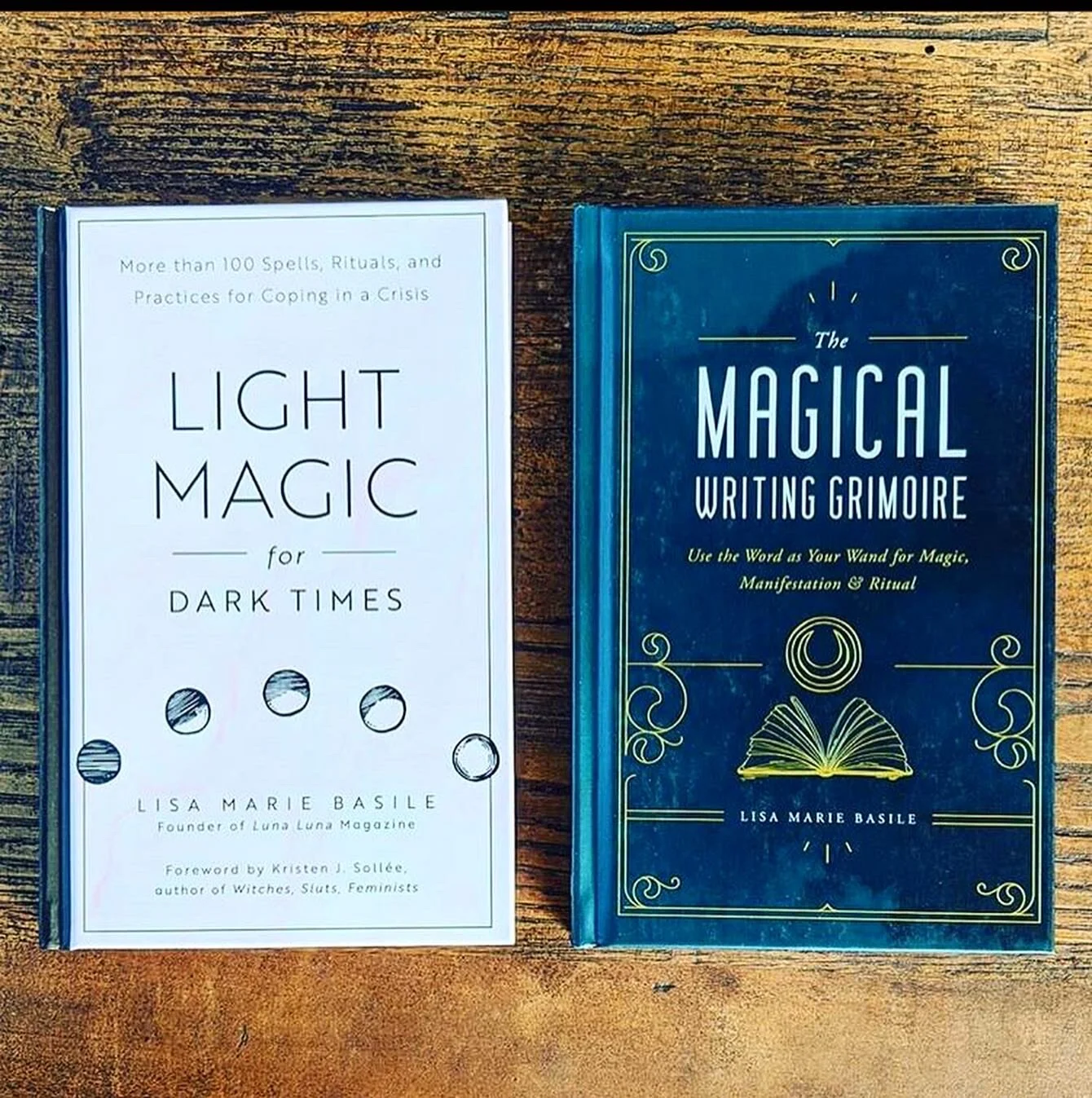
Prior to COVID-19, I’d been dealing with the aftershocks of a year of death (2017) that forever changed me. It pushed me to explore and meditate on grief and loss, and I’ve deeply integrated that into my writing. I still have fewer answers and more questions. I still hurt. In my poetry and in my nonfiction books, including Light Magic for Dark Times and The Magical Writing Grimoire, I offer grief rituals.

There is no way to skip over or lessen the impact of grief. Truly. The only way out is through, I believe now. More so, both ritual and journaling aren’t solutions or cures or magic elixirs for the sludge of grief. The sting of loss is part of the condition of being alive, and you may mourn hard for a lifetime. But there are small things we can do that can help us navigate our pain, find clarity, and work toward a semblance of closure or a space of finality — and science tells us that writing about grief works for many people (although it’s not a replacement for therapy).

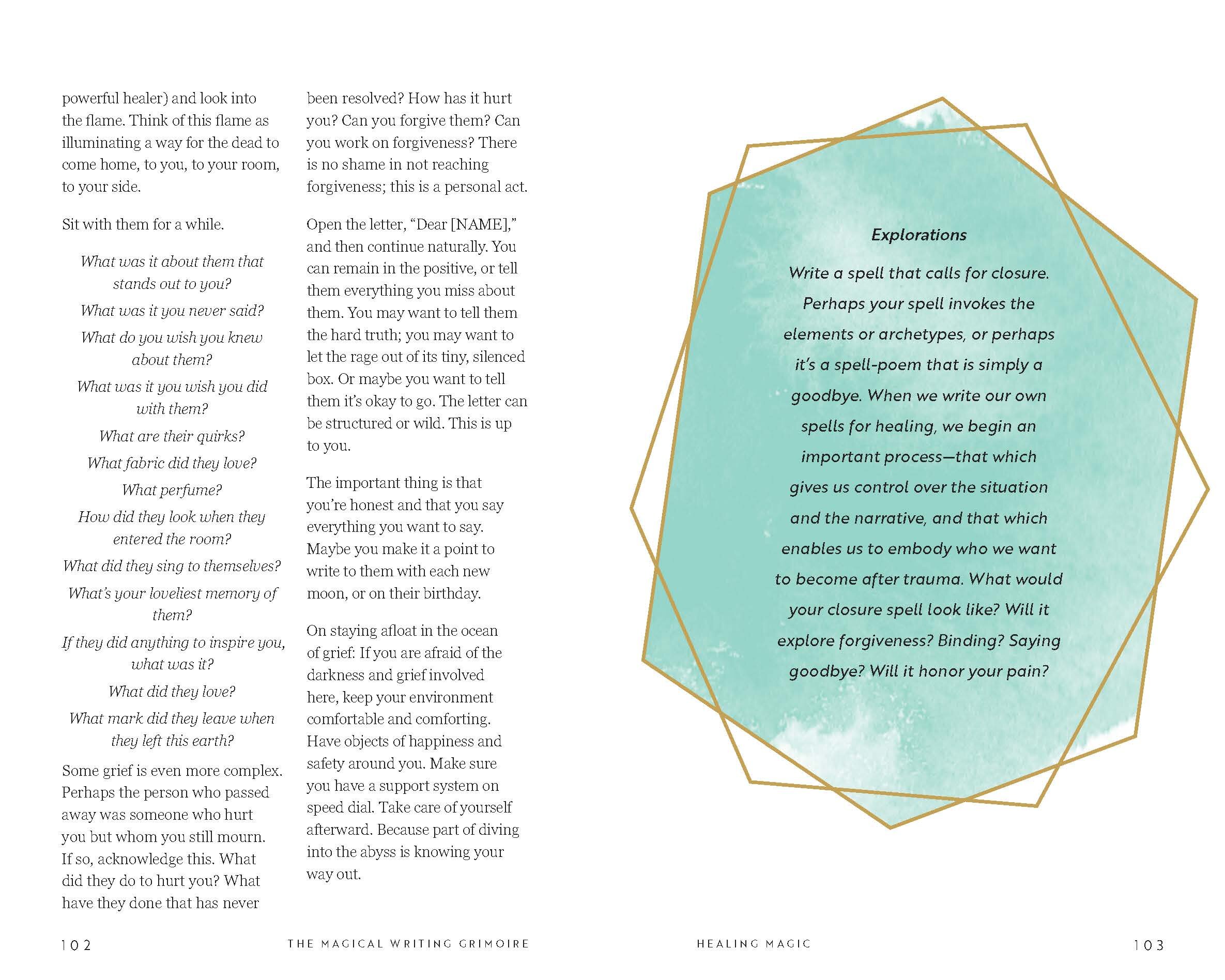
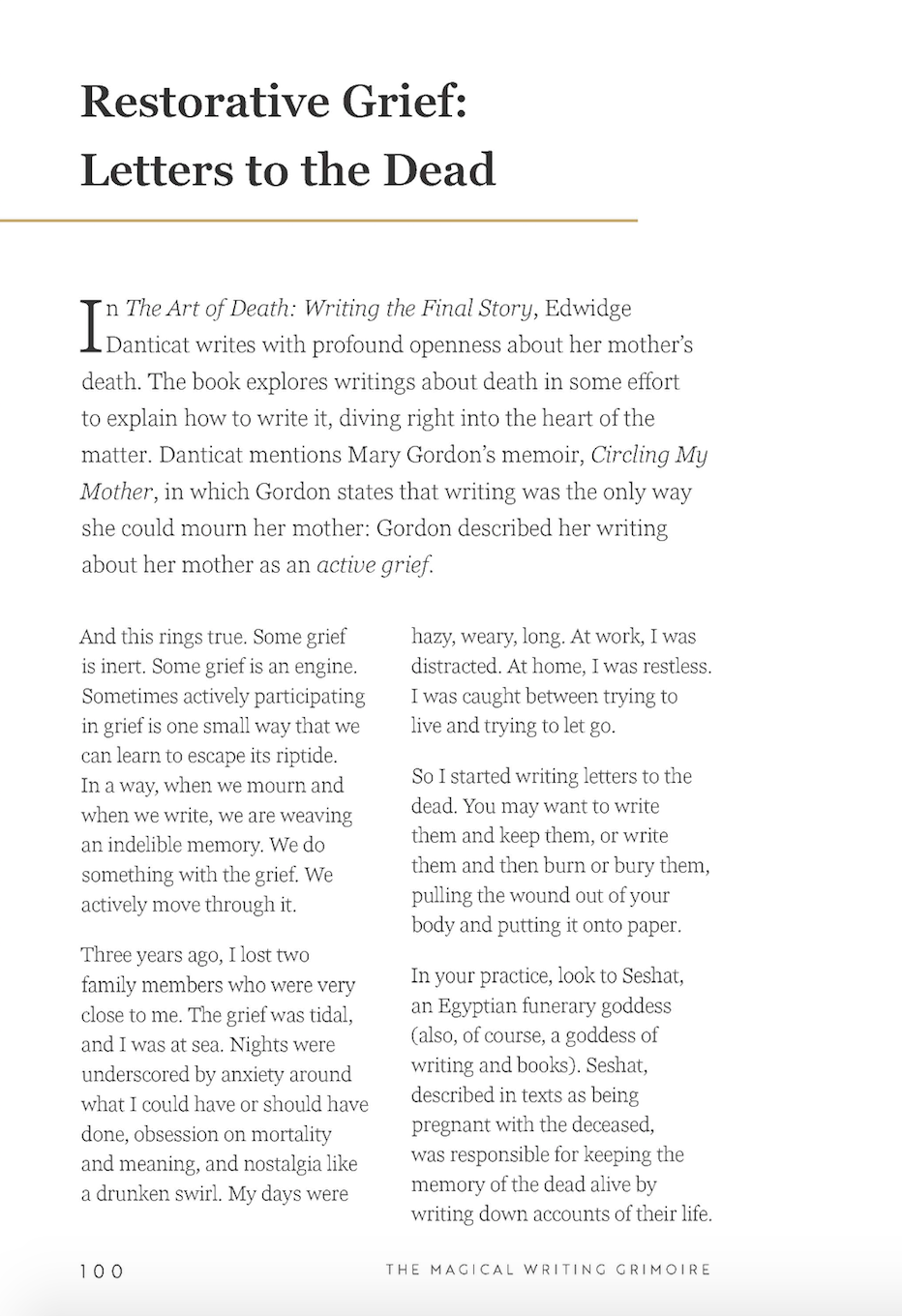
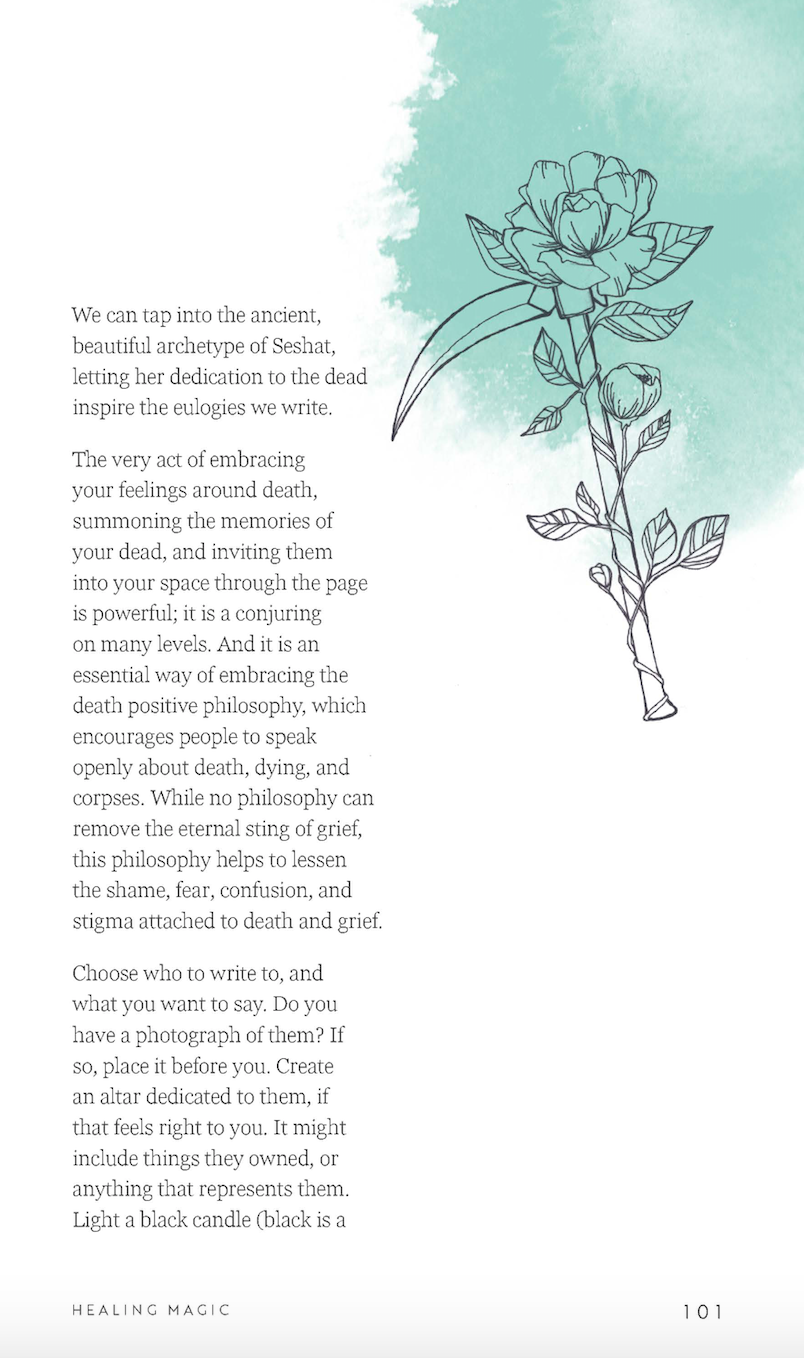
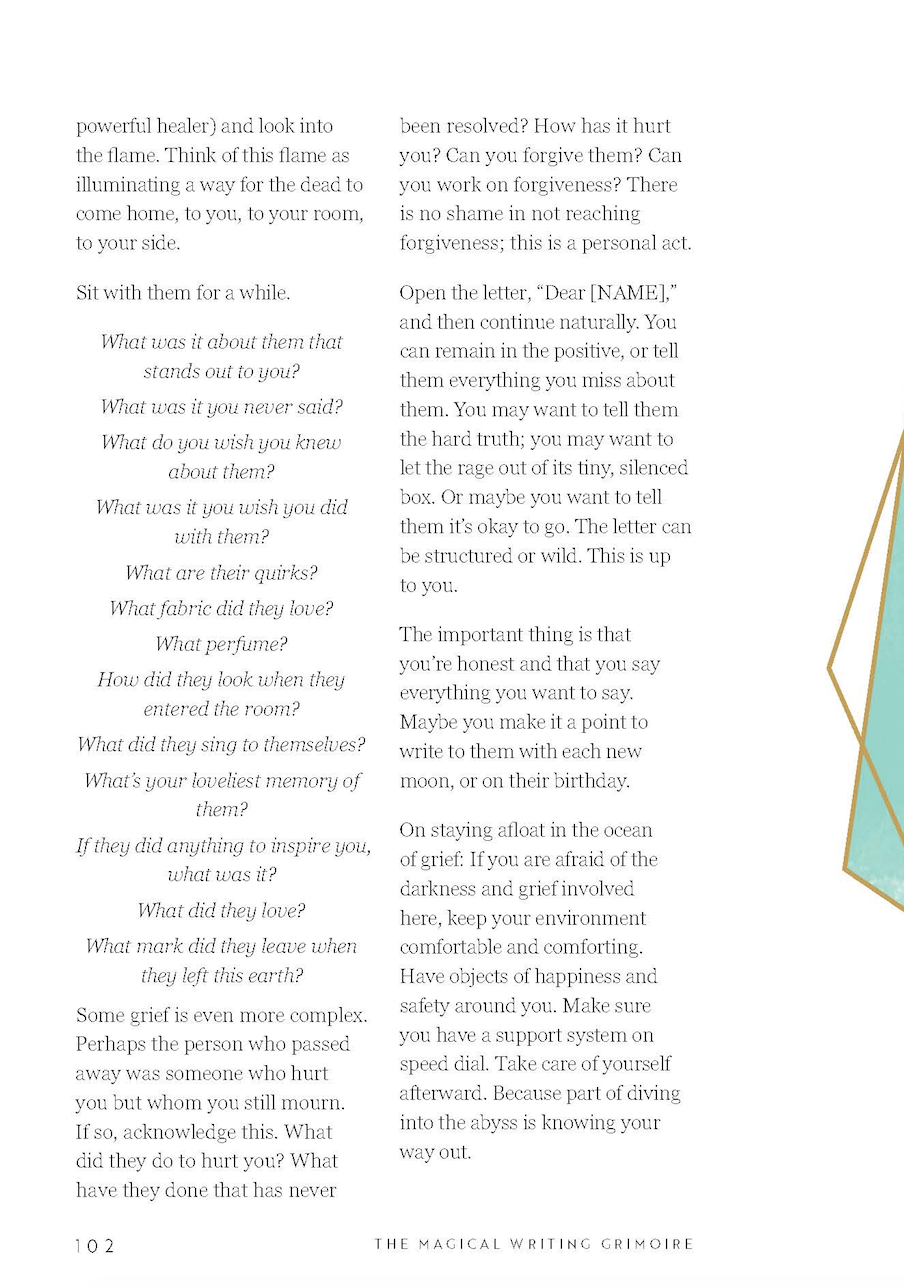
For this reason, I’ve included a ritual — Restorative Grief: Letters to the Dead — from my book, The Magical Writing Grimoire below. Maybe you’ll use it for someone you’ve lost in the past, or perhaps you’ll write a letter to the collective dead, to the many who have lost their lives in your city or community. Whatever you use it for, I hope it helps you find some stability and insight.

Below, I’ve included the original text for the ritual, along with the final pages from my book. Feel free to share and copy/download them.

Restorative Grief: Letters to the Dead

InThe Art of Death: Writing the Final Story, Edwidge Danticat writes with profound openness about her mother’s death. The book explores writings about death in some effort to explain how to write it, diving right into the heart of the matter. Danticat mentions Mary Gordon’s memoir, Circling My Mother, in which Gordon states that writing was the only way she could mourn her mother. Gordon described her writing about her month as an active grief.

And this rings true. Some grief is inert. Some grief is an engine. Sometimes actively participating in grief is one small way that we can learn to escape its riptide. In a way, when we mourn and when we write, we are weaving an indelible memory. We do something with the grief. We actively move through it. 

Three years ago, I lost two family members who were very close to me. The grief was tidal, and I was at sea. Nights were underscored by anxiety around what I could have or should have done, obsession on mortality and meaning, and nostalgia like a drunken swirl. My days were hazy, weary, long. At work, I was distracted. At home, I was restless. I was caught between trying to live and trying to let go.

Grief is a sickness that grows without a cure. It affects more than the body, more than the mind. It affects the essence of us, our starstuff, our souls, our hearts, our energy. It metastasizes over a lifetime, and with each new death, it takes a new organ. 

So I started writing letters to the dead. You may want to write them and keep them or write them and then burn or bury them, be pulling the wound out of your body, and putting it onto paper.

I like to look to Seshat, an Egyptian funerary goddess (also, of course, a goddess of writing and books). Seshat, described in texts as being pregnant with the deceased, was responsible for keeping the memory of the dead alive by writing down accounts of their life. We can tap into the ancient, beautiful archetype of Seshat, letting her dedication to the dead inspire the eulogies we write.

The very act of embracing your feelings around death, summoning the memories of your dead, and inviting them into your space through the page is powerful; it is a conjuring on many levels. And it is an essential way of embracing the death positive philosophy, which encourages people to speak openly about death, dying, and corpses. While no philosophy can remove the eternal sting of grief, this philosophy helps to lessen the shame, fear, confusion, and stigma attached to death and grief.

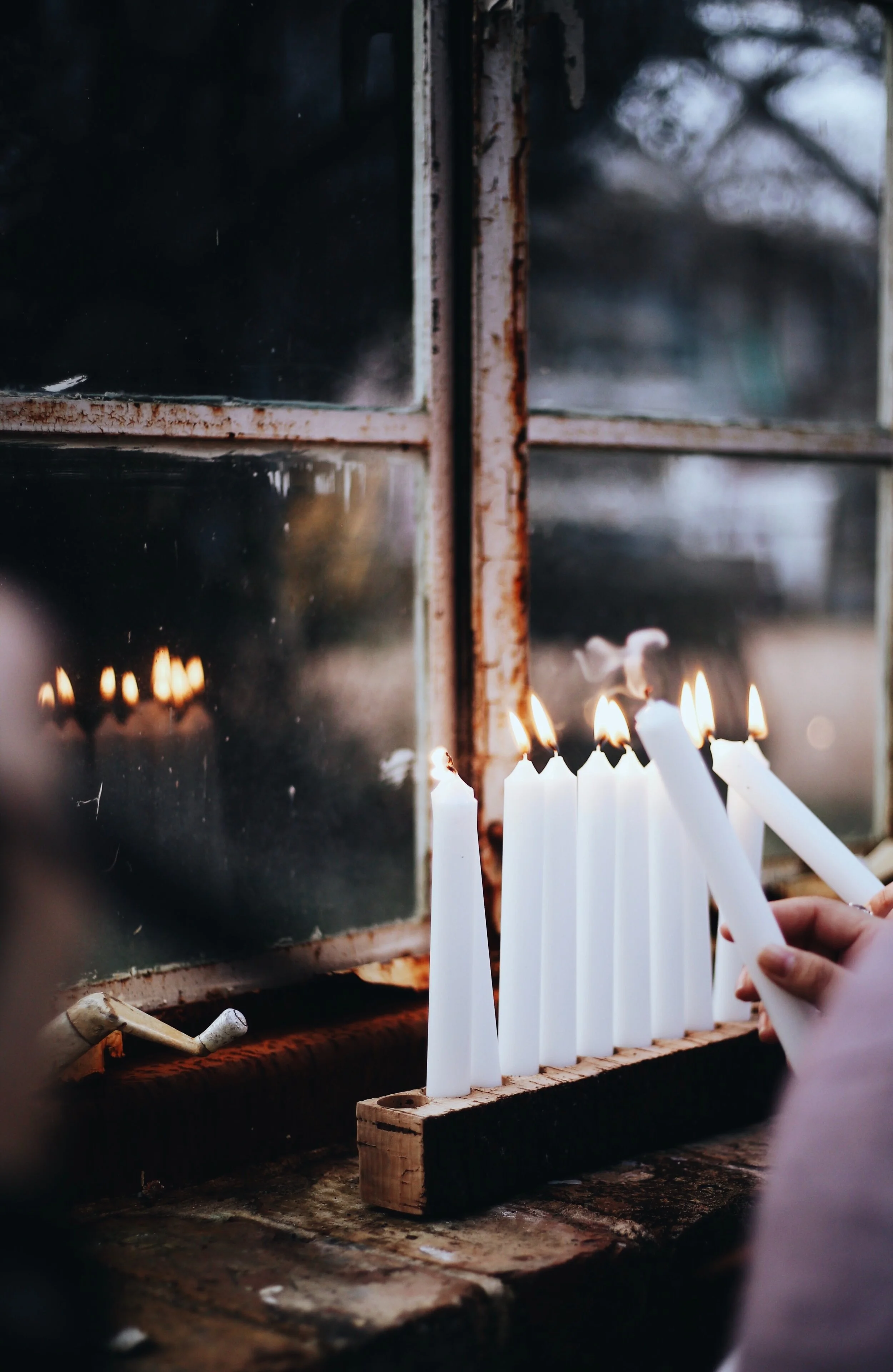
Choose who to write to, and what you want to say. Do you have a photograph of them? If so, place it before you. Create an altar dedicated to them, if that feels right to you. It might include things they owned, or anything that represents them. Light a black candle (black is a powerful healer) and look into the flame. Think of this flame as illuminating a way for the dead to come home, to you, to your room, to your side.

Sit with them for a while. 

What was it about them that stands out to you? What was it you never said? What do you wish you knew about them? What was it you wish you did with them? What are their quirks? What fabric did they love? What perfume? How did they look when they entered the room? What did they sing to themselves? What’s your loveliest memory of them? If they did anything to inspire you, what was it? What did they love? What mark did they leave when they left this earth? 

Some grief is even more complex. Perhaps the person who passed away was someone who hurt you but whom you still mourn. If so, acknowledge this. What did they do to hurt you? What have they done that has never been resolved? How has it hurt you? Can you forgive them? Can you work on forgiveness? There is no shame in not reaching forgiveness; this is a personal act. 

Open the letter, “Dear [NAME],” and then continue naturally. You can remain in the positive, or tell them everything you miss about them. You may want to tell them the hard truth; you may want to let the rage out of its tiny, silenced box. Or maybe you want to tell them it’s okay to go. Perhaps they felt they had to stay? Perhaps they suffered? Maybe you simply want to know what it’s like to be dead. The letter can be structured or wild. This is up to you.

The important thing is that you’re honest and that you say everything you want to say. Maybe you make it a point to write to them with each new moon, or on their birthday.

On staying afloat in the ocean of grief: If you are afraid of the darkness and grief involved here, keep your environment comfortable and comforting. Have objects of happiness and safety around you. Make sure you have a support system on speed dial. Take care of yourself afterward. Because part of diving into the abyss is knowing your way out.

A prompt

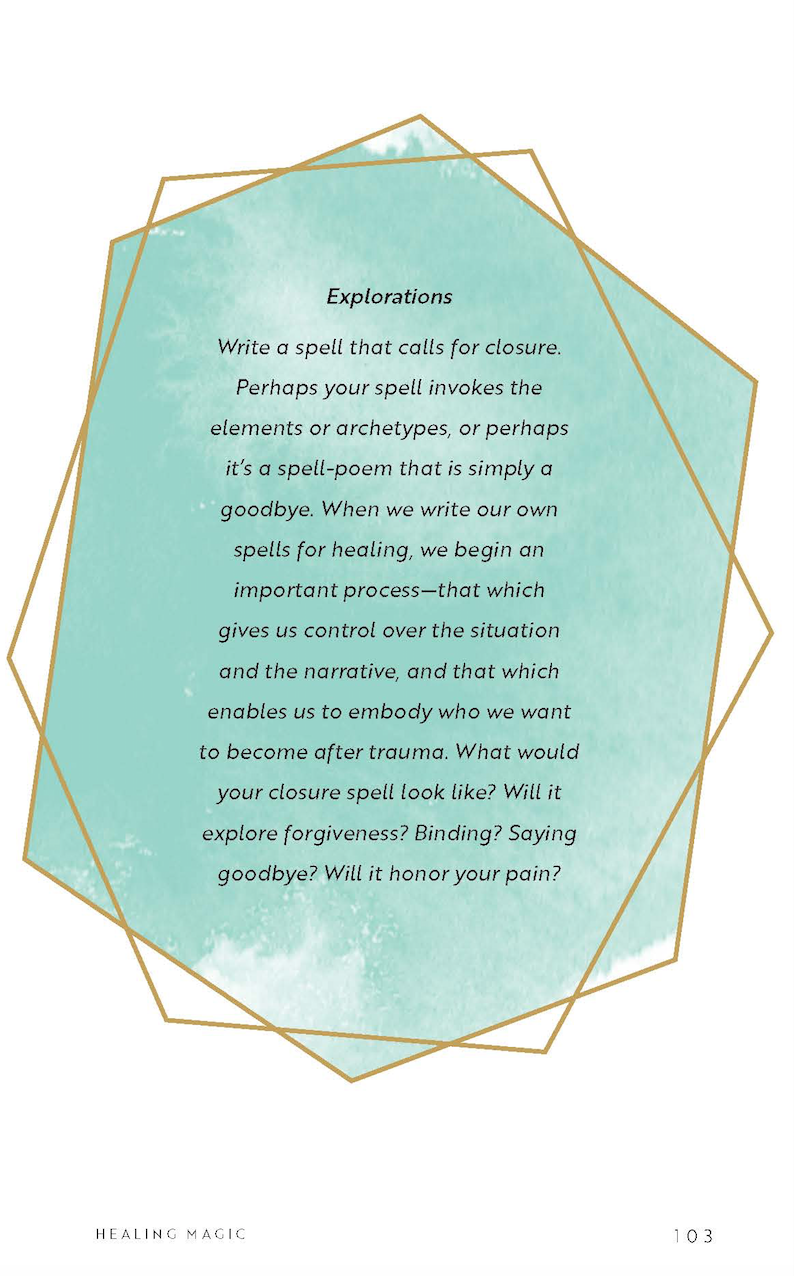
Write a spell that calls for closure. Perhaps your spell invokes the elements or archetypes, or perhaps it’s a spell-poem that is simply a goodbye. When we write our own spells for healing, we begin an important process—that which gives us control over the situation and the narrative, and that which enables us to embody who we want to become after trauma. What would your closure spell look like? Will it explore forgiveness? Binding? Saying goodbye? Will it honor your pain?

Feel free to download the keep the following pages:
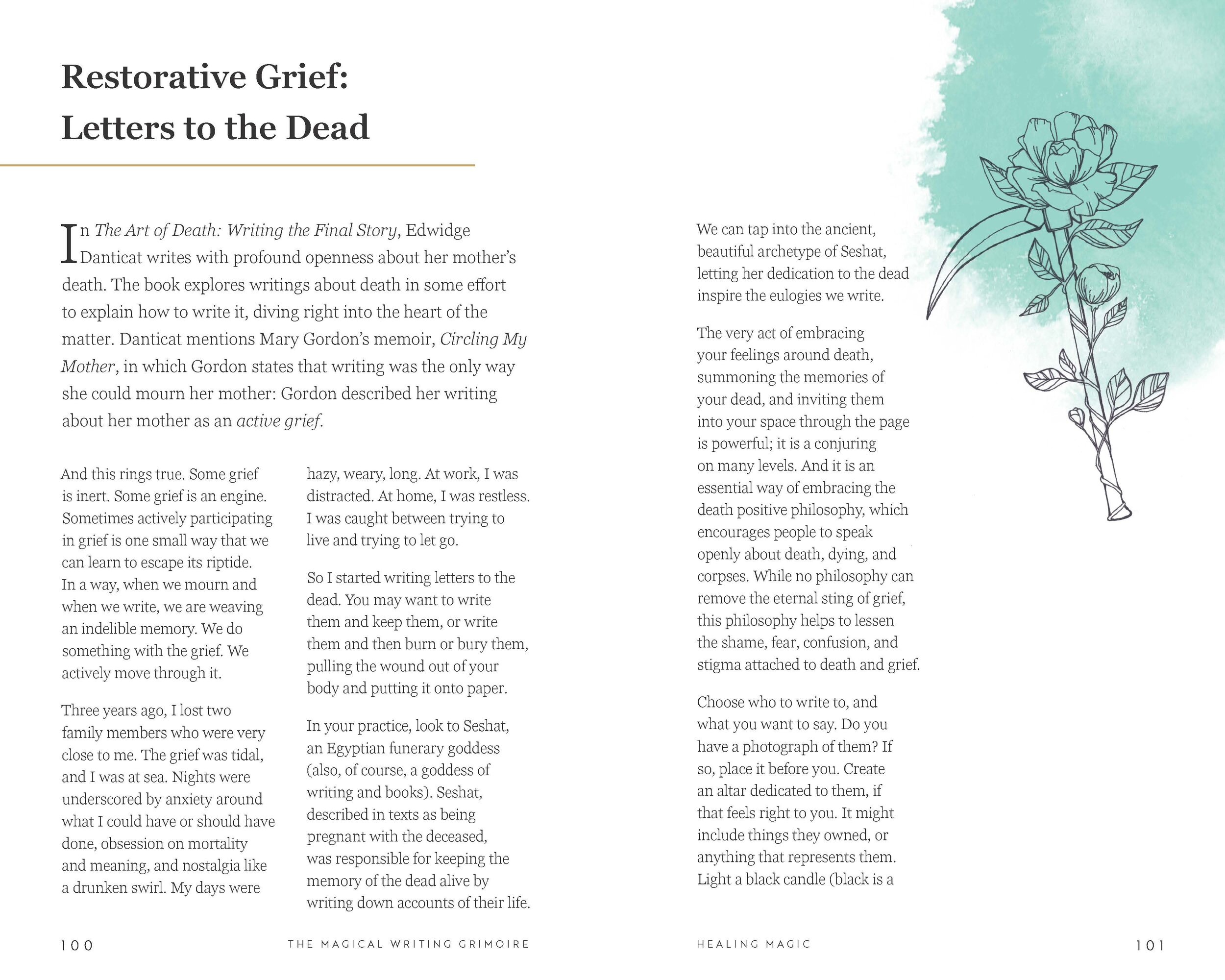
Restorative Grief_Page_1.jpg
Restorative Grief_Page_2 (1).jpg
Screen Shot 2020-04-22 at 3.13.25 PM.png
Screen Shot 2020-04-22 at 3.13.33 PM.png
Screen Shot 2020-04-22 at 3.14.23 PM.png
Screen Shot 2020-04-22 at 3.14.33 PM.png
In Occult, Books Tags death, grief, Rituals, Ritual, the magical writing grimoire, light magic for dark times, lisa marie basile, grief rituals, healing, loss, covid-19, coronavirus
Comment
the magical writing grimoire by lisa marie basile

How To Use Tarot Cards for Self-Care

November 11, 2019

BY LISA MARIE BASILE

I've always been intrigued by tarot cards, especially as they relate to tarot for self-care and introspection. In fact, some of my favorite books are approaching tarot as a healing tool — like the new Tarot for Self Care by Minerva Siegel and Tarot for Troubled Times by Theresa Reed and Shaheen Miro. And if you’re looking for an inclusive, healing deck, here are some excellent resources for the tarot enthusiast or the curious. Also, please make sure you check out The Hoodwitch. Also be sure to read all of our tarot content, including Joanna C. Valente’s tarot horoscopes.

For the longest time, I've turned to tarot cards — usually read by someone else for me — to seek wisdom. I was recently invited to The Witches Almanac Witches Masquerade Ball in Massachusetts (alongside Laura Tempest Zakroff, Christopher Penczak, and Harold Roth), where I received two tarot readings that essentially amounted to one lesson I’d been putting off learning: Stop only identifying with and relying so heavily on the dark; you forget to let the light in. And it’s true.

I don't personally believe that the tarot cards are in communication with some divine force, deity, ancestor or Spirit (although many people do, and that's awesome), but I do believe that pulling a card randomly generates a message or lesson on which I can reflect. In either case, it's divinatory in some sense.

In fact, writer, Strega, tarot reader (and my Astrolushes podcast co-host!) Andi Talarico put it beautifully:

Do I use tarot as divination or reflection? The short answer is both, for sure, though I'm less concerned with fortune-telling than I am with assessing the circumstances that brought us to this moment in time — hence the reflection. I do not believe that our fates are entirely pre-scripted or set in stone or that we are solely at the mercy of the heaven's transits but I DO think there are ways in which we can use tarot to arm ourselves for future issues that present themselves. When tarot is practiced on a regular and continuing basis, you start to see recurring themes and patterns and messages and thus you start to notice obstacles as well as strengths, and therein lie our answers, I believe.

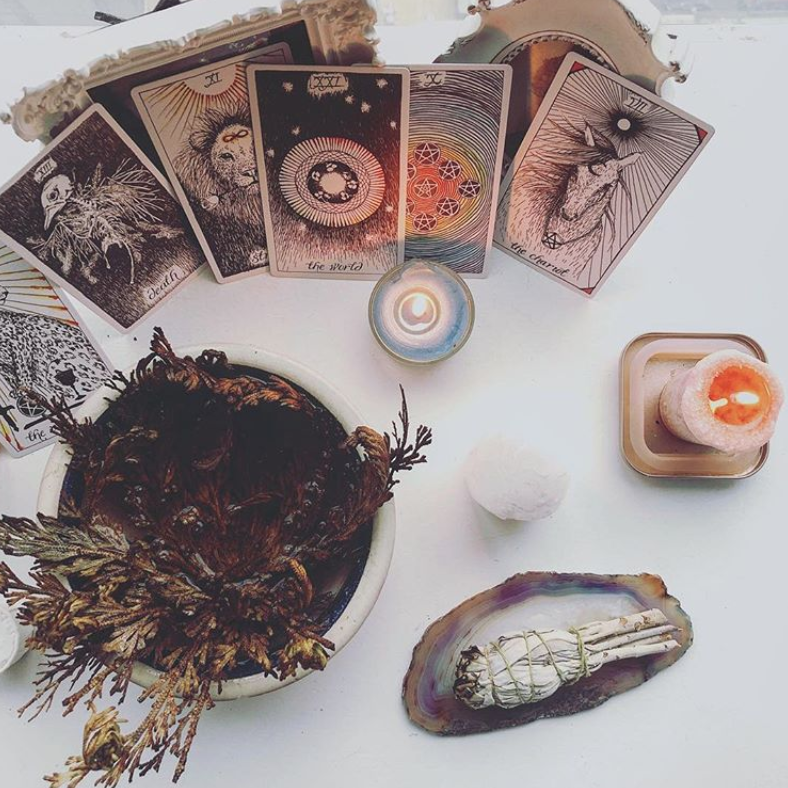
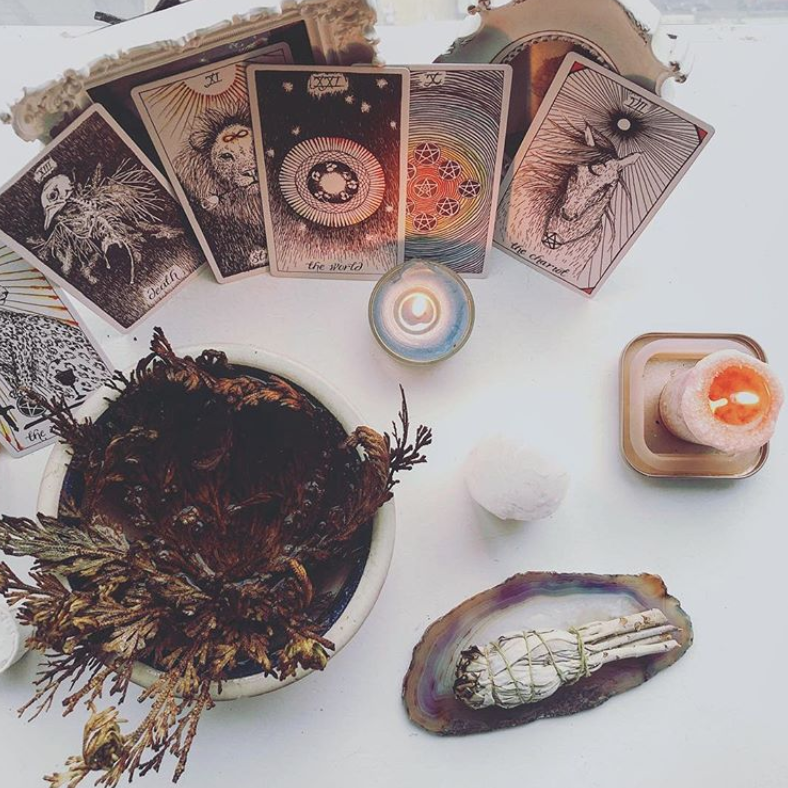
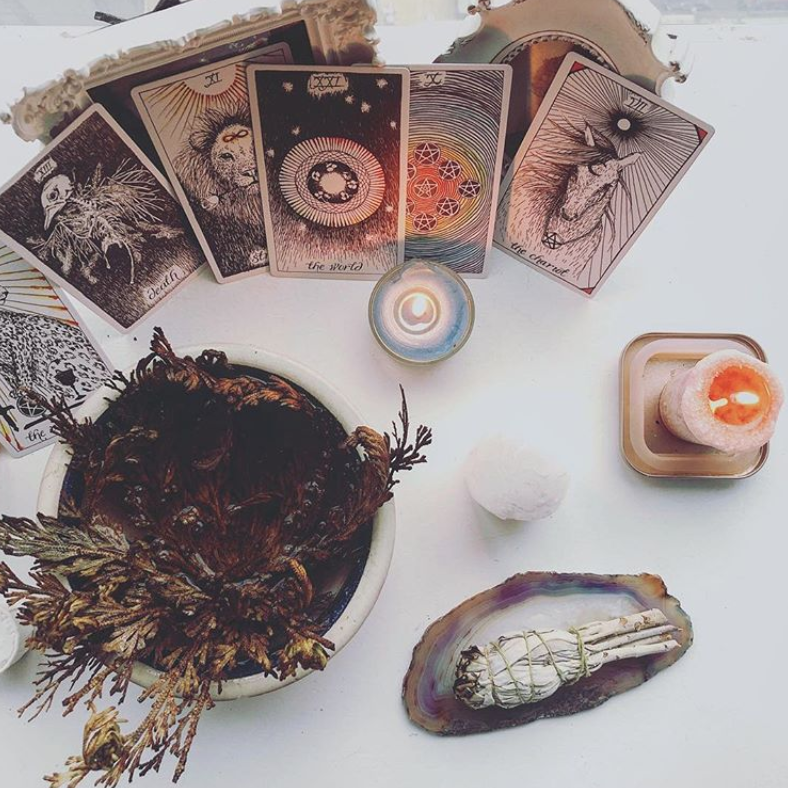
If I'm alone, I'll pull a single tarot card with a specific focus on themes like, say, expansion, transformation, or healing (#Scorpio here). The tarot card meanings that come with each individual deck are certainly something I'll take into account (I personally work with The Wild Unknown, as the animal and natural spirit of the deck speaks to me more than human figures do), too.

I usually pull a card for myself before bed or right when I wake up, depending on my need for clarity. I’ll read the deck’s guidebooks, but I also use my intuition and knowledge of symbols when interpreting the cards. How do the images make me feel? What is the lesson that I find myself falling into after pulling a tarot card or cards? What do the colors say to me? Are there recurring themes?

What is the history of tarot?

People have turned to tarot for hundreds of years, which comforts me; I love that something can remain so sacred throughout time. The cards were said to have originated around the early to mid-1400s in Northern Italy. They have their roots in something called Il Trionfos, or Triumph cards. There is also some research that suggests the playing cards belonged to the Islamic soldiers who made their way into Italy.

But were they always divinatory in nature? I’m not entirely sure, but according to a Mary K Greer, a tarot scholar, “While there are rare indications early on that both playing cards and tarot were used for divination and character delineations (in poems called Tarocchi Appropriati), true “reading” practices were not widely known until the late 18th century.”

Cartomancy, which refers to the use of playing cards in divination, has a pretty fascinating history. It suggests that cards are more than just fun and games. I certainly don’t see it that way.

Tarot cards present ways for us to connect to our deep truths, feelings, fears, and desires.

As Shaheen Miro and Theresa Reed write in Tarot for Troubled Times, "Tarot holds a mirror up to our selves, and when we engage with the insights we find there, we can take a significant step in healing ourselves and healing the world."

lisa marie basile

But more importantly, tarot asks us to trust our gut…and look inward.

And that's integral to proper self-care. As Cassandra Eason writes in the book Little Bit of Tarot, "Tarot reading is a matter of trusting yourself and what you feel as opposed to what you think or try to deduce from the cards."

Even if this self-reflection is uncomfortable, it's necessary. It makes self-care possible. Moreover, the major and minor cards that help with this contain a specific image with symbology. And many of the cards contain archetypes.

The Lover, the High Priestess, and the Tower are just a few of the archetypes the cards depict, depending on the deck.

Depending on the deck (again, there are hundreds of iterations), each card offers us a glimpse at ourselves. Do you associate with a specific archetype? Or maybe the better question is, How can you find yourself in each and every archetype within the Tarot? When you can look into the mirror through the lens of each card, you meet yourself.

So, how are you supposed to use tarot cards for self-care?

Studying the tarot can help you find what works best. In general, though, there's no right or wrong way to use a deck. So go with your gut! According to Biddy Tarot, "Tarot is simply a tool, and as with all kinds of tools, how you use it is completely up to you."

I personally tend to follow two ‘rules’: When using a tarot deck, remember that your intuition is key. Always be willing to listen to the voice within. If something jumps out to you, pay attention. Oh, and be prepared to get deep. If something in your tarot practice is uncomfortable, ask yourself why. If a card brings up a specific feeling, don't run from it. Jump into the abyss and learn from it.

So, I asked lots of witchy, magical folks about their use of tarot cards for self-care (you can see the whole thread here), so I'll be including their tips (and my own) below. Remember that you can amend or adjust these ideas as necessary!

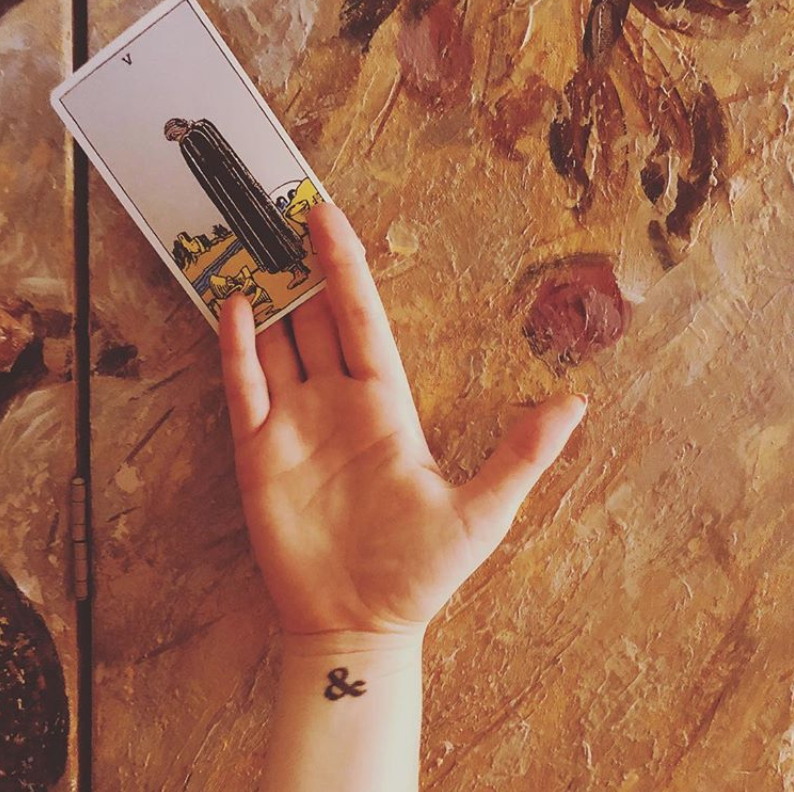
Pull a card each morning. Then reflect on its message throughout the day.

Pull a card and let it sit with you as you drink your coffee and get ready for work. Feel free to check out its meaning in your guidebook and then combine that with your own interpretations. If you pull a card, it's great to keep its lesson in your mind throughout the day. Often, it gets clearer as the day goes on.

Pull a series of cards every morning and reflect on them while journaling.

Gaby Herstik, the author of Inner Witch, pulls four cards every single morning and then journals about their message. A good idea is to get a journal specifically for tarot reflection. Journaling can help us drill down into our true feelings — and give them a name.

As I discuss in my book, The Magical Writing Grimoire (which you preorder now!), writing can help us find truth and autonomy in our feelings. That's because our words have inherent power and magic.

When we write, we create something out of nothing. The physical act of writing also forces us to be intentional with how we express ourselves (although you're more than welcome to use a computer or voice recorder when journaling, too).

lisa marie basile

Here are some tarot journaling prompts:

What do these cards mean to me?
What do these cards remind me of?
How do these cards inspire me?
Where in my body am I feeling these cards and their message?
What emotions are they bringing up?
What can I learn from these cards?
How I can make a change to my behavior or thought patterns today?
Why am I resistant to the lessons in these cards?
Am I forcing myself to pull new cards because I don't like their message? 

Use the tarot to disrupt your stagnant and negative thoughts.

We all fall into patterns of thinking that may be limiting or self-deprecating. Maybe we think we're not good enough.

We may fill our minds with thoughts that we'll always be too frightened to take the next step. Or maybe we're too negative toward others. The tarot can ask us to disrupt those ways of thinking.

When you pull a card, pay attention to how it challenges you.

How does a card resonate with you? Does it force you to think outside the box? If so, lean into that. Don't worry if it makes you uncomfortable. Just be sure to reward or soothe yourself for the time you took to peer inward. Draw a bath, dance, or listen to something beautiful.

Pull a card and then practice automatic writing.

Automatic writing, simply put, is a method of writing that asks us to enter a different mental state in order to generate words or channel ideas. 

Simply pull a card and write with censorship. Let the messages stream through you. The point here is to meditate yourself into a trance-like space where you feel receptive. Simply begin writing after pulling a card. Whatever words, phrases or ideas pour out is what you should write. Afterward, meditate on the results. How do they make you feel? What can you learn from them?

Use the tarot when you’re experiencing anxiety.

Obviously, tarot is NO replacement for medical care, so just remember that. But one of the replies on my Twitter thread said, “I use it for grounding when I‘m triggered! I carry my deck in my backpack and when I’m having a meltdown/crying in a coffee shop bathroom I can pull a card to find the medicine in that moment."

Simply pull a card when you feel overwhelmed and let it ground you. Pay attention to its feeling in your hand. Its colors. Its message. Its mood and tone. Perhaps you will want to pick a card you associate with positive feelings.

Use the tarot to connect with friends on a deeper level.

Self-care isn't always just about the self. It's about receiving and giving love. It's about creating a life that feels authentic, sustainable, safe, and beautiful. And it's about cultivating inspired and deep friendships. To start, pull a card with a friend and discuss it together with an open mind. How do you both react to the card? What feelings does it bring up? How can you both relate and learn from one another, based on the card?

Create an altar with a tarot card each week.

This altar can simply be made up a few flowers or crystals — anything that feels right — along with a tarot card of your choice. It should be a card (or an archetype) that speaks to you.

Prop the tarot card upon your altar. Surround it with things you love, things that bring it power, and pull its magic into your everyday life. Consider it as you pass the altar each day. What is its message? What does it stand for?

Pull a card during the new moon.

The new moon is a time for fresh beginnings, rerouting ideas, starting new ventures, and putting energy to good use. Pull a card on each new moon and let it guide you. Think about this for the next few weeks.

Make this ritual with each new moon. This way, you'll always have something to think about and reflect on. This allows us to check in with nature (always good!) and find healthy ways to reframe our thinking.

View this post on Instagram

Journal prompt & tarot magic: . I’m no tarot expert, but I do find a deeply replenishing and clarifying therapy and magic in tarot. I don’t read tarot for others, but I have slowly been learning it and connecting to it in a deep and personal way. It has become less about the guide book and more about my intuition. The archetypes have become friends who wander in and out of my life asking to be seen. What do they want to tell me?

A post shared by ritual poetica (@ritual_poetica) on Nov 5, 2019 at 9:23am PST

Pull three cards to find clarity under duress.

Sometimes when we're totally overwhelmed, we get lost in obsessive thoughts. Sometimes we just need to slow down and ask ourselves the big questions. It can help us parse through what is real and what isn't. According to Tarot mentor Sarah M. Chappell, she asks three questions, "What do I think is going on? What is actually going on? What, if anything, should I do about it?" Think about it — these are pretty useful.

Tarot readings in ASMR videos are soothing, too.

If you haven't checked out ASMR, you should. ASMR stands for autonomous sensory meridian response. It's a fancy way of saying, "sounds and movements give you a tingly, pleasurable feeling." There are plenty of oracl and tarot reading ASMR videos out there. And in those videos, people tend to do a little whispering. The intention? To get listeners to relax. Not only will the whispering tone lull you into a slumber, but you'll also learn more about the tarot.

Just make sure you find a deck that speaks to you. 

Find a deck that speaks to you and soothes you so that you can turn to it anytime. I love The Wild Unknown and The Amenti Oracle (which isn't exactly a Tarot deck, though) for this purpose.

In the end, tarot is about taking the time to check-in with yourself.

According to Jodie Layne at Bust, "Whether you take the tarot super seriously or just enjoy the time you get to spend with yourself, checking in with the cards is really about checking in with you."

If you check in with yourself, even for a few minutes each day, that's beneficial. When we disconnect from the phone, computer, and constant deluge of information — we give ourselves a chance to be quiet, contemplative, and honest. Tarot provides that respite.


Lisa Marie Basile
is the founding creative director of Luna Luna Magazine--a popular magazine focused on literature, magical living, and identity. She is the author of "Light Magic for Dark Times," a modern collection of inspired rituals and daily practices, as well as "The Magical Writing Grimoire: Use the Word as Your Wand for Magic, Manifestation & Ritual." She can be found writing about trauma recovery, writing as a healing tool, chronic illness, everyday magic, and poetry. She's written for The New York Times, Refinery 29, Self, Chakrubs, Marie Claire, Narratively, Catapult, Sabat Magazine, Healthline, Bust, Hello Giggles, Grimoire Magazine, and more. Lisa Marie has taught writing and ritual workshops at HausWitch in Salem, MA, Manhattanville College, and Pace University. She earned a Masters's degree in Writing from The New School and studied literature and psychology as an undergraduate at Pace University.

Tags tarot, Tarot, Tarot Reading, Tarot Deck, theresa reed, gaby herstik, shaheen miro, tarot for self care, minerva siegel, tarot for troubled times, light magic for dark times, the magical writing grimoire
Comment

Astrological Shadow Work: Healing Writing Prompts

September 9, 2019

BY LISA MARIE BASILE

Astrology helps us look at the many luminous (and perhaps limiting) narratives that impact and define humanity. Hanging above us in the stars in an illustrated fabric of what it means to be human: To want, to hurt, to self-destruct, to transform, to find justice, to intuit, to survive. You don’t need to ‘believe’ in astrology, though (although of course, if you’re here, you probably do turn to it from time to time).

Like tarot, these narratives offer a system by which to reflect. And let’s be honest — it’s fascinating.

And because each and every sign offers lessons and ideas on our potential (and perhaps our limitations), you can use these prompts in several ways: You can work with them for your sun, moon, or rising signs, or you can use every single one, as the moon enters each sign almost every two and a half days. 

An example: If you don’t have any Scorpio in your chart, for example, you can still use its prompt; just wait for the moon to enter Scorpio. Use the Scorpio energy to reflect on its prompt. Each sign offers valuable lessons and insights.

Below, prompts around the deeper, heavier, murkier aspects of the sun signs. Want more like this? The Magical Writing Grimoire (it’s out in 2020 and the cover/title isn’t finalized, but any of you witchy writers you can add it to your list!) includes magical and ritual writing prompts, practices and guided meditations.

Aries

What, in your triumphant, hard blaze, are you hiding from? Is there a softness you can grant yourself? What would it look like if you could undress in the light of flexibility? Does it pay to hold tight and remain stoic, or are you limiting yourself? 

Taurus

What happens when ugliness seeps in? What will you do to honor it without losing yourself? Can you handle the lack? What happens when there’s nothing around to beautify the void? What can you bring out of yourself, organically?

Gemini

When you silence or suppress one part of yourself, how does it feel? How can you worship at the feet of your multitudes? How can you become a chameleon without losing yourself? What does your foundation look like?

Cancer

When you are unsafe, can you find an anchor? If the sea keeps rocking, how can you find your strength without capsizing? How can you learn to let nostalgia bloom without its vines suffocating you? What does safety feel like inside your body?

Leo

Sometimes, you are so busy roaring you don’t hear the small sounds of morning and night. Meditate on this. What’s in front of you? What happens when the radiance machine stops working? Can there be power in the darkness? How can you be proud of yourself even when your crown falls off?

Virgo

In the chaos, there is a song. What does it sound like? Outside of the lines, you find yourself. When you are shapeless, what are you free to become? Can you find worth in the wildness, or hold space for the imperfect self? What happens when you dismantle the cliché?

Libra

What can you learn about yourself when you feel imbalanced? Is there authenticity to be found when you’re not busy balancing and performing seeking and connecting? What is found beneath the robe — and then beneath even that? Who are you when everyone goes home?

Scorpio

You feel the hum of power in the dark, but are you the architect of your own misery? Do you stay guarded in the shadows because it’s safer than letting the light in? Part the curtains. What can grow when you learn to differentiate the well from the water? What happens when you stop being jealous of the sky? 

Sagittarius

How can you learn what it feels like stay — with others, with yourself — when you always want to keep moving? Are you running?  What happens when the ideas and the wanderlust leave you empty? What happens when you stop wearing the mask? Who are you when you take the wings off and stand still?

Capricorn

Imagine the wild, wide desert. You are lost. You are thirsty. You are rescued. What happens when you learn to drink from someone else’s palm? Can you find peace in needing someone or something other than yourself? Can you lean into the softness, the slowness? Who are you when you aren’t in control?

Aquarius

Can you operate deep underground? Can you burrow into the murky waters of fear and love and want? What happens when you get naked and sit in the garden of your dark? When you don’t have a bird’s-eye view, when you comeinrealcloselikethis can you feel the granules? What do they feel like?

Pisces

What does it look like when you step out of the dream world? Can you remain here, and now, when fantasy and reality fail to merge? Can you intuit yourself? Are you able to hold space for your hopes — without crumbling under their impossible beauty? When you look your self-destruction in the face, what do you say to it? 


Lisa Marie Basile is the founding creative director of Luna Luna Magazine--a digital diary of literature, magical living and idea. She is the author of "Light Magic for Dark Times," a modern collection of inspired rituals and daily practices and the forthcoming "The Magical Writing Grimoire: Use The Word As Your Wand for Ritual, Magic, and Manifesation." She's also the author of a few poetry collections, including 2018's "Nympholepsy." Her work encounters the intersection of ritual, wellness, chronic illness, overcoming trauma, and creativity, and she has written for The New York Times, Chakrubs, Narratively, Catapult, Sabat Magazine, Healthline, The Establishment, Refinery 29, Bust, Hello Giggles, and more. Her work can be seen in Best Small Fictions, Best American Experimental Writing, and several other anthologies. Lisa Marie earned a Masters degree in Writing from The New School and studied literature and psychology as an undergraduate at Pace University.

In Occult, Astrology Tags Astrology, astrology, grimoire, writing prompts, zodiac, shadow work, magic, witchcraft, the magical writing grimoire
Comment
Featured
‘in the glitter-open black' — poetry by Fox Henry Frazier
'poet as tarantula,  poem as waste' — poetry by  Ewen Glass
'poet as tarantula, poem as waste' — poetry by Ewen Glass
'Hours rot away in regalia' — poetry by Stephanie Chang
'down down down the hall of mirrors' — poetry by Ronnie K. Stephens
'Grew appendages, clawed towards light' — poetry by Lucie Brooks
'do not be afraid' — poetry by Maia Decker
'The darkened bedroom' — poetry by Jessica Purdy
'I am the body that I am under' — poetry by Jennifer MacBain-Stephens
instagram

COPYRIGHT LUNA LUNA MAGAZINE 2025