



BY JOANNA C. VALENTE
My first memory of gender and performance comes from the ethereal wonder of The Wizard of Oz as I watched Dorothy win over the affection of everyone she came across with her girlish innocence. I didn’t actually want to be Dorothy, but I was curious about how she embodied desire and affection. I was transfixed by her shoes, these powerful objects that could bring you home. I wanted that redness, that desire. I wanted to be her shoes.
I also wanted to be Glenda, the good witch. She was elusive, strange, beautiful, and good. While she most definitely was portrayed as a woman, she was other. Even then, as a child, no older than four years old, I identified with that sense of otherness. She came from another world, almost like an angel, dwelling over the land of Oz, witnessing Dorothy’s struggle, seeming to understand her every thought in neon-colored candy pastel.
Witches are beyond gender, they are powerful beings; in Glenda’s case, she was neutral, beyond human comprehension. Sometimes, even now, I wonder where she lives, if she lives a thousand lives and identities like an ageless serpent coming out of the moon’s mouth, transforming into other beings. Witches are the embodiment of energy and power, regardless of how that power is used, and vessels for whatever they want to embody. They have a choice. That definition in itself has helped me choose who I want to be outside of the binary - since binaries are just a way to begin to understand the world; the point to progressing, however, is to go beyond the binary. Transcendence is spiritual, but not necessarily religious; it’s just a means to oneself, one’s true self.
Being other, outside of gender and sex constructs, is being explored right now in film and literature everywhere. The remake of Suspiria and Boy Erased, for instance, are two films exploring this right now, fighting against old ideas about gender and power and sex. In Suspiria, the dangers of womanhood, and the powerlessness that women face because of toxic gender ideas, is highlighted in every grotesque way you can imagine.
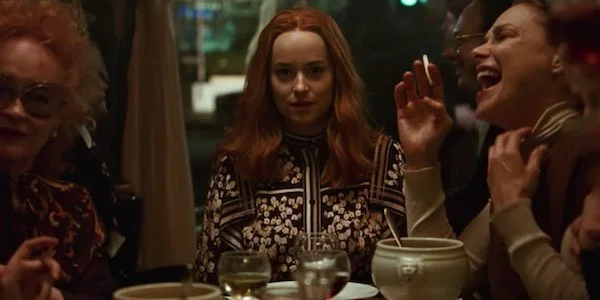
Olga’s body is absolutely destroyed by the other women in the coven, illustrating that toxic behaviors are upheld by everyone in society, by men and women and ourselves. Her destruction is the result of her rebellion, as a dancer and as a woman who rejects the ideas given to her. In a time where rebellious women and queer people are punished for being outspoken, this could not have resonated more.
The strictness of dance is the perfect metaphor for the strictness of the world, and how religion, culture, and patriarchal ideals set a rigid world for anyone who is other to exist in. Tilda Swinton’s performance adds a nuanced complexity to the film, as she sometimes aids in the dangerous destructiveness and pervasive abuse for the need to keep order, to keep power dynamics from shifting to an “other.”
And yet, she also has moments of compassion and a crisp clarity on the abuses happening. In the end, she wants to put a stop to this abuse, only to be overpowered herself. Swinton’s destruction is neither all good or bad (illustrating the complicated cycle of abuse, of the abused becoming abusers), showcasing that everyone becomes a victim in an abusive world.
What’s more: Klemperer, an elderly psychiatrist who followed the events, was confronted by one of the witches, who screamed at him: “You never believe women until it’s too late!” This statement alone sent chills down my spine. How truer and more real could this be? Women and survivors aren’t believed until it’s too late, until they are assaulted or murdered or abused and the damage is already done. Even when the damage is done, there is disbelief. Women’s bodies, and the “other,” are so disposable that no one seems to mind, no one seems to realize the magnitude - because their bodies don’t matter.
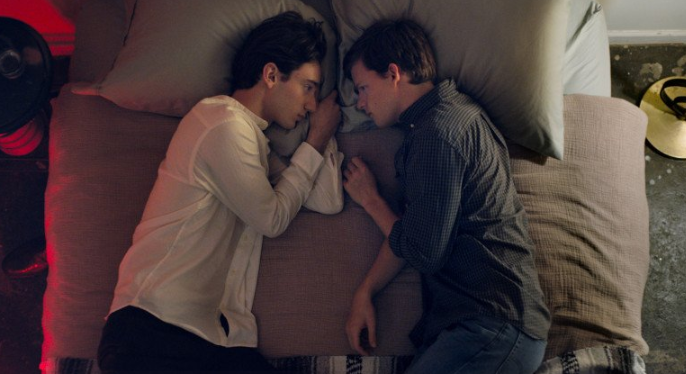
In Boy Erased, we see a similar situation (which is based on Garrad Conley’s memoir of the same name). Jared, played by Lucas Hedges, undergoes gay conversion therapy at the suggestion of his father. Jared is struggling with his sexual identity, wanting so desperately to not be attracted to men. His shame and frustration with his sexual identity is so palpable when he tries to destroy an ad of an attractive man at a bus stop, screaming “fuck you!” into the darkened sky. We feel his hatred of being embodied in that moment, because to have a body means you can’t escape. To be embodied means to become gendered and to have a sexual identity (whether queer, gay, straight, asexual). Jared wishes he was normal, to be embodied without struggle.
2018’s events (like Kavanaugh’s testimony) puts humanity’s Shakespearean drama on display for everyone to see: the gender and sex roles men and women are supposed to play, as if the binary is the only game in town. As if humans can’t be anything else. There has been heavy push back into these roles within the past decade, with LGBTQIA+ awareness becoming more clear.
However, just because there is more awareness doesn’t mean these roles aren’t still ever-present even within the queer community. We are forced to navigate and negotiate our identities to survive enough in this world, to pass enough to live regardless of the spaces we exist in.
All of us perform; it’s one thing that binds us together regardless of our identities. We perform our identities, even if they are identities we have chosen. As someone who identifies as nonbinary, I’ve run into an interesting quandary that I thought I finally avoided: I realized when I identify, I would always say “femme” to qualify it, both as a way to “describe” my nonbinary identity, but perhaps a way to pass. I realized recently that I am still confining myself into a box, even if that box has a door outside.
Am I continuing to perform a certain aesthetic because I have to, because it’s easier? There are no answers to these questions of course, as it’s so hard to completely separate from expectations, even when we create those expectations. Once someone else sees you a certain way, and has expectations of you, it’s hard to undo that image.
Realizing this has allowed myself to process my own limitations with language and need to belong in a passable way; I feel freer. I feel like I can finally start to express myself in a way that bows to no one, little by little. We will always exist within a box, but hopefully, with time, we can widen the boundaries.
The symbol of the witch and the symbol of the drag queen/king are similar as they are both fluid; they are the construct of the beholder, of how the spirit or the mind chooses to be embodied. Gender and sex, while performances to some extent, are like clay; they are always changing. So while it is a performance, we can also only learn about ourselves through the performance to begin with. We do everyday, as partners and friends and workers and parents. After all, don’t we perform everyday at our jobs, regardless of what those jobs are?
The origins of witchcraft and drag are ancient, and as old as we are. Witchcraft, or paganism, dates back to humankind’s existence. Any religion or ritual is a way for humans to understand the world around us and harness energy for a greater means beyond us. Drag is similarly spiritual and transcendent; in his book Drag Diaries, according to Pop Sugar, author Jonathan David focuses on its origin points, which are dated back to “ancient ceremonies (Native American, indigenous South American, and Ancient Egyptian) and Japanese theater.” David stated that "cross-dressing was widely documented among the Aztecs, Incas, and Egyptians, among other great civilizations of the past, and exists today in tribal ceremonies around the world."
Whether we are calling upon the other to become closer to nature and the universe, to become ourselves, or to accept who we are and who we love, performance is a necessary means to process nuance. The dangers of being ourselves can be mitigated by performance, but we are also burdened by this performance at the same time, as seen in films like Boy Erased, Suspiria, and The Wizard of Oz. Who are we when the masks are taken off, when we allow ourselves to undress?
Who are we without performance and ritual?
Joanna C. Valente is a human who lives in Brooklyn, New York. They are the author of Sirs & Madams, The Gods Are Dead, Marys of the Sea, Sexting Ghosts, Xenos, No(body) (forthcoming, Madhouse Press, 2019), and is the editor of A Shadow Map: Writing by Survivors of Sexual Assault. They received their MFA in writing at Sarah Lawrence College. Joanna is the founder of Yes Poetry and the senior managing editor for Luna Luna Magazine. Some of their writing has appeared in The Rumpus, Them, Brooklyn Magazine, BUST, and elsewhere. Joanna also leads workshops at Brooklyn Poets. joannavalente.com / Twitter: @joannasaid / IG: joannacvalente / FB: joannacvalente