


















BY COOPER WILHELM
The times we’re in are bad. Climate change is looming; fascism is on the rise; income inequality is getting worse; rents are going up; drought, famine, antibiotic-resistant diseases, artificial intelligence...the roster of apocalypses has gotten crowded. More and more, people are wrestling with the conclusion that the road we’re on right now leads only to ruin. If we’re going to save ourselves, and save each other, things need to change in big ways, and fast.
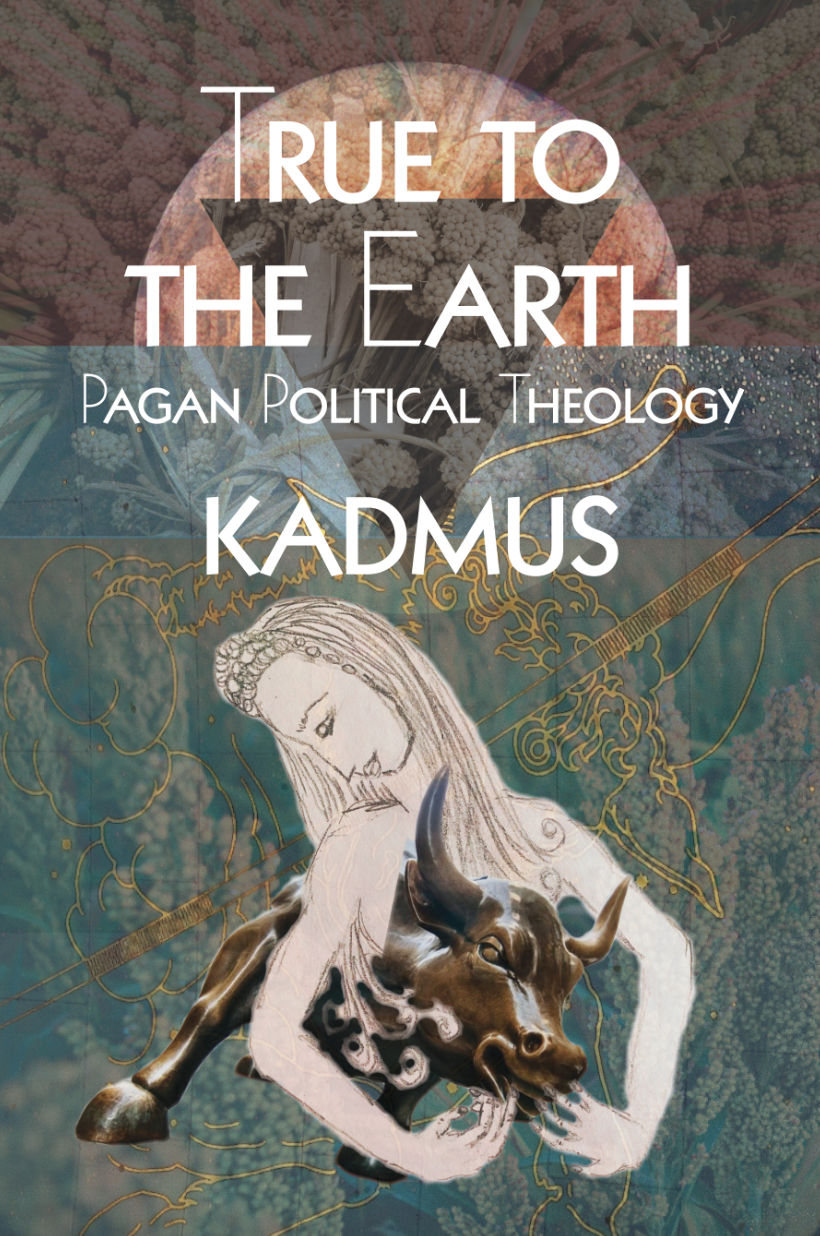
Enter True to the Earth: Pagan Political Theology, a new book which offers a bold solution to the troubles we’re in: a return to high-pagan ways of seeing the world and our place within it. The book’s author—a neopagan and practicing ceremonial magician (think summoning demons with a magic circle and the Order of the Golden Dawn, not Penn and Teller)—is quick to point out that the high paganism he advocates for is not Wiccanism or the paganism of a particular place at a particular time. Rather, he points to a number of what he calls “high pagan societies” and how their shared insights might give us the tools we need to remake the world and avert (more) catastrophe.
On a rainy day in Brooklyn, I sat down with the author, Kadmus, to talk about him, high paganism, magic, and his new book.
You wrote this book under a pseudonym. What prompted that?
I’ve had some people assume “oh are you worried you’ll get into trouble cause you’re criticizing capitalism” or something like that, and that’s not the motivation at all. The motivation is actually that I’m a professional academic in philosophy and the world of philosophy can be surprisingly dogmatic and surprisingly closed. I don’t have these statistics exactly right, but I wouldn’t be surprised if 80% of contemporary philosophers are naturalists. In other words, they’re committed to the idea that science has a monopoly on truth, and most questions worth asking can be answered by science. So if I was known in the world of philosophy as being a ceremonial magician, as being a committed pagan, there would have been consequences to my professional career that I wasn’t ready at the time to deal with.
Did your practice as a ceremonial magician or as a pagan affect or influence this book?
I think so. There’s a few aspects to this. One is I am very much a practicing ceremonial magician, and by and large the tradition of ceremonial magic tends to have, especially these days, an experimental aspect to it. What this means is that throughout my own life and my own career, I’ve worked with spirits and gods from many different cultures, from many different traditions. And I think that this made me already very open to seeing that there are shared insights throughout pagan cultures globally.
Not that they’re all the same—radically different; important differences—but when you really look at the orality of those societies, you see that there are shared metaphysical commitments.
And I think I was more open to that because, within my own life, I had already worked with spirits from several different cultures, from several different historical time periods. So I think that this informs the pluralistic approach of the book.
Another part of it is that I’m not writing this purely as an academic or intellectual endeavor. I am to the best of my ability living this worldview, to the best of my ability living within it, and a lot of the spirits I talk about and the gods and goddess are ones who I have very close relationships with.
Do you feel as though any of these spirits and gods had a say in this book?
Yes. I found, just as a matter of fact (not that this was planned), that a lot of the Interludes were inspired by, suggested by, directed by different spirits and divinities that I was working with.
What I would want to avoid saying is that anything in here would count as something like revelation. This isn’t dictated by them. But there’s support. There was support and encouragement and suggested insights.
I say early on in the book that I’m very skeptical—and I think we should be—of claims to authority via revelation. And that’s not because revelation doesn’t exist, I’m not saying that those things aren’t there, but I don’t care who’s revealing stuff to you. I have to come at it from where I am, and engage with it critically.
And I think that this comes from a more pagan view VS a monotheistic view—I’m not one for the acceptance of authority, especially on questions that we can think about, based on claiming divine dictate or something like this. Even if a god or goddess speaks to me, I’m going to critically engage with what they say. There’s not a spirit out there that I would accept what they say unquestioningly.
The gods are personalities, they have agency. And they’re up to stuff. They’re up to different stuff and they disagree. They’ve got agendas. Just like dealing with a group of people you have to think about what folks are up to and what parts of it seem to fit with what seems meaningful and of value to you.
I was watching Rosemary’s Baby for the first time last night, and it made me think about your book because there’s that scene where Rosemary is doing all this research on witchcraft, and she gets to a point where she demands that her husband take off his shirt to see if he has a witch’s spot. And there’s this sense that if you’re a witch, you absolutely have to have one, that to be a witch you have to believe some particular thing. Which is something I think your book is against.
Yeah, so, there is a difference between offering alternative ultimate truths like this is some new ultimate truth that someone should adopt VS entering the view from which you can see that there is no ultimate truth, there’s a plurality of truths that are fundamental to the universe, and it’s an ever-growing, ever-differing and changing collection of truths. This second position is the one offered by the book.
This pagan way of looking at the world is one you ascribe in the book to “high paganism.” And when you say, “high paganism,” you’re talking about something specific. What is that as opposed to paganism in general? Like, Plato is not a part of this.
There’s a period everywhere on the planet, in every culture, that was oral, before there was writing. Writing causes some really fundamental changes in the way we think, in the way that we view reality, in the way that we experience reality, right down to the bedrock of our experience. What I began to realize was that what seemed to be truly pagan cultures, what seemed to be most committed to these ideas of pluralism and plurality of truth in reality itself, were all oral societies, were all pre-writing.
So, high paganism is a period in any culture when the culture is oral, and that orality contributes to certain ways of seeing the world that I understood to be high pagan.
What are some of the biggest differences in how a high pagan society sees the world compared to a literate society?
The most basic difference is that oral societies are concrete and action-based, whereas in literate societies what writing allows us to do is have abstract nouns. You can talk about “goodness” all of a sudden as if it were a thing, rather than talking about how it’s good to act or what’s an example of good events in life.
We can give abstract definitions of a triangle and say that two sides of a right triangle have a relation to the other side and blah blah blah….If you were to do that in an oral society it would have to be a story. It would have to be some sort of story about the behavior of the sides or the triangle, so the one side stands firm and courageous and faces the other side in a certain way. It would have to be concrete. It would have to be about action.
This gets at something I really liked about this book—that one of the ways that high paganism can respond to and alleviate a certain amount of the alienation people feel in the current circumstances is with the way that high paganism understands how a body or a thing is defined.
The high pagan understanding as I’m defining it tends to be relational. So a thing is what it is based on what it does, and the relationships it has with other things, and its context in the world around it. So rather than defining something in terms of, say, the base matter it’s made out of, or the purpose for which it is designed—designed either by an ultimate creator or designed by us or designed by nature—you instead understand it in terms of the way it behaves and the relationships it has with other things.
A late-pagan thinker already is usually committed to what I call a monotheist metaphysics. Aristotle, who’s what I call a late-pagan thinker, thinks the entire universe is unified, that everything has a purpose that is internal to that thing, and if you want to understand what a thing is you understand its purpose. We look at a fruit tree, and Aristotle is going to say What is the function of a fruit tree? What does a fruit tree do that is unique to a fruit tree? And it’s make fruit. So, a good fruit tree is going to make good fruit, a bad fruit tree is going to fail at making fruit, and that’s the ultimate essence of a fruit tree.
A high pagan view of a fruit tree is going to look instead at all the other connections and relationships. Obviously we care about fruit trees partially because they make fruit. They’re important to the animals they feed with the fruit as well. But there's all kinds of other relationships that tie in there, and some of those are going to be cultural relationships—the role of the fruit tree in a society that isn’t just about providing fruit but is instead about its mythic history, for example. Or something like the other relationships: the squirrel that lives in it, the shade that it gives, and so on and so forth.
All of these relationships are going to be branching, and growing, and altering over time. So the nature of that fruit tree is going to be increasingly complex, increasingly pluralistic. The same can be said about us. We are the relationships we find ourselves within and tend. We are what we do in the world and how the world responds to us.
Do you feel that this sort of reductive purpose-driven or substance-driven view of the nature of things is widely applied to human beings right now?
Yeah absolutely! One way that we see this is that thinking that everything has an essence that pins down its purpose and is therefore the basis from which we can judge its goodness or badness shows up in society and shows up in our political approaches to society. That there is the right way to formulate a society, to structure it, the right political form; there is the right answer to how our society should be organized—we just have to figure that out and force anyone who disagrees into that structure in one way or another. This is the history of 20th-century politics and a lot else. This attempt for the “pure society” where you have some pre-set idea of what the purity is, what the purpose is, what the appropriate structure is, and you have to in some way destroy or heal or re-educate or fit in anything that doesn’t fit that perfect pure society.
Because the bottom line is that once you know (or once you think you know) what a thing’s nature is, then you come up with a very simple view. And the view is that anything that is closest to that nature is good, and anything outside of it is bad. You have to oppose this badness. So diversity itself, pluralism itself, becomes a mark of impurity or disorder or chaos
Whereas high paganism embraces this diversity.
Embraces it both as fundamental to reality—it’s always going to be there, you’re never going to be able to do away with it—but also embraces it as the source of the most important things in life.
For example, I talk a lot about the idea of council, and the Akan civilization talks about wisdom as something that can’t reside in any one person’s head. So if you want to be wise, you can’t do it, only a collective can. And the more diverse that collective is, the more pluralistic that grasp of reality, the wiser that council, that collection of viewpoints, is.
So, it’s both an unavoidable aspect of reality—it’s pluralistic, it’s irreducibly pluralistic—and it’s also the source of strength, of fertility, of growth, and of wisdom.
And this even goes to the level of the gods. You do an Interlude about the Greek Magical Papyri, and one of the points you make is that multiple gods from multiple cultures are brought up in a non-hierarchical framework.
Yeah, there are some exceptions, but by and large what’s striking about the Papyri is this wild multiplicity of gods from totally different cultures and traditions all thrown in together without some overarching system that would organize them in terms of importance and power and who rules who.
And this is actually an aspect of high pagan culture. We’re used to monotheistic religions that are hostile to alternative views. But it is a huge part of archaic or high pagan cultures, this curiosity, and even greed, for new gods and new traditions and new practices. So it’s both an openness to them, but it's also a hunger for them. Someone comes through Athens and says hey there's this weird tradition I picked up somewhere in Persia and they’re willing to give it a try. They’re willing to see what things look like from within that tradition.
Kwasi Wiredu, who’s an amazing philosopher who deals a lot with African philosophy and African culture, talks about the fact that the Akan society had what he calls an empirical or experimental attitude towards gods and spirits and religious practice, where if something is working, if you go to it for help—or if you go to it for healing, or for wisdom, or whatever you’re going to it for—and it’s useful for you, then it ends up increasing in value, and importance, and increasing in attention.
On the other hand when those things fail, you begin to withdraw from them. So it’s not in line with the way that faith is thought about in a monotheistic context, where whether God “fails you” or not, you owe absolute obedience and devotion, and if it seems like you’re being failed, if it seems like your prayer hasn’t been answered, it’s a test, it’s a test of your obedience and devotion.
In a pagan culture it’s not seen that way. The idea is that look, if these gods aren’t alive in my life, if these spirits aren’t alive in my life, if these practices aren’t meaningful in my life, if they're not doing something for me, if they're not intimately involved in the meaning of my world—I don’t owe them anything. There’s a sense that that idea of devotion to something that is precisely refusing to be present is a fool’s game.
So, in this high pagan culture, the gods are very present. You describe how there can be a god of rivers generally, and there can be a god who is a particular river, the river itself rather than, say, a magic god-person floating above the river.
And this isn’t an absolute distinction, gods aren't going to fall into the one category or the other constantly. But very often our modern perspective on pagan gods that are identified as gods of mountains, or the goddess of a river, or Gaia who is goddess of Earth, is that they are somehow the spirit of that thing: there’s the Earth and then there’s a conscious, intelligent spirit that is separate but maybe inhabits that thing.
Gaia is clearly identified by the high pagan Greeks as the Earth. When you dig in the Earth, you’re digging in the body of Gaia. She is described as “broad-bosomed” meaning the mountains and the hills. And this isn’t symbolic. Oral societies are not symbolic, they do not use symbolism, they are concrete and literal. So when Gaia is the Earth, she is the Earth, a living entity with a body that is the Earth.
We see a great example of this in the Iliad. There’s a scene where Achilles fights the river Scamander. And it’s not that some spirit steps out of the river, some, like, divine representative of the river. No, it’s the river! The waves are crashing on him as if a horde were attacking him and he is struggling in the river. The river itself is the god and the god is the river.
The gods were embodied, and many of them were directly understood to be the thing that was identified as divine. So, the Earth is divine, it is a goddess, it’s a living body—that is what Gaia is.
Then you get distinctions. Poseidon is a god of the ocean. It’s probably wrong to say he is the ocean. If you think about an engagement with Poseidon, it’s usually going to be something like a fairly anthropomorphic manifestation of the ocean, which is how a lot of neopagans think about all the gods, missing the fact that that works for some, but it doesn’t work for all.
Speaking of neo-paganism, because this ties in a bit to the political moment, there has been in recent years a connection between neopaganism and far-right politics, especially fascism. The Nazis used Norse sigils in their iconography, there’s the Soldiers of Odin, a far-right group that also uses Norse mythology…
You see this in Greece, too, a lot of far-right movements that identify with a return to Greek pagan religion.
...But your depiction and conception of high paganism, and the sort of high paganism you advocate, would seem to be an antidote to this, or at the very least certainly not part of this.
I would hope so! Part of what motivated the book was trying to get clear in my own mind about the full extent of the mistake you make when you think that to be engaged with the old Norse gods you have to fit into some sort of racial profile or nationalistic commitments.
Part of what I really try to stress is precisely the way in which purity, and the politics of purity, play such a key role in these fascist reinterpretations of paganism, and how foreign that would have been, how utterly opposed to the main insights of a pagan culture. The Norse gods were not pure, that were a mixing of various sorts, children of giants and so on and so forth. We also see the background of the Norse gods in the Æsir and the Vanir, who are two different families of gods. And there’s debates about which one is foreign, but it’s clear that at some point in time one of them was foreign and the other wasn’t. And the relationship between them wasn’t one of conquest and dominance, even though some people try to interpret it that way. It ends up being a compromise with exchanges of family, and this gives rise to some of the most distinct powers of the Norse gods.
So, my point is that the cultures that gave rise to these religions were not themselves committed to racial purity, they weren't committed to nationalistic purity. But also that the theology within these religions is opposed to these concepts of purity, to these concepts of firm boundaries between peoples to begin with….or between anything. The type of purities that obsess fascism wouldn’t have made any sense to high pagan cultures.
How else do you see the lessons of high paganism being applied in a contemporary context? How could someone apply these in their own life, maybe in a way that is anti-fascist, anti-capitalist, or anti-prejudice?
There’s a few things to say here. We can see that there are certain things that are very difficult for us to think and to experience and to see in the world that other cultures and other time periods could think and see much more easily. In and of itself that doesn’t convince us that we should adopt it, but it does allow us to begin to see the failures and the limitations of our own ways of seeing the world and the cost of them. So often nowadays what you find is that people want to use the very principles and very ways of seeing the world that got us into problems in the first place, that have led to disaster—they want to use those same ways of seeing the world to solve the problem. And it’s not going to work.
For example, with global warming, very often the dream is that it’s just some new technological order we need, some new collection of inventions. And it’s not to say that those things might not be helpful. But what got us into this problem in the first place was seeing the world as an object for use, as a source of raw material, and if the answer is well we just have to manage our raw material better, you’re gonna fail. Seeing that we’re already making that assumption requires seeing that there’s another way to see the world.
This is just an argument for why the history matters, because it gives us access to different ways of understanding reality. Which might be better, might be worse. I argue that there are some specific ways that it’s better, and there are some limits and failures as well, so it has to be a critical endeavor.
What’s the most direct way to apply this? There are a few things I can say.
One is that if you’re seeing the world in a pluralistic way, then you have to give up on the idea that what you think or what you understand is sufficient for solving any problem. And the same thing applies to this book. This book is insufficient for addressing the problem and for developing a full grasp of what a truly pagan worldview would be. It’s part of the process; it’s insufficient by itself.
And I see this in my students all the time. I’ll have someone who’s very deeply religious, and who’s also committed to freedom of religion and freedom of speech, and it’s a good thing, but when you dig into what their thinking is, their thinking is Look, I know I’m right, I’m committed entirely to the fact that I am right, and I’m giving other people the chance to realize that they’re wrong. Freedom of opinion and freedom of religion is a chance for everyone else to come to see that I’m right.
Now, there’s a fundamental failure there. If you’re going to gather folks together to try to solve a problem, and each of them thinks they’re right, and is open to debate and discussion with the sole aim of getting everyone else to realize that they’re right, you’re not going to come up with a solution. And you’re not going to be able to progress in that conversation.
On the other hand, what I think pagan cultures teach us is that there’s a radically different view when you admit from the start, and everyone does just as part of the framework, that every single one of the views present, every single one of the grasps of reality present, is incomplete. And that we need each other and we need an increased complex grasp on the situation to address it.
So an immediate, concrete, in-our-daily-life way to approach this is by accepting the limitations of our own position and accepting the vital necessity of the truths of others, the insight they have into reality.
You make this really interesting point in the book that there is this connection between divinity and what happens when you lie, whether or not your lies can become reality. Which is interesting, especially in the current climate where you have basically competing realities at play in the mainstream media.
That’s actually my favorite Interlude. There’s a whole Interlude about truth and lie and the role of lying and deception within a pagan worldview. And you see many examples of this, but when you lie to a god, if you do it well, it’s not always that you’re tricking the god—you’re able to, in some cases, trick divinities—but if you can lie to a god or a goddess and get them to accept the lie, that becomes a reality. At that point it's no longer you lying, it’s making a change.
A great example of this is Hermes and the Homeric Hymn to Hermes. Hermes just lies nonstop, and Zeus knows immediately he’s lying, and is really pleased and smiles to see how well Hermes is lying. And what that story ends up being about is that Hermes creates a space for himself on Olympus through telling these lies, and engaging in theft, and it makes space for him. And he ends up being a god.
We see this with Loki too, right, where you have someone who is not a god but essentially lies his way in.
Yeah. Another example that I love is the transformation that occurs of the Furies into the Eumenides. The Furies were these ancient goddesses that were very dangerous and their job was to enforce the oldest laws of the gods. And part of these laws were things like you don’t kill family members. So if you kill your mother or father, it’s the Furies that get to punish you.
And all this leads to this climax where the Furies are trying to punish someone, and Athena and Apollo do not agree that the person should be punished (this is all in the Oresteia). And the way that peace is brought about is that the people of Athens start calling the Furies the “Eumenides,” which means the ones who bless, it’s the good-minded ones, and the good-spirited ones, and the ones who bring blessings and all of this. And these aren’t blessing spirits.
It’s like when someone is being barked at by a big dog and they say, “Nice doggie!”
Yeah, exactly. And it works!
The official mythology is that the Eumenides are the Eumenides in Athens, that they are friendly to Athens. And they bless marriages and they bless new births, and there's all of this new meaning that comes with their new title. And it comes from lying to them, saying oh, you’re beautiful, you’re a force of blessing. And they accept the lie and become a force of blessing.
And one of the good things about this book is that there is a kind of despairing fatalism afoot these days—climate change seems inevitable, our politics don’t seem representative and aren’t terribly effective anymore—and one of the things that the book brings up is that you have access to all these tools: the lie that becomes reality, the fact that you can stand up to a god, you can fight that river and win.
Right, and we see these examples throughout cultures: times where the gods are defeated. Times where you can side with one god VS another. Rebellion is absolutely always a choice. And this is an important thing that we get from paganism—rebellion is always an option. There’s no value in absolute obedience.
In monotheism, rebellion is always foolish because the only source of existence is the one god. So there’s this sense in which there can be no victory against that force, so you simply have to obey, there’s no choice. This trickles down into politics, even in our contemporary world.
That’s not the pagan worldview. There, there are many sources of power. The sources of power rise and fall, and shift and change. So, if you’re in a tight spot, rebellion against the gods, some of the gods VS others, is always an option.
And that tied in with the idea of change becomes really important, because there’s this sense of fatalism. This comes from all different areas. Part of it you can see in certain types of Marxism, too, the idea that there’s a deterministic nature to history, things are going in a certain direction, and even if they change that change was determined by the structure of the universe, or something like this.
And what paganism as I understand it is committed to is the idea that the structure of the universe constantly changes. It’s been changing since whatever the start might be and it will go on changing, which means that no matter how determined something seems, the rule of reality is unexpected, unpredictable alteration. Which means that no matter how grim things be, tomorrow might be a world of difference.
Cooper Wilhelm is an occultist, researcher, and poet in NYC. He is the author of three books of poetry, including DUMBHEART/STUPIDFACE (Siren Songs/2017). More at CooperWilhelm.com and on twitter @CooperWilhelm
Kadmus is a published academic with a Ph.D. in philosophy teaching at the college level. He is also a practicing ceremonial magician with a long standing relationship to the ancient Celtic deities.