• Home
  • indulge
  • new poetry
    • About Luna Luna
    • resources
    • search
  • editor
  • dark hour
  • submit
Menu

luna luna magazine

  • Home
  • indulge
  • new poetry
  • About
    • About Luna Luna
    • resources
    • search
  • editor
  • dark hour
  • submit
delicious new poetry
'the doors of the night open' — poetry by Juan Armando Rojas (translated by Paula J. Lambert)
Nov 29, 2025
'the doors of the night open' — poetry by Juan Armando Rojas (translated by Paula J. Lambert)
Nov 29, 2025
Nov 29, 2025
'we can be forlorn women' — poetry by Stevie Belchak
Nov 29, 2025
'we can be forlorn women' — poetry by Stevie Belchak
Nov 29, 2025
Nov 29, 2025
'I do whatever the light tells me to' — poetry by Catherine Bai
Nov 29, 2025
'I do whatever the light tells me to' — poetry by Catherine Bai
Nov 29, 2025
Nov 29, 2025
‘to kill bodice and give sacrament’ — poetry By Kale Hensley
Nov 29, 2025
‘to kill bodice and give sacrament’ — poetry By Kale Hensley
Nov 29, 2025
Nov 29, 2025
'Venetian draped in goatskin' — poetry by Natalie Mariko
Nov 29, 2025
'Venetian draped in goatskin' — poetry by Natalie Mariko
Nov 29, 2025
Nov 29, 2025
'the long sorrow of the color red' — centos by Patrice Boyer Claeys
Nov 28, 2025
'the long sorrow of the color red' — centos by Patrice Boyer Claeys
Nov 28, 2025
Nov 28, 2025
'Flowers are the offspring of longing' — poetry by Ellen Kombiyil
Nov 28, 2025
'Flowers are the offspring of longing' — poetry by Ellen Kombiyil
Nov 28, 2025
Nov 28, 2025
'punish or repent' — poetry by Chris McCreary
Nov 28, 2025
'punish or repent' — poetry by Chris McCreary
Nov 28, 2025
Nov 28, 2025
'long, dangerous grasses' — poetry by Jessica Purdy
Nov 28, 2025
'long, dangerous grasses' — poetry by Jessica Purdy
Nov 28, 2025
Nov 28, 2025
'gifting nighttime honey' — poetry by Nathan Hassall
Nov 28, 2025
'gifting nighttime honey' — poetry by Nathan Hassall
Nov 28, 2025
Nov 28, 2025
'A theory of pauses' — poetry by Jeanne Morel and Anthony Warnke
Nov 28, 2025
'A theory of pauses' — poetry by Jeanne Morel and Anthony Warnke
Nov 28, 2025
Nov 28, 2025
'into the voluminous abyss' — poetry by D.J. Huppatz
Nov 28, 2025
'into the voluminous abyss' — poetry by D.J. Huppatz
Nov 28, 2025
Nov 28, 2025
'an animal within an animal' — a poem by Carolee Bennett
Nov 28, 2025
'an animal within an animal' — a poem by Carolee Bennett
Nov 28, 2025
Nov 28, 2025
‘in the glitter-open black' — poetry by Fox Henry Frazier
Oct 31, 2025
‘in the glitter-open black' — poetry by Fox Henry Frazier
Oct 31, 2025
Oct 31, 2025
'poet as tarantula,  poem as waste' — poetry by  Ewen Glass
Oct 31, 2025
'poet as tarantula, poem as waste' — poetry by Ewen Glass
Oct 31, 2025
Oct 31, 2025
'my god wearing a body' — poetry by Tom Nutting
Oct 31, 2025
'my god wearing a body' — poetry by Tom Nutting
Oct 31, 2025
Oct 31, 2025
'Hours rot away in regalia' — poetry by Stephanie Chang
Oct 31, 2025
'Hours rot away in regalia' — poetry by Stephanie Chang
Oct 31, 2025
Oct 31, 2025
'down down down the hall of mirrors' — poetry by Ronnie K. Stephens
Oct 31, 2025
'down down down the hall of mirrors' — poetry by Ronnie K. Stephens
Oct 31, 2025
Oct 31, 2025
'Grew appendages, clawed towards light' — poetry by Lucie Brooks
Oct 31, 2025
'Grew appendages, clawed towards light' — poetry by Lucie Brooks
Oct 31, 2025
Oct 31, 2025
'do not be afraid' — poetry by Maia Decker
Oct 31, 2025
'do not be afraid' — poetry by Maia Decker
Oct 31, 2025
Oct 31, 2025
'The darkened bedroom' — poetry by Jessica Purdy
Oct 31, 2025
'The darkened bedroom' — poetry by Jessica Purdy
Oct 31, 2025
Oct 31, 2025
'I am the body that I am under' — poetry by Jennifer MacBain-Stephens
Oct 31, 2025
'I am the body that I am under' — poetry by Jennifer MacBain-Stephens
Oct 31, 2025
Oct 31, 2025
goddess energy.jpg
Oct 26, 2025
'Hotter than gluttony' — poetry by Anne-Adele Wight
Oct 26, 2025
Oct 26, 2025
'As though from Babel' — poetry by Fox Henry Frazier
Oct 26, 2025
'As though from Babel' — poetry by Fox Henry Frazier
Oct 26, 2025
Oct 26, 2025
'See my wants' — poetry by Aaliyah Anderson
Oct 26, 2025
'See my wants' — poetry by Aaliyah Anderson
Oct 26, 2025
Oct 26, 2025
'black viper dangling a golden fruit' — poetry by Nova Glyn
Oct 26, 2025
'black viper dangling a golden fruit' — poetry by Nova Glyn
Oct 26, 2025
Oct 26, 2025
'It would be unfair to touch you' — poetry by grace (ge) gilbert
Oct 26, 2025
'It would be unfair to touch you' — poetry by grace (ge) gilbert
Oct 26, 2025
Oct 26, 2025
'Praying in retrograde' — poetry by Courtney Leigh
Oct 26, 2025
'Praying in retrograde' — poetry by Courtney Leigh
Oct 26, 2025
Oct 26, 2025
'To not want is death' — poetry by Letitia Trent
Oct 26, 2025
'To not want is death' — poetry by Letitia Trent
Oct 26, 2025
Oct 26, 2025
'Our wildness the eternal now' — poetry by Hannah Levy
Oct 26, 2025
'Our wildness the eternal now' — poetry by Hannah Levy
Oct 26, 2025
Oct 26, 2025

Pinterest

'all these lives swell up' — poetry by Marie Nunez

August 25, 2025

Crush/Wound

To set fire to veins is to scorch all fruits off the earth. A succulent desert is born. I eat ice cream every night, thinking, this is how you love in the middle of a dry season. Instead, the sugarmilk dissolves into water, into weight, and suddenly, we are no longer girl but ghostwoman. She wears her own topography, carves and decorates and hides all that she is. In an ancient mother tongue, this would mean supernatural grace. In this world, it only means, caution,

danger ahead.


Without


Absence is heavy when the landline rings at midnight and there, in the hollow silence, vibrates rage on the voice machine. Absence amplifies in the beginning of summer when all your friends celebrate in cataclysmic fashion in their signature youthful rebellion. Absence plateaus into a more permanent sadness come autumn. Absence is the one. Absence is the best friend turned heartbreak turned death because no one taught you the importance of time and momentum until adulthood. Absence is learning everything on your own. 


Absence is–


In The Midst of Healing


I.

I need to shut up before I disappear once again. At the center of myself will always be ghost. Sweetness says to slow down more often. My tongue doesn’t know how to speak these mindful languages, so she invents poetic emergencies to keep her busy. 


II.

Aloneness is allowing myself to be okay. To be more than that. This mood so exotic, I try to liken it to the history of my mothers. The first, always praying. The second, always wandering. The third, now working beyond the man. All these lives swell up. This manyed something gets to be too heavy sometimes. 


III.

The assemblage of my disorders is not to count all the ways I fail to love. But to continue to face the sun with enthusiasm and let that light feed my heart. To flirt between golden & not because yes, even this darkness contributes to my overall essence.


Marie Nunez has an MFA in Writing from VCFA. She has had work published in Kitchen Table Quarterly, Half Mystic Journal, and Ghost City Press. Her debut poetry book, I Bloom in the Dark, will be out December 2025 through Querencia Press. 

In Poetry 2025 Tags Marie Nunez
Comment

By Lisa Marie Basile (via Museo di Roma - Palazzo Braschi)

'something about becoming' — poetry by Isabelle Correa

August 25, 2025

AT 17


I wonder about the masculine
urge to prepare for the inevitable
apocalypse by buying steel bats
and acres of horses, the desire
for inevitability itself,
the engine behind legacy.
By a lake from my childhood
I slipped a boy into my mouth
in the grass in the afternoon
like a dream, like America shot
in the veins at the beginning
of the end. This is history
in my body killing it for fun.
What have we learned so far
from skinny dipping and spinning
doughnuts in the dunes? Church
can be anywhere. My heart belongs
to everyone but me. Mother is a myth
I made myself believe in on nights
I couldn’t fall asleep. Father is future-
less concrete. Last week I bled
in my uniform and left chemistry
early before she got to the elements.
Now I’ll never know the elements.
Oh well. I like to sit in the heavy heat
of the car after everyone else
heads inside. Maybe then
I will teach myself something useful.
Something about becoming.


LEARNING TO EAT MEN LIKE AIR
—title from “Lady Lazarus” by Sylvia Plath

Three girls in our first apartment.
18 last spring. Believers in the sin
of the flesh. We could recite the book

of Romans while drawing
infinities with our hips. We could tie
a cherry stem with our tongues

into a cross. Freshly liberated, we were
learning the basics: how to separate
lights and darks, how to carry keys

like claws when walking at night,
how to take someone
in our mouths as if we did not

exist. We had boyfriends
like splinters in our hands.
In the dark, a hushed we can’t

but we did, and we didn’t break
or burn. Sucking skin,
we spat them out.


Isabelle Correa is a poet from Washington state living in Mexico City. She studied creative writing at Western Washington University, is a Pushcart Prize nominee, and is the author of the chapbook Sex is From Mars But I Love You From Venus. She is a winner of the 2024 Jack McCarthy Book Prize with Write Bloody Publishing for her debut full-length collection, Good Girl and Other Yearnings. Her work has appeared in Hobart, Pank, The Rebis, and more. Find her on Instagram: @isabellecorreawrites and on Substack: A Poem Is A Place.

In Poetry 2025 Tags Isabelle Correa
Comment

Pinterest

'an amalgam double-ravenous' — a poem by Mallie Holcomb

August 25, 2025

bulimia (n.)

from ancient greek boulīmia,
literally “ox-hunger” as an affliction–

from boȗs, “cow”

and Līmos, “starvation;
the goddess of famine.”

an amalgam double-ravenous;
sunken sallow and holy,
hollow-loined, void-bellied
but bovine, waddling still
colossal alone in the
sacred wasteland and taken
by a hunger not human,
but both animal and divine.


Mallie Holcomb holds a B.A. in English from University of North Carolina Asheville. Her poetry has appeared in Ghost City Review, The Bitchin’ Kitsch, and The Emerson Review. Lately she has been working in nonprofits, practicing yoga, and testing the veracity of “we publish both established and emerging poets.”

In Poetry 2025 Tags Mallie Holcomb
Comment

Edwin Austin Abbey 

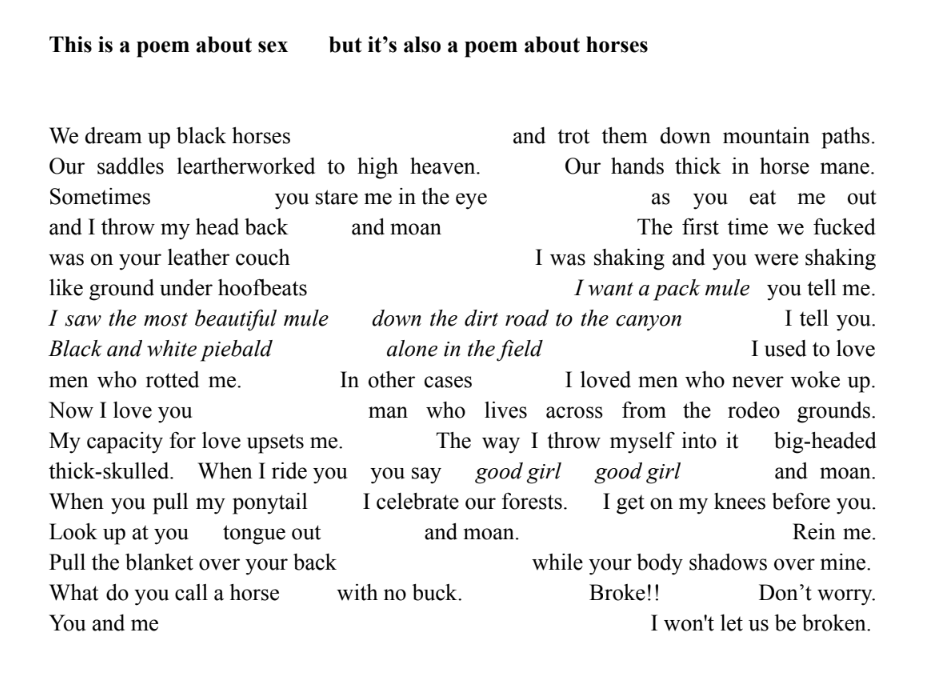
'we dream up black horses' — poetry by Alyssandra Tobin

August 11, 2025

Alyssandra Tobin is the author of PUT EYES ON ME NOT LIKE A CURSE, a chapbook published by Quarterly West in 2022. Her poetry appears in Poetry Northwest, Poet Lore, New Ohio Review, Grist, Fugue, and elsewhere. 

In Poetry 2025 Tags Alyssandra Tobin
Comment

Photo by Lisa Marie Basile

'I felt like I was disappearing' — poetry by Amirah Al Wassif

August 11, 2025

When My Arm Flew Into the Air

When my arm flew into the air,
I calmed myself by believing I must be dreaming.
Any moment now, I would wake to the sound
of the gecko that’s been living in my room
for the past four months.

I haven’t killed it.
I don’t want to.

I didn’t feel like I was flying.
I felt like I was disappearing.

You know that strange training—
when you teach your body to die,
and bit by bit,
you start to feel each part fade?

I smelled the okra stew
our ninety-year-old neighbor was cooking.
I saw a large yellow butterfly
telling a joke in Salvador Dalí’s ear.

He was trapped inside a painting
hanging across from the neighbors’ window.
I saw him laugh.

And I thought:
He really was mad.
Or maybe I’m the mad one.

It’s not easy to watch your arm
lift off into the air.
Not easy to ask:
Did you really detach from my body?
and hear it answer
in a voice beyond logic—
the voice of a muffled child,
as if his parents had rushed the burial,
believed he was gone too soon,
sealed the coffin,
and drove away.

When my arm flew up,
I thought:
This is delirium.
Maybe I’m dying.

Maybe I’m about to write a new poem—
one that will be rejected
by many editors
but adored by one person,
who will carve it into the bark
of a massive fig tree.

And after he walks home,
the fig tree will stir from its long sleep
and finish writing the rest of the poem.

I don’t know exactly what happened.
But I do know this:

Whatever part of you flies off
becomes braver
than it ever was
before.


Yesterday, I Met My Jinn Double

Yesterday, I met my jinn double.
Her fingers were shaped like forks.
She smiled at me three times—
with an upside-down mouth.

The roughness of her skin reminded me
of the last time I touched a leaf with my bare hand.

A long time ago,
back when trees could still be touched,
back when trees belonged to the earth.
Back when grape clusters were earrings—
and ropes to escape.

I knelt before her and whispered:
“How many times have they killed you?”
And I heard the echo:
“How many times have they killed me?”

I’m not her.
I don’t want to be her.
I’m free.
I flutter from flower to flower,
tasting mulberries,
playing with clay.

She points to the moon,
trying to pull it down with a rope.
I got scared.
I wet myself.

I’m not a child—
but fear makes everyone do that.
The baby next door does it.
So did my grandfather—
and he was a bank manager.

No one is bigger than fear.

She comes closer.
Her feet were shaped like hooks.
I step back.
Then again.
And again—
until I disappear.

Or wake up
from the dream.


Amirah Al Wassif is an award-winning poet with several publications to her name. Her poetry collection, For Those Who Don’t Know Chocolate was published in February 2019 by Poetic Justice Books & Arts, followed by her illustrated children’s book, The Cocoa Boy and Other Stories in February 2020. Bedazzled Ink Publishing Company published her most recent poetry book, How to Bury a Curious Girl in 2022. Her forthcoming poetry collection, The Rules of Blind Obedience will be released in December 2024.

Amirah’s poems have appeared in various print and online publications, including South Florida Poetry, Birmingham Arts Journal, Hawaii Review, The Meniscus, Chiron Review, The Hunger, Writers Resist, Right Now, Reckoning, New Welsh Review, Event Magazine, and many others.

In Poetry 2025 Tags Amirah Al Wassif
Comment

Photo by Lisa Marie Basile

'light in my teeth' — poetry by Lisa Marie Oliver

August 11, 2025

Aubade with Light In My Teeth

Daybreak. Broken fever.
Drip of the eggshell sink. Light
in my teeth. Quavering smoke-brain,
mute steps. Panel of bright fronds,
pink orbs presses window panes.
Last night, the mimosa tree fell.
I did not hear it. How not to gorge.
How not to fear. I’m not afraid
he said before he died. Almost
last words. I did not understand
the way he was brought down
minus any thunder. How to respire.
How to describe a silk tree’s last
gasps. How to shrine the afterwards,
unquiet altar of branches traced
with morning. Cool brow.
Bark-husk. Honey. Resin.


12 questions
after Bhanu Kapil

On a mountain trail at the ocean we visit an alder with split trunks intertwined, call it ours.

*

Every day, I feed crows and hummingbirds. A seagull perches on my neighbor’s roof, watching hungrily. 200 miles from home. 144 hours as the bird flies.

*

In this metaphor I’m all three variations of birds.

*

After my lover dies, I visit the tree. I offer feathers, skin, hair, shells.

*

A pale whelk on the sand: apex, suture, whorl, rib, striations, outer lip, aperture, spire.

*

Memory is a heavy hooked beak.

*

I walk fully clothed into the ocean. Seagulls squat on wet sand, mired with rain. For one brief moment, I remember nothing.

*

Despite expectations and desire, there is nothing silent beneath a wave.

*

After he dies, I pull out my hair. It takes many days to break my teeth. Feed them to the seagulls. Throw each arm into the sea. These knees. My cleaved feet. Bury them under marram grass until all that remains is a useless engorged heart.

*

Rain all night. Fog shore. No partition between wave and sky.

*

A balcony with a view of basalt sea stack. He is too sick to leave the bed. I eat quietly to not wake him. I’ve never tasted anything so perfectly sweet.

*

Whenever I consume a huckleberry.


Lisa Marie Oliver is the author of "Birthroot" (Glass Lyre Press). Recent poems have appeared in Harbor Review, Tupelo Quarterly, Rust and Moth, and elsewhere. She lives in Portland, Oregon with her son. For more: lisamarieoliver.com

In august 2025, Poetry 2025 Tags Lisa Marie Oliver
Comment

Pinterest

'a kind of devotion' — poetry by Elizabeth Sulis Kim

August 11, 2025

The bird


I saw the bird
heard
its high pitched trill
when I thought of a bird it’s what I saw
autumn
its cold-warm glow
the wind burnt my wet hair
or that’s how it seemed then
four years after the cat died
or rather,
was put out of her misery
in a room where nothing grew
it was late in the evening
hunger
no appetite we tasted the
bile at the
back of our
throats
death was uneventful
but the bird
flittered under my arm when I thought of it
disappeared into the thicket
in that shaded corner of town
months before I walked the crescent
glancing into the old houses
catching wafts of rose-tinted air
the Near East in the north
it always comes back again.
those petals were dew glazed and sweet
the bird came later when the flowers were gone
wet fir trees stirred
everything else garden mulch
and stone


The Heron
 

whenever I think of 
the heron
I think of 
the girl who traced the 
playground 
that now feels like a graveyard
hovered around its seams
weightless 
elated 
she stood on one leg
forgot to pray
or rather
thought her fasting 
a kind of devotion 
at the altar overlooking 
the precipice 
I wanted to be possessed by the 
same demoness 
or was she a haunting 
or a feeling 
or a spirit fuelled by light and air 
a body
borrowed:
something to overcome 
another mind-fuck myth: 
mind and body cannot be separated 
beyond the starving girl 
the heron stands on one leg
waiting for some thing
or other


Elizabeth Sulis Kim is an Edinburgh-based writer. Her writing has appeared in The Guardian, BBC Culture, Ambit, the LA Review of Books, the New Orleans Review, TANK, Stylist, Refinery29, Electric Literature, and Oh Comely, among others. She is the founding editor of Cunning Folk Magazine and edited Spiritus Mundi: Writings Borne from the Occult. 

In Poetry 2025, august 2025 Tags Elizabeth Sulis Kim
Comment

photo by Lisa Marie Basile

'disappear into the honeysuckle’s undying' — poetry by Marcus Myers

August 4, 2025

Love Song (6)

When she turned away my shame spoke its face
Tanned from a can  wearing its awful straw hat
And rusted sideburns like curved knives
And in cocky seersucker suspenders sweaty 
Spiting in my inner ear you’re not you’re too
And it fingers while mouthing the Mark Twain
Through its cigar-chomped mustache 
A tooth-rotted
And tobacco-stained vernacular in the excavation
Of the mud-preserved vessel
I can’t unhear its jawbone’s gold fillings when it says
You’re a stupid mother 
A dumber father of your futures
When she left my shame acted
It found me in my private quarters
Barged on in and pulled a cleaver from a leather sleeve
Hidden beneath my jacket slung left of my heart
It got what it demanded 
A pound of our flesh 
The returns on our returns


Can We Stop Calling it Blue Bile 


If we haven’t spoken 
In many years, the air
Between the trees
Thick as greenbrier. 
If these blue marks are cuts.
If my boots are full.
If I’ve already stained the thigh 
Of each pant leg.
If our fretboard holds
A fan of fingerprints.
If also the cap’s brim.
If cuffs and shirt pocket.
When footprints trail off
From the square. Disappear
Into the honeysuckle’s undying
And reappear along the stream 
To the river and delta.
Then let’s call it a map
Of the blue trail.
The tune we made and how
We might teach them
To play it again. Instead
To play it green or orange.
The songbook anybody
Can take from the sky.


Marcus Myers lives in Kansas City, Missouri, where he teaches, advises advanced students, and serves as co-founding and managing editor of Bear Review. In 2022, the Poet Laureate of Missouri published one of his poems, alongside those by MO poets Mary Jo Bang, Hadara Bar-Nadav, Aliki Barnstone, John Gallaher, Jenny Molberg and others, as a tiny book to hand to “readers who say they don’t read poetry”. Author of the chapbook Cloud Sanctum (Bottlecap Press 2022), his poems have appeared in or are forthcoming from The Common, Contemporary Verse 2, The Florida Review, Fourteen Hills, The Los Angeles Review, Mid-American Review, Pleiades, Poetry South, RHINO, Salt Hill, Southeast Review, and other such journals. 

In august 2025, Poetry 2025 Tags Marcus Myers
Comment

Pinterest

'pulled from dark stars' — poetry by Devan Murphy

August 4, 2025

ANGER AGENT (SCORPIO SUN)


Pulled from dark stars. Armored
luck, hot with breath.

My first planet is a heartbeat; my second
is dimmer and of the dead.

My attachment to the world is a knife floating
above my forehead and it’s how I make my way.

Dramatic taproot! I am my own rider and this knife
points only at my mouth; you couldn’t catch it.

However we originate, no matter the sky,
we are all fierce until we are not:

in dreams I shimmer
and am small.


ABSORBER (PISCES MOON)


Dreamed up by melting orbs. Scaly
assurance, shy and weepy with regret.

I take to my ice giant to forget. I am last in a loop—
a band no tine could puncture or divvy.

My attachment to the world is a crepe-paper
lantern over the sea: it cannot allure forever.

I am covered by the universe and I give
unto the universe. This concert of light pricks the eyes.

I melt. The lantern won’t resurface. You’ll see—after more
centuries, I will go beyond the farthest beyond.

Alone, I build fortresses
from fins, scales.


Devan Murphy is the author of the chapbook I'm Not I'm Not I'm Not a Baby (Ethel 2024), a collection of prose poems and essays and abstract comics about God and loneliness. Her writing and illustrations have appeared or are forthcoming in Electric Literature, The Cincinnati Review, -ette, The Iowa Review, Gigantic Sequins, and elsewhere. You can find her online at devmurphy.club or on Instagram @gytrashh. She resides in Pittsburgh with her cat, Buddy, where she writes wikiHow articles and personality quizzes for a living.

In Poetry 2025 Tags Devan Murphy, poetry, astrology poetry
Comment

Credit

'In dreams it’s your hands I see' — poetry by Kirun Kapur

August 3, 2025


Raga of the Reports
(for my father)

When it snapped, the thread of time, that chime—
god’s veena string—a line of melody I called life, 

it ended. The moon creaked off its hinge, wind blew in 
the little coffins of my ears, 

my mouth opened, I found a field—
pathless, unpeopled, fireflies: off-on, off-off. 


*

In dreams it’s your hands I see—peeling pith from an orange, midair telling a story, stirring sugar into tea, gesturing the makhta, lifting a splinter from my good-girl feet. 

It’s your voice—the only one to say my name the way god says it. 

I say my name in rooms, chairs full, the air conditioned, lights livid as if for surgery. I sound like I’m importing myself. 

When I open my mouth, I see the quince is in its glory. When I open my
mouth I hope to find

that line of sound—my name, chime of you and me, of time,

a coral blossom. In the mind. In the mouth.
In the yard, a whole bush shaking with sparrows. 


*

When the doctor couldn’t look at me. When she read out the report I’d already read—
the quince was glorious. I smelled the perfumed air. I felt the little mind. My mind 

became a coffin, then a field. Do you have questions, asked the doctor in the moon? 
I closed my eyes and listened to you call my name. My god. In the chime that used to be my life. 


*

God said, let there be light. God said, let the flowers and the little coffins bloom. God said, time and fathers—all there is. You must open your mouth 

and speak the world. You must import yourself to the field called life.

I repeat my name. My date of birth. 

I went to bed a person. Woke up a patient that first time, 
your hand on my forehead declaring 

I had cold-body-fever, rubbing Ram Tel, god’s oil, over my scraped palms. 

I went to bed a person and woke up sweating on a train. 
Never eat the dessert, you used to say. The fields 

of rice streaked by. I dozed and woke to find a charpai 

full of turbaned men playing cards outside the window. I wondered. I woke again. Would you be at the station? At my bedside with a book? 

Your hands. I see them— 

I went to bed and a song went by
and now another man putting his hand on mine saying my name the wrong way, saying 

Dexamethasone, Isatuximab, Lenalidomide, I’m saying 

soon there will be lilacs. The quince has passed. I cut the last prickly branches. I wait for the lilac to choke me with perfume. 

*

Once you brought me to a holy man. He told me not to put my nose too close to his roses. I could inhale small bugs. But you said every tiny thing makes a song. The holy know 

the syllables. The songs of all the little living things. Thick silky roses hung over dry pavers in the mid-June heat. Gulab. Gulabi. The monsoon 

hadn’t come, yet there was this pink lushness. I think of it now 
pressing my face to my own not-yet lilacs. Who knows what’s inside

when you open your mouth. Your mind. When you will wake up 
a dry field of study. 

What kind of syllables are the doctor’s? Divine 
enough to fill the little coffins? Lush 

enough for all the little living things? 

*

When god spoke in her ear, filled her night with fireflies. When she was 
pronounced out of herself and into the field of care—

A dream of roses. A dream of hands on her forehead. Her god-name spinning her into the world.

*

Saraswati plays the veena. The whole world vibrates with sound. Oh, the sound of your name in the mouth of the ones who love you. Oh, the little melody 

of love. Of fear. Of fever. Of flowers about to bloom.  Listen, listen—
strings of the veena 

calling  

*

It’s too hot when the lilacs finally bloom. Smell so intense it feels 
like sound. 

*

In waiting rooms, I give my name, my date of birth. In moon rooms,
on lunar dates. In scanners, the lights blink on and off.  I listen to the hum—

*

The goddess plays the veena. Flowers bloom and bloom. 
Fingers picking out the melody. Fingers laying down the drone. 

The holy wrote: the human throat 
is a sareer veena—moan and hum 

of the universe inside you. The rhyme of time. Open your mouth 
to find the lilac after the quince, the song-flower of your mind. 

*

On the day I first put the chemicals in my veins— 

On the first day I use a medicine that will ruin my body to save my life,
learning to tune myself to that string of syllables

19 children are shot in a school.

This poem should stop. All the blood should stop in every vein. 

What’s the use?

The broken veena string, the smashed chime— 

all the gods and goddesses 
should be stricken from the page. 

We open our mouths—

horror error sorrow terror— 

We open and close our mouths—

The syllable sobs 
of life keep pouring into the light—

Name. Date of Birth. 

The child blinking into the field. The field 
filled with little coffins. 

How will we bear the song?
How can any other story go on?

We open our mouths 
and lay the flowers on the graves.

Off-on-off-off. Even today—

Stop, I say. Stop.

The notes have changed. The raga continues to play,

the nurse repeats the syllables of my life. A new music—

report after report. Name after name 

nothing stops

How can a song contain it?
How can a vein? 

It should not. 
I open my mouth 

and here’s the nurse with the needle
saying my name.

Here’s a father with an inconsolable bouquet.
Here’s a god-tune in my ear. Saying,

listen, listen—

you were always just a little variation 
of one little refrain 

listen, listen—

the monsoon after the white-hot June.

Kirun Kapur is a poet, editor, teacher and translator. She is the author of three books of poetry, Visiting Indira Gandhi’s Palmist (Elixir Press, 2015) which won the Arts & Letters Rumi Prize and the Antivenom Poetry Award; Women in the Waiting Room (Black Lawrence Press, 2020), a finalist for the National Poetry Series; and the chapbook All the Rivers in Paradise (UChicago Arts, 2022). Her work has appeared in Ploughshares , AGNI, Poetry International, Prairie Schooner and many other journals. She serves as editor at the Beloit Poetry Journal and teaches at Amherst College, where she is director of the Creative Writing Program.

In august 2025, Poetry 2025 Tags Kirun Kapur
Comment

photo by lisa marie basile

'our gaze aqueous' — poems by Gioele Galea (translated by Abigail Ardelle Zammit)

August 3, 2025

08

Unyielding
in our head
the thought of water

and our gaze aqueous. 

Asking 
what our eyes bespeak   
is pointless. 

From water
no sound issues forth,
and no sound remains
in its hold.


Insistenti
ġo rasna
l-idea tal-ilma
u ħarsitna fluwida.
Nistaqsu
x’inhuma għajnejna
ma jrendix.
Mill-ilma
ma jqumx ħoss,
u ħoss ma jżommx
ġo ħoġru.


09

Look, everything has receded.

Down to sounds,
one by one,
falling dead
in our laps;
and there’s nothing to revive them,
not even our lips.

What could 
this water be, so still
as far as our sight can carry?  

Our eyes open,
as if within them 
the horizon awakes.  


Ara, kollox ċeda.
Sal-ħsejjes,
wieħed wieħed,
waqgħu mejta
f’ħoġorna;
u m’hemmx x’jirxuxtahom,
lanqas fommna.
Xi jkun
dan l-ilma mank imkemmex
sa fejn tagħtina l-ħarsa?
B’għajnejna miftuħin,
donnu ġo fihom
iqum ix-xefaq.


10

Yes,
you may
lose your eyes 
forever;
they might
never return
to your face.

If
the water takes them
the sky will swallow them up.

Have you ever
seen pools
not taken up 
by blueness?


Iva,
għandek mnejn
titlifhom għal dejjem
għajnejk;
għandhom mnejn
ma jerġgħux
lura f’wiċċek.
Jekk
jeħodhomlok l-ilma
jiblagħhomlok is-sema.
Qatt
rajt għadajjar
mhumiex meħuda
mill-kħula?


11

To renew
the mortified pool of your soul 
the sky sends water. 

Have you ever
seen it looking at you    
once more 
after rain?

Renewing you,
and letting go.
Lest you 
bind it through your gaze.


Biex iġedded
l-għadira umiljata ta’ ruħek
jibgħat l-ilma s-sema.
Qatt
rajtu jħares lejk
darb’oħra
wara x-xita?
Iġeddek,
u jitilqek.
Li ma tmurx
torbtu b’ħarstek.


12

What’s there 
to keep 
of your soul?

Water 
escapes 
from your hands
and the sun and wind
dry them up.

You’d be burying it
in a desert if you 
bury your face.
in your palms.


X’hemm
xi żżomm
minn ruħek?
Jaħrabl-ilma
minn idejk
u x-xemx u r-riħ
inixxfuhomlok.
Fil-pali,
tkun tidfnu ġo deżert
jekk tidfen wiċċek.


Gioele Galea read theology at the University of Malta. For fourteen years, he led a solitary life in a hermitage. He has published seven collections of poetry, including Ifrixli Ħdanek Beraħ (Malta: PalPrints Publications, 1996), Dija (Malta: Carmelite Institute, 2012), Bla Qiegħ' (Horizons, 2015), Għera (Malta: Horizons, 2018), Ilma (Malta: Horizons, 2022), al of which give witness to an uncompromising spiritual journey where bareness is as overwhelming as it is essential. Galea has also published two prize-winning hybrid memoirs, Tħabbat Xtaqtek (Malta: Horizons, 2017) u In-Nar Għandu Isem (Malta: Horizons, 2020). His poetry has been translated into English and Arabic. 

Abigail Ardelle Zammit is a Maltese writer, editor and educator whose poetry and reviews have appeared in international journals and anthologies including CounterText, Black Iris, Matter, Tupelo Quarterly, Boulevard, Gutter, Modern Poetry in Translation, Mslexia, Poetry International, The SHOp, Iota, Aesthetica, Ink, Sweat and Tears, High Window, O:JA&L, The Ekphrastic Review, Smokestack Lightning (Smokestack, 2021) and The Montreal Poetry Prize Anthology 2022 (Véhicule Press, 2023).  Abigail’s poetry collections are Leaves Borrowed from Human Flesh (Etruscan Press, Wilkes University, 2025), Portrait of a Woman with Sea Urchin (London: SPM, 2015) and Voices from the Land of Trees (UK: Smokestack, 2007).  She has co-authored two bilingual pamphlets (Half Spine, Half Wild Flower – Nofsi Spina, Nofsi Fjur Selvaġġ) and written A Seamus Heaney guidebook for high-school students. 

In Poetry 2025, august 2025 Tags Abigail Ardelle Zammit, Gioele Galea, Maltese poetry, In Translation, 2025 poetry
Comment

Trouble by Catherine Kyle

November 15, 2022

BY CATHERINE KYLE


Trouble

I dreamt I was a tree, deep in a forest. My roots were wound around a boulder covered with moss and needles I had shed. A voice in the dream said, “See—you’ve become so accustomed to this pain, you’ve grown yourself around it.” 

Even then, my roots did not let the boulder go. Even then, they clung to it like a precious creature sheltered, a satchel held close to the chest.

*

I do not know how to speak about this. I do not know the word for watching someone I love become, voluntarily and involuntarily, swallowed by a garment they put on. I do not know the cry to make as the fur grows over their hands. I do not know what plea to scream as the collar grows over their face. As the line between the sleeve and their skin disappears. 

A thing that transcended words. Words, the most reliable life raft I had known. 

*

I dreamt I was battling a beast in the woods. Snow made crystals on the ground. In the dream, I was flat on my back, lifting a shield with one exhausted arm. The beast pounded on it, scratched at it, knocking its jewels loose. It roared terribly, shaking snow from the bare branches. Its body moved, reckless and relentless. But the eyes were those of someone I loved. In anguish. As horrified as I was.

The eyes spoke in words I do not know. The beast’s breaths, rising through the cold air in puffs, were words I do not know. 

*

I do not know what to say when someone I love says, voice shaking, “If it is here, I will drink it”—then goes to the market, returns home, and fills the shelves with it. When my questioning of this, soft as a sparrow, is met with snarls and barks.

Whom am I speaking to, in these moments? The person, or the beast? 

* 

How many monsters can a heart contain? How many selves can dwell there? I imagine myself the way the beast must have seen me—a hindrance, a noisy gnat. 

I imagine myself the way the person must have seen me, but here, there is only a void. I imagine myself as two eyes pleading, the silence of lifting a shield. 

*

When everything explodes, when the powder keg of the home finally flashes into cinders, I dream I am hanging from a single board of its wreckage, dangling over a cliff. Smoke pours from the ruins of the home. The board I am gripping is charcoal. A voice in the dream whispers to me, “All you have to do is let go.” 

I know I will hit every rock on the way down. I know the sea is there to catch me. 

I unlock my fingers like roots from the board. I fall and fall and fall. 

* 

Foam and salt slice every red wound. I float on my back, gaze skyward. I have no name for the pillar of smoke at the cliff’s edge that used to be a home. I have no name for the absence of a figure that might have stood there and gazed back. 

I swim because the stars have no language, just presence. I swim because the waves have no words, just a pulse. I swim because my own heart is present and pulsing. I let these things carry me on. 

Catherine Kyle is the author of Fulgurite (Cornerstone Press, forthcoming), Shelter in Place (Spuyten Duyvil, 2019), and other poetry collections. She was the winner of the 2019-2020 COG Poetry Award, a finalist for the 2021 Mississippi Review Prize in poetry, and a finalist for the 2021 Pinch Literary Awards. She works as an assistant professor at DigiPen Institute of Technology, where she teaches creative writing.

In Poetry & Prose Tags Catherine Kyle
Comment

Checking my Dead Mother’s Horoscope by Alicia Turner

November 15, 2022

BY ALICIA TURNER


“the dead / borrow so little from / the past / as if they were alive.”

A Little White Shadow — Mary Ruefle


Shadow Work (on Checking my Dead Mother’s Horoscope)


It’s a Tuesday morning.
I am scrolling through an online obituary guestbook to relive my mother’s life.

She’s immortalized on the top of the page — the photo a scanned copy of a Polaroid from a throwaway camera that I once begged her to develop.

She’s wearing a solid white t-shirt — one that she changed out of just moments after the photo was taken, in fear of spilling something on it.

I always remember the minor moments, but not the mess. And I hate that about myself.

My mother went missing and was declared dead on the same day: Tuesday, October 17th, 2006.

Her body wasn’t found until weeks later, in the passenger seat of my uncle’s beaten-down, blue truck, nestled in muddy water and the river’s rage —

which is to say that she gave herself back to the earth and is the reason the earth has something to grieve.

Then, at fourteen, I colored it painfully ironic – that blue was her favorite color, and she never stopped moving, and she loved to swim. I was sure when the truck accelerated that she saw the sky in the rear view. Tested time, balled up her fists, and fought fate. Told fate to “Go fuck itself,” like she’d tell anyone who held her down, who told her to be still.

My mother was a twisting, turning thing. My mother was reckless in still water.


***


I’ve always said with certainty that October 17th was “blue.” On that day, the rain was relentless. I didn’t bring an umbrella to school because no one predicted it —

not even the weekly forecast in the back of the countertop magazines (* that my mother would refuse to get rid of solely for the horoscope sections). She was a real-life laugh track and a heavy heart (a proclaimed Leo rising), who loved to have her life be read back to her.

But not me, no — all Virgo. I’ve always been too afraid of flying off the page, to show up for life, to slow down. I’ve always been too careful to go puddle jumping for the fear of tracking messes – but my mother encouraged it. She liked predicted chaos, as simple and complex as it was.


***

This is the part where I transition into telling you that I tracked her body for weeks. And I tell you that the water was too elevated to find her. That October 17th was blue because it bruised me like a punch to the gut. Like a gut feeling. And you want to tell me that “it’s not [my] fault,” but I am not a blameless God. I am no God at all.

But on that day the moon was in Virgo.

And the moon controls the tides.

And rivers eventually end up flowing into oceans.

I make-believe that the sky helped me intuit the words she needed to her — and trust that I had the best view of her life.

While irrational, I wish I would’ve called it sooner. Not waited for her to call.

Not pretended to believe in underwater voyages where I spent whole days holding my breath.

Because now I think of her every time I find a phone book.

I think of her every time it’s bright out and twice when it rains.

I always check the weather before I leave the house, because I like predictions. Predictability.

And I always check my horoscope.


***

Today, it tries to teach me the difference between surface and depth:

“There’s a grand water configuration mysteriously guiding your hand.

Have you heard the water is still rising?”

From somewhere behind the shadow work, my mother’s starry-eyed news reads:

“Dear, Leo: Be cautious. Water is the only element that can extinguish your flame. But do not fear — your life is loud, all blazing. You are an incessantly-lit cigarette – no ashes. The river’s mouth is always hungry for more — but so are you.

You will never be caught dead in a white t-shirt, to be a stain on your own life.”


Alicia Turner holds an MA in English and is a grant writer & storyteller. She can be found writing confessional, conversational poetry in an over-priced apartment somewhere in WV. Her work is featured or forthcoming in Four Lines (4lines), CTD's ‘Pen-2-Paper’ project, Voicemail Poems, FreezeRay Poetry, Defunkt Magazine, Sybil Journal, The Daily Drunk, ExPat Press, Rejection Letters Press, Screen Door Review, J Journal Literary Magazine, Sledgehammer Lit, Screenshot Lit, Taint Taint Taint Magazine, Cartridge Lit., Space City Underground, époque press, among others.

In Poetry & Prose, Personal Essay, Magic Tags Alicia Turner
Comment

After Life by Aimée Keeble

November 15, 2022

By Aimée Keeble


After Life


When I die, I'm reunited with my parents for thousands of years. I look exactly like I did at twelve and my mom looks thirty-five which makes her happy. My dad is kind of a blur between thirty-seven and eighty. The cocker spaniel is back and so is the cat that ate my hamster. But he's outside because he was always outside. We have a great time, all four of us. There are always half-fizzy two liters of 7Up in the fridge and I wonder if there is any significance to this. We play board games a lot, especially Splat which I think disappeared from retail sometime in the early 90s. It feels good to be in memory. Mary Poppins comes on the TV a lot during the Holidays, and we normally make time to sit down together and watch it. Outside the windows, the sky is gold and moving.

Supercalifragilisticexpialidocious, my dad says to me.

Can you spell it?

S, I start.

No, he says.

S, I say again.

Wrong! He cries out.

I say S a few more times and he's looking at me with his forever eyes, smiling like he's always known he's smarter than me. And I'm so glad about that.

Can you spell it? He asks again.

I look at my mother but she's holding the cocker spaniel like a baby and Dick Van Dyke is talking to penguins. Animals can be distracting.

Can you spell it?

I give up, I tell my dad. I want to fall asleep on the sofa before the movie ends.

I,T! He yells. He's delighted.

I get it, I say. That's so stupid.

The movie ends but I'm awake, trying to backtrack my mind into getting to the answer.

Move on, my dad says.

I can't, my brain won't let me, I answer.

It's dark now and I stand in the doorway calling the cat's name. He doesn't come and so I go further into the yard and say his name a few more times. I turn back and close the front door and stand in the hallway, enjoying the safe night feeling. In life, the cat was the first to go. My dad would have been proud of him.

Aimée Keeble has her Master of Letters in Creative Writing from the University of Glasgow and is represented by Ayla Zuraw-Friedland at the Frances Goldin Agency. Aimée lives in North Carolina and is working on her second novel.

In Personal Essay, Poetry & Prose, Magic Tags Aimée Keeble, ghosts, afterlife, autumn
Comment

A Visit to El Cementerio Viejo by Isa Guzman

November 15, 2022

BY ISA GUZMAN

A Visit to El Cementerio Viejo
for Titi Paula


Before the trip, I drew the Ten of Swords.

It was the first time going back to La Isla for close to ten years. The first time I would be there as a woman. The last time I was on the island, I was saying my goodbyes to Titi. It has been years, but it was too difficult to imagine the island without her. It wasn't possible to acknowledge it. In my mind, I could still envision her living her life at her house in Ceiba Sur. Feeding the stray chickens, or dogs, or people with whatever she had left in her small kitchen. There was no other truth.

As expected, the trip started out rough. We had to go from San Juan, in the northern part of the island, to Juana Diaz, a town well on the southern coast. We were expecting a long drive, but because of some complications, we only left the capital as the sun was going down. We would drive into the night.

I had gone to the island with my chosen family, and we all had our plans to reconnect with the aspects of island life that always eluded us. Puerto Rico is a place we so desperately want to call home. Distance and time estrange us. I think it is easier for the rest to say this is home, but not me.

Watching the island from the passenger window, I couldn't help but feel each sword pierce me. Who could ignore the failing infrastructure? Unlit and incomplete highways? The empty buildings? The for-sale signs on dozens of houses? That unrelenting thought that I was just a visitor, or worse, an intruder, with no business being here? Even the mountains appeared to turn their faces away from me.

I carried these swords over the next few days and nights. It was difficult to appreciate the views, the sounds, and the calm. There was an impending collapse inside my chest and mind. I spent Sunday night wasted on the balcony of our rental, overlooking a mountainside covered in trees. In the worst of it, a hallucination overwhelmed me with images of figures walking back and forth through the trees. An army of ghosts who refused to approach the house, but would stand in the middle of the road and stare up at me.

Then my turn came. We agreed to a day to take a few hours to drive to Juncos, and make that all important visit. I wanted to visit my family house, but first I had to pay respects to my Titi and the rest of my familia at the Cementerio Viejo.

The day was rain. At least, all I can recall is the rain that poured as we approached the town. My heart jumped at the first houses we saw. The basketball court. The cemetery itself. Little had changed. In fact, the area was doing well compared to many other towns on the island. As soon as we stopped, I got out of the car and began walking straight to my destination with only the graveyard attendant called after me to take his umbrella.

As always, I wandered around the painted white stones. Every time my parents and I would visit the island, we always set time to pay our respects. Every visit was a strange incident. Often, we got lost. My thoughts were racing with memories of under-cooked chicken, lullabies, mosquito nets, quenepa trees by her driveway, the stray dogs she took in, and her coffee I never got to taste. I was lost. Lost, lost. Right until I noticed the unmarked grave, apparently occupied by a witch, situated right next to my family's tomb.

The rain hadn't let up. A trembling took over my limbs. It overwhelmed me with the quiet and finality of the moment. The first time presenting myself as the woman I am. The tears came easily, but I hadn't expected how clear my voice would be. I began speaking in fluent Spanish. Something I had never done. My Spanish is beyond rota. I began talking to my great aunt, my grandmother, and everyone else interred in that tomb. Spoke with them about my struggles with my gender and all the horrible experiences I’ve gone through and hidden. Spoke with them about all my hopes and dreams. Spoke with them in earnest about the hopelessness that defined these two years of both the pandemic and my transition.
It wasn't a confession. I was searching for acknowledgment. A sign that I could be accepted and loved. So many regrets had tangled themselves inside my body. My self-imposed silence being the most prominent. As the words kept flowing out, the silence of the area finally eased me. I felt as if I was being listened to. I was being listened to. At my last words, a plea to protégeme y cuídame, the rain let up. Some sun broke through the clouds. It was the cue to leave in peace. A moment of tremendous love. Not only for the possibility of the acceptance from my family, but a tremendous self love that brought me to this moment. To speak myself without fear.
Isa Guzman is a poet and recent Brooklyn College MFA graduate from Los Sures, Brooklyn. Dedicating her work to the hardship, traumas, and political struggle within the Boricua Diaspora, especially the LGBTQ+ (Boriquir) communities within it. Isa helps lead several projects including: The Titere Poets Collective, The Pan Con Titeres Podcast, La Esquina Open Mic, and La Cocina Workshop! She have published her work through several magazines, including The Acentos Review, The Bridge, Public Seminar, and also appears in several anthologies, such as The Other Side of Violet, Birds Fall Silent in the Mechanical Sea, and The Breakbeat Poets Vol. 4: LatiNext. You can follow her through their social media: @Isa_Writes.

In Poetry & Prose, Personal Essay, Magic Tags Isa Guzman
Comment
← Newer Posts Older Posts →
Featured
‘in the glitter-open black' — poetry by Fox Henry Frazier
'poet as tarantula,  poem as waste' — poetry by  Ewen Glass
'poet as tarantula, poem as waste' — poetry by Ewen Glass
'Hours rot away in regalia' — poetry by Stephanie Chang
'down down down the hall of mirrors' — poetry by Ronnie K. Stephens
'Grew appendages, clawed towards light' — poetry by Lucie Brooks
'do not be afraid' — poetry by Maia Decker
'The darkened bedroom' — poetry by Jessica Purdy
'I am the body that I am under' — poetry by Jennifer MacBain-Stephens
instagram

COPYRIGHT LUNA LUNA MAGAZINE 2025