

• Home
  • indulge
  • new poetry
    • About Luna Luna
    • resources
    • search
  • editor
  • dark hour
  • submit
Menu

luna luna magazine

  • Home
  • indulge
  • new poetry
  • About
    • About Luna Luna
    • resources
    • search
  • editor
  • dark hour
  • submit
delicious new poetry
'the doors of the night open' — poetry by Juan Armando Rojas (translated by Paula J. Lambert)
Nov 29, 2025
'the doors of the night open' — poetry by Juan Armando Rojas (translated by Paula J. Lambert)
Nov 29, 2025
Nov 29, 2025
'we can be forlorn women' — poetry by Stevie Belchak
Nov 29, 2025
'we can be forlorn women' — poetry by Stevie Belchak
Nov 29, 2025
Nov 29, 2025
'I do whatever the light tells me to' — poetry by Catherine Bai
Nov 29, 2025
'I do whatever the light tells me to' — poetry by Catherine Bai
Nov 29, 2025
Nov 29, 2025
‘to kill bodice and give sacrament’ — poetry By Kale Hensley
Nov 29, 2025
‘to kill bodice and give sacrament’ — poetry By Kale Hensley
Nov 29, 2025
Nov 29, 2025
'Venetian draped in goatskin' — poetry by Natalie Mariko
Nov 29, 2025
'Venetian draped in goatskin' — poetry by Natalie Mariko
Nov 29, 2025
Nov 29, 2025
'the long sorrow of the color red' — centos by Patrice Boyer Claeys
Nov 28, 2025
'the long sorrow of the color red' — centos by Patrice Boyer Claeys
Nov 28, 2025
Nov 28, 2025
'Flowers are the offspring of longing' — poetry by Ellen Kombiyil
Nov 28, 2025
'Flowers are the offspring of longing' — poetry by Ellen Kombiyil
Nov 28, 2025
Nov 28, 2025
'punish or repent' — poetry by Chris McCreary
Nov 28, 2025
'punish or repent' — poetry by Chris McCreary
Nov 28, 2025
Nov 28, 2025
'long, dangerous grasses' — poetry by Jessica Purdy
Nov 28, 2025
'long, dangerous grasses' — poetry by Jessica Purdy
Nov 28, 2025
Nov 28, 2025
'gifting nighttime honey' — poetry by Nathan Hassall
Nov 28, 2025
'gifting nighttime honey' — poetry by Nathan Hassall
Nov 28, 2025
Nov 28, 2025
'A theory of pauses' — poetry by Jeanne Morel and Anthony Warnke
Nov 28, 2025
'A theory of pauses' — poetry by Jeanne Morel and Anthony Warnke
Nov 28, 2025
Nov 28, 2025
'into the voluminous abyss' — poetry by D.J. Huppatz
Nov 28, 2025
'into the voluminous abyss' — poetry by D.J. Huppatz
Nov 28, 2025
Nov 28, 2025
'an animal within an animal' — a poem by Carolee Bennett
Nov 28, 2025
'an animal within an animal' — a poem by Carolee Bennett
Nov 28, 2025
Nov 28, 2025
‘in the glitter-open black' — poetry by Fox Henry Frazier
Oct 31, 2025
‘in the glitter-open black' — poetry by Fox Henry Frazier
Oct 31, 2025
Oct 31, 2025
'poet as tarantula,  poem as waste' — poetry by  Ewen Glass
Oct 31, 2025
'poet as tarantula, poem as waste' — poetry by Ewen Glass
Oct 31, 2025
Oct 31, 2025
'my god wearing a body' — poetry by Tom Nutting
Oct 31, 2025
'my god wearing a body' — poetry by Tom Nutting
Oct 31, 2025
Oct 31, 2025
'Hours rot away in regalia' — poetry by Stephanie Chang
Oct 31, 2025
'Hours rot away in regalia' — poetry by Stephanie Chang
Oct 31, 2025
Oct 31, 2025
'down down down the hall of mirrors' — poetry by Ronnie K. Stephens
Oct 31, 2025
'down down down the hall of mirrors' — poetry by Ronnie K. Stephens
Oct 31, 2025
Oct 31, 2025
'Grew appendages, clawed towards light' — poetry by Lucie Brooks
Oct 31, 2025
'Grew appendages, clawed towards light' — poetry by Lucie Brooks
Oct 31, 2025
Oct 31, 2025
'do not be afraid' — poetry by Maia Decker
Oct 31, 2025
'do not be afraid' — poetry by Maia Decker
Oct 31, 2025
Oct 31, 2025
'The darkened bedroom' — poetry by Jessica Purdy
Oct 31, 2025
'The darkened bedroom' — poetry by Jessica Purdy
Oct 31, 2025
Oct 31, 2025
'I am the body that I am under' — poetry by Jennifer MacBain-Stephens
Oct 31, 2025
'I am the body that I am under' — poetry by Jennifer MacBain-Stephens
Oct 31, 2025
Oct 31, 2025
goddess energy.jpg
Oct 26, 2025
'Hotter than gluttony' — poetry by Anne-Adele Wight
Oct 26, 2025
Oct 26, 2025
'As though from Babel' — poetry by Fox Henry Frazier
Oct 26, 2025
'As though from Babel' — poetry by Fox Henry Frazier
Oct 26, 2025
Oct 26, 2025
'See my wants' — poetry by Aaliyah Anderson
Oct 26, 2025
'See my wants' — poetry by Aaliyah Anderson
Oct 26, 2025
Oct 26, 2025
'black viper dangling a golden fruit' — poetry by Nova Glyn
Oct 26, 2025
'black viper dangling a golden fruit' — poetry by Nova Glyn
Oct 26, 2025
Oct 26, 2025
'It would be unfair to touch you' — poetry by grace (ge) gilbert
Oct 26, 2025
'It would be unfair to touch you' — poetry by grace (ge) gilbert
Oct 26, 2025
Oct 26, 2025
'Praying in retrograde' — poetry by Courtney Leigh
Oct 26, 2025
'Praying in retrograde' — poetry by Courtney Leigh
Oct 26, 2025
Oct 26, 2025
'To not want is death' — poetry by Letitia Trent
Oct 26, 2025
'To not want is death' — poetry by Letitia Trent
Oct 26, 2025
Oct 26, 2025
'Our wildness the eternal now' — poetry by Hannah Levy
Oct 26, 2025
'Our wildness the eternal now' — poetry by Hannah Levy
Oct 26, 2025
Oct 26, 2025

Identifying with the Vampire: Theda Bara's Century Old On-Screen Iconoclasm

November 24, 2015

BY SARAH COLLINS

A full century ago, Theda Bara became a sensation of silent cinema when she starred in the 1915 film A Fool There Was. Her portrayal of The Vampire, an otherwise unnamed woman who orchestrates the downfall of any man she chooses, drove a scandal-hungry audience wild for her titillating brand of perversity. She slithered, she seduced, and she shocked.
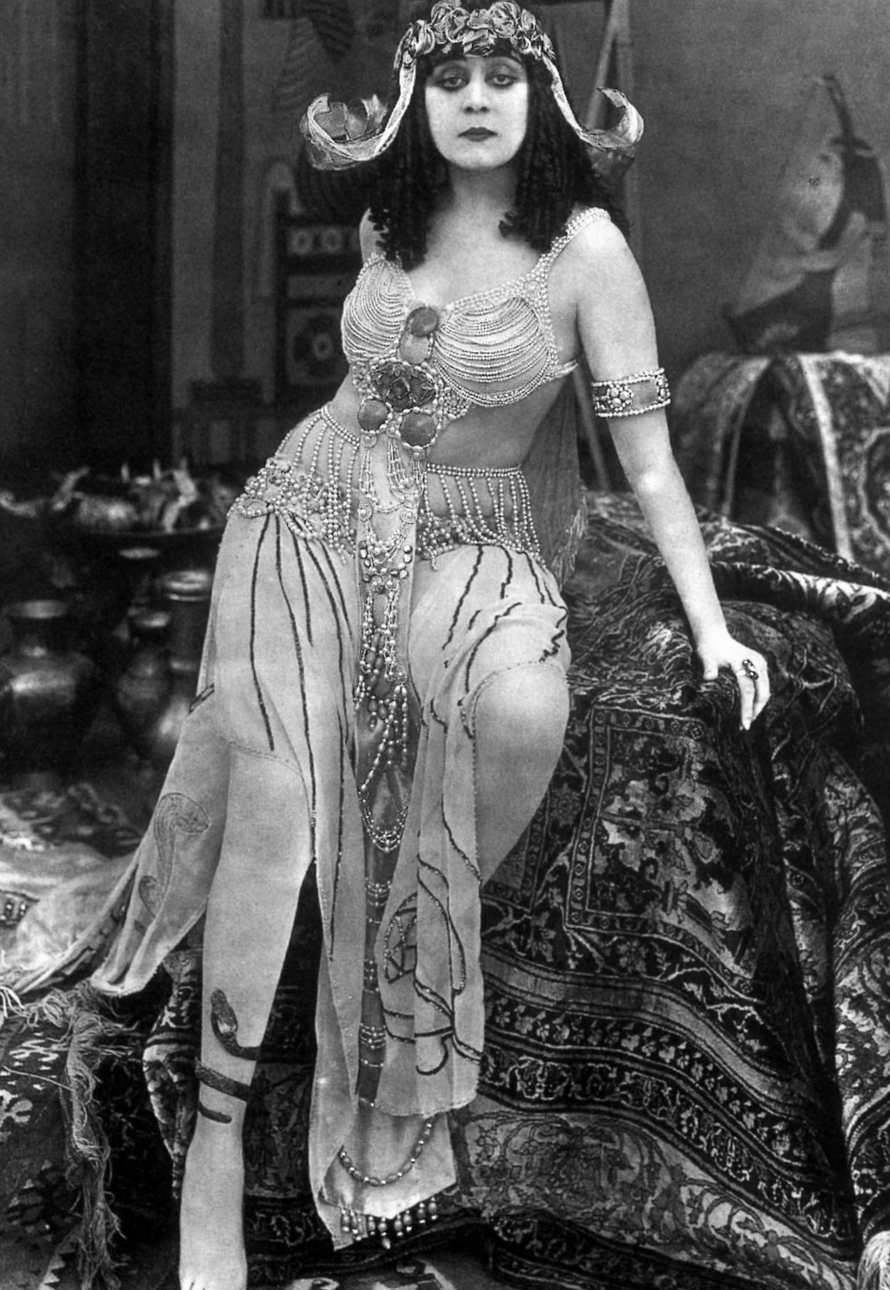
The popularity of A Fool There Was marked her beginning as a career-long icon of the femme fatale archetype, a career that would be almost completely erased due to studio film vault fires, were it not for but a few reels and a dearth of production stills. Unabashed, unapologetic and single-minded in the pursuit of her own desires, Bara's vamp is not the subject of scorn and scarlet lettering in the film; rather, she is triumphant at the conclusion, gliding away from the scene of corrupted domesticity to, presumably, her next exercise in destruction. She is an anti-heroine who breaks the era's dictates of onscreen morality and female virtue. From a critical perspective, her subversion of the marriage model serves as a view to human weakness in a way that utilizes the opposing side of the gender binary. Rather than manifesting in a portrayal of the fainting, hysteric feminine, weakness takes the form of a malleable, pliant masculinity that is easily twisted and trampled once the protective shell of a social institution has been penetrated and shattered. 

Like the atypical conclusion of A Fool There Was, Bara's image was antithetical to modern sensibilities of female beauty. Reigning silent film actresses, to which audiences were accustomed, were dewy-eyed waifs who sought to charm with sentimentality and ingenuousness. Like these immaculate angels of the silver screen, Bara exhibited otherworldly qualities, but in an opposing sense. Rather than descending from the heavens as an image of fragile, luminous beauty, she might have crawled up from below the surface of the earth--her ghostly complexion bereft of any sort of innocent glow, the dark masses of hair cascading around her shoulders in a web of ensnaring sensuousness.

Bara's vamp is not a fallen woman, as literary language might have termed women of her creed. Rather, she is a rising woman, digging her way out of the living grave of expected domesticity and repressed female sexuality. The vamp is a materialization of the specter of female agency that haunts structures and institutions of the time through its absence. 

In A Fool There Was, Bara's characterization as “The Vampire” set an intentionally biased precedent for public judgement of the character. A vampire is a monster to be abhorred and exorcised from pure, morally-upright societies. But monsters are manufactured, the products of mechanisms, societal or individual, that distort and disfigure materials into their final product. To condemn the product is to condemn the creator; to condemn the vampire is to condemn the world that made it. Bara's character rebels against the mechanisms that would create her and subsequently oppress her. She is a Byronic Other, an observer of human relations of which they do not partake, but actively work against.

The external indicator of Bara's Otherness manifests not just through her previously mentioned non-sylphic frame, but through her distinctive eyes. Hooded and deep-set, they brood and burn from the screen. They are hypnotic in their detachment, icing audiences with their blankness. Hers are the eyes of the introspector—they do not perform for the observer, but instead wall themselves against external discernment. Silent film relied heavily on expression within the eye and often focused on them in close-up shots; Bara's own, so singular in their appearance, could be completely blank and still compel.

A Fool There Was (1914) is the film that made Theda Bara a star, creating the term `vamp to describe a hypnotically alluring woman, and coining the now famous quote: `Kiss me, my fool! (often misquoted as `Kiss me, you fool).

In contrast with her fellow actresses, Theda Bara does not sparkle, wink and flutter a means of inviting the viewer. Rather, she watches from beneath half-closed lids, an enigma that cannot be divined. Interiority is sacred to the Other, especially the female Other, whose external performativity is so often the summation of her character and corresponding value. Bara's brooding, languorous vamp stands in opposition to the externalized vivacity valued in female performance both onscreen and off.           

Bourgeois morality would dictate trite narratives of good over evil, women being virtuous and men being heroic. Oppositions to these structures are atypical, and Theda Bara made a career of portraying these opposing Others (Carmen, Cleopatra, Salome and Madame du Barry, to name just a few). She is the dark underside of performativity, the inverse of socially-shaped concepts of expressions of the feminine. This darkness speaks to the taste for iconoclasm that lives within the uncharted interiority of the alienated Other. As such, Bara's lost body of work detaches her from the modern world in the way that mythology apotheosizes. Her surviving image is boon to all who delight in that silent, shadowy reality where mystery only heightens appeal and unnamed things that lurk in the recesses of consciousness scratch gravel out of the concrete.

In Art, Social Issues Tags vampires, film, feminism, Theda Bara, Vintage
← Hodaya Louis: Diary Of An Artist + Her Paintings Of Women Around The World4 Indie Press Books I Read in 2015 (& You Should, Too) →
Featured
‘in the glitter-open black' — poetry by Fox Henry Frazier
'poet as tarantula,  poem as waste' — poetry by  Ewen Glass
'poet as tarantula, poem as waste' — poetry by Ewen Glass
'Hours rot away in regalia' — poetry by Stephanie Chang
'down down down the hall of mirrors' — poetry by Ronnie K. Stephens
'Grew appendages, clawed towards light' — poetry by Lucie Brooks
'do not be afraid' — poetry by Maia Decker
'The darkened bedroom' — poetry by Jessica Purdy
'I am the body that I am under' — poetry by Jennifer MacBain-Stephens
instagram

COPYRIGHT LUNA LUNA MAGAZINE 2025