• Home
  • indulge
  • new poetry
    • About Luna Luna
    • resources
    • search
  • editor
  • NYC reading
  • dark hour
  • submit
Menu

luna luna magazine

  • Home
  • indulge
  • new poetry
  • About
    • About Luna Luna
    • resources
    • search
  • editor
  • NYC reading
  • dark hour
  • submit
delicious new poetry
'Make of me a piecemeal mound' — poetry by Matthew Gustafson
Mar 10, 2026
'Make of me a piecemeal mound' — poetry by Matthew Gustafson
Mar 10, 2026
Mar 10, 2026
'the fever always holds' — poetry by Abbie Allison
Mar 10, 2026
'the fever always holds' — poetry by Abbie Allison
Mar 10, 2026
Mar 10, 2026
'those petty midnights' — poetry by Zoë Davis
Mar 10, 2026
'those petty midnights' — poetry by Zoë Davis
Mar 10, 2026
Mar 10, 2026
'my dear vesuvius' — poetry by jp thorn
Mar 9, 2026
'my dear vesuvius' — poetry by jp thorn
Mar 9, 2026
Mar 9, 2026
'In the doom tunnel' — poetry by Melissa Eleftherion
Mar 9, 2026
'In the doom tunnel' — poetry by Melissa Eleftherion
Mar 9, 2026
Mar 9, 2026
'Love me as a wilderness' — Ruth Martinez
Mar 9, 2026
'Love me as a wilderness' — Ruth Martinez
Mar 9, 2026
Mar 9, 2026
'lost in the  rapture of man' — poetry by Ian Berger
Mar 9, 2026
'lost in the rapture of man' — poetry by Ian Berger
Mar 9, 2026
Mar 9, 2026
'Stop trying to write something beautiful' — poetry by Diana Whitney
Mar 9, 2026
'Stop trying to write something beautiful' — poetry by Diana Whitney
Mar 9, 2026
Mar 9, 2026
'I am a devotee' — poetry by Patricia Grisafi
Mar 9, 2026
'I am a devotee' — poetry by Patricia Grisafi
Mar 9, 2026
Mar 9, 2026
'come enflesh  our feast' — poetry by Haley Hodges
Mar 9, 2026
'come enflesh our feast' — poetry by Haley Hodges
Mar 9, 2026
Mar 9, 2026
'noonday I dive' — poetry by Karen Earle
Mar 9, 2026
'noonday I dive' — poetry by Karen Earle
Mar 9, 2026
Mar 9, 2026
'To eat dying stars' — poetry by Juliet Cook
Mar 9, 2026
'To eat dying stars' — poetry by Juliet Cook
Mar 9, 2026
Mar 9, 2026
‘same spectral symphony’ — poetry by Julio César Villegas
Jan 1, 2026
‘same spectral symphony’ — poetry by Julio César Villegas
Jan 1, 2026
Jan 1, 2026
'I think I know why I am looking at roses' — poetry by Stephanie Victoire
Jan 1, 2026
'I think I know why I am looking at roses' — poetry by Stephanie Victoire
Jan 1, 2026
Jan 1, 2026
'All the trees are you' — poetry by Barbara Ungar
Jan 1, 2026
'All the trees are you' — poetry by Barbara Ungar
Jan 1, 2026
Jan 1, 2026
'girl straddles the axis  of ancient  and eternal' — poetry by Grace Dignazio
Jan 1, 2026
'girl straddles the axis of ancient and eternal' — poetry by Grace Dignazio
Jan 1, 2026
Jan 1, 2026
'Talk light with me' — poetry by Catherine Graham
Jan 1, 2026
'Talk light with me' — poetry by Catherine Graham
Jan 1, 2026
Jan 1, 2026
'How thy high horse hath fallen' — poetry by Madeline Blair
Jan 1, 2026
'How thy high horse hath fallen' — poetry by Madeline Blair
Jan 1, 2026
Jan 1, 2026
'a paradise called  Loneliness' — poetry by Adam Jon Miller
Jan 1, 2026
'a paradise called  Loneliness' — poetry by Adam Jon Miller
Jan 1, 2026
Jan 1, 2026
'Tell me I taste like hunger' — poetry by Jennifer Molnar
Jan 1, 2026
'Tell me I taste like hunger' — poetry by Jennifer Molnar
Jan 1, 2026
Jan 1, 2026
'I prayed to be released from my longing' — poetry by Michelle Reale
Jan 1, 2026
'I prayed to be released from my longing' — poetry by Michelle Reale
Jan 1, 2026
Jan 1, 2026
'Resurrection dance, a prelude' — poetry by V.C. Myers
Jan 1, 2026
'Resurrection dance, a prelude' — poetry by V.C. Myers
Jan 1, 2026
Jan 1, 2026
'It is noon and the sun is ill' — poetry by Raquel Dionísio Abrantes
Jan 1, 2026
'It is noon and the sun is ill' — poetry by Raquel Dionísio Abrantes
Jan 1, 2026
Jan 1, 2026
'every moon rolling fat through the night' — poetry by Zann Carter
Jan 1, 2026
'every moon rolling fat through the night' — poetry by Zann Carter
Jan 1, 2026
Jan 1, 2026
jan1.jpeg
Jan 1, 2026
'I have been monstrously good' — erasures by Lauren Davis
Jan 1, 2026
Jan 1, 2026
'The light slices the mouth' — poetry by Aakriti Kuntal
Jan 1, 2026
'The light slices the mouth' — poetry by Aakriti Kuntal
Jan 1, 2026
Jan 1, 2026
'quiet grandfathers  in dark tuxedos' — poetry by Scott Ferry
Dec 19, 2025
'quiet grandfathers in dark tuxedos' — poetry by Scott Ferry
Dec 19, 2025
Dec 19, 2025
'made a deal / with Azrael' — poetry by Triniti Wade
Dec 19, 2025
'made a deal / with Azrael' — poetry by Triniti Wade
Dec 19, 2025
Dec 19, 2025
'The birth of a body that never unraveled' — an excerpt by Hillary Leftwich
Dec 19, 2025
'The birth of a body that never unraveled' — an excerpt by Hillary Leftwich
Dec 19, 2025
Dec 19, 2025
'Time's metronome blank' — poetry by Rehan Qayoom
Dec 19, 2025
'Time's metronome blank' — poetry by Rehan Qayoom
Dec 19, 2025
Dec 19, 2025

Culture Throwback: Thinking Back On How Charmed Captured Contemporary Feminism

November 23, 2015

BY SOPHIE MOSS

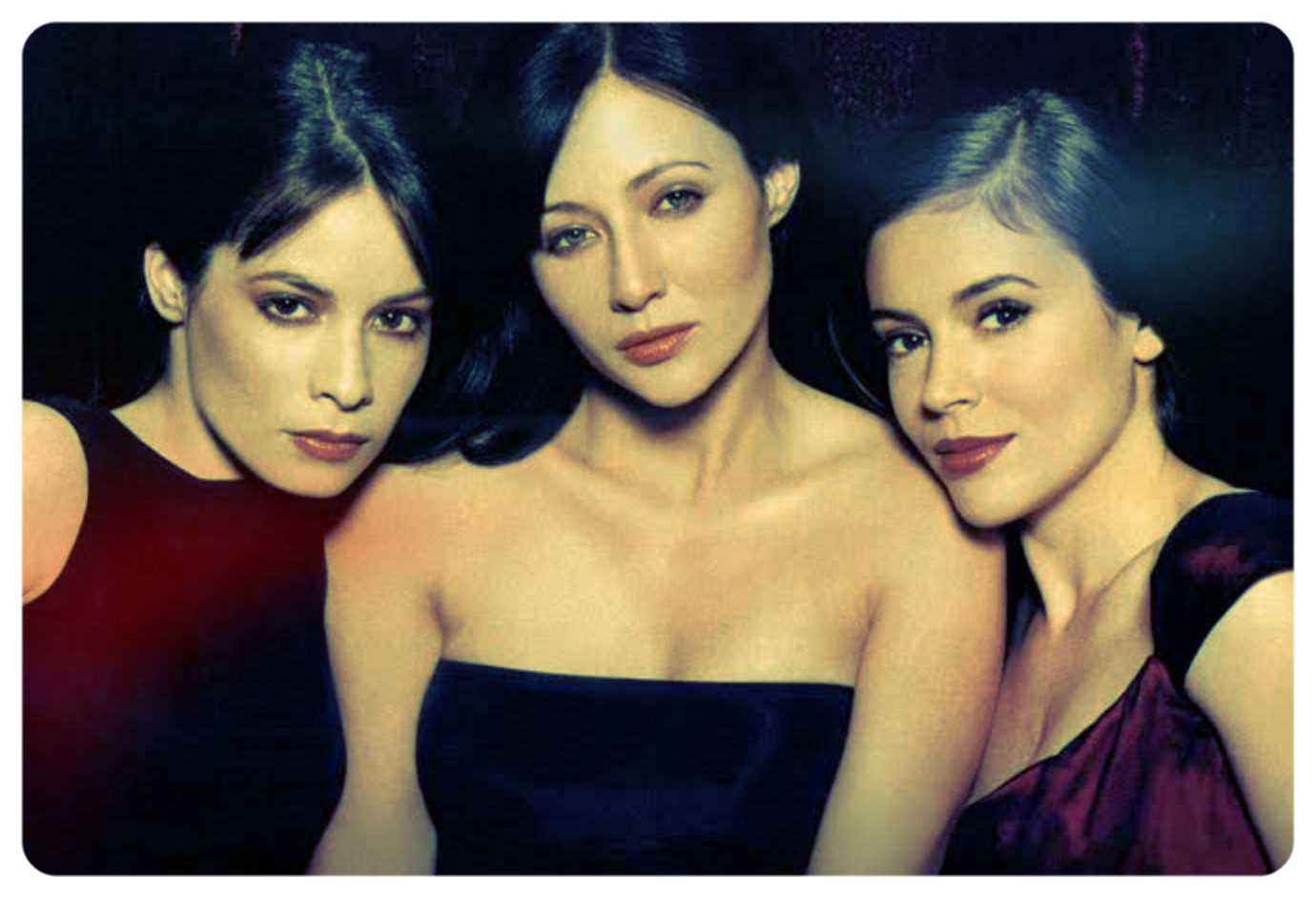
First airing on The WB in 1998, Charmed is the story of three sisters who discover they possess powerful magical powers and fight to defend their home city of San Francisco against the demonic population. As a curious and defiant fourteen year-old woman trying to make peace with myself and the universe, the three sisters in Charmed represented all that I looked to: they were ordinary women who possessed extraordinary mental and physical capabilities, thereby illustrating a fantastic resistance to the hegemonic gender roles that characterised much of contemporary television. For me, the sisters represented a unique brand of witchcraft, feminism and fantasy, and they did so with wisdom and flare. I saw myself as a fourth Charmed One, fighting both the demonic underworld and the gendered power structures it represented.

What is fascinating, for me, is the way the three sisters encapsulated the tensions of contemporary femininity, and they did so fiercely and unapologetically: They are desiring and desirable. They are independent and dependant. They are superhuman and human. They see and are seen. They are imperfect. They sleep with men who are rotten. They save humankind in high-heels. They are both dependent on, and dismissive of, traditional feminist ideals. It is in this historically specific period that I discovered Charmed, as a young teenager trying to figure out my own identity as a woman.
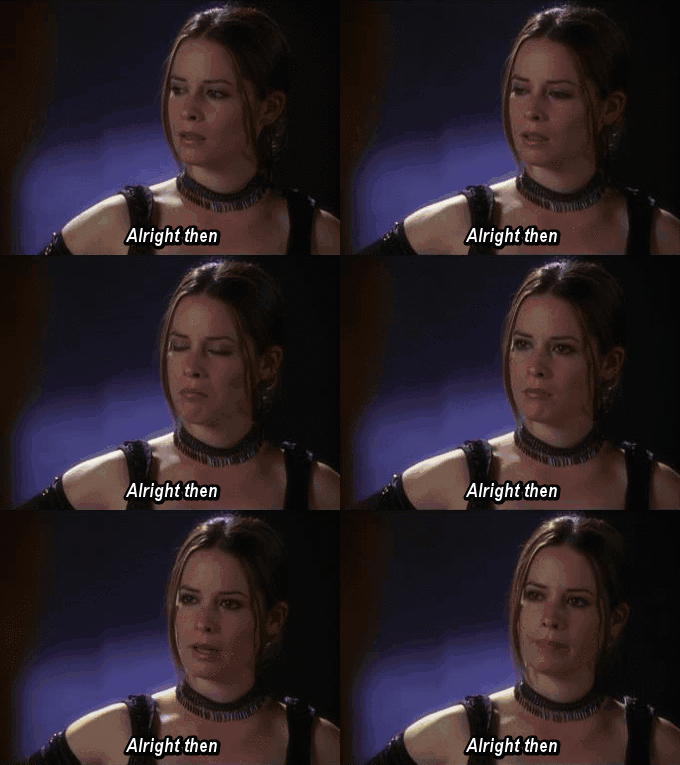
Prue, Piper, and Phoebe (and later Paige) are as much human as they are super-human. They struggled. Relationships failed. Jobs were lost. Just because Piper inherited the power of molecular manipulation, that didn’t mean her business wouldn’t threaten to go bust; while Prue could astral-project to be on two planes at any given moment, this didn’t give her the power to forgive her father for abandoning her and her sisters when they were young. Yes, witchcraft is here to protect us, and it does. But, as Almásy writes in The English Patient, “the heart is an organ of fire”, and no magic can protect that from being broken. The sisters knew that. In fact, they grappled with it frequently -- most of all, perhaps, in the season three finale, when they learned their hardest lesson to date: that magic could not save the life of their sister, Prue. It was at this moment that the audience were to understand that the Halliwell’s are not defined by their magic, or by their power, but by their humanity: they are sisters first, witches second. It was this display of solidarity, this unwavering loyalty to sisterhood, that played an important role in how I see myself as a woman, sister, and feminist.

Charmed existed in a sort of mid-90s golden-age of the super-powered female lead on television. There was Buffy. There was Sabrina. There were the Charmed Ones. What remains so unique about the latter, for me, is the show’s postfeminist values and the way it challenged traditional notions of what it meant to be a ‘strong woman.’ They were attractive, fashion-forward, individualistic, and sexually experimental. They kicked demonic ass and raised babies. They held down demanding jobs and threw fireballs at ex-boyfriends. The sisters were multifaceted, powerful women with a ‘girl-power’ rhetoric, though never entirely paradoxical to second-wave feminist ideals. What Charmed did, and did very well, was create a whole community of powerful, unique women, or, as Susan Latta writes, “[represented] the interconnection of empowered individuals and collective action.” Power, style, sin, sisterhood, desire: suddenly, these tough girls with innate supernatural capabilities found themselves understood within the wider context of contemporary feminism.

But Charmed wasn’t merely concerned with a popular mediation of femininity. Rather, the show is unique in its representation of an alternative, often marginalised religious paradigm in contemporary media. Focusing specifically on Wiccan philosophy rather than ‘witchcraft’ as an umbrella term, the sisters’ magic is rooted in the beliefs, structure and limitations of Wicca. Granted, there was glitz, glamour and special effects to-boot, but Charmed worked hard to represent the Wiccan faith with respect and accuracy. As Michaela D.E Meyer notes in her essay “‘Something Wicca This Way Comes’: Audience Interpretation of a Marginalized Religious Philosophy on Charmed”, the show’s writers were particularly skilled at weaving Wiccan philosophies into the narrative, such as not using magic for personal gain and an understanding that magic comes at a price.

For me, though, as a young woman obsessed with locked doors and unknown worlds, I found this popular representation of witchcraft entirely accessible. It was as though everything suddenly clicked into place. I devoured all that I could on Wiccan philosophy and Pagan cultures. I created my own Book of Shadows, a grimoire full of awkwardly written spells and uncomfortable rhymes. I would lay an atlas on my bedroom floor and scry for family members. I would stare at glass vases and wait for my powers of telekinesis to kick in. I can still recite “Dominus Trinus”, the spell to invoke the sisters’ powers (In this night and in this hour / We call upon the Ancient Power). As fervently as I waited for my Hogwarts letter, I waited for my powers to come.

But, eventually, that curious young girl would grow into an adult woman with a registry for darkness. While I follow no set religious path, I recognise and honour an innate spirituality. Witchcraft, ritual, spell-casting, the Occult -- these are all important to how I see myself as a woman and writer. I practice the tarot. I collect moon water. I celebrate the seasons. I’m constantly learning to better work with my own spiritual source. Constantly learning to be a better feminist. A better person.

It is this sense of constant growth and personal reinvention that characterises much of Charmed. A recurring theme throughout the series is that of reconciling their witchcraft with their personal selves, their womanhood, and the consequences that come from this. They aren’t perfect versions of themselves, by any means. They make bad decisions and have been known to choose themselves over the Higher Cause. They can be selfish. Piper chooses to marry Leo in secret, against The Elders’ rules. Phoebe falls in love with Cole, a half-demon and later The Source of All Evil, despite her sisters’ disapproval. In many ways, Phoebe is the most feminist of the three sisters, in spite and because of her many imperfections. We see her evolve from a reckless young girl with few prospects into this fierce, successful, loyal woman with great spirit. She put herself through school, worked hard to get a job she loved, and she did it entirely on her own. She grew up fast and hard and well, and did so in a universe filled with demons, death, and madness. But for me, it was her imperfections that made her who she was. She screwed up. Routinely. Fantastically. Sure, she married the Source of All Evil and became the Queen of the Underworld, but she sure as hell came to her senses and vanquished his demonic ass, too.

That’s what’s so great about the Charmed Ones: they never claim to have it all figured out. They’re always learning, questioning, struggling, and they take responsibility for their actions. They know that what’s coming will come, and they face it when it does. That is what I took from Charmed: that to be imperfect is okay. To be human in a world of chaos is okay. I might not be the best version of myself, but I am, much like the Halliwell sisters, an unstoppable cyclone of female strength and femininity, and that’s all my fourteen year-old self could ever have asked.


Sophie E. Moss is a dark witch & literary maven. She writes essays for Luna Luna and poetry for all the people she used to be. @Sophiedelays

In Pop Culture, Social Issues Tags Charmed, Witchcraft, Television, 90s, Feminsim
← Poems by Fox Frazier-FoleyLaura Victoria’s Poetry of the Pagan & the Maternal →
Featured
'I think I know why I am looking at roses' — poetry by Stephanie Victoire
Stephanie Victoire
'I think I know why I am looking at roses' — poetry by Stephanie Victoire
Stephanie Victoire
Stephanie Victoire
'All the trees are you' — poetry by Barbara Ungar
Barbara Ungar
'All the trees are you' — poetry by Barbara Ungar
Barbara Ungar
Barbara Ungar
'girl straddles the axis  of ancient  and eternal' — poetry by Grace Dignazio
Grace Dignazio
'girl straddles the axis of ancient and eternal' — poetry by Grace Dignazio
Grace Dignazio
Grace Dignazio
Featured
'Make of me a piecemeal mound' — poetry by Matthew Gustafson
Matthew Gustafson
Matthew Gustafson
'Make of me a piecemeal mound' — poetry by Matthew Gustafson
Matthew Gustafson
Matthew Gustafson
Matthew Gustafson
Matthew Gustafson
'the fever always holds' — poetry by Abbie Allison
Abbie Allison
Abbie Allison
'the fever always holds' — poetry by Abbie Allison
Abbie Allison
Abbie Allison
Abbie Allison
Abbie Allison
'those petty midnights' — poetry by Zoë Davis
Zoë Davis
Zoë Davis
'those petty midnights' — poetry by Zoë Davis
Zoë Davis
Zoë Davis
Zoë Davis
Zoë Davis
'my dear vesuvius' — poetry by jp thorn
jp thorn
jp thorn
'my dear vesuvius' — poetry by jp thorn
jp thorn
jp thorn
jp thorn
jp thorn
'In the doom tunnel' — poetry by Melissa Eleftherion
Melissa Eleftherion
Melissa Eleftherion
'In the doom tunnel' — poetry by Melissa Eleftherion
Melissa Eleftherion
Melissa Eleftherion
Melissa Eleftherion
Melissa Eleftherion
'Love me as a wilderness' — Ruth Martinez
Ruth Martinez
Ruth Martinez
'Love me as a wilderness' — Ruth Martinez
Ruth Martinez
Ruth Martinez
Ruth Martinez
Ruth Martinez
'lost in the  rapture of man' — poetry by Ian Berger
Ian Berger
Ian Berger
'lost in the rapture of man' — poetry by Ian Berger
Ian Berger
Ian Berger
Ian Berger
Ian Berger
'Stop trying to write something beautiful' — poetry by Diana Whitney
Diana Whitney
Diana Whitney
'Stop trying to write something beautiful' — poetry by Diana Whitney
Diana Whitney
Diana Whitney
Diana Whitney
Diana Whitney
'I am a devotee' — poetry by Patricia Grisafi
trish grisafi
trish grisafi
'I am a devotee' — poetry by Patricia Grisafi
trish grisafi
trish grisafi
trish grisafi
trish grisafi
'come enflesh  our feast' — poetry by Haley Hodges
Haley Hodges
Haley Hodges
'come enflesh our feast' — poetry by Haley Hodges
Haley Hodges
Haley Hodges
Haley Hodges
Haley Hodges
'noonday I dive' — poetry by Karen Earle
Karen Earle
Karen Earle
'noonday I dive' — poetry by Karen Earle
Karen Earle
Karen Earle
Karen Earle
Karen Earle
'To eat dying stars' — poetry by Juliet Cook
Juliet Cook
Juliet Cook
'To eat dying stars' — poetry by Juliet Cook
Juliet Cook
Juliet Cook
Juliet Cook
Juliet Cook
‘same spectral symphony’ — poetry by Julio César Villegas
Julio César Villegas
‘same spectral symphony’ — poetry by Julio César Villegas
Julio César Villegas
'I think I know why I am looking at roses' — poetry by Stephanie Victoire
Stephanie Victoire
Stephanie Victoire
'I think I know why I am looking at roses' — poetry by Stephanie Victoire
Stephanie Victoire
Stephanie Victoire
Stephanie Victoire
Stephanie Victoire
'All the trees are you' — poetry by Barbara Ungar
Barbara Ungar
Barbara Ungar
'All the trees are you' — poetry by Barbara Ungar
Barbara Ungar
Barbara Ungar
Barbara Ungar
Barbara Ungar
'girl straddles the axis  of ancient  and eternal' — poetry by Grace Dignazio
Grace Dignazio
Grace Dignazio
'girl straddles the axis of ancient and eternal' — poetry by Grace Dignazio
Grace Dignazio
Grace Dignazio
Grace Dignazio
Grace Dignazio
'Talk light with me' — poetry by Catherine Graham
Catherine Graham
Catherine Graham
'Talk light with me' — poetry by Catherine Graham
Catherine Graham
Catherine Graham
Catherine Graham
Catherine Graham
'How thy high horse hath fallen' — poetry by Madeline Blair
Madeline Blair
Madeline Blair
'How thy high horse hath fallen' — poetry by Madeline Blair
Madeline Blair
Madeline Blair
Madeline Blair
Madeline Blair
'a paradise called  Loneliness' — poetry by Adam Jon Miller
Adam Jon Miller
Adam Jon Miller
'a paradise called  Loneliness' — poetry by Adam Jon Miller
Adam Jon Miller
Adam Jon Miller
Adam Jon Miller
Adam Jon Miller
'Tell me I taste like hunger' — poetry by Jennifer Molnar
Jennifer Molnar
Jennifer Molnar
'Tell me I taste like hunger' — poetry by Jennifer Molnar
Jennifer Molnar
Jennifer Molnar
Jennifer Molnar
Jennifer Molnar
'I prayed to be released from my longing' — poetry by Michelle Reale
Michelle Reale
Michelle Reale
'I prayed to be released from my longing' — poetry by Michelle Reale
Michelle Reale
Michelle Reale
Michelle Reale
Michelle Reale
'Resurrection dance, a prelude' — poetry by V.C. Myers
V.C. Myers
V.C. Myers
'Resurrection dance, a prelude' — poetry by V.C. Myers
V.C. Myers
V.C. Myers
V.C. Myers
V.C. Myers
instagram

COPYRIGHT LUNA LUNA MAGAZINE 2025