
BY SANDRA MARCHETTI
This essay was originally delivered as a keynote address for Naperville Writers’ Group’s National Poetry Month event at Nichols Library in Naperville, IL on April 2nd, 2014.
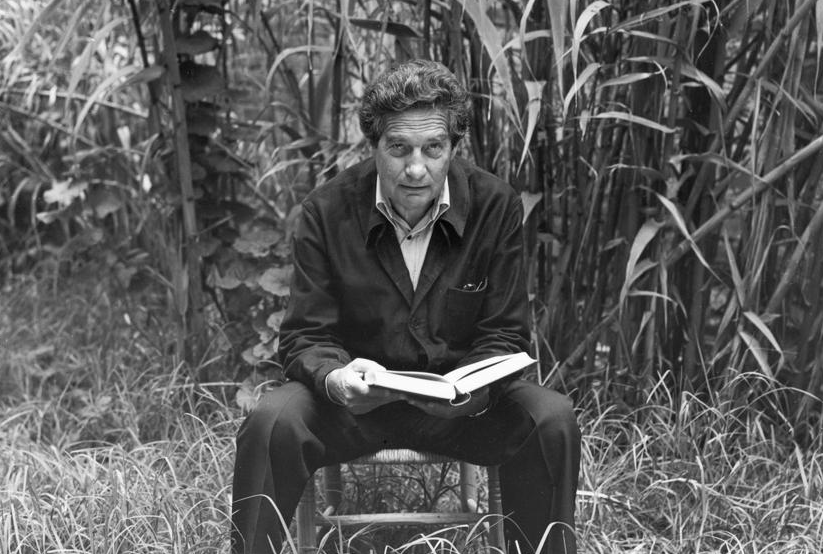
Oftentimes when poets speak about poetry, they speak of their own work. I am most certainly guilty of this. I’d like to begin a bit unconventionally here, and attempt to remedy that situation. A poet who deserves more acclaim in the United States—the great Mexican writer Octavio Paz—will serve, in some ways, as a guide for this piece. The poem I would like to begin with is one of his later works from A Tree Within, titled, "As One Listens to the Rain." I would like for you read the poem, and pause as you do to monitor your gut reactions. Close your eyes if you would like. What can you see, smell, taste, touch, or hear? Does the poem remind you of something else? What lines echo in your head?
***
The responses triggered when I read this wonderfully cycling piece include the smell of asphalt after the rain, the rain itself as a sort of white noise, and the metaphysical presence of the narrator over my shoulder. Your rich and varied responses and my own are part of the reason why I champion poetry, which accomplishes so much with so little. This poem is less than 200 words, but calls up a whole homeland of experience. It is the house where we dwell in possibility, as Emily Dickinson says. I love how spare and fragile poetry often is; yet, it is also steel girded. It blows my hair back, leaving me empty, while almost simultaneously opening a door to a new garden. Poets do it with less, but so beautifully. I sometimes fancy myself quite an adrenaline junkie, actually.
Poets must live in the world but also outside of it. We are so influenced by our immediate surroundings yet able to transform the ordinary into oddly slanted and surreal visions. Even the rain itself in Paz’s poem is personified, "rising and walking away." Everyday images are conflated and merged, mixed up and re-envisioned. According to Paz, "Poetry is memory become image, and image become voice. The other voice is not the voice from beyond the grave: it is that of man fast asleep in the heart of hearts of mankind. It is a thousand years old and as old as you and I, and it has not yet been born." In essence, as he says in his poem, poetry happens in "another time that is now," and that’s an incredibly difficult place in which to live. How does one balance between the present moment and the past? This reminds me of holding tree pose in yoga. Poems encapsulate what is right in front of us but also a part of our memories. They call on our whole menagerie of obsessions and ideas about the world to sort possible truths.
***
In the film Before Sunrise, the character Celine mentions that God exists in the space between people—in our connections and conversations. Nowhere is this more accurate than in the connection a poet has to his/her reader, it seems. When we read a poem we cherish, or when we write poems that others love, we tap into the radical symmetry of poetry. We are funneled into that "other time that is now"—outside of the realm of the immediate, distanced from the world but yet still close enough to be pricked by it.
I am a poet (rather than an artist, or a historian, or something else I was interested in as a child) because writing has always presented these wonderful challenges. I had some talent for words, but I was never "the best" writer in my grade at school—a label with which many readers here may identify. However, the wrangling of language is a maddeningly perfectionistic way to spend ones’ days (or ones’ weekends) and I am maddeningly perfectionistic. How else will I find God? So, identifying as a writer suits my natural personality. Like Paz, I tend to write poems that work at a deep sensory level. I want my poems to singe your ears and delight your eyes. In fact, the sound of a poem often comes to me before subject matter and sometimes even before an image. I hear and feel the undulations in my poems and follow that music through its own spiraling sequence. Poets have to make music from words only—we aren’t allowed notes and lyrics as musicians are—and it has always been challenging and very satisfying for me to twist a poem into an artifact that brings both sonic pleasure and thought into a rough symmetry.
Like many of us, I work in cycles and take great comfort in routines. When I know I will have a morning to myself to "write," I turn off tech and mindfully make a pot of coffee, smell the beans, look out the window, and go to my desk. Sometimes I will read a collection I have practically memorized, revise a piece, send submissions or actually draft a new poem or two. I am fairly serious about cleaning my workspace, the entire house actually, before any of this begins. Then I sit in silence doing that thing I love, completely oblivious. It rarely feels like work once I begin. My partner, a very creative chef and restaurateur but not a writer, sees the interworkings of my poems with a deft and generous eye. His suggestions always make them better. Also, as I mentioned before, I am an obsessive reviser, so most poems go through 80-100 drafts (ranging from full-scale revisions to tiny edits) over multiple years before I consider them anywhere near "done."
Since I don’t write as often as I would like, I hardly ever throw anything out; all scraps eventually become poems because they are so precious and rarely received. This type of revision is something I learned after my graduate study. I also figured out how to find great readers for my poems. Traditional writing workshops never brought out the best in me or my work; the folks who advise my poems well are compassionate or oblivious—my husband is compassionate, and the oblivious are those poets I adore, who I can only speak to through their books. These poets include: Elizabeth Bishop, John Ashbery, Li-Young Lee, Sylvia Plath, Louise Glück, and Carl Phillips. Reading and being alone with my work allowed me to hone my own voice, and shape my poems into what they have become.
My goal in writing and reading poetry is always one of transformation. If the poem transforms itself, its reader, or writer in some way, it is successful. I look to hone the quality Paz describes in his final essay, "The Other Voice," when he says, "Nothing distinguishes a poet from other men and women but those moments—rare yet frequent—in which, being themselves, they are other." This trait of otherness is apparent in the readers of poetry as well. We will be graced with the "other voice” this month and beyond, especially in Luna Luna’s Expert Poetry Selections feature. So as you read, listen for the tuning fork’s hum, that golden tone rising. Let the other voice speak, cracked and muffled, through the din this spring.
Editor's Note: A version of this article appeared on our old site.
Sandra Marchetti is the author of Confluence, a full-length collection of poems, selected by Erin Elizabeth Smith published by Sundress Publications.