









BY SARAH FLETCHER
There was something invigorating about reading Helene Cixous’s essay 'The Laugh of Medusa' for the first time. It didn’t feel like another academic essay or boring reading assignment: it felt like a call to arms. "Your body is yours", she writes in the first paragraph: "Take it. Your body must be heard". She described a revolutionary mode of writing—the écriture féminine—that breaks away from the traditional, male-dominated canon, a writing that privileges experience before language, and non-linear narratives above all. A mode of writing that can express, from first person, a femininity that has been pathologised, repressed, eroticised, and demeaned throughout literary history. It was a call for the female id to be unlocked.
My problem? I couldn’t find any female writers who wrote in this way. Even Cixous’s ultimate examples of écriture féminine writers were men: James Joyce and John Genet. I hadn’t discovered the postmodernist novelist Kathy Acker yet. I adored female poets like Plath and Sexton and Millay, but they seemed to assimilate into the male canon rather than defy it. But listening to Tori Amos’s 'Boys for Pele'—twenty years old as of January 22nd—felt like the purest expression of this mode I’ve been able to find. And it was a revelation.
'Boys for Pele' is not an accessible album. It’s full of demented-sounding, medieval harpsichords, gospel choirs, and industrial drones and beats. Reviewer Arnold Gina suggested listeners skip the album and listen to something "a little bit more intelligible—like maybe Gravity’s Rainbow written in Greek". Amos has songs that loop the cry of a bull, or, hilariously, the sound of literal bull shit being shovelled. Her voice is raw and gymnastics between desperate yelps, loud screams, and broken whispers. But above all, and perhaps most alienating of all, the album is unapologetically female.
In breakup anthem 'Blood Roses,' she spits, "I’ve shaved every place where you’ve been, boy", and describes her body going from "a warm little diamond" to "nothing but meat". The lyrics find their heart and pace in the female body. Amos describes this album as exploring "the hidden parts of the feminine"—an almost immediate, though unintentional, parallel to Cixous’ assertion that women had been taught not to explore their own femininity, having been told it is "dark and dangerous". And Amos herself realises this explosion has been alienating to many: "straight men are tortured by my shows. I’m too raw, the emotional thing, the things you don’t want to talk about".
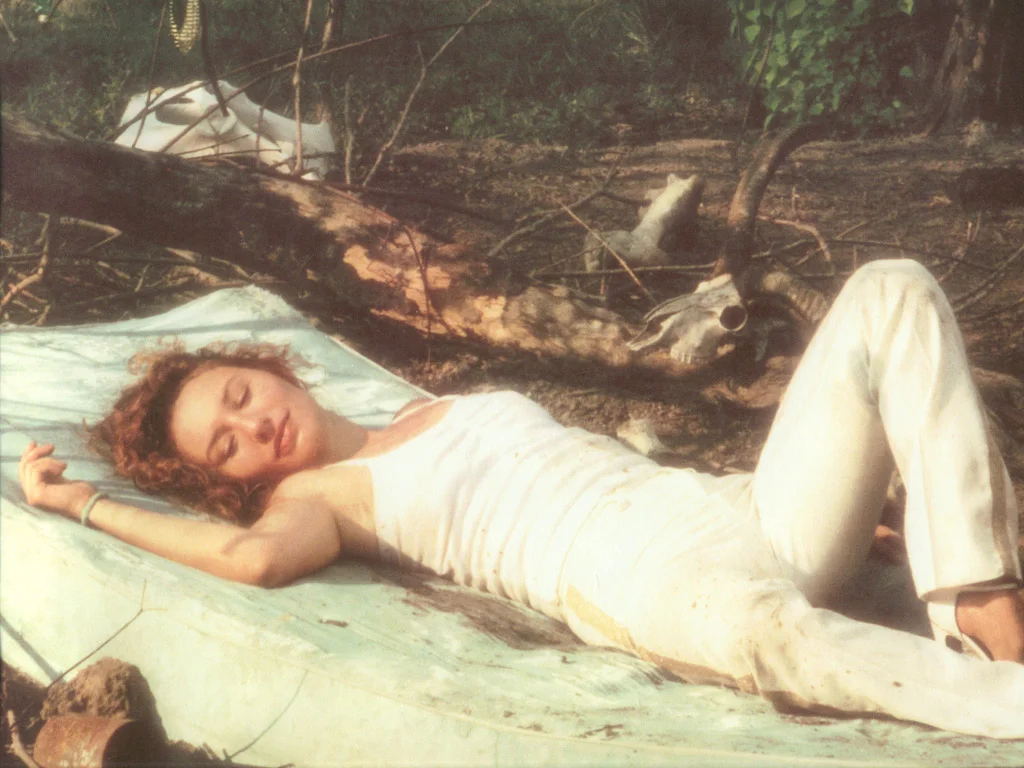
The 'femaleness' of the album goes above and beyond the strange lyrics and often obscure metaphors and similes. The cover of the album depicts Amos, with a Mona Lisa-esque half smile on her face, cockily holding a rifle. A snake winds around the leg of a chair, and a dead chicken rots in the background. Her legs are caked with dirt. There is no immediate female stereotype at hand to describe the image: she isn’t playing up either her sexuality or virginity. She isn’t immediately stereotypically feminine or masculine. Amos’s first single 'Me and a Gun' was a heart-breaking, fictionalised account of her own rape at gunpoint; in 'Boys for Pele', the gun is in Amos’s hands. One can already tell this is an album about reasserting the female perspective, and that it doesn’t give a damn what you think.
The French feminists (Cixous, Kristeva, Irigaray) have always espoused that, from a feminist perspective, language is not neutral territory. It’s wrought with phallogocentric barriers. Perhaps, because of this, it makes sense that I found Amos’ music a much better fit for the écriture féminine than poets or novelists. Music allows a wider range of expression: where words fail, music fills with sound. For women, who have so often been silenced, or felt there were no existing words to describe a feeling, perhaps this area offers more opportunity for exploration and creative innovation. Music can become a way for women to assert their own voices and space beyond the bounds and trappings of language.
'Boys for Pele' certainly did this. A Rolling Stones review critiques that the album "never works itself into a lather, which is one of Amos' failings; she doesn't seem to know how to rage". But I believe the opposite: Tori Amos has unlocked a new mode of female anger. She is perhaps even most angry at her quietest point in the album. In the beautiful piano ballad 'Putting The Damage On', she sings, "you told me last night, you were a sun, with your very own devoted satellite. I’m happy for you, and I am sure that I hate you". The cruel whisper among the icy, high-pitched piano keys is as scathing as any Rage Against The Machine song. It just deviates from the explosive, masculine norm: it is an anger that stews within itself. For women, who have been taught that their anger is often invalid and unattractive, it is perhaps a more relatable anger than the stereotypical rock template.
One of the most important parts of 'The Laugh of Medusa' is that Cixous focuses not only on women’s writing, but rather "what it will do". Nearing the 20th anniversary of 'Boys for Pele', it’s worth looking at the legacy this album, and Amos’ career, has had on women. In a 2010 study from the London School of Economics studied 2000 Amos fans and found that 98% of fans used her album as means for emotional support. Her concerts are famous for being cathartic, teeming with crying girls. Amos has estimated that one in three women at her concerts has been sexually abused. Her music has brought people together in this way, to both grieve and reclaim their darkest parts and histories.
To speak personally, 'Boys for Pele' was an album that made me feel less alone. When I was nineteen, I was going through a difficult time. I felt lonely my first year of university, unsure of who my friends were, and, even scarier point, unsure of who I was. I was, like many nineteen year old girls, heartbroken nearly every week. Something about 'Boys for Pele' seemed to speak directly to me. It made me feel less alone and less crazy. It was a time when I desperately wanted to scream but couldn’t. All of my emotions felt chaotic and ugly, and I found them organised and expressed in Amos’s songs. It was the écriture féminine I had been waiting for, and it found me at the perfect time.
Sarah Fletcher is an American-British writer living in London. Her articles have been published in Feminist Current, The F Word, and Ambit, and her poetry book 'Kissing Angles' was published by Dead Ink Books in 2015. She tweets at @Sarahfletcher27.