
















BY KAILEY TEDESCO
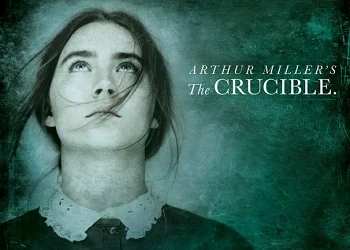
This May Day was completely sans May, and instead a drearily beautiful pastiche of early autumn. The rain-splashed winds in conjunction with the rush of traffic in Times Square made my bell-sleeve floral dress sway gently against my thighs, and I clasped my jacket close to me, smiling through the mist. Sometimes life does imitate art, but I had no idea how fully this chilly Sunday would complement Ivo Van Hove’s rendition of Arthur Miller’s "The Crucible," now on Broadway at the Walter Kerr Theatre.
Since it was May Day (or just a day in general) my boyfriend and I snuck a baggy of freshly baked cookies and macarons into the theatre. As we munched, people around us giddily discussed their run-ins with Arthur Miller’s classic. A young man two seats down from me hung his head in disdain as his father explained that it really is a very good story. Some women in line for the lav counted off the various showings they’ve seen across the country, with the 1996 film seeming to be paramount. I, too, entered into a reverie of my own--"The Crucible" is canon, and it is classic, but there is an accessibility to it that allows it to seemingly transcend the fare of your average high school syllabus. The title evokes school and discussions about symbols, but the story itself is rooted in enduring ideology and polemics. And, it’s just plain scary as hell.
Van Hove seemed to be one step ahead of his present-day audiences in many ways. While the play did not deviate from Miller’s original script, added nuances allowed for a modernization that played to current sensibilities in addition to the originally intended McCarthyism and, of course, the witch trials themselves. So many of us learned about "The Crucible" in school, and we have these memories that surround this unit much in the same way that one hears a song and associations spiral. I imagine Van Hove acknowledged this early on and thought what if this version, premiering over 50 years after the original, was set in the very place that so many current viewers have come to know it.
And so it begins. The curtains lift to reveal neat rows of desks, clasp-handed school girls in knee socks, and a poem scrawled upon a chalkboard. Phillip Glass’ score echoes and the quiet voices of children singing, chanting really, sink into the velvet carpeting of Walter Kerr. The curtains abruptly close and re-open to reveal the same classroom, slightly less organized, and Betty Parris (Elizabeth Teeter) catatonic on a cot. It then abruptly closes and opens a third time, this time revealing Betty Parris, bewitched and floating in the air in her stark white nightgown. This scene lasts for no more than thirty seconds, causing the audience to wonder if it happened at all. This is the first of many times that the play blurs the lines of both time and reality.
While the set remains in the classroom for the entire duration of the play, it is not a friendly or inviting room. The walls are drab and grey, the windows are barred -- my first instinct was that everything was taking place in a sort of post-apocalyptic refuge. In many ways, I was reminded of the isolation on the set of the 2010 MacBeth film. The classroom is never addressed, and, with the exception of the ever-present chalkboard, it seems mostly non-diegetic. Wojciech Dziedzic costumes are similarly norm-core and intentionally unremarkable. There is a meta quality to the milieu that makes audience member's question if the characters are in the classroom, or if you are.
As the play unfolds further, the dialogue was succinct to the point that I could recite my favorite lines along with the actors. However, added nuances in inflection or delivery allowed for humor in areas it otherwise did not exist. Giles Corey (Jim Norton) was especially strong at delivering his lines with a more colloquial snark than I have seen in previous versions. His character and arc became much more prominent while other previously spotlighted characters fell slightly away from the foreground.
I had expected Abigail Williams, played by the renowned Saoirse Ronan, to steal the show in much the same way that Winona Ryder had in the aforementioned 1996 film. While Ronan’s portrayal of Abigail was spectacular and wonderfully disturbing, the character was slightly downplayed. In previous versions, Abby, while self-motivated and manipulative, is the impetus of the action in a way that suggests empowerment and triumph over a society that otherwise would not tolerate her outspokenness. Here, Abby, dressed in pleats and knee socks, is more clearly a child, and her actions consequently come across as petulant.
This is also true of the other girls. Marry Warren is usually played by the prodigious Tavi Gevinson; however in this performance Erin Wilhelmi delivered the character’s girlish naivety for the first time to outstanding reception.
The relationship between John Proctor (Ben Whishaw) and Abby is dismissed early with just one hint of longing from Proctor very early in the first act. The suggestion seems to be that their romance was equivalent to that of a teacher and student, holding the same consequences and moral indictments. After Proctor dismisses Abby, the relationship between himself and his wife, Elizabeth Proctor (Sophie Okonedo) is quickly in the forefront. The chemistry between these two characters is stronger than ever. Even when the house is supposedly “winter,” the tension between the two radiates from the stage.
However, I would not call the execution of these characters romantic. Somehow, a stronger love than romance ensues. There is a newly revealed understanding and connection between the characters that ties them together in a way I had not previously considered. While I knew very well what would become of each of them, I found myself feeling emotional before the Act I curtain even closed.
I wasn’t the only one. At intermission, it was evident that the audience was moved. My boyfriend clasped my hand and whispered “I haven’t felt cathartic in such a long time. It feels...good.” As we settled back into our seats for Act II, we couldn’t fathom how it could get any more powerful. But then they released the hounds…literally.
The very first scene of Act II features a surprise appearance from a live wolf. (I later learned his name was Luchta.) He simply walks majestically across the stage. Many whispered “is that a real wolf?” while others rubbed their eyes. Just like that, the wolf enters stage right, exits stage left, and is not shown or even referenced again. This, much like the classroom setting, exudes formalistic qualities that one would expect from a David Lynch film. Yes, we all know about the figurative wolves in Salem in 1662, and the figurative wolves spying in 1953, but now here’s the symbol for us in 2016, incarnate. Yet, we ask ourselves, was it really there at all?
So Act II ensues with the magic that Abigail and those young women claimed to see and perform, now manifested in the classroom. High winds rolls through the windows, scattering paper and debris against the dejected faces of those persecuted. The chalkboard lights up, scrawls upon itself, while nine out of ten holy commandments (sans “thou shalt not”) still glare through the scribbling, with “KILL” enduring most prominently. Chanting sounds and wild instrumentals howl causing the actors to project their voices over the chaos.
Finally, we meet our characters in the final scene still littered with debris. The persecuted Rebecca Nurse (Brenda Wehle) turns to reveal a bare back etched with blood and blistering from lashes. Proctor and Elizabeth are similar bloodied, dejected, and sullen, while the characters who escaped their persecution, such as Reverend Hale (Bill Camp) and even Reverend Parris (Jason Butler Harner) have guilt weighing in the lines of their faces. The pathos is exceptional, and every emotion can be felt at once. At one point, I could feel the weight of my heart in my chest as I sat bleary-eyed, letting the scenes hit me piece by piece.
Once Elizabeth Proctor flawlessly delivers her final lines, and the curtains close, it becomes clear that the audience has just had a collective response, a renewal of some sort of lost vitality. The young boy whom begrudged his father for taking him to "The Crucible" at the beginning, is now visibly awestruck as he admits that he did, in fact, “like it.”
Arthur Miller’s "The Crucible" is an American parable whose endurance is everlasting. I don’t know if Miller knew that its themes would transcend the barriers of time and reflect the moral and political climates of generations to come, but I do know that Van Hove’s 2016 Broadway rendition does the play a great justice. I highly recommend that you run, don’t walk to see it. It’s the closest thing I’ve ever seen to real magic in a long time.
Kailey Tedesco will soon hold her MFA in Creative Writing from Arcadia University. She is the co-founder and editor-in-chief of Rag Queen Periodical, and holds bylines at Ultra Culture and Hello Giggles. Her poetry has appeared in FLAPPERHOUSE, Jersey Devil Press, Eternal Haunted Summer, Hermeneutic Chaos, and more. She is a recent Pushcart Prize nominee.