
BY MONIQUE QUINTANA, IN INTERVIEW WITH KRISTIN GARTH
Poet and editor Kristin Garth has created a career that plays with technology, new school pastels, and old Hollywood glamour. All of her literary endeavors are empathetically experimental, provocative, and nurture sex-positivity. I reviewed Garth's chapbook, Shut Your Eyes, Succubi last winter, and wanted to inquire more about her lyrical inclinations and what's coming for her next.
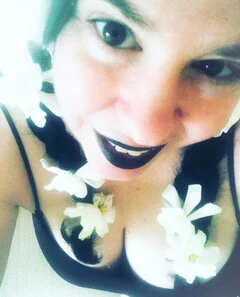
Kristin Garth
Monique Quintana: I love how you advocate for sex-positivity in literature. What was your journey towards sex positivity, and how is that reflected in the Pink Plastic House's architecture?
Kristin Garth: Thank you so much for this compliment. Sex positivity and sexual honesty are two qualities I find essential in a healthy psychology. I came from an abusive, extremely religious home, a home where people feared the body and sexuality — but also were obsessed with these things. As a young girl, I developed physically early, and I was also sexually abused early in my life.
In this way, sexuality has been a part of my life as long as I can remember. It wasn't a choice to learn about it, but you can't unknow it.
I have spoken to many other survivors of childhood sexual assault over the years in group therapy settings and just through friendships. I know for many survivors, sexuality becomes, post the trauma of childhood sexual abuse, a dark and intolerable, of barely tolerable, event.
Others, including me, comfort themselves with sexuality or attempt to — I certainly did. I would lock myself in the bathroom in elementary school, and touch myself, feel a sense of triumph and autonomy in these moments that my body was still mine. Fantasized about a future where I wouldn't have to hide or lie — where I wouldn't rage with my sex like my abuser. I would just be who I was and speak what I needed.
Pink Plastic House a tiny journal, represents this kind of complex, whole person I wanted to be. A house, when I was young, felt simply unsafe. It was people by adults who took what they wanted and deprived you of privacy/dignity and expected you to present a lie of purity to the world — a "purity" of which they deprived you.
The Pink Plastic House is safe and also complex in the way that honest worlds are — they have basements where people's darker urges manifest in consensual, communicative ways with adults. They have tea parties and slumber parties, too, because the Pink Plastic House's architecture is designed by a womanchild who is kinky and innocent, adult and emotionally still a little stunted and forever a child in the way that some survivors of sexual abuse are.
I place poems in Pink Plastic House a tiny journal into the rooms I feel they belong. It grows all the time with new elements emerging just like the honest and open human soul does. It's also developed a neighborhood of associated journals that deal with erotica and kink (Poke) and horror (The Haunted Dollhouse). These two journals both emerged out of a lack, I felt, of space for horror and sex writing in the post-pandemic world. Many journals began restricting their submissions to prohibit these categories.
I felt an urgent need to keep the lit world complex and give people like me a chance to voice their kink and horror because I know that doing that brings me peace. To feel restricted in my voice, I feel like I'm back with the Puritans again. I never want anyone to feel like that.
It t's ironic that Pink Plastic House a tiny journal came from the title of my first chapbook Pink Plastic House. The title poem of that chapbook is about me as a stripper playing with and populating a Barbie dreamhouse after work.
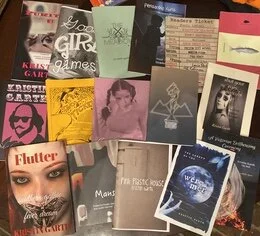
I stripped in pigtails and braids and schoolgirl uniforms for five years to establish my financial autonomy from my abusers. At that time, I think the house represented my loneliness and the normalcy that I craved so much. Writing about that lonely Barbie house and creating a journal in its name has connected me to countless people decades after that lonely schoolgirl stripper took off her clothes to be free. The Pink Plastic House represents community and wholeness to me now, and that's the power of writing — how it can transform your life.
MQ: Not only are you prolific in your writing ventures, but you have edited numerous projects. Anthologies are especially challenging to put together. What are a few pieces of advice you could give writers who want to pursue publishing an anthology?
KG: I have edited four anthologies, three with a partner and one alone. Justin Karcher was my first editorial partner. We worked together on Mansion, a Slenderman anthology, and These Poems Are Not What They Seem, a Twin Peaks anthology (in which you had a fantastic poem!). I had the idea for Mansion and shared it with Justin long before I had the Pink Plastic House journal or any editorial experience. He said we should do this and I felt empowered because he had the editorial experience I lacked.
I definitely think that is a great way to gain editorial experience is to work with a more experienced editor. If you have an idea for an anthology and feel lacking in the skills to execute, find yourself a more experienced partner. I'm a very hard-working human, and I love learning. I just needed someone who knew more than me about tech and editing.
Even on my newest anthology that it is my first solo project and the first publication of Pink Plastic Press, Pinkprint (the first of many. I hope, anthologies of work from Pink Plastic House journals), I hired Jeremy Gaulke of APEP, who has published me (and published the Twin Peaks anthology) before to print and design a cover. It was another way to ask for and receive a second pair of experienced eyes on this manuscript. Collaboration with people who know more than you is always good, I feel.
MQ: You often use video to share and promote your work on Instagram and Twitter. What do you specifically appreciate about each platform? If a writer could only use one of those platforms, which would you recommend and why?
KG: Wow. This is such a hard question, which is ironic because, for years, I said I'd never join Instagram. It was a statement completely informed by my ignorance of the platform.
People were always telling me I was a natural to be on Instagram because I make so many videos and post my selfies and socks.
I have been in the Twitter literary scene since 2017, and I am beyond grateful to Twitter to give me the space to finally be myself. I write a lot and publish a lot, and it was marvelous to have a place to share that.
I'm an introvert, stay-at-home girl in a small southern town. I don't have a local poetry scene I'm affiliated with — Twitter became that. By doing the videos, I felt like I was reading for my friends and people got to experience that as if we are in the same hometown.
It's sort of amazing that I'm known for my poetry readings being a poet who has never read in public "in real life." I had an engagement to teach a Delta State workshop at the Southern Literary Festival that was cancelled by the pandemic. After the pandemic, I began to feel that maybe I'd only be an online poetry reader, and maybe that's okay.
Poetry Twitter gave me a voice, and I spent so much time there that I did not believe I had time for another platform. To be honest, the only reason I joined Instagram is that in the middle of doing editing on The Meadow, a very vulnerable book I wrote about my experiences in BDSM as a young woman, my publisher at APEP left Twitter to focus on one social media platform. Since we communicated a lot during the writing of this book, a lot in messages, he told me I could talk to him there. So I got myself together and did what people had encouraged me to do — have an Instagram to archive my socks and sonnets and videos.
Twitter is very fulfilling to me for the friendships I've made and the opportunities present in the literary community. All my books came to pass through Twitter conversations and my would-be speaking engagement. I have a weekly sonnet podcast with Gadget G Radio called Kristin Whispers Sonnets that I was invited to do because of Twitter. Though I have come to love Instagram better in its actual layout and the archiving of video, for example, I could never betray Twitter, which has given me so much.
Though Pink Plastic House has a vacation Instagram house that has become a much a part of the journal as my website, so if you asked the house, she might have a different answer.
MQ: I love the film aesthetics of Anna Biller, Dario Argento, and Alejandro Jodorowsky and literary aesthetics as different as Edgar Allan Poe and Marguerite Duras and Guillermo Gomez-Peña. Your aesthetic is literary and cinematic. What are some artistic aesthetics that resonate with you that people would be surprised to hear? Whose aesthetic dollhouse would you like to spend a day?
KG: Thank you so much for calling my poetry cinematic. That means a lot as I primarily write Shakespearean sonnets, and it's always been important to me to try to create a world in 14 lines. I love films and how they engage all your senses and transport you places.
Obviously, I am a huge David Lynch fan, with my favorites by him being Mulholland Drive and the Twin Peaks film and series. That really wouldn't surprise many, though, as I've written many poems about Twin Peaks, and I've published the anthology about it.
I am so influenced by many other filmmakers, though from Whit Stillman, whose movies like Metropolitan taught me about dialogue and it's importance to the bravery of a filmmaker like Catherine Hardwicke in making the film Thirteen with its honest portrayals of troubled adolescence — to which I very much relate.
It's hard to speak about the raw truths of an abused child in a public way. I feel such a debt to films I watched, and books like We Were The Mulvaneys and Beasts by Joyce Carol Oates, as an example, that deal with sexual trauma, societal dynamics, and power imbalances. Reading books like these made it feel doable in an engaging, artistic way and my voice worthy of being heard.
I would love to be invited into anyone's dollhouse. I have three myself — an old wooden one that has been through a lot and became the logo of the literary journal. I also have a Barbie dreamhouse and a Disney Cinderella castle replica. I have an ongoing feature of poets who have dollhouses that has featured Kolleen Carney and Kailey Tedesco so far. I feel like it's my chance to virtually commune with other poet dollhouse lovers. That's a subset of people I just adore, so if you are one of them, feel free to reach out because I'd love to know you and for you to be in The Real Dollhouse Poets of The Pink Plastic Plasticity.
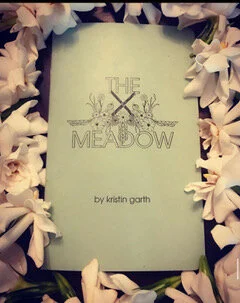
MQ: In your APEP Publications chapbook, The Meadow, the speaker takes a journey through hurt while at the same time recognizing intricate beauty and the body politics of BDSM. The speaker has autonomy through a memoir. What is a future "meadow" you envision walking down?
KG: That's such a lovely description of The Meadow, thank you. The Meadow is a book I've been wanting to write for twenty years. In fact, there is a poem inside of it called "Homecoming," which was my first and only publication until I was 43 and became who I was supposed to be.
The story of the publication of the sonnet "Homecoming" in No Other Tribute: Erotic Tales of Women in Submission, edited by Laura Antoniou, tells a lot about me at this time of my life. I wrote this sonnet and gave it to my first dom when I was just discovering the BDSM scene in my early 20's. I received a partial scholarship to graduate school in creative writing because of my sonnets, many of which were sexual and kinky as characterize many of my sonnets, but I would end up dropping out of graduate school to strip to have the financial autonomy to live my life away from abuse.
Even though I was in school studying writing, I didn't submit my poetry anywhere. Didn't have the strength yet to even contemplate that kind of rejection after the tortures of my childhood. I submitted, though sexually, and I gave this poem to my much older dom, who was also a writer. He didn't tell me, but he submitted it to Laura Antoniou's anthology, where it was accepted. At that point, of course, he told me to gain my consent to move forward with the publication, and I was shocked but delighted.
It was published under my scene name as pseudonym (Scarlet), and it was the only poem accepted in a collection of prose. The editor wrote the kindest introduction about me, how she couldn't help but publish this poem. It was that magical kind of publication experience that can change your life.
Of course, for me, it would take almost twenty years before I worked up the courage to submit myself in writing. But I always knew I eventually would because of the way this experience had made me feel seen in a world in which I was still invisible.
I had published it under a pseudonym, which made me very sad at the time because I feared my parents would find out. I still lived at home. I hated not being able to own my experiences due to abuse and the threat of more. I swore one day I would write whatever I felt with my name and be known for that name. Almost 700 publications later, I know my younger self would be so proud of the Kristin Garth I have become.
I am my meadow now. I feel I had to undergo the catharsis of hurt to discover myself — and sometimes I find myself in its thorns again. But I also ache for the petals and the dew of the meadow. I am learning to nourish and cultivate myself better and make roots, and value rest and replenishment. I don't leave myself open to predators and the elements the way I did in the desperation of my wandering youth. There is an architect in the meadow now. I am building a cottage. I am learning to shelter.
Kristin Garth is a Pushcart, Best of the Net & Rhysling nominated sonnet stalker. Her sonnets have stalked journals like Glass, Yes, Five:2: One, Luna Luna, and more. She is the author of seventeen books of poetry including Pink Plastic House (Maverick Duck Press), Crow Carriage (The Hedgehog Poetry Press), Flutter: Southern Gothic Fever Dream (TwistiT Press), The Meadow (APEP Publications), and Golden Ticket from Roaring Junior Press. She is the founder of Pink Plastic House a tiny journal and co-founder of Performance Anxiety, an online poetry reading series. Follow her on Twitter and her website.
Monique Quintana is a Xicana from Fresno, CA, and the author of the novella Cenote City (Clash Books, 2019). Her short works have been nominated for Best of the Net, Best Microfiction, and the Pushcart Prize. She has also been awarded artist residencies to Yaddo, The Mineral School, and Sundress Academy of the Arts. She has also received fellowships to the Community of Writers, the Open Mouth Poetry Retreat, and she was the inaugural winner of Amplify’s Megaphone Fellowship for a Writer of Color. You can find her @quintanagothic and moniquequintana.com.