BY JOANNA C. VALENTE
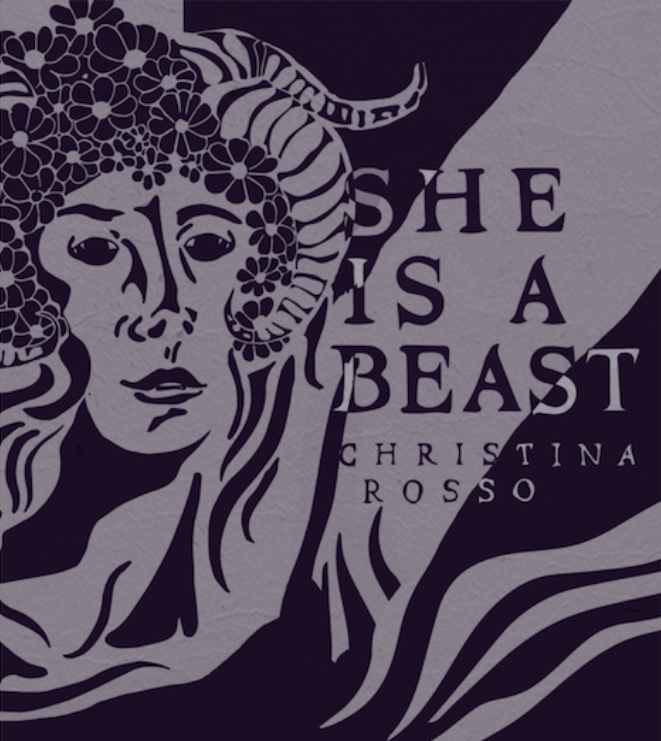
Christina Rosso is a weaver of stories - and she wants these stories to change your perspective. Rosso’s collection of feminist fairy tales, She Is a Beast, is forthcoming from Apep Publications this May. The book, gorgeously and delicately illustrated by the press’ founder, Jeremy Gaulke, provides portrayals of women in times of crisis, identity exploration, and reclamation.
I interviewed Rosso about her book, feminism, influences, and more.
What inspired you to write the book in the way that you did?
I didn’t originally plan for these stories to come together in a book. The last story of the collection, “Becoming a Beast,” was the first one I wrote (about three years ago). It was the first time I felt I had really hit the mark with the kind of stories I wanted to tell. The first line goes, “I was raised to become a maiden, yet I dreamed of becoming a beast.” I think this sums up what I try to accomplish by re-imagining fairy tales: twisting the prescribed roles to allow humanity and individuality to shine through.
“Becoming a Beast” also happened to be the first story I ever had published (thank you Twisted Sister Lit Mag).
From there I continued to write and submit feminist fairy tales. It wasn’t until about a year ago that I realized I had a collection. I was in the middle of working on two longer projects (a novel and full-length short story collection, both inspired by fairy tales) and needed a break. I also wanted to do something that would honor the stories I had been working on and the wild, brave women who resided in them. Why not give them their own storybook?
As I edited the stories and started to fit them together, shaping them into a collection, I knew the words she and beast had to be in the title. Society typically sets these two things as opposite; women are supposed to be beautiful, virginal, and sweet. Beasts are seen as wild, uncontrollable, and dangerous. But the women in these tales exist in an in-between state, on the cusp of both humanity and beastliness. They are both women and beasts, both beautiful and destructive.
As someone who often balks at the status quo, I feel a connection to these characters and hope that other people will too.
Fairy tales and folk legends teach us about the society we live in and I'm curious what takeaways you want your reader to get.
One takeaway I want my readers to get is that society often tries to force us into boxes that are too small and constrictive for human beings. Like society, fairy tales often deal in binaries. My work is about disassembling those binaries to reveal the layers that each character possesses. No person or thing can be whittled down to one thing alone.
Another takeaway I hope my readers get is that their voices and their stories are important. The characters in my collection often don’t have agency or voices (sometimes literally) in their original fairy tales. But here they are in control of their stories and are weaving new endings for themselves. In today’s world, I believe it is especially important to find our voices and share our stories.
What are some of your favorite fairy tales? Why?
There are three fairy tales I find myself returning to again and again: “Bluebeard,” “Beauty and the Beast,” and “Little Red Riding Hood.”
“Beauty and the Beast” I have loved since childhood. In fact, growing up I knew every word to Disney’s 1991 animated version. I’ve always seen a part of myself in Beauty; her love of books and how her interests make her an outsider in her village. I never felt I belonged until A Novel Idea opened and I found several communities full of wonderful people who see me and support me exactly as I am. I also love that in every version Beauty is smart and kind and willing to look past the surface level.
“Little Red Riding Hood” is a story I return to again and again. The moral Charles Perrault outlines for us is that girls shouldn’t stray from the path and talk to wolves. I like to think of this as the original stranger danger lesson. But in today’s world, I think it has deeper connotations. Little Red Riding Hood is often sexualized, whether she’s a little girl or a young woman. And the language surrounding hunger and the idea of devouring is clearly erotic.
I see this story as not only a warning that wolves can appear in sheep’s clothing but also that there are monsters in the world who want to and will devour you whole. For me, there are clear connections to the #MeToo movement in this moral and I often find when I write a version of Little Red Riding Hood it’s about sexual harassment or assault.
I discovered “Bluebeard” during grad school and have loved it ever since. There is so much in this fairy tale that I find delicious. To begin with, I am fascinated by serial killers. Bluebeard was inspired, at least in part, by Gilles de Rais, a nobleman who fought alongside Joan of Arc and became both Marshal of France and her official protector.
Rumors began to circulate when dozens of children went missing around his castles. In 1440, he was arrested and confessed to kidnapping, torturing, and killing children for over a decade. He was hanged and burned as a witch. Obviously, I don’t condone murder, especially of children, but I find the history behind Bluebeard and other serial killers to be worth studying.
Another reason “Bluebeard” speaks to me is that the wife always survives. You would think in a story about a naive young woman marrying a serial murderer that she would end up his next victim. Of course, she almost never escapes unscathed. But I find hope in the fact that she always does escape, whether of her volition or help from family. For a story with a moral about the danger of female curiosity her new knowledge doesn’t destroy her. In many versions, she thrives after her murderous husband dies.
Generally, with your writing, what do you hope to accomplish? Where do you see it evolve and go?
With my writing, I hope to give marginalized characters voices. I try to focus my work on experiences that I have had or can directly relate to so that my work is authentic and isn’t appropriating someone else’s unique experience and culture. I’m also drawn to write about experiences that society tries to keep hidden or silent, specifically violence towards women.
With this, I hope to make noise and to give those who have had to live through trauma of this kind some of their power back. Moving forward, I plan to continue the work I’m doing now with the same passion and tenacity. I think the stories I tell will always be relevant, however, I do hope that the world will evolve to become wiser and safer for those currently deemed others. I wish for more compassion and respect. I hope that one day I won’t write with such anger and pain coursing through my body.
What and who influences your work?
Angela Carter is a huge influence. I discovered The Bloody Chamber during my master’s program at Arcadia University and it completely changed my perception of fairy tales, writing, and myself. She pioneered the term feminist fairy tales by revealing what she called the “latent content” of these tales and their characters. The writing trembles with sexuality and violence and never ceases to inspire me to rethink the way I write and craft stories.
Some other authors who have or are currently doing important work in the fairy tale genre are Emma Donoghue, Daniel Mallory Ortberg, Carmen Lau, and Nikita Gill.
What are some of your favorite horror movies?
The Witch is, in my opinion, one of the best horror and witch movies of all time. I also really appreciate Midsommar. But my very favorite horror movie is The Conjuring. I am fascinated by Ed and Lorraine Warren and the many paranormal cases they investigated. Someday I plan to go to the Warren Occult Museum in Monroe, Connecticut. My husband, Alex, said he’ll wait outside for that one.
We live, sadly and obviously, in a politically turbulent time. How would you define feminism and inclusiveness? What are ways you try to be inclusive?
I define feminism as equality among all, regardless of gender, sexuality, race, spirituality, or identity. Inclusiveness is celebrating and welcoming people exactly as they are.
My writing is feminist in nature, so it’s very important to me to explore gender, sexuality, and identity in my work and give females or those deemed others the main stage. Since a lot of my work is inspired by fairy tales, I try to push the boundaries set by patriarchal society. I call this revealing the underbelly of the characters and their circumstances, and what this often means is eradicating the binaries laid out by society. These characters aren’t necessarily just good or evil, or just male or female. Sometimes they’re not simply human or beast.
I practice inclusivity by reading and promoting as many artists as possible, whether that’s through social media or the events I schedule at the bookstore Alex and I own in Philadelphia called A Novel Idea on Passyunk. I constantly try to find new artists, artisans, and educators and give them the space and opportunity to share their work.
I also try to always keep an open mind and ear to other’s experiences. Especially now, during our current health crisis, I believe it’s important to support and lift up one another and to practice compassion.
Define happiness - and a perfect day for you.
A perfect day for me involves waking up to puppy smooches from Atticus, lounging in bed with a good book, then spending time with my husband and pup, whether that’s watching TV or going for walks, good food, and finding some time to write or chat with Alex and spin a web of new story ideas. I’m very fortunate that my partner likes to talk through story concepts with me and has a different perspective to offer from his design and video game background.
Joanna C. Valente is a human who lives in Brooklyn, New York. They are the author of Sirs & Madams, The Gods Are Dead, Marys of the Sea, Sexting Ghosts, Xenos, No(body), #Survivor: A Photo Series (forthcoming), and A Love Story (Vegetarian Alcoholic Press, 2021). They are the editor of A Shadow Map: Writing by Survivors of Sexual Assault and the illustrator of Dead Tongue (Yes Poetry, 2020). They received their MFA in writing at Sarah Lawrence College, and Joanna is the founder of Yes Poetry and the senior managing editor for Luna Luna Magazine.
Christina Rosso lives and writes in South Philadelphia with her rescue pup, Atticus Finch, and bearded husband, Alex. Together they run an independent bookstore and event space called A Novel Idea on Passyunk. In 2016, Christina received an MFA in Creative Writing and MA in English from Arcadia University. Her writing has been featured in FIVE:2:ONE Magazine, Digging Through the Fat, Ellipsis Zine, and more. She is a Beast is her first book.