
BY LYDIA A. CYRUS
Categorically, I am my father’s daughter. He is my biological father, the man who "raised" me, but there is a distance between us established by years of abuse and anger.
Categorically, we are one and the same: dark hair, dark eyes, and olive skin. The same surname: Cyrus.
I was fifteen when I read Hemingway for the first time ever. A ragged, blue copy of The Old Man and the Sea from the school library launched me forward into an exploration of masculinity and powerful writing. I loved to run my fingers across the spine of the book and feel the embossed lettering as I sat in my bed and read the book, cover to cover, in one sitting.
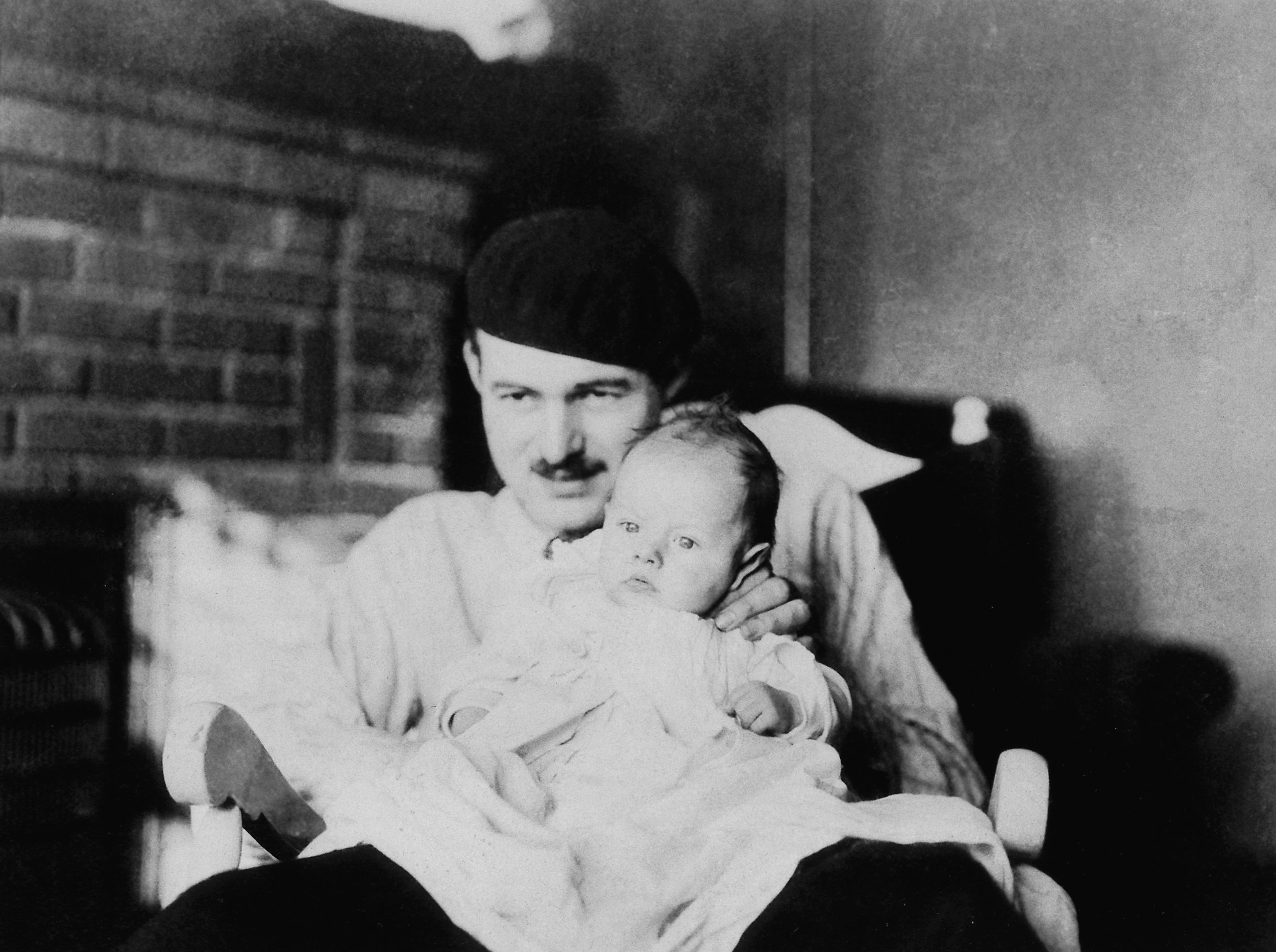
I thought that I would come to hate him, Hemingway, because he was so masculine. So brazen and drunk. Instead, I came to love him—so much that I decided to call him Papa instead of Ernest. Hemingway asked all of his loved ones to call him "Papa." Papa was born in July of 1899 and he died in July of 1962, seven years before my father, Tommy, was born in July. Papa had three sons: Jack, Patrick, and Gregory. He had no daughters and I’m unsure of whether or not he ever knew his grandchildren, whether or not they were daughters. Papa married many women: Hadley, Pauline, Martha, and Mary.
My mother once told me that young girls who live without their fathers always seek a father. First we seek our real father, sometimes we seek our spiritual father second, but always we search for a father. I have learned that you cannot pin the word father to a man’s jacket and expect him to remember to answer to the title or even to wear the jacket. Uncles and grandfathers have stood in line for me to pin a title to and all have failed. So why not pin the title to a man I never met? One I’ll never meet.
Papa died at the age of sixty-two from two self inflicted gun shot wounds. One morning, he said to Mary, "Goodnight, Kitten," and he ate his favorite breakfast while still in his silk pajamas. I like to imagine that he ate waffles with strawberries swirling in the syrup. I imagine that Ketchum, Idaho, was cold and that his waffles didn’t stay warm because he couldn’t eat them fast enough to spare them the cold Ketchum air. But I was not there when Papa died. Who can say that he did not eat waffles and strawberries? Perhaps he ate eggs instead. Papa ate breakfast and he shot himself with a gun.
It’s impossible to think of what would have become of Papa had he not ate breakfast that morning in 1962. By the age of sixty-two he had suffered through two world wars, two plane crashes, and countless smaller tragedies. Some tragedies I know I cannot name for him. I know that. They must have been there though, the bitter feeling of leaving Cuba in exchange for a mental hospital in America. The extreme paranoia he faced that no one believed him—paranoia that history knows now to be true. In the First World War, Papa suffered from shrapnel wounds that pierced his body: in sixty-two years I think that he suffered shrapnel wounds of metaphorical power. It is safe to say that even if he hadn’t died then, he would have some day. His body would not have held his spirit in place long enough to wait for my arrival a full thirty-three years later. So Papa’s spirit is carried to me in paper.
RELATED: The Car Goes First: On My Father's Death
I never learned how to ride a bike. I know how to do it, I know you sit on the seat and try to balance every organ, every atom, to stay upright and then you pedal. I have never ridden a bike because no one ever taught me how.
I bet Papa taught his sons how to ride bikes. I bet his sons never felt embarrassed about riding bikes with the other neighborhood children. It probably felt like breathing to them: natural and completely necessary to their existence.
I never learned to be an athlete because I would rather be a reader. When my father thought that I should be a volleyball player I stressed that I was afraid of breaking my thumbs and he was angry. I never wanted to play a team sport and engage with others and I never felt the need to exert force from my body for a spectacle.
Papa was a big game hunter and loved to fish for marlin. In photographs, his barrel chested figure illuminates the scenery of slaughter: enormous marlins hang from their tails as Papa stands next to them, sometimes placing a hand on them. Thousands of pounds of dead flesh hang in the balance as Papa and several other men laugh and thump each other on the back. Job well done, I bet they’d say. They probably smoked cigars and had stiff drinks to celebrate their seamless efforts to catch behemoth fish that exist only in photographs or in lore. They don’t seem disappointed in the size of the fish or the thought of what a bigger fish might look like. Papa doesn’t seem angry but content.
When I was twenty-one, my Aunt Martha had to be admitted to the hospital: a viral infection. In a desperate attempt to talk to somebody, anybody, I tried to call my father. The house phone rang out for what felt like eternity but he never answered. Then he came home. He hadn’t noticed the blaring red notifications on his cellphone: he hadn’t missed me. Something in the way I asked why didn’t you answer seemed to enrage him and before I knew it I was running. Across a gravel driveway and up two sets of stairs my feet carried me. By a stroke of dumb luck, he tripped on a concrete slab at the base of the stairs and I had the advantage then. I locked myself in a bathroom while he yelled: the only door with a lock on it. I’ll never ask again why a man does not answer his daughter’s calls.
Papa wrote stories. His books are scoffed at by the scholarly readers I know because he didn’t use a variety of punctuation, because he didn’t use a variety of men or women. The men in his books are hyper masculine, not criers, and the women are often viewed negatively. Papa was a masculine man: bar fights, marlin fishing, womanizing, and heavy drinking dictated much of his life. But Papa loved his cats, and his home became a breeding ground for those infamous six-toed cat. He loved his wives—perhaps the first one the best. Hadley never truly left his life even when he neared the end of his life and Mary Hemingway sent him off for treatments at the Mayo Clinic. Tenderness, even the smallest amount, weaved its way into his life even though the beer and the fistfights were more dominant. In his old age, I believe, the tenderness settles in his eyes and among his stark white hair you can see it leak over the brim: a façade of tears.
To be fatherless is to be godless. It is not that you do not believe in him, it is not that he isn’t there, it is simply that in all the places you need him most there is a desolate emptiness. It is simply this: you cannot wish, cannot want, something that doesn’t want you back, that does not exist in the way you need it to. I no longer hope for forgiveness or reconciliation. In the moments I remember him being kind I am much too young, a literal child yet to face decades of slipping and having her arms grabbed tightly in fits of shaking. My fingers had felt the prick of pins as I sorrowfully begged someone, some man, to let me be their daughter.
I have never had to ask for Ernest to be mine. I will most likely never get the chance to ask in this lifetime or another, but I don’t believe that I need to. Few men have stayed as long, left as much behind, as Papa has. It’s likely I found him because I was looking for him and because I saw the ways of a brute at home and in Papa’s books. I cannot blame Hemingway for the things he did. He is blameless in everything I search for. Ravaging through my life I have been unable to find a note of any kind that admits his guilt. It’s easier to find blame in my own father, his admissions of guilt are everywhere on my body, my mind. But I cannot blame, Papa. Papa is dead.
One spring afternoon I was driving home with the windows rolled down. The warm air was mixing with the radio waves and wafting out of the car. As I approached a small yellow trailer home I pasted an old, blue pickup truck. If the day had been cold and my windows had been sealed off tightly, I would not have looked at the other side of the road but that day I did. The man driving the truck was older: I could tell by the white beard etched across his face. His skin was tanned and spotted and he was smiling. He looked so familiar to me—so much like someone I knew—that I stopped the car. Right there in the middle of the road I stopped the car. The man was happy and enjoying the weather much like I had enjoyed it and yet his face made me weep.
There wasn’t much I could say to him. I couldn’t put the car in reverse and stop him. There would have been nothing to say except: I’m sorry but you look like someone I’m looking for.
Lydia A. Cyrus (STAFF WRITER) is a creative nonfiction writer and poet from Huntington, West Virginia. Her work as been featured in Thoreau's Rooster, Adelaide Literary Magazine, The Albion Review, and Luna Luna. Her essay "We Love You Anyway," was featured in the 2017 anthology Family Don't End with Blood which chronicles the lives of fans and actors from the television show Supernatural.
She lives and works in Huntington where she spends her time being politically active and volunteering. She is a proud Mountain Woman who strives to make positive change in Southern Appalachia. She enjoys the color red and all things Wonder Woman related! You can usually find her walking around the woods and surrounding areas as she strives to find solitude in the natural world. Twitter: @lydiaacyrus