

• Home
  • indulge
  • new poetry
    • About Luna Luna
    • resources
    • search
  • editor
  • dark hour
  • submit
Menu

luna luna magazine

  • Home
  • indulge
  • new poetry
  • About
    • About Luna Luna
    • resources
    • search
  • editor
  • dark hour
  • submit
delicious new poetry
'the doors of the night open' — poetry by Juan Armando Rojas (translated by Paula J. Lambert)
Nov 29, 2025
'the doors of the night open' — poetry by Juan Armando Rojas (translated by Paula J. Lambert)
Nov 29, 2025
Nov 29, 2025
'we can be forlorn women' — poetry by Stevie Belchak
Nov 29, 2025
'we can be forlorn women' — poetry by Stevie Belchak
Nov 29, 2025
Nov 29, 2025
'I do whatever the light tells me to' — poetry by Catherine Bai
Nov 29, 2025
'I do whatever the light tells me to' — poetry by Catherine Bai
Nov 29, 2025
Nov 29, 2025
‘to kill bodice and give sacrament’ — poetry By Kale Hensley
Nov 29, 2025
‘to kill bodice and give sacrament’ — poetry By Kale Hensley
Nov 29, 2025
Nov 29, 2025
'Venetian draped in goatskin' — poetry by Natalie Mariko
Nov 29, 2025
'Venetian draped in goatskin' — poetry by Natalie Mariko
Nov 29, 2025
Nov 29, 2025
'the long sorrow of the color red' — centos by Patrice Boyer Claeys
Nov 28, 2025
'the long sorrow of the color red' — centos by Patrice Boyer Claeys
Nov 28, 2025
Nov 28, 2025
'Flowers are the offspring of longing' — poetry by Ellen Kombiyil
Nov 28, 2025
'Flowers are the offspring of longing' — poetry by Ellen Kombiyil
Nov 28, 2025
Nov 28, 2025
'punish or repent' — poetry by Chris McCreary
Nov 28, 2025
'punish or repent' — poetry by Chris McCreary
Nov 28, 2025
Nov 28, 2025
'long, dangerous grasses' — poetry by Jessica Purdy
Nov 28, 2025
'long, dangerous grasses' — poetry by Jessica Purdy
Nov 28, 2025
Nov 28, 2025
'gifting nighttime honey' — poetry by Nathan Hassall
Nov 28, 2025
'gifting nighttime honey' — poetry by Nathan Hassall
Nov 28, 2025
Nov 28, 2025
'A theory of pauses' — poetry by Jeanne Morel and Anthony Warnke
Nov 28, 2025
'A theory of pauses' — poetry by Jeanne Morel and Anthony Warnke
Nov 28, 2025
Nov 28, 2025
'into the voluminous abyss' — poetry by D.J. Huppatz
Nov 28, 2025
'into the voluminous abyss' — poetry by D.J. Huppatz
Nov 28, 2025
Nov 28, 2025
'an animal within an animal' — a poem by Carolee Bennett
Nov 28, 2025
'an animal within an animal' — a poem by Carolee Bennett
Nov 28, 2025
Nov 28, 2025
‘in the glitter-open black' — poetry by Fox Henry Frazier
Oct 31, 2025
‘in the glitter-open black' — poetry by Fox Henry Frazier
Oct 31, 2025
Oct 31, 2025
'poet as tarantula,  poem as waste' — poetry by  Ewen Glass
Oct 31, 2025
'poet as tarantula, poem as waste' — poetry by Ewen Glass
Oct 31, 2025
Oct 31, 2025
'my god wearing a body' — poetry by Tom Nutting
Oct 31, 2025
'my god wearing a body' — poetry by Tom Nutting
Oct 31, 2025
Oct 31, 2025
'Hours rot away in regalia' — poetry by Stephanie Chang
Oct 31, 2025
'Hours rot away in regalia' — poetry by Stephanie Chang
Oct 31, 2025
Oct 31, 2025
'down down down the hall of mirrors' — poetry by Ronnie K. Stephens
Oct 31, 2025
'down down down the hall of mirrors' — poetry by Ronnie K. Stephens
Oct 31, 2025
Oct 31, 2025
'Grew appendages, clawed towards light' — poetry by Lucie Brooks
Oct 31, 2025
'Grew appendages, clawed towards light' — poetry by Lucie Brooks
Oct 31, 2025
Oct 31, 2025
'do not be afraid' — poetry by Maia Decker
Oct 31, 2025
'do not be afraid' — poetry by Maia Decker
Oct 31, 2025
Oct 31, 2025
'The darkened bedroom' — poetry by Jessica Purdy
Oct 31, 2025
'The darkened bedroom' — poetry by Jessica Purdy
Oct 31, 2025
Oct 31, 2025
'I am the body that I am under' — poetry by Jennifer MacBain-Stephens
Oct 31, 2025
'I am the body that I am under' — poetry by Jennifer MacBain-Stephens
Oct 31, 2025
Oct 31, 2025
goddess energy.jpg
Oct 26, 2025
'Hotter than gluttony' — poetry by Anne-Adele Wight
Oct 26, 2025
Oct 26, 2025
'As though from Babel' — poetry by Fox Henry Frazier
Oct 26, 2025
'As though from Babel' — poetry by Fox Henry Frazier
Oct 26, 2025
Oct 26, 2025
'See my wants' — poetry by Aaliyah Anderson
Oct 26, 2025
'See my wants' — poetry by Aaliyah Anderson
Oct 26, 2025
Oct 26, 2025
'black viper dangling a golden fruit' — poetry by Nova Glyn
Oct 26, 2025
'black viper dangling a golden fruit' — poetry by Nova Glyn
Oct 26, 2025
Oct 26, 2025
'It would be unfair to touch you' — poetry by grace (ge) gilbert
Oct 26, 2025
'It would be unfair to touch you' — poetry by grace (ge) gilbert
Oct 26, 2025
Oct 26, 2025
'Praying in retrograde' — poetry by Courtney Leigh
Oct 26, 2025
'Praying in retrograde' — poetry by Courtney Leigh
Oct 26, 2025
Oct 26, 2025
'To not want is death' — poetry by Letitia Trent
Oct 26, 2025
'To not want is death' — poetry by Letitia Trent
Oct 26, 2025
Oct 26, 2025
'Our wildness the eternal now' — poetry by Hannah Levy
Oct 26, 2025
'Our wildness the eternal now' — poetry by Hannah Levy
Oct 26, 2025
Oct 26, 2025
Playbuzz

Playbuzz

Whisper, with Blonde Hair: Mi Vida Loca's New Gangster Queen

November 15, 2016

BY MONIQUE QUINTANA

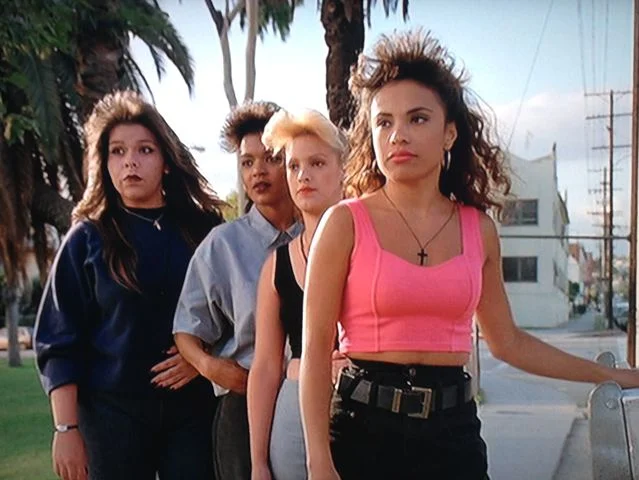
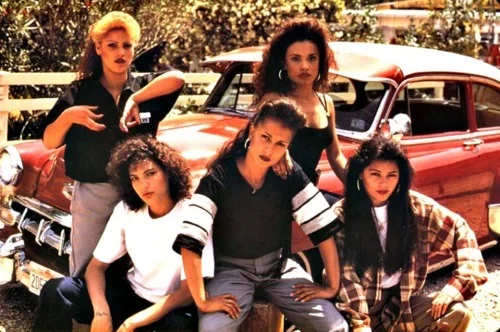
It’s been twenty-one years since the film, Mi Vida Loca was released in 1994, and it’s still a shining moment amongst gangster girl films. Its fashion has had an immeasurable impact of young Latina women. Historically, most gangster films are centered on men, with an occasional female character to provide a sense of glamour and romance. Mi Vida Loca was a pivotal film because it constantly challenged gender expectations and placed most of its value on the relationships between women.

The film is set in the Los Angeles’ Echo Park and explores, examines, and complicates the tumultuous lives of Mexican-American youth who find family and purpose in their neighborhood gang. The film has a postern-modern timeline narrative, told in multiple point-of-view and events are relayed out of sequence. While we hear from the “Locos,” the male members of the gang, the female members, the “Locos” are the undeniable pulse of the film. While all these women are dazzling in their dress and demeanor, there’s one character that seems to really speak to what the film was getting us to look at, the gangster girl at the turn of the century. I’m thinking of Whisper with the blonde hair.
HBO Video

HBO Video

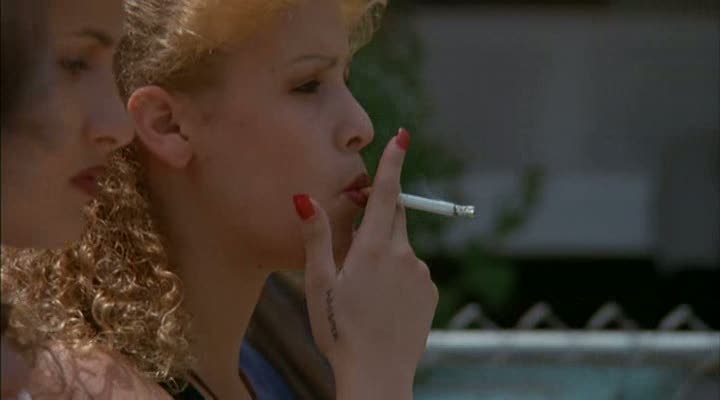
Whisper takes over her neighborhood’s drug operation when her friend, Ernesto is mysteriously killed. She owes her name to her soft raspy voice. Whisper is the anchor of her posse, the most confident and the most boss. Nelida Lopez, the actress that played Whisper recalls the reality of the film’s aesthetic. She did most of the styling for Whisper herself.

RELATED: Making Mermaids: The Politics of Bath Time

She says, “There wasn’t much of me getting dressed and dolled up. Whisper’s style was something from my normal daily routine. Putting on my eyeliner, and doing my hair was a must at that time. Getting to the set was always exciting, an awesome experience, but I dressed myself and I did my hair. My make-up was done by an artist, but with my assistance.” Cultivated by the hands of the woman who plays her to life, Whisper’s style was a mirror to what gangster girls were wearing at that time, and the film captures that integral moment in the narrative of the chola aesthetic.   

One of the resonating conflicts of the film is the relationship between best friends, Mousie and Sad Girl. When Sad Girl becomes pregnant by Mousie’s boyfriend and father of her child, the aforementioned Ernesto, their hurt and resentment fuels much of the tension in the movie. The tension between these two characters can make it easy for one to place themselves in a particular camp. There are many fans of the film who are either “Camp Mousie” or “Camp Sad Girl.” Mousie usually dresses uber feminine. One scene that stands out is when she wears a hot pink dress and matching high heels. Her hair is super long and teased and she always wears red lipstick. Sad Girl is very much a tomboy. She usually wears oversized shirts, pants, and dark brown lipstick. Her bangs were teased up in a pompadour.

Whisper’s style is different because it dances between both the masculine and the feminine.  There’s a poignant scene in the film where two of the elder “Locas” lament about how different the younger generation of “Locas,” look, saying that they are losing their femininity. While they discuss the young women as a unit, they talk about Whisper in particular, “And whisper, with blonde hair!” Whisper is the first Echo Park “Loca” to dare bleach her hair blonde. Lopez shares that she dyed her hair blonde especially for the film. She points out that Whisper was a character that was always brave and confident, “Whisper's style was mainly hood. It showed she was a gang member and didn’t care what others thought of her.” Whisper’s style reveals how the film is a coronation for the chola of the 90s.

RELATED: My Body Dysmorphia, Myself

Near the end of the film, there is the death of a rival gang leader, a pachuco who wears suits and drives class cars. He’s shot to death by one the young “Locos” from Echo Park. Whisper lives and becomes as a symbol for a new aesthetic, one that merges the old with the new, the feminine with the masculine. While the film pays homage to Pachuco/as, it seems to be arguing that the times are changing in a very real way. With a character like Whisper, we see a transition in urban gangster style, a woman anticipating new days and seeking new sources of aesthetic power.  
We Heart It

We Heart It

Like the pachucas that came before her, Whisper toyed with the idea of gender expectations. She throws them black and forth like a handball, she is hopeful about her community and her place in it. Lopez points out, “Whisper’s clothes were hood and baggy, but also wore tight form fitting clothes that showed off her figure and feminine side.”  Whisper wore skinny jeans, bra tops, crop tops, khakis, and jet-black Nike Cortez shoes. She wears a “Smile Now, Cry Later” barrette to pull her hair off her fully made-up face, and she teases her bangs in a bleach blonde halo around her head. She sports a custom-made baseball cap stitched with Old English letters. She paints her nails a candy apple red. She’s the gangster girl on the brink of a new century. Her palm trees don’t sway in lush California dreamscapes. They’re stitched along a concrete kingdom, where she reigns queen.


Monique Quintana is the Editor-in-Chief of the literary blogazine, Razorhouse. She holds an MFA in Creative Writing from CSU Fresno, and her work has been published or is forthcoming in Huizache, Bordersenses, and The Acentos Review, among others.  She is a Pocha/Chicana identified mother, daughter, sister, lover, and teacher from California’s Central Valley.  

In Art Tags fashion, makeup, feminism, Women
← Cult of Ego: What We Can Learn From Sofia Coppola's The Bling RingWitchy World Roundup - November 2016 →
Featured
‘in the glitter-open black' — poetry by Fox Henry Frazier
'poet as tarantula,  poem as waste' — poetry by  Ewen Glass
'poet as tarantula, poem as waste' — poetry by Ewen Glass
'Hours rot away in regalia' — poetry by Stephanie Chang
'down down down the hall of mirrors' — poetry by Ronnie K. Stephens
'Grew appendages, clawed towards light' — poetry by Lucie Brooks
'do not be afraid' — poetry by Maia Decker
'The darkened bedroom' — poetry by Jessica Purdy
'I am the body that I am under' — poetry by Jennifer MacBain-Stephens
instagram

COPYRIGHT LUNA LUNA MAGAZINE 2025