












BY JENNIFER CLEMENTS
Editor's Note: A version of this article appeared on our old site.
It’s the middle of December and my apartment in DC smells like a pastry shop from the cinnamon and nutmeg candles I’m burning. On the counter, there’s a bowl full of oranges that have been systematically impaled with cloves, as is the holiday way. There’s no fireplace, but if there were, a few logs would be crackling too. I’m in my footed pajamas (red, fleece, nary a butt flap in sight) and I’m going through the cards that have accumulated on the counter, making note of whose address has changed, whom I should visit on my travels, who had another kid.
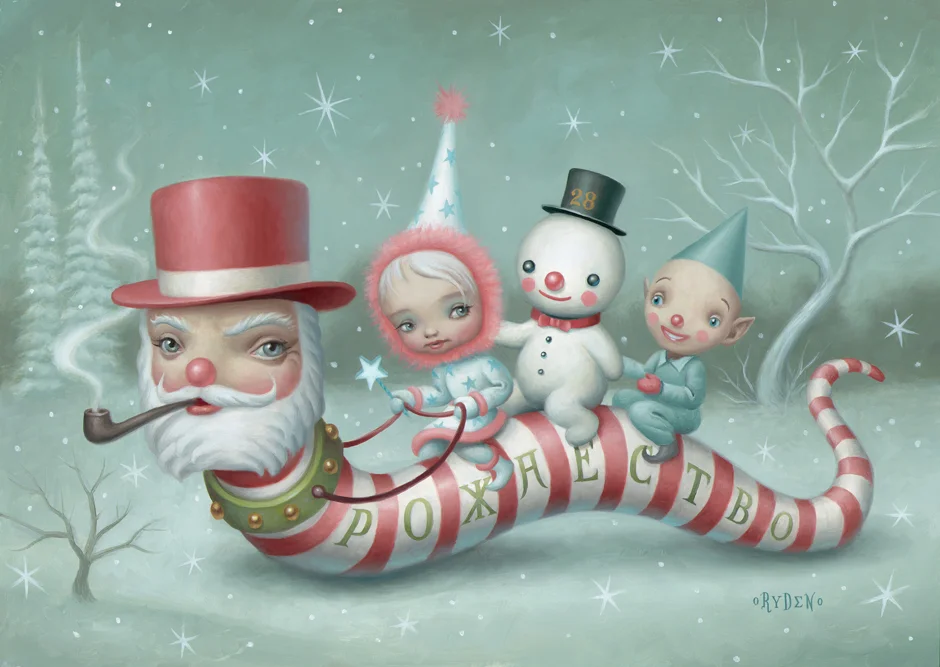
I can usually expect an eclectic assortment of cards from my friends. In this current batch, there’s a handmade collage, a conga line of flamingoes in glittering red Santa caps, a wreath of penguins. There’s a Currier and Ives lithograph with "Happy Holidays" printed in upward serifs. There’s a youthful one with Charlie Brown, Snoopy, Woodstock. There’s one with a smiling corgi dressed as an elf.
And then I find it. Every year I’m sent at least one: the card that tries so hard to be politically correct that it makes me feel tiny and separate and outside of the warmth and good cheer that everyone else is spreading around like spiked eggnog at a Christmas party.
As cards go, it’s innocuous. The outside shows a winding pine branch, ornamented in baubles and colored lights. Clearly it began its life as a Christmas card, all reds and greens and twists of tinsel making their way toward the edge. But inside, the sender has covered over its Merry Christmas text with a religion-neutral yellow sticker. She’s written in Happy Holidays with a Sharpie pen.
And despite the stack of other cards wishing me well in their different ways, despite this card’s apparent good intentions, I feel like I’ve been cast away from the group of festive merrymakers and banished to the corner. And the feeling is exacerbated by its familiarity. I’ve confronted this dilemma since childhood.
Because when it comes to the religion thing, I’m a conundrum. My mother was raised Catholic, my father Jewish, and they were married in a chapel in the United Nations building by both a priest and a rabbi. It sounds like the opening of a potentially offensive joke. My brother and I attended a school run out of an Episcopal church in a conservative Southern city, we were baptized in the kitchen sink by our grandmother, and our closest childhood friends were Hindu and Bahá'í. Our mother collected books about Native American spirituality. We were innately and spectacularly open-minded.
It’s an impossible history to intuit.
As a child, teachers made assumptions about my faith based on my last name (which, before I got married, "sounded Jewish"). The first time I remember this happening was in first grade, just after Thanksgiving, when the focus turned to the December holidays. We were coloring. And while my classmates fought over the best crayons to redden Rudolph’s nose, I stared down at the outline of a dreidel, wondering why I was being punished.
Didn’t I watch Rudolph’s Shiny New Year twenty times between December and January? Didn’t I know every frame of the California Raisins’ Rudolph sequence in A Claymation Christmas? Certainly that beloved reindeer meant more to me than a toy top with strange letters on it.
As an adult, I can appreciate that teacher’s good intentions. I understand that she wanted to customize her activity so that each student was working from a familiar image. But my coloring paper wasn’t familiar, and—more importantly—it wasn’t presented as an option. It felt like exclusion and othering: You are different from your peers. You get a separate activity. Part of me wonders if that feeling would have been the same even if I had identified strongly with Hanukkah and the dreidel coloring sheet. Because regardless of what I was or wasn’t, there was no choice, no opportunity to articulate my perspective. I was put in a box, and that box didn’t tell the whole story.
Which is exactly how it feels to get that Christmas card with the sticker over the name of the holiday: You are different. It’s a reminder of exclusion—and a symptom of someone who I thought knew me well not knowing something as simple as whether I would appreciate a Christmas card.
It’s envisioning the conversation a friend has with her husband: Does Jen celebrate Christmas? It’s hard not to feel disappointed that my friends don’t know the answer, and further still, that they don’t ask. At the same time, I recognize that removing the name of Christmas or Hanukkah has become the sensitive thing to do, that holidays has become the safe term to use for anyone with unknown beliefs. But when someone has tailored a card that presumably they’re sending, intact, to the rest of their address book, it feels less like Happy Holidays and more like Thinking of You Even Though You’re Not Like Us.
As a child of the politically correct era, I understand that the impulse to try not to offend is better than a total lack of consciousness. We shouldn’t assume that all people are the same, period. And I like to think we’ve done a pretty good job of dismantling that idea that people are all the same.
My hope, then, is that people follow that consciousness one step further and see that it’s assumption, more than any acknowledgment of any religious celebration, that should be avoided. I don’t want the Muslim kid to be forced to play a goat in the nativity scene if he doesn’t want to be there. But maybe he does want to be there. Maybe he thinks it’s awesome to play a goat. The bottom line is, you can’t glean a belief system from a skin color or a surname. You can’t assume you know the parameters of someone’s comfort zone. You have to ask the question.
Social inclusion seldom offends. Inclusion suggests common ground—or at least the invitation to common ground. Sure, there are instances where being the exception is regarded in a positive light—but there’s a crucial difference for being singled out for merit or accomplishment rather than race, class, religion, gender, parentage, nationality, language, or some other descriptor beyond anyone’s control.
Some years ago my Jewish boss brought her menorah to work so she could light it at sunset (we worked late), and it was my non-Jewish colleagues who were most eager to be a part of the ceremony. When traveling in Eastern Europe, someone put candies in my shoes for St. Mikuláš Day. No one in these scenarios is forcing anyone to appropriate a holiday or belief that isn’t their own—they’re only inviting them to the experience. The offer of inclusion says to someone, this means something to me and I’d like you to be a part of it in whatever way you feel comfortable.
So for me, go ahead—send me that Christmas card with the Christmas word all nice and proud. Send me your Hanukkah one, too, if that’s your thing. Tell me about your Diwali celebration or share your home-baked sweets. Wish me a happy new year as you observe Gantan-Sai or al-Hijiri or Nowruz or Losar. You’ll never offend me by opening your beliefs or celebrations to my understanding.
And if you want to know what I celebrate or believe, or which coloring sheet I prefer, there’s an easy way to find out—just ask.
Jennifer Dane Clements is a writer and editor based in Washington, DC. Her work has been featured or is forthcoming in publications including Barrelhouse, Hippocampus, WordRiot, Psychopomp, and The Intentional. She is a prose editor of ink&coda and a staff writer for DC Theatre Scene. She holds an MFA in creative writing from George Mason University.