



BY WHITNEY BRENNAN
“Look at the oversized hands, feet and penis.”
I looked. There was a noticeable size difference from what I assume a proportionately sized penis would be on an eighteen-foot tall man. But for David’s purposes, bigger was better.
“He was originally to be placed in a niche, along the outer edge of the dome of the Duomo. Up there, he would have been almost unnoticeable.”
I doubt there are fewer moments that inspire a love for art than the first close-up encounter with a nude work. The Venus de Milo, Ingres’ reclining odalisque, Michelangelo’s David. They have generated intrigue and shock, and have managed to keep our attention years after standards of aesthetic beauty have changed beyond their time. Even now, in the age of performance artist Marina Abramović, and Deborah de Robertis, the Luxembourgian visual artist who re-enacted Gustave Courbet’s ‘L’Origine du Monde’ at the Musee D’Orsay in Paris last May. Such is the mystique and the taboo of the naked body in art. So it was no surprise that one of my most memorable moments in Florence five years ago was meeting David, and his famous marble penis. Needless to say, the man’s presentation leaves nothing to the imagination, and the security guards do their best to protect his modesty, shouting “No photo!” at anyone who even tickles a shutter button. I’d seen photos of the statue before, of course. Isn’t it the same with all intimate encounters, the real thing is always better than a photograph?
Some versions of the story of David and Goliath describe David as a young boy, hardly a teenager. In others, he is a strapping youth, old enough to know how to handle more than a slingshot. If Michelangelo, the reclusive genius he is toted to be, is anything to go by, the representation of an underage boy is far from what David is. This is perhaps catering to Michelangelo’s own taste, but it is also the reiteration of the beauty of youth, and David’s symbolism to the people of Florence. It’s doubtful David would have had the same effect if he were depicted as a scrawny, button-nosed preteen.
Standing in the hallway that leads to the precursor of Armani ads everywhere, I was flanked on both sides by unfinished works by the Great Master – which I came to appreciate in a different way — and I was shocked. I really get to see this, in person? Holy shit. It was one of those moments where the rest of the room, the tourists, the guards and the noise, all disappeared. The room was left to me, and David. In that moment, I knew I could get used to looking at art all day.
The power of the nude has continuously held an intrigue beyond the appeal of human flesh. A disrobed body has the potential to say more than a political speech, an army assault, or a controversial tweet. However, there are always cultural and other important contexts that dictate the significance of the nude. The power of the body — nude or otherwise — speaks to a larger conversation on the social and political constraints that are put on all citizens’ flesh. There is little that can be done using a human body that does not have a political message. It is how we own those actions that determine our power to wage war with and within our bodies.
There are many examples of using one’s body to destroy impositions of power and restraint. From tattooing your skin to reclaim its ‘virginal’ space, to baring a breast, a source of food for your infant, to speak out against the social taboo of breastfeeding in public, bodies are a powerful space of political action. The exposure of skin aside, the refusal of nudity may be just as powerful. The choice to wear the clothing of your culture, religion or other beliefs, is condemned by the same powers that say that the length of your skirt dictates your sexual availability. These actions speak louder than the words that oppress them.
With the power to express, expose or conceal our bodies, we participate in a dialogue that is a continuously morphing aspect of our daily lives. What David represented to the people of 16th century Florence, can be seen in the faces of sex worker’s right activists, protesting for the right and safety of people to work within the realm of their bodies, or the high school girls who speak out when their schools chastise and suspend them for wearing tight pants. There are ways to use our bodies for change.
The perception of bodies can be just as influential to using a body politically. When we view bodies as objects, we do not see violent actions done upon them as criminal. When we see bodies as disposable, we no longer see the value saving a single life may have, or the circumstances that brought them to that disempowered state. It is easy to see other bodies as detached and outside of us. We are taught to see our own bodies as things within our control, yes, but also things that are controlled by others. We’re told this control is for our own good, that chaos might erupt if there were no boundaries, no limits to expression or bodily presentation. Restrictions on dress codes, public nudity, breastfeeding, and body modifications, these forms of control are said to be for the safety and wellbeing of society as a whole. Social and cultural theorists have posited at length on the politicization of the body and its manipulated condition within capitalist society.
Judith Butler, who theorized on “body politics” in the 1990s, Michel Foucault before her in the 1970s, Victoria Pitts, who discusses the politics surrounding body modifications, and Jackson Katz, who speaks on gender based violence and prevention. This is nothing new. Yet it is how we continue to work with these theories, and the deconstructions of social frameworks that we may begin to see change, and more change is needed.
This spring, we celebrated another International Women’s Day. Despite successes and political triumphs, there continue to be roadblocks to social equality, and there continues to be violence to women’s bodies. The power to use the body for radical political action is always at war with the institutionalized violence done against them.
In art, the nude has come full circle; from classical nymph to reclining courtesan, to the Guerrilla Girls asking “Do women have to be naked to get into the Met. Museum?” the female nude has been powerful and disempowered by artists. The male nude has a less muddied history; male nudes speak of valour, pride, or Christ; figures of power that are never overtly sexualized. The gaze is always expected to be male, looking at a female nude or object.
These issues in the art world have been dissolved, primarily by the work of feminist artists beginning in the 1970s. Since then, artists of all genders have explored the use of bodies for sexual, corporate or capitalist gain. However, as artist Deborah de Robertis knows all too well, institutions continue to conceal and restrict the expression of the human body, even for the sake of art.
My encounter with David was structured in a way that seeing his 18-foot high body and accompanying penis was not to evoke feelings of young lust, or even a giggle of penile humour. David is still supposed to be seen with the eye of a Renaissance Florentine, as the saviour of his people, and the incarnated strength of a young Italian city.
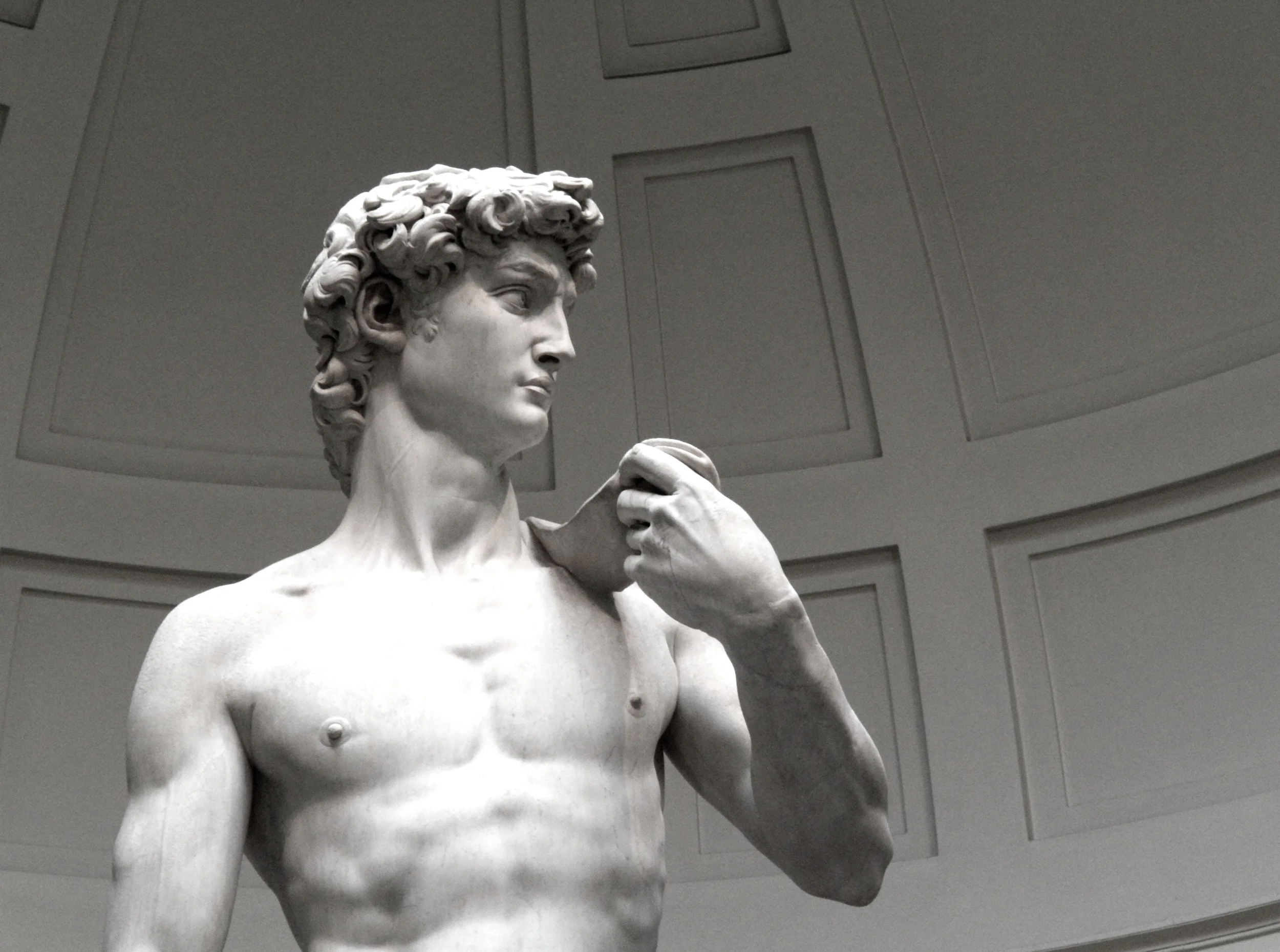
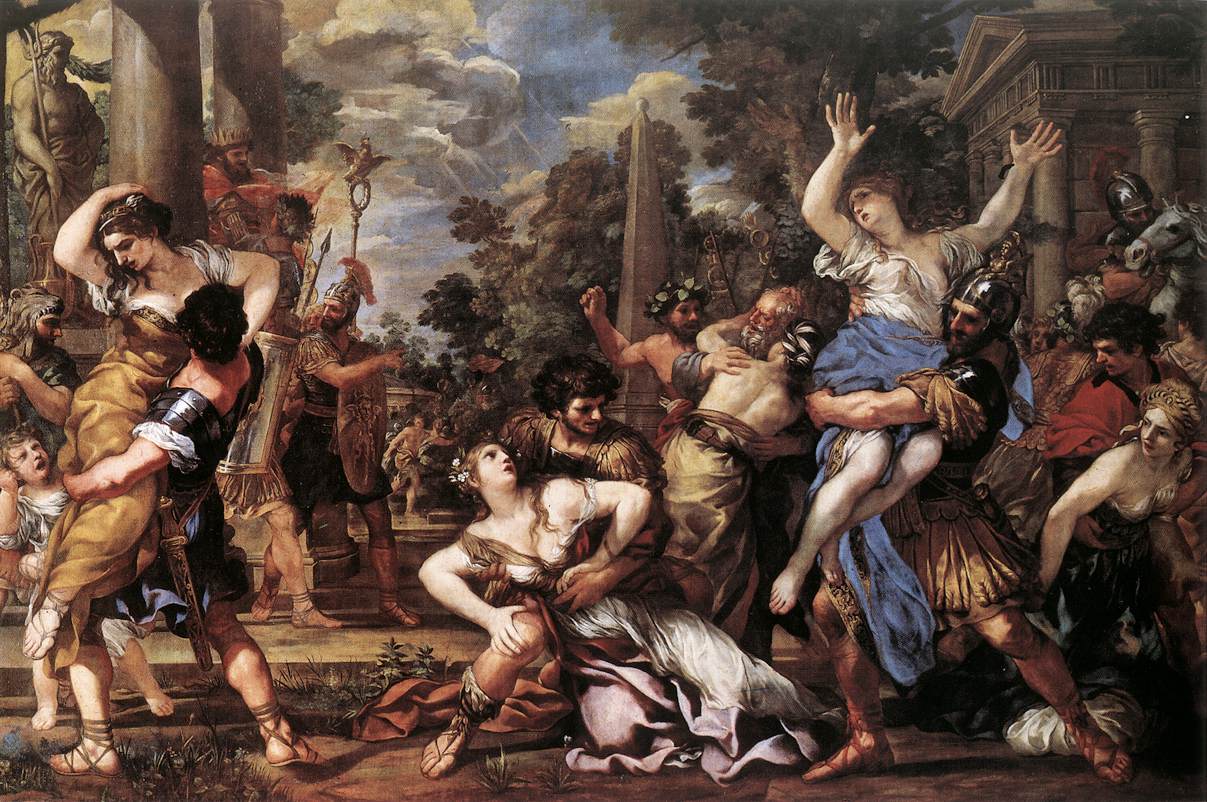
When David was unveiled in 1504, it was decided impossible to place him so far out of sight. Instead, he was placed outside the Palazzo Vecchio, the city hall at the time, to look over the popular Piazza della Signoria. However, since his fame had bought him prime real estate inside the Galleria dell'Accademia in the 1800s, a replica now stands in his place. Adjacent to this copy’s post is a shaded arcade with a selection of other sculptures, contemporary with Michelangelo and later. The one that gave me pause was “The Rape of the Sabine Women," done by Gianbologna some 80 years after David. Art historians will talk at length of the dynamism, the lust, and the verticality of the three figures, which all speak to the period’s early Baroque style. A Roman soldier hoists and carries a resisting nude woman, the wife of a crouching Sabine man, whom the soldier strides over. The woman’s face is terrified, and she pushes her hand against the shoulder of her abductor, her other hand reaching back toward her homeland.
The result of the Romans’ abduction of the Sabine women — the creation of new Roman citizens — was taken up by famed academic painter, Jacques-Louis David, some 200 years later in 1799, in “The Intervention of the Sabine Women," a monumental piece that spoke to 18th century Parisians after the devastation of the French Revolution, just as pensive David spoke to his Florentines about the defence of their young city-state from surrounding rivals.
The nude was once again used to convey a powerful message. “The Rape of the Sabine Women” is at once disarming and disturbing, emphasized by its triggering title. The Sabine woman does not speak to the people. If anything, a Florentine was supposed to identify with the Roman soldier, and understood that the statue speaks to the importance of marriage as a political bridge, as well as show off the artist’s skill. The Sabine woman was meant to symbolize the expansion of the Empire, the proliferation of the Roman bloodline, and the next generation of soldiers who would in their turn, fight and defend Rome and its citizens. Her body, and any violence done towards it, were disregarded as an instrumental part of continuing their civilization.
Florence’s ability to identify with the perpetrator, the rapist, speaks to a more insidious system of gender-based politics, and violence. The nude female does not elicit our sympathy; raping her to bear Roman children was necessary for the expansion of the Roman Empire. Her resistance does not receive a helping hand.
By 1614, the tide had turned on the depiction of the rapist, at least in the eyes of Artemisia Gentileschi. The famed painter depicted herself as the Biblical figure Judith, beheading Assyrian general Holofernes, represented by Gentileschi’s real life attacker. The gory brilliance and intimacy of this painting spoke louder than words. I can only hope some of the Sabine women were able to enact such a revenge on their Roman abductors.
Even though Gentileschi brought a strong perspective to artistic representations of sexual violence, the status quo of these scenes remained largely unchanged. Even into the 21st century, we can find examples of normalized violence against women’s bodies in magazine ads, commercials and the alarmingly common trope of rape scenes in movies and TV shows. The marketing of women’s bodies alongside, or as products, normalizes violence done to their bodies, which are in turn, viewed as objects, and not human beings. Many feminist scholars and anti-violence writers, such as Gail Dines, writer of “Pornland: How Porn has Hijacked our Sexuality” (2010), have spoken to the degradation and objectification of women’s bodies. These conversations are more common, but there is still a prevalent acceptability of violence against women that underscores our mainstream media.
The body continues to hold sway in artistic movements, which are arguably, just as political now as they were in history. Bodies are a medium that still has an identifiable corporality that outshines modern technology. From performance artists and dancers, to political protestors, it is unlikely that the presence of the human body will cease to have an impact on our conversations and demonstrations. This is a dialogue we should not forget to have, despite our culture having been saturated with technology and social media.
I thought about the conversation between David and Gianbologna’s piece, and the use of bodies as political allegory. Even through they didn’t shared a historical context, the two pieces share a popular, touristic space that is meant to show all sides of Florence; the good, the bad, the constant tour groups and couples that posed in front of the David imposter. His penis is freely photographed; his head is a perch for passing pigeons.
Whitney Brennan is a Art History major studying in Vancouver, Canada. She is passionate about the arts, feminism, social justice and her dog, who is her constant companion, even when writing. She works for an award winning gluten free bakery in Vancouver, and has a bad case of wanderlust.