






























BY VANESSA WILLOUGHBY
Editor's Note: This is a reprint of an article that appeared on our old site.
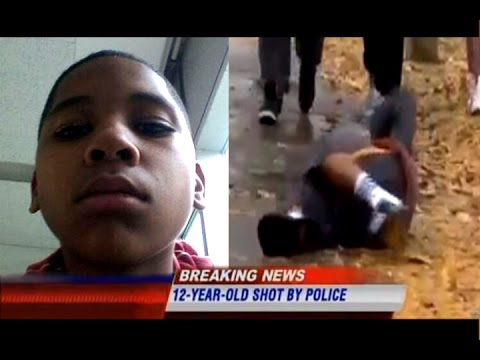
Minutes after the fatal shooting of 12-year-old Tamir Rice by two officers of the Cleveland Police Department, the narrative was tweaked in favor of the assailants. According to the LA Times, one of the officers told the dispatcher that Tamir was not a child, but believed to be “possibly 20 years old.” How can a person mistake an adolescent boy, a seventh grader, for a nearly full-grown adult?
Even in death, Tamir’s blackness denoted a lack of innocence, an obvious stain of presumed guilt and implied strength. By reacting to Tamir’s blackness, rather than remembering his humanity, the Cleveland police officers fed into racial stereotypes that demonize young black boys and men. Instead of seeing a child, they marked Tamir’s race as an unpredictable threat. In the video released by the Cleveland Police Department, there’s hardly a pause before the confrontation ends in the firing of the gun. The cop cruiser quickly drives up onto the grass, ultimately allowing Timothy Loehman to shoot at point-blank-range. What’s just as damning as the aging up of Tamir on the officers’ part is the 911 log, wherein the anonymous caller stated, “There is a guy with a pistol. It’s probably fake, but he’s pointing it at everybody.” Although the caller’s statement reveals the same racial biases conjured and acted upon by the officers, the caller did give Tamir the benefit of the doubt, however paltry and half-hearted. The caller was not entirely convinced of the authenticity of the gun. If the officers had been privy to this information, would it have prevented the altercation altogether, or least caused significant hesitation on part of the officers? It’s hard to say when the dehumanization of black youth is justified by authority figures who utilize character assassination, judging victims through discriminatory degrees of morality. Tamir’s existence, not the gun (which was actually a pellet gun), turned suspicion into proof.
Following the death of Trayvon Martin, Slate published an article that discussed the racial empathy gap and consequently, how lack of empathy can encourage discrimination. Jason Silverstein noted that, “The racial empathy gap helps explain disparities in everything from pain management to the criminal justice system. But the problem isn’t just that people disregard the pain of black people. It’s somehow even worse. The problem is that the pain isn’t even felt.” In other words, the fault doesn’t lie in indifference but the erasure of existence. The racial empathy gap worked its single-minded, insidious poison the day that Tamir was killed. The racial empathy gap turns boys into boogeymen, wherein blackness is deemed a kind of supernatural Otherness. In some ways, this psychological suspension of belief played a part in the shooting of Mike Brown in Ferguson.
Darren Wilson’s testimony was recently released and the documents reveal the fatal influence of the racial empathy gap. When it sways the decisions of those in positions of power, objectivity is corrupted. Wilson describes Brown as a supervillain ripped straight from the pages of a Marvel comic, an unstoppable source of brute force. In a few simple words, a teenager can become larger than life. Fears founded upon long-standing ignorance are given physicality. Curiously enough, Wilson and Brown were not grossly unmatched height or weight wise. Wilson is around 210 pounds at 6 feet 4 inches, while Brown was at 6 feet 5 inches at 290 pounds. If you take Wilson’s words at face value, he’d have you believe that the unarmed Brown was a thundering giant. Wilson recalls his confrontation with Brown as one of sheer terror, claiming, “[Brown] had the most intense aggressive face. The only way I can describe it, it looks like a demon, that's how angry he looked.” Wilson’s David vs. Goliath metaphor fails to recognize Brown’s humanity and he gives no thought to calling an eighteen-year-old college freshman an “it” and a “demon.” Using this type of inflammatory language forces Wilson’s audience to focus squarely on his toxic platform of “self-defense.”
Like George Zimmerman, Wilson masks his bigotry as a lawful form of control, a necessary method to ensure (white) safety. Later on, Wilson says, “I tell him get on the ground, get on the ground, he doesn’t. I shoot another round of shots. Again, I don’t recall how many it was or if I hit him every time….At this point it looked like he was almost bulking up to run through the shots, like it was making him mad that I’m shooting at him. And the face that he had was looking straight through me, like I wasn’t even there.”
Again, Brown is painted as a reckless animal, infuriated not by the threat to his life, but spurred on by primal fury and the need for retaliation. The photos that document Wilson’s injuries fail to showcase debilitating wounds beyond red splotches and a “facial contusion” (in layman’s terms, a bruise). How could someone like Brown, who Wilson repeatedly shapes as an intimidating aggressor with the tenacity of a pit bull’s jaws, not leave visible and lasting damage?
Studies have shown that racial biases exist and thrive within our justice system. According to The New Republic, “Social science research shows that, in video simulations, people are more likely to shoot black men. The participants—often undergraduate students, both black and white—play a simulation where they press “shoot” if they think the white or black suspect holds a gun. Consistently, psychologists have found the students more likely to shoot the unarmed black person over an unarmed white person.” Perhaps this racialized prioritizing of lives explains why white male perpetrators of mass shootings, such as the 2012 Aurora shooting, are able to walk away with their lives. Perhaps this also accounts for mainstream media’s tendency to point out the exemplary background of the shooters, including but not limited to their scholastic aptitude, shy nature, possible history of mental illness, and the B-roll of family, friends, and acquaintances who confess, “I could never have imagined that X would do such a thing!” Their public personas prior to the incident constitute the sincerity of the shooter’s ethos, evidence that the killings were a moment of character weakness, and not a reflection of an overall truth. In other words, white male shooters are given the chance for redemption, while black boys like Tamir and Mike Brown are not even deemed worthy of that chance.
When the New York Times published an article about Brown’s last days, readers were rightfully outraged to see that he’d been dubbed “no angel.” On the other hand, concerning the narrative of the Aurora shooter, the Times focused on the shooter’s history of mental illness, pointing out that “in the months before the attack paint a disturbing portrait of a young man struggling with a severe mental illness who more than once hinted to others that he was losing his footing.”
Tamir Rice and Mike Brown are two different cases fueled by the twin offshoots of racism. An effortless twist of the right words morphed boys into monsters, positioned on the wrong side of the following rationale: to be black, especially a young, black male, is the physical manifestation of criminality. When interviewed by ABC News, Wilson cited his trained instinct as an officer as the catch all explanation for his actions. Without remorse, he said, “I just did my job.”
Vanessa Willoughby is an editor and a writer. Her work has appeared on Hazlitt, The Toast, The Hairpin, Vice, Bookslut, and Bitch. She is Creative Director at Winter Tangerine.