











BY VERONICA SILVA
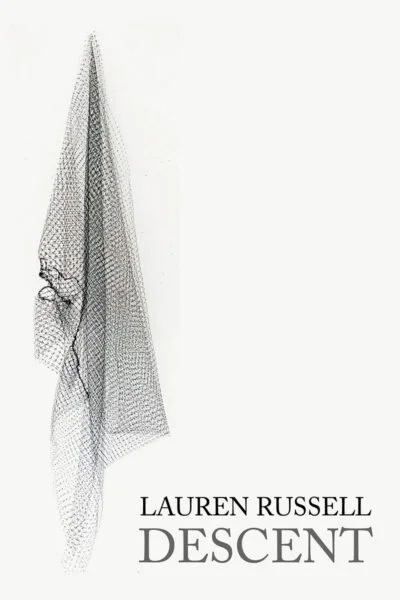
Descent, Lauren Russell. Tarpaulin Sky Press, June 2020. 120 pp. $18.00.
Lauren Russell’s latest hybrid collection, Descent, invites imagination as a way of coming to terms with a family’s, and a nation’s, difficult history. After acquiring the diary of an ancestor, Russell spent years transcribing the entries and sifting through archival records across the United States to uncover her ancestral line.
She reconstructs the stories of Robert Wallace Hubert, her great-great-grandfather who was a Captain in the Confederate Army during the Civil War, and Peggy Hubert, her great-great-grandmother who was Robert’s slave. Finding that Peggy was consistently erased from historical records, Russell writes into the gaps to build a textured landscape of her family’s history.
Traversing through the collection demands a refusal to separate recorded history from the imagined; without section headers or individual titles, Descent positions scans of documents, letters, and photographs alongside invented memories, myths, persona poems in various voices, and short personal essays from Russell’s perspective.
The effect is phantasmagoric, a term Russell uses while grappling with “degrees of blackness” and her own internalized racism: “a constantly shifting complex succession of things seen or imagined” or “a bizarre or fantastic combination, collection, or assemblage” (50).
Regardless of accuracy, invented memories act as tangible bits of the author’s consciousness—as well as a construction of a robust Black American experience. These additions work toward comfort, retribution, or even reconciliation. Early in the collection, Russell imagines that Peggy would jab her knee “into his [Robert’s] old war wound in what she pretended were the throes of a nightmare, and he who had been the master would allow this transgression” (31).
Russell also allows us a glimpse of her authorial hand at work: “I want to leave her there for a moment—before she was out of the sack-like shirt slave children wore, before she learned to cook” (14). She gives Peggy a pocket of time to safely exist within, but only by admitting manipulation of the narrative.
This friction between the archived and the personal also occurs on the micro-level of invented language, as seen in lines such as “The people of Texas are informed that, in accordance with a Proclamation from the Executive of the United States, all Peggies are free” (23).
Russell considers an oral story told to her by a distant relative who is also researching the Huberts. In the story, Robert asks Peggy or possibly a different female slave to visit him in a prison camp and she abides. Russell consults a historical expert who confirms that this story is unlikely. “I wonder why she [the distant relative] is so intent on believing this,” Russell asks on the page (29).
Her skepticism here seems strange at first, since readers know she has interests beyond recorded history. Russell could have scrubbed out the “myth of the slave savior” if she really believed it held no credibility, but the poignancy of the moment comes from grappling with those questions and discrepancies on the page, only to accept that the myth exists for comfort. “We want to believe that she is the heroine here, that she has some agency, that for once in her life she was given a choice,” Russell concludes (30).
At the end of the collection, Russell admits: “I know my Peggy is no approximation of the real Peggy, but the Peggy I know can see me here with my broken heart, and holds me, for a moment, still…” (95). In an interview with Poets & Writers, Russell states that “what actually happened is less important than who owns the narrative around it, and the narrative can change over time.” She both acknowledges that her Peggy on the page will never come close to the real Peggy and humanizes her Peggy by writing the story Russell believes she deserves. It is this friction between what we believe and what we want to believe that adds truth and texture to Descent.
This sense of friction becomes especially palpable in Russell’s treatment of her great-great-grandfather, Robert Hubert. She writes Robert as a complex character by alternating aspects of his personality with his position as a “master of omission” (9). In his introductory poem, Robert is referred to as both “Specter of the Great White Father” and “Jim Crow Defier, Hero of my Grandfather’s Childhood” (9).
He is never absolved, but Russell confesses that she also longs for Robert’s alternate story: “I have no way of knowing if Bob Hobert chained men for the journey, but I want to believe what seems to me an equally likely if not likelier possibility, that he did not” (103). This clashing of Robert’s story seems closely tied to her own feelings of dissonance regarding identity. At times, unable to fully name who she is, Russell names who she is not: “I have never been considered three fifths of a person or anybody’s master… all my fields are figurative…” (66).
Both history and imagination are needed for either to work in this collection; as Russell states in the opening, “History is neither the truth as it happened nor necessarily the truth we most want to believe” (5). History is limited to what we have been told or what historians have deemed worthy of recording. Russell understands that even tangible words printed on newspapers, photographs, or headstones are never the whole truth: “This is the version Jesse told the researcher, or at least this is the version the researcher decided to print” (55). These limitations of research bias, on the other hand, allow Russell imaginative openings.
Russell calls upon Audre Lorde’s Zami: A New Spelling of My Name, which Lorde describes as follows: "It's a biomythography, which is really fiction. It has the elements of biography and history and myth. In other words, it's fiction built from many sources. This is one way of expanding our vision." Russell adapts the term into “biomythology,” using myth, memory, oral stories, and omission to construct an archive of her own. Although Russell claims she is not a historian, works such as Descent demand that we move past viewing fact and poetry as opposing forces, and consider instead that poetry also speaks history, computes data, functions as an archive.
Veronica Silva is a Provost Fellow at the University of Central Florida, where she is currently pursuing her MFA in poetry. Her work has appeared or is forthcoming in PANK Magazine, The Acentos Review, The Blood Pudding, and Pleiades.