






















BY HABON ABDULLE
I am a Somali Muslim American woman. Like many others, the unpleasant 2016 presidential campaign is still vivid in my memory. The campaign engaged in words and actions that violated long fought-for civil sentiments of equality, respect and the peaceful transfer of power.
Our country is more polarized than ever. There were many times that I was taken aback by the strong emotional war waged against certain policies and certain groups. The campaign rhetoric is over; we have a new President and yet the emotional distress continues. For the first time in our lives many more of us are afraid of the policies of our government -- and this is not historically the American collective attitude.
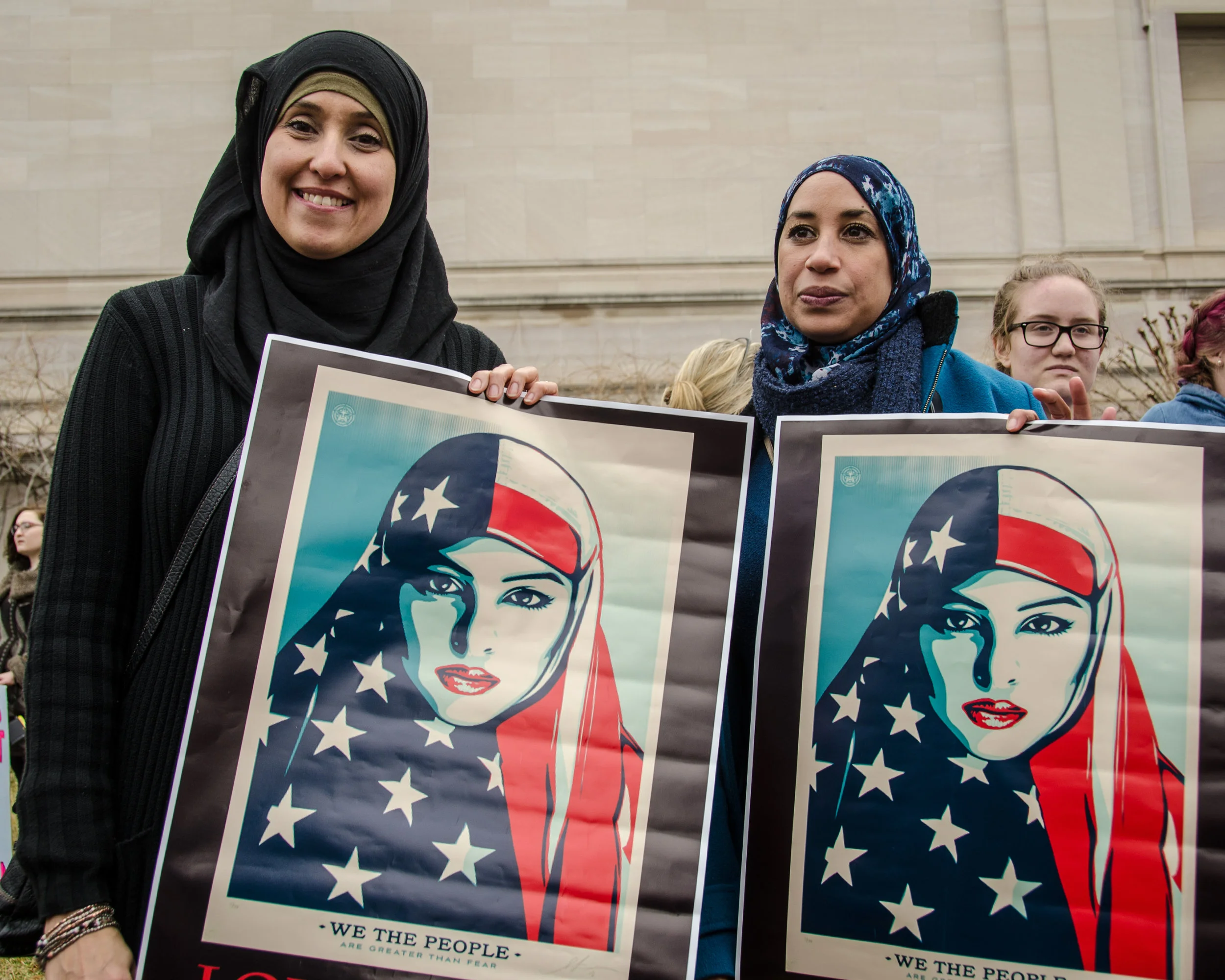
Since President Trump took office millions of people have begun exercising their rights to peaceful protest. Some have been getting serious about community organizing, others are denouncing injustices across social media and still others have been publicly demonstrating their disagreement with the President.
Recently, there have been two national mass protests. The weekend of January 20th was Women’s March where one million people, overwhelmingly women, gathered to object to President Trump’s position on women and their rights.
As a woman, I am proud that the Women’s March was organized by four women demonstrating themselves as emerging leaders with the primary intention to protect equality during the next four years and to hold fast to the progress already made on social issues. The organizers, like many of us, disagreed with the way then candidate Trump talked about the rights of minority groups and felt compelled to organize a movement.
Thus, after the President’s inauguration, they were ready to lead marches to demonstrate dissent against President Trump’s promises to repeal the current affordable healthcare, to deport all illegal immigrants and impose a ban against Muslims -- and to confront his downplay of the issues concerning police brutality, disability rights, LGBTQ discrimination, climate change and the environment.
The weekend of January 28th thousands of people protested in cities and airports nationwide in response to President Trump's executive order banning seven Muslim-majority countries- Iraq, Syria, Yemen, Sudan, Somalia and Libya- from entering the United States for at least 90 days (as well as suspending all refugee admission for 120 days).
I participated in the Women’s March of MN and Resisting the Muslim Ban rallies held in Minneapolis. The protests were powerful and gave me hope.
It was clear by the size of the protesters that many of us oppose President Trump and that there was a range of motives behind our acts of resistance. I believe this intersection of motives is the beginning of a long resistance effort which will have a very broad base seeking a common goal.
In the following weeks, months and years many will be participating in protest for the very first time because of their need to show how much they care about our country and our communities. Muslim Americans, Native Americans, Black Americans, along with many other people, have already joined together in these gatherings. I truly believe good triumphs over evil.
This is demonstrated in how our communities are becoming unified, engaging in narratives of respect and appreciation to build relationships and coalitions across cultural lines.
It is important that the new administration pay attention to these voices. The current government was put in place by some American citizens who also need to pay attention to the danger of the ‘othering narratives’ and the way these discriminatory policies desensitize them and divide our country.
Citizenship and belonging are intimately tied. Citizenship in America is not just the casual sense of having the right to carry an identification document. It expresses the ideal of a government that operates in relationship with the individual and the society.
For non-European immigrants this relationship is fraught with hostility and challenges. When many of us chose America as our country, our hope was that the United States of America, the world's quintessential country of immigrants, would continue to proclaim ‘Give me your tired, your poor, your huddled masses yearning to breathe free’. However, the reality is it doesn’t matter that the immigrant wants to belong -- even if they learn and adopt all the practices of the society, they will still be scrutinized and subject to processes of inclusion and exclusion.
Non-European citizens have been confronted by an attitude toward integration that is ambiguous, and which sets unachievable standards. There is an expectation that they embrace the receiving society’s prevailing practices and standards and become similar to the European descendant mainstream population -- to the point they are not noticed. Assimilation to that degree takes away all uniqueness and difference and is impossible to attain because there is still skin color, religious dress and cultural distinctions that create bias.
While many immigrants, including myself, admit that assimilation is not their ideal method for integration, we are outraged that even when we endeavor to assimilate, the bar is raised so high that there is justification to keep us out. At first we are told ‘learn the language, go to school and accept America as your country’. However, even when we have done all of that, we are still not fully accepted. Many of us are frustrated, wondering what else we can do to prove our absolute integration into this multicultural society.
Make no mistake about it, exclusion serves a purpose in the political agenda. The concepts of belonging, and identification with the country, is utilized as conditions for access to goods, rights and entitlements. When you don’t belong, your rights are restricted and it becomes easy to convince the wider citizenry of the threat that immigrants take what belongs to “true” citizens who “belong” to the country. This divisive concept feeds fear and anger among certain groups who isolate themselves from diversity.
Racists have managed to make fear the social glue that binds misled people together against a false threat. They have targeted minorities and immigrants and blamed them for any number of problems in their lives. They have mobilized an effort to remove the threat. Thus, the building of a wall, the tightening of borders, heightening of surveillance, the banning of Muslims and the promotion of policies against refugees and immigration becomes their focus and solution.
Minorities are not the threat. Diversity is actually what has made this country great. We may look different from you but we belong to this country. We work hard and contribute and it is our desire to better the United States. Racist solutions are not going to solve the economic and social condition of the misled people.
I firmly believe that if we get out of our comfort zone, stop the prioritization of certain cultures over others and begin to accept each other, our perspectives will change. The more likely we will be to recognize political tactics which exploit fear and be brave enough to call them out as being immoral.
We need to stop the assumption that if we campaign hard and put a certain political party in power then we will better off. Winning is not the same as governing. Good governance is not about one party beating the other, but rather the formation of a body chosen by the electorate (who work together for the good of the country).
We as a country must force ourselves to work towards long-lasting solutions for our problems and to develop ways to respect our diversities. While we may hold different ideologies, we need to safeguard our civility. If all of us want to live in a just and more prosperous society, then we need to move toward a more inclusive society.
Among the people who voted for President Trump there are many with whom I can find common ground (if given the chance for healthy dialogue). I am appealing to you: let us all work to build OUR future.
Habon Abdulle is the Executive Director of Women Organizing Women (WOW) Network. The organization is located in Minneapolis, MN and its purpose is to empower all women, specifically first– and second-generation immigrants, to become engaged citizens and community leaders, regardless of political affiliation.