

















BY KAILEY TEDESCO
cw: mentions of abuse & violence against women
Phantasmagoria, the PC point-and-click adventure game from 1995, has been a part of my life for as long as I can remember. My parents were very young when they had me, and this seemed to consequentially lead to a certain leniency in their parenting that my friends seldom experienced. Mostly, it meant that if they wanted to watch a movie/TV show, I would be watching it, too.
This also extended to games.
An objective onlooker might say that I was already well-primed for Phantasmagoria when, at six years old, I sat with my dad and teenaged uncle into the darkest hours of the night, clicking around the game’s haunted New England mansion. My dad, a budding web developer at the time, and my mom were both huge fans of both computers and horror.
Before I could speak full sentences, my dad brought me a PC game called Toonland that consisted of clicking around a farm and listening to songs sung by Howie Mandel. It was meant to teach a specific kind of dexterity that would surely be needed in the new millennium, but which, as it turns out, had the shelf life of a mouse pad. Additionally, I became used to napping with my mom midday before her midnight shifts while she put on a Tim Burton film or Stephen King adaptation. Killer clowns, seances, body horror, monsters, and possessed children were not antagonistic to my childhood, but very much a part of my forming identity.
Since that Saturday all-nighter I spent with my dad and uncle in 1997, the game has stuck with me for good. When, in 2006, my dad tried to sell his old ’95 IBM laptop to his cousin, I protested wildly and offered to buy it off of him myself. This laptop was the last vessel in which I could insert the seven, yes SEVEN, CD-rom disc set to play my favorite game. My dad obliged, and even though there are now ways to play retro PC games via sites like Steam, I still prefer to play on the bulky IBM. Call me a purist in this sense, I guess.
So what about this game is so enthralling and so immune to time, at least for me? As a child, I would say it’s the thrill of the game paired with the familiar fantasy elements (like a really twisted Disney movie). As a teen, I would tell you it’s the game’s Gothic/Victorian aesthetic and suspenseful storytelling. And now, I would tell you it’s the way the game deconstructs the possession narrative so that the female protagonist is not made to be a spectacle or object of punishment, but instead a fully competent, yet wholly secular exorcist of the misogyny that, even more so than non-specific ancient evils, consumes the bodies of men.

Known for it’s film-length script and cinematic turns, Phantasmagoria was groundbreaking even in its own time. In it, you play as Adrienne, a writer who has recently moved into a house— nay, a castle! — with her photographer husband, Don. And they must be incredibly successful in their respective trades, because a coastal New England property with sprawling fields and numerous carriage houses could not be even remotely affordable. Though neither of them seem to think it’s all that strange to live in secluded, gothic-style mansion all by themselves, even after Adrienne has a terrifying, bloodbath nightmare on their first night.
And on disc one, things are pretty copacetic: Adrienne writes on her clunky laptop (the same kind of laptop I play on!) and Don transforms one of the home’s two bathrooms into his darkroom. They eat tuna salad in their gilded kitchen & talk about their first Christmas together.
It’s all very sweet. Until…
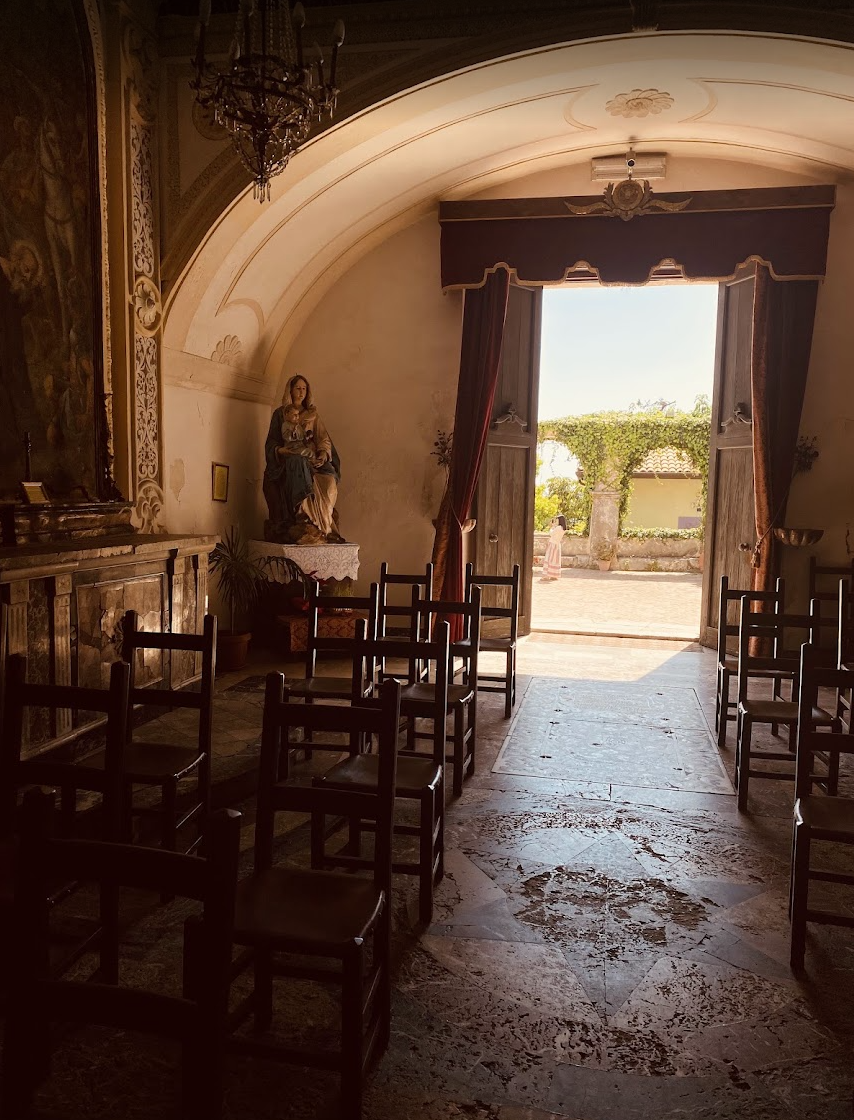
Adrienne (aka you) explores the house’s many rooms until she discovers a hidden chapel. Unbeknownst to her, this chapel has been sealed off for a reason — an ancient and powerful demon resides there. This half of the game is what we might expect out of classical horror or women in peril narratives. The female protagonist goes where she should not, a la Bluebeard, only to gain a forbidden knowledge that the narrative will assert she was better off not knowing — typically this information relates to her husband or romantic interest.
In this case, the Woman in Peril tropes are played more literally. When Adrienne forcibly breaks into the intentionally hidden chapel and unintentionally frees the demon, her husband Don is immediately possessed. His behavior while possessed is distinctive from his behavior pre-possession. Once gentle and supportive as a partner to Adrienne, he soon becomes demanding, condescending, elusive, and sexually abusive.
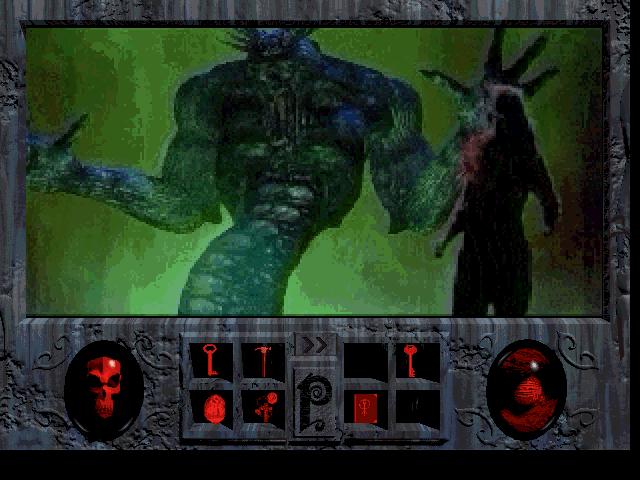
While all of this is harrowing to watch (don’t worry — my dad made me leave the room during any scenes of graphic abuse), it’s important to note how it differs from the possession narratives that we’re used to. In The Exorcist franchise, for example, it is most often females who are demonically possessed and males who must work to deliver them from that evil. In truth, I refuse to watch the The Exorcist. Though I’ve seen enough via clips & discussion to know that Regan is involuntarily dissociated from her body which is then sensationalized and admonished by figures who are arbitrarily deemed “godly.” And this extends to numerous Western possession narratives. Think Salem Witch Trials, too — pious men insisting that females are separate from their bodies, appearing spectrally in dreams, and ultimately causing women to suffer under the name of god.
Of course, this realistically translates to men in positions of power unable to view women in a way that is separate from their bodies, especially when they, for numerous reasons, feel they are denied access to those female bodies. The ultimate terror in all of these narratives becomes the thought that women are susceptible to punishment simply for having a corporeal form on this earth — the thought that, like a fantastical possession, you could lose complete control of your perceived morality and agency simply because your are gas-lit into believing your body is contrary to someone else’s reality.
Ultimately, these narratives tend to other their female characters by positioning them as the “monster.” In reality, the monster & horror of the film is anyone who asserts that a female is monstrous simply because she behaves in such a way the accuser sees unfit.
This is all to say that Phantasmagoria competently shifts the narrative so that Adrienne is now both victim and hero all at once. What we ultimately have is a hero who suffers under a systematic power dynamic that has existed every bit as long as the ancient demon possessing Don, yet still asserts her right to exist and survive in this world by effectively divorcing herself from the patriarchal tyranny and toxic masculinity that is literally woven into the architecture of the house.
Through Adrienne’s exploration of the objects, letters, portraits, and what I’ll call ectoplasm bubbles that decorate the home, we discover that Don is not the first man this ancient demon has possessed (surprise, surprise). Most recently, during the 19th century / Spiritualist movement, the demon possessed Zoltan “Carno” Carnovasch, a well-regarded theatrical magician who murdered all five of his wives.
We learn that after his possession, he became cruel, murderous, and easily threatened by his wives’ talent and sexuality, especially that of his last wife, Marie, who plotted to kill Carno and leave him for her lover, Gaston. We also learn that it was Carno himself who brought the demon into the home when he used black magic in an attempt to up his ticket sales.
This, too, is interesting when examining possession narratives. Typically, the female who is deemed possessed is assumed to have done some kind of evil, usually via either sex or the occult, a result of society’s deep-seeded satanic panic. In the case of the game, it is a man takes the forbidden fruit so to speak, and of course, it’s not in the name of agency over his body/sexuality (as is typical seen in female possessions/accusations), but instead in the name of capitalistic gain. Carno, while clearly unhinged and literally murderous, is not viewed as “hysterical” or “out of control” as a women might be, but instead he continues to thrive within a society that has implicitly agreed to excuse his wrongdoings. This applies similarly to Don’s narrative, though the game makes a point to show Don throwing several visible and “irrational” tantrums that would position him more in the role of the humiliated or sensationalized “other” that the media has traditionally applied to women.
The women who suffered from Carno’s abuse now work to assist Adrienne as she navigates the house and neighborhood for answers. Additionally, Harriet, a property squatter / clairvoyant, also helps Adrienne to contact Carno in order to confront him face to face. In the Final Boss of the game, Adrienne stands before Don with a strand of rosary beads (not her own) and their treasured snowman ornament. It is clear that no matter what, Don will not make it out of the house, but Adrienne can if she can effectively soften Don’s hyper-intensified masculinity by reminding him that he was once, very recently, capable of humanity & then exorcise the demon via a symbol of piousness held often by Catholic priest (a man) in order to rid the body of evils. Adrienne, in a victorious play, successfully rids the house of the corrupt powers that plagued it, and moves forward, independent and in control.
While playing, you control Adrienne’s actions via a cursor, and so for a time, the player is Adrienne. This lends itself to the player empathizing and identifying with the female protagonist as you share a common goal to overthrow the evil, or misogynistic constraints, of the household. The game’s female creator and the co-founder of Sierra On-Line, Roberta Williams, employs this ludonarrative consistency appropriately and in such a way that further communicates the games overall thesis that women must be humanized, not othered.
It’s not lost on me that my first time playing the game was with two young men. I wonder now if Williams’ was aware of Phantasmagoria’s demographic (games/gaming seemed to be marketed towards men even more so in the 90s), and used this platform to communicate these messages relating to bodily consent and empowerment to those who may have needed to hear them the most. Certainly, playing the game with two important male figures in my life is one of my favorite childhood memories, and it has continued to inform the ways I intake media & examine its social implications for decades.
You can view a play-through of the game via Youtube or you can play the game for yourself here.
Kailey Tedesco's books She Used to be on a Milk Carton (April Gloaming Publications) and These Ghosts of Mine, Siamese (Dancing Girl Press) are both forthcoming. She is the editor-in-chief of a Rag Queen Periodical and a performing member of the NYC Poetry Brothel. Her work has been nominated for the Pushcart Prize. You can find her poetry featured or forthcoming in Prelude, Prick of the Spindle, Bellevue Literary Review, Vanilla Sex Magazine, and more. For more information, please visit kaileytedesco.com.