
















BY KAILEY TEDESCO
In truth, I don’t believe I’ve ever met anyone who doesn’t like Dario Argento’s 1977 Suspiria. The film is, to put it gently, gorgeous, impactful, and full of a lore that keeps viewers hungry for the rest of the Three Mothers trilogy. It’s easily one of my top three favorite films of all time.
So, you’ll probably understand why, when I heard it was going to be remade by Luca Guadagnino and star Dakota Johnson, I balked. I balked again, and harder, when I read an article that the first clip had been released over the summer that included a young woman contorting unwillingly until she bled out and urinated on herself. I was so upset by this — what, at the time, I thought was a new director interpreting a film I loved in such a way that included horrific violence against women. That was not the point, I thought, that was not the point at all.
And, I think I was half-right. That, of course, wasn’t the point of Argento’s 1977 masterpiece. But, it also was also not the whole point of Guadagnino’s masterful adaptation.
Yup, I said masterful. I loved it.
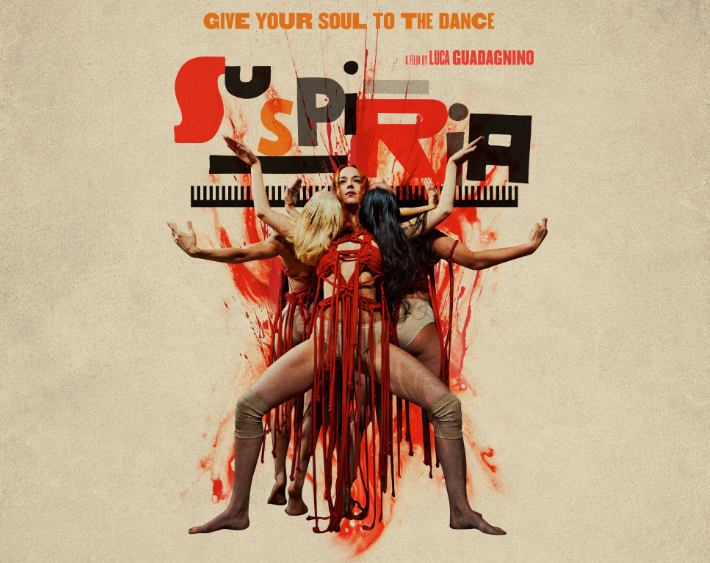
Ultimately, Suspiria (2018) is not Argento’s, nor does it try to be (though Argento did have a hand in writing its characters). What it is is a distinct look at bodily autonomy, violent and non-violent resistance in the face of fascism, and, believe it or not, actual dance.
The film opens with immediate characterization of Susie Bannion (they change the spelling of her name), a young girl growing up in what we later realize is an extremely abusive, Mennonite household in Ohio. This begins a matryoshka doll of microcosms within the film — Susie’s abusive household, the corrupted dance studio, and the body itself. Susie dreams of escaping her highly conservative upbringing so she might dance at a prestigious studio in Berlin. Because Berlin at this time (the film is set in 1977) is in a state of extreme post-World War II generational divide and terror, it makes one question why Susie wishes to dance there, of all places.
Even though Nazism (I know it should be capitalized, grammatically speaking, but guess what? I’m not doing it) has been disempowered as a ruling movement at this time, low-grade Nazis still maintained government positions. Because of this, Nazi views were still prominent. Vulture has an excellent article by Nate Jones that details the German history that parallels the plot within the dance studio.
Ultimately, it is important to note that there was resistance against this continued fascism, mostly from the Red Army Faction (RAF), a Marxist group led by Germany’s younger generations. While RAF was created as movement of radical protest against Nazism, they were also considered a terror group. Some of their protests included bombings and plane hijackings. In all, 30 innocent people were killed because of these actions. This raises a complicated question, and one that is mirrored in the politics of the studio — can violent resistance against tyranny be an act of tyranny in itself?
This question and historical situation is the macrocosm, or largest matryoshka, in which each microcosm is situated within the film. And from the complicated question comes its many complicated implications, including the ways in which women can exercise power and bodily autonomy in state of utter precariousness.
When her mother dies, Susie makes her journey to Berlin and all it takes is one audition for Madame Blanc (Tilda Swinton), the studio’s second in command dance instructor, to realize she is needed. And what is needed or wanted, versus what is not, is made distinct within the studio. When its dancers, for whatever reason, become unnecessary or contentious to the leaders (Madame Blanc and the seemingly illusive, yet omnipotent Markos) they are purged from its mirrored walls. The imagery of this “purging” is both deliberate and symbolic. Dancers such as Patricia (Chloë Grace Moretz), possibly a member of the RAF, and Olga (Elena Fokina) are maimed through powerful dance magicks (this is a film about witchcraft after all) to the point where they are no longer recognizable. They are then removed from the center of the studio, it’s mirrored room, using large hooks made precious by the studios leaders.
At one point in the film, Madame Blanc explains to Susie that the studio is a body. In this case, the entire building is a symbol of female autonomy, and therefore, the removal of some of its dancers, is perhaps an allegory for a women’s abortive rights. In the context of the film, this can seem triggering and overly violent. However, when paired with the idea of dance, it felt as though the studio (and the dancers within it) are trying to keep control of their collective identity in a time of turmoil. How does one exert individuality and self-love when politics and religion both insist hegemony. Bodily and abortive rights (symbolized by the hook) are kept locked in curio, seemingly safe from the outside world of oppression.
But when they fall into the hands of women who are deemed lesser or not worthy of those rights, such as Sara (who is a total badass in this version), the rights are stripped away and she is harshly punished. In other words, the film suggests the studio is one collective identity, rather than a company of individuals, at least under the rule of Markos. And under this rule, women oppress other women. This is mirrored by the purposeful grey, uniform color palette (in stark contrast to Argento’s louder aesthetic). This is one body, at odds with itself, split politically and ideologically, and in need of rebirthing, a complete rejection of the past. And this is Susie, who we later learn, was fated to come to Berlin — to become Mother Suspiriorum.
Susie herself asserts that she is the hands of the studio, and it is in its womb (the current house of Markos and the resting place of the studio’s power) that Susie steps into this role of motherhood, mercifully allowing the maimed dancers to finally die peacefully and destroying those who voted for Markos in an earlier scene. She is resisting violently (a la the RAF) in order to renew. Perhaps unlike the RAF though, Susie’s resistance is calculated against the oppressor alone.
She becomes the studio’s hands, the literal protagonist of the people, a god-like witch channeling the power in order to change it. In one of the final scenes, she visits Dr. Josef Klemperer (also Tilda Swinton), whose wife (played by the legendary Jessica Harper — her appearance made me cry big tears) died in a concentration camp. He was gaslit by the witches into believing his wife was still alive just as, we learn, he gaslit his wife into believing they did not need to flee. Susie erases this painful memory and instead assures Dr. Klemperer that his wife died in the arms of a woman who loved her — a reminder that love is another form of resistance in times of oppression, a reminder that women can love one another as an act of rebellion.
While Madame Blanc once insists that dance can never be beautiful again and that they must break the nose of everything beautiful (I’m paraphrasing a bit), Susie/Mother Suspiriorum is an archetype for love, albeit imperfect. She is not a “good” witch, but a witch of regeneration, renewal, and beauty. It is no accident that one of the major distinctions between Argento’s film and Guadagnino’s is the inclusion of actual choreographed dance numbers. Dance, witchcraft, and the body are all so completely intertwined. While I watched Susie perform complicated movements for her protagonist role in Volk, I thought about how dance is at once one of the most vulnerable and one of the most controlled things that can be done with a body. It is in moments of dance that the body can not be easily objectified because it is willingly and deliberately becoming something more than a body, something truly divine and powerful.
In the face of recent politics, I found myself moved and impacted by this film on a higher level than I may have been if it were released pre-2016. I found myself far more afraid than I was while watching the original. Witchcraft appeals to me, in large part, because of its liberating ideals and ability to position the body and the identity in a way that is meaningful, powerful, and capable all on its own, but also a practice with its own malleable political and spiritual center. It’s its own resistance against hegemony and tyranny. The film acts as a reminder that anything can become corrupted, that suffering is ubiquitous. Yet, rebirth is always possible, and that we can’t stop fighting oppression.
While I didn’t believe I would be as floored by the aesthetic, sound (thanks, Thom York — though of course Goblin is still everything), acting, and overall narrative of this film as I was, it was an amazing reminder that Suspiria, like dance, can be beautiful again. This meta-commentary on film reboots in general was, perhaps, heavy-handed, but a necessary reminder to welcome regenerative art in all aspects.
Kailey Tedesco is the author of These Ghosts of Mine, Siamese (Dancing Girl Press) and the forthcoming full-length collection, She Used to be on a Milk Carton (April Gloaming Publications). She is the co-founding editor-in-chief of Rag Queen Periodical and a member of the Poetry Brothel. She received her MFA in creative writing from Arcadia University, and she now teaches literature at several local colleges.
Her poetry has been nominated for the Pushcart Prize. You can find her work in Prelude, Bellevue Literary Review, Sugar House Review, Poetry Quarterly, Hello Giggles, UltraCulture, and more. For more information, please visit kaileytedesco.com.