

• Home
  • indulge
  • new poetry
    • About Luna Luna
    • resources
    • search
  • editor
  • dark hour
  • submit
Menu

luna luna magazine

  • Home
  • indulge
  • new poetry
  • About
    • About Luna Luna
    • resources
    • search
  • editor
  • dark hour
  • submit
delicious new poetry
‘same spectral symphony’ — poetry by Julio César Villegas
Jan 1, 2026
‘same spectral symphony’ — poetry by Julio César Villegas
Jan 1, 2026
Jan 1, 2026
'I think I know why I am looking at roses' — poetry by Stephanie Victoire
Jan 1, 2026
'I think I know why I am looking at roses' — poetry by Stephanie Victoire
Jan 1, 2026
Jan 1, 2026
'All the trees are you' — poetry by Barbara Ungar
Jan 1, 2026
'All the trees are you' — poetry by Barbara Ungar
Jan 1, 2026
Jan 1, 2026
'girl straddles the axis  of ancient  and eternal' — poetry by Grace Dignazio
Jan 1, 2026
'girl straddles the axis of ancient and eternal' — poetry by Grace Dignazio
Jan 1, 2026
Jan 1, 2026
'Talk light with me' — poetry by Catherine Graham
Jan 1, 2026
'Talk light with me' — poetry by Catherine Graham
Jan 1, 2026
Jan 1, 2026
'How thy high horse hath fallen' — poetry by Madeline Blair
Jan 1, 2026
'How thy high horse hath fallen' — poetry by Madeline Blair
Jan 1, 2026
Jan 1, 2026
'a paradise called  Loneliness' — poetry by Adam Jon Miller
Jan 1, 2026
'a paradise called  Loneliness' — poetry by Adam Jon Miller
Jan 1, 2026
Jan 1, 2026
'Tell me I taste like hunger' — poetry by Jennifer Molnar
Jan 1, 2026
'Tell me I taste like hunger' — poetry by Jennifer Molnar
Jan 1, 2026
Jan 1, 2026
'I prayed to be released from my longing' — poetry by Michelle Reale
Jan 1, 2026
'I prayed to be released from my longing' — poetry by Michelle Reale
Jan 1, 2026
Jan 1, 2026
'Resurrection dance, a prelude' — poetry by V.C. Myers
Jan 1, 2026
'Resurrection dance, a prelude' — poetry by V.C. Myers
Jan 1, 2026
Jan 1, 2026
'It is noon and the sun is ill' — poetry by Raquel Dionísio Abrantes
Jan 1, 2026
'It is noon and the sun is ill' — poetry by Raquel Dionísio Abrantes
Jan 1, 2026
Jan 1, 2026
'every moon rolling fat through the night' — poetry by Zann Carter
Jan 1, 2026
'every moon rolling fat through the night' — poetry by Zann Carter
Jan 1, 2026
Jan 1, 2026
jan1.jpeg
Jan 1, 2026
'I have been monstrously good' — erasures by Lauren Davis
Jan 1, 2026
Jan 1, 2026
'The light slices the mouth' — poetry by Aakriti Kuntal
Jan 1, 2026
'The light slices the mouth' — poetry by Aakriti Kuntal
Jan 1, 2026
Jan 1, 2026
'quiet grandfathers  in dark tuxedos' — poetry by Scott Ferry
Dec 19, 2025
'quiet grandfathers in dark tuxedos' — poetry by Scott Ferry
Dec 19, 2025
Dec 19, 2025
'made a deal / with Azrael' — poetry by Triniti Wade
Dec 19, 2025
'made a deal / with Azrael' — poetry by Triniti Wade
Dec 19, 2025
Dec 19, 2025
'The birth of a body that never unraveled' — an excerpt by Hillary Leftwich
Dec 19, 2025
'The birth of a body that never unraveled' — an excerpt by Hillary Leftwich
Dec 19, 2025
Dec 19, 2025
'Time's metronome blank' — poetry by Rehan Qayoom
Dec 19, 2025
'Time's metronome blank' — poetry by Rehan Qayoom
Dec 19, 2025
Dec 19, 2025
'There is no choir on the mountain' — poetry by Dawn Tefft
Dec 19, 2025
'There is no choir on the mountain' — poetry by Dawn Tefft
Dec 19, 2025
Dec 19, 2025
'to anoint the robes' — poetry by Timothy Otte
Dec 19, 2025
'to anoint the robes' — poetry by Timothy Otte
Dec 19, 2025
Dec 19, 2025
'a stone portal in the woods' — RJ Equality Ingram
Dec 19, 2025
'a stone portal in the woods' — RJ Equality Ingram
Dec 19, 2025
Dec 19, 2025
'crooked castle wanting' — poetry by Lindsay D’Andrea
Dec 19, 2025
'crooked castle wanting' — poetry by Lindsay D’Andrea
Dec 19, 2025
Dec 19, 2025
'earth’s marble cage' — poetry by Annah Atane
Dec 19, 2025
'earth’s marble cage' — poetry by Annah Atane
Dec 19, 2025
Dec 19, 2025
'silent, Sunday morning' — poetry by Nathalie Spaans
Dec 19, 2025
'silent, Sunday morning' — poetry by Nathalie Spaans
Dec 19, 2025
Dec 19, 2025
'this strikes me as a Rorschach' — poetry by John Amen
Dec 19, 2025
'this strikes me as a Rorschach' — poetry by John Amen
Dec 19, 2025
Dec 19, 2025
'O, to bloom, to arch open' — poetry by Karen L. George
Dec 19, 2025
'O, to bloom, to arch open' — poetry by Karen L. George
Dec 19, 2025
Dec 19, 2025
'the sky violent' — poetry by Robert Warf
Dec 19, 2025
'the sky violent' — poetry by Robert Warf
Dec 19, 2025
Dec 19, 2025
'Love is a necessary duty' — poetry by Tabitha Dial
Dec 19, 2025
'Love is a necessary duty' — poetry by Tabitha Dial
Dec 19, 2025
Dec 19, 2025
'the doors of the night open' — poetry by Juan Armando Rojas (translated by Paula J. Lambert)
Nov 29, 2025
'the doors of the night open' — poetry by Juan Armando Rojas (translated by Paula J. Lambert)
Nov 29, 2025
Nov 29, 2025
'we can be forlorn women' — poetry by Stevie Belchak
Nov 29, 2025
'we can be forlorn women' — poetry by Stevie Belchak
Nov 29, 2025
Nov 29, 2025

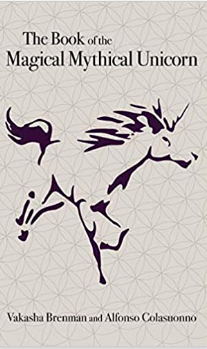
An Excerpt from 'The Book of the Magical Mythical Unicorn'

September 17, 2020

By Vakasha Brenman and Alfonso Colasuonno


Editor’s Note: Below is an excerpt of The Book of the Magical Mythical Unicorn, published by O-Books, an imprint of John Hunt Publishing.


The Unicorn and European Royalty

There are a multiplicity of traditions and legends about the unicorn’s horn within the history and mythology of the world, though its use was perhaps most recorded in medieval Europe, where the horn was known as the alicorn. The unicorn’s horn has been revered by people across the globe for a wide variety of reasons, not the least of which is its profound ability to heal. No feature of the unicorn has been as closely associated with healing as its majestic spiraled horn. The horn’s power to heal and transform has long been a source of wonder, with these attributes coming from its connection to the third eye, or expanded consciousness. The unicorn’s horn can heal not only the body, but also the mind and heart, bringing one into a balanced state.
Screen Shot 2020-06-08 at 7.20.37 PM.png

Around the beginning of the 13th century, the alicorn started to become a major part of European culture. By that time, Asian traditions about the unicorn’s amazing ability to purify poisoned waters for other animals had begun to filter into Europe. Commonly known as the water-conning story, these tales revolved around how animals would wait for the unicorn to dip its horn into poisoned water to eliminate all of the maladies that would come from drinking or bathing in the water. Many travelers from Europe who visited other parts of the globe were able to learn about and witness the healing properties of the unicorn’s horn. After Europeans heard these incredible stories that the travelers brought back with them, they became curious about the power of the alicorn to heal and detect poisons. Europeans began to investigate and later believe in the alicorn’s medicinal attributes.

Until the 16th century, alicorns were purchased and used exclusively by Europe’s wealthiest individuals. Many European kings and queens owned full intact alicorns, including King Edward I of England, King Charles VI of France, King Henry II of France, King Philip II of Spain (who was said to have acquired twelve alicorns), Mary Queen of Scots, King Francis I of France, Queen Elizabeth I of England, and numerous other royal figures. King Frederick III of Denmark even chose to have his throne made entirely of alicorns. Some churches, including St. Denis in Paris and St. Mark’s in Venice, also owned alicorns, displaying them as sacred objects that were held in awe by the people. To these powerful individuals and institutions, owning an alicorn signified wealth and prestige. However, such value came at a steep price. One such example is in 1560, when German merchants sold the Pope an alicorn for 90,000 scudi, an exorbitant sum for the time.

During Europe’s Middle Ages, poisoning became commonplace as a tactic performed to eliminate political rivals. The fear that one may sit down for a meal or beverage and meet their demise at the hands of a frustrated subject, an ambitious relative, or a ruthless political opponent weighed on the minds of European royalty. Fortunately, the introduction of the alicorn presented a solution; its magic could determine whether food and drink had been poisoned. The alicorn would sweat in the presence of poison. European royalty believed that when dipped into a tainted item, the alicorn would neutralize all effects of the harmful substance. Because of these properties as an antidote, the magical alicorn became invaluable to European dignitaries, who eagerly sought to purchase alicorns to protect themselves and their families.

Unfortunately, there have always been individuals who seek to profit via exploitation. In Europe, a fraudulent market developed soon after the introduction of the alicorn. Swindlers made a lucrative trade out of producing and selling fake horns. David de Pomis, a 16th century Italian Jewish physician, wrote that “There is very little of the true horn to be found, most of that which is sold being either stag’s horn, or elephant’s tusk.” Other items sold in place of the true unicorn horn included bull horns, goat horns, rhinoceros horns, artificially-straightened walrus tusks, fossil bones, dog bones, petrified wood, stalactites, and many other substances. Fake horns regularly made their way to wealthy individuals, perhaps most notably in the case of King James I of England and Scotland. After King James purchased what he believed was an alicorn, he chose to test it on a servant. Regrettably for the servant, his King had been deceived.


You can read more in The Book of the Magical Mythical Unicorn, published by O-Books, an imprint of John Hunt Publishing. The Book of the Magical Mythical Unicorn is available on Amazon, Kindle, BarnesandNoble.com, and wherever books are sold. For more information, please visit theunicornbook.com and its Facebook page.


Alfonso Colasuonno is the co-author of The Book of the Magical Mythical Unicorn, published by O-Books, an imprint of John Hunt Publishing. His poetry and short fiction have appeared in Rusty Truck, The Camel Saloon, Pretty Owl Poetry, and Quail Bell Magazine, among other publications. Alfonso helps emerging authors perfect their manuscripts through offering detailed book audits via his website, the-lit-game.com. He lives in Baltimore, Maryland with his wife Lauren and Bengal cat Edie Sedgwick.  

Vakasha Brenman was President of the Unicorn Archive, Inc. and one of the foremost researchers in the field. She devoted her life to preserving and disseminating mythological and esoteric knowledge through the creation of documentary films, theatre, and illustrated children's books. Born in Trinity, North Carolina, Vakasha lived in New York, NY for the last several decades of her life. She passed away in 2020.

In Poetry & Prose Tags Vakasha Brenman, Alfonso Colasuonno, books
← What Is Sacred Self-Care?Poetry by Elizabeth Ditty →
Featured
'quiet grandfathers  in dark tuxedos' — poetry by Scott Ferry
'quiet grandfathers in dark tuxedos' — poetry by Scott Ferry
'made a deal / with Azrael' — poetry by Triniti Wade
'The birth of a body that never unraveled' — an excerpt by Hillary Leftwich
'Time's metronome blank' — poetry by Rehan Qayoom
'There is no choir on the mountain' — poetry by Dawn Tefft
'to anoint the robes' — poetry by Timothy Otte
'a stone portal in the woods' — RJ Equality Ingram
'crooked castle wanting' — poetry by Lindsay D’Andrea
'earth’s marble cage' — poetry by Annah Atane
'silent, Sunday morning' — poetry by Nathalie Spaans
'this strikes me as a Rorschach' — poetry by John Amen
'O, to bloom, to arch open' — poetry by Karen L. George
'the sky violent' — poetry by Robert Warf
'Love is a necessary duty' — poetry by Tabitha Dial
'the doors of the night open' — poetry by Juan Armando Rojas (translated by Paula J. Lambert)
'we can be forlorn women' — poetry by Stevie Belchak
'I do whatever the light tells me to' — poetry by Catherine Bai
‘to kill bodice and give sacrament’ — poetry By Kale Hensley
'Venetian draped in goatskin' — poetry by Natalie Mariko
'the long sorrow of the color red' — centos by Patrice Boyer Claeys
'Flowers are the offspring of longing' — poetry by Ellen Kombiyil
'punish or repent' — poetry by Chris McCreary
instagram

COPYRIGHT LUNA LUNA MAGAZINE 2025