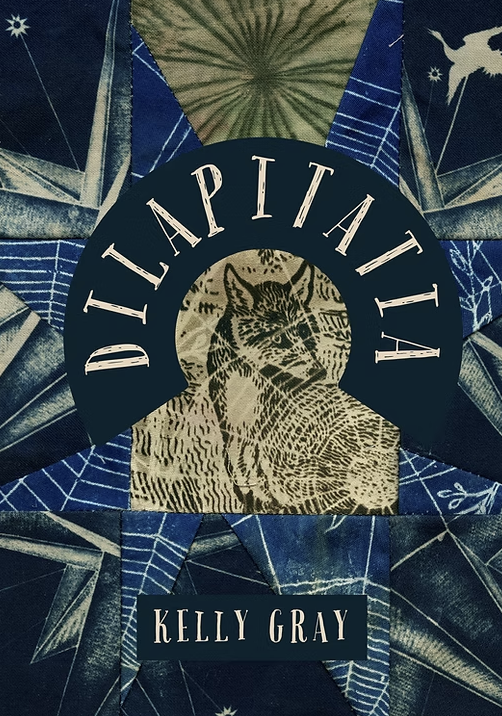
Dilapitatia (Moon Tide Press, 2025) — reviewed by Miranda Dennis
If you forget for one moment that you have a body, Kelly Gray’s Dilapitatia will remind you. Dilapitatia is anchored by an eponymous poem-cum-definition, which begins by stating that “Dilapitatia” is of the “Disorder Class: Obsessive” and begins with “[r]ecurrent and persistent thoughts about dilapidated structures and junctures.” Her final definition of this framework is that it “[b]uilds new homes with legs, sticks, throat,” as if offering a deconstructed baba yaga to haunt these pages. Homes are bodies, and bodies are homes. This opening is the primer for how to navigate this collection, but you can also just let your body do the talking.
In “The Eating Elegy” a father begs the narrator to be smaller, and so she enacts this: “I lose this air, this breath/ like a balloon mouth pulled taught/ into a sad sound...” In a time when bodies are still battlegrounds being legislated by men in power, this aches beyond the winnowing of a self. The poem becomes anthemic by degrees before its grand finale: “Hold on baby, I cry,/ daddy is almost dead…” Hell yes daddy is almost dead. And now it’s time to turn the page.
In addition to –or in defiance of – daddy’s presence in these pages, several poems are anchored in mothering. To be mothered and to mother becomes a performance of rage against the fragility of the body. In “I Listen from the Ground to Her Mouth,” Gray writes, “Each time she stops breathing, I rattle/ her heart’s electricity back to working with my hot palms.” This evokes the image of a mother’s panic watching a newborn sleep, or an impending grief for someone else entirely. One constructed trope seems to link to another; I never know if I’m reading a mother or a daughter’s tale, or some secret third thing. It is in this liminal space that Gray universalizes the surreal, gives just enough blank space for fear to connect right at the belly. And it is in this visceral space that the magic of these poems connects the brain to the heart.
The fragility of the human body is ordinary, commonplace. In “The Art of It,” we begin with “Most people in this restaurant/ have cancer.” But because these poems meet deterioration with hope, we’re introduced to waitresses who “have been hired to float their soft palms across scalps.” By the end of the poem, the narrator’s Auntie has died presumably of cancer: “thin at last, she whispered,/ and I grieved the whole fat mess of her.” If there can be a thesis to this collection, I believe it is this: full-bodied love comes with its own grief, and includes the body, and elevates the body right at its fall. If we think back to the poem of the father who asks his daughter to be smaller, it’s hard to take him seriously in the face of love.
With all the dilapidation, how does one stand upright? In “Crowned” Gray writes sex as a means to rewrite or possibly unmask trauma: “I think I should like to have sex now/ just to show that I can ungown/ the awful stories from my body…” Colloquially, the body keeps the score, and yet how we even the score becomes an investigation through understanding the body’s relation to self.
After all, selves get compartmentalized. If we return to “The Eating Elegy” from earlier, Gray describes “another part of me/ masturbating to Jeremy Allen White/ in tighty-whities.” Is that self disassociating, or is that self liberated? At the least, it’s a moment of levity in a heavy poem, which pulls the reader to a place of pop culture, perhaps a place of laughter or touchy relatability. Can the self be recovered through self-love? What about masturbation? It’s worth considering.
Even the title of the poem “Of Reading to People Who Consider Themselves Selves” seems to be a poem itself about self-identification (or non-identification), which is a bold headline for a poem haunted by a narrator who suffers the “predicament of not being/dead enough.” And in “My Death Retracts,” Gray writes, “I convince myself/ of my livingness…” And then: “I sleep with men wielding chainsaws.” That’s a lot to process! But if these poems have taught me anything it’s that liminality belongs equally to the living as to the dead. And that there sure are a lot of ways to process this living grief.
Kelly Gray writes a grounded dreamscape. These poems are simply no stranger to duality, which makes them so human: fine lyrical beauty meets organ meat, and love meets alienation. Every piece of gorgeousness is imbued with an echoing loss; after all, we’re in the land of dilapitatia, where nothing remains upright. Maybe family will rebuild the broken home; or sex; or love. Maybe not. But one thing is sure: houses and bodies will eventually fall, and you reading this will someday, too.