






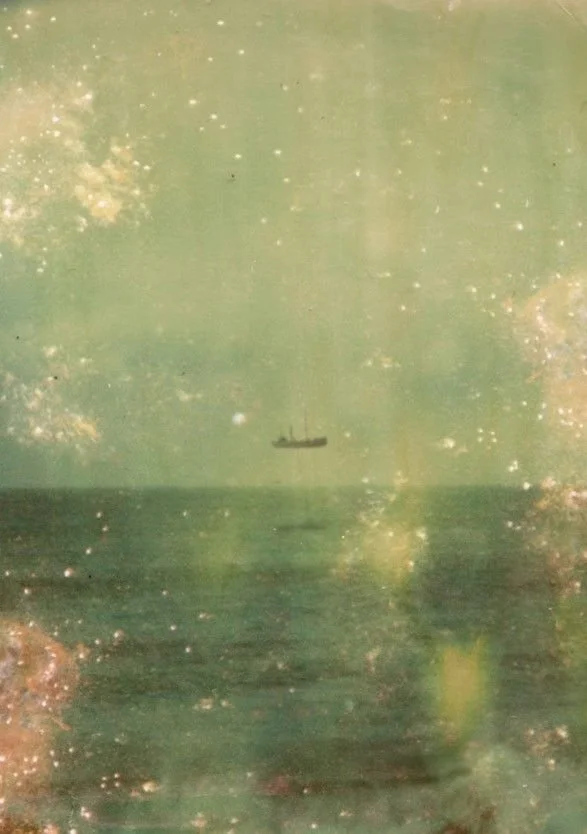
Taking a Picture of the Waxing Gibbous Moon with My Shitty Phone
I tried to forget this poem the entire walk, to let the lines go and focus on the meaty slap of my sandals against the pavement, the breath rasping up my throat. A poet said to sometimes let a line go to signal your lack of attachment, your trust that it will come back or trust that what’s lost is worth the presence. I believe this, though when I was in a mindfulness program I wrote “to not want is death” in the margins of a notebook when an instructor extolled the freedom of emptiness. I get it, I believe it, but sitting together in a circle where everyone agrees makes me want to defend the busy, humming mind. I argued with the teacher who instructed us on spontaneous photography as opposed to planned composition. I argued the idea of Big Mind, a distance from which every horror becomes the bumbling of ants over a dropped crouton. We’ve got to hold the lived proportion of horror, I said, otherwise, how do we not sit placid at a wise distance, another kind of separation? When everyone in the room agrees I need to sour the vibe, make the vibes as unbearable to everyone else as they are to me, the vibes like smell from the garbage, the lid lost, overflowing. On this walk I saw the moon and wanted to photograph it, then wondered if the desire to photograph was just another attachment, a way not to just be here but instead to grasp it, hold it in my hand, the pictures just a frantic bright bleed on the blueblack sky. I know Big Mind isn’t floating above the world but an attempt to set the busy workings of the mind aside to see the bigger system, to let in a little peace when we have no control. I know here is the only place I live, that’s why I want to capture it. I know it’s good sometimes to give away a line, a whole poem, to the wind to prove I don’t need it, that the well won’t go dry. There isn’t even a well. The waters always rise.
Infinite Resignation
An old throb, hot as the new rise
across my cheeks, red wine
exploding in my blood, I know
you from a time, 1996, 95.
Nearly thirty years later I’m reading
Kierkegaard, who says in loving
another one must be sufficient
unto himself, the lover’s
availability or actions irrelevant,
and so God’s apparent absence
is just another interpersonal challenge.
Resignation is the shirt
you sew with the fabric of your own
acceptance that maybe everything is wrong,
permanently, but also exactly
as it should be. I write this
as a sick balloon expands
across my chest. A shirt I make
of that expansion, could I wear it
through a fire, come out devoured,
and still believe I’ll make it home
for dinner? It’s nearly Christmas
again, and I don’t believe in God
but I like an impossible riddle.
Here’s one - what leaves every
room empty, what walks though it’s cut off
at the chest, what stands though
it’s a puddle on the pavement,
what’s waiting at the bus stop all night
with flowers in hand and no expectation
that you’ll ever arrive.
Letitia Trent's work has most recently appeared in Figure One,
Biscuit Hill, and Diagram. Her books include the novel Summer Girls
(Agape Editions, 20204) and poetry Collection Match Cut (Sundress
Publications, 2018). Trent is a mental health professional and lives
in an Ozark mountain town. Find her Substack here:
https://letitiatrent.substack.com/