












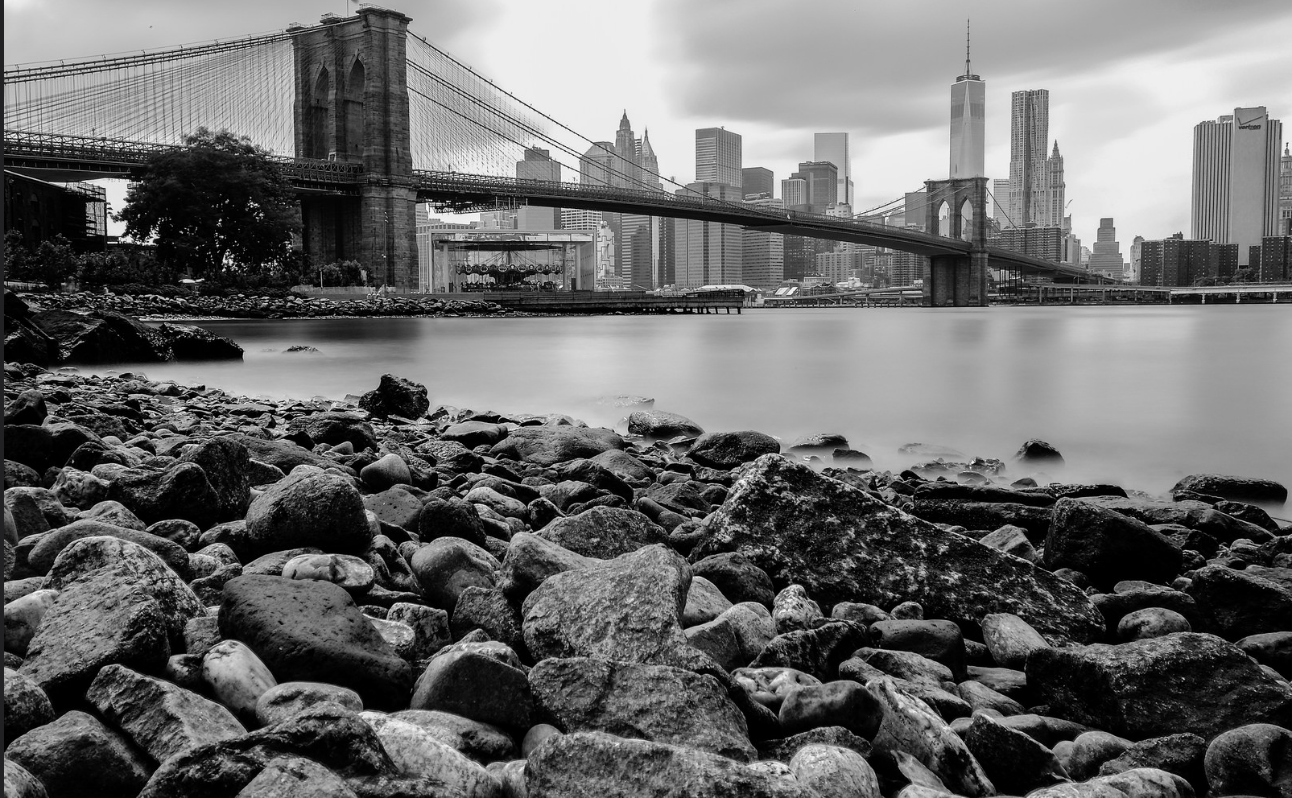
"You know, New York will always be here," someone told me as I struggled with the decision to abandon the city.
BY JESSICA PENNER
"There are roughly three New Yorks. There is, first, the New York of the man or woman who was born here, who takes the city for granted and accepts its size and its turbulence as natural and inevitable. Second, there is the New York of the commuter—the city that is devoured by locusts each day and spat out each night. Third, there is the New York of the person who was born somewhere else and came to New York in quest of something. Of these three trembling cities the greatest is the last—the city of final destination, the city that is a goal."
― E.B. White, Here Is New York
I left New York for one concrete reason: money. There was no philosophical discord between me and the city. True, I dreaded the intense cold and the sweltering heat; I sighed about my hour and a half commute to my thankless adjunct post; I ranted about the rise in rent when our building was bought by another landlord. At the same time, I loved New York because of those things. I wasn’t about to let the simple joys of wandering among the statues in Central Park or swaying on the subway in time with thousands of people be killed by my weak comfort needs. "What doesn’t kill you makes you stronger," has been drilled into my head through my Martyr-Immigrant-Dustbowl-Farm Crisis ancestry. I was determined to either be killed or add a callous or two.
Like so many, I always assumed I’d live in New York. It began with my first reading of A Tree Grows in Brooklyn. I fell in love with Francie and her stark life in what seemed to me a glorious setting. When I learned that Willa Cather, a writer whose work loomed largely in my young reading life as well, lived in New York when she wrote her books about Nebraska, I knew my destiny was set. I was a prairie girl myself, having spent my first eighteen years in a small Kansas town.
When the end of college loomed and my brain surgery was still unknown, I had a choice between two placements as a volunteer: Topeka, Kansas, or New York, New York. Even with my destiny of New York standing before me, I honestly struggled with the decision. The position in Topeka was more aligned with my BA in English Literature and Theater: teach drama to inmates in a medium-security prison. The position in New York was a desk job: a lot of letters to fold and envelopes to seal with peace protests in between.
"Um, it’s New York," a tiny, feisty friend said. I think she actually yelled at me as I sat in agony in my apartment. "Who cares what the job is!"
But then my brain tumor loomed its ugly head. September 11 struck the same day a neurosurgeon opened my skull in an operating room a few miles away from the Pentagon; a little over a month after the surgery, my boyfriend, Tom, and I proposed to each other and were married seven months later. Tom found a volunteer position at a needle exchange in the Lower East Side. People warned us that a stressful move combined with a first year of marriage spelled disaster, but we moved to New York anyway.
My devotion to New York is somewhat founded on September 11. New York and I have both been through hell. We are battered, but we are survivors. When I visited Ground Zero for the first time, it was still a giant hole surrounded by cement barriers and bent chain-link fences. Tourists swarmed the site as though they were at an amusement park. People posed their children on the barriers and called out "Smile!" before police hustled them off. It reminded me of the way some people greeted me after my surgery: unsure of what to do, they laughed and pretended nothing had happened that couldn’t be hidden by a grin. I didn’t come back to the site for a long time.
We never questioned our decision to stay beyond our time of service. It seemed natural to stay. Tom was hired at the needle exchange; I briefly sold academic bible software on East Broadway, studied creative writing at Sarah Lawrence College, and finally became an English teacher at a business college. I assumed I would easily find an agent once my first book was finished, and that agent would lead me to a publisher that could guarantee modest success. I didn’t expect to take New York by storm, though a squall seemed possible.
But money was short. Tom and I cooked at home; I shopped at thrift and discount stores, and both of us usually brought our lunches to work or did without. With all that, our checking account only crested a few hundred dollars beyond what we needed to survive, since college loans, credit card debt (the only thing that kept our checking account so robust), rent, and medical bills ate our paychecks. I was writing as much as possible, but with grading, lesson planning, and commuting, my novel was routinely pushed aside. Finally, the Almighty Dollar sang its Siren song. I found a job in Virginia that paid nearly what Tom and I earned combined in New York.
"You know, New York will always be here," someone told me as I struggled with the decision to abandon the city.
I agreed.
Tom and I packed up our studio apartment in Harlem and moved south to Harrisonburg, Virginia, a small city of 50,000. I was 29. I hadn’t grasped the concept that just because you cross a threshold a thousand times does not mean you will cross it one more time. It didn’t occur to me that I might never be able to come back; that the New York I was living in was not any more permanent than a human life. A New York friend died suddenly while we still lived in Virginia. When I talked to her husband a few months later, he mentioned that he regretted the years he’d been living in Pennsylvania for a job, while she remained in New York for hers.
"Those are years I can never have with her," he said.
I don’t regret those five years and seven months in Virginia. Wonderful friendships were made and sustained in the shadow of a paired run of mountains. I finished my novel and eventually found a publisher. My younger brother moved there, and I was able to get to know him as a person, rather than just a sibling. I joined a small church populated by people who traveled the Shenandoah Valley and the globe in order to work for peace and justice, not to hawk the tinny wares of Salvation, and chose to return to this town for rejuvenation. The Siren song ended when I lost the job for which I’d abandoned New York, but financial and emotional assistance was given to us without question from the community, so we stayed.
At the same time, Tom and I realized we would never fit the Harrisonburg mold of the typical politically-liberal couple: married, but with open minds about marriage and sexual orientation; homeowners, or building our own environmentally-conscious house; shoppers that were supportive of domestic gardens, food co-ops, fair trade, and local farmers; parents of one or two children that were consumers of "happy meat." We were many of those things, but did not have the obvious markers—namely, a house and children. Too many of our friends had play dates or house projects during the weekend. Only a few were able to drop everything for a drive through the Blue Ridge Mountains or sip coffee and talk. In Harrisonburg, it was too easy to think everyone else should follow the same path as you, whereas vastly different worlds are in your face the moment you step outdoors in New York.
"I think the overall effect is that it's much harder to imagine the world is moving in lock step without you," a friend once said as we contrasted Harrisonburg to large cities.
Possibly due to my Martyr-Immigrant-Dustbowl-Farm Crisis ancestry, I usually need a concrete reason to make a change. Emotions or philosophical leanings don’t push me. The concrete thing that told me that Virginia was just a hiatus was the fact that my dream house came onto the market.
This house was a green bungalow on Wolfe Street, just up the street from child-free friends and near enough to downtown to allow for late night drinks and a short walk home. The price was reasonable. The interior photos on the website matched my ideas of what Anne Shirley would’ve called a "House of Dreams." Large front windows. Built-in bookcases. Airy dining room, kitchen, and living room. I mentioned all this to Tom one evening as we drove past this house that had a tiny balcony over the wide veranda.
"What do you think? Should we look into it?" I asked him.
"It seems right, you know?" he said in the darkness.
I resolved to call the realtor for a tour. But I never did. I knew that if we did this, it would be saying something I wasn’t ready to say: We were in it for the long haul. New York was in the past. We were never going back.
If we’d been expecting a child, the house would’ve made more sense. The idea of having a real home in which someone could build childhood memories was part of my "House of Dreams." But we weren’t expecting, though we’d tried for a long enough time for the OBGYN to suggest going to a specialist, and I wasn’t sure if I wanted to go through the invasiveness that would follow. I’d spent many years of my childhood in hospitals, due to Ollier’s disease, a syndrome that stunts the growth of bones on one side of the body, and grows tumors—one of which had found its way into my brain. It had taken a full year to recover my mobility and dexterity that was a result of the brain surgery that only removed part of the tumor; the rest was targeted with seven weeks of photon/proton radiation. I was done with the poking and prodding, the scars that tattooed my body and my memories.
Tom and I never discussed the house again. Maybe he was having the same thoughts as I was.
Around this time, a friend mentioned that her son, his wife, and two children were considering moving to Brooklyn when they finished their teaching commitments in the Congo. I could see them easily fit into Park Slope or Carroll Gardens with their tow-headed darlings. I smiled and nodded, fighting back a scream of lament. Why was it so easy for some people to have beautiful children and move to a city I’d nearly turned into a distant idol, while both seemed impossible for us?
That afternoon, I lay on the futon that had followed us from Harlem to a house and three apartments in the past five-and-a-half years, and stared at the walls. The walls of that apartment were bare. In every place I have lived since I walked into my first dorm room, I’ve immediately decorated the walls. The only evidence we had lived in this apartment for two years, besides thrift store furniture and overgrown plants, was a small string of flags with "peace" written in different languages.
I didn’t want to decorate this apartment. I didn’t want to decorate a childless house. I didn’t want to wake up in five years and find myself still in Virginia, surrounded by those whose plans were neatly scored like perforated Valentine’s Day cards. I’d tried my hardest to become one of those people, but in the end, it wasn’t going to happen.
Tom crouched beside me and asked what was wrong. In the deepening dusk, we discussed why I was alone and sad on a beautiful day. I don’t remember exactly what was said, but by the evening’s end, we had committed to each other that both of us would actively look for work in New York.
The next day, Tom found a vacancy at the same needle exchange he had worked at when we first came to New York. Within a few weeks, he’d been offered the job and I’d found an apartment in the Bronx with bay windows, red, green, yellow walls, hardwood floors, a staircase that led nowhere, and an unused stove from the 1960s that was slowly leaking gas.
Five years and seven months after we left, we were riding the subway downtown when our new reality hit us at the same time. "Did we ever leave?" we asked each other.
A friend from our volunteer days noted that we’d overturned the usual narrative: a young, twenty-something couple lives hedonistically for a few years in the Big Apple, only to "settle down" and live responsibly in a small town. He wondered what the next few years will bring, since we’ve gone off script.
I don’t know what to expect, other than I want to write and live in New York. The first time around, my quest was to make my mark on New York, rather than let New York make its mark on me. I didn’t realize it had done just that until I had left it a little too quickly, a little too flippantly. The city is my quest this time around. I want it to pour more ink into that mark. To define itself.
Jessica Penner is the author of the novel Shaken in the Water. Her fiction, nonfiction, and poetry appear in Bellevue Literary Review, The Fiddleback, Wordgathering Rhubarb, and Tongue Screws and Testimonies, among others. She was nominated for a Pushcart Prize for her essay, “Mustard Seed.” She lives in the Bronx and is working on a memoir about her brain surgery on September 11, 2001.