











BY ASHLIE STEVENS
In 2002, Manolescu Loan, a Romanian man who was walking cross-country after his truck broke down, found 8-year-old Traian, legs splayed from rickets, eating from the carcass of a dog. He was the size of a three-year-old and huddled for warmth in a cardboard box; his circulation slowing because of the frostbite--inevitable in the freezing Transylvanian forest. Three years prior, it seems Traian had been abandoned by his 20-year mother who had been abused by the man to whom she was married under Gypsy law. The doctors who observed the case (and who nicknamed the boy Mowgli) believe that he was fostered by wolves: he barked, howled, growled and bit.
Dr. Florea was the attending physician who deemed Traian’s mother (who arrived at the hospital after the ‘Wolf Boy’ was shown on television) fit to care for her son again. After the story broke, the 6 o’clock news gathered in the lobby of Clinaca Ponderas. In the fuzzy video, everything is white. The tile, the walls, the coats, the snow sticking to the window, even Dr. Florea’s beard. He made one comment to the flickering cameras: "He has now started to learn how to behave himself. With proper care, he can become a human being."
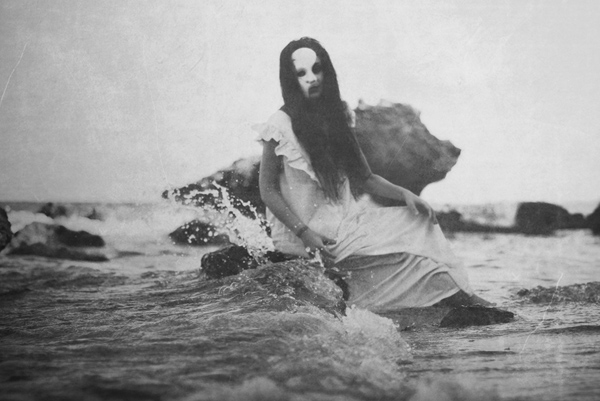
Despite our gradual evolution from animal kind, we have always been suspect of the beast within. Our most natural state is all at once exhilarating and frightening, considered both pure and ignorant, something to boast and something to blame. Tapping into that is ostensibly tapping into our most primal desires: free as a bird, hungry as a wolf, sex like animals. Yet historically, as “civilized people” (read as: typically white, European males) conquered indigenous populations, any perceived differences-- in apparel, occupation, religion-- would be categorized as “animalistic,” and therefore inferior. It’s the rhetoric of “us” versus “the other.”
A 1922 article in the Washington Times featured an array of brain illustrations (fish, bird, dog, cow) scattered around one large brain-- the human brain-- imposed over a sketch of Dr. Jekyll shadowed by his alter-ego, Mr. Hyde. The headline, in bold, splashy letters read: "Why You Have Impulses You Are Ashamed Of." The author posits that through the evolution of the human brain, layers have built upon previous layers (ie., we have a fish brain, beneath a bird brain, and so on). These layers form the “old brain” and are responsible for our sensory, gustatory reactions--taste, smell, desire, hunger--and contrast with our “new brain,” the outermost layer which is responsible for more lofty thought.
"In eminent men so far studied," says Professor Smallwood, the physician interviewed for the article, "this new brain is much thicker than in the brains of savages or ignorant workmen."
How the brains that were studied for this experiment were acquired is not mentioned (which is suspect since prior to the 1930s, doctors had only infrequently experimented with novel surgical operations on the brains of those deemed insane-- which then calls into question whom Professor Smallwood considers “eminent”). Regardless, the idea of the ‘savage brain’ trickled into the public discourse, prompting passages like this from anthropological researchers:
“The mind of the savage is concrete. It is able to deal with actual things only,” wrote Dr. John Howard in his 1926 book Savage Survivals:
“Abstract ideas, such as those of numbers, are foreign to the simple sense of the savage. They puzzle very much after five in counting, because no spare hand remains to grasp and secure the fingers that are required for units.”
These are the accusations that bolstered the rallying cries of Manifest Destiny. They don’t think, speak, or behave as we do-- what purpose do they serve in ‘our’ country?
John Quincy Adams once wrote to his father:
“The whole continent of North America appears to be destined by Divine Providence to be peopled by one nation, speaking one language, professing one general system of religious and political principles, and accustomed to one general tenor of customs.”
Despite the flowery, patriotic language, the message is implicit: Our way is the enlightened way; theirs is that of the savage, no better than the animals. That was in 1811.
This is the message that allowed slavery to be justified for so long; Thomas Jefferson wrote in his 1787 text Notes on the State of Virginia:
“I advance it therefore as a suspicion only, that the blacks, whether originally a distinct race, or made distinct by time and circumstances, are inferior to the whites in the endowments both of body and mind...This unfortunate difference of colour, and perhaps of faculty, is a powerful obstacle to the emancipation of these people.”
And it is the same message that perpetuated discrimination against immigrants in the late-19th and 20th century: Jews, Catholics, Sicilians, Chinese. The list goes on.
It’s now 2016 and some Americans (70 percent of whom say illegal immigrants threaten traditional US values) patrol the border towns, flags and rifles raised, spitting on children who’ve crossed over looking for a better life. Governors of 25 states have petitioned to close their states off from Syrian refugees. Some suggested that applicants should be vetted based on their religious affiliation.
Presidential candidate Ted Cruz, whose own father fled Cuba for the US, ironically poses the question: Who in their right mind would want to bring over tens of thousands of Syrian refugees, when we cannot determine, when the administration cannot determine, who is, and isn’t, a terrorist? The ensuing debate linked back to border-control, bringing to light an overarching fear: shadowy foreigners entering the country through porous borders for unknown purposes.
However, looking back on history, it doesn’t actually matter from where these individuals come, or if, in fact, they were in this country first. If--based on their skin color, dialect, customs, diet, hair texture, family systems, religion--they are different, these peoples are seen as inferior. Dangerous and animalistic. Yet when examining that same history--filled with genocide, war, slavery and ongoing discrimination--one has to consider, who are the true animals here?
Ashlie Stevens is a journalist and creative nonfiction writer from Louisville, Kentucky. Her journalism has appeared in The Atlantic's CityLab, National Geographic, Slate, Salon, Hyperallergic, The Ariel, Swan Children Magazine, and Acquired Taste. Her essay "Redline to Twinbrook" is a finalist for The Flounce 2015 Non-Fiction Writer's Award.