



BY MICHELLE ROSIQUE
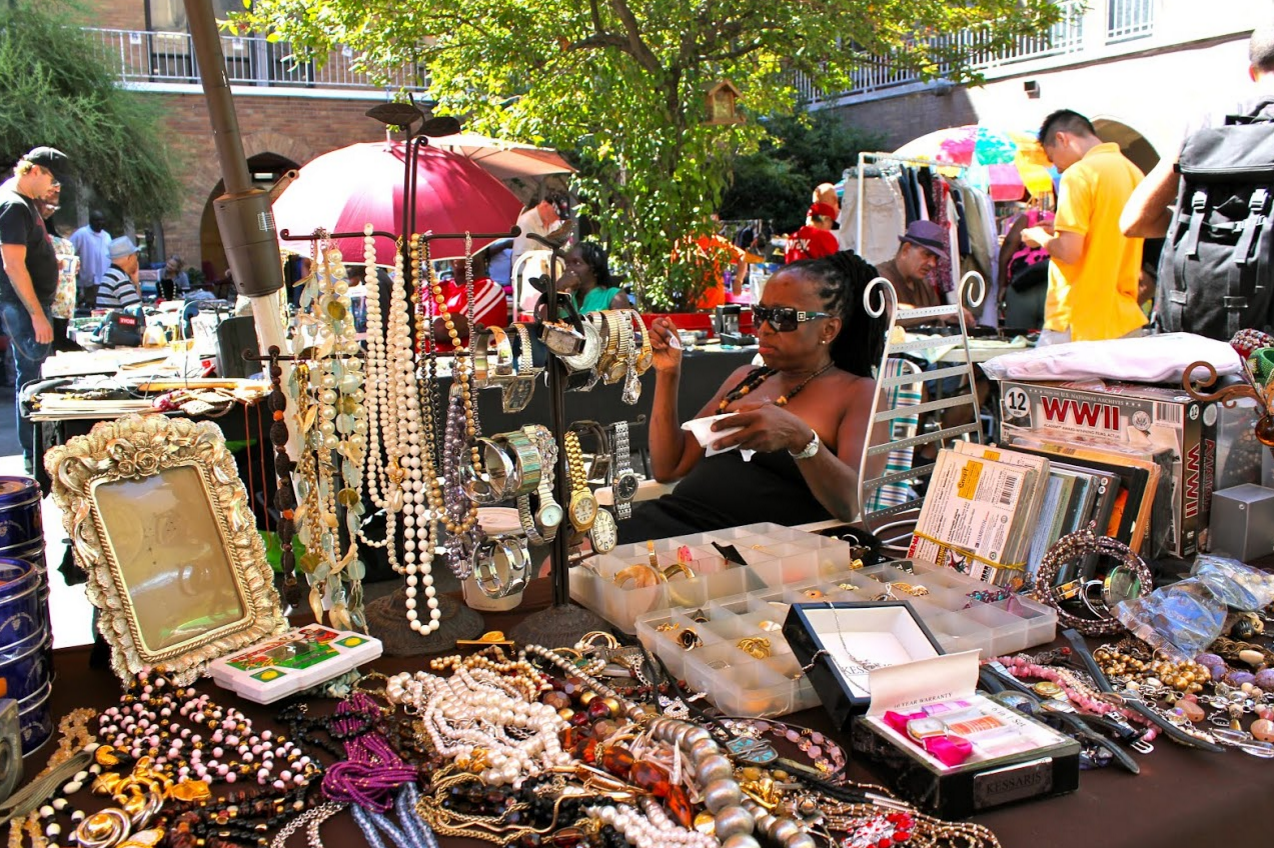
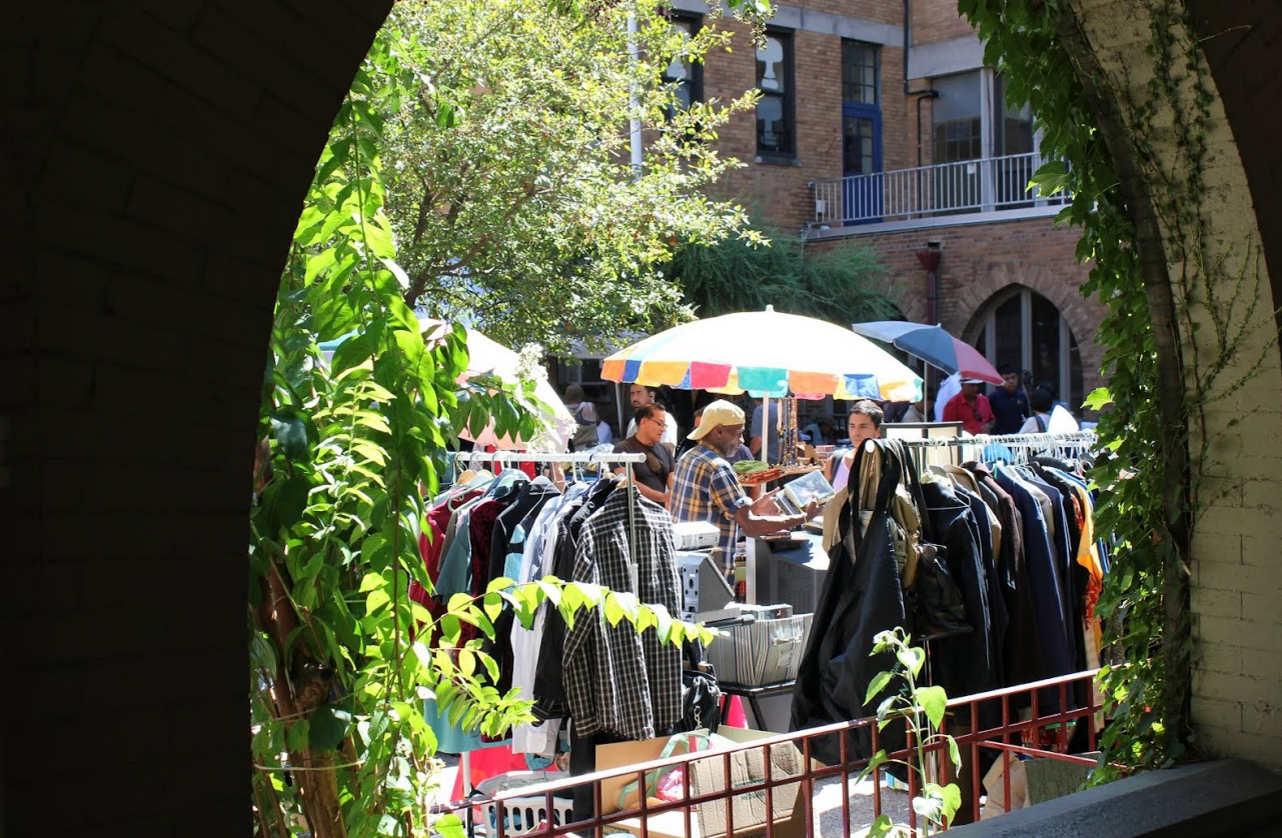
The small courtyard is crowded with splintered cafeteria tables cluttered with various items in various states of cleanliness: worn black Reeboks, outgrown children’s clothes, hoards of garish costume jewelry, books that should have been long ago returned to a library, disc-man headphones with slightly gnawed on connection jacks, and, the most archaeological finding of all, teetering pillars of VHS’s stacked haphazardly atop each other like ruins.
There does not appear to be any connection amongst the miscellaneous items shoved onto a table save for the fact that they all belong to the flea market vendor’s past. All together they tell the story of a life: a story that is for sale, memories for $1.50. The Immaculate Conception courtyard, home to the flea market on weekends, cramped with used objects and worn people, is hemmed in by buildings of prestige on either side of it.
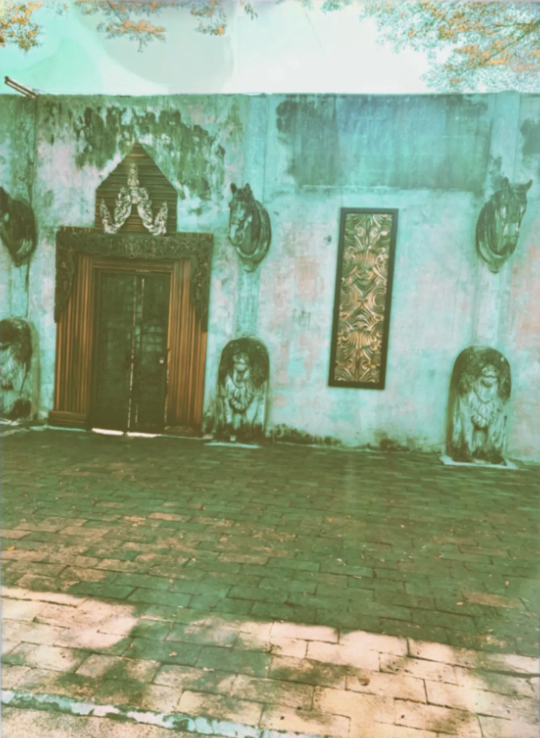
To its left stands a ten story, glass duplex that looks down on the courtyard and to its right a towering church that looks only upward. A humble-sized cherry blossom tree, its buds just shy of blooming, grows in the center, and, off to the side, a white marble Virgin Mary blesses the lot, her head bent, palms pressed together. She is life-size and stands not above, but level with the people. I sit at the courtyard's edge, next to the archway entrance, and listen to the swelling of Al Green's tenor as he muscles his way out of the static filled speakers of a prehistoric not-for-sale cassette player to let the crowd know that “loving you forever is what [he] needs.”
I overhear a friendly conversation between two flea market vendors, an elderly black man and an equally elderly white woman. I cannot hear what they are saying but I do not need to. The muffled seesawing of their voices, punctuated by light laughter, tells me all I need to know about their relationship; familiar, friendly, having no doubt shared many weekends at the flea market together. After five or so more minutes of conversation the black man turns to leave, saying that, unfortunately, he has to check on his table but he’ll be “back in a bit.”
Once out of earshot, a different elderly black man manning the table just beside the white woman says to her, with a sly conspiratorial smile, “I bet you’re glad he’s gone!” The woman touches her thumb to her forefingers in a blah-blah-blah gesture and bemoans, “he just goes on and on and on.” I felt bad for the first black man, having lived over half a century and still completely oblivious as to how annoying he is. I felt bad for myself, having lived nearly five years in the city and still naively surprised when it continues to disappoint me.
~
I find myself returning to the flea market nearly every weekend to watch the vendors co-exist, hoping that they do not notice my presence and also hoping that they do. I wonder whether their lives are as intimately interwoven as their tables in that cramped courtyard. I want to imagine that they are like family, or at least like neighbors in the religious, most sentimental of senses. I imagine that they know about each other’s children and grandchildren, that they remember each other's birthdays. I imagine that they feel comfortable enough to step away from their booths for minutes at a time because they know that their neighbor will watch over their stuff as if it was his or her own. I visit the market at dawn, when they are setting up their tables, and watch to see if they share coffee or ask about each other's week. I watch to see if they quarrel over whose space is whose and, more importantly, if the quarrel is soon forgotten with the rising of the sun.
Each time I visit the flea market, it appears uniform and yet exudes a subtle sense of having been altered; the same unsold items shinier with the polish of new fingerprints. The flea market always has an identity, but its identity is always indefinite, in flux. It is determined by elements as intrinsic as whether or not the sun is shining, to details as intimate as whether or not I spoke to my mother on the phone that day--from whether I choose to leave my headphones on as I walk through the courtyard, to the song that is playing over the cassette player's speakers, to whether anyone is singing along. From how many unseasoned vendors will be there for the first time, to how many of the veteran vendors will remember me from previous weekends, to how many will ask me how I’m doing, to how many will ask me in Spanish. It depends on whether the cherry blossom tree is blossoming, whether the VHS’s are selling.
I’ve noticed that Saturdays are very different from Sundays. One would assume that because Sunday mass is held in the church housing the courtyard that there would be a larger crowd, and perhaps a larger amount of generosity, but Sundays are, in fact, slower days. I’ve noticed that Starbucks-cup-holding me is treated very differently than beat-up-back-pack-wearing me. I've noticed that things cost less when I ask for the price in Spanish.
If I visit in an oversized sweatshirt, a vendor will tell me not to bend the comics while I’m rifling through them, but if I show up in a dress the same vendor will tell me that there are more comics on the other side of the table if I want to look at those as well. Even more compelling than the vacillating opinions of me is how quick I am to accommodate them. If I am seen with the prestige of a patron who came to buy, not just look, I will often end up buying something. I'd like to think that my adapting is a subconscious harmonizing with my location, but it is much more likely that it is a conscious conformity to the shallow identities bestowed upon me in a vain attempt to belong to the market any way it'll have me.
~
Standing in the center of the courtyard, next to the cherry-blossom tree, I can hear both the “My Girl” playing from the right corner (courtesy of the black gentleman with the prehistoric stereo) and samba coming from the left corner (a Latin family listens as they bead rosaries for their booth). The songs are not in opposition with each other, but oddly symphonic; I am able to sing along to one song and sway my hips to the other.
The most common question I’ve been asked at the flea market, and in Manhattan in general, by strangers and neighbors alike, is, “Where are you from?” Sometimes I say East Elmhurst, Queens (I have an aunt and an uncle living there). Sometimes I say Veracruz, Mexico (my grandparents on my mother's side were born there). Only once have I ever said San Antonio, Texas (my actual birthplace) and the one time that I did I was asked again, “No, but where are you from originally?”
Texas is not exotic enough for the flea market where there are vendors from all parts of South America, Indonesia, Africa, and elsewhere. Most of them are proud to proclaim, very early on in the conversation, that they are originally from faraway lands: foreigners. It would appear that to truly be at home in the market one must identify as an outsider in Manhattan. However, though the half-breed music of Motown lyrics and samba sound can be harmonious, it is not without implications. Why is it that one stereo is in the far left hand corner and the other in the far right hand corner? Even in the haven for foreigners that is the flea market there are borders and, though one can find solace in some pockets of the courtyard, there is also segregation.
I became distinctly aware of this phenomenon upon a visit to the flea market on a day when I was feeling particularly pleasant; I was my favorite self, my Spanish-speaking self. I gravitated towards a booth manned by two middle-aged, Latin women conversing in Spanish, the jewelry on their table aggressively competing with the quilted tablecloth for attention. Picking up a necklace at random, I asked, slightly hesitant to interrupt their conversation but overall fairly comfortable, “Disculpe, ¿cuánto cuesta?” (Excuse me, how much is this?) The lady turned to me and answered, “ten dollars.” In English!
It was a slap in the face. I had not spoken in Spanish because I thought that she would not understand me in English, but because I was seeking a sense of sanctuary, a feeling of familiarity that I felt was possible because of a shared language. I had said, “how much is this?” but I had asked, “do I belong?” When the woman answered me in English she effectively disowned me, making me an outsider in what I had wrongly assumed was a home. It felt like all of my tías and abuelitas turning me away at the door. I left the flea market soon after that. I did not speak Spanish for the next few weekends that I visited.
When we leave places and return to them, either by choice or by chance, they do not only appear different but are different, because we always return to places anew; our minds, moods and memories constantly altered, enhanced, disillusioned, and back again. The locations we frequent merely reflect those implicit changes. My mistake was not in claiming the market as a sanctuary in which to speak Spanish, but in being taken aback upon discovering that the market did not define itself solely by my parameters; it did not belong to me alone. Realizing this, however, did nothing to lessen my desire to belong to it entirely.
This devotion to finding one's home-away-from-home, a pursuit shared by countless writers and New Yorkers before me, is, in essence, an oxymoronic endeavor. A home-away-from-home has only one requisite, that it is not home. Therefor, the oasis's we find for ourselves, if looked at too closely, if stayed at for too long, appear merely mirages. And though there is no question of the comfort of a mirage, can we survive on sand alone by firmly choosing to believe that it is, indeed, water?
~
I was aimlessly meandering through the flea market with a notebook in hand and barren pockets when I met Anita. She was elderly, Latin, and sitting on a beach chair smiling up at me, a palpable maternal air about her. I paused for a moment to glance at a line-up of vividly colored nail polishes neatly arranged on her table, some of them half-used. “Why would anyone buy half-used nail polish?” I thought. She saw me looking and, mistaking my musings for interest, told me that there was a dollar discount for students. “The way that they do it in the stores is the way I do it here,” she said with pride. She was undeniably charming.
Anita went on to talk about how she found it important to organize the merchandise on the table in an appealing way and let me in on the secret that “You gotta put a tablecloth on your table so that people stop by. You don’t put a tablecloth and people just walk on by.” I simply nodded as if this made all the sense in the world. I wondered if it was acceptable for me to leave yet.
Before I could subtly turn away, she added, “I used to put flowers on the edge of the table, right here, but my mother passed on and the funeral is tomorrow so I have to save the flowers for that.” I skeptically assumed (and I attribute this to having lived in Manhattan for too long, where nothing is free) that she was pressuring me into buying something from her out of sympathy.
I told her that I was very sorry for her loss but--and it pains me to be this honest--I wasn’t. I did not feel any sincere remorse, only vague politeness. Anita readily accepted my empty condolences, however, and continued talking in length about her family. I learned that her mother had been 93 years old when she'd passed. I learned that Anita herself has a son currently serving in Iraq and a daughter working for Homeland Security in Florida. She told me to “never take your mother for granted and always say you love her when you tell her goodbye on the phone,” and she wasn’t talking to me when she said it. She told me that I was “a good girl” and I wondered how she could possibly know that.
Then, noticing the small notepad I had been absentmindedly fingering while listening to her lecture, she said, “Take it, a gift from me.” I tried to tell her that I couldn't accept it, that I didn't have any cash, that I wasn't that good a girl, honest, but she pushed, “Please, for me. So you can remember me.” Anita did not want my money or my guilt. She only wanted to trade memories; a few of her sad ones in exchange for my having a pleasant one of my encounter with her.
I have looked for her every weekend since (that’s three weekends now) and she has not returned to the market. I want to ask how her kids are doing, when her son is coming back from Iraq. I want to ask about the funeral; how is she holding up. I want her to ask me what I’ve been up to and to tell me that I am a good girl. I opened the notepad the weekend that she gave it to me; it broke the moment I took it out of its plastic wrapping, the pages falling out of the brackets all at once. It seems that it was only ever meant for the purpose Anita intended, to remember her by.
~
The flea market once existed outside of the Immaculate Conception Church courtyard, at a much larger, less hidden location. It was born in 1994 and bred in a large, unused parking lot belonging to the privately owned, out of commission Mary Church on Ave A and 11th St. Unfortunatly, in 2012, despite parishioners prayers and neighborhood petitions, the land, along with both the church and the lot, were sold for renovation. The flea market was then forced to re-locate and was taken in by Immaculate Conception.
The new venue is half the size of its predecessor, causing the market to lose more than half of its vendors. The courtyard is also hidden from street view, unlike the old lot, and thus patrons are more difficult to come by. The vendors now pay dues to Immaculate Conception that were not required of them when they were at Ave. A. The market’s character has shifted, its profits taken a hit, and its loyalties been tested, but it lives on. The flea market is not only a refugee camp, but itself an exile.
In Manhattan places like the market and people like Anita are forever moving, growing, leaving, and returning anew; constantly shifting and changing in irretrievable ways. Attempting to make Manhattan a home becomes demoralizing, forcing many to abandon the island before it abandons them one time too many, and those that stay are dogged.
They fight to hold onto their neighbors while their neighborhoods continue to be demolished, gentrified, and migrated altogether. They continuously knock on the doors of strangers hoping to be answered in their native language. They hand out notepads to anyone who will stop for a moment and listen. And they do this for the same reason that those lost in the desert discover mirages. Manhattan makes them many promises but can only keep one, that those with the ability to turn sand into water will always be able to find an oasis.
Michelle Rosique is a female NYU recent grad with a BFA in Film & Television who is 23 and attempting to write her life story before she's yet to live it.