



















BY JENNIFER CLEMENTS
Editor's Note: A version of this article appeared on our old site.
I. Let’s talk about theatre and sheep and robots and construction vehicles.
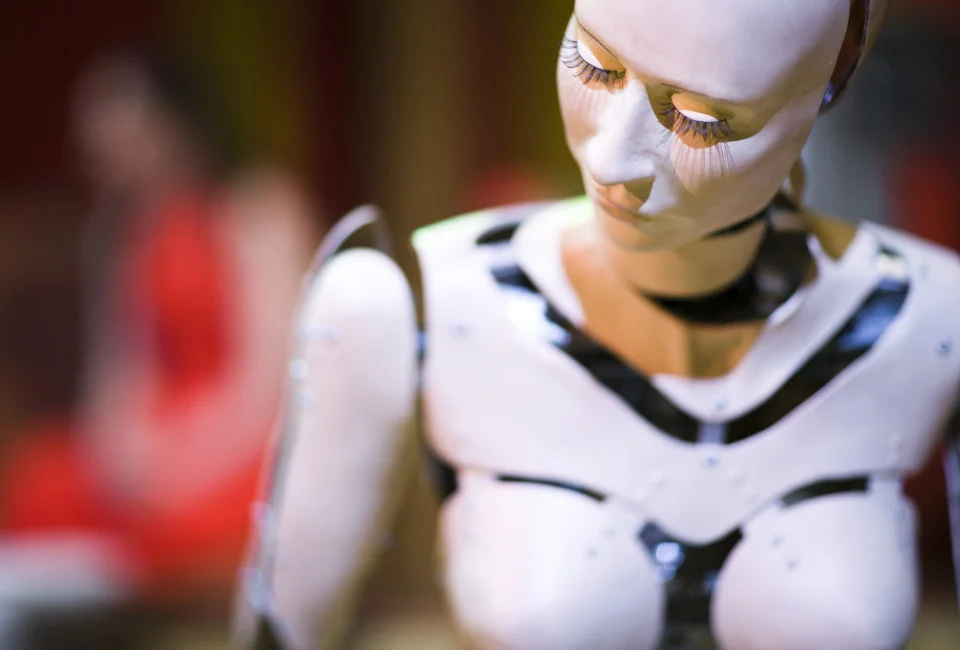
Berlin, this past June: At the Komische Oper, a large and gilded venue dating back to 1892, you might cross paths with a white cycloptic robot, looking a bit like a child designed by Steve Jobs, moving and singing its way through a postmodern Pygmalion. The theatre has partnered with a British arts collective and a neurorobotics laboratory to bring this production--called My Square Lady--to its synthetic life, a process spanning eighteen months to program and rehearse the autonomous and artificially intelligent star.
A part of DC’s Capital Fringe Festival in July, just steps from the Chinatown Metro, two construction cranes dance a long and elaborate pas des deux. Long metal necks lift and lower and twirl; music blares through a neighboring park stuffed with picnic blankets, children, and professionals still dressed for work. For just over an hour, the lines between utility and entertainment become blurred, and the sociopolitical implications of a quickly gentrifying city look like elegant twin giraffes.
In Hoxton, a suburb of London, the Courtyard Theatre nestles into the shell of an old library: aging brick with a wide crimson gate. This month’s performance of King Lear with Sheep brings one human and nine bleating co-stars to the stage to prove that bard and barn are only a letter apart. Never mind the smell, it’s an immersive part of the experience. The sheep have been outfitted in miniature Elizabethan ermines and coronets. The company markets this play as a work that "overturns theatre conventions through the startling and revolutionary device of costumed sheep."
I am not attending any of these productions.
II. Let’s talk about the human factor.
It’s a Monday evening in a quiet corner of the city, the outdoor air casually threatening rain. I’m waiting outside the Folger Shakespeare Library, picking at a slice of carry-out quiche with a plastic fork, balancing my tea and my dinner and my ticket along a ledge and looking across the line to where I recognize a friend.
We’re waiting to watch an annual Bootleg Shakespeare event, which is as ephemeral as theatre can be: there is but one performance every year.
Inside, twenty actors from Taffety Punk Theatre Company are preparing. I don’t know any of them personally, but I feel sympathetic anxiety for them all: They’ve separately memorized the entire script of Two Gentlemen of Verona, then come together just today for their first-last-and-only rehearsal before performing in front of more than a hundred strangers. What must it feel like backstage? I imagine the frenzied cloud of adrenaline in the green room halls. I imagine one of the leads meditating hard in a corner, or swigging from a bottle of nearby tequila, or threatening to papier-mâché his own body with pages from the script so the lines might seep in by osmosis. I imagine more than one of them asking, not quite rhetorically, why are we doing this to ourselves?
Because this scenario steps within an inch of the performer’s nightmare. A full, five-act Shakespearean comedy. Scarcely one rehearsal. Some of the actors meeting for the first time in the wings. There’s a lighting designer and a sound designer, but they’re working on the fly just like everyone else. No one, onstage or off, is in any position to know what’s about to happen. Just one chance to get it right.
It will be one of the most powerful shows I see all year.
III. Let’s talk about risk.
I have seen many naked bodies onstage. I don’t seek this out; it’s an inevitable part of attending live theatre in a city that yearns to up its own edginess quotient. More often than not, the undressing of a character tries to convey some power dynamic, or vulnerability, or the unexpected within the world of the play. I can’t recall the last time I saw onstage nudity that sought to be sexually provocative. In any case, when an actor is physically nude onstage, the nakedness has been rehearsed. It has been written up in their contract, then choreographed, anticipated, and made as familiar--if not altogether comfortable--as a fight scene, a dance sequence, or a particularly difficult costume change.
The members of the Bootleg Shakespeare ensemble offer something more raw and vulnerable than clotheslessness. That’s what it takes to step out knowingly unprepared. We can feel, beneath the spoken lines, the urgent hope that all will go well, that insistent desire to not jeopardize their performance or the work of their fellow artists, to give something to the audience. Of course, any live performance carries a dash of that sentiment. But the palpable and subcutaneous tension, this night, is heightened by uncertainty. Only the instincts of these human beings will dictate what’s about to happen.
One actress becomes tickled by her scene partner and nearly erupts into laughter onstage. A bit with a prop goes awry and something falls when it’s not meant to. And about once every act, someone forgets a line and asks the prompter for help. Yet nothing is spoiled.
We are rooting for them to do well because we understand the difficulty of what they are doing, and the generosity of what we, the audience, have been given.
IV. Let’s talk about what we ask of performance.
It has been a hard summer, one of perpetual motion and easing friends through personal challenges, with a backdrop of current events pounding a sucker punch to the heart with every new headline. But then, that’s what it is to live in the world.
I ask the theatre to do what any art form might--to engage my mind or my heart in a fearless and powerful way. And, because theatre as a medium hinges on immediate contributions by fellow humans, because the energy shared between those onstage and off is unique to each performance, when I go to the theatre I am hopeful that what I see will touch both heart and mind; that it will not just pull me out of my own experience but enrich it, challenge it, grant it new, glimmering, or unexpected dimension.
And so I have to examine why this quirky, raw, and unrehearsed performance surpassed many of the sleekest, most innovative or exquisitely designed productions I’ve seen recently. Is it because I--and perhaps the rest of the audience--had already begun to imagine the performers’ experience onstage? That there was, somehow, double the capacity for empathy and understanding, because we were granted permission to see past the veneer of character and into the people portraying them?
The immediacy of theatre demands emotional discourse from every person in the room. It might be twenty people, it might be two thousand. It’s a trust exercise. It’s a contract. And the more risked, the more gained.
That’s not to say that the robots of Berlin or the sheep of London or the cranes of Washington possess any less artistic value. So long as these works resonate with their audience, they have a place and a purpose. It isn’t a contest, and the medium as a whole is strengthened by having many and varied perspectives.
For me, though, that empathy element is vital. The trust granted between human beings--onstage and off. When I don’t always come out of a play feeling totally fulfilled, I am challenged to understand how performances by sheep, or cranes, or robots would develop real empathy, though they might offer some sort of escape or intellectual provocation or novel experience for their audiences. At the end of the day, I know I will be most moved--heart, mind, and otherwise--by the work that challenges us to revel in the messy and complicated pieces of our existence, and to understand that we’re all in it together.
Because, if nothing else, we are then reminded of our humanness. And isn’t that the most we could want?
Jennifer Dane Clements is a writer and editor based in Washington, DC. Her work has been featured or is forthcoming in publications including Barrelhouse, Hippocampus, WordRiot, Psychopomp, and The Intentional. She is a prose editor of ink&coda and a staff writer for DC Theatre Scene. She holds an MFA in creative writing from George Mason University.