
Aces represent Pride and Prejudice; Hearts display Emma; Clubs detail Persuasion; and Diamonds showcase Sense and Sensibility.
Read MorePhoto credit: John Eric Ligon
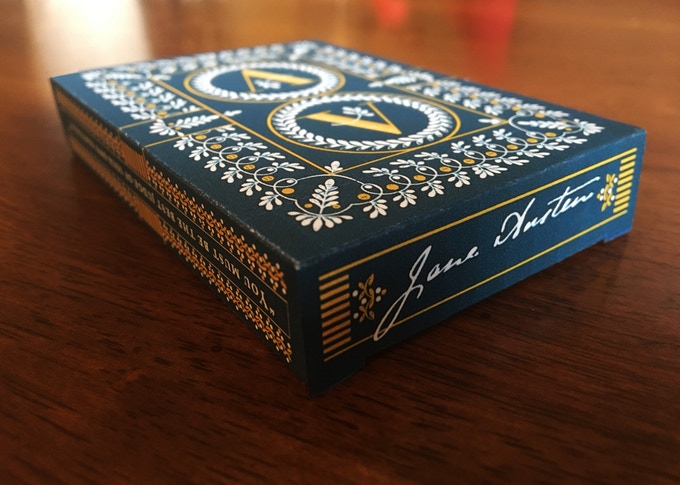
Photo credit: John Eric Ligon
Aces represent Pride and Prejudice; Hearts display Emma; Clubs detail Persuasion; and Diamonds showcase Sense and Sensibility.
Read More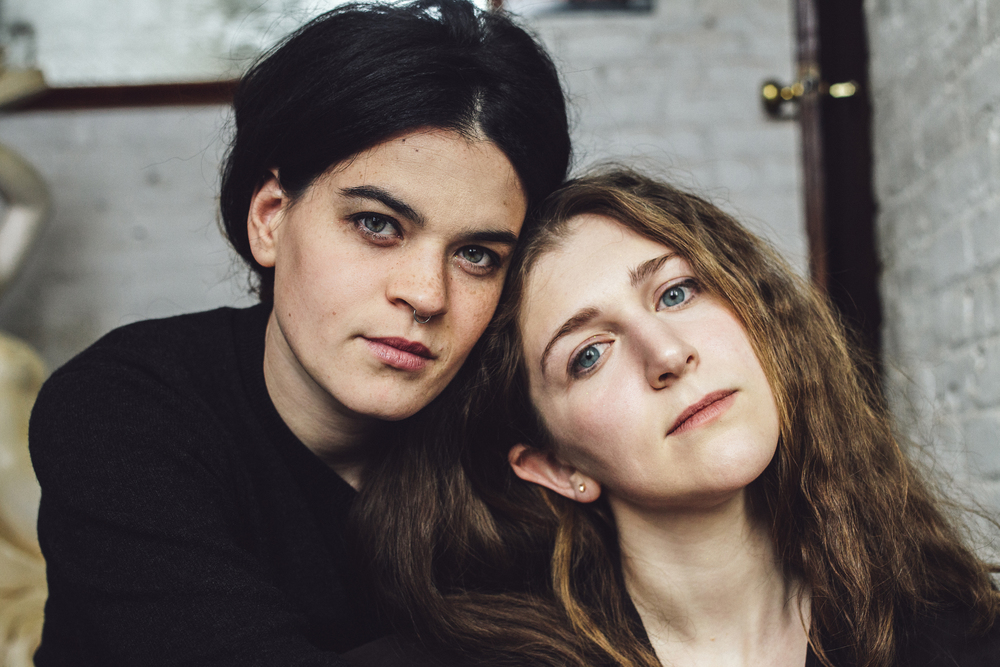
Dusdin Condren
There is something enthralling about a song that deceives you. A first listen can prompt upbeat head-bobbing in the car or prancing around your room, but on a second or third reflection, you detect a sadness, fear, or anxiety in the lyrics that wasn’t apparent at first. This was my experience listening to YOUNG, Overcoats’ debut album.
Read More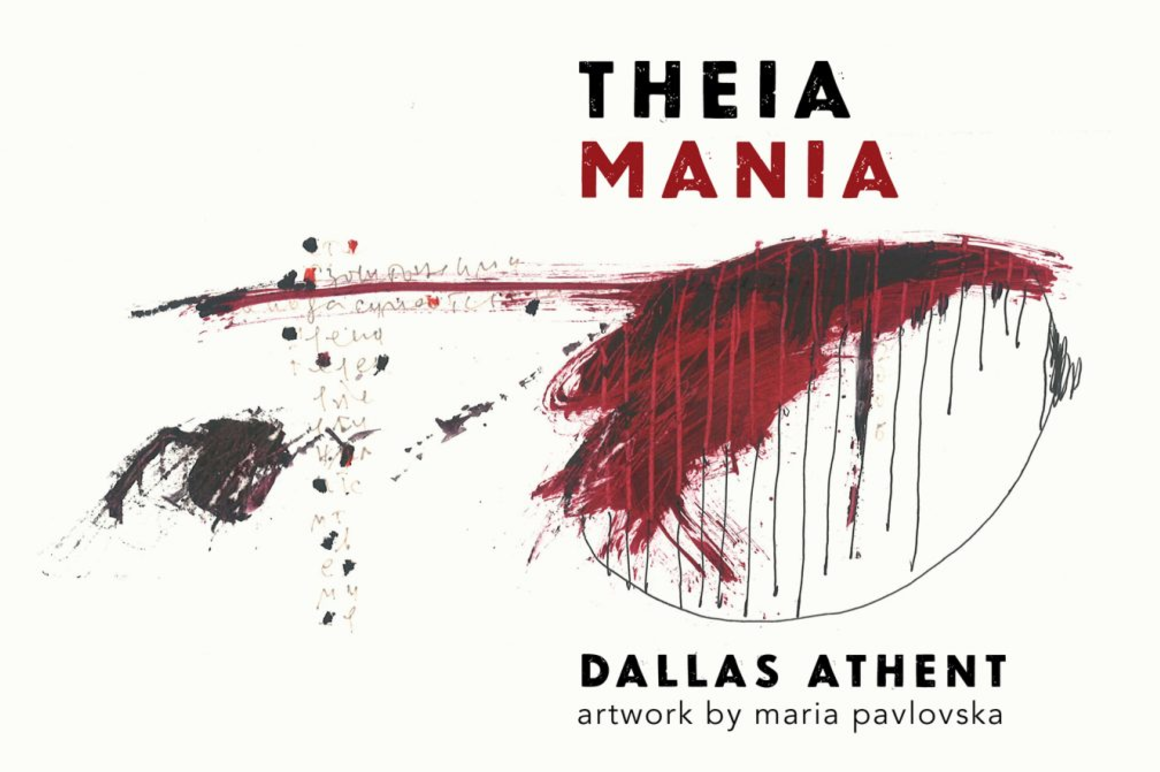
BY LISA MARIE BASILE
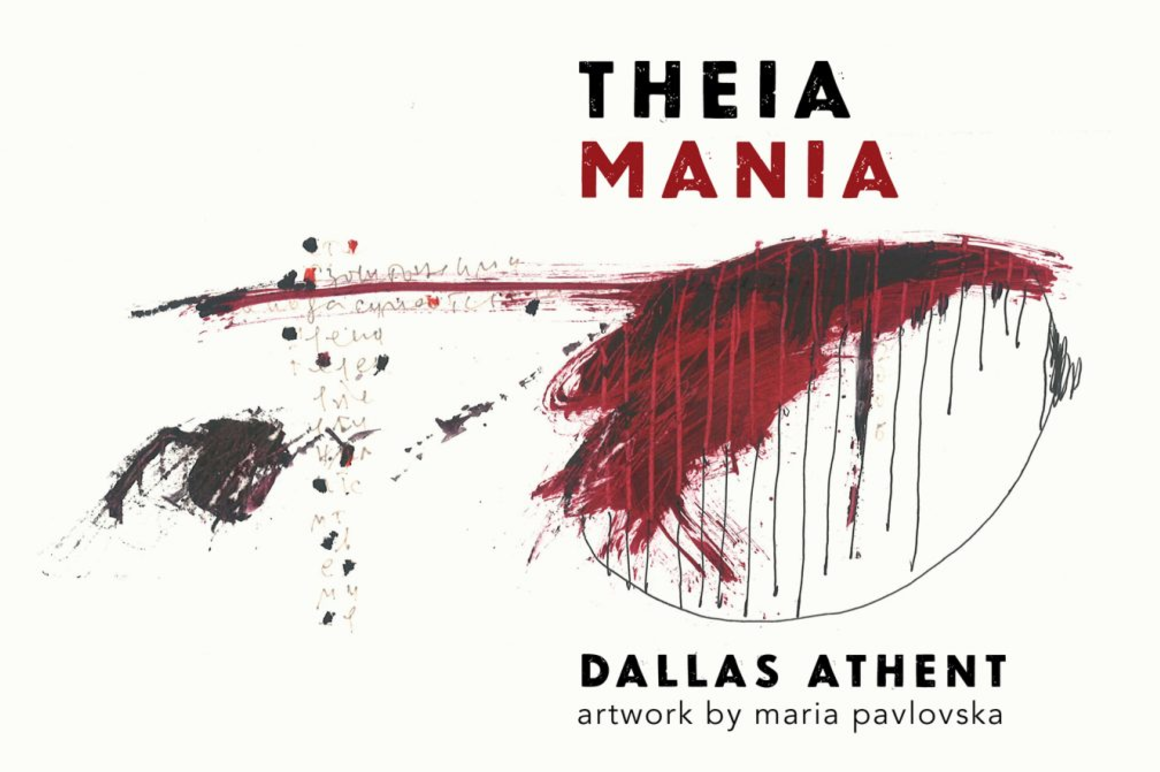
Editor's Note: Theia Mania is a book of poetry by Dallas Athent with illustrations by Maria Pavlovska (Black Square Editions). This book is fiercely feminine, self-empowered, loud, brash, beautiful, and filled with references to gods and the Divine. Here. I interviewed Dallas and Maria about their collaboration and their work.
LISA MARIE BASILE: Ah, the binary. I am addicted to it and your work explores it so well. It's bikinis versus god and bars versus transcendence and the problematic versus self-empowerment. Except here, the light always seems to win. Was that a conscious choice?
DALLAS ATHENT: I used to believe in good and evil. After my studies ofThe Golden Dawn and Platonic elements, I began believing instead in light and dark. Light elements are things that are connected to the divine, the higher powers, spirituality. Dark matter is that which makes us mortal. It's what drives us to be gluttons. This book is really a study of both states. Light doesn't always win because it is "good," per say, it wins because making art is a struggle for our dark matter to be connected to higher powers.
LISA MARIE BASILE: There's not a lot of subversion here, although on first read I thought there was. I think you're screaming, HEAR ME. And I love it. I don't see a lot of work that encounters radical self strength with such bravado. Tell me, were there weaknesses and fears and vulnerabilities you grappled with while writing this?
DALLAS ATHENT: At one point during this I was laid off from my job the same week I was closing on my apartment. It was a hard week for me and that's where on the one hand I was celebrating an accomplishment, but it felt fake, not knowing if I could really afford this thing I had been working towards. A lot of the darker poems were written during that week, and the ones that are more about me feeling like I can do anything were written when I got myself out of the hole.
LISA MARIE BASILE: So, you keep mentioning England. How did England shape you IRL?
DALLAS ATHENT: I love England. I lived there for a short while and I'm always trying to move back. I adore pub culture. A lot of my friends talk about wanting to visit warm places, and how beautiful beaches are, but for me the most natural state is in the corner of a pub on a rainy day with a book and a pint.
LISA MARIE BASILE: You say, "the purpose of art is horror," and I think that's fucking magic. I agree, but I haven't seen it put so succinctly. Tell me about this idea. Did you aim to horrify?
DALLAS ATHENT: The poem that's taken from is about making art, and trying to leave a mark through doing so. That being the last line was just me thinking of how hard we try and end up nowhere. It's like a beautiful nightmare.
LISA MARIE BASILE: I feel like this book is like if contemporary feminist discourse had a baby with the baddest, most rebellious, most sassy Lana Del Rey video ever. It's all girls and alcohol and scum and the body, but it's elevated with these ideas of divinity and Theia and the powerful feminine. How do you approach talking about BIG IDEAS in such an aesthetic way? I know when I was writing Apocryphal, I wanted this landscape of cars and deserts and fabrics and gardens and beaches and fires and tropics, but at the end of it, that was a character all meant to juxtapose the grandiose shit. What about you? Was this landscape and aesthetic conscious or not? Or was it just, "I love these things. They're real to me?"
DALLAS ATHENT: That's a great question. And I actually feel the same way about Apocryphal. You managed to create this classic, desperate, suburban summer on a coast feel — but used that landscape to illustrate what it's like being a young woman.
For Theia Mania, I've always loved cities and lived in cities. I'm obsessed with places where there's so many people and they all live so close to each other but don't actually know each other and have such drastically different lives. I just like how that contributes to the concept of trying to make art to be someone. It's a constant reminder that we will fade into the fabric of the earth no matter how well known we are.
LISA MARIE BASILE: (Thanks, Dallas). I've heard you talk about Yeats before. You write, "there is an oppressive veil separating us from the stars and Yeats." Can you tell me more?
DALLAS ATHENT: A while ago I read this essay titled the The Gnostics by Jacques Lacarriere. What I got from it was that the Gnostics believed there was a veil that separated us from all that is holy and divine, and that's why mortality is always doomed. Because we're always trying to see everything behind the veil but can never possibly. Yeats, being everyone's favorite Golden Dawn member, and a true inspiration to me, seems to have been someone who has achieved crossing the veil. It was a little line to give him a nod.
LISA MARIE BASILE: What does Theia mean to you?
DALLAS ATHENT: Theia Mania is a Platonic theory about how people who are experiencing horrible things, like heartbreak, are brought closer to the divine in those moments, and that's why we make great art. That state is really what the book is about, along with the dualities of being mortal and immoral, and trying to leave a mark on the world. That's how it got its title.
LISA MARIE BASILE: Your pictures evoke chaos, but they seem finely, painstakingly deliberate. I'd love to learn about how you approached these works for this book.
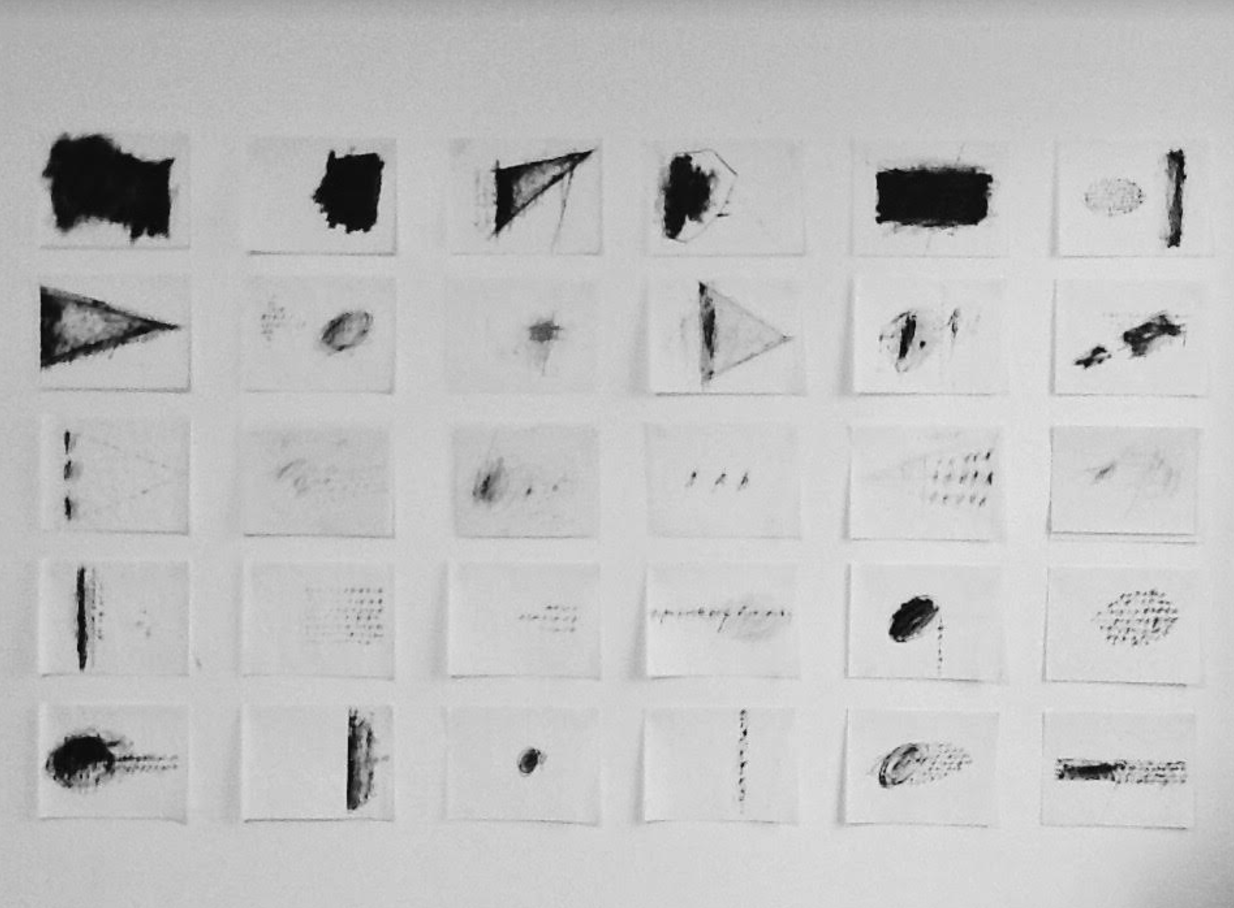
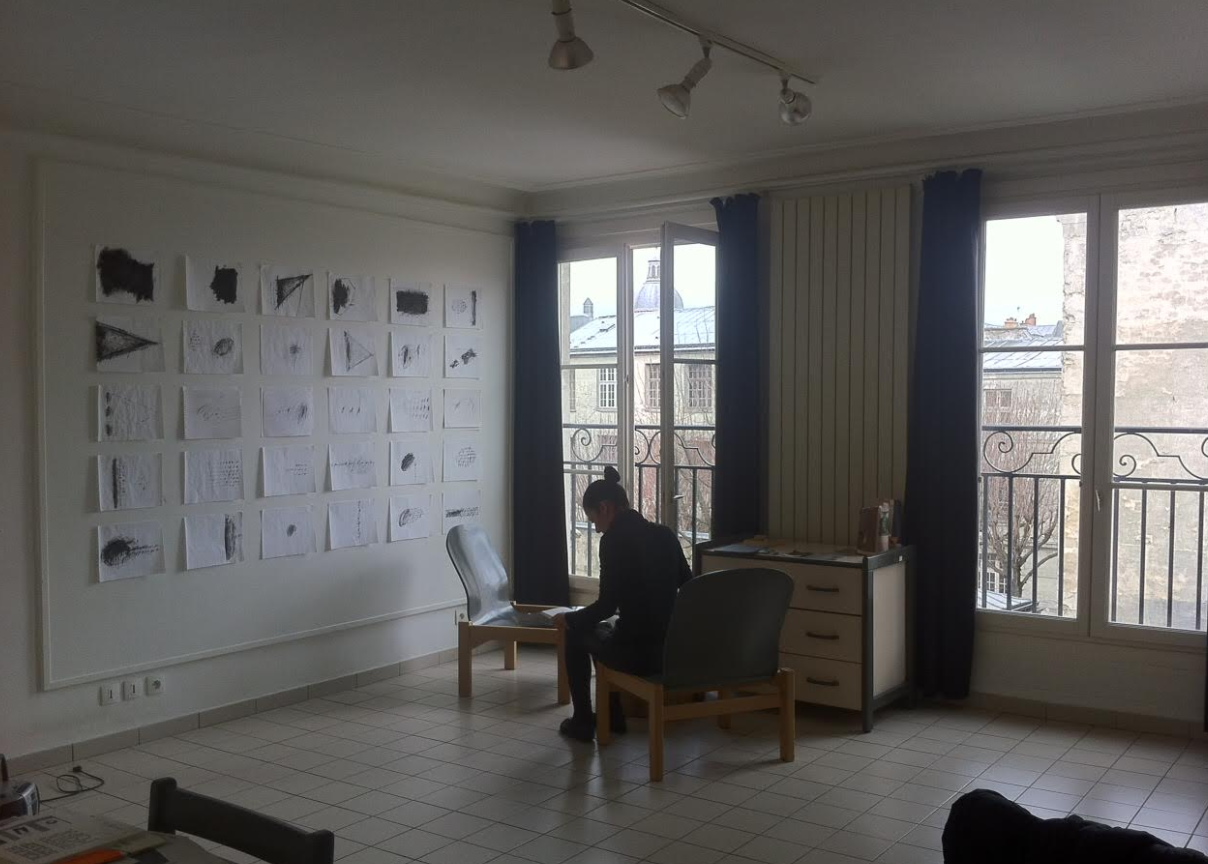
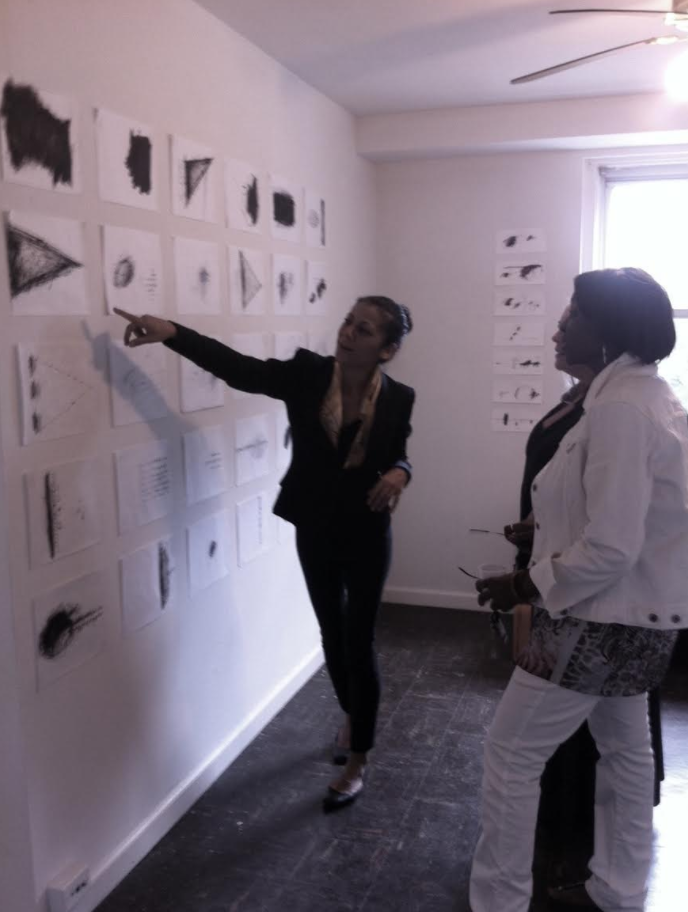
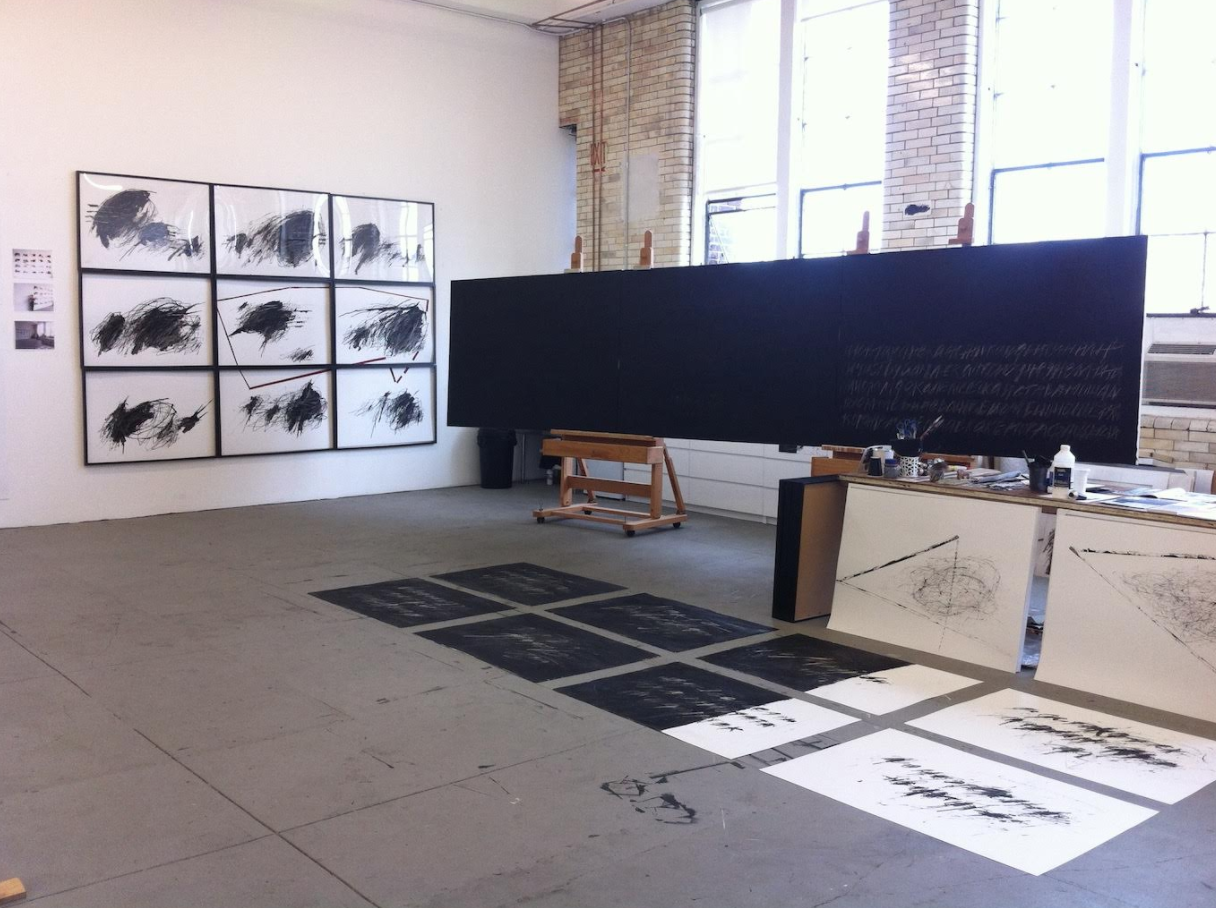
MARIA PAVLOVSKA: There is a series of 30 drawings, which was one piece related to each other from the first one to the 30th. Altogether it is one story. They are not meant to be viewed individually, but as a collection. They were originally conceived as part of a show "Black and White Diaries," which included also large canvasses. I wanted to show, as I always do, the progression from drawing to painting.
LISA MARIE BASILE: Something I realized about this book is that there really is a balance between the good/bad or holy/not holy polarity. In your work, I sense that you contributed in a big way to that feeling. I find it very hard to strike a balance; how do you, as an artist, find that median?
MARIA PAVLOVSKA: My work translates topics of choice into pictorial language that demonstrate a quietly powerful eloquence. My drawings and paintings reflect painting as a battlefield, where light and darkness fight and the result is unpredictable.
One sees the lightning bolts of ideas at work, as they are being worked out. That is the balance I look for. This sort of simultaneous image /process / results in a dialectic that lies frozen in space, stimulating the viewer to actively participate in the image creation themselves by way of investigation, inviting myriad readings within a given theme.
LISA MARIE BASILE: You're from Macedonia. What about the culture inspires your work? Is there something you're bringing to your work — and Dallas' poetry — that is related to Macedonia in some way?
MARIA PAVLOVSKA: My inspiration does not specifically reflect my Macedonian heritage. I draw inspiration from who I am and how I see the world, in me and around me, and this is more of a global perspective. The people that see my work, whether they are in Berlin, Vienna, Belgrade, Paris or NYC derive this universal feeling from the art as unique.
LISA MARIE BASILE: What does Theia mean to you? Who is she in your work?
MARIA PAVLOVSKA: In my work, the contrast between light and dark, shadow and brightness, is evident. Theia, the Titaness, has several distinctions: brightness, uprightness, belief. Theia is a good omen.
LISA MARIE BASILE: Each of the works in this book feel like they're unraveling to some sort of secret that I finally learn. Can you tell me a secret?
MARIA PAVLOVSKA: As the viewer can notice, there is a lot of writing in my work. You cannot really make out the words or read it, as it's not a poem or a thought that needs to be read. I need to write inside during my work as the thoughts are coming from me, and i'ts part of the composition. In the end it is part of the piece. So in that sense, it is a kind of secret (obvious secret).
LISA MARIE BASILE: How do you make art from literature, like this? Is it a translation? Or a collaboration?
MARIA PAVLOVSKA: It is a collaboration as Dallas in one of her visits to the studio noticed the drawings realizing that they relate to her poems, and they seem to compliment each other. The drawings already existed, they were not created for the book, but, they seemed to fit with her poems perfectly (what I draw and explain with the lines, she writes and explains with words). We commented that my work would work well with her poems and that we could create this remarkable, new book Theia Mania.
Note: The images above were part of Pavlovska's Black & White Diaries concept. They were developed in a two-month residency studio Pavlovska won in 2014 at Cite Des Arts in Paris. The works were displayed at DRAWING ROOMS Gallery in New York City at the group show "Automatic - Systematic" in May 2014 and then shown at MANA CONTEMPORARY Open House in January 2015.
RELATED: 6 Incredible Pieces of Art We Saw at Mana Contemporary’s Open House
Dallas Athent is an art reviewer for At Large Magazine, a board member of Nomadic Press and the editor of the short story collection, Bushwick Nightz. Her writing has appeared in Buzzfeed Community, PACKET Bi-Weekly, PANK Magazine, VIDA Reports from the Field, BUST Magazine, Yes Poetry & more. She has been an editor for Bushwick Daily and Luna Luna Magazine. Her work has been profiled in Bedford + Bowery of New York Magazine, Brooklyn Based, Brooklyn Magazine, Papermag among others.
Maria Pavlovska was born in Skopje, Macedonia (Former Yugoslavia) in 1975. BA and MA she receved at the Faculty of Fine Art in Skopje, Macedonia. Her work has been featured around the globe in over 28 solo shows and more than 100 group international exhibitions including Art Basel Miami, The Kunsthalle-Vienna and Kunsthalle-Krems (Austria), Gallery Lang (Vienna), Cite Internationale des Arts, The Dock (Paris), Museum of Contemporary Art, The National Gallery, Museum of the City - Skopje (Macedonia), City House in Nurnberg (Germany), Station Gallery, Gallery MC, The Open Space Gallery, Citibank (New York), FLA Gallery (Connecticut), Viota Gallery (San Juan - Puerto Rico), Prima Center (Berlin), MANA Contemporary and Drawing Rooms (New Jersey). Her work is held in private and public collections worldwide, including embassies, museums, galleries and libraries.
Kailey Tedesco's books These Ghosts of Mine, Siamese (Dancing Girl Press) and She Used to be on a Milk Carton (April Gloaming Publications) are both forthcoming. She is the editor-in-chief of Rag Queen Periodical and a performing member of the Poetry Brothel. Her work has been nominated for the Pushcart. You can find her work in Bellevue Literary Review, Hello Giggles, UltraCulture, Poetry Quarterly, and more. For more, please visit kaileytedesco.com.
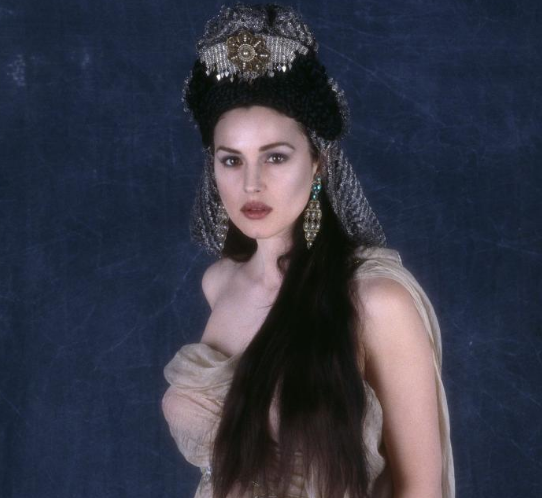
Dracula
Stephanie Valente lives in Brooklyn, NY. She has published Hotel Ghost (Bottlecap Press, 2015) and waiting for the end of the world (Bottlecap Press, forthcoming 2017) and has work included in Susan, TL;DR, and Cosmonauts Avenue. Sometimes, she feels human.
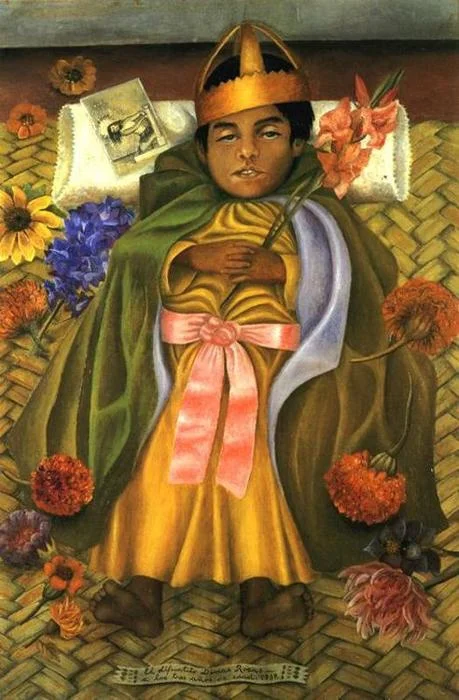
Frida Kahlo
Gerardo Pacheco Matus, a Mayan Native, is the recipient of the distinguished Joseph Henry Jackson Award and fellowships from CantoMundo, The Frost Place, Bread Loaf Writers' Conference and The Katharine Bakeless Nason Endowment. Pacheco’s poems and essays have appeared and are forthcoming from La Bloga, Spillway, Grantmakers in the Arts, Apricity Press, Amistad, Haight Ashbury Literary Journal, Cipactli, Poets Responding to SB 1070, The Packinghouse Review, Tinderbox Poetry Journal, West Branch Wired, and The Cortland Review.
Read More
Joanna C. Valente is the author of Sirs & Madams, The Gods Are Dead, Marys of the Sea, Xenos, and the editor of A Shadow Map: An Anthology by Survivors of Sexual Assault.
Read More
Ali Inay
Calin Van Paris is a reader who somehow became a writer. She writes about beauty for Vogue.com, fashion for Allure.com, and travel and lifestyle for the local magazine that gave her a start. She writes copy about sweaters for a Bay Area brand.
Read More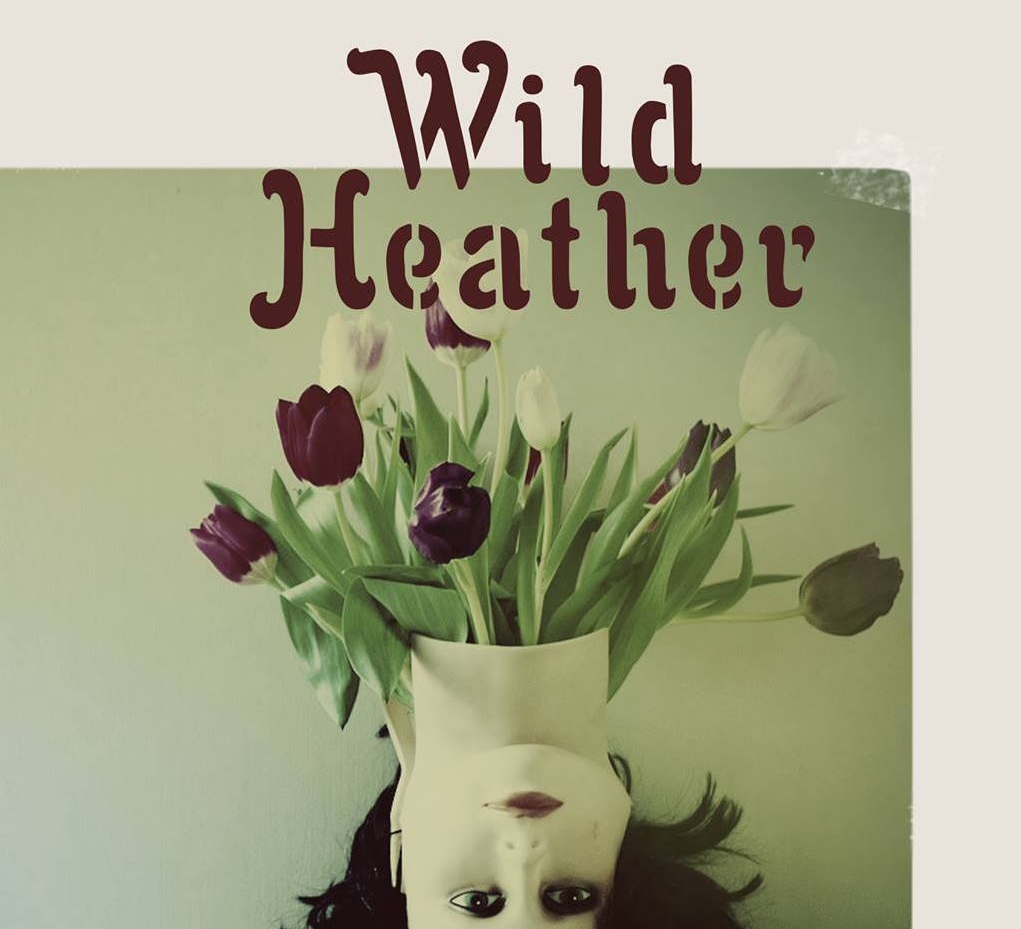
In Wild Heather, we go inside the head of Rathore as lover, as friend, as non-binary human, kin, and yet none of the above, however everything plus more. We are brought into the fold, we watch the cuckold, and we thank the universe for heavy moments for without them, the muse would not be able to animate Rathore, to allow the spindling of poetic births and mutations of witchy proportions. A classic conjuring of Sexton or Tzara’s stream of consciousness writing. All the greats have done it, Rathore no different, following suit and instinct alike.
Read More
Eugene Richards
I passed the doors of patients who were on bed rest, their bodies weak from lithium side effects and felt immediately lucky to be on such a mild dose of my anti-psychotic medication. The hospital psychiatrist seemed to only prescribe two medications: Seroquel for the depressed, and lithium for those with bi-polar disorder.
Read More
Ghosts! I don’t really believe they exist, but I like the idea that there are these mostly silent, invisible creatures causing great psychic upheaval, haunting places and people, refusing to rest. There’s something very powerful about their intangibility and rage.
Read More
Annie Spratt
Courtney Leigh Jameson is The Bowhunter of White Stag Publishing LLC & a QC Analyst (proofreader) at CVS/caremark. Her poems & prose have appeared in several journals, including Sierra Nevada Review, Naughty Ghost, FLARE: Flaglar Review, The Doctor T.J. EckelburgReview, MadHat Lit, Crack The Spine, Slipstream Press, Cowboy Poetry Press, GoneLawn, Danse Macabre, Similar:Peaks::, & Clockwise Cat. She just completed her chapbook Milton[ic] Partisan & her first full length book of poetry ghosts in the sky. She currently resides in Phoenix, Arizona.
Read More
Samuel Zeller
Lee Taylor is a writer, musician and light worker raising two children in Brooklyn, NY. She has an MFA in creative writing from The New School and spent the past six years living and blogging in Switzerland. Her essay “The Patron” was recently published in the inaugural print edition of Hofstra University’s literary journal, Windmill. She was also featured in the March issue of Bodega, an online literary magazine.
Read More
BY THE EDITORS OF LUNA LUNA
We here at Luna Luna love our contributors. We know how busy they are—running their own magazines, writing books, resisting the darkness in the world, and making all sorts of magic. That they come back to Luna Luna again and again to write and share and create is an honor, and there are no words to express our thanks. They are family to us, so we thought we'd spotlight them so you could learn more about who they are and what they do. Please support them! Read their articles, buy their books, subscribe to their blogs, and send kisses.
I write because I feel compelled to do it. If I go too long without writing, I get anxious and I have a hard time sleeping. I was an extremely shy child, and I always felt more confident when I wrote things down. I always seem to articulate myself better that way. I always feel more powerful when I write as opposed to speaking.
I’ve been really inspired the writings of Wendy Ortiz, Myriam Gurba, Jennifer Givhan, and Laurie Ann Guerrero because they write about sex and death in joyful and grotesquely beautiful ways.
I’m mostly inspired to write by my friends, Jackie Huertaz, Steven Sanchez, and Jacob Hernandez, who got me through my painful/beautiful MFA experience and are still my point people. They’re the other three corners of my tiny coven and are all doing great things with their writing.
I’m expanding my MFA thesis into a longer manuscript, tentatively titled, Chola Mona Lisa and Other Pieces. It’s a hybrid collection of interconnected Xicana gothic flash fiction, micro-fiction, short stories, and a novella.
I’d recommend reading my first Luna Luna piece, “Trash Glamour: A Manifesto,” because it gets at what I’m trying to do with my beauty, fashion, and wellness writing for the magazine. These things aren’t petty things, they’re rituals, they’re a part of our everyday lives. Individuals should find what makes them feel powerful and helps them to manifest their existence to the fullest.
In this current political climate, I’m trying to find ways to politicize my spending. Time is energy, and money is energy. I’m not interested in telling individuals how to look good to appease other people or how to spend a ton of money to live up to a certain ideal that might not be conducive to their own experience. I love transformation and glamour, but it has to be done on my own terms. I adore Old Hollywood and a gothic aesthetic, but I’m not going to forfeit my feminism to try to fit into some kind of preconceived idea of what that means. As a woman of color, it is always going to mean something different for me. There are a lot of brown and black alt girls out there and I’m trying to make contact with them.
All three of these entities have been a resounding presence in my life and are connected in some way. Years ago, my father had a woman do a limpia blessing on his house when a ghost refused to leave, and I prayed many nights to be a vampire when I was a kid, because I wanted to live forever. I was really a witch. Ultimately, witching is my feminism. It makes me think of the women who came before me. It makes me think of my ancestors. It makes me think of a time before colonization. My great-grandmother helped women give birth on both sides of the Mexican border. One day, she left her husband, took back her maiden name, and went to live alone in a doll’s house with a pond and ducklings in the backyard. She was a curandera, and I am a witch, a bruja. They are different, but there are some commonalities. I still try to learn from her.
Monique Quintana is the fashion editor for Luna Luna, and is the Editor-in-Chief of the literary blogazine, Razorhouse. She holds an MFA in Creative Writing from CSU Fresno, and her work has been published or is forthcoming in Huizache, Bordersenses, and The Acentos Review, among others. She is a Squaw Valley Writers Fellow and was the Senior Associate Fiction Editor for The Normal School. She has an affinity for Ray Bans, red lipstick, and Ramón Novarro. She is a Pocha/Chicana identified mother, daughter, sister, lover, and English teacher from central California.
Alison Scarpulla
Nancy Mercado is the author of It Concerns the Madness (Long Shot Productions, 2000). Her work has also appeared in numerous anthologies and collections, including Looking In Looking Out Anthology of Latino Poetry (Arte Publico Press, 2013), Me No Habla with Acento: Contemporary Latino Poetry (Rebel Satori Press, 2011), and Poetry After 9/11: An Anthology of New York Poets (Tenth Anniversary Edition; Melville House, 2011). Mercado is currently an editor for Eco-poetry.org and an associate professor in English literature at Boricua College in New York City. More at www.nancy-mercado.com
Read More