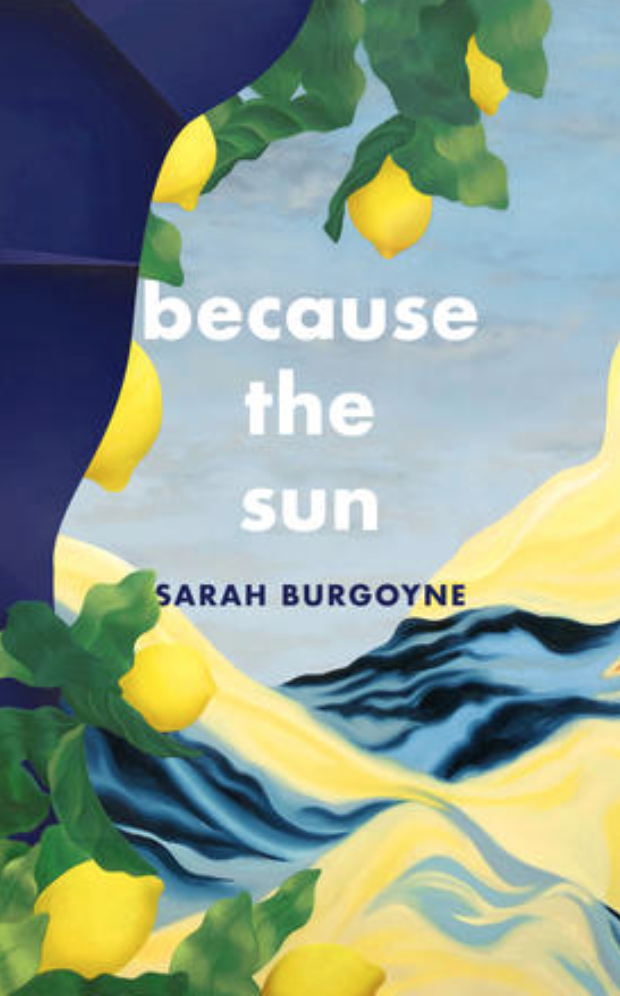
SARAH BURGOYNE: Sadly, it snowed today! A friend of mine emailed me describing it as an April Fool’s Day joke, since it has been unseasonably (which always means ‘unreasonably’) warm lately. I’m sorry to hear you had a rainy time in Montreal--it’s normally not a rainy city, like Vancouver, where I’m from.
VKN: What was it like growing up in Vancouver? Is it the birth home of your poetry?
SB: I was born in Vancouver, but I left when I was four years old. Or, my parents left and took me along. I grew up in Langley, in the suburbs I guess, but suburbs adjacent to massive, gorgeous cranberry fields, so very close to farms. But I was on a track team so I feel like I grew up in the Suburbs. Langley is the birth home of my poetry--a writing class I took in high school where we were asked to write one hundred poems in one month, as an assignment. I remember having written forty-nine the day before the due date and asking the teacher if I was doomed. He said I had probably written more than anyone else, so it was fine. I think being forced to immerse myself so completely in poetry piqued my interest. But because all the poetry I had been learning in English class was nineteenth-century work, there were a lot of “thees” and “thous” in my work. I still try to pop in a “thee” every now and then…
VKN: For nostalgic sake, I assume. 49 is still a lot! I love rain. I didn’t mind it. I mentioned the weather because the title of your collection is very weather oriented or rather solarly “accusatory” - if that is the right word -- due to the conjunction of “because” - often a title doesn’t offer itself or open itself for reason or elucidation. The content of this book’s unraveling is structured/outlined by a quote you pulled from Camus: ‘I count. I say: one, the sea; two, the sky (ah, how beautiful it is); three women; four, flowers (ah, how happy I am).’ Can you share with us the intentions behind the omission of the content in parentheses? Are beauty and happiness not a part of Camus’ sun? Did you want them implied?
SB: These are great questions, first of all. And I want to say that “solarly-accusatory” is an excellent description of the title. It’s actually the reason Meursault gives in l’Etranger during his trial for having shot the man on the beach: “c’était à cause du soleil.” Not the most convincing excuse… but every time the sun is at that low angle and burning right into my eyes I think of that scene. As for the beauty and happiness--yes--I believe they are very much part of Camus’ sun. The reason I scoured his notebooks was because I knew he must be obsessed with the sun, and even though it isn’t always written about in conjunction with beauty and happiness, (at one point he talks about ‘the real climate of tragedy’ being not the night but ‘the heat on the quays’), one doesn’t usually obsess over something unless one is somewhat in love with it…
VKN: I read l’Etranger maybe twenty years ago - I still recalled the sun pulling the trigger - or “having been accused of pulling the trigger” - squinting having hands - & I remember Meursault in prison - with the priest at the end. Did you want your collection to have the same heliotropic/existential effect for the reader as the sun to Meursault? Say for instance, “Because of Sarah Burgoyne’s Because the Sun that I fell into a well ( three stories below) or plucked five roses from my neighbor’s garden. What did you want the reader(s) to be properly (if there is such a thing) accused of upon reading your work?
SB: I would be honoured if my book became an excuse for certain subversive acts (hopefully not falling into a well since that sounds very painful), but what interested me about the sun in this case was that it precisely was not the sun that caused Meursault to pull the trigger, and yet it also was. It felt symbolic of what I call “ambient violence” or circumstances around us causing us so much pain that we redirect it (unfairly) at others.
I would be honoured if my book became an excuse for certain subversive acts (hopefully not falling into a well since that sounds very painful), but what interested me about the sun in this case was that it precisely was not the sun that caused Meursault to pull the trigger, and yet it also was.
VKN: In the notes section of your collection, you wrote, “What is it that moves Louise to pull the trigger on Thelma’s assailant after Thelma is safe? In both cases, the sun is a material symbol of pain.” And, I keep on revisiting this thought logic and I wonder what you meant by “material symbol of pain.” What kind of pain is that? What kind of material is the sun on the moral ethics of its human customer? I also thought perhaps Louise pulled the trigger because Thelma’s assailant has become the escapable sun: violent, blinding, forcing Louise to squint, leaving her body to chance, and when chance has been given permission to be at the right place at the right time - the consequence is inevitable: she pulls the trigger - something in her has been wanting to do this for a long time now.
Just as Meursault has been, I assume (also), wanting to as well. I also think about the arrival of death on a particular species’ soul. Is the sun a way of managing that delay? And, why the pain? When the sun, one of the designated marker of time, tells everything arbitrary that its purpose has arrived?
SB: You’re right when you say the sun is the “marker of time.” As the “marker of time” it is involved in our every action and also we can project everything we want to onto the sun. When I write that the sun is a “material symbol of pain” I am thinking of how the sun appears in Thelma & Louise and also l’Étranger. I was fascinated by the genre “film soleil” when I wrote the book, which is like film noir but all of the devastating events take place under the midday sun instead of at night through the Venetian blinds, and so when I speak of the sun as a symbol I am thinking also of the particular authors of these works, Callie Khouri and Camus, respectively, and how they perceived the sun or how it became a character in their artworks.
Growing up, to go back to your earlier question about Vancouver, in a very temperate climate, my experience with the sun had been much more mild. I rarely experienced its incredible heat. So, you’re absolutely right when you say Louise had wanted to pull the trigger for a long time, and Meursault also. For Louise, she had been harbouring so much pain and saw her own assault in Thelma’s--like Thelma’s assault was the symbolic moment for Louise. But after that moment the sun reigns in the film; it’s the constant reminder that they’re under pressure and maybe doomed.
For Meursault, the sun pushed him over the edge, so he says. So in these cases, I think of the sun as an eye… this ultimate image of relentless oppression (as in hot, hot heat) but also this watcher who sort of soaks up the affect of the characters, who are negative images of us who experience pain (relentlessly) every day.
VKN: When I think of automatic - I think of violence. Do you often do automatic writing? To give a textual voice to your poetry? Do you, from time to time, think automatic writing is a type of ritual carried out by a poet at a shooting range? & the poet just locks in her ammunitions of word & let the current of bullets ride towards a ubiquitous target?
Do you, from time to time, think automatic writing is a type of ritual carried out by a poet at a shooting range? & the poet just locks in her ammunitions of word & let the current of bullets ride towards a ubiquitous target?
SB: I love this question. I absolutely cannot write without automatic writing. One of my earliest poetry mentors, Tim Lilburn, called this exercise “emptying the hands.” The way you phrase the question makes me realize how many bullets are actually packed into our hands, without us even knowing. Automatic writing brings them out. Sadly, not every shot is on target (I’ve never felt the impulse to burn my writing as intensely as when I do a burst of automatic writing), but for me it’s a necessary practice to keep afield or just ahead of that pesky, judgmental editing mind who’s galloping at our heels.
VKN: If one of your poems has to sit (be pinched) on a clothes hanger or perch like a bird on an electrical wire, which poem from this collection would you choose? To dry overnight or rest before taking flight again?
SB: “A bird on a wire” makes me think of Leonard Cohen, a fellow Montreal poet. My poem that is a bird on a wire, or as he would say is a “drunk in a midnight choir” is called “What You Have.” I wonder if you also have a poem that you like more than the others you have written but doesn’t happen to be the most popular one? This is that poem for me. It was originally called “How Do You Like What You Have”. To me this is the most important poem in the collection, and I’d like it to hang on everyone’s clotheslines. I want it to be the alien that invites you to its ship.
VKN: I hope it rains profusely overnight so they stay longer on the clothesline - making ambient noises nocturnally. It goes without saying that sound is important in poetry, but your work pays more exquisite lucid attention to the word “sound” - is sound a type of “ambient violence” you desire? You wrote “like every person become sound: (p.14). Assuming that you are a person, what is the sound of Sarah Burgoyne’s existence? Are you a needle falling into a pile of cotton? Are you a “bruised foot” or a “bargain” or “some empty bottles”? What do you think is the function of poetry in a place surrounded by the sound of pain and violence?
SB: A word that sparked this book was “relentlessness” which is the feeling of oppressive heat, of harassment, and also of incessant noise, and in the book I tried to translate “relentlessness” into sound, particularly in the final section “Four, Flowers” which doesn’t let the reader breathe very much. The sound of my existence...hmm...this is an excellent question. I first thought of how a friend of mine describes the music I like as “kitten yodel,” but that’s not quite it. I think dogs and dogs barking show up a lot in my work in general, but not like hostile dog barking, like the dog in a far-off field barking at dusk--do you know that dog? It makes me think of Juliana Spahr’s description of the function of poetry in the context of protest: at a protest she was at, there were dogs barking alongside the people who had gathered. She described what those dogs were doing at the protest as what poetry can do.
VKN: When I first read your line “the number six woke me up from a feeling” (pg.18) – I had imagined a small child or rabbit hovering near your bed, shaking you lightly. If poetry can wake one up out of bed or for a protest and the number 6 woke you, did number 5 and 4 fail to have the same effect? Is there a significantness to that particular number? Or can it be as purposefully arbitrary as someone being murdered by the sun’s overwhelming potency?
SB: I like to think about numbers a lot and how they are such a big part of our everyday lives so much so that we forget that they are just numbers. When I think about money, I often wonder how strange it is that dollars are just numbers and you only have so many of them at a given time. “That will cost twenty-five numbers, please.” Same with time.
When I wrote the line you mention about the number 6 waking me up, I was thinking of my alarm clock, which went off at 6AM the day I wrote that poem. Or maybe I had just woken up and it happened to be 6 on the dot. I was struggling a lot with insomnia during the writing of this book and oddly I happened to wake up at very precise (frequent) numbers. I was defamiliarizing time because it feels strange (in my world and of course in the world of the insomniac) to have numbers doing or not doing all this stuff for you and having such high stakes yet they’re just little numbers.
VKN: Do you have a favorite number?
SB: I’ve always had a fondness for number 2.
VKN: Why is that?
SB: I like the way it looks as a word: “two” is adorable to me. I am the second child of my parents. I think a lot about twins and doubles. I like that it has a couple aliases in English (“to” and “too”). I like that in French it’s a sign of familiarity: “tu.” I’ve always just kind of liked it.
VKN: 2 looks like a swan to me - it’s not my favorite number in the world - but I can see how its hookedness can hook someone into its efficient world. Has the first child of your parents read your collection yet? Do you have a compelling relationship with your parents’ first child? Have your parents read your work?
SB: What’s your favourite number?
VKN: 3, 6, and 9. They are all the same - I see it as one number.
SB: Because they stack into each other like Russian dolls?
VKN: No - like one is beside the other and other – like linear translucency. I also like geometry.
SB: I love geometry. And circle theorems. As for my sister, I wish we had a compelling relationship. I wrote a poem for her in my first collection, “The Unhad Backyard,” but I’m not sure she read it. My parents have read my first book, but they haven’t had the chance to read Because the Sun yet.
VKN: Well, what is your favorite geometric shape then? How come it is not compelling? May I assume that the circle is your favorite shape? Given that section three in your collection is very solarly imbued? Is that the right word? While visual poetry can act as both a catalyst and vehicle, I think poetry can be extraordinarily potent if one uses negative space well in poetry - where the absence of word/sound - where form and content join forces on the page to dictate and command the vector of a poem’s ontological identity - I believe section 3 of this collection reflects this paradigm well.
I see in that section - the violent nature of the sun, the nature of Harlan’s violence - The black and white sun alternating between darkness and light -gives me these meta triptyched feeling (the readers and for Thelma and Louise too) - that these alternating solar erasures depict the absence and also presence of bullets - these exit wounds - these unspoken bullet wounds born from assault. Given that this collection is so methodically and tightly edited, designed, and structured, I want to ask about your relationship with synchronicity - did you see this collection’s content before you see its form - which arrives first? Or, like an epiphany - they all arrive together at this party called Because the Sun because you sent the invitation ahead of time or planned this party for so many years.
SB: In my writing, I feel like form and content need to arrive together, or are never separate, like your 3, 6 and 9. I’ve tried taking the “content” of a poem and pouring it into a new shape and it just gets ruined...like an aspic that doesn’t set and so can no longer be called an aspic but is more like a pile of sad organs. So I’ve learned my lesson a few times over on that point. This connects to geometry, but I also just love shapes and the visual aspect of poetry. I’m glad you saw both the sun and the bullet holes in the Thelma & Louise section… the black and white circles, in my mind, are meant to be both.
Lisa Robertson, who was around during the genesis of this project but then also ended up editing the collection, gave me the idea of putting a little blank square in the centre of the prose poems, which cause the poems to sort of glitch out when you read them. I decided a circle would be better for the reasons you mentioned. And also, in the film, the movement from night to scorching day where the sun is at its peak happens right after Thelma’s assault and Harlan is shot and, to me, this connects with Camus’ observation about ‘the real climate of tragedy’ — we had moved from the night, which is often a dangerous time for women, to the day, in which the real tragedy unfolded, which was that the legal system could not protect Thelma or Louise, despite their being victims, which renders Thelma and Louise’s violated bodies like negative images from which thousands of positive copies can and would emerge. This is also where Sara Ahmed comes in.
In The Cultural Politics of Emotion she writes, “Hate has effects on the bodies of those who are made into its objects,” and “we cannot assume we know in advance what it feels like to be the object of hate.” Louise shoots Harlan after Thelma is safe (the final dark bullet hole in part three of my book), and we come to understand later that Louise was also a rape victim and her own private pain surfaced at that fatal moment. Because the legal system cannot recognize this—a wound that is invisible (Louise’s) as opposed to a wound that is visible (Harlan’s corpse)--they had to go on the run. The circle was my favourite shape for this book, but I’m not sure it’s my favourite shape in the world...though I tend to like the shapes that have equal sides. They please me. As for my sister… that’s a Gretchenfrage I dare not answer! Not here anyway. But it has to do with unequal sides, maybe.
VKN: Your section 1 and 2 and 4 - the poetry in those sections are more abstract - in the way their worlds unravel - their words have more volition to take momentum. Yet, section 3 - the most violent section of your collection - is more controlled, guided by a plot, and more supervised by a precise vision. They move quite organically in and out of each other - complementing each other’s antipodic impulses - is this section the hardest section for you to write? While it can be self-evident that a “camera” becomes the third eye for a film or the meta-angle of a film, what is the “camera” like equivalent for poetry do you think, Sarah?
SB: I actually started writing the Thelma & Louise section not as a section of this book at first but as a totally separate project. I watched the film for the first time in 2016, and then decided it’d be funny if I just wrote out everything that happens. (I tried this out first for a French film called Plein Soleil but it never made it into the manuscript). I meant it sort of as a joke at first, like the Borges character Pierre Menard who decides he’s going to write Don Quixote exactly as it is already written. I love that story. I think because I was having fun with it, it was the easiest part to write.
Even though it ends when Harlan is shot in Because the Sun, I actually wrote out much more of the film. It took forever and had become a physical exercise more than anything by the time I stopped--once it took me an hour to write out thirty seconds of the film. What is the camera equivalent for poetry… what is the third eye of the poem…? For me, I think it’s that odd thing about poetry seeming closer to non-fiction than to fiction. Whether we like it or not the poem is haunted by the author, I’d like to say more readily than in fiction, but I could be wrong. Maybe it’s what Celan was getting at in his speech “The Meridian”--the poem is always in transit… it’s always moving away from you toward some other. I think that this ghostliness is the “invisible camera” in the poem or the mechanism at work that’s moving our consciousness around.
For me, I think it’s that odd thing about poetry seeming closer to non-fiction than to fiction. Whether we like it or not the poem is haunted by the author, I’d like to say more readily than in fiction, but I could be wrong.
VKN: By capturing something that is still moving - which is what poetry can do - the third eye also shifts with it - in motion - cannot be pinned down when it is still moving.
SB: Yes. “The poem is lonely. It is lonely and en route. Its author stays with it.” That’s what Celan said. I’m equating the camera with the author in this case.
VKN: Yes. Well, Garielle Lutz did say that “The sentence is a lonely place to be.” So, it’s quite reasonable that a poem is lonely too | https://believermag.com/the-sentence-is-a-lonely-place/
SB: Do you find?
VKN: Do I find?
SB: Do you find the sentence a lonely place to be?
VKN: No, I don’t. Humans are though. Sentences, generally, are very social creatures. They are nomadic and live in strange residencies - mostly squared and boring - but they are not lonely creatures.
SB: How about the poem?
VKN: The poem - well - that is harder to define the spectrum of its loneliness or its destitution. The poem is complicated. What about you? Do you think a sentence is a lonely place to be?
SB: I agree with you--a sentence I find to be a sort of jubilant place to be, often. And if it isn’t, I feel that it has become a poem by accident. Not that poems can’t be jubilant, but there’s that sort of “clunk-feeling” when you accidentally stumble across a poem and fall into its three-story well. I remember coming across a line in a student’s paper once that I don’t think she meant to be a poem but it was one. She wrote: “What has happened will always remain happened.” I fell into the well of that sentence-poem.
A sentence I find to be a sort of jubilant place to be, often. And if it isn’t, I feel that it has become a poem by accident.
VKN: Ah, I like that very much! Your student suddenly becomes a poet.
SB: Yes. I always thought of her after that as the “wise student” though I don’t think she was particularly invested in the class...
VKN: There is one of many lines, I love, from your collection that is an antidote to loneliness ( for a poem or a for a sentence) - From page 46 of your titled “THE SUN’S CITIZENS ARE SOLAR NOTES” - and it’s this line “sun-lung, my tea is cold” - I don’t know why I find that line so compelling. One of my favorite questions to ask a poet is if they are willing to break down one of their poems for us/readers. Where were you when you wrote that poem? What was your state of mind? I also love this line “be serious/ hand me a beer” - perhaps I did not expect “a beer” to appear as a nocturnal figure in something I feel so diurnal.
SB: You can’t see me but I’m chuckling at that line, because I wrote it as a way to poke fun at myself. How serious can she be?, one might ask…I ask this to myself a lot.
VKN: I mean if Albert Camus wrote ’Etranger and then you reply, “Be serious/hand me a beer.” The juxtaposition of casualness/ nonchalant vernacular -next to existentialism! I feel a beer is most fitting, yes?
SB: Definitely! Humour is really important to me in poetry, and in life too, and I don’t think it dilutes sadness in any way, but can actually work to amplify it, like salting a dish. That poem is a lonely poem, in my view, despite its moments of levity. The title references something I learned while I was writing the book which is that the sun sings--we can’t hear it, but there is a lot of sound happening inside the sun. I find that fact so gorgeous and so lonely.
And-- I don’t think I’ll be able to ‘break down’ the poem but I can hand you some of its flowers— the poem feels a lot like self-talk to me. Not just personal self-talk but self-talk we all engage in. Even the sun is always talking to itself. And we are always arguing with ourselves--chastising ourselves, encouraging ourselves, feeling sorry for ourselves--until that rupture where we break the cycle in search of the new but also as a means of having something to do with our pain—to find a “house to perfume it with sundown.” Something to anoint, so that it wasn’t all for naught. I think the sun does the same thing--has these moments of rupture built from self-talk, and this desire to use imperatives to somehow exorcise these thoughts that endlessly ricochet around in our minds and ultimately aren’t useful (except for lonely poems, it seems).
VKN: I don’t have any green fingers - or green thumb - so I hope these flowers won’t die after I place them in a vase. I hope you walk by sometimes and remember to water them or change them out.
SB: I’m not sure if they are sufficiently bloomed…
VKN: Even neophytal things have a pre-bloomed period before being fully bloomed - though this is not a measurement - this sentence- of their maturation. Is there a page from your collection that you wish for close inspection? It’s hard with a full-length - I always feel with an interview - a question or two or ten moves like stones skipping across water - not fully diving into its infinite depths. Is there a page or clusters of pages that you wish that I toss such stone and it lands more deeply - instead of skimming its surface?
SB: Well, I feel like I handed you a wilted flower in response to your last question so maybe I should give “breaking it down” another go.
VKN: It’s not wilted. For sure. Let me try to remember my other questions - I lost my footings very early on in this interview and am still trying to find my shoes.
SB: I think it’s more that the question of breaking down a poem makes me afraid, for some reason. Not because I do not want to —
VKN: Why are you afraid of?
SB: I think it’s a combination of a few things. There’s a Gretchenfrage element (which is that it feels personal and it makes me sad to think back on the context of this poem), and also a fear of forcing it into a shape the poem might not want to take, like capturing it in a photograph while it is running, which I read of recently as giving something a “flat death” (though I think this term is also kind of funny, more road-kill adjacent than photography adjacent). But I also know there’s a way for me to break down the poem and have it open up as opposed to shutting down. I feel like I’m feeling the bookcase for the secret book I have to pull so that it becomes a door through which I can enter and have you follow me.
VKN: Can one be cryptic and also vulnerable? Or is it like water and oil - where they cannot be mixed?
SB: Yes--I think one can. I think the little word that opens the poem, for me, might be the word “amount.” Amount, not as a noun, but as a command. Why can’t some experiences amount to something? Or, the desire for what feels like something that was uselessly violent that happened to you can’t amount to something spiritual or profound or transcendent. Why do some things just plain suck, and not really amount to anything? You know? It questions the fantasy of hardship as something that makes us wiser or stronger or more worldly not… coming to fruition. Not amounting. So there’s this voice in our heart yelling amount, amount, amount! Maybe this is also what it feels like to be a poet every time you sit down to write. I think this is also what Louise felt.
So there’s this voice in our heart yelling amount, amount, amount! Maybe this is also what it feels like to be a poet every time you sit down to write
VKN: I see so many mountains in that word “amount” - just the mere existence of something being fruitless feels fruitful somehow. Perhaps it’s futile to nail a butterfly to a branch with three or two splotches of ink - but if futility is a fruit one grows by sitting - I like the idea of something spilling over - even if it is not ripe or never designed to be ripe.
SB: I love that idea.
VKN: Well, Sarah, we barely scratch the surface of your collection. Not that my lungs are tea-cold or too old to clarify the sound of your work, but I think a lot about the readers - as they work through your collection - as they find their way to your work - or on their way to finding your work or your voice - on their table or kitchen sink - where the sun may or may not reside - & they are taking a break - to come to this ravine/lake/river of this interview - I want them to walk into something they have not yet discovered within themselves - I don’t want them to just linger were “the two owls with their backs turned” - I want them to go a bit blind or deaf - from the sun’s soprano voice - but, you, what do you want the readers to do?
SB: On the contrary, I feel like there is more than a scratched surface here… you held a magnifying glass between the sun and the book and somehow its very core has started to smoke, speaking of fruitful. I definitely want the readers to feel that ‘relentlessness’ I was talking about earlier, or at least invite that relentlessness to tea and not be frightened by it, and also I want them to “ferry along in the light” at the bottom of its pool.
One of my favourite things about the sun is what it does to pools or any bodies of water at particular angles, and makes these wild electric-looking light shows of it, known as “caustics.” I want people to notice those patterns also. Like what you were saying earlier about Camus’s sun — it’s the antagonist but it is also the lover or the beloved, rather. There’s beauty in the things that ultimately do not “amount” or become a mount, be it a mountain to gaze at or a horse to ride off on, because they connect us to each other if we let them.
Sarah Burgoyne is an experimental poet. Her second collection, Because the Sun, which thinks with and against Camus’ extensive notebooks and the iconic outlaw film Thelma & Louise, was published with Coach House Books in April 2021. Her first collection Saint Twin (Mansfield: 2016) was a finalist for the A.M. Klein Prize in Poetry (2016), awarded a prize from l'Académie de la vie littéraire (2017), and shortlisted for a Canadian ReLit Award. Other works have appeared in journals across Canada and the U.S., have been featured in scores by American composer J.P. Merz and have appeared with or alongside the visual art of Susanna Barlow, Jamie Macaulay, and Joani Tremblay. She currently lives and writes in Montreal.