• Home
  • indulge
  • new poetry
    • About Luna Luna
    • resources
    • search
  • editor
  • dark hour
  • submit
Menu

luna luna magazine

  • Home
  • indulge
  • new poetry
  • About
    • About Luna Luna
    • resources
    • search
  • editor
  • dark hour
  • submit
delicious new poetry
'the doors of the night open' — poetry by Juan Armando Rojas (translated by Paula J. Lambert)
Nov 29, 2025
'the doors of the night open' — poetry by Juan Armando Rojas (translated by Paula J. Lambert)
Nov 29, 2025
Nov 29, 2025
'we can be forlorn women' — poetry by Stevie Belchak
Nov 29, 2025
'we can be forlorn women' — poetry by Stevie Belchak
Nov 29, 2025
Nov 29, 2025
'I do whatever the light tells me to' — poetry by Catherine Bai
Nov 29, 2025
'I do whatever the light tells me to' — poetry by Catherine Bai
Nov 29, 2025
Nov 29, 2025
‘to kill bodice and give sacrament’ — poetry By Kale Hensley
Nov 29, 2025
‘to kill bodice and give sacrament’ — poetry By Kale Hensley
Nov 29, 2025
Nov 29, 2025
'Venetian draped in goatskin' — poetry by Natalie Mariko
Nov 29, 2025
'Venetian draped in goatskin' — poetry by Natalie Mariko
Nov 29, 2025
Nov 29, 2025
'the long sorrow of the color red' — centos by Patrice Boyer Claeys
Nov 28, 2025
'the long sorrow of the color red' — centos by Patrice Boyer Claeys
Nov 28, 2025
Nov 28, 2025
'Flowers are the offspring of longing' — poetry by Ellen Kombiyil
Nov 28, 2025
'Flowers are the offspring of longing' — poetry by Ellen Kombiyil
Nov 28, 2025
Nov 28, 2025
'punish or repent' — poetry by Chris McCreary
Nov 28, 2025
'punish or repent' — poetry by Chris McCreary
Nov 28, 2025
Nov 28, 2025
'long, dangerous grasses' — poetry by Jessica Purdy
Nov 28, 2025
'long, dangerous grasses' — poetry by Jessica Purdy
Nov 28, 2025
Nov 28, 2025
'gifting nighttime honey' — poetry by Nathan Hassall
Nov 28, 2025
'gifting nighttime honey' — poetry by Nathan Hassall
Nov 28, 2025
Nov 28, 2025
'A theory of pauses' — poetry by Jeanne Morel and Anthony Warnke
Nov 28, 2025
'A theory of pauses' — poetry by Jeanne Morel and Anthony Warnke
Nov 28, 2025
Nov 28, 2025
'into the voluminous abyss' — poetry by D.J. Huppatz
Nov 28, 2025
'into the voluminous abyss' — poetry by D.J. Huppatz
Nov 28, 2025
Nov 28, 2025
'an animal within an animal' — a poem by Carolee Bennett
Nov 28, 2025
'an animal within an animal' — a poem by Carolee Bennett
Nov 28, 2025
Nov 28, 2025
‘in the glitter-open black' — poetry by Fox Henry Frazier
Oct 31, 2025
‘in the glitter-open black' — poetry by Fox Henry Frazier
Oct 31, 2025
Oct 31, 2025
'poet as tarantula,  poem as waste' — poetry by  Ewen Glass
Oct 31, 2025
'poet as tarantula, poem as waste' — poetry by Ewen Glass
Oct 31, 2025
Oct 31, 2025
'my god wearing a body' — poetry by Tom Nutting
Oct 31, 2025
'my god wearing a body' — poetry by Tom Nutting
Oct 31, 2025
Oct 31, 2025
'Hours rot away in regalia' — poetry by Stephanie Chang
Oct 31, 2025
'Hours rot away in regalia' — poetry by Stephanie Chang
Oct 31, 2025
Oct 31, 2025
'down down down the hall of mirrors' — poetry by Ronnie K. Stephens
Oct 31, 2025
'down down down the hall of mirrors' — poetry by Ronnie K. Stephens
Oct 31, 2025
Oct 31, 2025
'Grew appendages, clawed towards light' — poetry by Lucie Brooks
Oct 31, 2025
'Grew appendages, clawed towards light' — poetry by Lucie Brooks
Oct 31, 2025
Oct 31, 2025
'do not be afraid' — poetry by Maia Decker
Oct 31, 2025
'do not be afraid' — poetry by Maia Decker
Oct 31, 2025
Oct 31, 2025
'The darkened bedroom' — poetry by Jessica Purdy
Oct 31, 2025
'The darkened bedroom' — poetry by Jessica Purdy
Oct 31, 2025
Oct 31, 2025
'I am the body that I am under' — poetry by Jennifer MacBain-Stephens
Oct 31, 2025
'I am the body that I am under' — poetry by Jennifer MacBain-Stephens
Oct 31, 2025
Oct 31, 2025
goddess energy.jpg
Oct 26, 2025
'Hotter than gluttony' — poetry by Anne-Adele Wight
Oct 26, 2025
Oct 26, 2025
'As though from Babel' — poetry by Fox Henry Frazier
Oct 26, 2025
'As though from Babel' — poetry by Fox Henry Frazier
Oct 26, 2025
Oct 26, 2025
'See my wants' — poetry by Aaliyah Anderson
Oct 26, 2025
'See my wants' — poetry by Aaliyah Anderson
Oct 26, 2025
Oct 26, 2025
'black viper dangling a golden fruit' — poetry by Nova Glyn
Oct 26, 2025
'black viper dangling a golden fruit' — poetry by Nova Glyn
Oct 26, 2025
Oct 26, 2025
'It would be unfair to touch you' — poetry by grace (ge) gilbert
Oct 26, 2025
'It would be unfair to touch you' — poetry by grace (ge) gilbert
Oct 26, 2025
Oct 26, 2025
'Praying in retrograde' — poetry by Courtney Leigh
Oct 26, 2025
'Praying in retrograde' — poetry by Courtney Leigh
Oct 26, 2025
Oct 26, 2025
'To not want is death' — poetry by Letitia Trent
Oct 26, 2025
'To not want is death' — poetry by Letitia Trent
Oct 26, 2025
Oct 26, 2025
'Our wildness the eternal now' — poetry by Hannah Levy
Oct 26, 2025
'Our wildness the eternal now' — poetry by Hannah Levy
Oct 26, 2025
Oct 26, 2025

Poetry by Danielle Rose

July 23, 2019

BY DANIELLE ROSE

Variations on Drawing Down the Moon


it is about drawing things in. i want

to be tree-roots / & lightning

striking an open field.

how first i open myself like the face

of the moon / so that i become

the face of the moon.

& into me flows the face of the moon.

goddess / descend into me

through me into the earth.

it is about remaining open like how

i want to be tree-roots / to hold

you both hopeful & ashamed

that i may be unfaithful / i imagine

that i am tree leaves & they

drink in the moonlight

& into me flows the hungry moon.

goddess / projection / demon 

whatever just enter me now.

this is how you drink

divinity / & perhaps why 

tides swell. in both there is dancing.

arms toward the sky / you drink god

then she seeps out again.

this must be how

we can bear to be so empty / so

we can be so full / so we can be tree-root

drawing ourselves into the moon.

On Dancing


these are the skills i never quite understood / the idea of celebration 

like a trip to the dentist / i understand how out of place i am 

awkward everything elbows & shoulders / awful at blowing out candles 

& my wishes were just beads of sweat a sudden dampness 

a stumble / because this was how i was taught to dance 

to step on others’ toes / but i am not awaiting extradition

i am learning how to belong to where i am / because this is the way a sewing needle 

becomes a sword / & how i stitch together myself a dance 


Danielle Rose lives in Massachusetts with her partner and their two cats. She is the managing editor of Dovecote Magazine and used to be a boy.

In Poetry & Prose Tags DANIELLE ROSE, poetry
1 Comment
marble pink gold

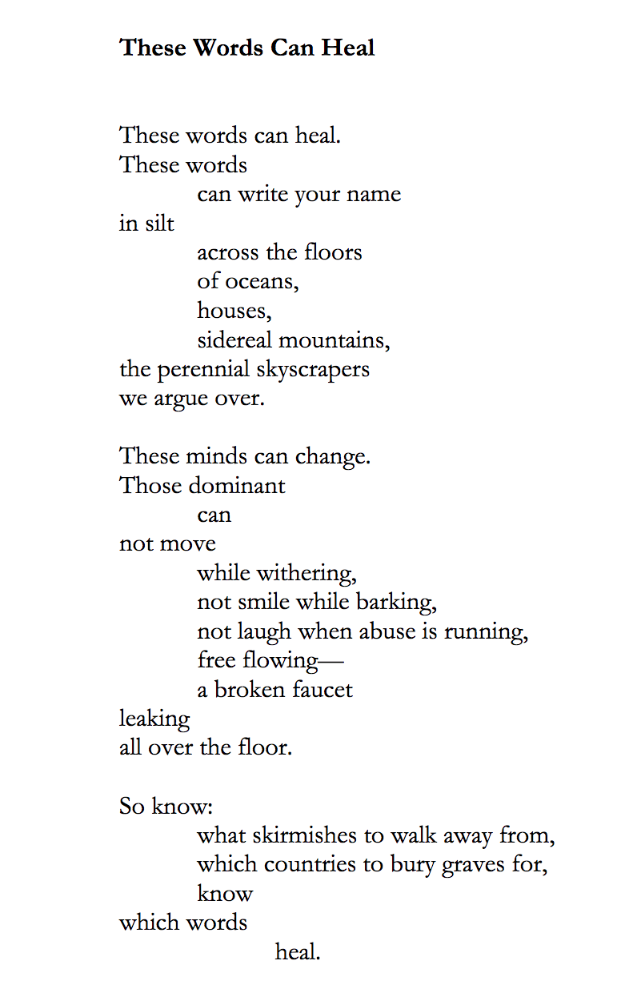
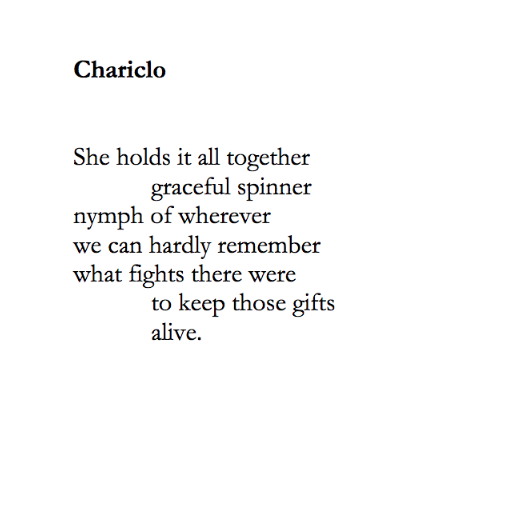
Poetry by Laura Paul

July 23, 2019

BY LAURA PAUL

LAURA PAUL POEM
Screen Shot 2019-07-23 at 4.16.11 PM.png

Laura Paul is a writer living in Los Angeles. Previously, her work has been published by the Brooklyn Rail, Coffin Bell Journal, Entropy Magazine, FIVE:2:ONE, Shirley Magazine, Soft Cartel, Touring Bird, and featured at the West Hollywood Book Fair and Los Angeles Zine Fair. She is the author of Entropy's monthly astrology column, Stars to Stories, and since June 2018 she's been filming a weekly video series of her poetry at poemvideo.com. She was raised in Sacramento, earned her B.A. from the University of Washington, Seattle, and her Master's from UCLA where she was the recipient of the 2011 Gilbert Cates Fellowship. She can be found on Twitter and Instagram as @laura_n_paul.

In Poetry & Prose Tags Poetry, Laura Paul
Comment
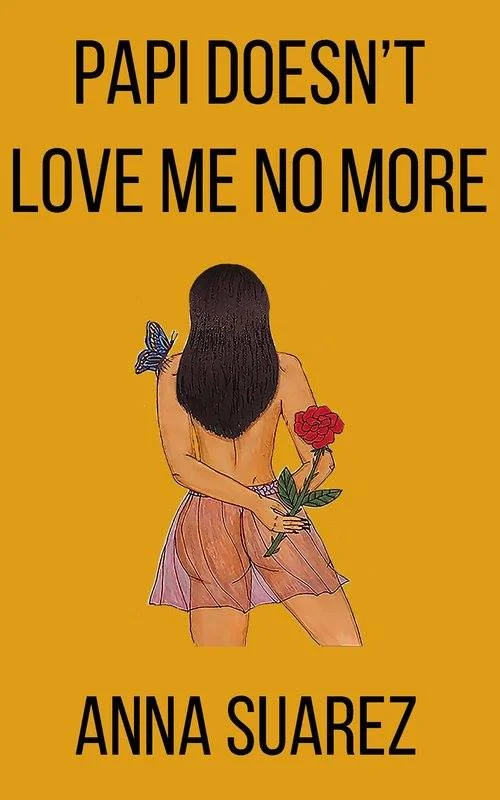
Papi Doesn't Love Me No More.jpg

Review of Anna Suarez's 'Papi Doesn't Love Me No More'

July 9, 2019

While the bruise of men is present in these poems, there are great alliances with women, “Sister says I touch/ and I destroy. ” The aspect of doubling is in this poetry, but women aren’t harmed by their doubles, rather, they feed of each other’s prowess. The twinning of the speaker’s self adds to the labyrinthine structure of the book, so though you encounter a new scene is each hole and crevice, there is still that familiar ache of letting go and the hope of regeneration.  

Read More
In Art, Poetry & Prose Tags poetry, queer, Latinx, insectional feminism, Review
Comment

3 Poems You Need to Read This Month

June 26, 2019

Joanna C. Valente is a human who lives in Brooklyn, New York. They are the author of Sirs & Madams, The Gods Are Dead, Marys of the Sea, Sexting Ghosts, Xenos, No(body) (forthcoming, Madhouse Press, 2019), and is the editor of A Shadow Map: Writing by Survivors of Sexual Assault. They received their MFA in writing at Sarah Lawrence College. Joanna is the founder of Yes Poetry and the senior managing editor for Luna Luna Magazine. Some of their writing has appeared in The Rumpus, Them, Brooklyn Magazine, BUST, and elsewhere. Joanna also leads workshops at Brooklyn Poets. joannavalente.com / Twitter: @joannasaid / IG: joannacvalente / FB: joannacvalente


Read More
In Poetry & Prose Tags poetry, Tiana Clark, xandria phillips, constantine jones
Comment
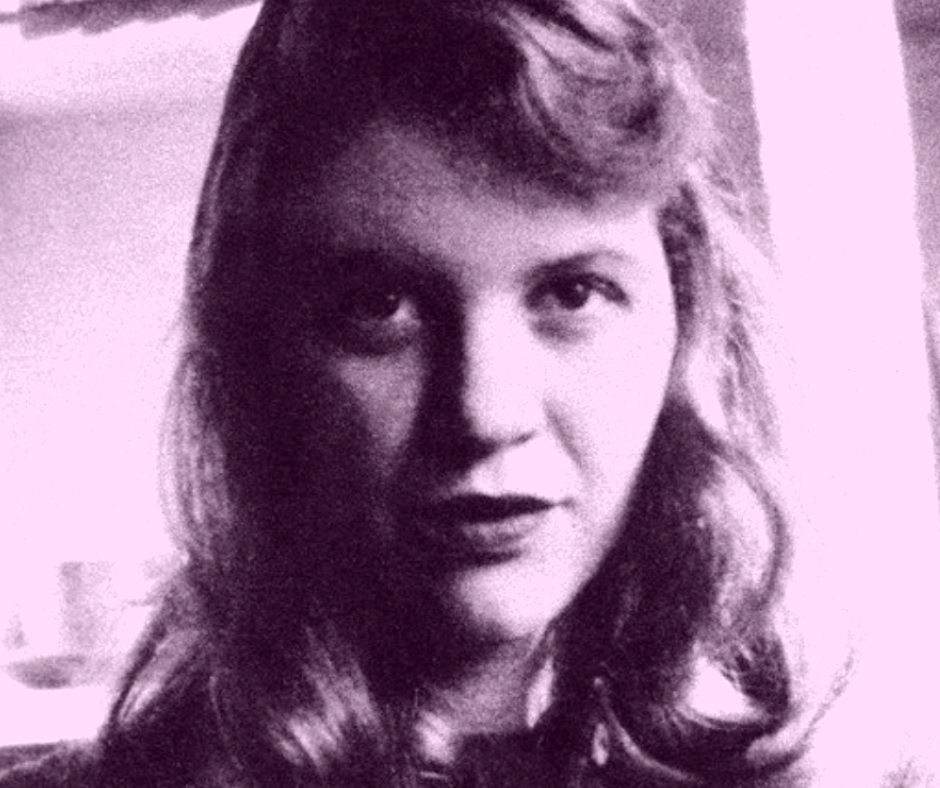
SYLVIA PLATH

Wearing Sylvia Plath’s Lipstick 

June 20, 2019

BY PATRICIA GRISAFI

The dutifully hip girl behind the register at the Chelsea Urban Outfitters was sporting a ravishing shade of reddish, hot pinkish lipstick. 

“That’s a great color,” I said. “Who makes it?” 

“It’s by Revlon. The color is called Cherries in the Snow. You really can’t forget that name, can you?” 

I stopped by Duane Reade on the way home and picked up a tube, knowing full well that the lipstick would end up in the heart-shaped box in the closet where all my other lipsticks went to die. 

You know how some women wear lipstick every day as a matter of routine? They can apply a perfect lip while riding a bike, walking a tightrope, or herding ten unruly toddlers. I’m not talking about beige-y pinks or fleshy nudes, but serious, bright, punch-you-in-the-face colors. 

I’m not one of those women. 

Time and time again I’ve proven incompetent at the simple task of applying a lipstick that isn’t the color of my lip; usually, I look like someone’s grandmother in Fort Lauderdale on her fifth Valium and third Mai Tai. Still, every few months, I’ll give a new color a whirl only to frown in the mirror and return to my trusty mess-proof staple since the 90s: Clinique Black Honey. 

Would Cherries in the Snow convert me? 

I stood in front of the bathroom mirror and carefully drew on a bright, pinkish-red grin. Then I fussed a bit, cleaning up the lines with a Q-tip and some concealer. I cocked my head to the side, bared my teeth like a hyena. I imagined myself tooling around the East Village in white Birkenstocks and large black sunglasses, with a bouquet of bodega peonies in one hand and a coffee in the other. I’d give a breezy, hot pink smile and everyone would think I was quirky and chic. 

By the end of the week, Cherries in the Snow was in the heart-shaped graveyard of lipsticks past. 

The next time I heard of Cherries in the Snow was in a book. Pain, Parties, and Work by Elizabeth Winder details poet Sylvia Plath’s harrowing experience as a guest editor for Mademoiselle in the summer of 1953. Readers will recognize many of the events Plath writes about in The Bell Jar as based on the details of that summer: getting food poisoning, figuring out fashion, suffering from depression. 

There’s one mundane detail that Plath doesn’t include in The Bell Jar: her preferred lipstick: “She wore Revlon’s Cherries in the Snow lipstick on her very full lips,” Winder writers. 

I thought I knew an absurd amount about Sylvia Plath. As one of my earliest and long-standing loves, I’ve read and re-read her poems and fiction, written about her work in my Doctoral thesis, visited her homes in both Massachusetts and London, even touched her hair under the careful eyes of the curators at the Lilly Library, Bloomington. But I had missed this small, seemingly insignificant detail. 

Revlon has manufactured Cherries in the Snow for the past sixty two years; it’s known as one of their “classic” shades, along with another popular color, Fire and Ice. It’s a cult item, a relic from another era when most women wore lipstick faithfully (a fun but gross tidbit from Winder’s book: one 1950s survey revealed that 98 percent of women wore lipstick; 96 percent of women brushed their teeth). The color isn’t exactly the same as it was when Plath wore it because of changes in industry practice, but it’s pretty damn close. 

I scrambled for the heart-shaped lipstick box and sat cross-legged in front of it, fishing around for Cherries in the Snow. I held the shiny black tube in my hand like Indiana Jones held the idol in the beginning scenes of Raiders of the Lost Ark. The lipstick seemed different, changed. Imbued with special meaning. I swiped on a coat, this time imagining how Plath might have applied her makeup, what she might have thought as she looked back in the mirror. Did it change her mood, feel comforting, bestow power? 

People are interested in discovering the mundane habits of their favorite singers, actors, writers, and artists. They might even purchase a product based solely on a celebrity endorsement. I’ve always been interested in finding out what products my favorite dead icons used, as if I can access a part of their lost inner lives by slathering on Erno Laszlo’s Phormula 3-9 (one of Marilyn Monroe’s favorite creams) or spritzing myself with Fracas (Edie Sedgwick’s signature scent). Wearing Cherries in the Snow allowed me to experience a strange intimacy with a writer I admired, even more so than reading the very personal things Plath wrote about — including how satisfying scooping a pesky glob of snot from her nose feels. 

Ultimately, Cherries in the Snow did not become my lipstick, but I gained an appreciation for the shared ritual with and strange connection to Plath that it allowed me to experience. So many of the artists who have influenced our lives are gone; it feels comforting to find a bit of their essence in something as tangible as makeup. 


Patricia Grisafi is a New York City-based freelance writer, editor, and former college professor. She received her PhD in English Literature in 2016. She is currently an Associate Editor at Ravishly. Her work has appeared in Salon, Vice, Bitch, The Rumpus, Bustle, The Establishment, and elsewhere. Her short fiction is published in Tragedy Queens (Clash Books). She is passionate about pit bull rescue, cursed objects, and horror movies.

In Personal Essay, Poetry & Prose Tags SYLVIA PLATH, LIPSTICK, FEMINISM, POETRY
Comment
maxime-amoudruz-99191-unsplash.jpg

Poetry by Denise Jarrott

June 20, 2019

BY DENISE JARROTT

denise jarrott
denise jarrott poetry

Denise Jarrott is the author of a collection of poems called NYMPH (vegetarian alcoholic press) and a chapbook, Nine Elegies (dancing girl press). Her work has appeared in Black Warrior Review, Bombay Gin, The Volta, Poor Claudia, and elsewhere. She was nominated for a 2018 Pushcart Prize and is currently at work on a series of essays in conversation with Roland Barthes' A Lover's Discourse. She lives in Brooklyn.


In Poetry & Prose Tags denise jarrott, poetry
Comment
andy-holmes-734162-unsplash.jpg

The Astrolushes Podcast: Skeptics, Cosmic Lessons, & Authenticity

June 13, 2019

Astrolushes is a podcast at the intersection of astrology and literature, ritual, wellness, pop culture, creativity — and, of course, wine. Expect guests, giveaways, & games — and get ready to go deep with us.

The water-sign hosts are Andi Talarico, poet, book reviewer and Strega (@anditalarico) & Lisa Marie Basile, poet, author of Light Magic for Dark Times, & editor of Luna Luna Magazine (@lisamariebasile + @lunalunamag). You can the astrolushes on Twitter, too, here.

Screen Shot 2019-06-13 at 4.35.28 PM.png Screen Shot 2019-06-13 at 4.35.45 PM.png Screen Shot 2019-06-13 at 4.36.00 PM.png

LISA MARIE BASILE: Let’s chat about the birth of AstroLushes! I think it sort of started on a drive we took to Salem, MA, where we witched out for a weekend and visited HausWitch for my Light Magic for Dark Times writing workshop. In the car, I threw celebrity and literary names at you and had you guess their big 3 signs. You were amazingly on point! I'm wondering, besides having fun with it, what do you personally think the 'use' or 'reason' for this astro-knowledge is? I think people are generally fascinated, but we both know there's more to it.

ANDI TALARICO: That road trip and our time in Salem definitely feels like the genesis of this show! It started with us guessing celebrity's charts and now it's just a part of all of our conversations. I feel like now we're constantly wondering about writers and actors and philosophers through the lens of their astrological placements. It's a fun game but I think it also allows for a possibly deeper understanding of the art and culture that we engage with.

And engagement was how I came to astrology. My mother always read our horoscopes from the paper when I was growing up; she's a mystical Pisces who has visited psychics, believes in prophetic dreams, and finds herself fascinated by the moon. I inherited a lot of my curiosity from her. But by age 12 our household had changed considerably and it became a harder place to exist and grow in. So it's no surprise to me, looking back, why that was the time I started studying astrology.

It was a way of making sense of the world. It also gave me an opportunity to talk to people about themselves (and to keep the focus off of myself.) It made me feel like I had some sort of agency, a voice, a new authority. Now, the language of astrology, to me, is less about telling people about themselves and actually, much like my tarot practice, using the themes and ideas as lessons that we can use to fully become our best, most authentic selves. That's where it crosses over into self-care as well.

How do you feel about people who think astrology is bogus, Lisa?

Astrology…much like tarot practice, uses the themes and ideas as lessons that we can use to fully become our best, most authentic selves. That's where it crosses over into self-care as well. — Andi Talarico

Screen Shot 2019-06-13 at 4.37.11 PM.png

LISA MARIE BASILE: I love that you say it's an engagement with everything around us. And that, as a child, it helped you navigate a very difficult world. It truly is a language we learn and then we speak, and that can bring people together in an instant. And it can help us focus on the many characteristics of ourselves. In my life, processing the trauma I've experienced through the filter of the Scorpio has been amazingly beneficial; I now look on it all as transformative, rather than destructive. 

It's also really interesting to give a name to the various inclinations and motivations for people's art or behaviors. Especially when you look at creative people, or really evil people, and you start seeing how many of them fit into a certain astrological sign, or element. It may not be scientifically proven, but that’s the sort of mystery and liminality that we derive meaning from.

I am a scientific person. I believe that reason, empirical evidence, and research is important. I live with a chronic illness, and I'm a health writer as a day job. It's important to me that information is disseminated accurately, or, say, that the injections I take have been proven both effective and safe, and that sometimes, you need medication over meditation, in order to heal.

At the same time — people need to know there’s more to health and wellness than big pharma. And there’s more to this world than what we can see. I think the zodiac allows us to approach the liminal, the intuitive, the subterranean. It does exist outside of 'objective science' and that's okay. It allows us to dive headfirst into the shadows of this world and our lives, and I think that's the key to the feeling whole — straddling both sides. Science has a place, but so does the esoteric. You can't prove love, but we all feel it. So, it's the same thing. Some things we just explore knowing that it may be obscure. I am grateful to be able to take part in the world from both stances. 

What do you think about how people can use the zodiac as a healing tool, or in daily ritual?

There more to this world than what we can see. I think the zodiac allows us to approach the liminal, the intuitive, the subterranean. It exists outside of 'objective science' and that's okay. It allows us to dive headfirst into the shadows of this world and our lives, and I think that's the key to the feeling whole — straddling both sides. Science has a place, but so does the esoteric. You can't prove love, but we all feel it. — LISA MARIE BASILE

View this post on Instagram

Sunday afternoons at home. 📸 by @michaelsterling

A post shared by Andi Talarico (@anditalarico) on Apr 7, 2019 at 10:18am PDT

ANDI TALARICO: I definitely look through several horoscopes during the morning to see what my day/week might bring me. I mean, the basis of horoscopes are transits, what the movement of the current celestial journey means in my zodiac placements, and I love that about horoscopes — how it's a constant reminder that everything changes, nothing stays still, and how cyclical life can be, for good or bad.

I like to look to the planets/celestial bodies and their assigned western astrological associations for greater personal meeting. Like, what does it mean to be represented, as I am, by the Moon? The Moon shines because it reflects the light that is given to it. I feel the same way, again, for good and bad. I also shine brightest when I'm basking in the the light of stimulating conversation and affection. I turn inward and dark when I'm not given light to work with.

Also, since the Moon transits more often than other bodies, since it's constantly waxing or waning, it serves as a beautiful remind to keep pushing forward, that this moment isn't forever, to enjoy the view and perspective before it changes yet again. It's why I have a little crescent moon tattooed on my finger — my constant reminder that the only constant is change.

How do you feel connected or represented by Pluto, Lisa? Pluto is such a symbolically important planet of creative destruction, I'd love to hear your thoughts on that!

What does it mean to be represented, as I am, by the Moon? The Moon shines because it reflects the light that is given to it. I feel the same way, again, for good and bad. I also shine brightest when I'm basking in the the light of stimulating conversation and affection. I turn inward and dark when I'm not given light to work with. — ANDI TALARICO

LISA MARIE BASILE: Oh, that’s so beautiful! When you say, “I turn inward and dark when I'm not given light to work with,” I feel that in my core! I love the idea of this cosmic duality, how it represents the shadowy quietude and the display of light. It reminds me that we are all just star stuff. It’s why I started Luna Luna! 

It’s funny you mention the tattoo, because I have one that also reminds me that things change; it’s an ampersand. Maybe that’s why you and I are so drawn astrology? That it provides a foundation we can find stability in but the fluidity we need to always be growing.

I think the fact that Pluto has been considered a planet, a not-planet, an exoplanet and whatever else, is very beautiful—a perfect and living representation of Pluto as a symbol: it dies and is reborn, and yet it remains this beautiful archetype of transformation, weathering the storms of idea and rule and order. Could literally anything be more perfect? 

Pluto is my beautiful ruler, and I am indebted to its reminders. I have always been able to die and rise. I lean into the dark and then I die. I go into dark periods of change and emerge. I almost need it more than the light. But I suppose, that is my language. The darkness becomes a kind of light that makes sense. 

I think that’s the beauty of this cosmic story. No matter what you believe or feel skeptical about, astrology’s narrative, symbolism and reminder to explore the grandness of human emotion and circumstance is all splayed out up there. We just need to look up. 

What do you think about people who say they they believe in astrology and make Huge Life Decisions around it? Do you think it’s important to figure astrology into your day to day? Jobs? Dates? Etc? Or do you think it serves its best purpose as a tool for introspection, rather than a rulebook?

No matter what you believe or feel skeptical about, astrology’s narrative, symbolism and reminder to explore the grandness of human emotion and circumstance is all splayed out up there. We just need to look up. — LISA MARIE BASILE

ANDI TALARICO: LOVE this: "...Pluto as a symbol: it dies and is reborn, and yet it remains this beautiful archetype of transformation, weathering the storms of idea and rule and order. "

View this post on Instagram

wandering the streets, finding magic in Spanish taverns and wooden bars and long conversations and hanging flowers 💐 camera 📷 by either @lifestudies or @anditalarico

A post shared by lisa marie basile (@lisamariebasile) on Apr 15, 2019 at 8:50am PDT

As for me, I don't make huge life decisions based on astrology in the sense, that, say, I won't work with people of certain signs or judge them based on their natal chart. The idea of not dating this sign or that sign is a prejudice to me, and unfair. Even knowing someone's chart information is an act of intimacy — that's private knowledge — and to use it against someone or to think you know everything about a person based on it...hell no. Absolutely not.

Can it help you locate potential challenges? Yes, I believe that. Is is exciting when your synastry is in alignment and looks positive? Of course. But we're all much more than our natal charts. We're our upbringing, we're our ancestors, we're survivors, we're our good days and bad days, we're what we've been allowed to be and what we've rebelled against. Our zodiac signs matter but they don't make or break us.

I WILL make decisions based on transits and the moon's phases, though. Like, new beginnings during the new moon — that just makes sense to my entire being, both my physical and spiritual self. I definitely believe in harnessing the new energy at the start of a new zodiac phase — focus on good communication at the start of Gemini season! Make those spreadsheets in honor of Virgos everywhere! Get real sexy at Scorpio time!

But, would I, say, not send an important email when Mercury's in Retrograde? No, I try not to rely THAT heavily on astrology. I try to use it more as a guide and tool for learning than a strict rulebook. But...I also hate rules and authority in general. I naturally bristle against those who think they have the exact answers, at least in areas that don't involve exactitude and true yes or no areas. I'm a skeptical human, in many ways.

Is is exciting when your synastry is in alignment and looks positive? Of course. But we're all much more than our natal charts. We're our upbringing, we're our ancestors, we're survivors, we're our good days and bad days, we're what we've been allowed to be and what we've rebelled against. Our zodiac signs matter but they don't make or break us. — ANDI TALARICO


FANCY THE COSMOS, WINE, AND A COZY CONVERSATION BETWEEN FRIENDS? LISTEN TO THE ASTROLUSHES PODCAST HERE


In Pop Culture, Social Issues, Poetry & Prose, Interviews, Lifestyle, Body Ritual, Wellness Tags astrolushes
Comment
Photo: Joanna C. Valente

Photo: Joanna C. Valente

Poetry by Joanna C. Valente

June 7, 2019

Joanna C. Valente is a human who lives in Brooklyn, New York. They are the author of Sirs & Madams, The Gods Are Dead, Marys of the Sea, Sexting Ghosts, Xenos, No(body) (forthcoming, Madhouse Press, 2019), and is the editor of A Shadow Map: Writing by Survivors of Sexual Assault. They received their MFA in writing at Sarah Lawrence College. Joanna is the founder of Yes Poetry and the senior managing editor for Luna Luna Magazine. Some of their writing has appeared in The Rumpus, Them, Brooklyn Magazine, BUST, and elsewhere. Joanna also leads workshops at Brooklyn Poets. joannavalente.com / Twitter: @joannasaid / IG: joannacvalente / FB: joannacvalente


Read More
In Poetry & Prose Tags poetry, joanna valente
Comment
Image by Ignacio Martinez Egea

Image by Ignacio Martinez Egea

A Short Monster-Themed Reading List

May 22, 2019

**Monique Quintana** is the author of Cenote City(Clash Books, 2019), Associate Editor at Luna Luna Magazine, and Fiction Editor at Five 2 One Magazine. She holds an MFA in Creative Writing from CSU Fresno and is an alumna of Sundress Academy for the Arts and the Community of Writers at Squaw Valley. Her work has appeared in Queen Mobs Teahouse, Winter Tangerine, Dream Pop, Grimoire, and the Acentos Review, among other publications. You can find her at [moniquequintana.com][1]

Read More
In Art, Poetry & Prose, Pop Culture, Politics Tags fairy tales, Monsters, Supernatural, literature, Poetry, Fiction, feminism
Comment
CHRISTINE SHAN SHAN HOU

Christine Shan Shan Hou In Conversation With Vi Khi Nao

May 13, 2019

BY VI KHI NAO
in conversation with CHRISTINE SHAN SHAN HOU


VI KHI NAO: How would you describe your poetry and your art (collage)? Do they seem similar to you? How close do you feel to Dadaism? Is there a particular literary movement or artistic movement you wish had been invented? 

CHRISTINE SHAN SHAN HOU: I look at both my poems and my collages like miniature worlds—each filled with their own characters, tastes, textures, and elements of strangeness and love. However, I actually feel like my poetry and collage are quite different from one another; my poetry—specifically the process of writing poetry—feels heavier, darker, whereas my collages feel lighter and more directly pleasurable. Writing poetry is hard. Collaging is fun. I don’t feel particularly close to Dadaism. I remember studying them in college and being very excited at first, but now I look at them and think: Look at all those old white men! Now that we’ve seen the first image of the black hole, I wonder: What would movement look like in a black hole?

VKN: Your collection, Community Garden For Lonely Girls, shows that you have a natural linguistic impulse to produce words/thoughts that mirror each other—as if you were trying to use the rhetoric of repetition to create content by allowing it to erase itself through doubling. For example, lines such as “my ancestors’ ghosts have ghosts” (p.3), “my split ends have split ends” (p. 4), “If I lay here, how long will I lay here?” (p. 18), “Act without acting out” (p.54), etc. Do you prefer sentences/lines that never look at each other or always look at each other? 

When you write these lines, I think that your poetry uses symmetry as a way to acknowledge the lexical self they haven’t been able to access; when a particular word repeats itself in the same context, it brings something out. What do you hope to bring out? In each other, meaning poetry and yourself. 

CSSH: I love this question, this image, of two sentences/lines looking at each other. It brings to mind an artwork by the Korean artist, Koo Jeong A. She made this one piece called Ousss Sister (2010) where two projections of the full moon are facing each other within a very narrow space. It is so bewildering, this concept of a self without eyes looking at one’s self. Is this still considered “looking” if one can’t see? Does one have to have eyes in order to have a face? I prefer sentences that look at each other, even though my sentences don’t always have eyes. Meaning arises from the act of looking. Repetition ensures its existence. Where there is existence, there is possibility bubbling beneath the surface. When I repeat words within sentence structures I am suggesting a possibility. A possibility for what? I don’t know.

When people read my poetry their hair grows a little longer. 

VKN: That is a mesmerizing image from Koo Jeong A. It reminds me of a pair of lungs. If your collages and your poems were to arm-wrestle each other and the yoga instructor/practitioner in you was forced to be the ultimate referee, who would win that tournament? And, ideally, which two aesthetic competitors would you like to see compete with each other in a match? Would you prefer to be the cheerleader or the umpire? If the winner between the two mentioned competitors (collages & poems) is the one who is able to break a reader/viewer’s aesthetic heart the fastest, which one would it be? 

CSSH: My collages would definitely win! My visual art feels lighter and not so bogged down by my past, by my thoughts, or by the heaviness of the language in the air! When I make collages, I am often listening to a podcast, or music, or have a tv show on in the background, all of which feels good for my brain, whereas when I am writing poetry, I can’t have any other distractions. I have to be very in it. One could argue that this extreme awareness of the present when writing poetry seems more mindful than the multitasking of collaging, but ultimately for me, the collage process is much more enjoyable, and the yoga instructor in me will lean towards the direction of joy. I think my collages would break the reader/viewer’s aesthetic heart the fastest. 

I would love to see film go head-to-head with any form of live art. 

VKN: Why do you want your readers’ hair to grow a little longer? I would hope it would grow shorter, to defy the law of gravity or the law of expansion. 

CSSH: Honestly, I don’t know why! It was just an image that floated into my head. I think it’s because I equate growing hair to growing older, which also means growing calmer. 

VKN: You are currently a poetry professor at Columbia. Do you enjoy teaching? Would you ever play a prank on your students? If so, what would be one prank that would bring out your impishness? What collage of yours or poem of yours would be a great example of a prank? What poem or collage of yours (or someone else’s) would be equivalent to this prank? And, what is the best way for a student of the arts or in general to express rebellion?    

CSSH: I do enjoy teaching. It is very invigorating to be in a room with young people who are as excited by poetry as me! However, to be honest, I prefer teaching yoga over teaching poetry. I’m not much of a prankster, but the poem that is closest to a prank is “Masculinity and the Imperative to Prove it” in Community Garden For Lonely Girls

That prank is very funny, but also mean. I think I’m too sensitive for pranks. I realize that makes me sound a little bit like a wet blanket, but I am ok with that. I think the best way for a student of the arts to express rebellion is to pursue the practice outside of the academic institution and at one’s own pace, whether that pace is a sprint or a crawl. 

VKN: I view pranks as one way or a tool an artist can use to express him or herself creatively in a comedic fashion. My brother sent me that prank at a sad point in my life, and it cheered me up and made me feel closer to him. I do not view it as a gesture of meanness, as in: shampoo is just shampoo and irritation is irritation and water running down one’s face excessively once every millennium is a divine act of profound charity. 

Speaking of visual or kinetic creativity, one can view your visual works on your Instagram: hypothetical arrangement. Can you talk about the piece below? Can you walk us through the process of how you created it? From seed of conception to final product? 

How often do you make your collages? I know you have one daughter, but in terms of sibling rivalry (how many of you are there, btw?), has poetry ever fought with you for creative space because you devote more time to one discipline or art form rather than another? You must understand scissors and surgical knives very well. Do you ever feel like you are a surgeon? Have you ever created a collage where you feel like you are performing a heart surgery and the life of this art piece heavily depends on how well you incise? Have you ever cut through the artery of an image and felt lost or lonely or regretful or sorrowful or overjoyed? 

CHRISTINE SHAN SHAN HOU ART

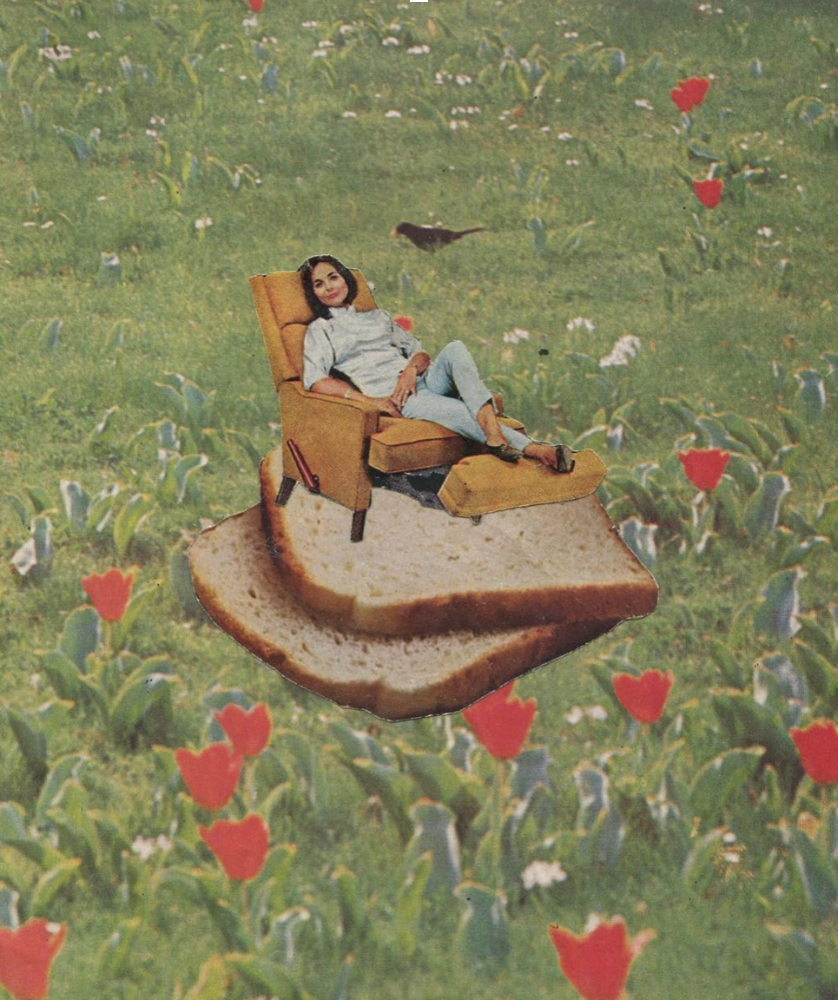
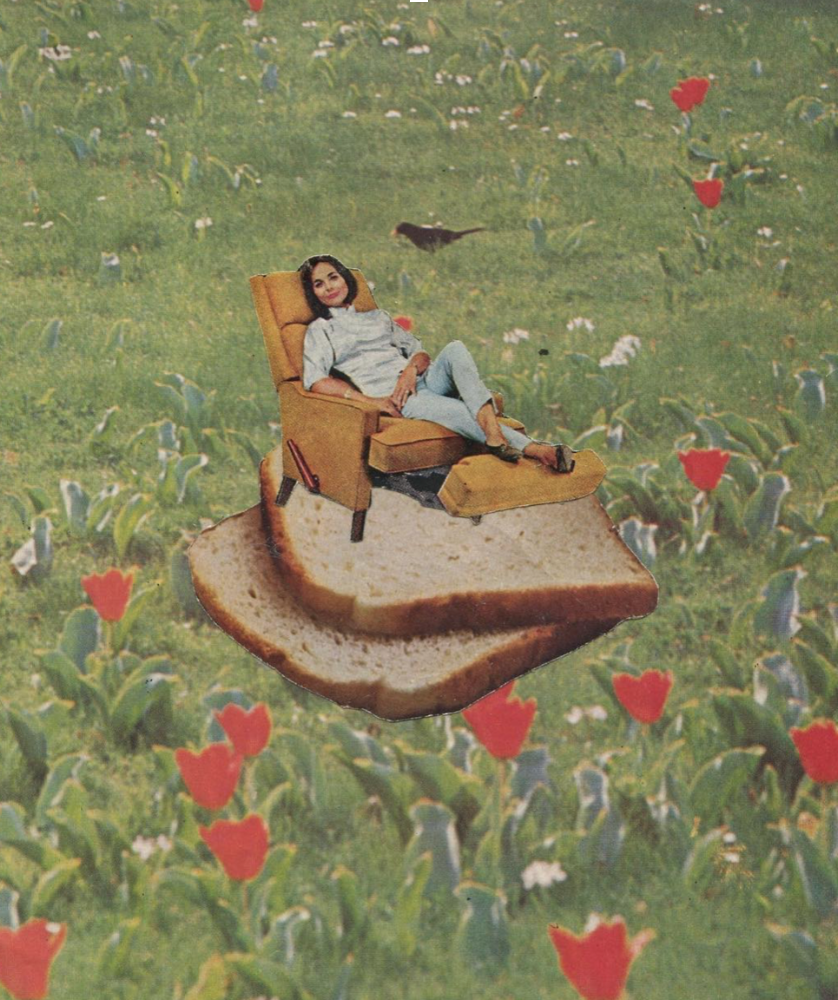
CSSH: This collage is called “Self-actualization (in recline).” When I make collages I go through old magazines and start cutting out images that speak to me. I have several categories for images and three of them are: food, women, and seascape/landscape. I don’t remember how I arrived at this final image, but I remember liking the way the red flowers contrasted with the dreary, soft slices of bread and then the ease of the woman’s posture. I like her shimmering periwinkle outfit and her pet bird in the background.

I try to make at least one collage a week, but that doesn’t always happen. I tend to make many collages in a short period of time, or even in one sitting, and then occasionally mess with them for a few minutes every few days, until I feel satisfied with them. 

I am one out of four siblings. However I do not see any “sibling rivalry” between poetry and my yoga and/or collage practice. I think they all work in harmony with one another and give each other the time and space to breathe.

Yes! I definitely feel like a surgeon when I am making collages. I use an x-acto knife so I can really get into the details. And there are so many pieces I’ve considered “ruined” or “dead” because I was too impatient with the cutting of a very precise detail. But then I immediately let it go. I try not to get too precious about paper arteries. 

VKN: Will you break down the poem “A History of Detainment” (p. 72) or (“Masculinity and the Imperative to Prove it,” or why this poem may feel pranky to you) from your collection, Community Garden For Lonely Girls, for us, Christine? Can you talk about the process of writing that poem? Do you recall writing it? What was it like? Where were you emotionally? Intellectually? Were you preparing a meal? On a train? Or what piece of writing/art inspired it? Did it take you long? And, could you talk to us about this line: “While navigating the meadow of hypotheticals, I tripped and broke my arm” (p.72). If you broke your arm, what one line from a canonized poet would you want to scribble on your cast? 

CSSH: “A History of Detainment” is so long and heavy and my brain is so tired after a full day of running around with my kid. But I can say a little bit about “Masculinity and the Imperative to Prove It”: When I was a child, my grandparents owned a Chinese restaurant called Oriental Court inside of a New Jersey shopping mall. Every Saturday night my entire paternal family—grandparents, all of their children and all of their children's children—would eat dinner after the mall's closing hours. After the meal, me, my siblings, and my cousins would run around like crazed little people in the empty mall and play all sorts of games including: "Red Light Green Light," "Red Rover," "What Time is it Mr. Fox?" and "Mother May I."

However, the golden rule was that we had to wait at least thirty minutes after eating before engaging in any physical activity, or you would get sick. When I was a young girl, I was often ashamed of my body. I used to wish that I were white so that I could fit in with the popular crowd; I would make myself throw up because I thought I was fat; and because I was sick a lot as a child, I would view my medical issues as a reflection of moral shortcomings. In other words, I was a very sad child. But at the end of the poem, the sad child is actually a fish. And we all know that a salad can be both a curse and a blessing. 

VKN: That’s a very beautiful story, Christine. I understand your tiredness. Perhaps this last question then: What do you think is the best way for one poet to feel at home in a poetry collection by another poet?

CSSH: Poetry collections are like homes unto themselves. I think the best way for a poet to feel at home in someone else’s poetry collection is by taking their time while reading it and listening closely, attentively, to what it is trying to say.


CHRISTINE SHAN SHAN HOU

Christine Shan Shan Hou is a poet and visual artist based in Brooklyn, NY. Publications include Community Garden for Lonely Girls (Gramma Poetry 2017),“I'm Sunlight” (The Song Cave 2016), and C O N C R E T E  S O U N D (2011) a collaborative artists’ book with Audra Wolowiec. She currently teaches yoga in Brooklyn and poetry at Columbia University. christinehou.com

VI KHI NAO is the author of Sheep Machine (Black Sun Lit, 2018) and Umbilical Hospital (Press 1913, 2017), and of the short stories collection, A Brief Alphabet of Torture, which won FC2’s Ronald Sukenick Innovative Fiction Prize in 2016, the novel, Fish in Exile (Coffee House Press, 2016), and the poetry collection, The Old Philosopher, which won the Nightboat Books Prize for Poetry in 2014.  Her work includes poetry, fiction, film and cross-genre collaboration. Her stories, poems, and drawings have appeared in NOON, Ploughshares, Black Warrior Review and BOMB, among others. She holds an MFA in fiction from Brown University.

In Art, Interviews, Poetry & Prose Tags vi khi nao, CHRISTINE SHAN SHAN HOU, interview, art, poetry, sheep machine, I'm sunlight
Comment

Poetry Weekly: Yesenia Montilla, Martín Espada, Denise Jarrott

April 22, 2019

As the senior managing editor at Luna Luna and the founding editor at Yes Poetry, you could say writing is important to me, especially poetry. For me, it’s vital to highlight poetic voices in order to support literature, activism, and expression.

Here are three of my favorite poems I read recently.

Read More
In Poetry & Prose Tags poetry, roundup
Comment

Poetry by Annie Finch

April 16, 2019

Annie Finch is the author of six books of poetry including Eve, Calendars, and Spells: New and Selected Poems. Her books about poetry include The Body of Poetry and A Poet’s Craft: A Comprehensive Guide to Making and Sharing Your Poetry. She lives in Washington, DC. More information at anniefinch.com


Read More
In Poetry & Prose Tags poetry, Annie Finch
Comment
long live the tribe of fatherless girls

15 Books By Women We're Loving Right Now

April 9, 2019

BY LYDIA A. CYRUS

Here is a list of books written by brilliant women in non-fiction, poetry, and fiction — inspired by this past Women’s History Month.

User Not Found by Felicity Fenton 

This book is actually a tiny essay. Think: A powerful essay about the intricacies of social media and womanhood that fits in your pocket! Fenton writes about her life in social media (and out). If you’ve ever wondered about the color of apps, been sent a dick pic, or just wondered about the profundity of existing digitally in present day, this essay is for you. Fenton wonders at one point if anyone is thinking about her. This thought leads her to the realization that she is, “just a human mammal amongst billions of other human mammals. I’m dander in the corner, the buzz in the background.” Fenton’s lyrical work is biting and honest and I’ve been keeping her little book on my nightstand for those nights when I’m up too late, window shopping on Etsy and checking Twitter every five minutes. 

Goodbye, Sweet Girl by Kelly Sundberg

Sundberg’s memoir centers around the physically and mentally abusive relationship with her husband. She chronicles the life of a woman from a working-class background who aims to not only exit an abusive marriage but to also gain an education and return to herself. The memoir is a fast read, lyrical and endearing. Sundberg writes the truths that are hardest to say and quite frankly doesn’t give a damn if the truth reveals the brutality that others have hidden. She reminds the reader all along the wild, highly intelligent woman she was before the abuse never left the room and will always triumph in the end. 

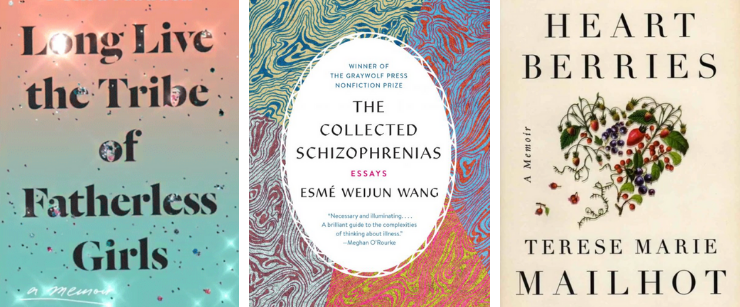
Heartberries by Terese Mailhot

Mailhot, a First Nation Canadian writer, weaves together the story of her life revealing the trauma and silence that clouded her. Her memoir welcomes the reader into the scenes of her early life with her mother and leads the reader to the revelation that perforates her story. The truth, she writes, is essential and the most powerful thing to unleash. She writes about her diagnosis of PTSD and bipolar II, the bitterness of loss in relationships, and provides insight into what the pathway to after looks like. 

Excavation by Wendy C. Ortiz

When I saw the cover of this memoir, a stunning photo of a young Ortiz at the beach, I felt compelled to look further. Excavation explores the relationship between a young Ortiz and her teacher, a man fifteen years older than her. He fuels her passion for writing and helps her to access a powerful sense of self as a teenager living with her alcoholic parents. Ortiz does the daring task of unraveling preconceived notion of what a predatory relationship is and what a victim looks like. She proves that the world and the relationships we create within it is made up of uncertainty and nothing is what it seems to be. 

Boyfriends by Tara Atkinson 

Atkinson writes about a young woman whose journey from first boyfriend, to college, to second boyfriend, and beyond. She reminds readers about what it feels like to have your first kiss, first real crush, first everything. And how, as you get older, not only do you change but your desires and wants change too. She explores what it means to be a single woman in 2019, searching in person and online for connection. It’s sweet and nostalgic in the best ways, and will make you think about what it means to be in a relationship not only with others, but with yourself too. 

Long Live the Tribe of Fatherless Girls by T Kira Madden

I have patiently awaited the arrival of this book for months. Admiring Madden through my phone screen and awestruck by the glitter on the cover of the book (it’s seriously a beautiful cover). Madden’s memoir takes you to Boca Raton, Florida where, growing up as a queer, biracial teen, her concepts of right and wrong, beauty and ruin live together. Her parents are battling their own addictions and realizations as she tries to navigate the spaces around her. Madden, an acclaimed essayist, wields her language fiercely and writes fluidly, stitching together the warm, sometimes heartbreaking, answer to the question, “what do you want to know?” 

Starvation Mode by Elissa Washuta 

I picked Washuta’s book My Body is a Book of Rules last summer and loved it so much that I read most of it in the bathtub. Washuta’s prose is so illuminating and honest that it feels like conversation between the reader and a close, trustworthy friend. In Starvation Mode, she writes about her complicated relationship with food. When nothing is in your control, how do you cope? Washuta struggles to create her body in the image of her longing while also experimenting with the genre of creative non-fiction. Both of which creates a work that stands elegantly and surely as an essential read for women who have complicated relationships with their body, their sustenance, and shattering the traditions of appearance. 

The Underneath by Melanie Finn 

Follow the trail of unsettling memories and the uncanny, as Kay, the protagonist, as she slowly unravels. While trying to reconcile a tumultuous marriage, the heaviness of motherhood, and a traumatic past event, she begins to wonder what really happened to the family that lived in her house before her. Finn’s novel is a true modern day haunting that deals not with ghosts but with the possession of the demands of being a woman. The novel investigates the things that plague Kay as she tries to solve the puzzles of her life. 

The Word for Woman is Wilderness by Abi Andrews

If you’ve ever read or watched the countless narratives about men traveling to Alaska to blow up their lives, you’ve probably wondered why it is there are so few narratives of women doing the same. Women seeking out the natural world as a means of personal growth. Andrews does just that in The Word. The protagonist is nineteen year old Erin who leaves the safety of home behind in order to discover. She questions the history of everything from nuclear warfare to birth control. Andrews tackles the old archetype of the adventure always belonging to a man. 

Brute by Emily Skaja

The highly anticipated first collection from poet Emily Skaja deals with remains of an ended relationship. Skaja carves survival and redemption into the landscape of what a women grieving looks like. She writes of pain that begins as internal and seeps into a physicality that beckons her to scale and defeat it. The universal truth of what it feels like to be abused and to move on leaks throughout the poems and enchants the reader. Skaja’s book begins with the same Anne Carson epigraph as T Kira Madden’s and positions the reader to prepare themselves for the journey. Skaja twists the plight of hurt into a weapon that strikes out as beauty and has the potential leave readers in both tears and smiles.

The Empathy Exams by Leslie Jamison 

This collection of essays considers the possibilities of what it means to care. Is it ever really possible to feel the pain of others? Over the course of several essay, Jamison depicts curious events such as the story of an actor who presents to medical students as someone with symptoms that the students must identify in order to learn. She also writes about the sense of voyeurism the plagues the pain of women in literature. This collection is an essential piece of reading for those still learning how to balance self-love and love for others too. It doesn’t ask, can you pour from empty cup? but instead defines what that cup looks like and what rests within it and why. 

Abandon Me by Melissa Febos

Febos’ first memoir Whipsmart detailed her life as a graduate student working as a dominatrix. In Abandon Me she writes about the difficult reality of longing for connection with others. What happens when you drown yourself in another? She visits relationships both romantic and not and the ways in which abandonment can strike and wound at any time, with anyone. As with Whipsmart, Febos isn’t afraid to have conversations about the elements of her life that both built and seemingly destroyed her. She writes about the longing of belonging. Seemingly asking, what does inclusion look like and how do we achieve it? 

The Collected Schizophrenias by Esmé Weijun Wang

One of the most talked about books of 2019, Collected, is a collection of essays telling about the life of a woman who suffers from mental illness and a chronic illness. Wang slices open the examination of what her diagnosis of schizoaffective disorder and examines the chaos of coping. She attests to the incredible resiliency that endures recovery and shapes the future of the diagnosed through her own experiences. When it comes to balancing a debilitating reality with the hopes of a promising future, Wang constructs an important conversation not only about mental health but also about the possibilities of life for women whose lives do not fit into one box or even two. 

Animals Strike Curious Poses by Elena Passarello 

In this collection of essays, Passarello meditates on the fascinating nature of animals and performance. She discussed what it means to be an immortal animal, placed into history by humans and how their fame came to be. Humanity commodifies the bodies animals both living and not and Passarello presents this with careful prose. She is aware of the ways in which humanity must always somehow have the position of authority over others and spares the reader nothing. She goes so far as to highlight the aftermath of the death of Cecil the Lion in 2015 by repeating the notion that the doctor who killed Cecil did not know he had a name at all. This repetition begs the question: Do we have to name an animal, give it celebrity status, and attempt to mythologize in order to respect it?

Girls Are Coming Out of the Woods by Tishani Doshi 

In her third collection of poetry, Doshi aims to rebuke the history of silence surrounding women who have survived. She pulls apart identity and trauma in order to create a space in time where silence is no longer synonymous with womanhood. The poems are constructed with careful detail and attention to movement and sound. As the title suggests, women are no longer hidden but are now returning to their lives with power and the capability of anything. 


Lydia A. Cyrus is a creative nonfiction writer and poet from Huntington, West Virginia. Her work as been featured in Thoreau's Rooster, Adelaide Literary Magazine, The Albion Review, and Luna Luna. Her essay "We Love You Anyway," was featured in the 2017 anthology Family Don't End with Blood which chronicles the lives of fans and actors from the television show Supernatural.

She lives and works in Huntington where she spends her time being politically active and volunteering. She is a proud Mountain Woman who strives to make positive change in Southern Appalachia. She enjoys the color red and all things Wonder Woman related! You can usually find her walking around the woods and surrounding areas as she strives to find solitude in the natural world.  Twitter: @lydiaacyrus 

In Poetry & Prose, Personal Essay Tags women's history, books, Lydia A. Cyrus, Tishani Doshi, Elena Passarello, Esmé Weijun Wang, Melissa Febos, Leslie Jamison, Emily Skaja, Abi Andrews, Melanie Finn, Elissa Washuta, T Kira Madden, Tara Atkinson, Wendy C. Ortiz, Terese Mailhot, Kelly Sundberg, Felicity Fenton
Comment
zodiac

3 Poems by Liv Walton

April 4, 2019

BY LIV WALTON
Curated by Nicola Maye Goldberg

Taurus

You will feel a flash of orange and then something new. You will feel, maybe — that it is your birthright to have tangerines in a bowl on your counter, and you will be correct. The stars have aligned above a tear in the earth and you should dress in sienna, paint your nails rust; lie with your shoulder blades against a cool plot of ground and recall that without gravity, the flame of a candle is round and blue.

We can’t say for certain, but if you were to wear blush on Friday something nice might happen to you. We can’t say for certain, but if you pause to buy lilacs at the bodega on the corner a beautiful stranger might know you. We can’t say for certain, but if you come across water you have gone the right direction.

You are in motion — the burn of your lungs, the length of your spine; you are running and itching and spilling this springtime. You will outgrow something that was once a comfort; you will replace it with a song you hum in the soft parts of yourself.

Taurus, you might always be on the strange side of tender but someone has given you a secret that tastes yellow. Have you seen the phosphorescence in August? You will be that wild light to someone who loves you.

Suggestions: write the words you need on the back of your hand. cry on an uptown train in the odd hours of morning [there is awe to be considered]. look at the photo you haven’t forgotten. the number 27 will be important.


Aquarius

So far you have seen every type of sunset, but you miss the way light casts blue in those slow hours before dawn. Of course there are strings, but you will know how to weave together what is wanted when it calls you. Make the motion that feels natural, then make it again with your other hand.

In general, you should pet more dogs. Place yourself in green surroundings and put down what can afford to be left behind. Midweek you will spill an important thing, but you will find it again in some unexpected way. We wish we could tell you more, but we’ve already forgotten —

Aquarius, you are numbers and numbers but the rhythm of desire speaks in so many different tongues. Be slow with yourself and sit amongst the hidden pages: a message you wrote will reveal itself in those depths. This month your horizons will shift endless and open; you will feel unmoored but not unsettled. Consider the points where you have made contact and the direction of your motions — you move to a frequency others should attune to.

We suggest you write a haiku that has no thread. We suggest that you log off of web md forever. And we suggest that, if you know the words, try to speak them. Be mindful of the bits that smolder.


Virgo


The good news is that the days have been getting longer for three weeks now. The good news is that the rain has cleared, and tonight there will be sky through the top corner of your kitchen. The good news is that always and always but especially today, when they look down at you the stars say: whatever.

You will learn this year that Instagram fame is rapturous but fleeting, and you will parse the difference between types of stillness (a clue: one will tremble). You will unspool something that spills navy, and minutes will sit heavy, but you will think: moon cycle. Think: fingerprints. Think: unravel.

Virgo, you are a different touch – for you I am new, I am neat and terrible and please; all teeth. (A habit I can’t shake: the unbelievableness of wantingsomeonewantingme still jolts me back to sixteen, delirious).

For you, we suggest downhill and downtime. For you, we suggest Frank Ocean’s brand of forever. For you, we suggest leaving this one up to chance. The good news is that there’s still more to be had


Liv Walton is a Canadian writer based in New York City. 

In Poetry & Prose Tags liz walton, poetry, zodiac
Comment
italia

Giovan Coppola & Vi Khi Nao Talking Italian Poets, Cats and Place

March 25, 2019

by VI KHI NAO
in conversation with GIOVAN COPPOLA

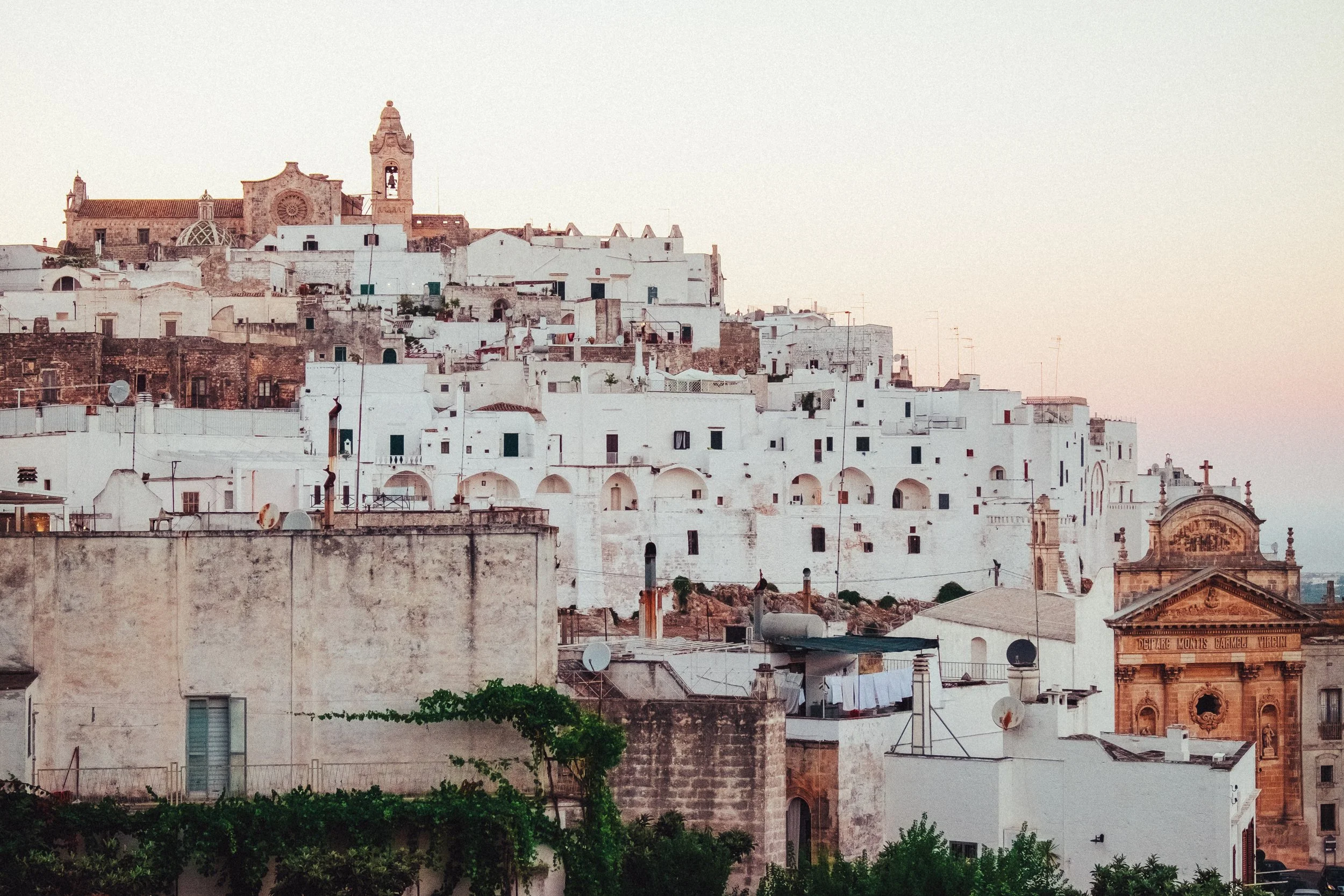
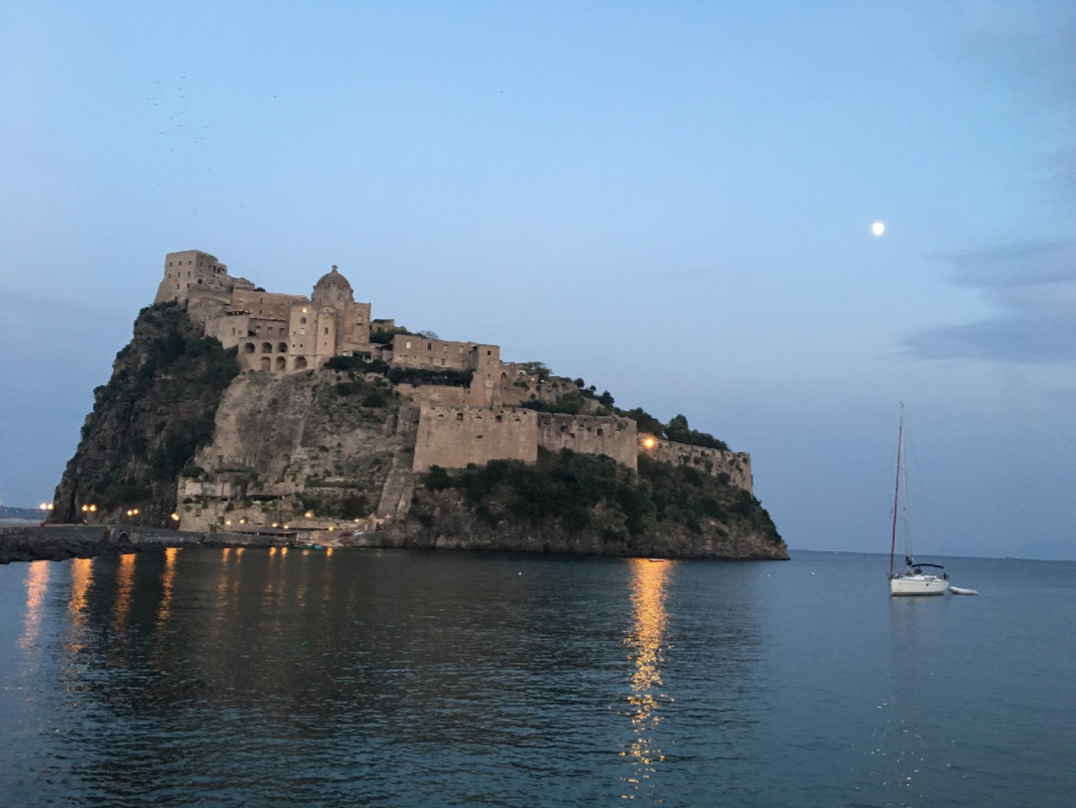
VI KHI NAO: Will you depict the landscape of Ischia. What is it like today?

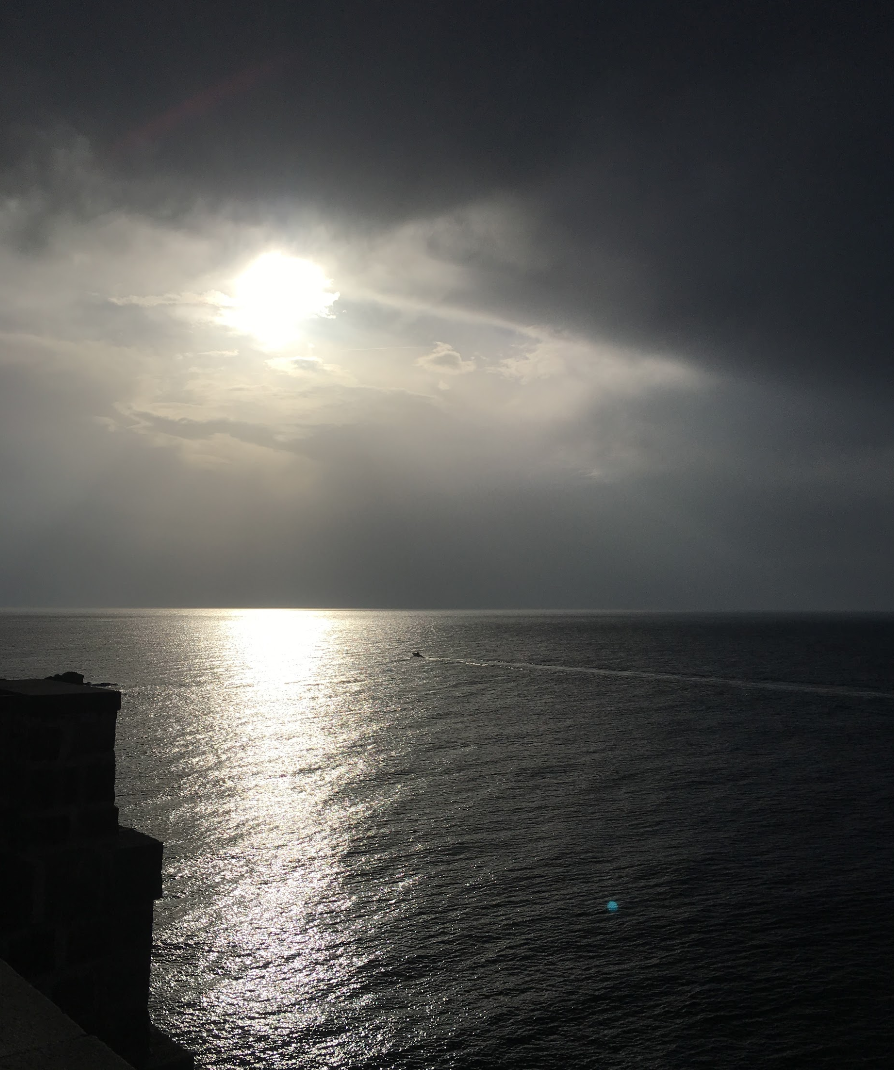
GIOVAN COPPOLA: I’m looking out the bedroom window and I see a sliver of the sea between the trees. The sun is setting and the clouds are bathing. And the wind has started. Tomorrow it’s supposed to be windy. I wish I could tell you which wind it is, but I’m still learning their names.

VKN: The way you lovingly and lyrically depict this filled my heart with love for your Ischia. If you were to invent a name or two for that wind, what would you call it? Also, if you had an ideal poet life, what would that writing life look like?

GC: I remember you once told me that ‘eloigne’ was your favourite word. Wait, I don’t think that’s the right word. Do you remember it?

VKN: Eloign. Without the “e”, but I prefer your invention.

GC: I would name the wind Eloign.

VKN: I noticed that you were reading Rabbit by Sophie Robinson, which recently came out. How is it so far? Will you talk about the current landscape of the poetry world? You have read internationally from Brit lit and American. What do you think make a poet great in this Brexit, Trump era? What are some of the criteria or traits for such poets? In other words, what kind of linguistic or lyrical materials seduce your soul the most?

GC: I’ve loved Sophie Robinson’s poetry for a few years now. Her poems make me feel like it’s morning and I’ve just woken up and realised that something has happened to me during the night that has changed everything. Like during the night I was lassoed and pulled to a group of stars that have pumped their gumption into me and I will now become a better braver person in the waking world. Her poems have fish bone teeth and crime. They break open the pain and make something new.

Second question: I don’t know what makes a poet great in this Brexit - Trump era. A poet that keeps writing, keeps wanting to know, I guess. A poet that keeps loving. A poet that takes care of herself and the winds.

Third question: What materials seduce my soul? Poems that live where they want to live. Poems that make room. Poems that love things.

VKN: That is so gorgeously depicted “lassoed and pulled to a group of stars.” She is so lucky to have you as a reader ! If you were to interview her, what would be one question you would like to ask?

GC: Once your poems pull through the pain, where do they lay down their heads?

VKN: Can you talk about the poems or any translations you are working on? What is the process like for you? And, what direction do you foresee your own journey with your work? Would you like your process to be more accelerated? Where it infuses everything you touch and cook?

GC: Thank you for all of these questions, Vi. They inoculate me.

I recently came back from FILL, the Festival of Italian Literature in London, and I did a reading with a group of poets. We were all included in the anthology Wretched Strangers (Boiler House Press) as non-UK poets who contributed to the poetry world in the UK. The anthology was put together in response to Brexit and the current political upheaval making way for powerful responses from the far right against refugees and immigration. Four of the poets that read were non-native English speakers writing in English and also mixed in other languages into their English poems. And I thought how wonderful that was and wondered why I didn’t think I could do the same in Italian? It made me think about how the English language can be a symbol of progress. That you learn English, you move to an English speaking country, you transform yourself in a different language. What does that mean about me moving back to Italy where my parents have come from? Would me writing in Italian be seen as progress? Or is it pedalling counter-clockwise? Or is it turning into a seed?

I want to write in Italian or mix English and Italian. I think my poems, at least when I read them out loud, sound tough, like hard cheese rinds before you throw them in the soup. And my New York accent comes out. <dawg> I’d like to see what happens in Italian. I’d like to dissolve in Italian. I don’t think I’d have to dismantle anything, but I think it means when I go for walks I would have to push myself onto people. Linger and talk to them. Even to the Jehovah Witnesses, although I don’t want to talk about Jesus.

You know one thing I noticed that I really liked? When I was in London for the Italian Literature Festival, I sat next to a lady. She was an academic that studied post-war Neapolitan literature written by women. At one point she gave me a candy. A few days later, I took one of my cats to the vet and the vet offered me a gummy worm from a bag. I really love eating candy with Italian women.

VKN: I want to eat Starbursts with Italian women too !What are the poets you read with were like? Are they different from you or similar? Will you introduce us to a few great Italian poets that everyone must read or else their existence on earth would seem meaningless otherwise?

GC: The poets I read with at FILL were really diverse. I wish I could have talked to them more or asked more interesting questions during the Q&A, but I suspect like many people, I’m always shy after readings and there doesn’t seem to be enough time to calm down afterwards and talk. I wish after a reading there was always dinner. Food disarms people and makes people trust each other. You can’t take yourself seriously when you have food in your mouth. Like eating candy with people. The next poetry reading I’m going to bring candy.

But yes, some Italian poets I really love and that I’ve got to meet during poetry readings or have been recommended to me are Carla Mussi, Roberto Minardi, Alessandro Mistrorigo, Chandra Livia Candiani, Alessandro Burbank, Andrea Inglese, Giovanni Asmundo, Fabia Ghenzovich, I want to know so many more.

VKN: I am not familiar with these poets. Will you please give me a little introduction to one or two poets you mentioned? Are they contemporary? Old-fashioned? Dead? Alive but obscure? Alive and gregarious? Dreadfully enticing in their form, but wouldn't take a dog out for a walk?

GC: They are alive and contemporary, some I’ve met, some I’ve just read. Some are young and shy and delicate and others are robust in their sexuality. Some are travelers and some like to stay home. There are so many people to know about and read! I’m still learning about what’s out there and letting things carry me to where they want to go. Carla Mussi’s latest book of poetry is Sconto di Pena (Puntoacapo, 2016) roughly translated as ‘Reduced sentence’ and it’s about a murder trial of a woman who has killed her husband from the woman’s point of view. Each poem is like a holographic statement, phrases that cut, the woman is like a genius wild animal.

Then there are Roberto Minardi and Alessandro Mistrorigo. Roberto Minardi’s La citta’ che c’entra (ZONAcontemporanea, 2015) are about living in an urban landscape. There are people, birds and cats, public transportation, sandwiches and dinner in front of the television. The poems give you a perspective of solitude where many things happen. Roberto and I have translated a few poems for each other which was really fun. That was my first time translating poetry and he was lovely to work with, encouraging and patient. Alessandro Mistrorigo’s Stazioni (Ronzani Editore, 2018) were written in various places across Europe and Asia. Characters that all come from somewhere else, temporary people and places and it makes me think about how we become a place, how we can blend into the space around us. Reading the poems reminded me of the Alexandria Quartet by Lawrence Durrell.

VKN: What was life in UK like for you before you moved back to Italy? Do you miss the poetry landscape there? And, if you were to create your own here in Italy, a poetry club, what kind of baking or culinary dishes would you make to seduce those who already love the sea to consistently come? Would you ever run or host a regular reading series?

GC: I loved London for many reasons and I loved the poetry landscape there. I met many poets and writers and there were many writers that would pass through to give readings. All kinds of readings to party style reading slam poetry jams to sit down quiet readings to poetry as performance art to elevated academic readings to rock concert style readings, so many kinds so you didn’t have to feel like every single one of them had to have a meaning. I mean you didn’t feel the pressure to have a great time or to even listen. It was okay to be bored because you were still going to get something out of it.

I miss that, but not enough to go back. I like it here and I want to hold dinner party poetry readings in the garden. I want poets to come over and eat and read poems. How do I invite people that don’t know me to come over and eat? A no-pressure environment. If they want to, they could use big words and talk about the PhD they’re working on. And they could also talk about how many times a week they wash their hair. I’d like to read poems where anything can happen and I want to read poems that change you. I want to eat things while reading poems.

VKN: The question you asked Sophie R earlier in our interview, if you were to answer that question on her behalf, how would you reply to it? I don’t know if she would mind, but let us pretend that she wouldn’t.

GC: I think her poems rest on her cat and they watch television together. Maybe her cat is a little wheezy and the poem who has done all the heavy breathing in the lines, can now show her cat how to slow down. They teach each other about the aftermath.

VKN: You are a cat lover. This is obvious on your Instagram posts. Do cats make great poets based on your observation of them? Or they make better ice cream, left too long in the sun and they would melt.

GC: I don’t think cats melt. They imitate their dry little turds in the sand. I think cats are spectacular poets. Have you read The History by Elsa Morante? There is a character Usepe, who is a little boy that suffers from epileptic seizures. He’s a little boy and he’s a poet and he doesn’t write them down, he just says them. Shouts them into the air. He talks to the trees and tells them a poem or tells the river a poem. He’s a lonely boy. I think cats are like Usepe. They say the poems, but it’s not necessary to preserve them. I think that’s why wherever they are it feels like home. That’s why they make home feel like home.

VKN: If you have a dish you made that looks like a walking example of poetry, will you share that pic with us?

GC: Good question. Let me check the files.

I have to find a picture of it, but maybe I didn’t take the picture of what I have in my mind. I made roasted tomatoes over the summer that I loved. I had bought an electric oven because my gas oven is shit. So the tomatoes were the first thing I made. I think I roasted them for two hours. I set up the oven in the garden so it wouldn’t heat up the house. I sliced the tomatoes, sprinkled fresh thyme on them, some salt and olive oil and then I put them in the oven. I sat in the kitchen while they roasted outside, keeping an eye on the cats in case they toppled over the oven. They were still kittens then and I anticipated constant trouble. I wore a green striped house dress and sweated my guts. The tomatoes were delicious. Carmelised. I put them on top of bread.

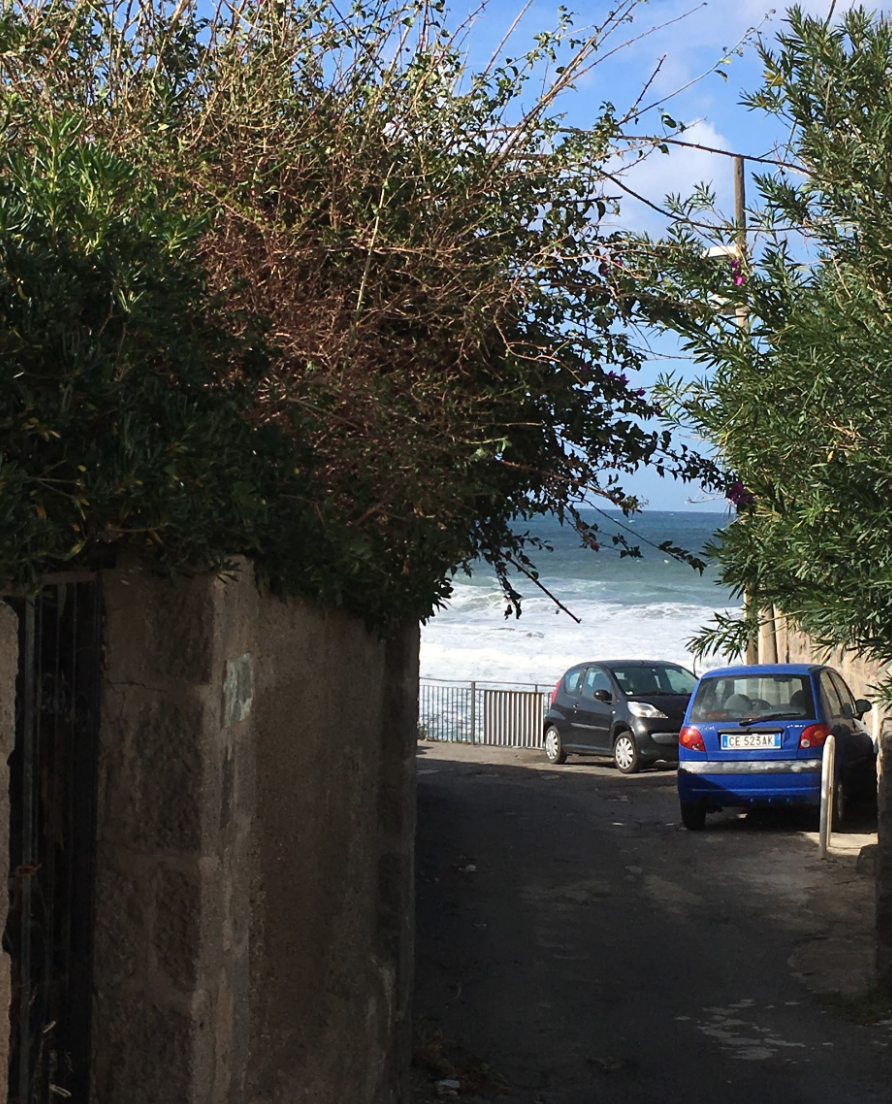
VKN: You take amazing photographs, Giovan! And, I just want the world to see through your eyes. Will you share one that you are able to access? So that we have some sense of your aesthetics?

GC: Let me look for one. What would you like to see?

VKN: Photos of Ischia? Or places you went for your morning, afternoon, or evening walk? Maybe some pictures of your cats, languishing like supermodels?

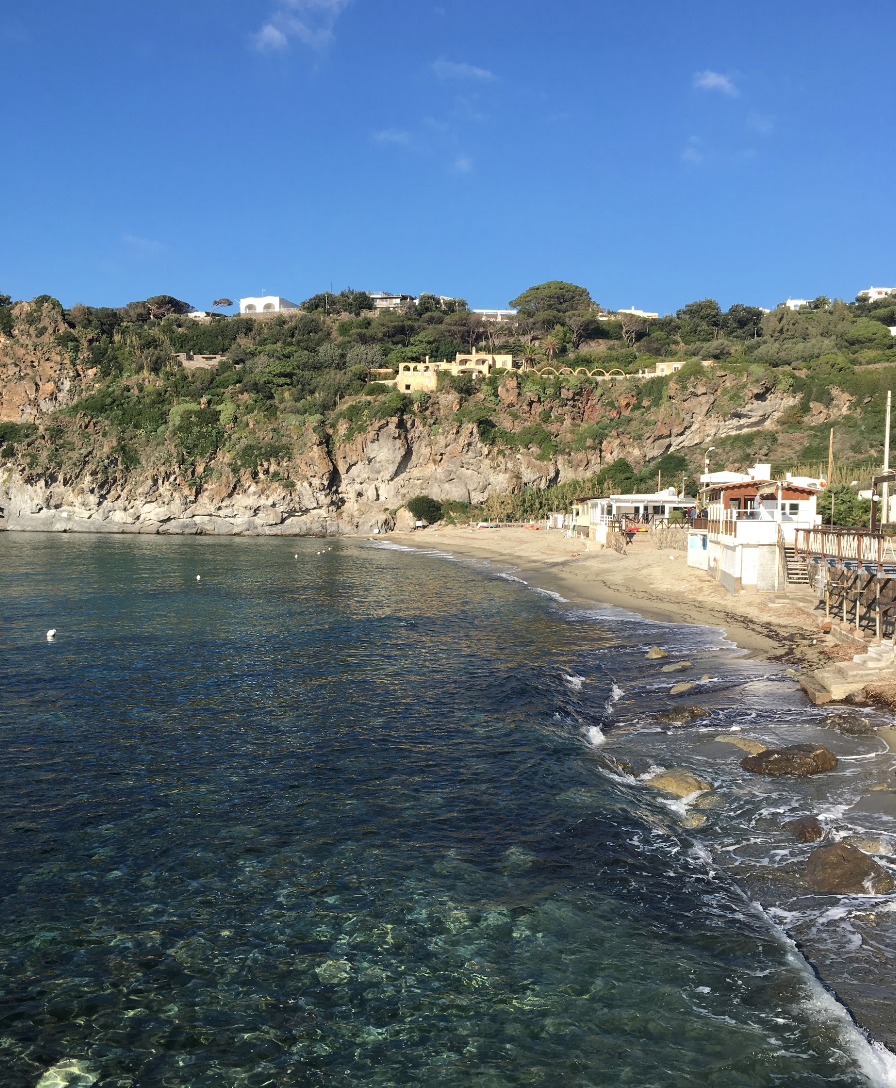
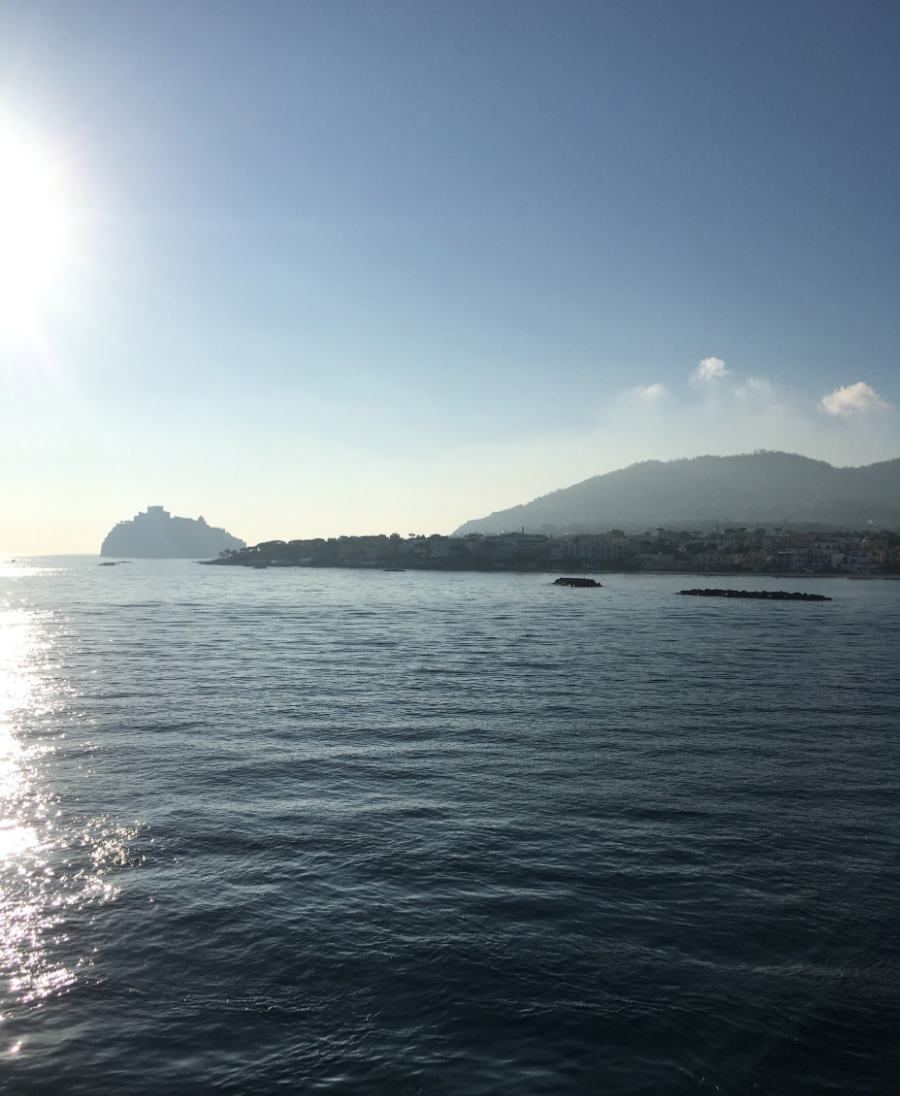
GC: See below
Screen Shot 2019-03-25 at 3.06.50 PM.png
Screen Shot 2019-03-25 at 3.06.57 PM.png
Screen Shot 2019-03-25 at 3.07.04 PM.png
Screen Shot 2019-03-25 at 3.07.20 PM.png
Screen Shot 2019-03-25 at 3.07.30 PM.png
Screen Shot 2019-03-25 at 3.07.43 PM.png
Screen Shot 2019-03-25 at 3.07.54 PM.png


VKN: How are your cats? Some were ill the last few times I spoke to you. Why do you think they fall ill? Which one is potentially most poetic? And, what is writing poetry for a felinic entity? If they had to work like us homo sapiens, which profession do you think they would excel in? Oraclers? Philosophers? Dancers? Bartenders?

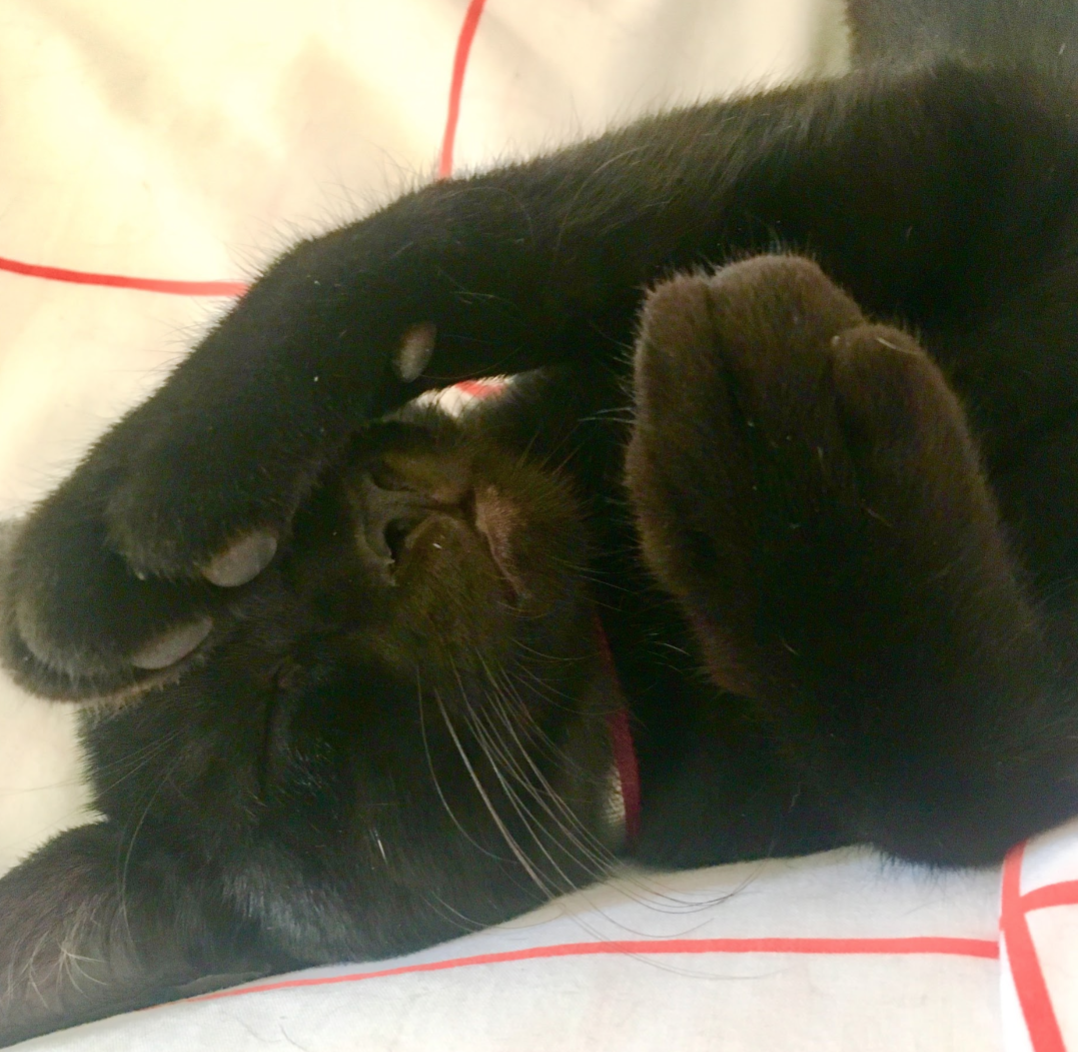
GC: My cats are wonderful. I love them more and more every day. Indy has had a bad cough that she’s been taking medicine for. I even put her in the cat carrier, wrapped it in plastic, and stuck in a tube that steamed out a medicinal vapor. She didn’t like that. So then I decided to leave her alone and now she’s getting better. I think she got sick because I went away to New York and she got sad. All of them are poetic, some days one is more poetic than the others.

If cats had a human job, I could see Sesto as a garbage collector and have a lot of fun doing it. He looks like he’d enjoy a union. Indy would be a research scientist. Rose would be a talk show host, she loves to gossip. Mucca would be a creepy neighbour who collects cans. Pippo would be a basketball player and have a large sneaker collection.

VKN: My god! Their profession so wild ! There was one project about stinking nuns you were eagerly and excitedly pursuing. How is it going so far? Are these nuns really stinky like durians? Or different stinkiness? Is your project a collection of essays or poems? Or a combination of personal anecdotes of your post-nomadic life or something else? How would you like to work or rework on this?

GC: That’s funny you asked Vi. Now that I quit my job, I want to work on the stinking nun. My poet friend Ariadne Radi Cor, who lives in Blacksburg, Virginia is starting a writing group. It is a collection of 6 of us and we will have a monthly deadline to share work with each other and then do a skype call where we can both talk about shit and serious things. So my plan is to use the writing group to work on the stinking nun and let it be whatever it wants to be. Right now it’s like a poetic novella, but I’d like to write some parts in Italian and see what happens.

VKN: You have made so many life-altering changes in the last year or so, can you talk about the emotional thoughts or intuitive courage that drove your soul to make these transformative paths?

GC: It’s been almost exactly a year since I moved to Italy and if I remember myself a year ago, I was terrified and I ate a lot of burgers and fries. One week I ate McDonalds two days in a row and then the third day I ate 5 hot dogs for a snack.

So many emotions and so much fear. I had never been as terrified doing something because it felt like there was no way back. And I imagined all the terrible things that could happen. I felt like I was doing something I wasn’t supposed to be doing. Like I was making my ancestors angry by going back to Italy, doing the impossible, going back to live in the place that they had to leave. I could hear their voices and voices of other Italians in London, like it was a bourgeouis american expat fantasy, that my desire to live where I wanted to live was invalid.

But I kept pushing through and the burgers and hot dogs gave me temporary relief. And each step that I took, it was like someone smiled back at me. Like at the airport check in the airline person let us go through without paying for our overweight luggage. And slowly, even if there were difficult times and frustrating moments, things were okay. Neither of us were punished or yelled out or threatened to get kicked out.

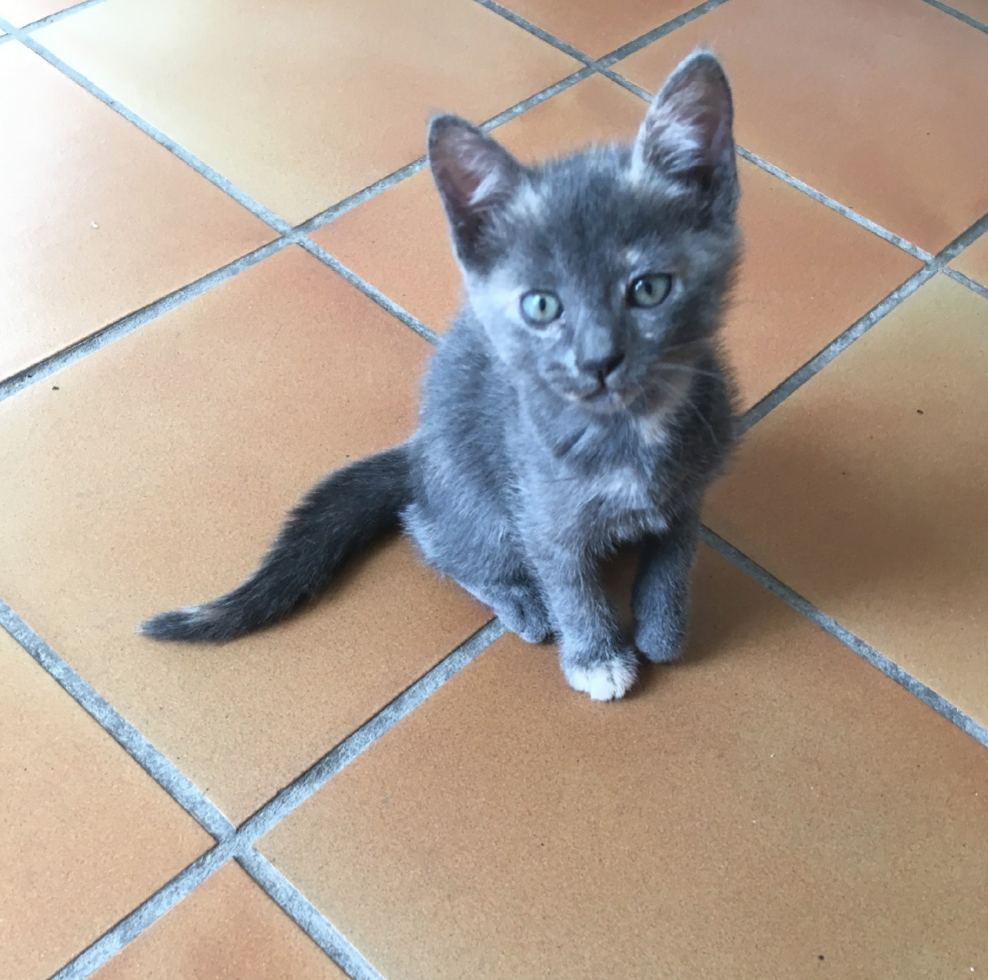
But if I think about what kept me going was that I was doing what I wanted and then as soon as we moved into our yellow house, a pregnant cat showed up and decided to move in. And she had her babies. And then once my residency permit was ready (after 8 months of waiting) a little abandoned kitten showed up in the garden. And then, as soon as I decided to quit my job and work on the stinking nun, another little kitten showed up in the garden.
That cats make me feel like this is home. And also that I can’t leave that we need to take care of each other now.

VKN: You are so brave, Giovan! Thank you for sharing your process with us. If there were an omelet or a piece of fruit or a poem to depict you today or a famous actor or actress in the black and white era who could cat-ure (capture) your emotional composition today, what would that object be?

GC: Hm, let me think. Anna Magnani they say was a gattarda, meaning a cat lady, someone who loves cats. She would feed the stray cats in Rome. But she wore her scars like a dress. I’m not sure I’m as strong as her. Her fury was smoldering.

I think I would be broken clementine peels on a powder blue table today. A diaphanous dress. An eloign wind. Smack face down on the couch, lazing like wax.

VKN: You are currently in Ischia, Italy and I am in Iowa City when this interview takes place, if you could teleport one cat who could pretend to be my secretary for a day, which one of your cats would you deploy for this service? I would pay your cat naturally. One poppy or peony to his/her owner per hour.
GC: Hah! I would send you Pippo. He could help you organise your receipts.

Screen Shot 2019-03-25 at 3.14.37 PM.png

Giovanna Coppola (New York, 1979) is a poet and writer. After living in London for 10 years, she recently moved to Naples, Italy. She has performed at events and poetry festivals in the US, UK and Italy recently including the Festival of Italian Literature in London (FILL 2018), La Palabra en el Mundo Venesia (2018) and the European Poetry Festival (2018). Her work (poems, short stories, essay) have been published in Crab Fat Magazine, The Stockholm Review of Literature, Journal 69, JSTOR Daily and in the anthologies Millets (2017, Zeno Press) and Wretched Strangers (2018, Boiler House Press).

VI KHI NAO is the author of Sheep Machine (Black Sun Lit, 2018) and Umbilical Hospital (Press 1913, 2017), and of the short stories collection, A Brief Alphabet of Torture, which won FC2’s Ronald Sukenick Innovative Fiction Prize in 2016, the novel, Fish in Exile (Coffee House Press, 2016), and the poetry collection, The Old Philosopher, which won the Nightboat Books Prize for Poetry in 2014.  Her work includes poetry, fiction, film and cross-genre collaboration. Her stories, poems, and drawings have appeared in NOON, Ploughshares, Black Warrior Review and BOMB, among others. She holds an MFA in fiction from Brown University, where she received the John Hawkes and Feldman Prizes in fiction and the Kim Ann Arstark Memorial Award in poetry. 

In Poetry & Prose Tags Giovanna Coppola, Vi Khi Nao, italy, cats, italian poetry, italian poets
Comment
← Newer Posts Older Posts →
Featured
‘in the glitter-open black' — poetry by Fox Henry Frazier
'poet as tarantula,  poem as waste' — poetry by  Ewen Glass
'poet as tarantula, poem as waste' — poetry by Ewen Glass
'Hours rot away in regalia' — poetry by Stephanie Chang
'down down down the hall of mirrors' — poetry by Ronnie K. Stephens
'Grew appendages, clawed towards light' — poetry by Lucie Brooks
'do not be afraid' — poetry by Maia Decker
'The darkened bedroom' — poetry by Jessica Purdy
'I am the body that I am under' — poetry by Jennifer MacBain-Stephens
instagram

COPYRIGHT LUNA LUNA MAGAZINE 2025