

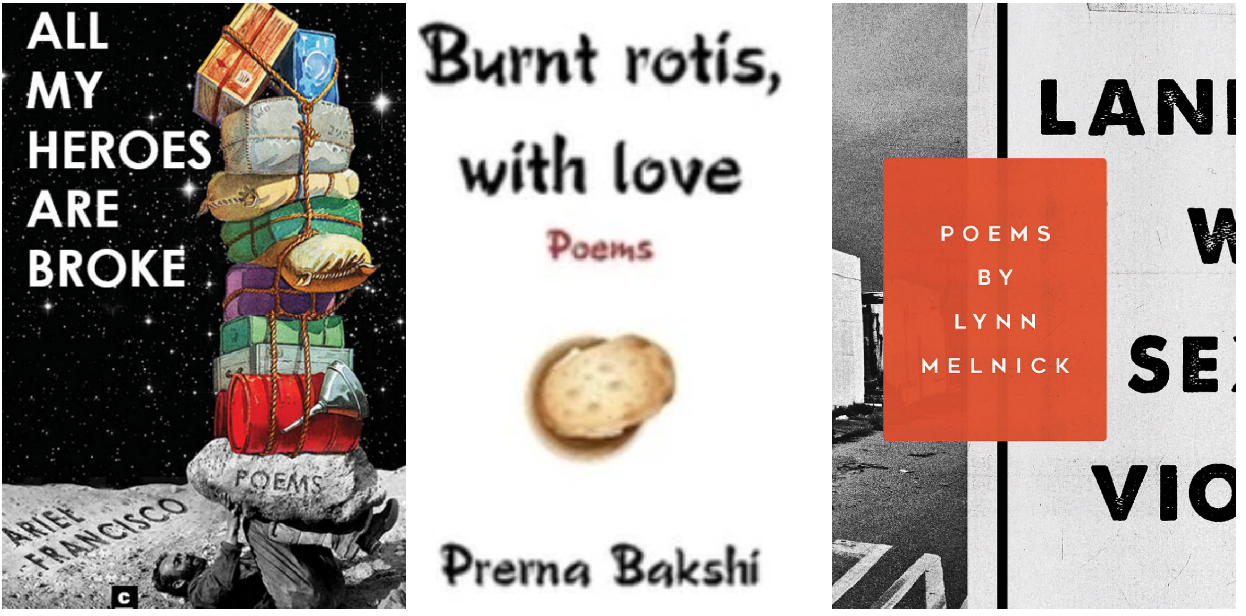
Here are some books that stole my heart and mind recently (and still haven't given them back):
Read More
A Brief History of Your Bathroom Mirror
You start with water. The stream ripples your skin with its current, warps your eyes, leaves you colorless. Water leaves you colorless. Motionless water is better, you discover. A puddle, a lake, a shallow bowl. You obsess over your reflection—the curve of your jaw, the speckles on your cheeks you never knew existed. You sneak glances at yourself in the black pits of someone else’s eyes, the tiny round distortion, the tiny colorless you. These are your first mirrors—the water like a cup of liquid glass, the spheres that sit in your lover’s skull like two black moons.
Read More
Luna Luna can't find an image credit. Help us!
Diagnóstico de cáncer: Poetry by Marjorie Maddox
Sage Graduate Fellow of Cornell University (MFA) and Professor of English and Creative Writing at Lock Haven University, Marjorie Maddox has published eleven collections
Read More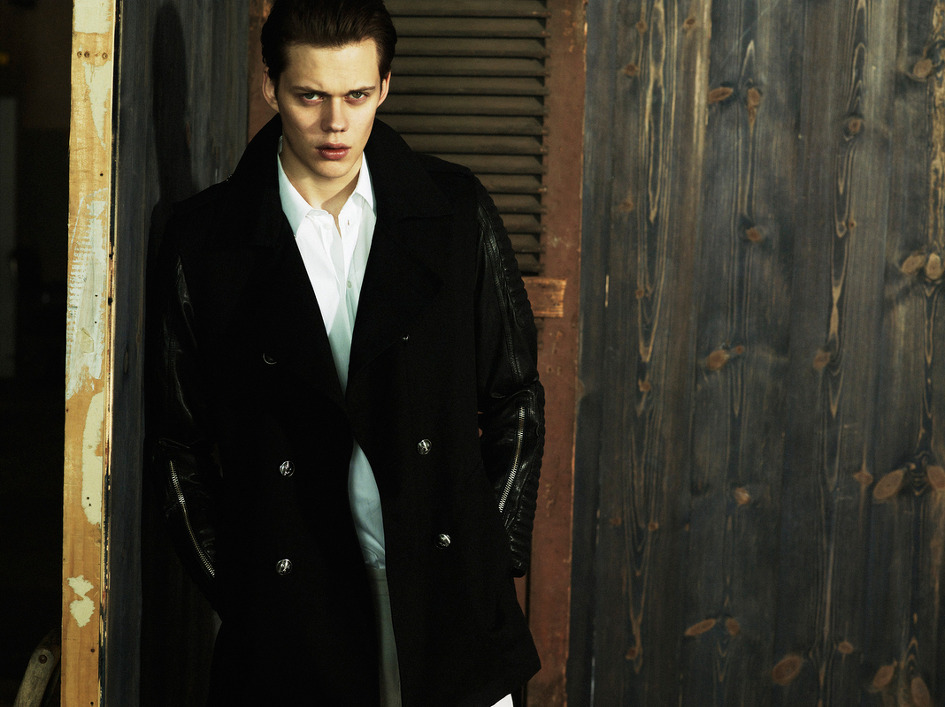
L'uomo Vogue
What Being a Caulbearer Means to Me
Finding out that I was born with the caul was like having an epiphany. I didn’t know exactly what it was as I sat in the passenger seat talking about Romanian werewolves and Frankenstein teenage girls with my mom that day, but I knew it explained something about me. It made me feel validated.
Read More
3 Poems by Alexandra Naughton — My Posey Taste Like: The Paradise Lost Edition
ALEXANDRA NAUGHTON
Alexandra Naughton's My Posey Taste Like: The Paradise Lost Edition (Bottlecap Press, 2017) includes poems from the original, highly-acclaimed collection My Posey Taste Like (Bottlecap Press, 2015) plus ten new poems. Watch this video.
maybe i don’t deserve it but i’m tired. i would like to just stop. i don’t really know what that means and i also feel the exact opposite. like i would just like to go. because maybe i don’t deserve it. so i go any where. i like feeling night time on my skin wandering but going some where it doesn’t matter why any thing can be an adventure when you let it and i let it, and it pulls me forward by invisible strings keeping the radio perfect to keep the momentum just right and i’m not even thinking any more just being part of an other body an other calling an other way to worship. and then when it feels right to stop. and then curling up to rest.
**
peeing in your shower when you’re not looking and drowning in self importance. later you’re underlining how little I mean to you, tracing fingers back and forth in the carpeting for emphasis. i’m propped up on pillows and yawning like i’ve waited for this moment all weekend. our similarities can only go so far, sing so much harmony. the difference between a poem and just something you wrote is just not saying something completely fucking ordinary, it’s how you say it too.
**
my posey taste like soiled tablecloths in a hamper heap. paradise lost or a parasite, lost. let the puppy lick your hand and quit being such a killjoy. touching myself in the mirror like this is the best i can do. i’m not wasting time, i’m not looking for any thing except what i can devour. straddling you on an apartment building rooftop watching the sun go down and drinking from cold glasses. i will take apart your face to find the morsels i like most, taking big bites from the sides like a dad with his kid’s ice cream cone because it’s melting. this is what love is, you say, peeling back my sweaty spousebeater to scream into my skin, my stains. every thing you do i just absorb you. staying so damn quit it makes you madder and i just take you in.
Alexandra Naughton is editor in chief of @baipress in California. Her first novel, American Mary, was published by Civil Coping Mechanisms in March 2016 . She’s a Libra. Follow her on twitter: @thetsaritsa
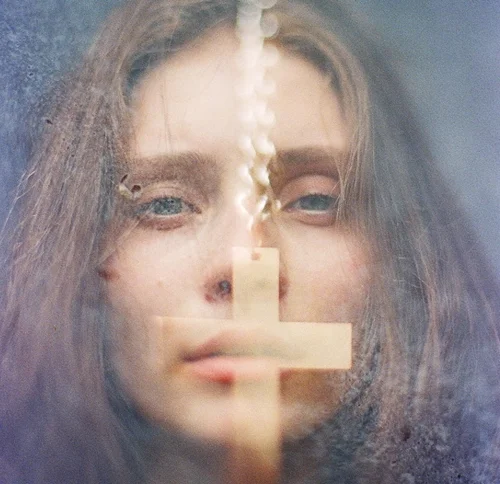
Tania Shcheglova
Poetry by Sarah Nichols
The Black Dahlia Dreams of Blade Runner
Last night, I dreamed of
Los Angeles.
Not as it was, when I
died. The promise and
sun of it.
I dreamed of its
now, a neon smear.
The city of
ghosts.
My voice in
its moving darkness,
saying
I’ve seen things you people
wouldn’t believe.
Sources: Ellroy, James. The Black Dahlia. New York: Mysterious Press, 1987; Hampton Fancher and David Peoples, Blade Runner screenplay, 1981.
Bloodline
My bloodline ends in
silence.
I circle back,
before my myth.
Slow now,
like conjuring a
storm.
Still in my descent,
a fury
beckoning.
I stir now,
watchful.
Someone’s out there.
Sources: Ellroy, James. The Black Dahlia. New York: Mysterious Press, 1987. Print, and James Ellroy, “My Mother and the Dahlia,” Virginia Quarterly Review, 82/3 (2006). N. pag. vqr online, Virginia Quarterly Review 19 June 2006. Web.
Dresses, Jewelry, Food
I wanted to be ready.
No one tells you what to
pack for the trip.
I met Cleopatra in
the underworld, and
she told me that
none of it
(dresses, jewelry, food)
matters down here.
Time cures everyone,
she says.
Whatever you thought
you wanted
dies or
goes away.
People worship you or
forget.
No one knows
that
until
they arrive.
Source: Ellroy, James. The Black Dahlia. New York: Mysterious Press, 1987. Print.
Sarah Nichols lives and writes in Connecticut. She is the author of four chapbooks, including Dreamland for Keeps (Porkbelly Press, forthcoming, 2018) and She May Be a Saint (Hermeneutic Chaos Press, 2016). Her poems and essays have also appeared in Thirteen Myna Birds, The Ekphrastic Review, Calamus, and The RS 500.
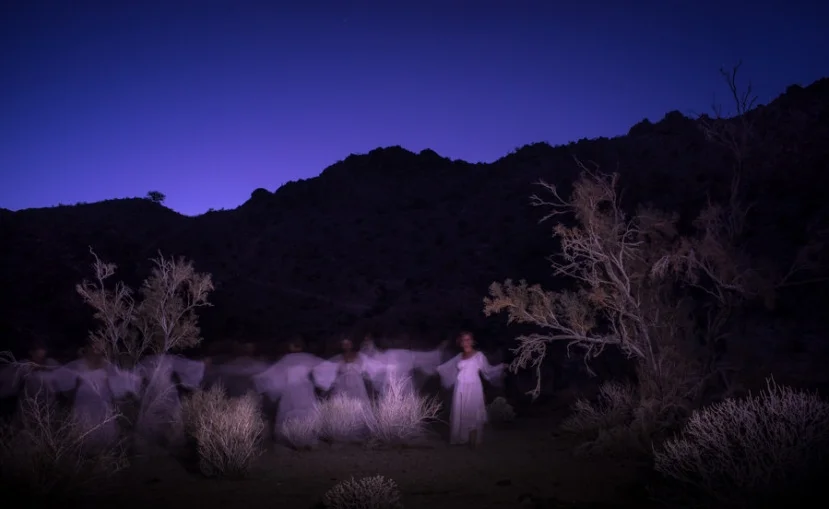
Heather Simonds Photography
Fiction by Lydia A. Cyrus: Coyotes
All coyotes are memories. With their skinny bodies and hungry mouths, they exist as a precautionary tale. They eat calves on my grandfather’s farm, or they used to anyway. I’ve never seen one outside of photos before, but I know that they are tricksters: they provide the world with chaos and fury. The men in my family have shot coyotes for nothing less than being seen. Like foxes, the coyote is a symbol of invasion or peril and they must be purged from sight. Coyotes steal bullets and memories. Coyotes eat youth and hide in dark, discrete areas sometimes never revealing themselves to the light of day.
Read More
Riccardo Melosu
Fibromyalgia: Three Instances Of
I think about how people usually only preach mind over matter when they don’t understand how to explain what’s going on with the matter.
Read More
via hystericalbooks
Review of 'A Red Witch, Every Which Way' by Juliet Cook & j/j hastain
What happens when two energies collide as if they were falling stars against an inky sky? What happens when two cauldrons boil over and into each other? What happens when two spirits are provoked to write as though conjoined and based on intuition? A Red Witch, Every Which Way is that result of such syntheses. The binding of unwinding and winding again, it’s the stitching of words, pages, and spirits. It is a spell the universe hummed into two sets of ears, banged into a writing desk, bled into a pen.
Read More
John Fournelle
Depression: Fear and Loathing in My Prefrontal Cortex
Six months later, I clawed myself again. This time I drew blood – real blood. I fought depression, and I lost. Again and again and again.
Read More
Guy Denning
Darrrryl
The way that Darrrryl appears to you is special. Each of these drawings embodies one person grappling with a powerful entity. Each of them is sacred. It is a gallery with one subject.
Read More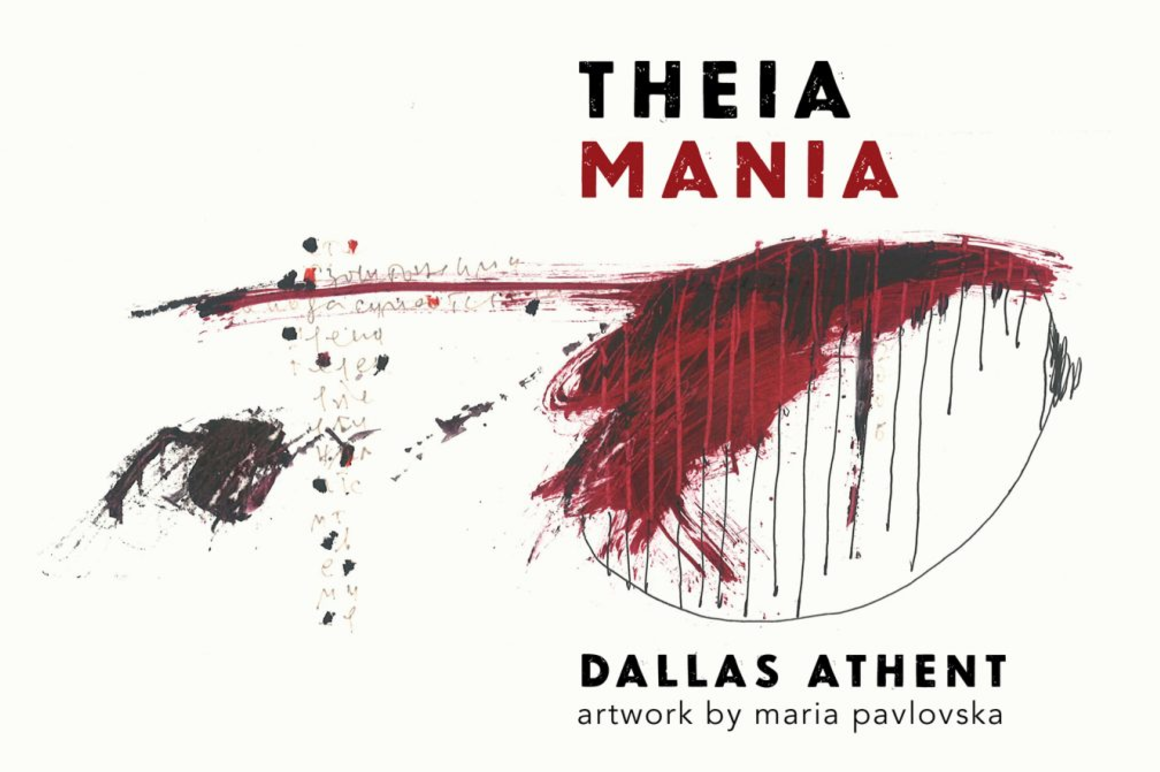
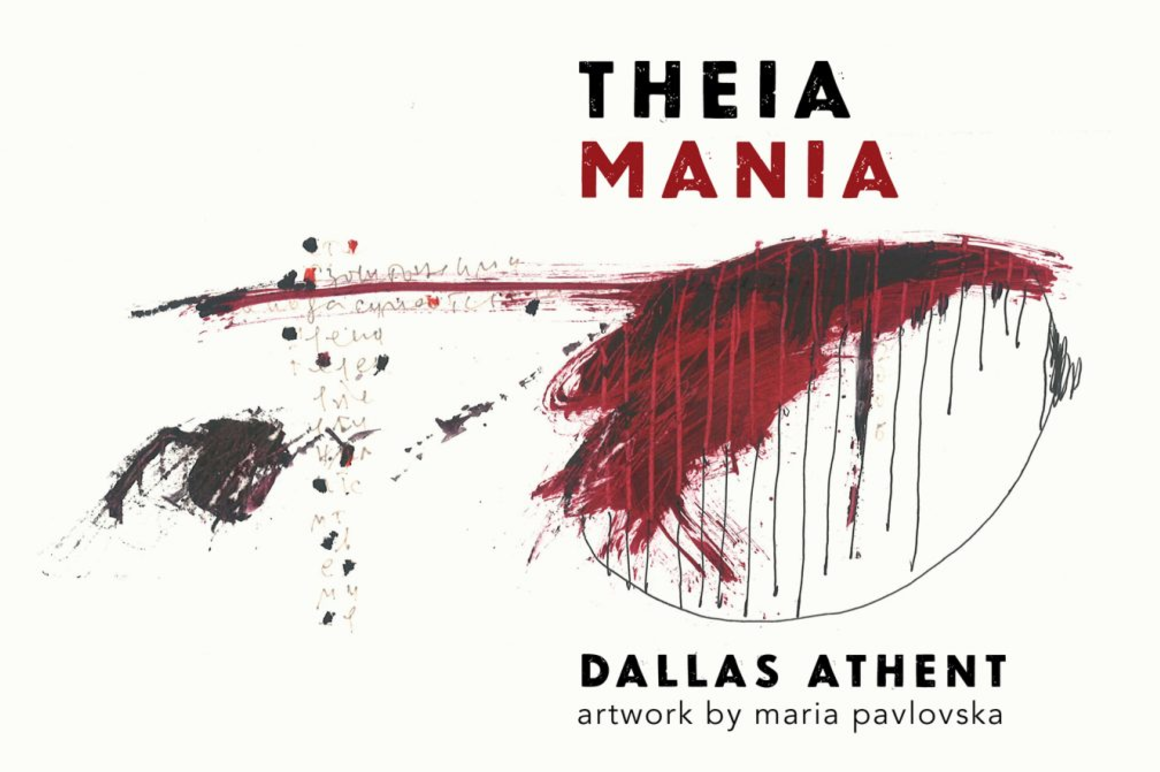
Theia Mania: In Conversation With Dallas Athent & Maria Pavlovska
BY LISA MARIE BASILE
Editor's Note: Theia Mania is a book of poetry by Dallas Athent with illustrations by Maria Pavlovska (Black Square Editions). This book is fiercely feminine, self-empowered, loud, brash, beautiful, and filled with references to gods and the Divine. Here. I interviewed Dallas and Maria about their collaboration and their work.
INTERVIEW WITH DALLAS ATHENT
LISA MARIE BASILE: Ah, the binary. I am addicted to it and your work explores it so well. It's bikinis versus god and bars versus transcendence and the problematic versus self-empowerment. Except here, the light always seems to win. Was that a conscious choice?
DALLAS ATHENT: I used to believe in good and evil. After my studies ofThe Golden Dawn and Platonic elements, I began believing instead in light and dark. Light elements are things that are connected to the divine, the higher powers, spirituality. Dark matter is that which makes us mortal. It's what drives us to be gluttons. This book is really a study of both states. Light doesn't always win because it is "good," per say, it wins because making art is a struggle for our dark matter to be connected to higher powers.
LISA MARIE BASILE: There's not a lot of subversion here, although on first read I thought there was. I think you're screaming, HEAR ME. And I love it. I don't see a lot of work that encounters radical self strength with such bravado. Tell me, were there weaknesses and fears and vulnerabilities you grappled with while writing this?
DALLAS ATHENT: At one point during this I was laid off from my job the same week I was closing on my apartment. It was a hard week for me and that's where on the one hand I was celebrating an accomplishment, but it felt fake, not knowing if I could really afford this thing I had been working towards. A lot of the darker poems were written during that week, and the ones that are more about me feeling like I can do anything were written when I got myself out of the hole.
LISA MARIE BASILE: So, you keep mentioning England. How did England shape you IRL?
DALLAS ATHENT: I love England. I lived there for a short while and I'm always trying to move back. I adore pub culture. A lot of my friends talk about wanting to visit warm places, and how beautiful beaches are, but for me the most natural state is in the corner of a pub on a rainy day with a book and a pint.
LISA MARIE BASILE: You say, "the purpose of art is horror," and I think that's fucking magic. I agree, but I haven't seen it put so succinctly. Tell me about this idea. Did you aim to horrify?
DALLAS ATHENT: The poem that's taken from is about making art, and trying to leave a mark through doing so. That being the last line was just me thinking of how hard we try and end up nowhere. It's like a beautiful nightmare.
LISA MARIE BASILE: I feel like this book is like if contemporary feminist discourse had a baby with the baddest, most rebellious, most sassy Lana Del Rey video ever. It's all girls and alcohol and scum and the body, but it's elevated with these ideas of divinity and Theia and the powerful feminine. How do you approach talking about BIG IDEAS in such an aesthetic way? I know when I was writing Apocryphal, I wanted this landscape of cars and deserts and fabrics and gardens and beaches and fires and tropics, but at the end of it, that was a character all meant to juxtapose the grandiose shit. What about you? Was this landscape and aesthetic conscious or not? Or was it just, "I love these things. They're real to me?"
DALLAS ATHENT: That's a great question. And I actually feel the same way about Apocryphal. You managed to create this classic, desperate, suburban summer on a coast feel — but used that landscape to illustrate what it's like being a young woman.
For Theia Mania, I've always loved cities and lived in cities. I'm obsessed with places where there's so many people and they all live so close to each other but don't actually know each other and have such drastically different lives. I just like how that contributes to the concept of trying to make art to be someone. It's a constant reminder that we will fade into the fabric of the earth no matter how well known we are.
LISA MARIE BASILE: (Thanks, Dallas). I've heard you talk about Yeats before. You write, "there is an oppressive veil separating us from the stars and Yeats." Can you tell me more?
DALLAS ATHENT: A while ago I read this essay titled the The Gnostics by Jacques Lacarriere. What I got from it was that the Gnostics believed there was a veil that separated us from all that is holy and divine, and that's why mortality is always doomed. Because we're always trying to see everything behind the veil but can never possibly. Yeats, being everyone's favorite Golden Dawn member, and a true inspiration to me, seems to have been someone who has achieved crossing the veil. It was a little line to give him a nod.
LISA MARIE BASILE: What does Theia mean to you?
DALLAS ATHENT: Theia Mania is a Platonic theory about how people who are experiencing horrible things, like heartbreak, are brought closer to the divine in those moments, and that's why we make great art. That state is really what the book is about, along with the dualities of being mortal and immoral, and trying to leave a mark on the world. That's how it got its title.
INTERVIEW WITH ARTIST MARIA PAVLOVSKA
LISA MARIE BASILE: Your pictures evoke chaos, but they seem finely, painstakingly deliberate. I'd love to learn about how you approached these works for this book.
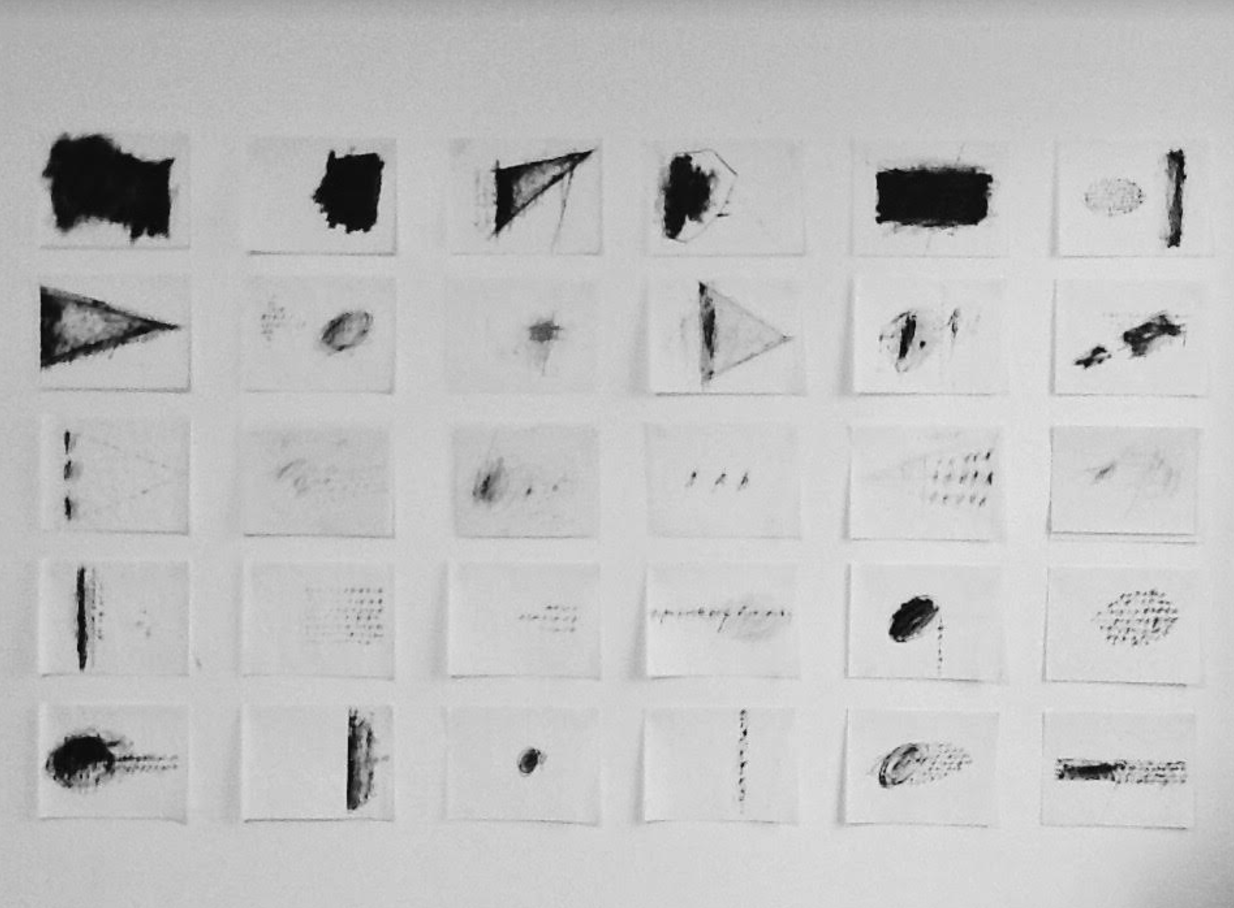
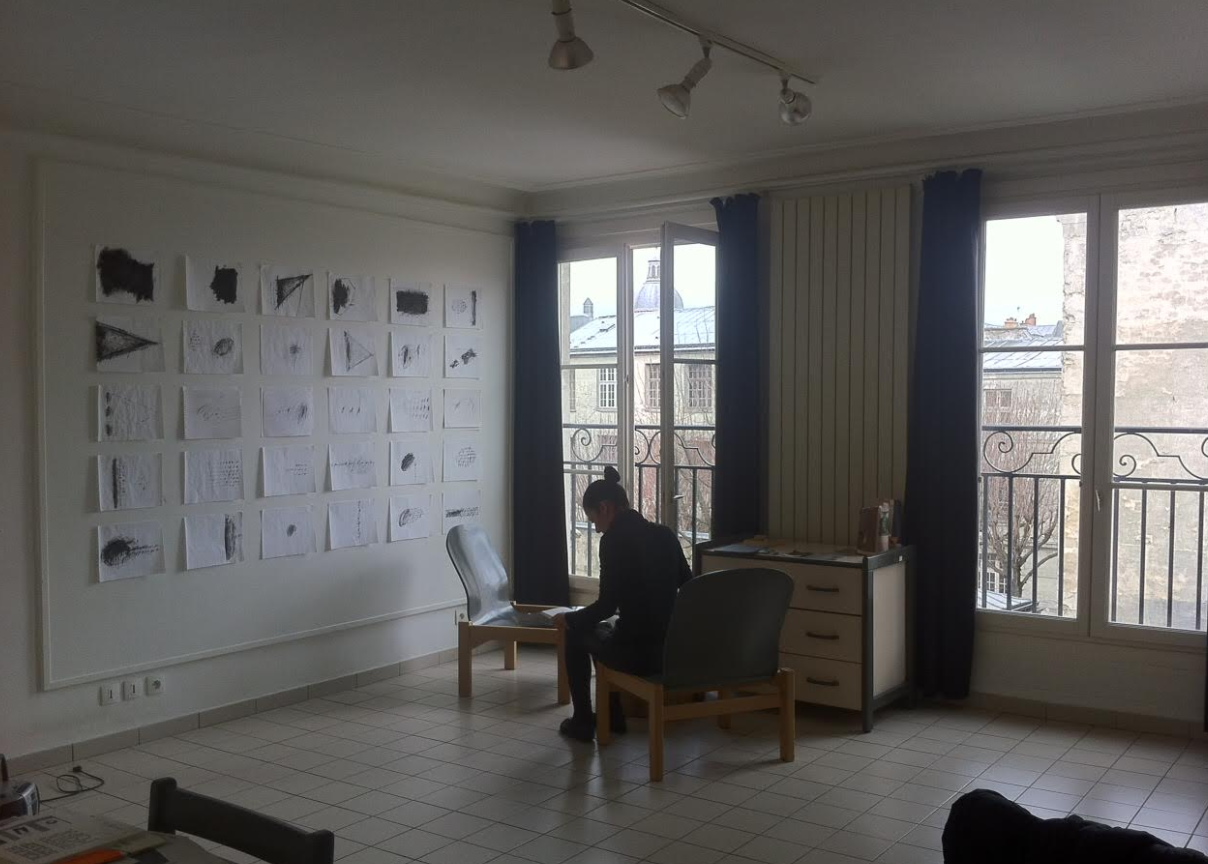
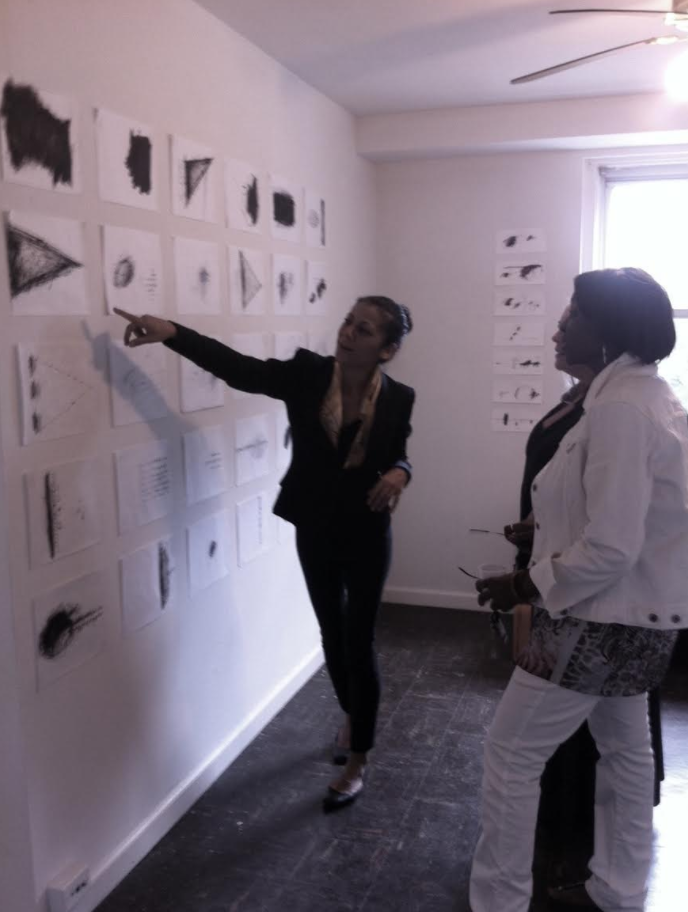
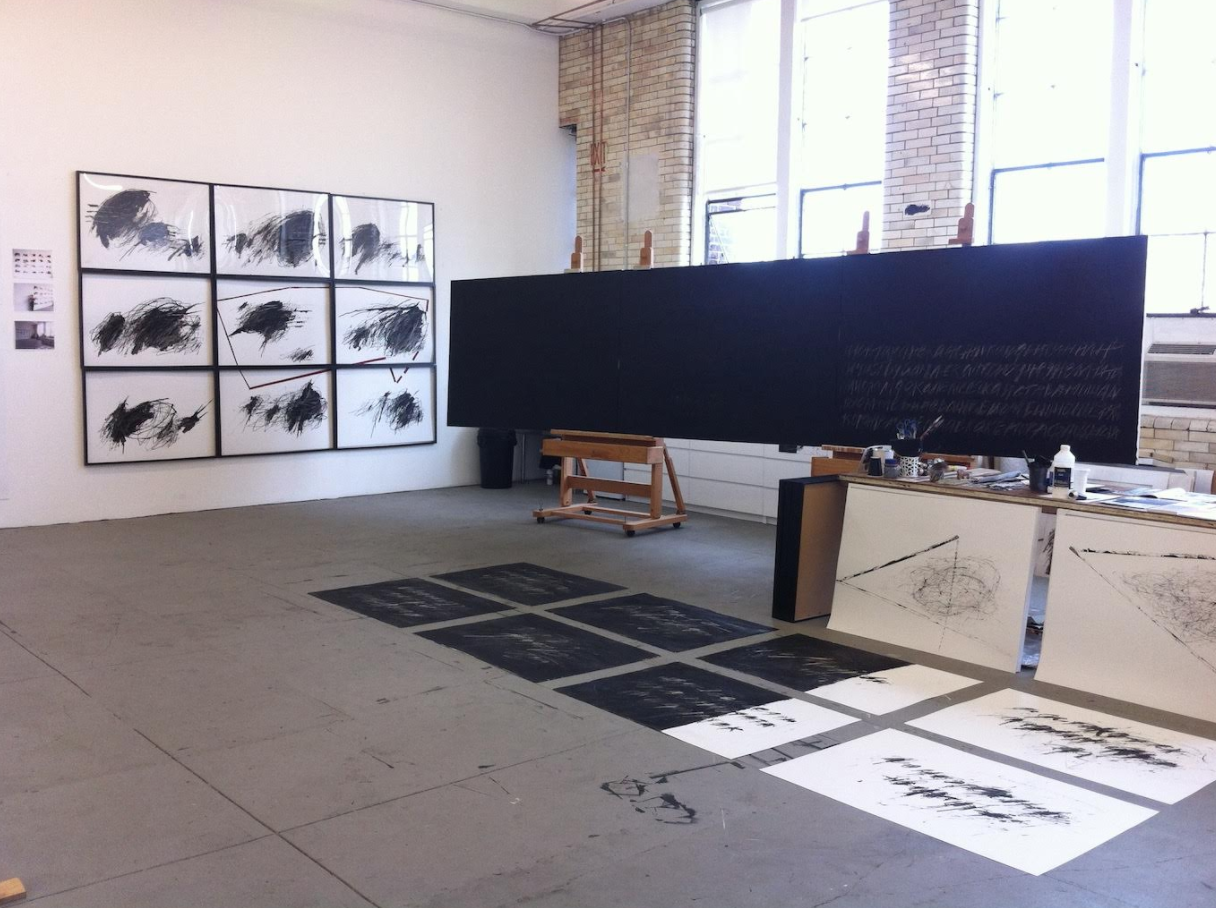
MARIA PAVLOVSKA: There is a series of 30 drawings, which was one piece related to each other from the first one to the 30th. Altogether it is one story. They are not meant to be viewed individually, but as a collection. They were originally conceived as part of a show "Black and White Diaries," which included also large canvasses. I wanted to show, as I always do, the progression from drawing to painting.
LISA MARIE BASILE: Something I realized about this book is that there really is a balance between the good/bad or holy/not holy polarity. In your work, I sense that you contributed in a big way to that feeling. I find it very hard to strike a balance; how do you, as an artist, find that median?
MARIA PAVLOVSKA: My work translates topics of choice into pictorial language that demonstrate a quietly powerful eloquence. My drawings and paintings reflect painting as a battlefield, where light and darkness fight and the result is unpredictable.
One sees the lightning bolts of ideas at work, as they are being worked out. That is the balance I look for. This sort of simultaneous image /process / results in a dialectic that lies frozen in space, stimulating the viewer to actively participate in the image creation themselves by way of investigation, inviting myriad readings within a given theme.
LISA MARIE BASILE: You're from Macedonia. What about the culture inspires your work? Is there something you're bringing to your work — and Dallas' poetry — that is related to Macedonia in some way?
MARIA PAVLOVSKA: My inspiration does not specifically reflect my Macedonian heritage. I draw inspiration from who I am and how I see the world, in me and around me, and this is more of a global perspective. The people that see my work, whether they are in Berlin, Vienna, Belgrade, Paris or NYC derive this universal feeling from the art as unique.
LISA MARIE BASILE: What does Theia mean to you? Who is she in your work?
MARIA PAVLOVSKA: In my work, the contrast between light and dark, shadow and brightness, is evident. Theia, the Titaness, has several distinctions: brightness, uprightness, belief. Theia is a good omen.
LISA MARIE BASILE: Each of the works in this book feel like they're unraveling to some sort of secret that I finally learn. Can you tell me a secret?
MARIA PAVLOVSKA: As the viewer can notice, there is a lot of writing in my work. You cannot really make out the words or read it, as it's not a poem or a thought that needs to be read. I need to write inside during my work as the thoughts are coming from me, and i'ts part of the composition. In the end it is part of the piece. So in that sense, it is a kind of secret (obvious secret).
LISA MARIE BASILE: How do you make art from literature, like this? Is it a translation? Or a collaboration?
MARIA PAVLOVSKA: It is a collaboration as Dallas in one of her visits to the studio noticed the drawings realizing that they relate to her poems, and they seem to compliment each other. The drawings already existed, they were not created for the book, but, they seemed to fit with her poems perfectly (what I draw and explain with the lines, she writes and explains with words). We commented that my work would work well with her poems and that we could create this remarkable, new book Theia Mania.
Note: The images above were part of Pavlovska's Black & White Diaries concept. They were developed in a two-month residency studio Pavlovska won in 2014 at Cite Des Arts in Paris. The works were displayed at DRAWING ROOMS Gallery in New York City at the group show "Automatic - Systematic" in May 2014 and then shown at MANA CONTEMPORARY Open House in January 2015.
RELATED: 6 Incredible Pieces of Art We Saw at Mana Contemporary’s Open House
Dallas Athent is an art reviewer for At Large Magazine, a board member of Nomadic Press and the editor of the short story collection, Bushwick Nightz. Her writing has appeared in Buzzfeed Community, PACKET Bi-Weekly, PANK Magazine, VIDA Reports from the Field, BUST Magazine, Yes Poetry & more. She has been an editor for Bushwick Daily and Luna Luna Magazine. Her work has been profiled in Bedford + Bowery of New York Magazine, Brooklyn Based, Brooklyn Magazine, Papermag among others.
Maria Pavlovska was born in Skopje, Macedonia (Former Yugoslavia) in 1975. BA and MA she receved at the Faculty of Fine Art in Skopje, Macedonia. Her work has been featured around the globe in over 28 solo shows and more than 100 group international exhibitions including Art Basel Miami, The Kunsthalle-Vienna and Kunsthalle-Krems (Austria), Gallery Lang (Vienna), Cite Internationale des Arts, The Dock (Paris), Museum of Contemporary Art, The National Gallery, Museum of the City - Skopje (Macedonia), City House in Nurnberg (Germany), Station Gallery, Gallery MC, The Open Space Gallery, Citibank (New York), FLA Gallery (Connecticut), Viota Gallery (San Juan - Puerto Rico), Prima Center (Berlin), MANA Contemporary and Drawing Rooms (New Jersey). Her work is held in private and public collections worldwide, including embassies, museums, galleries and libraries.
Frida Kahlo
Mi Nombre Es Dimas: Poetry by Gerardo Pacheco Matus
Gerardo Pacheco Matus, a Mayan Native, is the recipient of the distinguished Joseph Henry Jackson Award and fellowships from CantoMundo, The Frost Place, Bread Loaf Writers' Conference and The Katharine Bakeless Nason Endowment. Pacheco’s poems and essays have appeared and are forthcoming from La Bloga, Spillway, Grantmakers in the Arts, Apricity Press, Amistad, Haight Ashbury Literary Journal, Cipactli, Poets Responding to SB 1070, The Packinghouse Review, Tinderbox Poetry Journal, West Branch Wired, and The Cortland Review.
Read More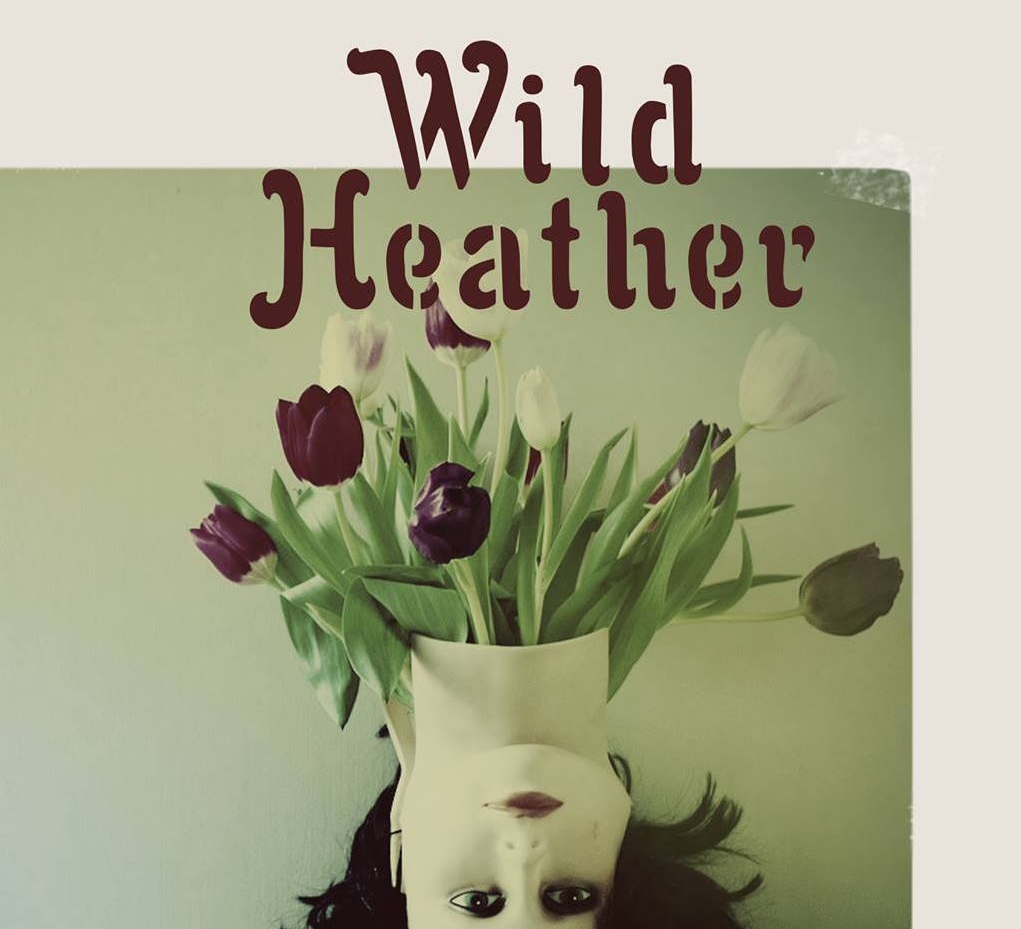
Review of Siân S. Rathore’s 'Wild Heather'
In Wild Heather, we go inside the head of Rathore as lover, as friend, as non-binary human, kin, and yet none of the above, however everything plus more. We are brought into the fold, we watch the cuckold, and we thank the universe for heavy moments for without them, the muse would not be able to animate Rathore, to allow the spindling of poetic births and mutations of witchy proportions. A classic conjuring of Sexton or Tzara’s stream of consciousness writing. All the greats have done it, Rathore no different, following suit and instinct alike.
Read More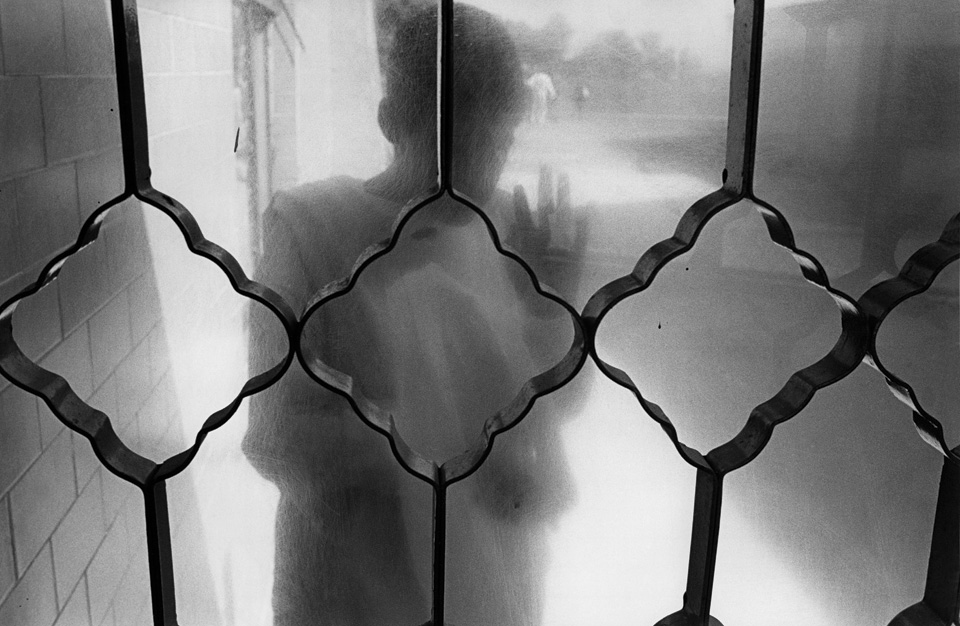
Eugene Richards
My Eight Days in a Mental Hospital
I passed the doors of patients who were on bed rest, their bodies weak from lithium side effects and felt immediately lucky to be on such a mild dose of my anti-psychotic medication. The hospital psychiatrist seemed to only prescribe two medications: Seroquel for the depressed, and lithium for those with bi-polar disorder.
Read More