








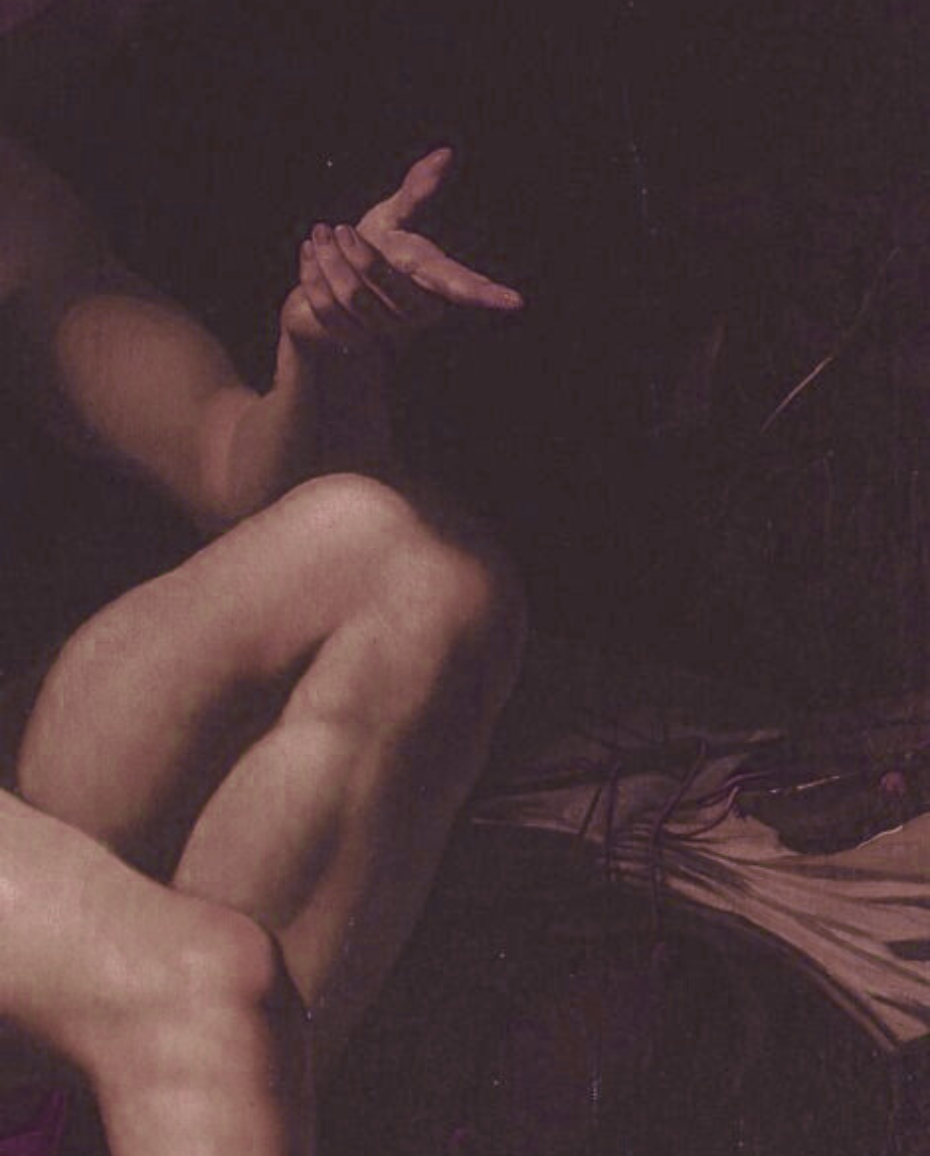
Holding shovel is a boy—not boy so much as a body growing.
How his skin—patch of ground—is like a bed. What can’t be
sown in youth? Clean well mouth—spring of throat.
Read More
Aela Labbe
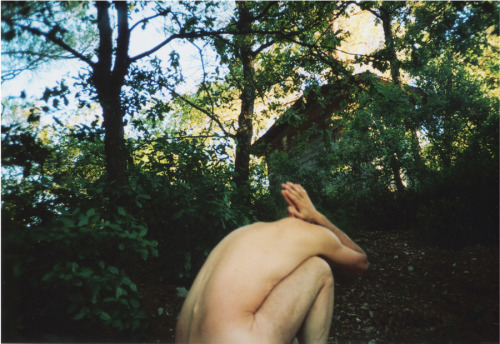
Holding shovel is a boy—not boy so much as a body growing.
How his skin—patch of ground—is like a bed. What can’t be
sown in youth? Clean well mouth—spring of throat.
Read More
Aela Labbe
Books are like people--they have their own personalities, bodies, & hearts. When I first met Bigfoot for Women (Orange Monkey Publishing, 2014) by Amy Pickworth, I was intrigued. Bigfoot poems? Sign me up. I was already on board before I even cracked the spine. Of course, once I opened the book, it was hard not to devour in one sitting.
Read More
Aela Labbe
This may sound simple but stop—
There is more than cell death, the subsequent shock for return
Put aside the yogis who may will their organs still
I am right here and you are somewhere in a room of eggs
And someone right now is stopping—I can feel the strong glaze.
Read More
Aëla Labbé
i often worry that i will be pre-judged for being a bisexual person who has up until the past couple of years only pursued romantic relationships with ciswomen. i always wondered if i was genderqueer enough to my trans friends.
Read More
Aëla Labbé
Multi-tasking is exceptionally difficult when one is pushed to commit the same intensity of eye contact to each person they meet
Read More
Aela Labbe
When she was still learning to tie her shoes, a band of girls from her new neighborhood convinced her to drop her pants. In the dim underground garage that was damp with the morning’s rain, she leaned up against the bike rack, her daisy-printed shorts gathered at her flip-flops.
Read More
Niel Rosenthalis is a poet. If there was ever someone who not only loved poetry with ever fiber of his being, but could actually write a goddamn good poem, it's Niel. This is exactly why I say he's a poet; he's earned the title. I was lucky enough to meet Niel while he was studying at Sarah Lawrence College--we met by accident, really. We never took classes together, but happened to volunteer to run a poetry festival.
Read More
Aela Labbe
The wild grass is the child wanting to climb the wall,
out of desperation, out the vague awareness of fate.
Read More
Editor's note: these poems originally appeared in the old/previous Luna Luna
The New Twilight Zone: “Empty City”
The cloud cover enveloping our hull
splits, shifts to our back like a parachute,
and we descend to the city below. Its three
mighty rivers: now kinked, dribbling hoses.
The scent of seething biomass—brown mounds
going green again with psyched, thriving mold—
reaches us far up as we are—and look: plumes
of smoke snaking into the air there. Flames
and dry backyard blowup pools below coming
into focus, but too much sun to see the windows
in the buildings all have x’s in their eyes.
Between white lines dash-dash-dashing the roads:
not a car. The voice on the tower mic:
silent as a bee hive.
“Schenectady Is Most Definitely
a hyperbolic landscape full of empty swimming pools,
violent men with tight asses straining the seams of their acid
washed jeans, pizza swamps of molten cheese with slices,
like my heart, rrrrrripped out—like starfish missing arms,
but opposite—inverted—or something,” my voice trails
off but my hands keep miming a triangle shape in the air,
tee-peeing it pointy and knifey to show him the purport of that
invisible missing piece, its edge so etched in my brain, then
one hand slips down the other side like a bathtub spider so
I climb back up the spout…
“Did you take your crazy pills?”
he asks. “I don’t have anything to swallow them with,” I reply,
about to cry. He pulls over, we get out, I follow him into
the branches of an overgrown cloud of a hedge, green
as animal eyes, to a blue pool hidden in the middle.
“Swallow them with that,” he points at the water.
“It’s full of chemicals,” I insist. “Not for years,”
he grins. I bend down to the water, “You’re like
an almanac—gulp gulp.” Somehow, again, I’d
missed the shy emptying and filling,
the husk, bud and bloom.
The End of NYC
I sat down on the F train across from a woman (?)—long stringy black wig, short dirty white skirt, bad plastic surgery, bulges like slugs shifting under her skin. Taking up her entire right calf: a tattoo of a woman’s face—a sad woman with her hair in rollers—thick lips and eyelids—lips curled back—teeth showing but not smiling. The hair rollers. The eyes rolled back. My mind told me that the woman across from me was a genius. I made eye contact with her. “That’s the best tattoo I’ve ever seen,” I said. She lit up, “Yes, I’ve got two! It only took him an hour, it’s my angel…” her words poured out without pause. Instantly, I understood she was nervous and desperately lonely—not the kind of woman who’d get an ironic tattoo. My eyes moved back to her calf. Those weren’t hair rollers‚ just sproingy ringlet curls. It was an angel, and the worst tattoo I’d ever seen. I felt the recognition of this fall across my face, and I saw her see it on my face. Like when Jack Nicholson in The Shining thinks he’s making out with the hot chick who just crawled out of the bathtub, and he looks in the mirror and sees she’s really dead. I’d like to think I didn’t look that horrified, when, for no reason she would ever understand, I turned on her and her angels.
Hive Minds
Riding in the car with my mother, I never graduated from the back seat to the front. Whenever I tried to climbing in next to her (“This is stupid—I’m riding up front”), she’d howl and swipe at me until I caved. That was how she defended her space. We drove around like that until I got my driver’s license: us two, locked in the dust-mote mottled skies of our own minds, counting things. Me: syllables and the shadows of telephone poles falling across the car. Her: I don’t know. She can’t describe her OCD to me—only that it has to do with numbers—some inexplicable tally she’s been running all her life. I imagine it like a spider’s web, easily disturbed, then dispersed by the breath of other people. Whatever its shape, it’s the only thing that’s ever soothed her.
One stalk of corn can’t bear fruit by itself. It needs other stalks around to pollinate. Even a single row won’t cut it. Indians knew to grow them in circles, my boyfriend tells me. And sunflowers, his father adds, grown in a row will take turns bending north, then south, etc. down the line to give each other a shot at the light. We’re in the garden after dinner. Suddenly I envy anything that moves itself to accommodate another: a subtle shift to the left or right, self preservation that could pass for love.
____________________________________________________
Jennifer L. Knox is the author of Days of Shame and Failure (Bloof Books, 2015). Her other books, The Mystery of the Hidden Driveway, Drunk by Noon, and A Gringo Like Me are also available from Bloof. Her poems have appeared four times in the Best American Poetry series (1997, 2003, 2006, and 2011), as well as in the anthologies Great American Prose Poems: From Poe to the Present and Best American Erotic Poems.


Happy holidays! Everyone’s doing lists and talking of shopping and getting together with family. They brave the crowds and wait in violent sweaty lines. I myself avoid holiday shopping like the plague (and flu shots). I’m doing it all online this year while happily celebrating Yule and lighting the Mickey Menorah, like the good Pagan Jew I am.
Read More
Nine veterans from Minneapolis were identical as defined by the primitive pleomorphic army
We followed them to the blast-site 47 months before the serial counting
Read More

Improbably, they face their gods, pants unbuckled,
belts unzipped, the energy of fear and light shedding
Read More